Sanjivani Rural Education Society’s
Sanjivani College of Engineering, Kopargaon-423 603
( An Autonomous Institute Affiliated to Savitribai Phule Pune University, Pune)
NAAC ‘A’ Grade, NBA Accredited, ISO 9001:2015 Certified
Unit I : Classification of sections
By
Prof V M Mahajan (Asst. Professor)
Department of Civil Engineering
Email Id: mahajanvalmik@sanjivani.org.in
Classification of cross section
Fig. Moment – rotation behaviour of the four classes of cross section
 As per the (IS 800:2007, Cl. No. 3.7, page no. 17)
 To determine the strength of structural steel component requires to
consider first behaviour and the second overall member behaviour
c/s are placed in four behavioural classes.
 depends upon material yield and
 width to thickness ratio of component.
Classification of cross section
a) class 1 (plastic)- c/s can develop plastic hinges and rotation capacity
required for failure of the structure by formation of plastic mechanism,
b/tf < 9.4
b) class 2 (compact)- c/s can develop plastic moment of resistance, but
have inadequate plastic hinge rotation capacity for formation of plastic
mechanism, due to local buckling, b/tf < 10.5
c) class 3 (semi-compact)- extreme fiber in compression can reach yield
stress, but cannot develop the plastic moment of resistance, due to local
buckling,
b/t f < 15.7
d) Class 4 (slender)- elements buckle locally even before reaching yield
stress.
b/t f > 15.7
Yield stress ratio,




yf/250
Limiting width to thickness ratio, IS:800-2007,
Table no. 2, Cl. No. 3.7.2 & 3.7.4, page no. 18
Neumerical Example-
 Classify the following section using Fy=250MPa.
1) ISHB 400@77.4kg/m.
2) ISMC 300@35.8kg/m.
3) ISA 150X150X12@ 27.2kg/m.
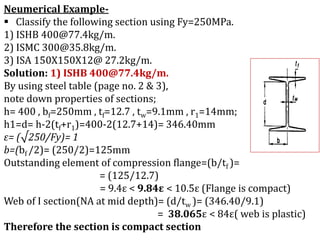
Solution: 1) ISHB 400@77.4kg/m.
By using steel table (page no. 2 & 3),
note down properties of sections;
h= 400 , bf=250mm , tf=12.7 , tw=9.1mm , r1=14mm;
h1=d= h-2(tf+r1)=400-2(12.7+14)= 346.40mm
ε= (√250/Fy)= 1
b=(bf /2)= (250/2)=125mm
Outstanding element of compression flange=(b/tf )=
= (125/12.7)
= 9.4ε < 9.84ε < 10.5ε (Flange is compact)
Web of I section(NA at mid depth)= (d/tw )= (346.40/9.1)
= 38.065ε < 84ε( web is plastic)
Therefore the section is compact section
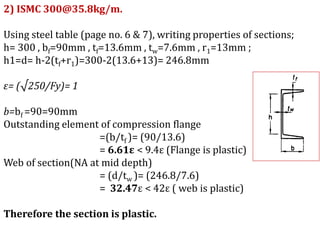
2) ISMC 300@35.8kg/m.
Using steel table (page no. 6 & 7), writing properties of sections;
h= 300 , bf=90mm , tf=13.6mm , tw=7.6mm , r1=13mm ;
h1=d= h-2(tf+r1)=300-2(13.6+13)= 246.8mm
ε= (√250/Fy)= 1
b=bf =90=90mm
Outstanding element of compression flange
=(b/tf )= (90/13.6)
= 6.61ε < 9.4ε (Flange is plastic)
Web of section(NA at mid depth)
= (d/tw )= (246.8/7.6)
= 32.47ε < 42ε ( web is plastic)
Therefore the section is plastic.
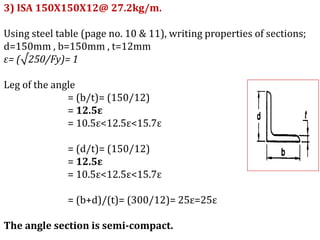
3) ISA 150X150X12@ 27.2kg/m.
Using steel table (page no. 10 & 11), writing properties of sections;
d=150mm , b=150mm , t=12mm
ε= (√250/Fy)= 1
Leg of the angle
= (b/t)= (150/12)
= 12.5ε
= 10.5ε<12.5ε<15.7ε
= (d/t)= (150/12)
= 12.5ε
= 10.5ε<12.5ε<15.7ε
= (b+d)/(t)= (300/12)= 25ε=25ε
The angle section is semi-compact.

Classification of cross section

  • 1.
    Sanjivani Rural EducationSociety’s Sanjivani College of Engineering, Kopargaon-423 603 ( An Autonomous Institute Affiliated to Savitribai Phule Pune University, Pune) NAAC ‘A’ Grade, NBA Accredited, ISO 9001:2015 Certified Unit I : Classification of sections By Prof V M Mahajan (Asst. Professor) Department of Civil Engineering Email Id: mahajanvalmik@sanjivani.org.in
  • 2.
    Classification of crosssection Fig. Moment – rotation behaviour of the four classes of cross section  As per the (IS 800:2007, Cl. No. 3.7, page no. 17)  To determine the strength of structural steel component requires to consider first behaviour and the second overall member behaviour c/s are placed in four behavioural classes.  depends upon material yield and  width to thickness ratio of component.
  • 3.
    Classification of crosssection a) class 1 (plastic)- c/s can develop plastic hinges and rotation capacity required for failure of the structure by formation of plastic mechanism, b/tf < 9.4 b) class 2 (compact)- c/s can develop plastic moment of resistance, but have inadequate plastic hinge rotation capacity for formation of plastic mechanism, due to local buckling, b/tf < 10.5 c) class 3 (semi-compact)- extreme fiber in compression can reach yield stress, but cannot develop the plastic moment of resistance, due to local buckling, b/t f < 15.7 d) Class 4 (slender)- elements buckle locally even before reaching yield stress. b/t f > 15.7 Yield stress ratio,     yf/250
  • 4.
    Limiting width tothickness ratio, IS:800-2007, Table no. 2, Cl. No. 3.7.2 & 3.7.4, page no. 18
  • 5.
    Neumerical Example-  Classifythe following section using Fy=250MPa. 1) ISHB 400@77.4kg/m. 2) ISMC 300@35.8kg/m. 3) ISA 150X150X12@ 27.2kg/m. Solution: 1) ISHB 400@77.4kg/m. By using steel table (page no. 2 & 3), note down properties of sections; h= 400 , bf=250mm , tf=12.7 , tw=9.1mm , r1=14mm; h1=d= h-2(tf+r1)=400-2(12.7+14)= 346.40mm ε= (√250/Fy)= 1 b=(bf /2)= (250/2)=125mm Outstanding element of compression flange=(b/tf )= = (125/12.7) = 9.4ε < 9.84ε < 10.5ε (Flange is compact) Web of I section(NA at mid depth)= (d/tw )= (346.40/9.1) = 38.065ε < 84ε( web is plastic) Therefore the section is compact section
  • 6.
    2) ISMC 300@35.8kg/m. Usingsteel table (page no. 6 & 7), writing properties of sections; h= 300 , bf=90mm , tf=13.6mm , tw=7.6mm , r1=13mm ; h1=d= h-2(tf+r1)=300-2(13.6+13)= 246.8mm ε= (√250/Fy)= 1 b=bf =90=90mm Outstanding element of compression flange =(b/tf )= (90/13.6) = 6.61ε < 9.4ε (Flange is plastic) Web of section(NA at mid depth) = (d/tw )= (246.8/7.6) = 32.47ε < 42ε ( web is plastic) Therefore the section is plastic.
  • 7.
    3) ISA 150X150X12@27.2kg/m. Using steel table (page no. 10 & 11), writing properties of sections; d=150mm , b=150mm , t=12mm ε= (√250/Fy)= 1 Leg of the angle = (b/t)= (150/12) = 12.5ε = 10.5ε<12.5ε<15.7ε = (d/t)= (150/12) = 12.5ε = 10.5ε<12.5ε<15.7ε = (b+d)/(t)= (300/12)= 25ε=25ε The angle section is semi-compact.