Machine Design
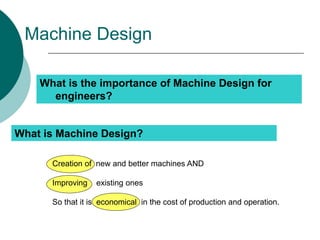
What is the importance of Machine Design for
engineers?
What is Machine Design?
Creation of new and better machines AND
Improving existing ones
So that it is economical in the cost of production and operation.
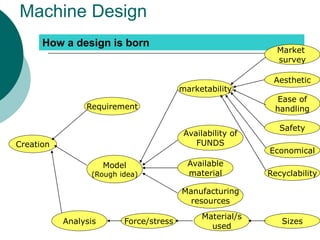
Machine Design
Requirement
Model
(Rough idea)
Creation
How a design is born
marketability
Availability of
FUNDS
Available
material
Manufacturing
resources
Analysis
Market
survey
Aesthetic
Ease of
handling
Safety
Economical
Recyclability
Force/stress
Material/s
used
Sizes
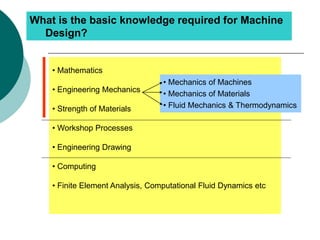
What is the basic knowledge required for Machine
Design?
•Mathematics
•Engineering Mechanics
•Strength of Materials
•Mathematics
•Engineering Mechanics
•Strength of Materials
•Workshop Processes
•Engineering Drawing
• Mathematics
• Engineering Mechanics
• Strength of Materials
• Workshop Processes
• Engineering Drawing
• Computing
• Finite Element Analysis, Computational Fluid Dynamics etc
• Mechanics of Machines
• Mechanics of Materials
• Fluid Mechanics & Thermodynamics
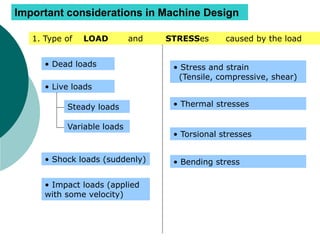
Important considerations in Machine Design
1. Type of LOAD and STRESSes caused by the load
Steady loads
• Dead loads
• Live loads
Variable loads
• Shock loads (suddenly)
• Impact loads (applied
with some velocity)
• Stress and strain
(Tensile, compressive, shear)
• Thermal stresses
• Torsional stresses
• Bending stress
Important considerations in Machine Design…..
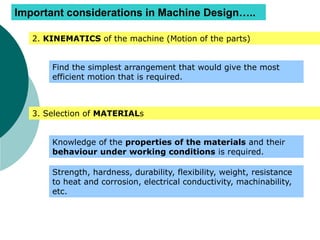
2. KINEMATICS of the machine (Motion of the parts)
Find the simplest arrangement that would give the most
efficient motion that is required.
3. Selection of MATERIALs
Knowledge of the properties of the materials and their
behaviour under working conditions is required.
Strength, hardness, durability, flexibility, weight, resistance
to heat and corrosion, electrical conductivity, machinability,
etc.
Important considerations in Machine Design…..
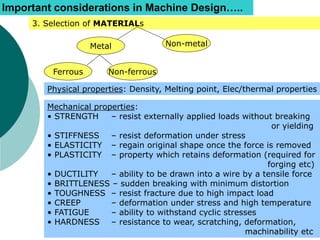
3. Selection of MATERIALs
Physical properties: Density, Melting point, Elec/thermal properties
Mechanical properties:
• STRENGTH – resist externally applied loads without breaking
or yielding
• STIFFNESS – resist deformation under stress
• ELASTICITY – regain original shape once the force is removed
• PLASTICITY – property which retains deformation (required for
forging etc)
• DUCTILITY – ability to be drawn into a wire by a tensile force
• BRITTLENESS – sudden breaking with minimum distortion
• TOUGHNESS – resist fracture due to high impact load
• CREEP – deformation under stress and high temperature
• FATIGUE – ability to withstand cyclic stresses
• HARDNESS – resistance to wear, scratching, deformation,
machinability etc
Metal Non-metal
Ferrous Non-ferrous
Important considerations in Machine Design…..
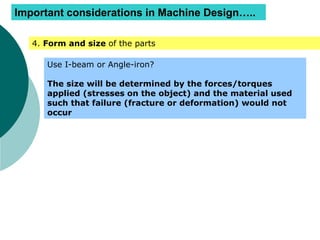
4. Form and size of the parts
Use I-beam or Angle-iron?
The size will be determined by the forces/torques
applied (stresses on the object) and the material used
such that failure (fracture or deformation) would not
occur
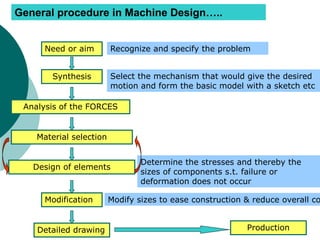
General procedure in Machine Design…..
Detailed drawing
Need or aim
Synthesis
Analysis of the FORCES
Material selection
Design of elements
Modification
Recognize and specify the problem
Select the mechanism that would give the desired
motion and form the basic model with a sketch etc
Determine the stresses and thereby the
sizes of components s.t. failure or
deformation does not occur
Modify sizes to ease construction & reduce overall co
Production
Course content
ME209 MACHINE DESIGN 1
Sessions
Time allocated
L T P A
Introduction to machine design: Principles and
methodology; a field visit.
3
01 04
Dynamics of simple mechanism:
Force analysis of a linkage mechanism
01 06
Failure analysis of mechanical elements:
Design of a cottered joint
3 01 10
Design of machine elements:
Design of a flywheel
6 01 16
Design of a simple mechanical device:
Design of a screw clamp
4 01 12
Design of steel structures: 10 01 16
Design Project 4 14
Total 30 06 64 14
Course
Evaluation
Assignments Coursework
20 80
Syllabus and method of evaluation

Machine Design - Introduction.ppt

  • 1.
    Machine Design What isthe importance of Machine Design for engineers? What is Machine Design? Creation of new and better machines AND Improving existing ones So that it is economical in the cost of production and operation.
  • 2.
    Machine Design Requirement Model (Rough idea) Creation Howa design is born marketability Availability of FUNDS Available material Manufacturing resources Analysis Market survey Aesthetic Ease of handling Safety Economical Recyclability Force/stress Material/s used Sizes
  • 3.
    What is thebasic knowledge required for Machine Design? •Mathematics •Engineering Mechanics •Strength of Materials •Mathematics •Engineering Mechanics •Strength of Materials •Workshop Processes •Engineering Drawing • Mathematics • Engineering Mechanics • Strength of Materials • Workshop Processes • Engineering Drawing • Computing • Finite Element Analysis, Computational Fluid Dynamics etc • Mechanics of Machines • Mechanics of Materials • Fluid Mechanics & Thermodynamics
  • 4.
    Important considerations inMachine Design 1. Type of LOAD and STRESSes caused by the load Steady loads • Dead loads • Live loads Variable loads • Shock loads (suddenly) • Impact loads (applied with some velocity) • Stress and strain (Tensile, compressive, shear) • Thermal stresses • Torsional stresses • Bending stress
  • 5.
    Important considerations inMachine Design….. 2. KINEMATICS of the machine (Motion of the parts) Find the simplest arrangement that would give the most efficient motion that is required. 3. Selection of MATERIALs Knowledge of the properties of the materials and their behaviour under working conditions is required. Strength, hardness, durability, flexibility, weight, resistance to heat and corrosion, electrical conductivity, machinability, etc.
  • 6.
    Important considerations inMachine Design….. 3. Selection of MATERIALs Physical properties: Density, Melting point, Elec/thermal properties Mechanical properties: • STRENGTH – resist externally applied loads without breaking or yielding • STIFFNESS – resist deformation under stress • ELASTICITY – regain original shape once the force is removed • PLASTICITY – property which retains deformation (required for forging etc) • DUCTILITY – ability to be drawn into a wire by a tensile force • BRITTLENESS – sudden breaking with minimum distortion • TOUGHNESS – resist fracture due to high impact load • CREEP – deformation under stress and high temperature • FATIGUE – ability to withstand cyclic stresses • HARDNESS – resistance to wear, scratching, deformation, machinability etc Metal Non-metal Ferrous Non-ferrous
  • 7.
    Important considerations inMachine Design….. 4. Form and size of the parts Use I-beam or Angle-iron? The size will be determined by the forces/torques applied (stresses on the object) and the material used such that failure (fracture or deformation) would not occur
  • 8.
    General procedure inMachine Design….. Detailed drawing Need or aim Synthesis Analysis of the FORCES Material selection Design of elements Modification Recognize and specify the problem Select the mechanism that would give the desired motion and form the basic model with a sketch etc Determine the stresses and thereby the sizes of components s.t. failure or deformation does not occur Modify sizes to ease construction & reduce overall co Production
  • 9.
    Course content ME209 MACHINEDESIGN 1 Sessions Time allocated L T P A Introduction to machine design: Principles and methodology; a field visit. 3 01 04 Dynamics of simple mechanism: Force analysis of a linkage mechanism 01 06 Failure analysis of mechanical elements: Design of a cottered joint 3 01 10 Design of machine elements: Design of a flywheel 6 01 16 Design of a simple mechanical device: Design of a screw clamp 4 01 12 Design of steel structures: 10 01 16 Design Project 4 14 Total 30 06 64 14 Course Evaluation Assignments Coursework 20 80 Syllabus and method of evaluation