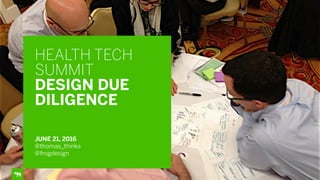
HEALTH TECH
SUMMIT
DESIGN DUE
DILIGENCE
JUNE 21, 2016
@thomas_thinks
@frogdesign
WHYIS DESIGN IMPORTANT?
3
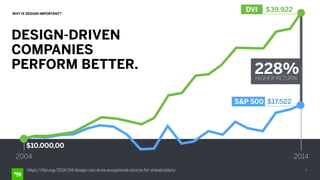
$39.922
$17.522
$10.000,00
2004 2014
S&P 500
DVI
228%HIGHER RETURN
https://hbr.org/2014/04/design-can-drive-exceptional-returns-for-shareholders/
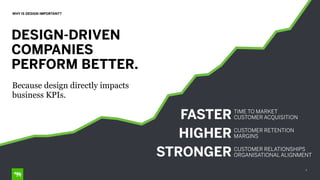
WHY IS DESIGN IMPORTANT?
DESIGN-DRIVEN
COMPANIES
PERFORM BETTER.
4
WHY IS DESIGN IMPORTANT?
FASTER
HIGHER
STRONGER
TIME TO MARKET
CUSTOMER ACQUISITION
CUSTOMER RELATIONSHIPS
ORGANISATIONAL ALIGNMENT
CUSTOMER RETENTION
MARGINS
DESIGN-DRIVEN
COMPANIES
PERFORM BETTER.
Because design directly impacts
business KPIs.
5
WHY IS DESIGN IMPORTANT?
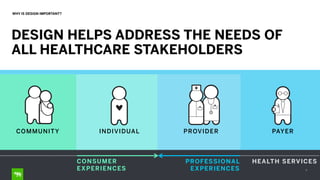
DESIGN HELPS ADDRESS THE NEEDS OF
ALL HEALTHCARE STAKEHOLDERS
INDIVIDUALCOMMUNITY PROVIDER PAYER
CONSUMER
EXPERIENCES
PROFESSIONAL
EXPERIENCES
HEALTH SERVICES
WHAT
IS DESIGN?
7
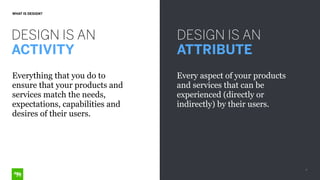
WHAT IS DESIGN?
DESIGN IS AN
ACTIVITY
DESIGN IS AN
ATTRIBUTE
Everything that you do to
ensure that your products and
services match the needs,
expectations, capabilities and
desires of their users.
Every aspect of your products
and services that can be
experienced (directly or
indirectly) by their users.
8
WHAT IS DESIGN?
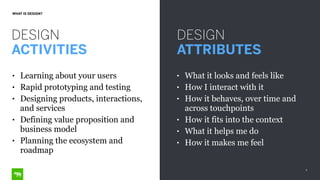
DESIGN
ACTIVITIES
DESIGN
ATTRIBUTES
• What it looks and feels like
• How I interact with it
• How it behaves, over time and
across touchpoints
• How it fits into the context
• What it helps me do
• How it makes me feel
• Learning about your users
• Rapid prototyping and testing
• Designing products, interactions,
and services
• Defining value proposition and
business model
• Planning the ecosystem and
roadmap
9
WHAT IS DESIGN?
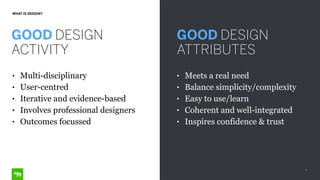
GOOD DESIGN
ACTIVITY
GOOD DESIGN
ATTRIBUTES
• Meets a real need
• Balance simplicity/complexity
• Easy to use/learn
• Coherent and well-integrated
• Inspires confidence & trust
• Multi-disciplinary
• User-centred
• Iterative and evidence-based
• Involves professional designers
• Outcomes focussed
HOWTO EVALUATE DESIGN
11
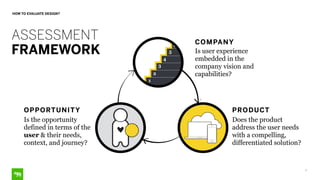
HOW TO EVALUATE DESIGN?
ASSESSMENT
FRAMEWORK
1
2
3
4
5
6
COMPANY
PRODUCTOPPORTUNITY
Is the opportunity
defined in terms of the
user & their needs,
context, and journey?
Does the product
address the user needs
with a compelling,
differentiated solution?
Is user experience
embedded in the
company vision and
capabilities?
12
HOW TO EVALUATE DESIGN?
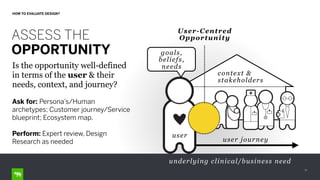
ASSESS THE
OPPORTUNITY goals,
beliefs,
needs
user journey
user
context &
stakeholders
underlying clinical/business need
User-Centred
Opportunity
Is the opportunity well-defined
in terms of the user & their
needs, context, and journey?
Ask for: Persona’s/Human
archetypes; Customer journey/Service
blueprint; Ecosystem map.
Perform: Expert review, Design
Research as needed
13
HOW TO EVALUATE DESIGN?
ASSESS THE
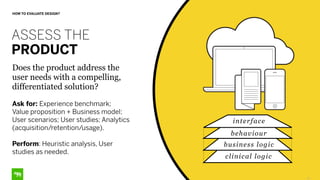
PRODUCT
Does the product address the
user needs with a compelling,
differentiated solution?
Ask for: Experience benchmark;
Value proposition + Business model;
User scenarios; User studies; Analytics
(acquisition/retention/usage).
Perform: Heuristic analysis, User
studies as needed.
interface
behaviour
business logic
clinical logic
14
HOW TO EVALUATE DESIGN?
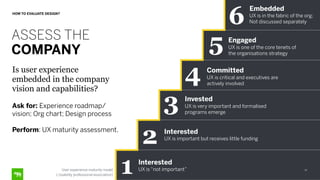
ASSESS THE
COMPANY
Is user experience
embedded in the company
vision and capabilities?
Ask for: Experience roadmap/
vision; Org chart; Design process
Perform: UX maturity assessment.
1
2
3
4
5
6
Embedded
UX is in the fabric of the org;
Not discussed separately
Engaged
UX is one of the core tenets of
the organisations strategy
Committed
UX is critical and executives are
actively involved
Invested
UX is very important and formalised
programs emerge
Interested
UX is important but receives little funding
Interested
UX is “not important”User experience maturity model
( Usability professional association)
15
HOW TO EVALUATE DESIGN?
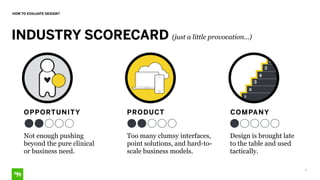
INDUSTRY SCORECARD
1
2
3
4
5
6
COMPANYPRODUCTOPPORTUNITY
Not enough pushing
beyond the pure clinical
or business need.
Too many clumsy interfaces,
point solutions, and hard-to-
scale business models.
Design is brought late
to the table and used
tactically.
(just a little provocation…)
16
HOW TO EVALUATE DESIGN?
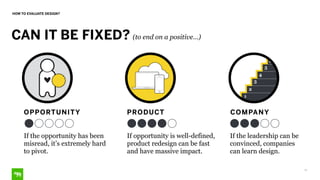
CAN IT BE FIXED?
1
2
3
4
5
6
COMPANYPRODUCTOPPORTUNITY
If the opportunity has been
misread, it’s extremely hard
to pivot.
If opportunity is well-defined,
product redesign can be fast
and have massive impact.
If the leadership can be
convinced, companies
can learn design.
(to end on a positive…)
frog is a company of Aricent. © 2014 frog design inc.
@thomas_thinks
@frogdesign

Design due diligence

  • 1.
    HEALTH TECH SUMMIT DESIGN DUE DILIGENCE JUNE21, 2016 @thomas_thinks @frogdesign
  • 2.
  • 3.
    3 $39.922 $17.522 $10.000,00 2004 2014 S&P 500 DVI 228%HIGHERRETURN https://hbr.org/2014/04/design-can-drive-exceptional-returns-for-shareholders/ WHY IS DESIGN IMPORTANT? DESIGN-DRIVEN COMPANIES PERFORM BETTER.
  • 4.
    4 WHY IS DESIGNIMPORTANT? FASTER HIGHER STRONGER TIME TO MARKET CUSTOMER ACQUISITION CUSTOMER RELATIONSHIPS ORGANISATIONAL ALIGNMENT CUSTOMER RETENTION MARGINS DESIGN-DRIVEN COMPANIES PERFORM BETTER. Because design directly impacts business KPIs.
  • 5.
    5 WHY IS DESIGNIMPORTANT? DESIGN HELPS ADDRESS THE NEEDS OF ALL HEALTHCARE STAKEHOLDERS INDIVIDUALCOMMUNITY PROVIDER PAYER CONSUMER EXPERIENCES PROFESSIONAL EXPERIENCES HEALTH SERVICES
  • 6.
  • 7.
    7 WHAT IS DESIGN? DESIGNIS AN ACTIVITY DESIGN IS AN ATTRIBUTE Everything that you do to ensure that your products and services match the needs, expectations, capabilities and desires of their users. Every aspect of your products and services that can be experienced (directly or indirectly) by their users.
  • 8.
    8 WHAT IS DESIGN? DESIGN ACTIVITIES DESIGN ATTRIBUTES •What it looks and feels like • How I interact with it • How it behaves, over time and across touchpoints • How it fits into the context • What it helps me do • How it makes me feel • Learning about your users • Rapid prototyping and testing • Designing products, interactions, and services • Defining value proposition and business model • Planning the ecosystem and roadmap
  • 9.
    9 WHAT IS DESIGN? GOODDESIGN ACTIVITY GOOD DESIGN ATTRIBUTES • Meets a real need • Balance simplicity/complexity • Easy to use/learn • Coherent and well-integrated • Inspires confidence & trust • Multi-disciplinary • User-centred • Iterative and evidence-based • Involves professional designers • Outcomes focussed
  • 10.
  • 11.
    11 HOW TO EVALUATEDESIGN? ASSESSMENT FRAMEWORK 1 2 3 4 5 6 COMPANY PRODUCTOPPORTUNITY Is the opportunity defined in terms of the user & their needs, context, and journey? Does the product address the user needs with a compelling, differentiated solution? Is user experience embedded in the company vision and capabilities?
  • 12.
    12 HOW TO EVALUATEDESIGN? ASSESS THE OPPORTUNITY goals, beliefs, needs user journey user context & stakeholders underlying clinical/business need User-Centred Opportunity Is the opportunity well-defined in terms of the user & their needs, context, and journey? Ask for: Persona’s/Human archetypes; Customer journey/Service blueprint; Ecosystem map. Perform: Expert review, Design Research as needed
  • 13.
    13 HOW TO EVALUATEDESIGN? ASSESS THE PRODUCT Does the product address the user needs with a compelling, differentiated solution? Ask for: Experience benchmark; Value proposition + Business model; User scenarios; User studies; Analytics (acquisition/retention/usage). Perform: Heuristic analysis, User studies as needed. interface behaviour business logic clinical logic
  • 14.
    14 HOW TO EVALUATEDESIGN? ASSESS THE COMPANY Is user experience embedded in the company vision and capabilities? Ask for: Experience roadmap/ vision; Org chart; Design process Perform: UX maturity assessment. 1 2 3 4 5 6 Embedded UX is in the fabric of the org; Not discussed separately Engaged UX is one of the core tenets of the organisations strategy Committed UX is critical and executives are actively involved Invested UX is very important and formalised programs emerge Interested UX is important but receives little funding Interested UX is “not important”User experience maturity model ( Usability professional association)
  • 15.
    15 HOW TO EVALUATEDESIGN? INDUSTRY SCORECARD 1 2 3 4 5 6 COMPANYPRODUCTOPPORTUNITY Not enough pushing beyond the pure clinical or business need. Too many clumsy interfaces, point solutions, and hard-to- scale business models. Design is brought late to the table and used tactically. (just a little provocation…)
  • 16.
    16 HOW TO EVALUATEDESIGN? CAN IT BE FIXED? 1 2 3 4 5 6 COMPANYPRODUCTOPPORTUNITY If the opportunity has been misread, it’s extremely hard to pivot. If opportunity is well-defined, product redesign can be fast and have massive impact. If the leadership can be convinced, companies can learn design. (to end on a positive…)
  • 17.
    frog is acompany of Aricent. © 2014 frog design inc. @thomas_thinks @frogdesign