International Research Journal of Engineering and Technology (IRJET) e-ISSN: 2395-0056
Volume: 10 Issue: 06 | Jun 2023 www.irjet.net p-ISSN: 2395-0072
© 2023, IRJET | Impact Factor value: 8.226 | ISO 9001:2008 Certified Journal | Page 282
Design and Optimization of steering and Suspension System of All
Terrain Vehicle
Lalith H N1, Ravi Ragul R2
1Student, Dept. of Mechanical Engineering, Kumaraguru College of Technology, Coimbatore, India
2Student, Dept. of Mechanical Engineering, Kumaraguru College of Technology, Coimbatore, India
---------------------------------------------------------------------***---------------------------------------------------------------------
Abstract - One of the most important automotivesystemsis
suspension. The primary purpose is to protect the driver from
shocks from the road. In addition to providing proper wheel
travel and load transfer, secondary functions also include
lateral stability and ergonomics and driver comfort. Vehicles
with all-terrain capabilities are built to tackle any surface.
Stability, vehicle behavior, and driver comfort are the main
issues because the vehicle is designed to operate on various
types of terrain. The paper's primary goal was to develop and
optimize the front suspension wishbone for a BAJA (ATV)
vehicle. The purpose of this study is to analyze the entire
suspension system of an ATV vehicle to enhance wheel
handling and stability. The entire system was made to be
strong enough to absorb shocks from the rough terrain that
ATVs are typically used on. Calculations were used to design
the springs, and SOLIDWORKS was used to design the
components. The front and rear systems were simulated using
Lotus software, and the components were examined using
commercial FEA software from ANSYS. The steering and
suspension system's pivotpoint, knownasthesteeringknuckle,
enables the steering arm to turn the front wheels. The knuckle
is put to the test in a variety of loading conditions, including
bump, cornering, and braking.
Key Words: Suspension, load transfer, stability and
handling, driver comfort, less weight, less expensive,
SOLIDWORKS, ANSYS, LOTUS software
1.INTRODUCTION
1.1 Problem Identification
 Failure of steering knuckle and wishbone due to
lack of design validation.
 Bump steer, over steer, under steer, loss of traction
and roll of vehicle affects handling and
performance of the vehicle.
 Slipping of wheel due to undesirable Ackermann
geometry
1.2 Design Consideration
 To have a quick steering response and to attain
minimum free play.
 To reduce the bump steer, and steering effort
The rack and pinion mechanism were chosen for its
simplicity, higher displacement of the wheels, and ease of
packaging in the vehicle’s toe box. The Ackerman steering
geometry was chosen considering the load transfer
characteristics, cornering speed, track characteristics, and
required turning angle to achieve minimal turning radius
with specific wheelbase and trackwidth and to achieve the
perfect rolling of the wheels. The Ackerman angle wasfound
to be 25 degrees which was designedtoachieveanoversteer
that provides sensitive handling characteristics.
Table 1 : Steering Specifications
1.3 Steering Calculations
Steering mechanism Rack and Pinion
Steering geometry Ackerman
Turning radius 2.27m
Ackerman angle 25°
Steering ratio 6:1
Lock to lock 264°
Rack lock to lock travel 72mm
C factor 96mm
Steering Effort 62N
Tie Rod Length 412mm
Ackermann angle
Tan β = king pin – king pin center distance/ 2x Wheelbase
β = 25°
Max inner wheel angle-Si= 44°(considering maximum slip)
By Ackermann condition
Cot So- cot Si = Track width/wheelbase
Outer wheel turning angle So = 25.6°
Turning radius of the wheel
Front inner wheel,
Ri = wheelbase /Sin (Si)- (Track width -K. k)/2
Front outer wheel,
Ro = Wheelbase/ Sin Si -Track width -k. K)/2
Where k. k is the kingpin center to center distance
RI = 1828.9 mm, RO = 2926.7 mm
International Research Journal of Engineering and Technology (IRJET) e-ISSN: 2395-0056
Volume: 10 Issue: 06 | Jun 2023 www.irjet.net p-ISSN: 2395-0072
© 2023, IRJET | Impact Factor value: 8.226 | ISO 9001:2008 Certified Journal | Page 283
Steering Effort Calculations
Total weight of the vehicle = 245 kg
On front axle = 40% of W
On Rear axle = 60% of W
Weight on one wheel in front = 40% of W = 49 kg
Torque on pinion = Weight on one-wheel x radius co-
efficient of friction
= 49 x9.81x21x0.7 =7066. 143N.mm
Torque on pinion = 7.066 Nm
Steering effort Torque on pinion = torque on steering wheel
Torque on steering wheel= steering effort (force given by
driver) x Radius
7066.143= F x (5 x 25.4)
F= 55.63
Steering effort = 55.63 N
1.4 SUSPENSION DESIGN CONSIDERATION
 To maintain maximum contact patch with the
ground in all conditions, providing higher traction,
better handling, and comfort by isolating road
shocks while riding.
 To provide minimum body roll while cornering.
 To attain minimum jacking force by managing the
static roll center location. Unequal and Unparallel
wishbone geometry is chosen to minimize the
camber change during cornering.
The front Trackwidth of the vehicle was chosen to be 52” for
better stability and rear trackwidth was reduced to 48” for
better traction during acceleration. The vehicle’s 18” inch
ground clearance provides the wheel vertical room to travel
and absorb shocks.
This helps reduce scraping against the obstacles andreduces
damage underbody. The negative camber aids in better
handlingat corners and this setup is expected to oversteerin
the track because of the camber angles pre-set at the front.
1.5. Spring Rate Calculations
Sprung mass (front) =71.11kg/2 =35.55kg (one wheel)
Sprung mass(rear) =106.67kg/2 =53.3kg (one wheel)
For front, ride frequency (Rf) =1.6Hz
For rear, ride frequency (Rr) = 1.8Hz
Spring stiffness (K) = 4×π^2×(Rf)^2×(Mf)×(Mr)^2
= 4x(3.14)^2×(1.6)^2×(35.55)×(1.57)^2
= 8847.04N/m = 8.29 N/mm
Motion ratio (MRr) = D1/D2 = 431.8/253.05= 1.70
Spring stiffness (K) = 4×π^2×(Rr)^2×(Mr)×(MRr)^2
= 4×(3.14)^2×(1.8)×(53.3)×(1.7)^2
= 19682.91N/m
Kr = 19.165 N/mm
Table 2 : Technical Specifications
Parameters Front Rear
Spring stiffness 8.29 N/mm 16.15 N/mm
Motion ratio 0.65 0.70
Wheel rate 3.287 N/mm 6.72 N/mm
Roll rate 50.01 Nm/deg 87.13 Nm/deg
Ride frequency 1.6 1.8
Table 1 : Front wheel specifications
Trackwidth(mm) 1320.8
Kingpin Inclination +8
Scrub radius(mm) +25.70
Camber angle -1
Toe angle 0
Ground clearance(mm) 457.2
Roll center height(mm) 341.60
CG Height(mm) 450
Damper length(mm) 482.60
Damper travel(mm) 162.5
Damper angle 21
Motion ratio 0.65
Table 4 : Rear wheel specifications
Trackwidth(mm) 1219.2
Ground clearance(mm) 457.2
Roll center height(mm) 298.91
Damper length(mm) 457.20
Damper travel(mm) 134.62
Damper angle 22
Motion ratio 0.70
1.6 Front Wheel Geometry
International Research Journal of Engineering and Technology (IRJET) e-ISSN: 2395-0056
Volume: 10 Issue: 06 | Jun 2023 www.irjet.net p-ISSN: 2395-0072
© 2023, IRJET | Impact Factor value: 8.226 | ISO 9001:2008 Certified Journal | Page 284
Table 5 : Anti-dive geometry specifications
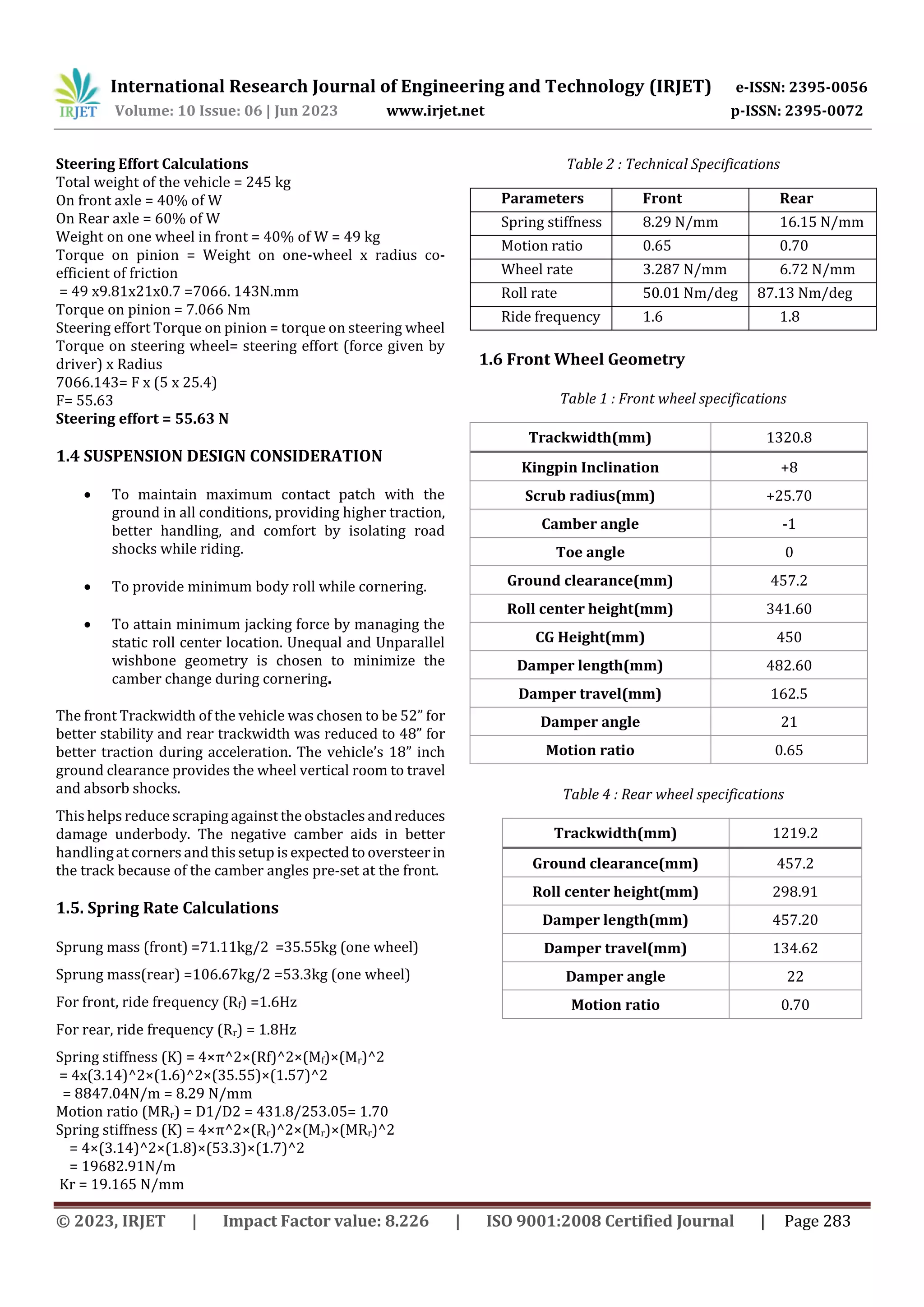
2. DESIGN of Knuckle
• Front Upright weight: 965 g
• Overall height of Upright: 140mm
• Overall height and length of upper ball joint
mounting point is reduced.
Figure 1 : Front Knuckle
Figure 2 : Front Knuckle
2. ANALYSIS
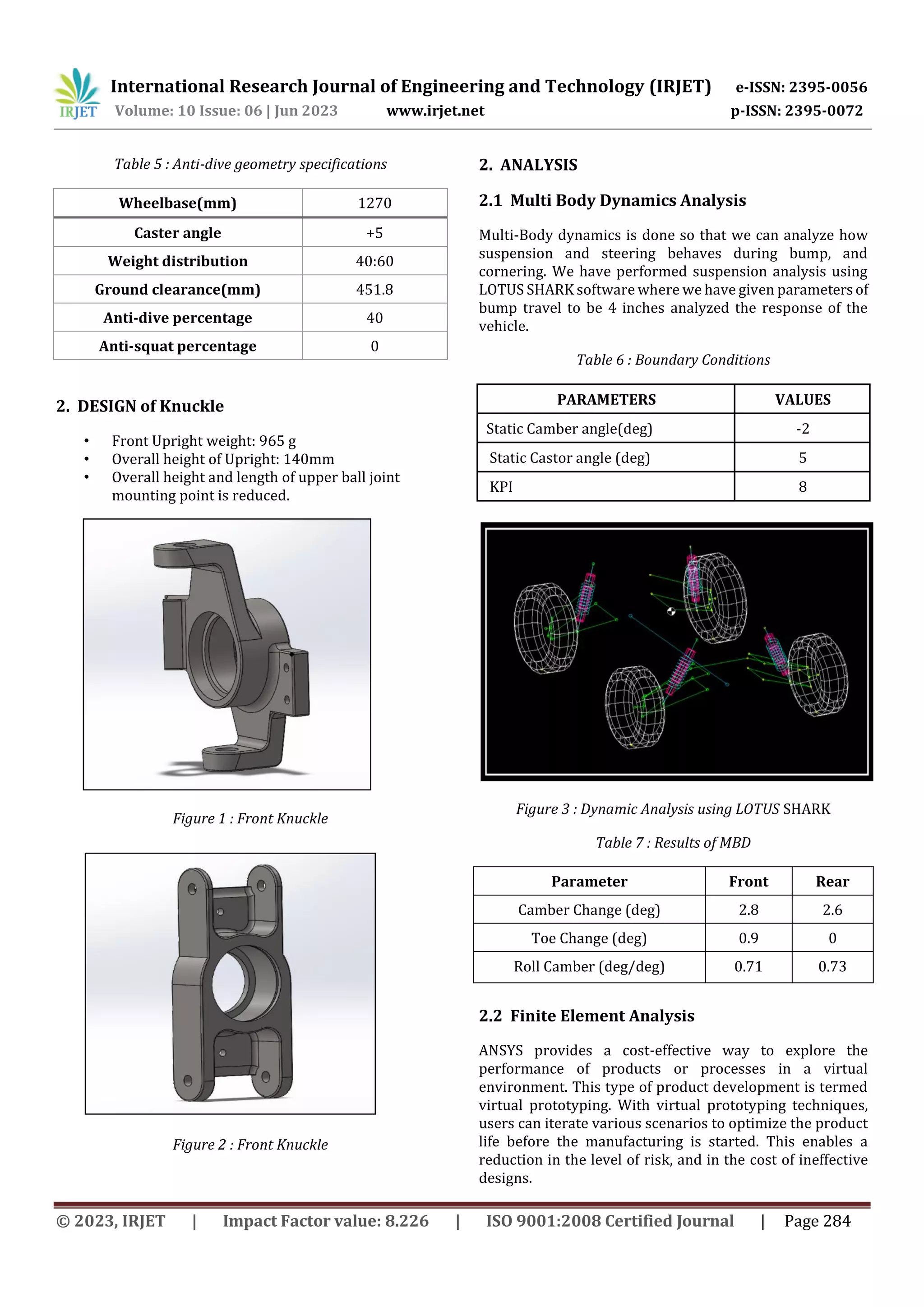
2.1 Multi Body Dynamics Analysis
Multi-Body dynamics is done so that we can analyze how
suspension and steering behaves during bump, and
cornering. We have performed suspension analysis using
LOTUS SHARK software where we have given parametersof
bump travel to be 4 inches analyzed the response of the
vehicle.
Table 6 : Boundary Conditions
PARAMETERS VALUES
Static Camber angle(deg) -2
Static Castor angle (deg) 5
KPI 8
Figure 3 : Dynamic Analysis using LOTUS SHARK
Table 7 : Results of MBD
Parameter Front Rear
Camber Change (deg) 2.8 2.6
Toe Change (deg) 0.9 0
Roll Camber (deg/deg) 0.71 0.73
2.2 Finite Element Analysis
ANSYS provides a cost-effective way to explore the
performance of products or processes in a virtual
environment. This type of product development is termed
virtual prototyping. With virtual prototyping techniques,
users can iterate various scenarios to optimize the product
life before the manufacturing is started. This enables a
reduction in the level of risk, and in the cost of ineffective
designs.
Wheelbase(mm) 1270
Caster angle +5
Weight distribution 40:60
Ground clearance(mm) 451.8
Anti-dive percentage 40
Anti-squat percentage 0
International Research Journal of Engineering and Technology (IRJET) e-ISSN: 2395-0056
Volume: 10 Issue: 06 | Jun 2023 www.irjet.net p-ISSN: 2395-0072
© 2023, IRJET | Impact Factor value: 8.226 | ISO 9001:2008 Certified Journal | Page 285
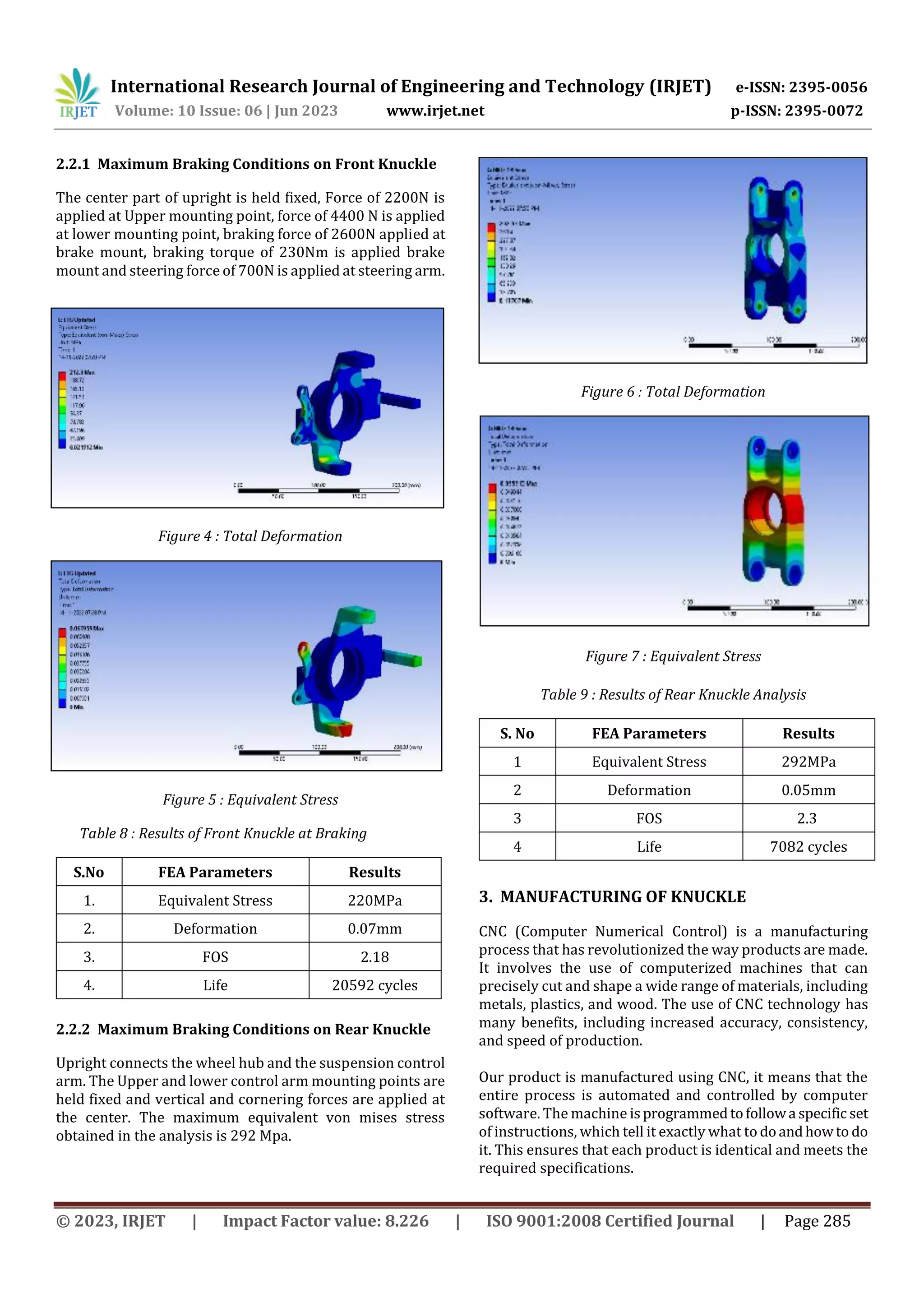
2.2.1 Maximum Braking Conditions on Front Knuckle
The center part of upright is held fixed, Force of 2200N is
applied at Upper mounting point, force of 4400 N is applied
at lower mounting point, braking force of 2600N applied at
brake mount, braking torque of 230Nm is applied brake
mount and steering force of 700N is applied at steering arm.
Figure 4 : Total Deformation
Figure 5 : Equivalent Stress
Table 8 : Results of Front Knuckle at Braking
S.No FEA Parameters Results
1. Equivalent Stress 220MPa
2. Deformation 0.07mm
3. FOS 2.18
4. Life 20592 cycles
2.2.2 Maximum Braking Conditions on Rear Knuckle
Upright connects the wheel hub and the suspension control
arm. The Upper and lower control arm mounting points are
held fixed and vertical and cornering forces are applied at
the center. The maximum equivalent von mises stress
obtained in the analysis is 292 Mpa.
Figure 6 : Total Deformation
Figure 7 : Equivalent Stress
Table 9 : Results of Rear Knuckle Analysis
S. No FEA Parameters Results
1 Equivalent Stress 292MPa
2 Deformation 0.05mm
3 FOS 2.3
4 Life 7082 cycles
3. MANUFACTURING OF KNUCKLE
CNC (Computer Numerical Control) is a manufacturing
process that has revolutionized the way products are made.
It involves the use of computerized machines that can
precisely cut and shape a wide range of materials, including
metals, plastics, and wood. The use of CNC technology has
many benefits, including increased accuracy, consistency,
and speed of production.
Our product is manufactured using CNC, it means that the
entire process is automated and controlled by computer
software. The machine isprogrammedtofollowa specific set
of instructions, which tell it exactly what to doandhowto do
it. This ensures that each product is identical and meets the
required specifications.
International Research Journal of Engineering and Technology (IRJET) e-ISSN: 2395-0056
Volume: 10 Issue: 06 | Jun 2023 www.irjet.net p-ISSN: 2395-0072
© 2023, IRJET | Impact Factor value: 8.226 | ISO 9001:2008 Certified Journal | Page 286
Figure 8 : Undergoing CNC Machining of Knuckle
Figure 9 : Finished Knuckle
4. RESULTS
From the overall design and the analysis of the front and
rear knuckle we have optimized the suspension system for
better off-roading and speed cornering. And the designed
system can take high impact forces which is very important
for an all-terrain vehicle.
The analysis of the control arm helps to understand the
behavior of the suspension systeminheavyloading,braking,
and cornering conditions which helps to study the system in
a better way.
5. CONCLUSION
The design of a knuckle and control arm is critical to the
performance, stability, and safety of a vehicle’s suspension
system. The knuckle and control arm work together to
support the weight of the vehicle, absorb shocks and
vibrations, and provide steering control and stability. The
knuckle is the component that connects the wheel hubto the
suspension system. It typically has a flange that mounts to
the hub and a spindle that connects to the control arm. The
knuckle must be designed to withstand the lateral and
vertical loads that are generated during cornering, braking,
and acceleration.
When designing a knuckle and control arm, several factors
must be considered. These include the material selection,
manufacturing processes, and the specific loads and forces
that the components will encounter during operation.Finite
element analysis and other simulation tools can be used to
test and optimize the design, ensuring that it meets the
necessary strength and durability requirements.
Additionally, the design of a knuckle and control arm should
also consider factors such as ease of installation,
maintenance, and repair. Access to critical components and
ease of disassembly can significantly impact the cost and
time required for maintenance or repairs.
In conclusion, a successful design of a knuckle and control
arm requires careful consideration of many factors,
including strength, durability, manufacturingprocesses, and
maintenance requirements. A well-designed suspension
system can improve the ride quality,handling,andsafetyofa
vehicle, reducing wear and tear on tires and other
components, and enhancing the overall driving experience.
REFERENCES
[1] Shripad Mane “Design and Analysis of Suspension and
Steering system along with the Wheel Assembly of a
BAJA ATV” -International Journal ofInnovativeResearch
in Science, Engineering and Technology
[2] Aditya Shahane, Manasi Kathale, Pratik Rathi and
Ashank Gujar “KINEMATICS OF REAR SUSPENSION
SYSTEM FOR A BAJA ALL-TERRAIN VEHICLE” -
International Journal of Mechanical Engineering and
Technology (IJMET)
[3] Debidutta Mishra “Baja SAE UTEP 2014 Design Report-
Team Jaabaz, VIT University – ResearchGate
[4] Jason Bracco, Coleman DeAnda, Jaime Deschenes Tara
Olson, Austin Sabbagha “SAE Baja Front Suspension” -
Mechanical Engineering Laboratory the George
Washington University School of Engineering and
Applied Sciences
[5] Sumit Sharma “Design Review of SuspensionAssembly
of a BAJA ATV” - International Research Journal of
Engineering and Technology (IRJET)
[6] I. P. Dhurai “Optimization and Effects of Suspension
Parameter on Front Suspension of SAE Baja Vehicle
using ADAMS” - International Journal of Engineering
Research & Technology (IJERT)

Design and Optimization of steering and Suspension System of All Terrain Vehicle

  • 1.
    International Research Journalof Engineering and Technology (IRJET) e-ISSN: 2395-0056 Volume: 10 Issue: 06 | Jun 2023 www.irjet.net p-ISSN: 2395-0072 © 2023, IRJET | Impact Factor value: 8.226 | ISO 9001:2008 Certified Journal | Page 282 Design and Optimization of steering and Suspension System of All Terrain Vehicle Lalith H N1, Ravi Ragul R2 1Student, Dept. of Mechanical Engineering, Kumaraguru College of Technology, Coimbatore, India 2Student, Dept. of Mechanical Engineering, Kumaraguru College of Technology, Coimbatore, India ---------------------------------------------------------------------***--------------------------------------------------------------------- Abstract - One of the most important automotivesystemsis suspension. The primary purpose is to protect the driver from shocks from the road. In addition to providing proper wheel travel and load transfer, secondary functions also include lateral stability and ergonomics and driver comfort. Vehicles with all-terrain capabilities are built to tackle any surface. Stability, vehicle behavior, and driver comfort are the main issues because the vehicle is designed to operate on various types of terrain. The paper's primary goal was to develop and optimize the front suspension wishbone for a BAJA (ATV) vehicle. The purpose of this study is to analyze the entire suspension system of an ATV vehicle to enhance wheel handling and stability. The entire system was made to be strong enough to absorb shocks from the rough terrain that ATVs are typically used on. Calculations were used to design the springs, and SOLIDWORKS was used to design the components. The front and rear systems were simulated using Lotus software, and the components were examined using commercial FEA software from ANSYS. The steering and suspension system's pivotpoint, knownasthesteeringknuckle, enables the steering arm to turn the front wheels. The knuckle is put to the test in a variety of loading conditions, including bump, cornering, and braking. Key Words: Suspension, load transfer, stability and handling, driver comfort, less weight, less expensive, SOLIDWORKS, ANSYS, LOTUS software 1.INTRODUCTION 1.1 Problem Identification  Failure of steering knuckle and wishbone due to lack of design validation.  Bump steer, over steer, under steer, loss of traction and roll of vehicle affects handling and performance of the vehicle.  Slipping of wheel due to undesirable Ackermann geometry 1.2 Design Consideration  To have a quick steering response and to attain minimum free play.  To reduce the bump steer, and steering effort The rack and pinion mechanism were chosen for its simplicity, higher displacement of the wheels, and ease of packaging in the vehicle’s toe box. The Ackerman steering geometry was chosen considering the load transfer characteristics, cornering speed, track characteristics, and required turning angle to achieve minimal turning radius with specific wheelbase and trackwidth and to achieve the perfect rolling of the wheels. The Ackerman angle wasfound to be 25 degrees which was designedtoachieveanoversteer that provides sensitive handling characteristics. Table 1 : Steering Specifications 1.3 Steering Calculations Steering mechanism Rack and Pinion Steering geometry Ackerman Turning radius 2.27m Ackerman angle 25° Steering ratio 6:1 Lock to lock 264° Rack lock to lock travel 72mm C factor 96mm Steering Effort 62N Tie Rod Length 412mm Ackermann angle Tan β = king pin – king pin center distance/ 2x Wheelbase β = 25° Max inner wheel angle-Si= 44°(considering maximum slip) By Ackermann condition Cot So- cot Si = Track width/wheelbase Outer wheel turning angle So = 25.6° Turning radius of the wheel Front inner wheel, Ri = wheelbase /Sin (Si)- (Track width -K. k)/2 Front outer wheel, Ro = Wheelbase/ Sin Si -Track width -k. K)/2 Where k. k is the kingpin center to center distance RI = 1828.9 mm, RO = 2926.7 mm
  • 2.
    International Research Journalof Engineering and Technology (IRJET) e-ISSN: 2395-0056 Volume: 10 Issue: 06 | Jun 2023 www.irjet.net p-ISSN: 2395-0072 © 2023, IRJET | Impact Factor value: 8.226 | ISO 9001:2008 Certified Journal | Page 283 Steering Effort Calculations Total weight of the vehicle = 245 kg On front axle = 40% of W On Rear axle = 60% of W Weight on one wheel in front = 40% of W = 49 kg Torque on pinion = Weight on one-wheel x radius co- efficient of friction = 49 x9.81x21x0.7 =7066. 143N.mm Torque on pinion = 7.066 Nm Steering effort Torque on pinion = torque on steering wheel Torque on steering wheel= steering effort (force given by driver) x Radius 7066.143= F x (5 x 25.4) F= 55.63 Steering effort = 55.63 N 1.4 SUSPENSION DESIGN CONSIDERATION  To maintain maximum contact patch with the ground in all conditions, providing higher traction, better handling, and comfort by isolating road shocks while riding.  To provide minimum body roll while cornering.  To attain minimum jacking force by managing the static roll center location. Unequal and Unparallel wishbone geometry is chosen to minimize the camber change during cornering. The front Trackwidth of the vehicle was chosen to be 52” for better stability and rear trackwidth was reduced to 48” for better traction during acceleration. The vehicle’s 18” inch ground clearance provides the wheel vertical room to travel and absorb shocks. This helps reduce scraping against the obstacles andreduces damage underbody. The negative camber aids in better handlingat corners and this setup is expected to oversteerin the track because of the camber angles pre-set at the front. 1.5. Spring Rate Calculations Sprung mass (front) =71.11kg/2 =35.55kg (one wheel) Sprung mass(rear) =106.67kg/2 =53.3kg (one wheel) For front, ride frequency (Rf) =1.6Hz For rear, ride frequency (Rr) = 1.8Hz Spring stiffness (K) = 4×π^2×(Rf)^2×(Mf)×(Mr)^2 = 4x(3.14)^2×(1.6)^2×(35.55)×(1.57)^2 = 8847.04N/m = 8.29 N/mm Motion ratio (MRr) = D1/D2 = 431.8/253.05= 1.70 Spring stiffness (K) = 4×π^2×(Rr)^2×(Mr)×(MRr)^2 = 4×(3.14)^2×(1.8)×(53.3)×(1.7)^2 = 19682.91N/m Kr = 19.165 N/mm Table 2 : Technical Specifications Parameters Front Rear Spring stiffness 8.29 N/mm 16.15 N/mm Motion ratio 0.65 0.70 Wheel rate 3.287 N/mm 6.72 N/mm Roll rate 50.01 Nm/deg 87.13 Nm/deg Ride frequency 1.6 1.8 Table 1 : Front wheel specifications Trackwidth(mm) 1320.8 Kingpin Inclination +8 Scrub radius(mm) +25.70 Camber angle -1 Toe angle 0 Ground clearance(mm) 457.2 Roll center height(mm) 341.60 CG Height(mm) 450 Damper length(mm) 482.60 Damper travel(mm) 162.5 Damper angle 21 Motion ratio 0.65 Table 4 : Rear wheel specifications Trackwidth(mm) 1219.2 Ground clearance(mm) 457.2 Roll center height(mm) 298.91 Damper length(mm) 457.20 Damper travel(mm) 134.62 Damper angle 22 Motion ratio 0.70 1.6 Front Wheel Geometry
  • 3.
    International Research Journalof Engineering and Technology (IRJET) e-ISSN: 2395-0056 Volume: 10 Issue: 06 | Jun 2023 www.irjet.net p-ISSN: 2395-0072 © 2023, IRJET | Impact Factor value: 8.226 | ISO 9001:2008 Certified Journal | Page 284 Table 5 : Anti-dive geometry specifications 2. DESIGN of Knuckle • Front Upright weight: 965 g • Overall height of Upright: 140mm • Overall height and length of upper ball joint mounting point is reduced. Figure 1 : Front Knuckle Figure 2 : Front Knuckle 2. ANALYSIS 2.1 Multi Body Dynamics Analysis Multi-Body dynamics is done so that we can analyze how suspension and steering behaves during bump, and cornering. We have performed suspension analysis using LOTUS SHARK software where we have given parametersof bump travel to be 4 inches analyzed the response of the vehicle. Table 6 : Boundary Conditions PARAMETERS VALUES Static Camber angle(deg) -2 Static Castor angle (deg) 5 KPI 8 Figure 3 : Dynamic Analysis using LOTUS SHARK Table 7 : Results of MBD Parameter Front Rear Camber Change (deg) 2.8 2.6 Toe Change (deg) 0.9 0 Roll Camber (deg/deg) 0.71 0.73 2.2 Finite Element Analysis ANSYS provides a cost-effective way to explore the performance of products or processes in a virtual environment. This type of product development is termed virtual prototyping. With virtual prototyping techniques, users can iterate various scenarios to optimize the product life before the manufacturing is started. This enables a reduction in the level of risk, and in the cost of ineffective designs. Wheelbase(mm) 1270 Caster angle +5 Weight distribution 40:60 Ground clearance(mm) 451.8 Anti-dive percentage 40 Anti-squat percentage 0
  • 4.
    International Research Journalof Engineering and Technology (IRJET) e-ISSN: 2395-0056 Volume: 10 Issue: 06 | Jun 2023 www.irjet.net p-ISSN: 2395-0072 © 2023, IRJET | Impact Factor value: 8.226 | ISO 9001:2008 Certified Journal | Page 285 2.2.1 Maximum Braking Conditions on Front Knuckle The center part of upright is held fixed, Force of 2200N is applied at Upper mounting point, force of 4400 N is applied at lower mounting point, braking force of 2600N applied at brake mount, braking torque of 230Nm is applied brake mount and steering force of 700N is applied at steering arm. Figure 4 : Total Deformation Figure 5 : Equivalent Stress Table 8 : Results of Front Knuckle at Braking S.No FEA Parameters Results 1. Equivalent Stress 220MPa 2. Deformation 0.07mm 3. FOS 2.18 4. Life 20592 cycles 2.2.2 Maximum Braking Conditions on Rear Knuckle Upright connects the wheel hub and the suspension control arm. The Upper and lower control arm mounting points are held fixed and vertical and cornering forces are applied at the center. The maximum equivalent von mises stress obtained in the analysis is 292 Mpa. Figure 6 : Total Deformation Figure 7 : Equivalent Stress Table 9 : Results of Rear Knuckle Analysis S. No FEA Parameters Results 1 Equivalent Stress 292MPa 2 Deformation 0.05mm 3 FOS 2.3 4 Life 7082 cycles 3. MANUFACTURING OF KNUCKLE CNC (Computer Numerical Control) is a manufacturing process that has revolutionized the way products are made. It involves the use of computerized machines that can precisely cut and shape a wide range of materials, including metals, plastics, and wood. The use of CNC technology has many benefits, including increased accuracy, consistency, and speed of production. Our product is manufactured using CNC, it means that the entire process is automated and controlled by computer software. The machine isprogrammedtofollowa specific set of instructions, which tell it exactly what to doandhowto do it. This ensures that each product is identical and meets the required specifications.
  • 5.
    International Research Journalof Engineering and Technology (IRJET) e-ISSN: 2395-0056 Volume: 10 Issue: 06 | Jun 2023 www.irjet.net p-ISSN: 2395-0072 © 2023, IRJET | Impact Factor value: 8.226 | ISO 9001:2008 Certified Journal | Page 286 Figure 8 : Undergoing CNC Machining of Knuckle Figure 9 : Finished Knuckle 4. RESULTS From the overall design and the analysis of the front and rear knuckle we have optimized the suspension system for better off-roading and speed cornering. And the designed system can take high impact forces which is very important for an all-terrain vehicle. The analysis of the control arm helps to understand the behavior of the suspension systeminheavyloading,braking, and cornering conditions which helps to study the system in a better way. 5. CONCLUSION The design of a knuckle and control arm is critical to the performance, stability, and safety of a vehicle’s suspension system. The knuckle and control arm work together to support the weight of the vehicle, absorb shocks and vibrations, and provide steering control and stability. The knuckle is the component that connects the wheel hubto the suspension system. It typically has a flange that mounts to the hub and a spindle that connects to the control arm. The knuckle must be designed to withstand the lateral and vertical loads that are generated during cornering, braking, and acceleration. When designing a knuckle and control arm, several factors must be considered. These include the material selection, manufacturing processes, and the specific loads and forces that the components will encounter during operation.Finite element analysis and other simulation tools can be used to test and optimize the design, ensuring that it meets the necessary strength and durability requirements. Additionally, the design of a knuckle and control arm should also consider factors such as ease of installation, maintenance, and repair. Access to critical components and ease of disassembly can significantly impact the cost and time required for maintenance or repairs. In conclusion, a successful design of a knuckle and control arm requires careful consideration of many factors, including strength, durability, manufacturingprocesses, and maintenance requirements. A well-designed suspension system can improve the ride quality,handling,andsafetyofa vehicle, reducing wear and tear on tires and other components, and enhancing the overall driving experience. REFERENCES [1] Shripad Mane “Design and Analysis of Suspension and Steering system along with the Wheel Assembly of a BAJA ATV” -International Journal ofInnovativeResearch in Science, Engineering and Technology [2] Aditya Shahane, Manasi Kathale, Pratik Rathi and Ashank Gujar “KINEMATICS OF REAR SUSPENSION SYSTEM FOR A BAJA ALL-TERRAIN VEHICLE” - International Journal of Mechanical Engineering and Technology (IJMET) [3] Debidutta Mishra “Baja SAE UTEP 2014 Design Report- Team Jaabaz, VIT University – ResearchGate [4] Jason Bracco, Coleman DeAnda, Jaime Deschenes Tara Olson, Austin Sabbagha “SAE Baja Front Suspension” - Mechanical Engineering Laboratory the George Washington University School of Engineering and Applied Sciences [5] Sumit Sharma “Design Review of SuspensionAssembly of a BAJA ATV” - International Research Journal of Engineering and Technology (IRJET) [6] I. P. Dhurai “Optimization and Effects of Suspension Parameter on Front Suspension of SAE Baja Vehicle using ADAMS” - International Journal of Engineering Research & Technology (IJERT)