
Design of 3E REDD+ Benefit 
Sharing Mechanisms: Learning 
from Other Experiences 
Maria Brockhaus, Grace Wong, Cecilia Luttrell, 
Lasse Loft, Anastasia Yang and Shintia Arwida 
COP 20 
Lima, Peru, 9 December 2014
CIFOR’s Global 
Comparative Study (GCS-REDD+) 
• To support REDD+ policy arenas 
and practitioner communities with 
- information 
- analysis 
- tools 
• so as to ensure 3E+ outcomes: 
- effectiveness 
- efficiency 
- equity and co-benefits
EC-funded: Opportunities and challenges 
to developing REDD+ benefit sharing 
mechanisms in developing countries 
 To provide REDD+ policymakers and practitioners with policy 
options and guidance to improve the design, development 
and implementation of REDD+ benefit sharing mechanisms. 
- Review of existing performance-based distribution and 
benefit-sharing mechanisms 
- Estimating the costs and benefits of REDD+ Policies and 
Measures, and of REDD+ projects 
- Understanding multi-level forest governance as the context 
for REDD+ and assessing rights to REDD+ benefits 
- Comparative options assessments to guide the 
development of REDD+ benefit sharing mechanisms
What do we mean by benefit sharing? 
 Benefit sharing is the distribution of direct and indirect 
net gains from the implementation of REDD+ 
 Two types of direct benefits: 
• Monetary gains and cash incentives from international and 
national finance related to REDD+ 
• Benefits associated with the increased availability of forest 
products and ecosystem services 
 Indirect benefits, e.g. improved institutional and governance 
processes 
 Benefit sharing mechanisms (BSM): Range of 
institutional means: governance structures and instruments 
that distribute finance and other net benefits from REDD+
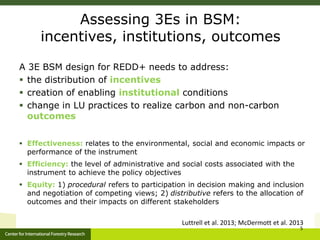
Assessing 3Es in BSM: 
incentives, institutions, outcomes 
A 3E BSM design for REDD+ needs to address: 
 the distribution of incentives 
 creation of enabling institutional conditions 
 change in LU practices to realize carbon and non-carbon 
outcomes 
 Effectiveness: relates to the environmental, social and economic impacts or 
performance of the instrument 
 Efficiency: the level of administrative and social costs associated with the 
instrument to achieve the policy objectives 
 Equity: 1) procedural refers to participation in decision making and inclusion 
and negotiation of competing views; 2) distributive refers to the allocation of 
outcomes and their impacts on different stakeholders 
Luttrell et al. 2013; McDermott et al. 2013 
5
Why a review of other sectors and 
experiences for REDD+ benefit sharing? 
1. How to operationalize equity, identifying 
target groups, setting up eligibility criteria? 
2. Should incentives be provided for inputs 
or outcomes to change behavior? 
3. What is the process of participation and 
decision-making (institutions) at multiple 
levels? 
4. How is accountability and outcomes 
measured/ monitored?
Lesson from … 
 Lessons derived from current BSMs: 
Payment for Ecosystem Services (PES), Community Forestry 
systems (CF), Conditional Cash Transfers (CCT), Indigenous 
People’s trust funds in Brazil (IPTF), and European Rural 
Development Policy (RDP) 
 Lessons from governance practices: Anti-corruption 
measures in Indonesia (ACM), standards and 
certification (S&C); VPAs under FLEGT 
Loft et al. 2014; Wong 2014; Gebara et al. 2014; Forthcoming: Nawir et al., Yang; Arwida et al.; Tjajadi et al.
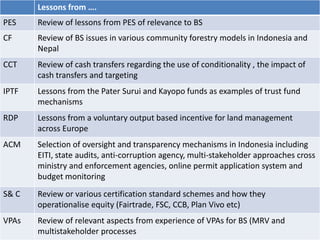
Lessons from …. 
PES Review of lessons from PES of relevance to BS 
CF Review of BS issues in various community forestry models in Indonesia and 
Nepal 
CCT Review of cash transfers regarding the use of conditionality , the impact of 
cash transfers and targeting 
IPTF Lessons from the Pater Surui and Kayopo funds as examples of trust fund 
mechanisms 
RDP Lessons from a voluntary output based incentive for land management 
across Europe 
ACM Selection of oversight and transparency mechanisms in Indonesia including 
EITI, state audits, anti-corruption agency, multi-stakeholder approaches cross 
ministry and enforcement agencies, online permit application system and 
budget monitoring 
S& C Review or various certification standard schemes and how they 
operationalise equity (Fairtrade, FSC, CCB, Plan Vivo etc) 
VPAs Review of relevant aspects from experience of VPAs for BS (MRV and 
multistakeholder processes
1. Operationalizing equity 
a) Techniques for assessing and recognizing the level 
of costs and to whom they are accruing 
- S&C periodic review of producer costs 
(Fairtrade) 
b) Setting fair and minimum payments 
c)Establishing phased and upfront payments (but need 
to make sure financial incentives are maintained till 
end - Plan Vivo TGB) 
d) Paying attention to the type of benefit 
• A focus on development activities and in kind 
benefits 
• The pros and cons of cash 
• Securing of rights
2. Increasing efficiency as a key 
element in cost and benefit sharing 
a) The use of input rather than output indicators 
b) Addressing scale e.g. bundling smallholders into 
groups (Son La and Lam Dong) 
c) Using targeting to increase effectiveness and 
efficiency 
d) Clarifying tenure
3. Institutional design to enhance 
efficiency and effectiveness 
a) Using existing governance systems to reduce 
costs 
b) Role of local government 
c) Role of intermediaries - collect and distribute 
payments and to promote the scheme to 
potential beneficiaries. Examples include the 
National Fund for Forest Financing (FONAFIFO) 
which manages the Costa Rica PES and the 
independent private nongovernmental institution 
(FAS) which manage the Bolsa Floresta program 
d) Coordination
4. Accountability through MRV 
a) Inclusion and participation in process 
b) Transparency 
- Lack of transparency in the land fee 
distribution process in Cameroon from the 
transparent distribution of money to the 
transfer to the local Governments accounts 
c) Dispute resolution
Negotiating options – key lessons.. 
PES: - helps understanding risks (elite capture) 
and advantages (effective collection/ distribution) 
of the role of intermediaries in cross-scale 
transactions 
CF: - indicates that allocation of rights is a more 
sustainable incentive than performance or input 
based incentives in a situation when difficult for 
theses incentives to reflect true transaction and 
opportunity costs 
CCT: indicates that: a) cash may be more effective 
than in-kind transfers to ensure more flexible, 
efficient and effective incentives; b)conditionalities 
bring effectiveness but are costly;
and more … so much to learn – 
IPTF : - creates awareness that heavy safeguards 
requirements of funds may restrict IP participation 
RDP: - indicates that targeting to poorer areas helps 
to achieve equity objectives 
ACMs – requires a (budgeted for) coordination 
mechanism and strong !! authority 
C&S: - shows that integrate minimum price 
guarantee can lower risks 
VPAs under FLEGT: - highlights a) need to plan for 
time and compromise involved in inclusive multi-stakeholder 
process (MSP); b) the value of dispute 
resolution mechanisms & transparency
This presentation draws from the following CIFOR research: 
 Assembe, S. et al. 2013. Assessment of the effectiveness, efficiency and equity of benefit 
sharing schemes under large-scale agriculture: Lessons from land fees in Cameroon, European 
Journal of Development Research 
 Arwida S. et al. (Forthcoming) Lessons from anti-corruption measures in Indonesia 
 Gebara MF. et al. 2014. Lessons from local environmental funds for REDD+ benefit sharing with 
indigenous people in Brazil. CIFOR InfoBrief 98. Bogor, Indonesia: CIFOR. 
 Kowler LF. et al. 2014. The legitimacy of multilevel governance structures for benefit sharing: 
REDD+ and other low emissions options in Peru. CIFOR InfoBrief 101. Bogor, Indonesia: CIFOR. 
 Loft L. et al. 2014. Lessons from payments for ecosystem services for REDD+ benefit-sharing 
mechanisms. CIFOR InfoBrief 68. Bogor, Indonesia: CIFOR. 
 Loft, L. et al. (Forthcoming) Taking stock of carbon rights in REDD+ candidate countries: 
Concept meets reality. 
 Luttrell et al. 2013. Who should benefit from REDD+? Rationales and realities. Ecology and 
Society 18(4): 52. 
 Myers, R. et al. (2014) Who holds power in land use decisions? Implications for REDD+ in 
Indonesia. CIFOR InfoBrief 100. Bogor, Indonesia: CIFOR. 
 Nawir A. et al. (Forthcoming) Lessons from community forestry in Nepal and Indonesia 
 Pham T.T. et al. 2013. Approaches to benefit sharing: A preliminary comparative analysis of 13 
REDD+ countries. Working Paper 108. Bogor, Indonesia: CIFOR. 
 Pham T.T. et al. 2014. Local preferences and strategies for effective, efficient and equitable PES 
benefit distribution options in Vietnam: Lessons for REDD+. Human Ecology. 
 Tjajadi, J. et al. (Forthcoming) Lessons from environmental and social sustainability certification 
standards 
 Wong G. 2014. The experience of conditional cash transfers: Lessons for REDD+ benefit sharing. 
CIFOR InfoBrief 97. Bogor, Indonesia: CIFOR. 
 Yang, A. (Forthcoming) Lessons from Scotland’s Rural Development Policy.
Thank you! 
http://www1.cifor.org/redd-benefit-sharing/home.html 
The CIFOR REDD+ Benefit Sharing project is supported by: 
With co-financing from:
Design of 3E REDD+ Benefit Sharing Mechanisms: Learning from Other Experiences

Design of 3E REDD+ Benefit Sharing Mechanisms: Learning from Other Experiences

  • 1.
    Design of 3EREDD+ Benefit Sharing Mechanisms: Learning from Other Experiences Maria Brockhaus, Grace Wong, Cecilia Luttrell, Lasse Loft, Anastasia Yang and Shintia Arwida COP 20 Lima, Peru, 9 December 2014
  • 2.
    CIFOR’s Global ComparativeStudy (GCS-REDD+) • To support REDD+ policy arenas and practitioner communities with - information - analysis - tools • so as to ensure 3E+ outcomes: - effectiveness - efficiency - equity and co-benefits
  • 3.
    EC-funded: Opportunities andchallenges to developing REDD+ benefit sharing mechanisms in developing countries  To provide REDD+ policymakers and practitioners with policy options and guidance to improve the design, development and implementation of REDD+ benefit sharing mechanisms. - Review of existing performance-based distribution and benefit-sharing mechanisms - Estimating the costs and benefits of REDD+ Policies and Measures, and of REDD+ projects - Understanding multi-level forest governance as the context for REDD+ and assessing rights to REDD+ benefits - Comparative options assessments to guide the development of REDD+ benefit sharing mechanisms
  • 4.
    What do wemean by benefit sharing?  Benefit sharing is the distribution of direct and indirect net gains from the implementation of REDD+  Two types of direct benefits: • Monetary gains and cash incentives from international and national finance related to REDD+ • Benefits associated with the increased availability of forest products and ecosystem services  Indirect benefits, e.g. improved institutional and governance processes  Benefit sharing mechanisms (BSM): Range of institutional means: governance structures and instruments that distribute finance and other net benefits from REDD+
  • 5.
    Assessing 3Es inBSM: incentives, institutions, outcomes A 3E BSM design for REDD+ needs to address:  the distribution of incentives  creation of enabling institutional conditions  change in LU practices to realize carbon and non-carbon outcomes  Effectiveness: relates to the environmental, social and economic impacts or performance of the instrument  Efficiency: the level of administrative and social costs associated with the instrument to achieve the policy objectives  Equity: 1) procedural refers to participation in decision making and inclusion and negotiation of competing views; 2) distributive refers to the allocation of outcomes and their impacts on different stakeholders Luttrell et al. 2013; McDermott et al. 2013 5
  • 6.
    Why a reviewof other sectors and experiences for REDD+ benefit sharing? 1. How to operationalize equity, identifying target groups, setting up eligibility criteria? 2. Should incentives be provided for inputs or outcomes to change behavior? 3. What is the process of participation and decision-making (institutions) at multiple levels? 4. How is accountability and outcomes measured/ monitored?
  • 7.
    Lesson from …  Lessons derived from current BSMs: Payment for Ecosystem Services (PES), Community Forestry systems (CF), Conditional Cash Transfers (CCT), Indigenous People’s trust funds in Brazil (IPTF), and European Rural Development Policy (RDP)  Lessons from governance practices: Anti-corruption measures in Indonesia (ACM), standards and certification (S&C); VPAs under FLEGT Loft et al. 2014; Wong 2014; Gebara et al. 2014; Forthcoming: Nawir et al., Yang; Arwida et al.; Tjajadi et al.
  • 8.
    Lessons from …. PES Review of lessons from PES of relevance to BS CF Review of BS issues in various community forestry models in Indonesia and Nepal CCT Review of cash transfers regarding the use of conditionality , the impact of cash transfers and targeting IPTF Lessons from the Pater Surui and Kayopo funds as examples of trust fund mechanisms RDP Lessons from a voluntary output based incentive for land management across Europe ACM Selection of oversight and transparency mechanisms in Indonesia including EITI, state audits, anti-corruption agency, multi-stakeholder approaches cross ministry and enforcement agencies, online permit application system and budget monitoring S& C Review or various certification standard schemes and how they operationalise equity (Fairtrade, FSC, CCB, Plan Vivo etc) VPAs Review of relevant aspects from experience of VPAs for BS (MRV and multistakeholder processes
  • 9.
    1. Operationalizing equity a) Techniques for assessing and recognizing the level of costs and to whom they are accruing - S&C periodic review of producer costs (Fairtrade) b) Setting fair and minimum payments c)Establishing phased and upfront payments (but need to make sure financial incentives are maintained till end - Plan Vivo TGB) d) Paying attention to the type of benefit • A focus on development activities and in kind benefits • The pros and cons of cash • Securing of rights
  • 10.
    2. Increasing efficiencyas a key element in cost and benefit sharing a) The use of input rather than output indicators b) Addressing scale e.g. bundling smallholders into groups (Son La and Lam Dong) c) Using targeting to increase effectiveness and efficiency d) Clarifying tenure
  • 11.
    3. Institutional designto enhance efficiency and effectiveness a) Using existing governance systems to reduce costs b) Role of local government c) Role of intermediaries - collect and distribute payments and to promote the scheme to potential beneficiaries. Examples include the National Fund for Forest Financing (FONAFIFO) which manages the Costa Rica PES and the independent private nongovernmental institution (FAS) which manage the Bolsa Floresta program d) Coordination
  • 12.
    4. Accountability throughMRV a) Inclusion and participation in process b) Transparency - Lack of transparency in the land fee distribution process in Cameroon from the transparent distribution of money to the transfer to the local Governments accounts c) Dispute resolution
  • 13.
    Negotiating options –key lessons.. PES: - helps understanding risks (elite capture) and advantages (effective collection/ distribution) of the role of intermediaries in cross-scale transactions CF: - indicates that allocation of rights is a more sustainable incentive than performance or input based incentives in a situation when difficult for theses incentives to reflect true transaction and opportunity costs CCT: indicates that: a) cash may be more effective than in-kind transfers to ensure more flexible, efficient and effective incentives; b)conditionalities bring effectiveness but are costly;
  • 14.
    and more …so much to learn – IPTF : - creates awareness that heavy safeguards requirements of funds may restrict IP participation RDP: - indicates that targeting to poorer areas helps to achieve equity objectives ACMs – requires a (budgeted for) coordination mechanism and strong !! authority C&S: - shows that integrate minimum price guarantee can lower risks VPAs under FLEGT: - highlights a) need to plan for time and compromise involved in inclusive multi-stakeholder process (MSP); b) the value of dispute resolution mechanisms & transparency
  • 15.
    This presentation drawsfrom the following CIFOR research:  Assembe, S. et al. 2013. Assessment of the effectiveness, efficiency and equity of benefit sharing schemes under large-scale agriculture: Lessons from land fees in Cameroon, European Journal of Development Research  Arwida S. et al. (Forthcoming) Lessons from anti-corruption measures in Indonesia  Gebara MF. et al. 2014. Lessons from local environmental funds for REDD+ benefit sharing with indigenous people in Brazil. CIFOR InfoBrief 98. Bogor, Indonesia: CIFOR.  Kowler LF. et al. 2014. The legitimacy of multilevel governance structures for benefit sharing: REDD+ and other low emissions options in Peru. CIFOR InfoBrief 101. Bogor, Indonesia: CIFOR.  Loft L. et al. 2014. Lessons from payments for ecosystem services for REDD+ benefit-sharing mechanisms. CIFOR InfoBrief 68. Bogor, Indonesia: CIFOR.  Loft, L. et al. (Forthcoming) Taking stock of carbon rights in REDD+ candidate countries: Concept meets reality.  Luttrell et al. 2013. Who should benefit from REDD+? Rationales and realities. Ecology and Society 18(4): 52.  Myers, R. et al. (2014) Who holds power in land use decisions? Implications for REDD+ in Indonesia. CIFOR InfoBrief 100. Bogor, Indonesia: CIFOR.  Nawir A. et al. (Forthcoming) Lessons from community forestry in Nepal and Indonesia  Pham T.T. et al. 2013. Approaches to benefit sharing: A preliminary comparative analysis of 13 REDD+ countries. Working Paper 108. Bogor, Indonesia: CIFOR.  Pham T.T. et al. 2014. Local preferences and strategies for effective, efficient and equitable PES benefit distribution options in Vietnam: Lessons for REDD+. Human Ecology.  Tjajadi, J. et al. (Forthcoming) Lessons from environmental and social sustainability certification standards  Wong G. 2014. The experience of conditional cash transfers: Lessons for REDD+ benefit sharing. CIFOR InfoBrief 97. Bogor, Indonesia: CIFOR.  Yang, A. (Forthcoming) Lessons from Scotland’s Rural Development Policy.
  • 16.
    Thank you! http://www1.cifor.org/redd-benefit-sharing/home.html The CIFOR REDD+ Benefit Sharing project is supported by: With co-financing from:

Editor's Notes

  • #3 In the face of numerous emerging first-generation REDD+ activities – both projects and national strategies – CIFOR has started in 2009, a global comparative study on REDD+.
  • #6 For these assessment steps we apply the following criteria: Effectiveness Efficiency Equity
  • #7 We chose the mechanisms to review because they are grappling with, and have experience of, many of the same questions that we face in the REDD BS debate These include questions on 1 . How to operationalize equity 2. How to  reduce costs 3. How to enhance participation and multi-stakeholder (MS) processes 4. How to address accountability around outcome through the design of the MRV systems One line on each review and what lessons it gives us - i.e. why we looked at it?
  • #8 PES – review of lessons from PES of relevance to BS CF Community Forestry systems – review of BS issues in various community forestry models in Indonesia and Nepal CCT Conditional Cash Transfers – review of cash transfers regarding the use of conditionality , the impact of cash transfers and targeting IPTF People’s trust funds in Brazil – Lessons from the Pater Surui and Kayopo funds as examples of trust fund mechanisms RDP European Rural Development Policy – A voluntary output based incentive for land management across Europe ACMs Anti-corruption measures in Indonesia – selection of oversight and transparency mechanisms in Indonesia including EITI, state audits, anti-corruption agency, multi-stakeholder approaches cross ministry and enforcement agencies, online permit application system and budget monitoring S & C standards and certification - review or various certification standard schemes and how they operationalise equity (Fairtrade, FSC, CCB, Plan Vivo etc) VPAs under FLEGT – review of relevant aspects from experuence of VPAs for BS (MRV and multistakeholder processes)
  • #9 PES – review of lessons from PES of relevance to BS CF – review of BS issues in various community forestry models in Indonesia and Nepal CCT –IPTF – Lessons from the Pater Surui and Kayopo funds as examples of trust fund mechanisms RDP – A voluntary output based incentive for land management across Europe ACMs – selection of oversight and transparency mechanisms in Indonesia including EITI, state audits, anti-corruption agency, multi-stakeholder approaches cross ministry and enforcement agencies, online permit application system and budget monitoring S & C - review or various certification standard schemes and how they operationalise equity (Fairtrade, FSC, CCB, Plan Vivo etc) VPAs under FLEGT – review of relevant aspects from experience of VPAs for BS (MRV and multistakeholder processes)
  • #10 Our review of other mechanisms suggest a number of ways of operationalizing equity ranging from - techniques for assessing and recognizing the level of costs and to whom they are accruing One of the big questions we come up against in the BS debate the importance of incorporating an assessment of cost into the definition of benefit levels. This concern was mirrored most significantly in the reviews of PES and CF where transaction costs can be high - indeed a review of PES systems by (Alston et al) suggests that transaction costs can be up to 66% of income generated   The certification body Fairtrade attempts to address this issue through periodcic reviews to ensure producers’ production costs are being covered. They use methodologies which calculate the ‘cost of sustainable production’ from a panel of producers providing detailed farm operating information for a one-year production period.   In most of the PES cases we looked at - a major criterion for setting the level of benefits included some form of implementation cost calculation. Wunder’s 2008 review concludes that “in practically every case, payments are based implicitly or explicitly on the cost of ES provision, rather than on the value of the ES.”   - setting minimum payments A key technique for dealing with unpredictability of markets is the use of minimum payment or Price setting . For example Plan Vivo requires a minimum of 60 % of the total carbon finance generated go to communities, Fairtrade sets a minimum price to farmers which reduces the risk of price fluctuation faced by the producers, and theoretically ensures the producers are at least  compensated for the costs. A key lesson from PES in this respect is the importance of involving both the buyers and sellers in price setting. In Vietnam, for example, the government’s practice of unilaterally setting the level of payment with limited consultation with buyer groups (water supply companies, hydropower plants) has led to a lack of compliance by buyers. As a result, in many provinces, buyers’ willingness to pay is low. c) Establishing phased and upfront payments Our reviews also show the equity benefit of upfront payments to cover set up costs and to give an initial incentive for participation . This suggests that it may be advantageous to disburse benefits in intervals. To ensure conditionality, some PES schemes provide payments upon delivery of the service and some mix approaches and provide payments both in intervals and for performance. In Fairtrade and Plan Vivo, the pre-financing is disbursed in phases based on meeting performance benchmarks. For example, In the Plan Vivo TGB project in Uganda   for example, producers received pre-financing in five instalments within 10 years, based upon certain performances, over the course of 25 year contract. However ths timing does leaves the producers with no financial incentives and sanction in the final 15 years of their contract so as well as the risk for carbon outcomes which this this brings, there may be some temporal equity issues to consider for the end of a project cycle as well as the end d) Paying attention to the type of benefit One of the big questions facing BS is ‘ in what form should the benefit occur’ i. In kind It is interesting to note that much of the debate in community forestry cases, the IP funds and the certification schemes reviewed showed a preference for in kind or collective level benefit . This is partly due to the concern than cash might exclusively benefit individuals or elites; (Nery et al. 2013.) Fairtrade for example requires buyers to pay a “Fairtrade Premium” to the farmers to ensure the development of common social goals of its members. The premium value can be relatively meager for individual producers, but the sum of money might be significant at a community level. Ii At the same time there is a whole strand of debate in the literature on CCT on the benefits of cash and cash transfers With some evidence that cash may be more flexible, efficient and effective than other in-kind transfers (Fiszbein and Schady 2011 ) iii. A striking conclusion from our review of selected CF cases is the importance of rights as a benefit The CF cases highlight the way in which the allocation of rights is more sustainable incentive than performance or input based incentives for maintaining community involvement in situations of inadequate financing – this is because it is hard to get the pricing incentive correct relative to transaction and opportunity costs
  • #11 Cost sharing rather than benefit sharing remains the key concern across many of the mechanisms we looked at and a major element of this is how to reduce the costs involved, many of which fall disproportionately on small producers . Some of the mechanisms used to address these issues include : 1. The use of input rather than output indicators    A common theme across all the mechanisms we looked at is that of the tension between efficiency and equity. One of the areas this is reflected in is the tradeoff between precision of monitoring outcomes and the cost of doing so – this is clearly seen for example in the experience of CCTs (conditional cash transfers) where more complex eligibility criteria to ensure equity outcomes entail higher costs to implement and to monitor. The feasibility of setting and monitoring sophisticated outcomes more realistic in some countries than in others with the level of infrastructure available being a key variable IN PES schemes it seems that there are few cases where payments are being made on monitoring outputs - partly due to the lack of data & technology as well as low capacity and poor coordination and information exchange between agencies .     2. Addressing scale e.g. bundling smallholders into groups (Son La and Lam Dong);or using existing contracts et Terrat n Tanzania where use existing contracts between communities and private company 3. Using targeting to increase effectiveness Focus on producers where ES production is high but low cost (link this to focusing on low OpportunityCosts). This targeting may have a equity trade off highlights the need to monitor and adapt payments and targeting criteria where necessary . 4. Clarifying tenure Type of the ecosystem service – the more it has public good characteristics the more costly it is to exclude  5
  • #12 Our different case studies raised a number of lessons regarding institutions design Using existing governance systems to reduce cost Many reviews (Wunder et al. 2008; OECD 2010; Alston et al. 2013 suggest that the use of existing governance structures can reduce costs. The review of ACMs (anti-corruption mechanisms) shows some benefits of building on existing decentralized government structures due the problems seen by initiatives such as FLEGT etc faced in mainstreaming new initiatives. For example the succes of the Know Your Customer Principle verification mechanism used by banks in Indonesia is said to be partly due to the way in which the system was embedded into day to day standard operating procedures which meant that it did not require many additional transaction costs. 2. Another lesson emerging from our reviews are the longer term benefits of involving local government the design of the BSM .there are two main reasons for this. One is local governments’ proximity to the location of REDD+ implementation and the other is that their comprehension of local context means they have more potential than national government to empower local community by involving them in decision making processes. 3. A key aspect emerging from many of the case studies is the important role of intermediaries in facilitating BSMs. The review of PES highlights the way in which intermediaries are key in many PES schemes – particularly those which operate across scales - to help collect and distribute payments and to promote the scheme to potential beneficiaries. Examples include the National Fund for Forest Financing (FONAFIFO) which manages the Costa Rica PES and the independent private nongovernmental institution (FAS) which manage the Bolsa Floresta program 4. Coordination The importance of Improving coordination between institutions is a theme running through out many of the mechanisms we looked at. Some of the key aspects to this are that the official coordinatory body should have sufficient authority and resources for the job . The review of ACMs show that a common failure is the lack of funding for such a coodinatory mechanism within the design of the mechanism. This review also suggest that there are advantages in having a coordinating institution which possess both investigative and punitive authorities to oversee and resolve any corruption. However care should be taken to maintain a balance of powers and oversight of the institution itself within the mechanism design.
  • #13 Effectiveness can be enhanced by a clear and strong link between monitoring and payment and clarity regarding the consequences when an infringement of the conditions of a programme occurs. LL: BUT THIS ENHANCEMENT MIGHT LEAD TO HIGH COSTS OF THE MONITORING SYSTEM, SO THE EFFICIENCY QUESTION ARISES. MORE EFFICIENT BECAUSE LESS INFRINGEMENT OR LESS EFFICIENT BECAUSE HIGHER MRV COSTS? The lessons from the ACM and FLEGT reviews in particular feed into design aspects of BSMs around MRV and how to enhance the credibility of MRV systems through getting the design right. The FLEGT debate for example gives us a set of lessons around how to monitor, report and verify against a set of standards as well as how to get a set of standards over which there is broad ownership. Other ACMs looked at give us lessons of the various Institutional arrangements and varying balances between state, private and NGO actors as well as different form of oversight mechanisms and Dispute and conflict mechanisms   1. Inclusion and participation All our case studies suggest that multi-stakeholder processes (MSPs) can help Bring credibility, ownership and better design. For example inthe case of the PES scheme in Cidanau, Indonesia, both buyers and sellers prefer the use of multi-stakeholder trust funds, comprising both state and non-state actors, because this increases accountability for management of the funds.  From standards review: Both Fairtrade and Plan Vivo require active participation and ownership by producers. In these standards,  participating farmers, can organize to form a local governance structure, which takes a lead role in development and implementation of their own management plan to comply with the standards. However MSP do indeed slow down the process (and increase the costs) and this is one of the reasons (as well as concerns over conflict of inters) that the the Amazon Fund appears to restrict participation by indigenous peoples in the decision-making processes the Kayopo Fund. The experience of FLEGT and the elaborate MSP processes that these have included highlight the need for time and compromise in the develppment of such processes. 2. Transparency Transparency emerges as a key design principle across may of the mechanisms we looked at . A key way in which many of the ACMs we reviewed foster transparency and accountability is by incorporating information and communication technology (ICT)—in the form of internet and social media—into the existing process. Examples of this in Indonesia include the posting of local government meetings on you tube and the provision of website information on local budgets by the NGO FITRA - both of these have helped to increase public involvement. However this review also highlighted the importance of there being a clear procedure for follow-up and the involvement of institutions that have the mandate do so act as  transparency alone is not sufficient: enforcement and penalties are also important for accountability and effectiveness. 3. Dispute mechanisms   This links into the importance of dispute resolution mechanism. An example of the inclusion of a local conflict resolution mechanism comes from Bolas Floresta (Brazil), where ecosystem service providers who breach their contract by failing to conserve forest receive a warning, and must justify their reasons for deforestation to the community association. Those who continue to breach the contract may have the contract terminated (Pereira 2010; Conceicao 2012).. FSC created an independent body which authorizes and monitors the certification body and FSC itself. Accreditation Services International (ASI) allows stakeholders with concerns about a certificate holder to contact the certification holder directly (FSC 2009).  
  • #14 Mechaisms reviewed Relevance to BS Key lessons PES Designing performance based finance (PBF) for environmental services - important role of intermediaries in cross-scale transactions - assessment of transaction and opportunity costs and to whom is crucial - focus on areas with low-medium opportunity costs Community forestry Type of benefit; how to incorporate costs - Rights allocation of rights is a more sustainable incentive than performance or input based incentives because it is hard for theses incentives to reflect true transaction and opportunity costs - equity enhanced through financing community development and explicitly weighting payments to marginalised Conditional Cash Transfers (CCT) - How PBF is best structured; - pros and cons of cash - conditionalities bring effectiveness but are costly - high costs of sophisticated outcome indicators vs simple input monitoring indicators - cash may be more flexible, efficient and effective than in-kind transfers Indigenous Peoples’ trust funds in Brazil (IPTF) Design of financial transfer systems - Heavy safeguards requirements of funds may restrict IP participation - inclusive processes require sophisticated attentio n to culture - Importance of timey financial flow to reduce risk Rural Development Policy in Scotland (RDP) - How to mix centralized and decentralized incentives for a regional goal - Phased & anticipated payments incentivize small-holder involvement - Targeting to poorer areas for equity Certification and standard systems How to incorporate equity into the design & implementation The importance of specifying how to achieve equity (many have it as a n objective only) Minimum price guarantee can lower risks Value of inclusive assessments of implementation costs as a basis for price setting VPAs under FLEGT - How to bring credibility in the design of MRV systems - The time and compromise involved an inclusive multi-stakeholder process (MSP) - Value of dispute resolution mechanisms & transparency - Independence can be built into a system with varying combinations of state, private and NGO players
  • #18 Layout: Closing Slide Variation: none