Global Comparative Study on REDD+: 
some highlights of the PNA study
Knowledge sharing seminar
Addis Ababa – 26 May 2017
Outline of presentation
 Concepts: Forest & climate change, Forest Governance
and REDD+
 Introducing CIFOR’s Global Comparative Study on
REDD+
 Networks and Policy Network analysis
 Highlights from 8 country studies
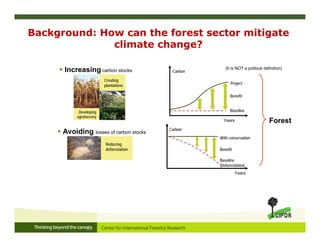
Background: How can the forest sector mitigate
climate change?
 Increasing carbon stocks
Reducing
deforestation
Developing
agroforestry
Creating
plantations
 Avoiding losses of carbon stocks
Forest
(It is NOT a political definition)
Years
Carbon
Project
Baseline
Benefit
Years
Carbon
With conservation
Baseline
(Deforestation)
Benefit
Background: Forest governance and policy
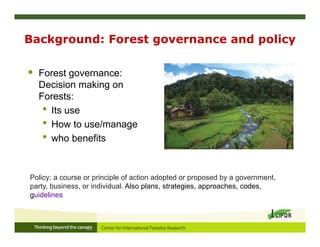
 Forest governance:
Decision making on
Forests:
• Its use
• How to use/manage
• who benefits
Policy: a course or principle of action adopted or proposed by a government,
party, business, or individual. Also plans, strategies, approaches, codes,
guidelines
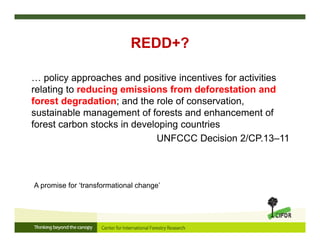
… policy approaches and positive incentives for activities
relating to reducing emissions from deforestation and
forest degradation; and the role of conservation,
sustainable management of forests and enhancement of
forest carbon stocks in developing countries
UNFCCC Decision 2/CP.13–11
REDD+?
A promise for ‘transformational change’
THINKING beyond the canopy
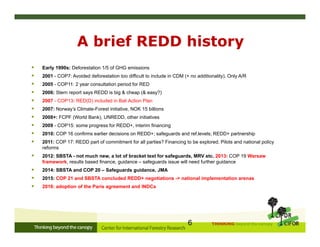
A brief REDD history
 Early 1990s: Deforestation 1/5 of GHG emissions
 2001 - COP7: Avoided deforestation too difficult to include in CDM (+ no additionality). Only A/R
 2005 - COP11: 2 year consultation period for RED
 2006: Stern report says REDD is big & cheap (& easy?)
 2007 - COP13: RED(D) included in Bali Action Plan
 2007: Norway’s Climate-Forest initiative, NOK 15 billions
 2008+: FCPF (World Bank), UNREDD, other initiatives
 2009 - COP15: some progress for REDD+, interim financing
 2010: COP 16 confirms earlier decisions on REDD+; safeguards and ref.levels; REDD+ partnership
 2011: COP 17: REDD part of commitment for all parties? Financing to be explored. Pilots and national policy
reforms
 2012: SBSTA - not much new, a lot of bracket text for safeguards, MRV etc. 2013: COP 19 Warsaw
framework, results based finance, guidance – safeguards issue will need further guidance
 2014: SBSTA and COP 20 – Safeguards guidance, JMA
 2015: COP 21 and SBSTA concluded REDD+ negotiations -> national implementation arenas
 2016: adoption of the Paris agreement and INDCs
6
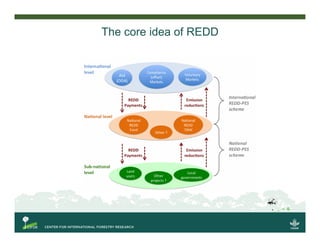
The core idea of REDD
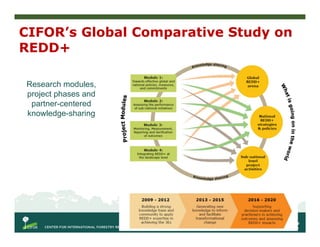
Research modules,
project phases and
partner-centered
knowledge-sharing
CIFOR’s Global Comparative Study on
REDD+
THINKING beyond the canopy
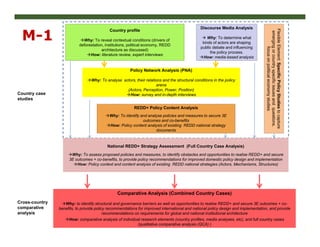
Comparative Analysis (Combined Country Cases)
Why: to identify structural and governance barriers as well as opportunities to realise REDD+ and secure 3E outcomes + co-
benefits, to provide policy recommendations for improved international and national policy design and implementation, and provide
recommendations on requirements for global and national institutional architecture
How: comparative analysis of individual research elements (country profiles, media analyses, etc), and full country cases
(qualitative comparative analysis (QCA) )
Comparative Analysis (Combined Country Cases)
Why: to identify structural and governance barriers as well as opportunities to realise REDD+ and secure 3E outcomes + co-
benefits, to provide policy recommendations for improved international and national policy design and implementation, and provide
recommendations on requirements for global and national institutional architecture
How: comparative analysis of individual research elements (country profiles, media analyses, etc), and full country cases
(qualitative comparative analysis (QCA) )
Country case
studies
Cross-country
comparative
analysis
Country profile
Why: To reveal contextual conditions (drivers of
deforestation, institutions, political economy, REDD
architecture as discussed)
How: literature review, expert interviews
Discourse Media Analysis
 Why: To determine what
kinds of actors are shaping
public debate and influencing
the policy process.
How: media-based analysis
REDD+ Policy Content Analysis
Why: To identify and analyse policies and measures to secure 3E
outcomes and co-benefits
How: Policy content analysis of existing REDD national strategy
documents
y p
Policy Network Analysis (PNA)
Why: To analyse actors, their relations and the structural conditions in the policy
arena
(Actors, Perception, Power, Position)
How: survey and in-depth interviews
FlexibleElement:SpecificPolicyStudiestocapture
emergingorcountryspecificissuesandquestions,
focusonpoliticaleconomystudies
National REDD+ Strategy Assessment (Full Country Case Analysis)
Why: To assess proposed policies and measures, to identify obstacles and opportunities to realise REDD+ and secure
3E outcomes + co-benefits, to provide policy recommendations for improved domestic policy design and implementation
How: Policy context and content analysis of existing REDD national strategies (Actors, Mechanisms, Structures)
National REDD+ Strategy Assessment (Full Country Case Analysis)
Why: To assess proposed policies and measures, to identify obstacles and opportunities to realise REDD+ and secure
3E outcomes + co-benefits, to provide policy recommendations for improved domestic policy design and implementation
How: Policy context and content analysis of existing REDD national strategies (Actors, Mechanisms, Structures)
M-1
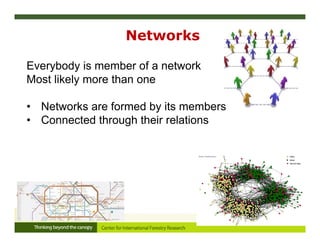
Everybody is member of a network
Most likely more than one
• Networks are formed by its members
• Connected through their relations
Networks
THINKING beyond the canopy
Networks: a new form of
governance
arrangements among a range of different actors including
representatives from private and other non-governmental
institutions related through competition over or exchange of
resources and thereby making policy making in today’s
world increasingly complex
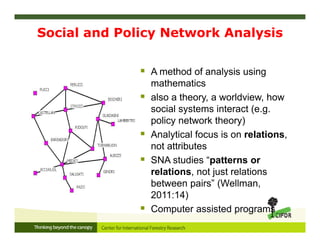
Social and Policy Network Analysis
 A method of analysis using
mathematics
 also a theory, a worldview, how
social systems interact (e.g.
policy network theory)
 Analytical focus is on relations,
not attributes
 SNA studies “patterns or
relations, not just relations
between pairs” (Wellman,
2011:14)
 Computer assisted programs
THINKING beyond the canopy
Why PNA
1. Investigate in detail features of policy processes in
multiactor policy domains
2. Explore how resource exchange, and pooling of
resources, is used as a basis for political negotiation
3. Understand how policy actors exercise power and
influence through interactions in policy processes
4. Analyze the form and role of policy coalitions/forum
/partnerships in influencing policy outcomes
• Surveys done in 8 countries and about to start in Ethiopia 
• 2nd round of interviews in Indonesia, Brazil, Vietnam, Cameroon
• Assesses relational and structural aspects of actors and the REDD 
arena and considers implications for the 3E+ content of REDD 
strategies. 
REDD+ 
Policy Network 
Analysis 
(PNA)
Examines questions including:
•Who is involved in national REDD policy making?
•What are their perceptions, interests, and power relations?
•What are their networks of information and influence?
Repeated over time, this method can assess dynamics and power 
relations over time. Results of policy outcomes emerging from 
CIFOR’s global comparative study and other analysis will allow us 
to assess efficiency outcomes.
REDD+ 
Policy Network 
Analysis 
(PNA)
Highlights from the study in 6 countries
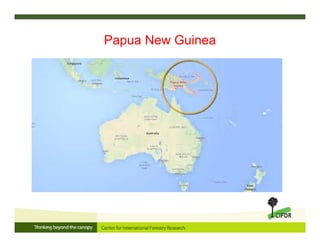
Papua New Guinea
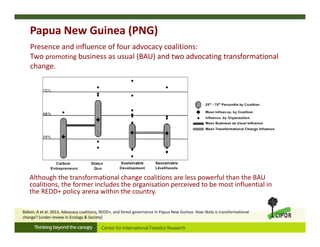
Presence and influence of four advocacy coalitions: 
Two promoting business as usual (BAU) and two advocating transformational 
change.
Although the transformational change coalitions are less powerful than the BAU 
coalitions, the former includes the organisation perceived to be most influential in 
the REDD+ policy arena within the country.
Papua New Guinea (PNG)
Babon, A et al. 2013. Advocacy coalitions, REDD+, and forest governance in Papua New Guinea: How likely is transformational 
change? (under review in Ecology & Society) 
Presence and influence of four advocacy coalitions: 
Two promoting business as usual (BAU) and two advocating transformational 
change.
Although the transformational change coalitions are less powerful than the BAU 
coalitions, the former includes the organisation perceived to be most influential in 
the REDD+ policy arena within the country.
Papua New Guinea (PNG)
Babon, A et al. 2013. Advocacy coalitions, REDD+, and forest governance in Papua New Guinea: How likely is transformational 
change? (under review in Ecology & Society) 
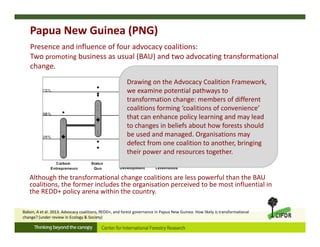
Drawing on the Advocacy Coalition Framework, 
we examine potential pathways to 
transformation change: members of different 
coalitions forming ‘coalitions of convenience’
that can enhance policy learning and may lead 
to changes in beliefs about how forests should 
be used and managed. Organisations may 
defect from one coalition to another, bringing 
their power and resources together.
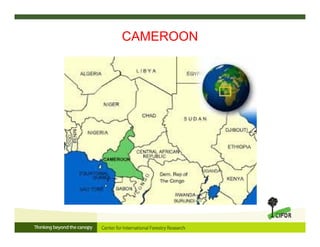
CAMEROON
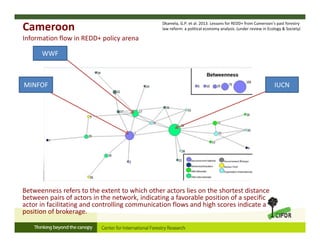
Cameroon
Information flow in REDD+ policy arena
Betweenness refers to the extent to which other actors lies on the shortest distance 
between pairs of actors in the network, indicating a favorable position of a specific 
actor in facilitating and controlling communication flows and high scores indicate a 
position of brokerage.
Dkamela, G.P. et al. 2013. Lessons for REDD+ from Cameroon’s past forestry 
law reform: a political economy analysis. (under review in Ecology & Society)
IUCNMINFOF
WWF
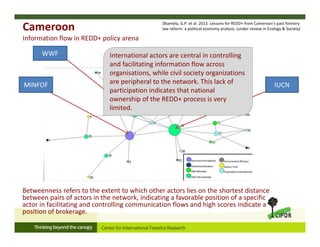
Cameroon
Information flow in REDD+ policy arena
Betweenness refers to the extent to which other actors lies on the shortest distance 
between pairs of actors in the network, indicating a favorable position of a specific 
actor in facilitating and controlling communication flows and high scores indicate a 
position of brokerage.
Dkamela, G.P. et al. 2013. Lessons for REDD+ from Cameroon’s past forestry 
law reform: a political economy analysis. (under review in Ecology & Society)
IUCNMINFOF
WWF International actors are central in controlling 
and facilitating information flow across 
organisations, while civil society organizations 
are peripheral to the network. This lack of 
participation indicates that national 
ownership of the REDD+ process is very 
limited. 
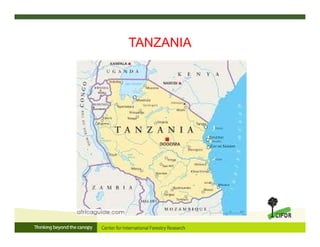
TANZANIA
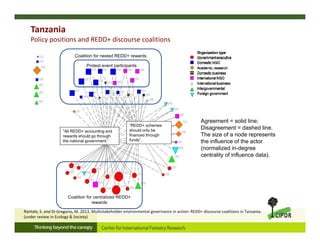
Tanzania
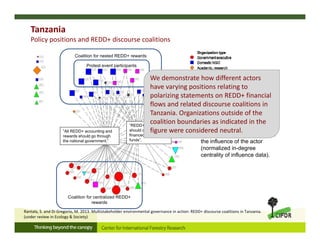
Policy positions and REDD+ discourse coalitions
”All REDD+ accounting and
rewards should go through
the national government.”
”REDD+ schemes
should only be
financed through
funds”.
Protest event participants
Coalition for nested REDD+ rewards
Coalition for centralized REDD+
rewards
Agreement = solid line;
Disagreement = dashed line.
The size of a node represents
the influence of the actor
(normalized in-degree
centrality of influence data).
Rantala, S. and Di Gregorio, M. 2013. Multistakeholder environmental governance in action: REDD+ discourse coalitions in Tanzania. 
(under review in Ecology & Society)
Tanzania
Policy positions and REDD+ discourse coalitions
”All REDD+ accounting and
rewards should go through
the national government.”
”REDD+ schemes
should only be
financed through
funds”.
Protest event participants
Coalition for nested REDD+ rewards
Coalition for centralized REDD+
rewards
Agreement = solid line;
Disagreement = dashed line.
The size of a node represents
the influence of the actor
(normalized in-degree
centrality of influence data).
Rantala, S. and Di Gregorio, M. 2013. Multistakeholder environmental governance in action: REDD+ discourse coalitions in Tanzania. 
(under review in Ecology & Society)
We demonstrate how different actors 
have varying positions relating to 
polarizing statements on REDD+ financial 
flows and related discourse coalitions in 
Tanzania. Organizations outside of the 
coalition boundaries as indicated in the 
figure were considered neutral.  
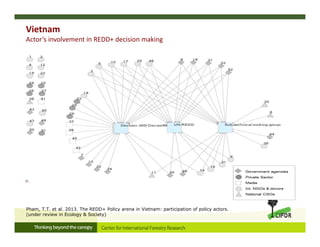
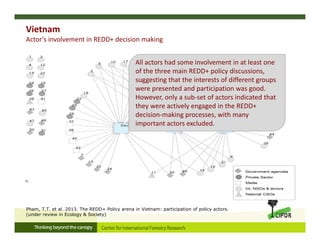
Vietnam
Actor’s involvement in REDD+ decision making
Pham, T.T. et al. 2013. The REDD+ Policy arena in Vietnam: participation of policy actors.
(under review in Ecology & Society)
Vietnam
Actor’s involvement in REDD+ decision making
Pham, T.T. et al. 2013. The REDD+ Policy arena in Vietnam: participation of policy actors.
(under review in Ecology & Society)
All actors had some involvement in at least one 
of the three main REDD+ policy discussions, 
suggesting that the interests of different groups 
were presented and participation was good. 
However, only a sub‐set of actors indicated that 
they were actively engaged in the REDD+ 
decision‐making processes, with many 
important actors excluded.
KEY: ORGANIZATION TYPES
Government
Civil Society Organizations
Business Associations
Education/Research
International NGOs
Multilateral/Bilateral Donors
REDD 
Cell
DNPWC
WWF
RECOFTC
FECOFUN
NEFIN
NFA
DFID
DoF
WWF
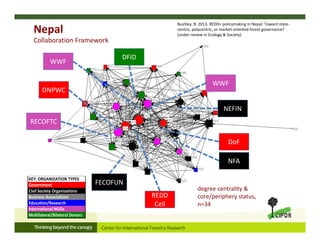
degree centrality & 
core/periphery status, 
n=34
Nepal
Collaboration Framework
Bushley, B. 2013. REDD+ policymaking in Nepal: Toward state‐
centric, polycentric, or market‐oriented forest governance? 
(under review in Ecology & Society)
KEY: ORGANIZATION TYPES
Government
Civil Society Organizations
Business Associations
Education/Research
International NGOs
Multilateral/Bilateral Donors
REDD 
Cell
DNPWC
WWF
RECOFTC
FECOFUN
NEFIN
NFA
DFID
DoF
WWF
degree centrality & 
core/periphery status, 
n=34
Nepal
Collaboration Framework
Bushley, B. 2013. REDD+ policymaking in Nepal: Toward state‐
centric, polycentric, or market‐oriented forest governance? 
(under review in Ecology & Society)
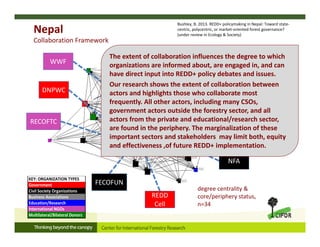
The extent of collaboration influences the degree to which 
organizations are informed about, are engaged in, and can 
have direct input into REDD+ policy debates and issues. 
Our research shows the extent of collaboration between 
actors and highlights those who collaborate most 
frequently. All other actors, including many CSOs, 
government actors outside the forestry sector, and all 
actors from the private and educational/research sector, 
are found in the periphery. The marginalization of these 
important sectors and stakeholders  may limit both, equity 
and effectiveness ,of future REDD+ implementation. 
INDONESIA
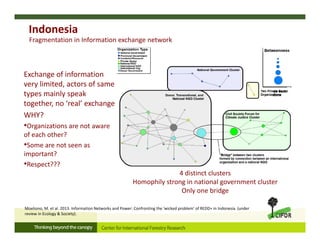
Exchange of information 
very limited, actors of same 
types mainly speak 
together, no ‘real’ exchange 
WHY?
•Organizations are not aware 
of each other?
•Some are not seen as 
important?
•Respect???
4 distinct clusters
Homophily strong in national government cluster
Only one bridge
Indonesia
Fragmentation in Information exchange network
Moeliono, M. et al. 2013. Information Networks and Power: Confronting the ‘wicked problem’ of REDD+ in Indonesia. (under 
review in Ecology & Society). 
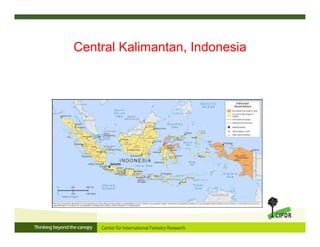
Central Kalimantan, Indonesia
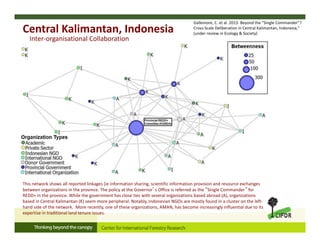
Central Kalimantan, Indonesia 
Inter‐organisational Collaboration
This network shows all reported linkages (ie information sharing, scientific information provision and resource exchanges 
between organizations in the province. The policy at the Governor’s Office is referred as the “Single Commander” for 
REDD+ in the province. While the government has close ties with several organizations based abroad (A), organizations 
based in Central Kalimantan (K) seem more peripheral. Notably, Indonesian NGOs are mostly found in a cluster on the left‐
hand side of the network.  More recently, one of these organizations, AMAN, has become increasingly influential due to its 
expertise in traditional land tenure issues.  
Gallemore, C. et al. 2013. Beyond the “Single Commander”? 
Cross‐Scale Deliberation in Central Kalimantan, Indonesia,” 
(under review in Ecology & Society)
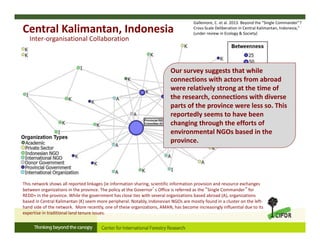
Central Kalimantan, Indonesia 
Inter‐organisational Collaboration
This network shows all reported linkages (ie information sharing, scientific information provision and resource exchanges 
between organizations in the province. The policy at the Governor’s Office is referred as the “Single Commander” for 
REDD+ in the province. While the government has close ties with several organizations based abroad (A), organizations 
based in Central Kalimantan (K) seem more peripheral. Notably, Indonesian NGOs are mostly found in a cluster on the left‐
hand side of the network.  More recently, one of these organizations, AMAN, has become increasingly influential due to its 
expertise in traditional land tenure issues.  
Gallemore, C. et al. 2013. Beyond the “Single Commander”? 
Cross‐Scale Deliberation in Central Kalimantan, Indonesia,” 
(under review in Ecology & Society)
Our survey suggests that while 
connections with actors from abroad 
were relatively strong at the time of 
the research, connections with diverse 
parts of the province were less so. This 
reportedly seems to have been 
changing through the efforts of 
environmental NGOs based in the 
province.
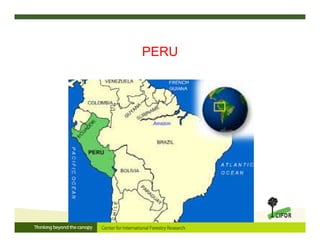
PERU
CIFOR
Min. 
Envt
FAO
IIAP
Peru
Scientific Information Network
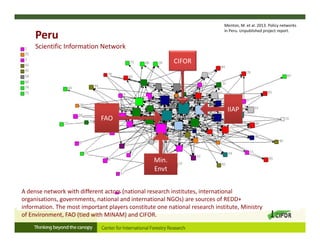
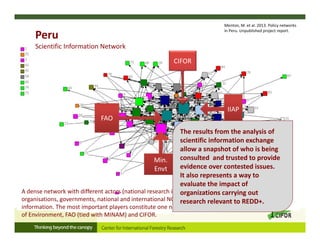
A dense network with different actors (national research institutes, international 
organisations, governments, national and international NGOs) are sources of REDD+ 
information. The most important players constitute one national research institute, Ministry 
of Environment, FAO (tied with MINAM) and CIFOR. 
Menton, M. et al. 2013. Policy networks 
in Peru. Unpublished project report. 
CIFOR
Min. 
Envt
FAO
IIAP
Peru
Scientific Information Network
A dense network with different actors (national research institutes, international 
organisations, governments, national and international NGOs) are sources of REDD+ 
information. The most important players constitute one national research institute, Ministry 
of Environment, FAO (tied with MINAM) and CIFOR. 
Menton, M. et al. 2013. Policy networks 
in Peru. Unpublished project report. 
The results from the analysis of 
scientific information exchange 
allow a snapshot of who is being 
consulted  and trusted to provide 
evidence over contested issues. 
It also represents a way to 
evaluate the impact of 
organizations carrying out 
research relevant to REDD+.
Acknowledgements
This work is part of the policy component of CIFOR’s global comparative study on REDD (GCS). The methods and guidelines used in 
this research component were designed by Maria Brockhaus, Monica Di Gregorio and Sheila Wertz‐Kanounnikoff. Parts of the 
methodology are adapted from the research protocol for media and network analysis designed by COMPON (‘Comparing Climate 
Change Policy Networks’).
Case leaders:  Thuy Thu Pham (Nepal), Thuy Thu Pham & Moira Moeliono  (Vietnam),  Thuy Thu Pham and Guillaume Lestrelin 
(Laos), Daju Resosudarmo & Moira Moeliono (Indonesia), Andrea Babon (PNG), Peter Cronkleton, Kaisa Korhonen‐Kurki, Pablo 
Pacheco (Bolivia), Mary Menton (Peru), Sven Wunder & Peter May (Brazil), Samuel Assembe & Jolien Schure  (Cameroon), Samuel 
Assembe (DRC), Salla Rantala (Tanzania), Sheila Wertz‐Kanounnikoff (Mozambique), Suwadu Sakho‐Jimbira & Houria Djoudi (Burkina 
Faso), Arild Angelsen (Norway). Special thanks to our national partners from REDES, CEDLA, Libelula and DAR, REPOA, UEM, CODELT,
ICEL, ForestAction, CIEM, CERDA, Son La FD, UPNG, NRI‐PNG, and UMB. 
Thanks to contributors to case studies, analysis and review : Levania Santoso, Tim Cronin, Giorgio Indrarto, Prayekti Murharjanti, Josi 
Khatarina, Irvan Pulungan, Feby Ivalerina, Justitia Rahman, Muhar Nala Prana, Caleb Gallemore (Indonesia), Nguyen Thi Hien, 
Nguyen Huu Tho, Vu Thi Hien, Bui Thi Minh Nguyet, Nguyen Tuan Viet and Huynh Thu Ba (Vietnam), Dil Badhur, Rahul Karki, Bryan 
Bushley, Naya Paudel (Nepal), Daniel McIntyre, Gae Gowae, Nidatha Martin, Nalau Bingeding, Ronald Sofe, Abel Simon (PNG), Walter 
Arteaga, Bernado Peredo, Jesinka Pastor (Bolivia), Maria Fernanda Gebara, Brent Millikan, Bruno Calixto, Shaozeng Zhang (Brazil), 
Hugo Piu, Javier Perla, Daniela Freundt, Eduardo Burga Barrantes, Talía Postigo Takahashi (Peru), Guy Patrice Dkamela, Felicien 
Kengoum (Cameroon), Felicien Kabamba, Augustin Mpoyi, Angelique Mbelu (DRC), Demetrius Kweka, Therese Dokken, Rehema 
Tukai, George Jambiya, Riziki Shemdoe, (Tanzania), Almeida Sitoe, Alda Salomão (Mozambique), Mathurin Zida, Michael Balinga 
(Burkina Faso), Laila Borge (Norway). 
Special thanks to Efrian Muharrom, Sofi Mardiah, Christine Wairata, Ria Widjaja‐Adhi, Cecilia Luttrell,  Frances Seymour, Lou Verchot, 
Markku Kanninen, Elena Petkova, Arild Angelsen, Jan Boerner, Anne Larson, Martin Herold, Rachel Carmenta, Juniarta Tjajadi, 
Cynthia Maharani

Global Comparative Study on REDD+:  Some highlights of the PNA study