REDD+ benefit sharing:
        discourses on who ‘should’
                 benefit
    Cecilia Luttrell , Lasse Loft (BiK-F) , Maria Fernanda Gebara
      (Getulio Vargas Foundation), Demetrius Kwerka , Maria
                     Brockhaus; William Sunderlin
;

                         Bogor 27th Sept 2012
Overview of what we looked at
 Description of incipient BS arrangements at national and local
  levels
 Discourses on who should benefit
 Tradeoffs between objectives of REDD+
 Data from GCS work on national policy processes in 6 countries
  and 21 projects,
Definitions
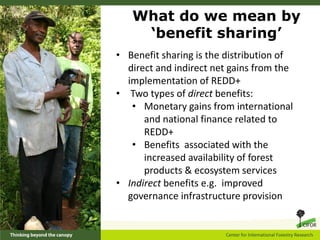
What do we mean by
    ‘benefit sharing’
• Benefit sharing is the distribution of
  direct and indirect net gains from the
  implementation of REDD+
• Two types of direct benefits:
   • Monetary gains from international
      and national finance related to
      REDD+
   • Benefits associated with the
      increased availability of forest
      products & ecosystem services
• Indirect benefits e.g. improved
  governance infrastructure provision
What is a BSM

• Range of institutional means: governance
  structures and instruments that distribute
  finance and other net benefits from REDD+
  – Direct incentives e.g. cash transfers, PFM, ICDPs
  – Policy and governance processes e.g. tenure
    clarification, law enforcement, agricultural
    intensification
Benefits come with costs:
   net benefits are what matter
• Direct financial outlays related to REDD+
  (implementation and transaction costs)
• Costs arising from changes in forest land and
  resource use (opportunity costs)
• Cost recovery (compensation) vs. the surplus
  (REDD rent)
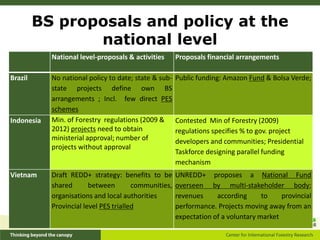
BS proposals and policy at the
                national level
            National level-proposals & activities      Proposals financial arrangements

Brazil      No national policy to date; state & sub-   Public funding: Amazon Fund & Bolsa Verde;
            state projects define own BS
            arrangements ; Incl. few direct PES
            schemes
Indonesia   Min. of Forestry regulations (2009 &       Contested Min of Forestry (2009)
            2012) projects need to obtain              regulations specifies % to gov. project
            ministerial approval; number of            developers and communities; Presidential
            projects without approval
                                                       Taskforce designing parallel funding
                                                       mechanism
Vietnam     Draft REDD+ strategy: benefits to be       UNREDD+ proposes a National Fund
            shared       between        communities,   overseen by multi-stakeholder body;
            organisations and local authorities        revenues     according      to    provincial
            Provincial level PES trialled              performance. Projects moving away from an
                                                       expectation of a voluntary market
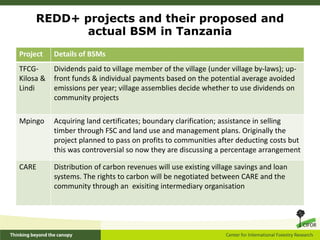
REDD+ projects and their proposed and
            actual BSM in Tanzania
Project    Details of BSMs
TFCG-      Dividends paid to village member of the village (under village by-laws); up-
Kilosa &   front funds & individual payments based on the potential average avoided
Lindi      emissions per year; village assemblies decide whether to use dividends on
           community projects

Mpingo     Acquiring land certificates; boundary clarification; assistance in selling
           timber through FSC and land use and management plans. Originally the
           project planned to pass on profits to communities after deducting costs but
           this was controversial so now they are discussing a percentage arrangement

CARE       Distribution of carbon revenues will use existing village savings and loan
           systems. The rights to carbon will be negotiated between CARE and the
           community through an exisiting intermediary organisation
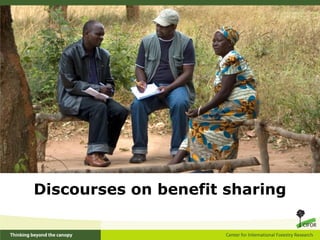
Discourses on benefit sharing
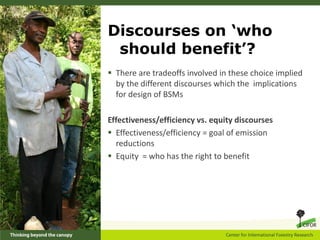
Discourses on ‘who
 should benefit’?
 There are tradeoffs involved in these choice implied
  by the different discourses which the implications
  for design of BSMs

Effectiveness/efficiency vs. equity discourses
 Effectiveness/efficiency = goal of emission
  reductions
 Equity = who has the right to benefit
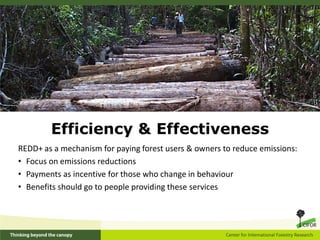
Efficiency & Effectiveness
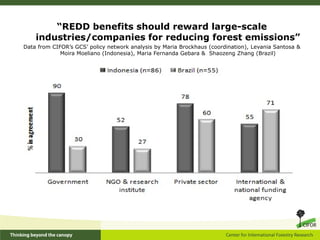
REDD+ as a mechanism for paying forest users & owners to reduce emissions:
• Focus on emissions reductions
• Payments as incentive for those who change in behaviour
• Benefits should go to people providing these services
“REDD benefits should reward large-scale
    industries/companies for reducing forest emissions”
Data from CIFOR’s GCS’ policy network analysis by Maria Brockhaus (coordination), Levania Santosa &
             Moira Moeliano (Indonesia), Maria Fernanda Gebara & Shaozeng Zhang (Brazil)
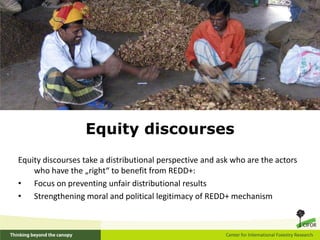
Equity discourses
Equity discourses take a distributional perspective and ask who are the actors
    who have the „right“ to benefit from REDD+:
• Focus on preventing unfair distributional results
• Strengthening moral and political legitimacy of REDD+ mechanism
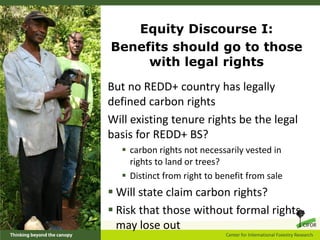
Equity Discourse I:
Benefits should go to those
     with legal rights
But no REDD+ country has legally
defined carbon rights
Will existing tenure rights be the legal
basis for REDD+ BS?
   carbon rights not necessarily vested in
    rights to land or trees?
   Distinct from right to benefit from sale
 Will state claim carbon rights?
 Risk that those without formal rights
  may lose out
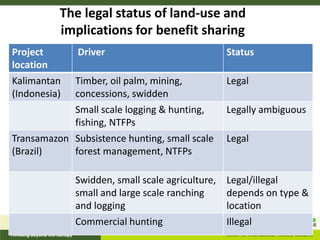
The legal status of land-use and
          implications for benefit sharing
Project       Driver                              Status
location
Kalimantan  Timber, oil palm, mining,             Legal
(Indonesia) concessions, swidden
            Small scale logging & hunting,        Legally ambiguous
            fishing, NTFPs
Transamazon Subsistence hunting, small scale      Legal
(Brazil)    forest management, NTFPs

              Swidden, small scale agriculture,   Legal/illegal
              small and large scale ranching      depends on type &
              and logging                         location
              Commercial hunting                  Illegal
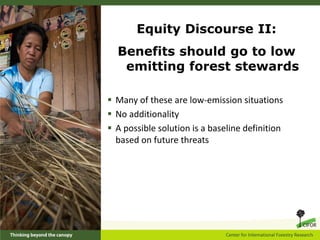
Equity Discourse II:
  Benefits should go to low
   emitting forest stewards

 Many of these are low-emission situations
 No additionality
 A possible solution is a baseline definition
  based on future threats
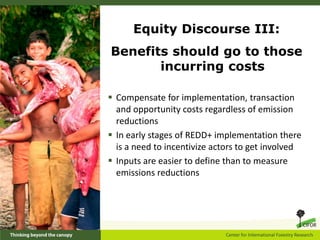
Equity Discourse III:
Benefits should go to those
       incurring costs

 Compensate for implementation, transaction
  and opportunity costs regardless of emission
  reductions
 In early stages of REDD+ implementation there
  is a need to incentivize actors to get involved
 Inputs are easier to define than to measure
  emissions reductions
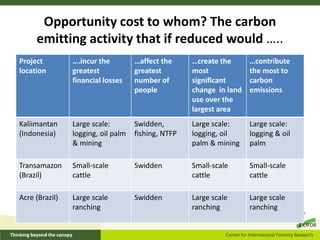
Opportunity cost to whom? The carbon
     emitting activity that if reduced would …..
Project         ….incur the         …affect the     …create the      …contribute
location        greatest            greatest        most             the most to
                financial losses    number of       significant      carbon
                                    people          change in land   emissions
                                                    use over the
                                                    largest area
Kaliimantan     Large scale:        Swidden,        Large scale:     Large scale:
(Indonesia)     logging, oil palm   fishing, NTFP   logging, oil     logging & oil
                & mining                            palm & mining    palm

Transamazon     Small-scale         Swidden         Small-scale      Small-scale
(Brazil)        cattle                              cattle           cattle

Acre (Brazil)   Large scale         Swidden         Large scale      Large scale
                ranching                            ranching         ranching
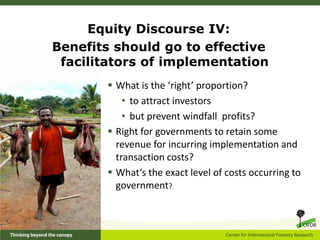
Equity Discourse IV:
Benefits should go to effective
 facilitators of implementation
        What is the ‘right’ proportion?
           • to attract investors
           • but prevent windfall profits?
        Right for governments to retain some
         revenue for incurring implementation and
         transaction costs?
        What‘s the exact level of costs occurring to
         government?
Negotiating choices:
           legitimacy of the process
 Clarify objectives of national REDD+ implementation before designing BSMs
 Clarity on objectives help to define who ‘should‘ benefit

 Lack of clarity over what is the ‘competent agency’ with these decision
  making powers
 Legitimacy of the decision needs the decision to be made by those with:
    • Legal mandate to make them
    • Adherence to due process & to procedural rights
 Requires a legitimate decision-making process and institutions
Key questions for WP5
 Who are the legitimate beneficiaries?
 Criteria
 Need to reward performance
 Liability
 What is an efficient distribution of costs?
 Property rights
 What are the structures needed for financial transfers?
 What should be the processes for decision making and
  implementation
 Oversight and monitoring
Sectors to learn from:
             some examples
- PES /CBNRM
 - Development and public administration: PFM,
  anti corruption, performance assessment
- Financial structures: fiscal transfers , subsidies,
  sovereign wealth fund etc

- Specific processes: extractive sector
 mechanisms, FLEGT, CBD, ecological taxation
REDD+ benefit sharing: discourses on who ‘should’ benefit

REDD+ benefit sharing: discourses on who ‘should’ benefit

  • 1.
    REDD+ benefit sharing: discourses on who ‘should’ benefit Cecilia Luttrell , Lasse Loft (BiK-F) , Maria Fernanda Gebara (Getulio Vargas Foundation), Demetrius Kwerka , Maria Brockhaus; William Sunderlin ; Bogor 27th Sept 2012
  • 2.
    Overview of whatwe looked at  Description of incipient BS arrangements at national and local levels  Discourses on who should benefit  Tradeoffs between objectives of REDD+  Data from GCS work on national policy processes in 6 countries and 21 projects,
  • 3.
  • 4.
    What do wemean by ‘benefit sharing’ • Benefit sharing is the distribution of direct and indirect net gains from the implementation of REDD+ • Two types of direct benefits: • Monetary gains from international and national finance related to REDD+ • Benefits associated with the increased availability of forest products & ecosystem services • Indirect benefits e.g. improved governance infrastructure provision
  • 5.
    What is aBSM • Range of institutional means: governance structures and instruments that distribute finance and other net benefits from REDD+ – Direct incentives e.g. cash transfers, PFM, ICDPs – Policy and governance processes e.g. tenure clarification, law enforcement, agricultural intensification
  • 6.
    Benefits come withcosts: net benefits are what matter • Direct financial outlays related to REDD+ (implementation and transaction costs) • Costs arising from changes in forest land and resource use (opportunity costs) • Cost recovery (compensation) vs. the surplus (REDD rent)
  • 7.
    BS proposals andpolicy at the national level National level-proposals & activities Proposals financial arrangements Brazil No national policy to date; state & sub- Public funding: Amazon Fund & Bolsa Verde; state projects define own BS arrangements ; Incl. few direct PES schemes Indonesia Min. of Forestry regulations (2009 & Contested Min of Forestry (2009) 2012) projects need to obtain regulations specifies % to gov. project ministerial approval; number of developers and communities; Presidential projects without approval Taskforce designing parallel funding mechanism Vietnam Draft REDD+ strategy: benefits to be UNREDD+ proposes a National Fund shared between communities, overseen by multi-stakeholder body; organisations and local authorities revenues according to provincial Provincial level PES trialled performance. Projects moving away from an expectation of a voluntary market
  • 8.
    REDD+ projects andtheir proposed and actual BSM in Tanzania Project Details of BSMs TFCG- Dividends paid to village member of the village (under village by-laws); up- Kilosa & front funds & individual payments based on the potential average avoided Lindi emissions per year; village assemblies decide whether to use dividends on community projects Mpingo Acquiring land certificates; boundary clarification; assistance in selling timber through FSC and land use and management plans. Originally the project planned to pass on profits to communities after deducting costs but this was controversial so now they are discussing a percentage arrangement CARE Distribution of carbon revenues will use existing village savings and loan systems. The rights to carbon will be negotiated between CARE and the community through an exisiting intermediary organisation
  • 9.
  • 10.
    Discourses on ‘who should benefit’?  There are tradeoffs involved in these choice implied by the different discourses which the implications for design of BSMs Effectiveness/efficiency vs. equity discourses  Effectiveness/efficiency = goal of emission reductions  Equity = who has the right to benefit
  • 11.
    Efficiency & Effectiveness REDD+as a mechanism for paying forest users & owners to reduce emissions: • Focus on emissions reductions • Payments as incentive for those who change in behaviour • Benefits should go to people providing these services
  • 12.
    “REDD benefits shouldreward large-scale industries/companies for reducing forest emissions” Data from CIFOR’s GCS’ policy network analysis by Maria Brockhaus (coordination), Levania Santosa & Moira Moeliano (Indonesia), Maria Fernanda Gebara & Shaozeng Zhang (Brazil)
  • 13.
    Equity discourses Equity discoursestake a distributional perspective and ask who are the actors who have the „right“ to benefit from REDD+: • Focus on preventing unfair distributional results • Strengthening moral and political legitimacy of REDD+ mechanism
  • 14.
    Equity Discourse I: Benefitsshould go to those with legal rights But no REDD+ country has legally defined carbon rights Will existing tenure rights be the legal basis for REDD+ BS?  carbon rights not necessarily vested in rights to land or trees?  Distinct from right to benefit from sale  Will state claim carbon rights?  Risk that those without formal rights may lose out
  • 15.
    The legal statusof land-use and implications for benefit sharing Project Driver Status location Kalimantan Timber, oil palm, mining, Legal (Indonesia) concessions, swidden Small scale logging & hunting, Legally ambiguous fishing, NTFPs Transamazon Subsistence hunting, small scale Legal (Brazil) forest management, NTFPs Swidden, small scale agriculture, Legal/illegal small and large scale ranching depends on type & and logging location Commercial hunting Illegal
  • 16.
    Equity Discourse II: Benefits should go to low emitting forest stewards  Many of these are low-emission situations  No additionality  A possible solution is a baseline definition based on future threats
  • 17.
    Equity Discourse III: Benefitsshould go to those incurring costs  Compensate for implementation, transaction and opportunity costs regardless of emission reductions  In early stages of REDD+ implementation there is a need to incentivize actors to get involved  Inputs are easier to define than to measure emissions reductions
  • 18.
    Opportunity cost towhom? The carbon emitting activity that if reduced would ….. Project ….incur the …affect the …create the …contribute location greatest greatest most the most to financial losses number of significant carbon people change in land emissions use over the largest area Kaliimantan Large scale: Swidden, Large scale: Large scale: (Indonesia) logging, oil palm fishing, NTFP logging, oil logging & oil & mining palm & mining palm Transamazon Small-scale Swidden Small-scale Small-scale (Brazil) cattle cattle cattle Acre (Brazil) Large scale Swidden Large scale Large scale ranching ranching ranching
  • 19.
    Equity Discourse IV: Benefitsshould go to effective facilitators of implementation  What is the ‘right’ proportion? • to attract investors • but prevent windfall profits?  Right for governments to retain some revenue for incurring implementation and transaction costs?  What‘s the exact level of costs occurring to government?
  • 20.
    Negotiating choices: legitimacy of the process  Clarify objectives of national REDD+ implementation before designing BSMs  Clarity on objectives help to define who ‘should‘ benefit  Lack of clarity over what is the ‘competent agency’ with these decision making powers  Legitimacy of the decision needs the decision to be made by those with: • Legal mandate to make them • Adherence to due process & to procedural rights  Requires a legitimate decision-making process and institutions
  • 21.
    Key questions forWP5  Who are the legitimate beneficiaries?  Criteria  Need to reward performance  Liability  What is an efficient distribution of costs?  Property rights  What are the structures needed for financial transfers?  What should be the processes for decision making and implementation  Oversight and monitoring
  • 22.
    Sectors to learnfrom: some examples - PES /CBNRM - Development and public administration: PFM, anti corruption, performance assessment - Financial structures: fiscal transfers , subsidies, sovereign wealth fund etc - Specific processes: extractive sector mechanisms, FLEGT, CBD, ecological taxation