GLOBAL EXPERT WORKSHOP ON
    BIODIVERSITY BENEFITS OF REDD+ IN
         DEVELOPING COUNTRIES


   REDD READINESS ACTIVITIES IN KENYA
   AND ROLE IN TACKLING BIODIVERSITY
            CONSERVATION
Kefa M. Wamichwe
Kenya Forest Service
kmwamichwe@yahoo.com or
kmwamichwe@kenyaforestservice.org
Kenya Country Profile

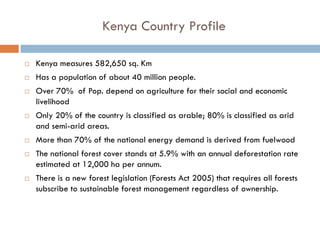
Kenya measures 582,650 sq. Km
Has a population of about 40 million people.
Over 70% of Pop. depend on agriculture for their social and economic
livelihood
Only 20% of the country is classified as arable; 80% is classified as arid
and semi-arid areas.
More than 70% of the national energy demand is derived from fuelwood
The national forest cover stands at 5.9% with an annual deforestation rate
estimated at 12,000 ha per annum.
There is a new forest legislation (Forests Act 2005) that requires all forests
subscribe to sustainable forest management regardless of ownership.
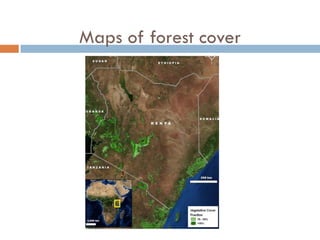
Maps of forest cover
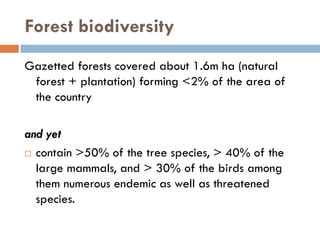
Kenya’s Forest administration
 Coast
 North Eastern
 Ewaso North
 Eastern
 Nairobi
 Central Highlands
 Mau
 North Rift
 Western
 Nyanza
Forest biodiversity
Gazetted forests covered about 1.6m ha (natural
 forest + plantation) forming <2% of the area of
 the country

and yet
  contain >50% of the tree species, > 40% of the
  large mammals, and > 30% of the birds among
  them numerous endemic as well as threatened
  species.
REDD readiness activities in Kenya

 Kenya with support from the FCPF started the process of
 preparing a readiness package through a multi-stakeholder,
 multi-institutional process.
 A Participation Agreement between GOK and PC signed
 A Grant Agreement between GOK and WB was signed to
 support development of the Readiness Plan Proposal (RPP).
 A multi-sectoral REDD- Technical Working Group established
 Process of establishing a Steering Committee initiated
 Process of formulating the REDD Preparation Proposal that will
 inform the other phases finalized and fowarded to FCPF.
 A consultation and participation plan developed and
 5regional consultation workshop held of which one focused on
 indigenous communities
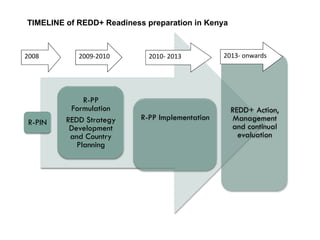
TIMELINE of REDD+ Readiness preparation in Kenya


2008        2009‐2010        2010‐ 2013          2013‐ onwards


              R-PP
          Formulation                              REDD+ Action,
         REDD Strategy     R-PP Implementation     Management
R-PIN                                              and continual
          Development
          and Country                                evaluation
            Planning
Key steps towards implementation of RPP

 Detailed analysis of policies relevant for REDD+ (e.g. forest, agriculture,
 infrastructure policies), legal and technical requirements for different
 policies and measures
 Setting of the Reference Emissions Level (REL)
 Confirmation of institutional roles, responsibilities and oversight for REDD+
 arrangements
 Nomination or establishment of one or several entities responsible for MRV
 Selection of potential REDD+ early action and testing activities
 Continued consultation, information sharing and awareness raising on
 REDD+ strategy, legislative and institutional proposals
 Finalization of REDD+ strategy (to progress towards REDD+ readiness)
Key drivers for deforestation and forest
degradation in Kenya identified through
R-PP process

Several socio-economic factors contribute to Kenya’s loss of
  forest:
  Pressure for expansion of agricultural land, settlement and
  development,
  Unsustainable utilization of forest resources,
  High dependence on wood energy for lighting and domestic
  consumption especially firewood and charcoal
  Overgrazing and Forest Fires,
  Institutional failures arising from weak governance structures,
  inadequate capacity to enforce the law and lack of real
  stakeholder participation forest management.
Proposed interventions

1.   Strict protection of water catchment forests Mt. Elgon and
     Cherangany, Aberdare, Mt. Kenya, Mau Complex
2.   improved stoves & other energy conservation technologies
3.   Promotion of nature based micro enterprises
4.   Institutional strengthening to enhance sustainable management
5.   Public education and awareness
6.   Improvement on fire monitoring and management
7.   Provision of incentives, particularly payment for environmental
     services and tax holidays / tax rebates
8.   Incentives to promote efficiency in forest resource utilization
9.   Supporting afforestation and reforestation to reduce the current
     national timber deficit
Benefit sharing
 The new policy and legislation introduces provision for
 empowerment of communities in forest management and
 equitable sharing of benefits through the Community Forest
 Associations (CFAs),
   Aimed at improving livelihoods by increasing the benefits of
   forests and thereby reducing the pressures on forests.

 Benefit sharing arrangements are being discussed between
 KFS and communities but are not finalized.
   The benefits include access to firewood and other wood and non
   wood resources in forests and participation in taungya system
   The new arrangements support sustainable forest management
   (SFM) which brings greater social and environmental benefits as
   well as resulting in higher carbon stock in forests.
Climate Change initiatives with multiple
benefit
1. The Green Belt Movement currently coordinating a community
   based reforestation of 1,800 ha of Mt. Kenya and
   Aberdares ecosystems
2. Farmers around Mt. Kenya & Laikipia Districts implementing
   carbon financed farm forestry reforestation programme.
3. Afforestation and reforestation activities in Kikuyu escarpment
   by a community forest association covering 300 ha
4. KFS and partners supporting community afforestation prog of
   500 ha in Kakamega forest as a carbon offset project
5. Development of a REDD project in Rukinga Wildlife sanctuary
   in coast province covering 30,000 ha
Investing in water Tower forests
 The Government has already embarked on a massive
 restoration programme for the Mau ecosystem but would
 benefit greatly from the carbon markets to supplement local
 resources.
 Mau ecosystem, the biggest in the country covers approximately
 400,000 ha.
 It is estimated the complex lost 67,000 ha to deforestation
 between 2000 to 2005
 This is the area the government is keen on reclaiming and
 rehabilitation and securing for environmental conservation
 including climate change mitigation
 This area is particularly very promising for establishing REDD
 demonstration activities and which can be replicated in other
 water towers.
Key challenges
  Forest assessments to establish an emission reference
  scenario; the baseline accounting for carbon leakage,
  as well as for biodiversity leakage
  Establishing a monitoring system for emissions, emission
  reductions -Forest resource assessments and monitoring and
  verification of carbon stocks
  Generating synergies in support of REDD activities
  across the stakeholder spectrum
  Enlisting formal support across the government to
  facilitate and entrench cross-sectoral collaboration.
  Development of benefit sharing framework
END

ASANTE SANA

Presentation cbd

  • 1.
    GLOBAL EXPERT WORKSHOPON BIODIVERSITY BENEFITS OF REDD+ IN DEVELOPING COUNTRIES REDD READINESS ACTIVITIES IN KENYA AND ROLE IN TACKLING BIODIVERSITY CONSERVATION Kefa M. Wamichwe Kenya Forest Service kmwamichwe@yahoo.com or kmwamichwe@kenyaforestservice.org
  • 2.
    Kenya Country Profile Kenyameasures 582,650 sq. Km Has a population of about 40 million people. Over 70% of Pop. depend on agriculture for their social and economic livelihood Only 20% of the country is classified as arable; 80% is classified as arid and semi-arid areas. More than 70% of the national energy demand is derived from fuelwood The national forest cover stands at 5.9% with an annual deforestation rate estimated at 12,000 ha per annum. There is a new forest legislation (Forests Act 2005) that requires all forests subscribe to sustainable forest management regardless of ownership.
  • 3.
  • 4.
    Kenya’s Forest administration Coast North Eastern Ewaso North Eastern Nairobi Central Highlands Mau North Rift Western Nyanza
  • 5.
    Forest biodiversity Gazetted forestscovered about 1.6m ha (natural forest + plantation) forming <2% of the area of the country and yet contain >50% of the tree species, > 40% of the large mammals, and > 30% of the birds among them numerous endemic as well as threatened species.
  • 6.
    REDD readiness activitiesin Kenya Kenya with support from the FCPF started the process of preparing a readiness package through a multi-stakeholder, multi-institutional process. A Participation Agreement between GOK and PC signed A Grant Agreement between GOK and WB was signed to support development of the Readiness Plan Proposal (RPP). A multi-sectoral REDD- Technical Working Group established Process of establishing a Steering Committee initiated Process of formulating the REDD Preparation Proposal that will inform the other phases finalized and fowarded to FCPF. A consultation and participation plan developed and 5regional consultation workshop held of which one focused on indigenous communities
  • 7.
    TIMELINE of REDD+Readiness preparation in Kenya 2008 2009‐2010 2010‐ 2013 2013‐ onwards R-PP Formulation REDD+ Action, REDD Strategy R-PP Implementation Management R-PIN and continual Development and Country evaluation Planning
  • 8.
    Key steps towardsimplementation of RPP Detailed analysis of policies relevant for REDD+ (e.g. forest, agriculture, infrastructure policies), legal and technical requirements for different policies and measures Setting of the Reference Emissions Level (REL) Confirmation of institutional roles, responsibilities and oversight for REDD+ arrangements Nomination or establishment of one or several entities responsible for MRV Selection of potential REDD+ early action and testing activities Continued consultation, information sharing and awareness raising on REDD+ strategy, legislative and institutional proposals Finalization of REDD+ strategy (to progress towards REDD+ readiness)
  • 9.
    Key drivers fordeforestation and forest degradation in Kenya identified through R-PP process Several socio-economic factors contribute to Kenya’s loss of forest: Pressure for expansion of agricultural land, settlement and development, Unsustainable utilization of forest resources, High dependence on wood energy for lighting and domestic consumption especially firewood and charcoal Overgrazing and Forest Fires, Institutional failures arising from weak governance structures, inadequate capacity to enforce the law and lack of real stakeholder participation forest management.
  • 10.
    Proposed interventions 1. Strict protection of water catchment forests Mt. Elgon and Cherangany, Aberdare, Mt. Kenya, Mau Complex 2. improved stoves & other energy conservation technologies 3. Promotion of nature based micro enterprises 4. Institutional strengthening to enhance sustainable management 5. Public education and awareness 6. Improvement on fire monitoring and management 7. Provision of incentives, particularly payment for environmental services and tax holidays / tax rebates 8. Incentives to promote efficiency in forest resource utilization 9. Supporting afforestation and reforestation to reduce the current national timber deficit
  • 11.
    Benefit sharing Thenew policy and legislation introduces provision for empowerment of communities in forest management and equitable sharing of benefits through the Community Forest Associations (CFAs), Aimed at improving livelihoods by increasing the benefits of forests and thereby reducing the pressures on forests. Benefit sharing arrangements are being discussed between KFS and communities but are not finalized. The benefits include access to firewood and other wood and non wood resources in forests and participation in taungya system The new arrangements support sustainable forest management (SFM) which brings greater social and environmental benefits as well as resulting in higher carbon stock in forests.
  • 12.
    Climate Change initiativeswith multiple benefit 1. The Green Belt Movement currently coordinating a community based reforestation of 1,800 ha of Mt. Kenya and Aberdares ecosystems 2. Farmers around Mt. Kenya & Laikipia Districts implementing carbon financed farm forestry reforestation programme. 3. Afforestation and reforestation activities in Kikuyu escarpment by a community forest association covering 300 ha 4. KFS and partners supporting community afforestation prog of 500 ha in Kakamega forest as a carbon offset project 5. Development of a REDD project in Rukinga Wildlife sanctuary in coast province covering 30,000 ha
  • 13.
    Investing in waterTower forests The Government has already embarked on a massive restoration programme for the Mau ecosystem but would benefit greatly from the carbon markets to supplement local resources. Mau ecosystem, the biggest in the country covers approximately 400,000 ha. It is estimated the complex lost 67,000 ha to deforestation between 2000 to 2005 This is the area the government is keen on reclaiming and rehabilitation and securing for environmental conservation including climate change mitigation This area is particularly very promising for establishing REDD demonstration activities and which can be replicated in other water towers.
  • 14.
    Key challenges Forest assessments to establish an emission reference scenario; the baseline accounting for carbon leakage, as well as for biodiversity leakage Establishing a monitoring system for emissions, emission reductions -Forest resource assessments and monitoring and verification of carbon stocks Generating synergies in support of REDD activities across the stakeholder spectrum Enlisting formal support across the government to facilitate and entrench cross-sectoral collaboration. Development of benefit sharing framework
  • 15.