CIFOR’S REDD+ Research
Louis Verchot
A NATURAL EVOLUTON FOR REDD+
The Gartner hype cycle: How do technology firms look at these things?
Early
inception
Quick,
cheap, and
easy
COP21
decisions?
Finance
fails to
materialize
No new
projects
2015-2020
experiences?
Post-2020
Seeing REDD+ through the lens of 4 I’s
Political
Econom
y
lens
6 countries have comprehensive
policies targeting transformational
change for REDD+: Brazil, DRC,
Guyana, Indonesia, Tanzania and
Vietnam.
The critical issues that hinder
countries in achieving REDD+ are
related to policy implementation:
lack of grievance procedures and
lack of operationalized financial
systems.
Analysis Of 13 National REDD+ Programs
Of the six successful cases three
have access to performance-based
finance for REDD+.
Availability of performance based
funds has a positive impact when it
is combined with strong national
ownership of the REDD+ process.
Analysis Of 13 National REDD+ Programs
In cases where national ownership
is low, (donors or other external
agencies dominate the REDD+
policy processes) countries can
achieve the outcome without
performance-based funding.
Where REDD+ commitment is
externally driven, non-performance-
based funding has an effect equal to
that of performance-based funding.
Analysis Of 13 National REDD+ Programs
6 countries - 23 subnational REDD+ initiatives
190 villages – 4,500 households
Mix of forest interventions at sampled sites
Brazil
Peru
Cameroon
Tanzania
Indonesia
Vietnam
010203040506070
enabling conditions disincentives incentives
#interventions
Local participation in REDD+
Villages
Women'sgroups
Households
050100
Knowledge of REDD+ initiative
2010 2014
%respondents
Villages
Women'sgroups
Households
050100
Participation in REDD+ initiative
Multiple levels of governance
 REDD+ is now moving toward “nested, jurisdictional” and other “national”
approaches
 REDD+ requires coordination across levels: finance and benefit sharing,
carbon monitoring and verification systems, land tenure and titling policies,
safeguards, and so on.
 All of this requires integrating notions of power:
 Despite diverse legal and decentralization systems , powerful actors with a
stake in deforestation often figure out how to get their way –using or
circumventing the rules.
 Most (REDD+ and REDD-like) efforts are trying to change the behavior of
the weaker actors.
 Political will and coalitions for change are indispensable for advancing
REDD+ and low emissions development.
MRVcapacitychange
Erika Romijn,
Martin Herold
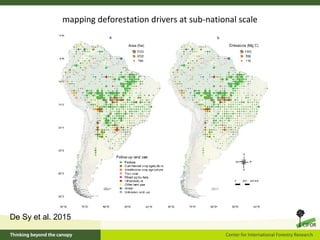
mapping deforestation drivers at sub-national scale
De Sy et al. 2015
2008
2012
2009
CIFOR’s edited volumes on
REDD 2015

CIFOR's REDD+ research

  • 1.
  • 2.
    A NATURAL EVOLUTONFOR REDD+ The Gartner hype cycle: How do technology firms look at these things? Early inception Quick, cheap, and easy COP21 decisions? Finance fails to materialize No new projects 2015-2020 experiences? Post-2020
  • 3.
    Seeing REDD+ throughthe lens of 4 I’s Political Econom y lens
  • 4.
    6 countries havecomprehensive policies targeting transformational change for REDD+: Brazil, DRC, Guyana, Indonesia, Tanzania and Vietnam. The critical issues that hinder countries in achieving REDD+ are related to policy implementation: lack of grievance procedures and lack of operationalized financial systems. Analysis Of 13 National REDD+ Programs
  • 5.
    Of the sixsuccessful cases three have access to performance-based finance for REDD+. Availability of performance based funds has a positive impact when it is combined with strong national ownership of the REDD+ process. Analysis Of 13 National REDD+ Programs
  • 6.
    In cases wherenational ownership is low, (donors or other external agencies dominate the REDD+ policy processes) countries can achieve the outcome without performance-based funding. Where REDD+ commitment is externally driven, non-performance- based funding has an effect equal to that of performance-based funding. Analysis Of 13 National REDD+ Programs
  • 7.
    6 countries -23 subnational REDD+ initiatives 190 villages – 4,500 households
  • 8.
    Mix of forestinterventions at sampled sites Brazil Peru Cameroon Tanzania Indonesia Vietnam 010203040506070 enabling conditions disincentives incentives #interventions
  • 9.
    Local participation inREDD+ Villages Women'sgroups Households 050100 Knowledge of REDD+ initiative 2010 2014 %respondents Villages Women'sgroups Households 050100 Participation in REDD+ initiative
  • 10.
    Multiple levels ofgovernance  REDD+ is now moving toward “nested, jurisdictional” and other “national” approaches  REDD+ requires coordination across levels: finance and benefit sharing, carbon monitoring and verification systems, land tenure and titling policies, safeguards, and so on.  All of this requires integrating notions of power:  Despite diverse legal and decentralization systems , powerful actors with a stake in deforestation often figure out how to get their way –using or circumventing the rules.  Most (REDD+ and REDD-like) efforts are trying to change the behavior of the weaker actors.  Political will and coalitions for change are indispensable for advancing REDD+ and low emissions development.
  • 11.
  • 12.
    mapping deforestation driversat sub-national scale De Sy et al. 2015
  • 13.

Editor's Notes

  • #2 Layout: Title Slide Variation: none <number>
  • #3 Source: https://en.wikipedia.org/wiki/File:Hype-Cycle-General.png <number>
  • #4 How the 4 I’s hinder or enable change Institutions Formal power rests with ‘stickiest’ organisations – those with enough influence to resist change E.g. colonial rules new institutions and actors are often ignored or remain isolated E.g. Ministries for natural resources Interests State’s interest in social and economic welfare can fall short if not autonomous from interests that drive deforestation and degradation rent seeking, fraud, collusion and corruption practices in the bureaucratic system Ideas discourse affects policy making it frames the problem and presents limited choices of ‘reasonable’ or ‘possible’ REDD+ benefits for those who contribute to efficiency and effectiveness, versus benefits for those who have moral rights based on equity considerations Information Facts are selected, interpreted, and put in context in ways that reflect the interests of the information provider reference level setting (from Maria‘s slides) Maria: the 4 Is is not a method but it is a political economy lens on the underlying problem, or if you want to say so, a baseline study combined with a theory of change in REDD+ terms <number>
  • #8 <number>
  • #9 In absence of a substantial funding stream to pay the opportunity costs of forest conservation (via conditional rewards), REDD+ cannot compete with conversion of forest to other uses. Many REDD+ initiatives are actually a continuation of pre-existing ICDPs operating at the same site. That is why what is now called “REDD+ on the ground” is dominated by classic forest interventions: enabling conditions (tenure clarification, environmental education), disincentives (e.g. environmental fines), incentives (livelihood enhancements that are only in some cases conditional) <number>
  • #10 Improved local knowledge of initiatives – especially among women’s groups and households at the study sites – but participation in REDD+ still lacking, especially among women <number>