What Works and What Doesn’t?
Introducing CIFOR’s
Benefit Sharing Knowledge Tool
Cecilia Luttrell, Grace Wong, Anne Larson, Michelle
Kovacevic, Annie Yang, Sven Wunder,
Maria Brockhaus, Imogen Badgery-Parker, Lasse
Loft, Pham Thuy, Januarti Tjajadi,
Ani Nawir, Naya Paudel
Asia Pacific Forestry Week
February 24th 2016, Clark, Philippines
Session on
“Getting a fair share in the benefits derived from forests: Approaches and Tools”
Organized by the Non-Timber Forest Products Exchange Programme-Asia (NTFP-EP Asia) in
cooperation with the Asian Farmers Association
for Sustainable Rural Development (AFA) and the Asia Indigenous Peoples
CIFOR’s REDD+
Benefit Sharing Project
 Focal countries: Brazil, Peru, Cameroon,
Tanzania, Indonesia, Vietnam
 EU funded. Builds on and complements work
ongoing in CIFOR’s Global Comparative Study on
REDD+.
 Structured as seven interlinked work packages
that together will generate evidence-based policy
options framed by political-economic context in
six focal countries
 Covering: national/project costs, multi-level
governance rights, gender etc
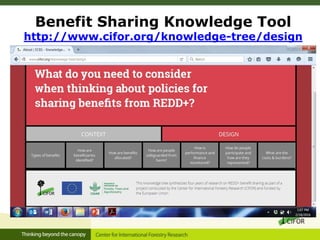
Benefit Sharing Knowledge Tool
http://www.cifor.org/knowledge-tree/design
http://www.cifor.org/knowledge-
tree/design
 Insert video here
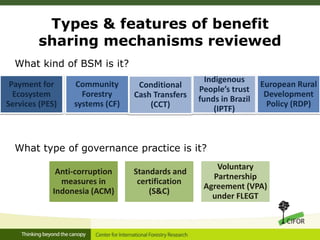
Types & features of benefit
sharing mechanisms reviewed
What kind of BSM is it?
What type of governance practice is it?
Payment for
Ecosystem
Services (PES)
Community
Forestry
systems (CF)
Conditional
Cash Transfers
(CCT)
Indigenous
People’s trust
funds in Brazil
(IPTF)
European Rural
Development
Policy (RDP)
Anti-corruption
measures in
Indonesia (ACM)
Standards and
certification
(S&C)
Voluntary
Partnership
Agreement (VPA)
under FLEGT
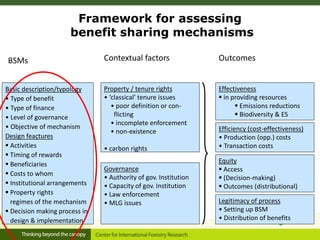
Framework for assessing
benefit sharing mechanisms
Basic description/typology
• Type of benefit
• Type of finance
• Level of governance
• Objective of mechanism
Design feaçtures
 Activities
 Timing of rewards
 Beneficiaries
 Costs to whom
 Institutional arrangements
 Property rights
regimes of the mechanism
 Decision making process in
design & implementation
BSMs Contextual factors Outcomes
Governance
• Authority of gov. Institution
• Capacity of gov. Institution
• Law enforcement
• MLG issues
Effectiveness
 in providing resources
 Emissions reductions
 Biodiversity & ES
Property / tenure rights
• ‘classical’ tenure issues
• poor definition or con-
flicting
• incomplete enforcement
• non-existence
• carbon rights
Efficiency (cost-effectiveness)
• Production (opp.) costs
• Transaction costs
Equity
 Access
 (Decision-making)
 Outcomes (distributional)
Legitimacy of process
• Setting up BSM
• Distribution of benefits
Operationalizing equity (1)
a) Techniques for assessing and
recognizing the level of costs and to
whom they are accruing
- periodic review of producer costs
(Fairtrade)
b) Setting fair and minimum payments
- reduces risk; but needs consultation
with buyers
Operationalizing equity (2)
a)Establishing phased and upfront payments
- also need to make sure financial
incentives are maintained till end – (Plan
Vivo)
d) Paying attention to the type of benefit
• A focus on development activities and in
kind benefits
• The pros and cons of cash
• Securing of rights
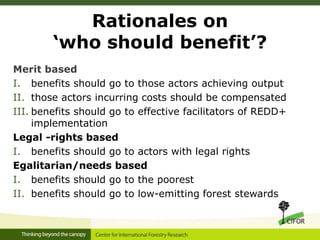
Rationales on
‘who should benefit’?
Merit based
I. benefits should go to those actors achieving output
II. those actors incurring costs should be compensated
III. benefits should go to effective facilitators of REDD+
implementation
Legal -rights based
I. benefits should go to actors with legal rights
Egalitarian/needs based
I. benefits should go to the poorest
II. benefits should go to low-emitting forest stewards
Clarifying objectives: process is
important
Clarity on REDD objectives and thus the
rationale to be followed
Legitimacy of the decision needs the decision to
be made by those with:
• Legal mandate to make them
• Adherence to due process & to procedural
rights
Legitimacy vs urgency?
Is it too early to think about the
detailed design of BSMs before
fundamental questions such as
authority and tenure have been
resolved?
Or is the urgency so great that ad-
hoc solutions need to be found to
deal with sub-optimal policy
contexts?
Thank you!
http://www.cifor.org/redd-benefit-sharing/
With co-financing from:
The CIFOR REDD+ Benefit Sharing project is supported by:
With co-financing from:
The CIFOR REDD+ Benefit Sharing project is funded by:
REDD+ Benefit Sharing research team:
Grace Wong, Sven Wunder, William Sunderlin, Anne Larson, Esther Mwangi, Imogen Badgery-
Parker, Maria Brockhaus, Cecilia Luttrell, Pham Thu Thuy, Samuel Assembe-Mvondo, Le Ngoc Dung,
Annie Yang, Shintia Arwida, Januarti Tjajadi, Ashwin Ravikumar, Jazmin Gonzales, Eduardo Marinho,
Ani Nawir, Jan Boerner, Lasse Loft, Erin Sills, Krister Andersson, Naya Paudel, Maria Fernandes
Gebara, Peter May, Rodd Myers, Laura Kowler, Anna Sanders, Martin Kijazi, Sofi Mardiah, Vu Tan
Phuong, Thang Manh Le, Dan Cooney, Adinda Hassan, Cynthia Maharani, Demetrius Kweka, Noah
Greenberg, Christopher Martius
Key CIFOR papers on Benefit Sharing
 Assembe, S. et al. 2013. Assessment of the effectiveness, efficiency and equity of benefit
sharing schemes under large-scale agriculture: Lessons from land fees in Cameroon, European
Journal of Development Research.
 Arwida S. et al. 2015 Lessons from anti-corruption measures in Indonesia. InfoBrief 120.
 Gebara MF. et al. 2014. Lessons from local environmental funds for REDD+ benefit sharing with
indigenous people in Brazil. InfoBrief 98.
 Kowler LF. et al. 2014. The legitimacy of multilevel governance structures for benefit sharing:
REDD+ and other low emissions options in Peru. InfoBrief 101.
 Loft L. et al. 2014. Lessons from payments for ecosystem services for REDD+ benefit-sharing
mechanisms. InfoBrief 68.
 Loft, L. et al. (2015) Taking stock of carbon rights in REDD+ candidate countries: Concept meets
reality. Forests 6:1031-1060.
 Luttrell et al. 2013. Who should benefit from REDD+? Rationales and realities. Ecology and
Society 18(4): 52.
 Myers, R. et al. 2015. A comparative study of 10 land use change case studies in Indonesia.
InfoBrief 18
 Myers, R. et al. 2014. Who holds power in land use decisions? Implications for REDD+ in
Indonesia. InfoBrief 100.
 Nawir A. et al. (2015) Lessons from community forestry in Nepal and Indonesia, InfoBrief 112.
 Pham T.T. et al. (2013). Approaches to benefit sharing: A preliminary comparative analysis of 13
REDD+ countries. Working Paper 108..
 Pham T.T. et al. (2014). Local preferences and strategies for effective, efficient and equitable PES
benefit distribution options in Vietnam: Lessons for REDD+. Human Ecology.
 Tjajadi, J. et al. 2015 Lessons from environmental and social sustainability certification
standards. InfoBrief 119.
 Wong G. (2014). The experience of conditional cash transfers: Lessons for REDD+ benefit
sharing. InfoBrief 97.
 Yang, A. (2015)) Lessons from Scotland’s Rural Development Policy.

What Works and What Doesn't? Introducing CIFOR's Benefit Sharing Knowledge Tool

  • 1.
    What Works andWhat Doesn’t? Introducing CIFOR’s Benefit Sharing Knowledge Tool Cecilia Luttrell, Grace Wong, Anne Larson, Michelle Kovacevic, Annie Yang, Sven Wunder, Maria Brockhaus, Imogen Badgery-Parker, Lasse Loft, Pham Thuy, Januarti Tjajadi, Ani Nawir, Naya Paudel Asia Pacific Forestry Week February 24th 2016, Clark, Philippines Session on “Getting a fair share in the benefits derived from forests: Approaches and Tools” Organized by the Non-Timber Forest Products Exchange Programme-Asia (NTFP-EP Asia) in cooperation with the Asian Farmers Association for Sustainable Rural Development (AFA) and the Asia Indigenous Peoples
  • 2.
    CIFOR’s REDD+ Benefit SharingProject  Focal countries: Brazil, Peru, Cameroon, Tanzania, Indonesia, Vietnam  EU funded. Builds on and complements work ongoing in CIFOR’s Global Comparative Study on REDD+.  Structured as seven interlinked work packages that together will generate evidence-based policy options framed by political-economic context in six focal countries  Covering: national/project costs, multi-level governance rights, gender etc
  • 3.
    Benefit Sharing KnowledgeTool http://www.cifor.org/knowledge-tree/design
  • 4.
  • 5.
    Types & featuresof benefit sharing mechanisms reviewed What kind of BSM is it? What type of governance practice is it? Payment for Ecosystem Services (PES) Community Forestry systems (CF) Conditional Cash Transfers (CCT) Indigenous People’s trust funds in Brazil (IPTF) European Rural Development Policy (RDP) Anti-corruption measures in Indonesia (ACM) Standards and certification (S&C) Voluntary Partnership Agreement (VPA) under FLEGT
  • 6.
    Framework for assessing benefitsharing mechanisms Basic description/typology • Type of benefit • Type of finance • Level of governance • Objective of mechanism Design feaçtures  Activities  Timing of rewards  Beneficiaries  Costs to whom  Institutional arrangements  Property rights regimes of the mechanism  Decision making process in design & implementation BSMs Contextual factors Outcomes Governance • Authority of gov. Institution • Capacity of gov. Institution • Law enforcement • MLG issues Effectiveness  in providing resources  Emissions reductions  Biodiversity & ES Property / tenure rights • ‘classical’ tenure issues • poor definition or con- flicting • incomplete enforcement • non-existence • carbon rights Efficiency (cost-effectiveness) • Production (opp.) costs • Transaction costs Equity  Access  (Decision-making)  Outcomes (distributional) Legitimacy of process • Setting up BSM • Distribution of benefits
  • 7.
    Operationalizing equity (1) a)Techniques for assessing and recognizing the level of costs and to whom they are accruing - periodic review of producer costs (Fairtrade) b) Setting fair and minimum payments - reduces risk; but needs consultation with buyers
  • 8.
    Operationalizing equity (2) a)Establishingphased and upfront payments - also need to make sure financial incentives are maintained till end – (Plan Vivo) d) Paying attention to the type of benefit • A focus on development activities and in kind benefits • The pros and cons of cash • Securing of rights
  • 9.
    Rationales on ‘who shouldbenefit’? Merit based I. benefits should go to those actors achieving output II. those actors incurring costs should be compensated III. benefits should go to effective facilitators of REDD+ implementation Legal -rights based I. benefits should go to actors with legal rights Egalitarian/needs based I. benefits should go to the poorest II. benefits should go to low-emitting forest stewards
  • 10.
    Clarifying objectives: processis important Clarity on REDD objectives and thus the rationale to be followed Legitimacy of the decision needs the decision to be made by those with: • Legal mandate to make them • Adherence to due process & to procedural rights
  • 11.
    Legitimacy vs urgency? Isit too early to think about the detailed design of BSMs before fundamental questions such as authority and tenure have been resolved? Or is the urgency so great that ad- hoc solutions need to be found to deal with sub-optimal policy contexts?
  • 12.
    Thank you! http://www.cifor.org/redd-benefit-sharing/ With co-financingfrom: The CIFOR REDD+ Benefit Sharing project is supported by:
  • 13.
    With co-financing from: TheCIFOR REDD+ Benefit Sharing project is funded by: REDD+ Benefit Sharing research team: Grace Wong, Sven Wunder, William Sunderlin, Anne Larson, Esther Mwangi, Imogen Badgery- Parker, Maria Brockhaus, Cecilia Luttrell, Pham Thu Thuy, Samuel Assembe-Mvondo, Le Ngoc Dung, Annie Yang, Shintia Arwida, Januarti Tjajadi, Ashwin Ravikumar, Jazmin Gonzales, Eduardo Marinho, Ani Nawir, Jan Boerner, Lasse Loft, Erin Sills, Krister Andersson, Naya Paudel, Maria Fernandes Gebara, Peter May, Rodd Myers, Laura Kowler, Anna Sanders, Martin Kijazi, Sofi Mardiah, Vu Tan Phuong, Thang Manh Le, Dan Cooney, Adinda Hassan, Cynthia Maharani, Demetrius Kweka, Noah Greenberg, Christopher Martius
  • 14.
    Key CIFOR paperson Benefit Sharing  Assembe, S. et al. 2013. Assessment of the effectiveness, efficiency and equity of benefit sharing schemes under large-scale agriculture: Lessons from land fees in Cameroon, European Journal of Development Research.  Arwida S. et al. 2015 Lessons from anti-corruption measures in Indonesia. InfoBrief 120.  Gebara MF. et al. 2014. Lessons from local environmental funds for REDD+ benefit sharing with indigenous people in Brazil. InfoBrief 98.  Kowler LF. et al. 2014. The legitimacy of multilevel governance structures for benefit sharing: REDD+ and other low emissions options in Peru. InfoBrief 101.  Loft L. et al. 2014. Lessons from payments for ecosystem services for REDD+ benefit-sharing mechanisms. InfoBrief 68.  Loft, L. et al. (2015) Taking stock of carbon rights in REDD+ candidate countries: Concept meets reality. Forests 6:1031-1060.  Luttrell et al. 2013. Who should benefit from REDD+? Rationales and realities. Ecology and Society 18(4): 52.  Myers, R. et al. 2015. A comparative study of 10 land use change case studies in Indonesia. InfoBrief 18  Myers, R. et al. 2014. Who holds power in land use decisions? Implications for REDD+ in Indonesia. InfoBrief 100.  Nawir A. et al. (2015) Lessons from community forestry in Nepal and Indonesia, InfoBrief 112.  Pham T.T. et al. (2013). Approaches to benefit sharing: A preliminary comparative analysis of 13 REDD+ countries. Working Paper 108..  Pham T.T. et al. (2014). Local preferences and strategies for effective, efficient and equitable PES benefit distribution options in Vietnam: Lessons for REDD+. Human Ecology.  Tjajadi, J. et al. 2015 Lessons from environmental and social sustainability certification standards. InfoBrief 119.  Wong G. (2014). The experience of conditional cash transfers: Lessons for REDD+ benefit sharing. InfoBrief 97.  Yang, A. (2015)) Lessons from Scotland’s Rural Development Policy.