Shaik Nayeem
Engineering Mechanics
Introduction: Derived Laws and System of
forces
1
Shaik Nayeem
• Derived Laws
• Triangle Law of Forces
• Polygon law of forces
• Units in Mechanics
• System of Forces
• Idealisations in Mechanics
Contents
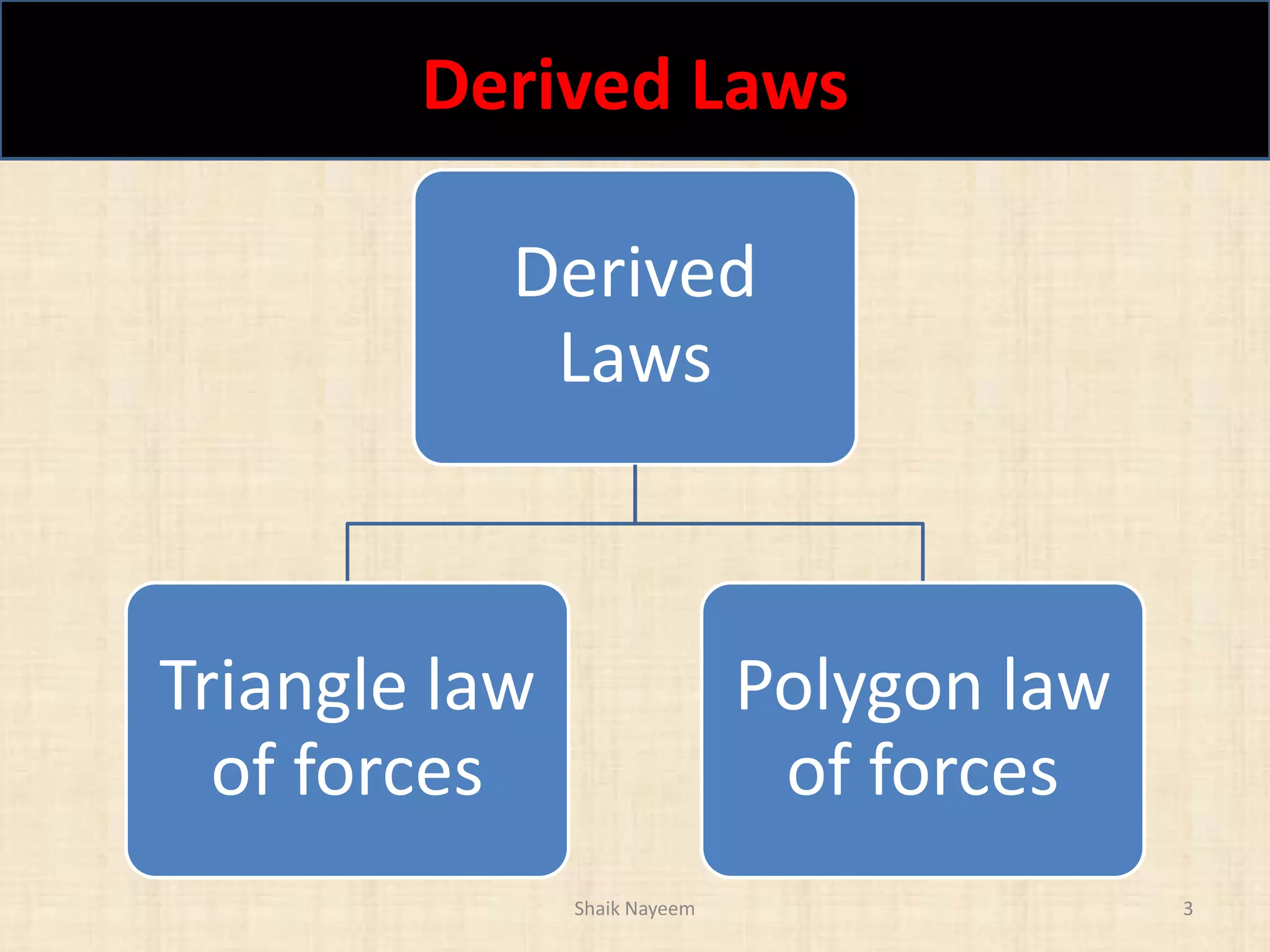
Derived Laws
Shaik Nayeem 3
Derived
Laws
Triangle law
of forces
Polygon law
of forces
Triangle Law of Forces
Shaik Nayeem 4
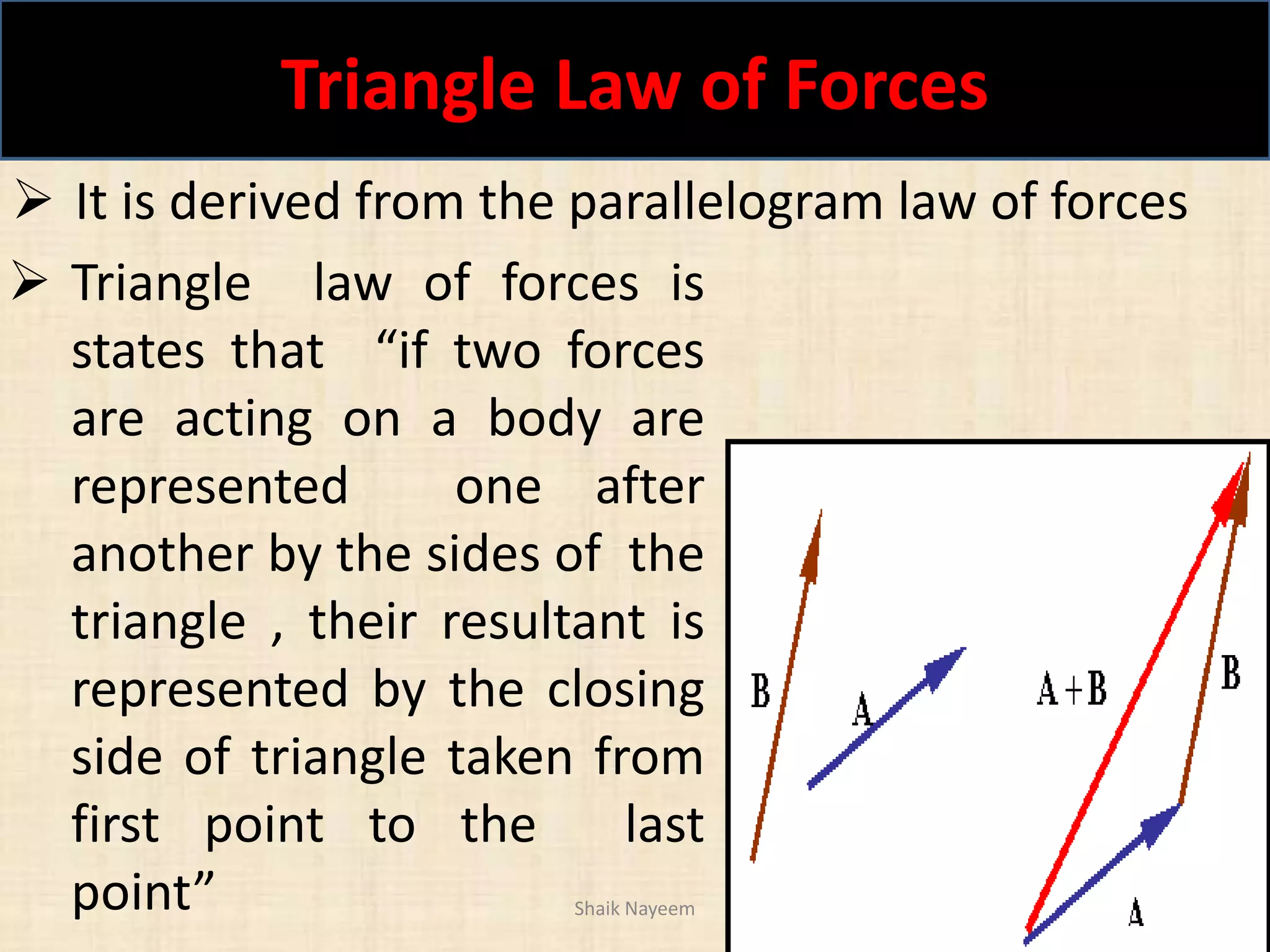
 It is derived from the parallelogram law of forces
 Triangle law of forces is
states that “if two forces
are acting on a body are
represented one after
another by the sides of the
triangle , their resultant is
represented by the closing
side of triangle taken from
first point to the last
point”
Polygon law of forces
Shaik Nayeem 5
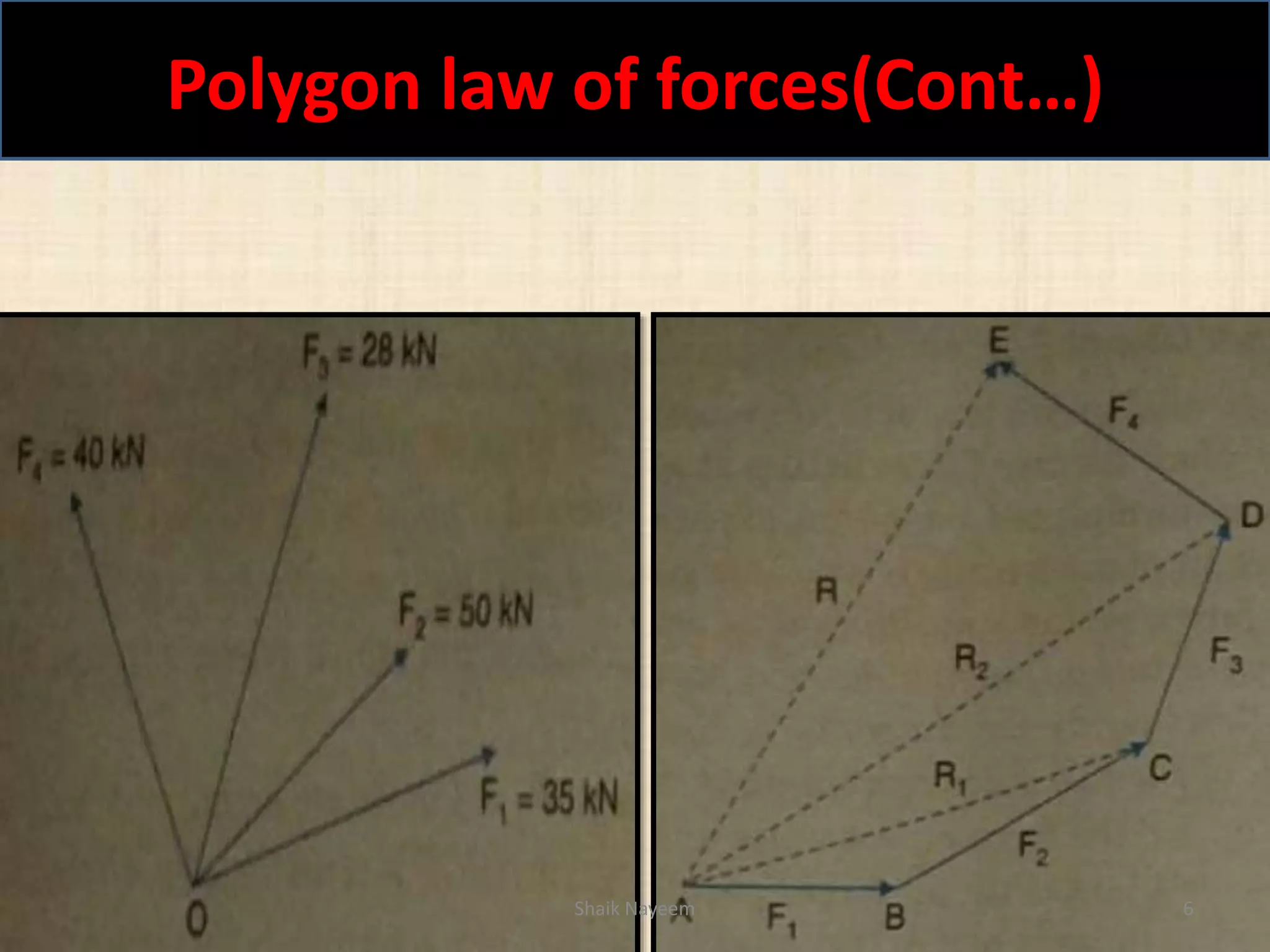
 States that “if number of concurrent forces acting
simultaneously on a body are represented in
magnitude and direction by the sides of the
polygon, taken in order, then the resultant is
represented in magnitude and direction by the
closing side of the polygon , taken from first point
to last point”
Polygon law of forces(Cont…)
Shaik Nayeem 6
Units in Mechanics
Shaik Nayeem 7
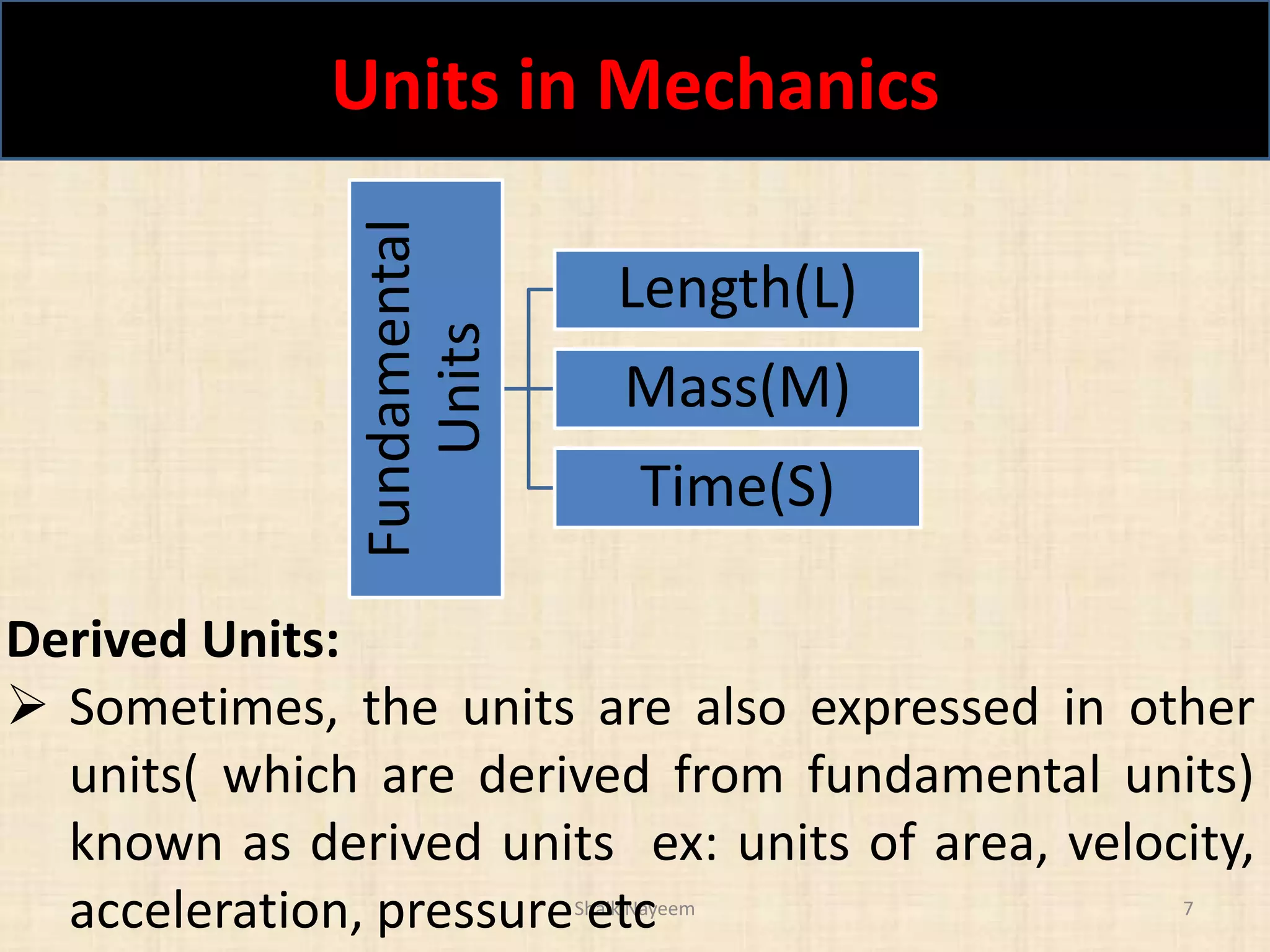
Fundamental
Units
Length(L)
Mass(M)
Time(S)
Derived Units:
 Sometimes, the units are also expressed in other
units( which are derived from fundamental units)
known as derived units ex: units of area, velocity,
acceleration, pressure etc
Units in Mechanics (Cont…)
Shaik Nayeem 8
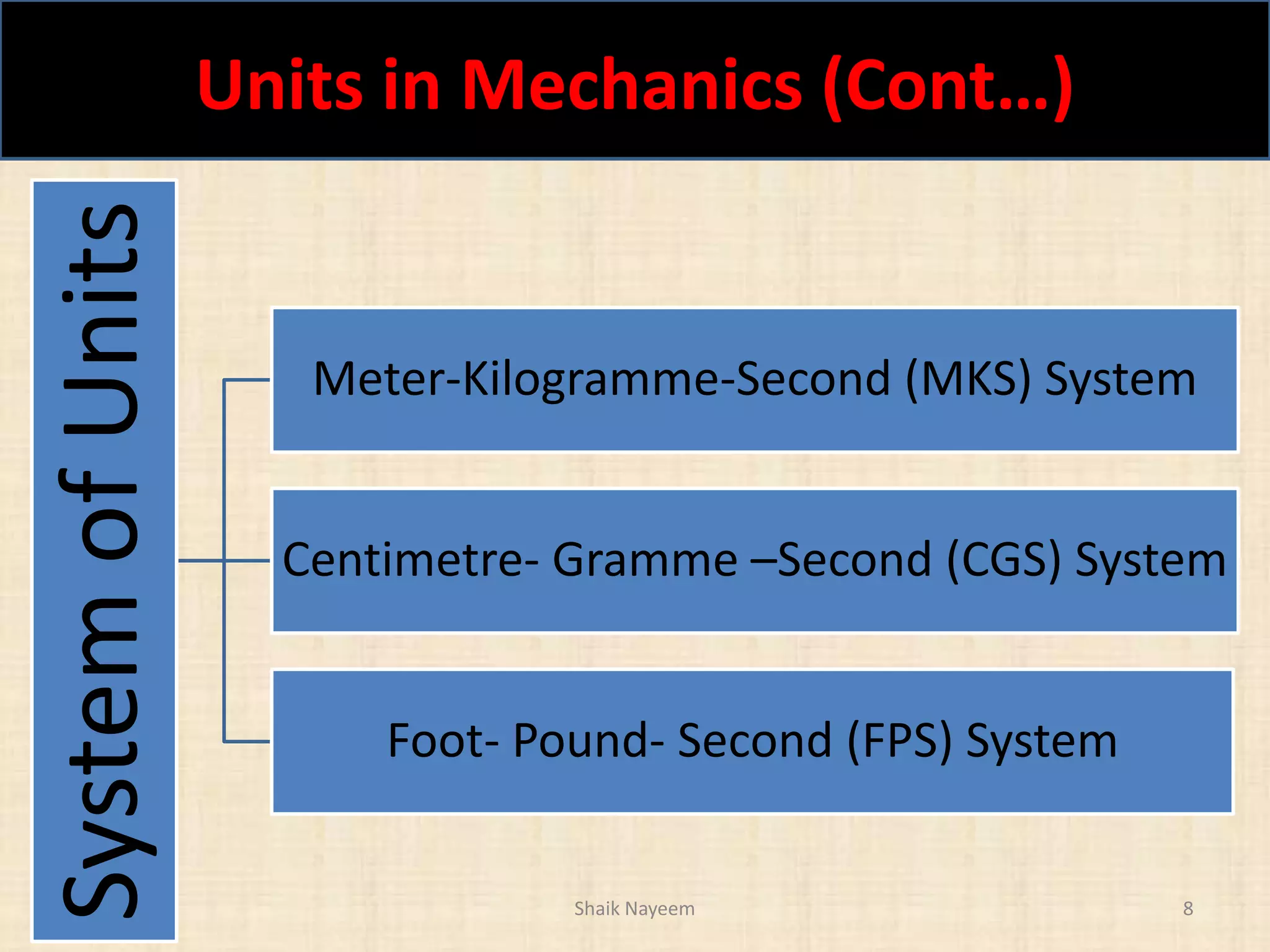
SystemofUnits
Meter-Kilogramme-Second (MKS) System
Centimetre- Gramme –Second (CGS) System
Foot- Pound- Second (FPS) System
Units in Mechanics (Cont…)
Shaik Nayeem 9
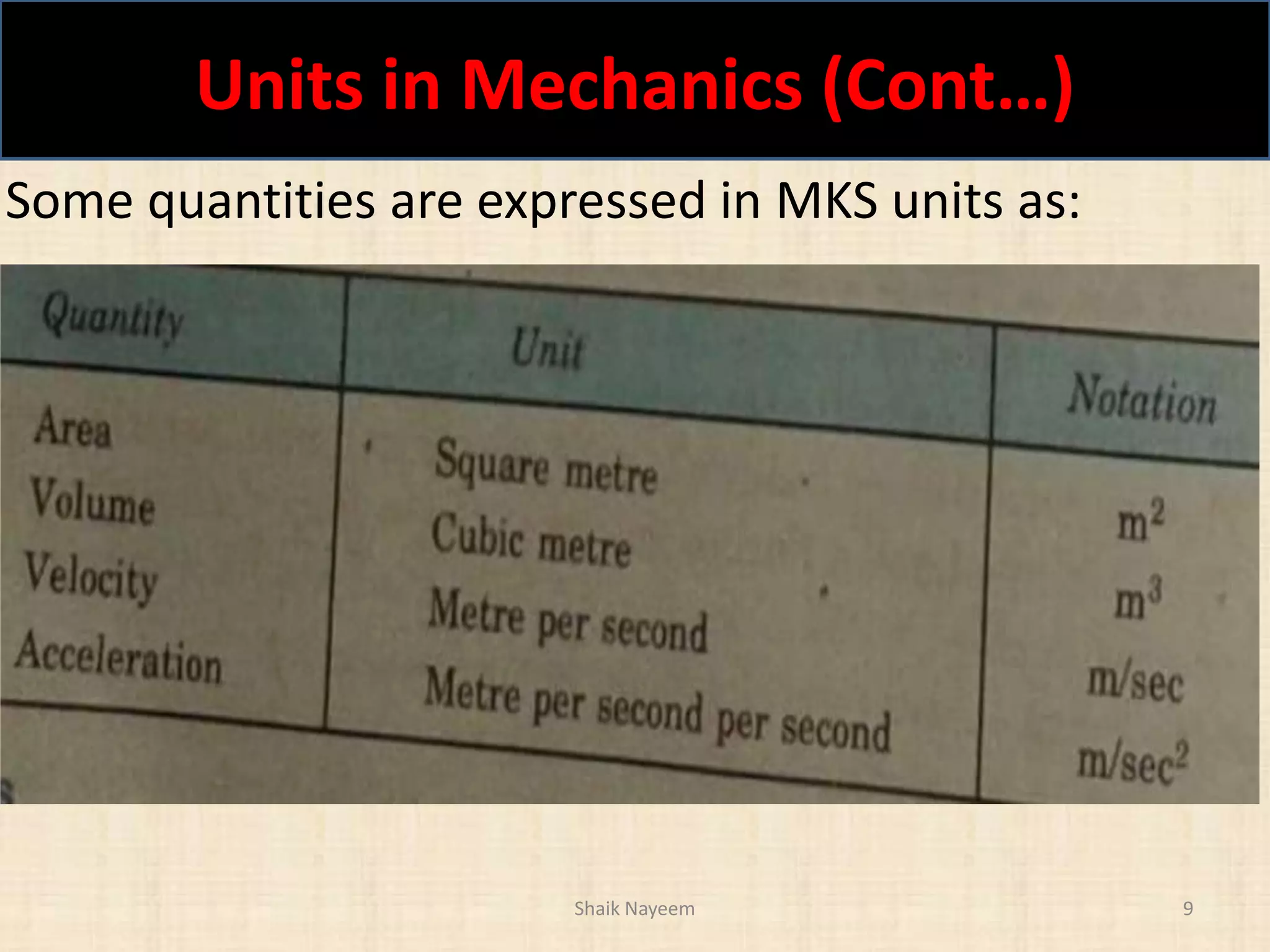
Some quantities are expressed in MKS units as:
Units in Mechanics(Cont…)
Shaik Nayeem 10
 Another type of system of unit is SI( International
System) units
 SI:- Meter-Kilogramme – Second
 The difference between MKS and SI is mainly in
selecting the unit of force
Units in Mechanics(Cont…)
Shaik Nayeem 11
 Force ∝ 𝑀𝑎𝑠𝑠 𝑋 𝐴𝑐𝑐𝑒𝑙𝑒𝑟𝑎𝑡𝑖𝑜𝑛
 Force = k X Mass X Acceleration
 In SI units: a=1 m /𝒔𝒆𝒄 𝟐
Force units are: kg-m/𝑠𝑒𝑐2
is called “Newton”
 In MKS units: a=g = 9.81 m /𝒔𝒆𝒄 𝟐
Force in MKS units: kg-wt is called kilogramme
weight
 1kg-wt = 9.81 Newton
Units in Mechanics
Shaik Nayeem 12
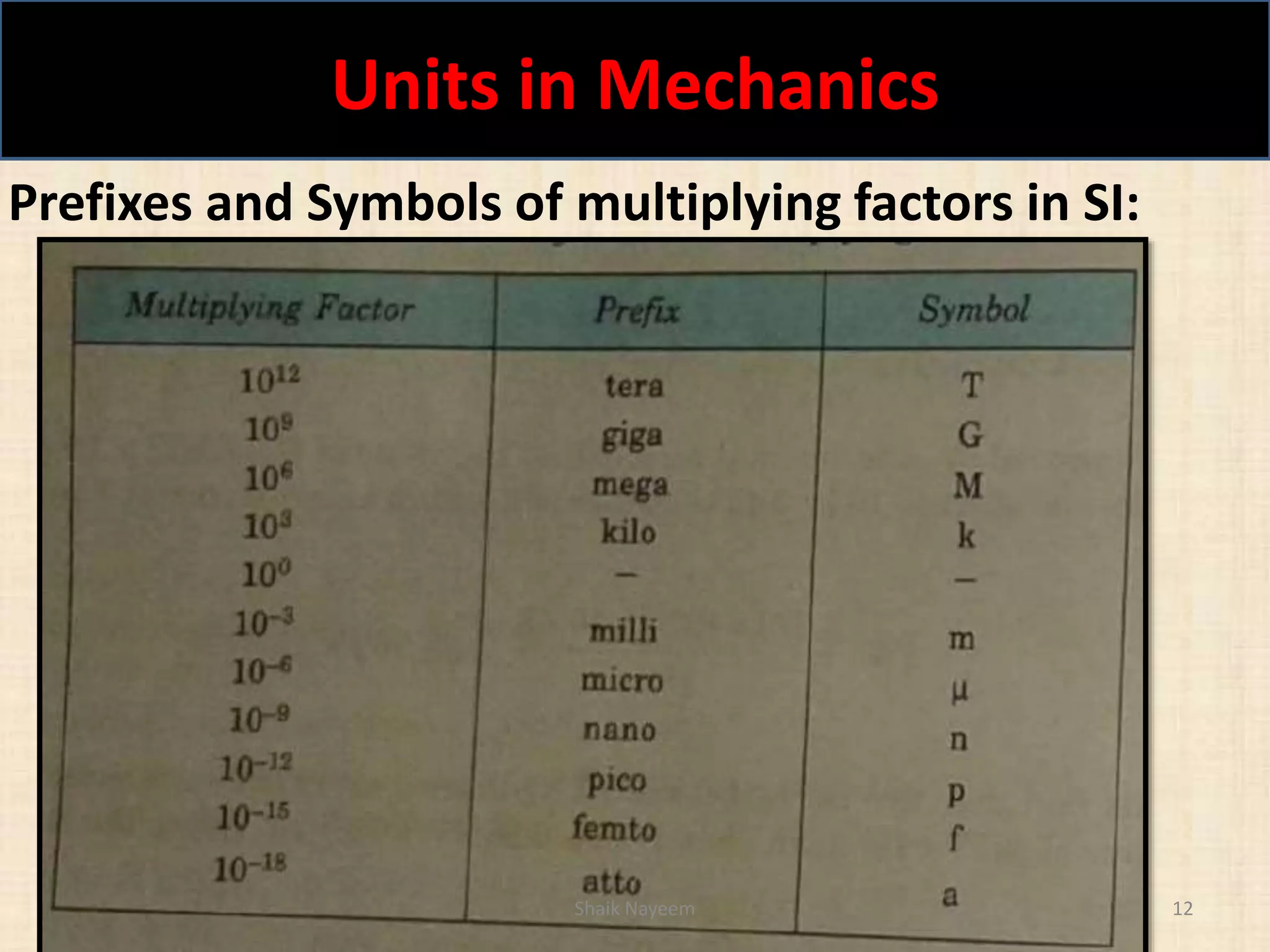
Prefixes and Symbols of multiplying factors in SI:
System of Forces
Shaik Nayeem 13
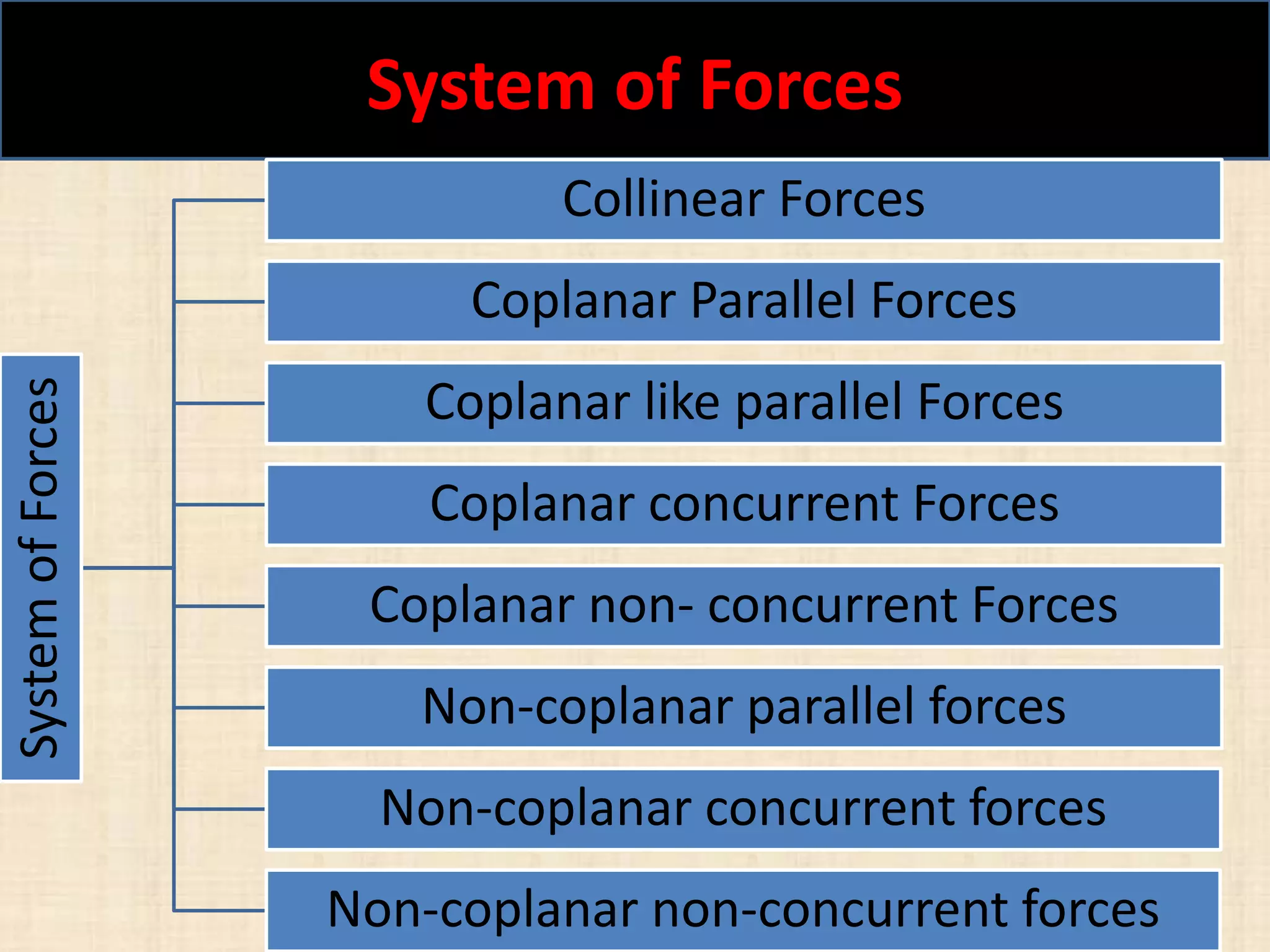
SystemofForces
Collinear Forces
Coplanar Parallel Forces
Coplanar like parallel Forces
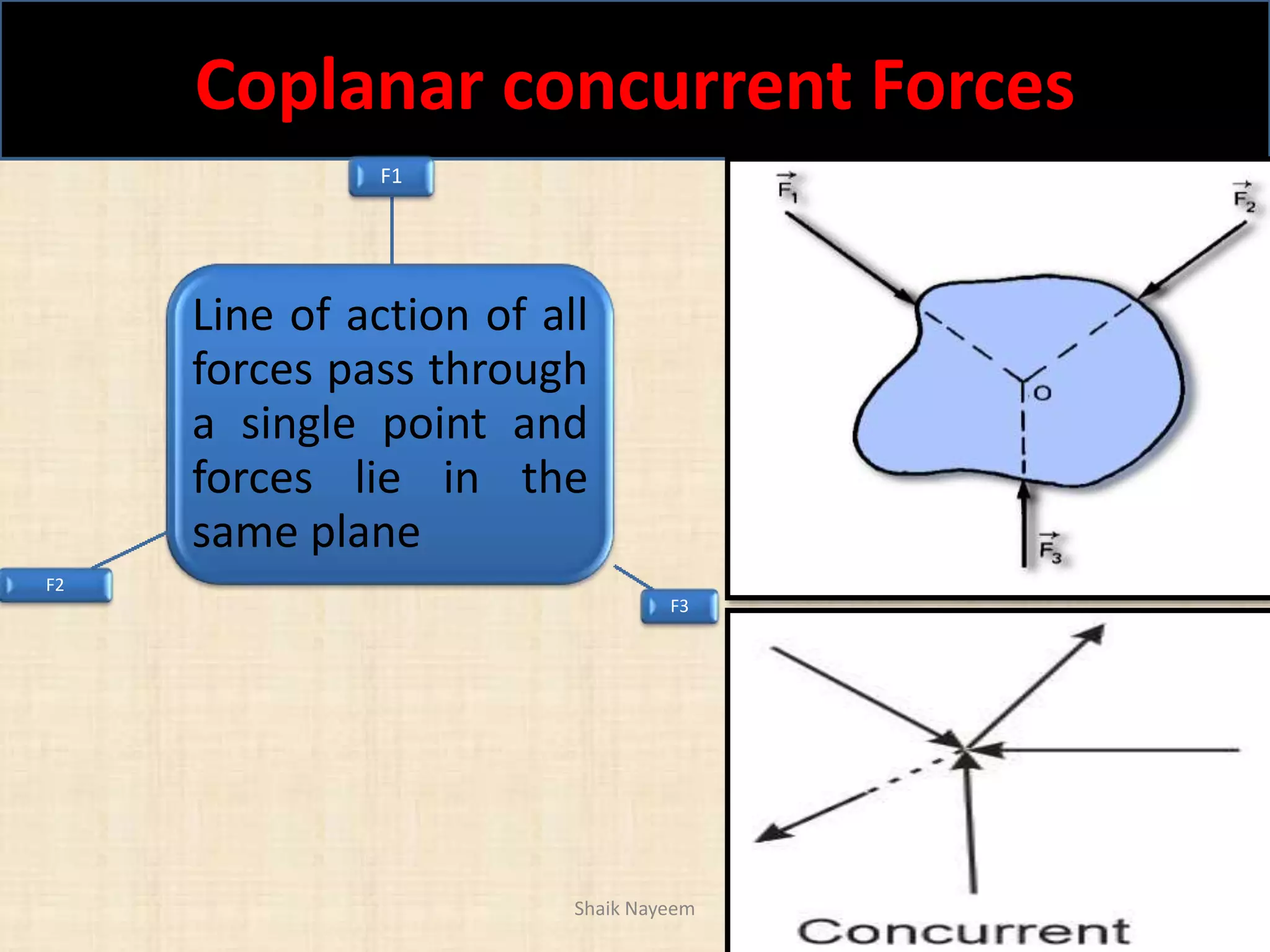
Coplanar concurrent Forces
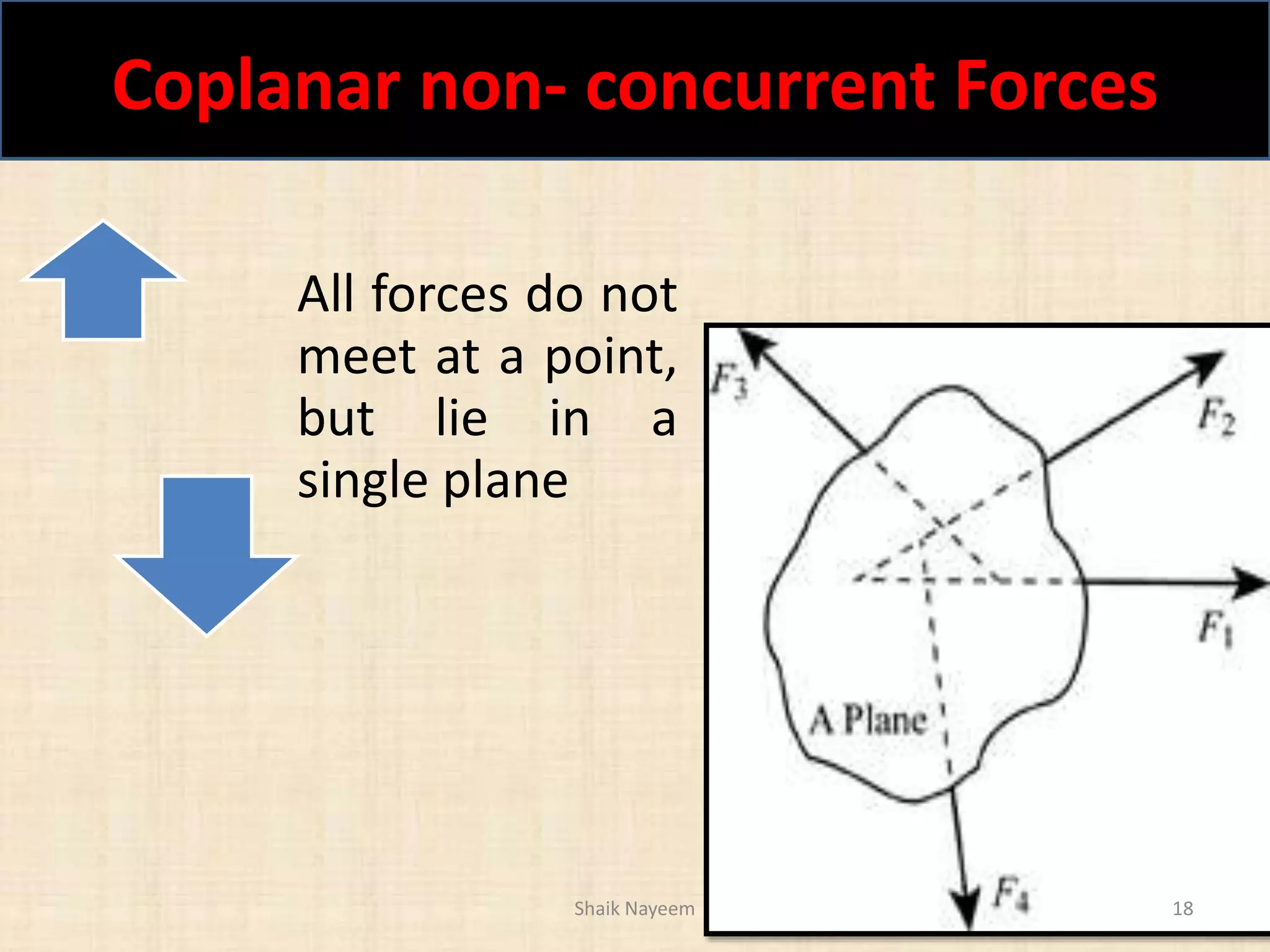
Coplanar non- concurrent Forces
Non-coplanar parallel forces
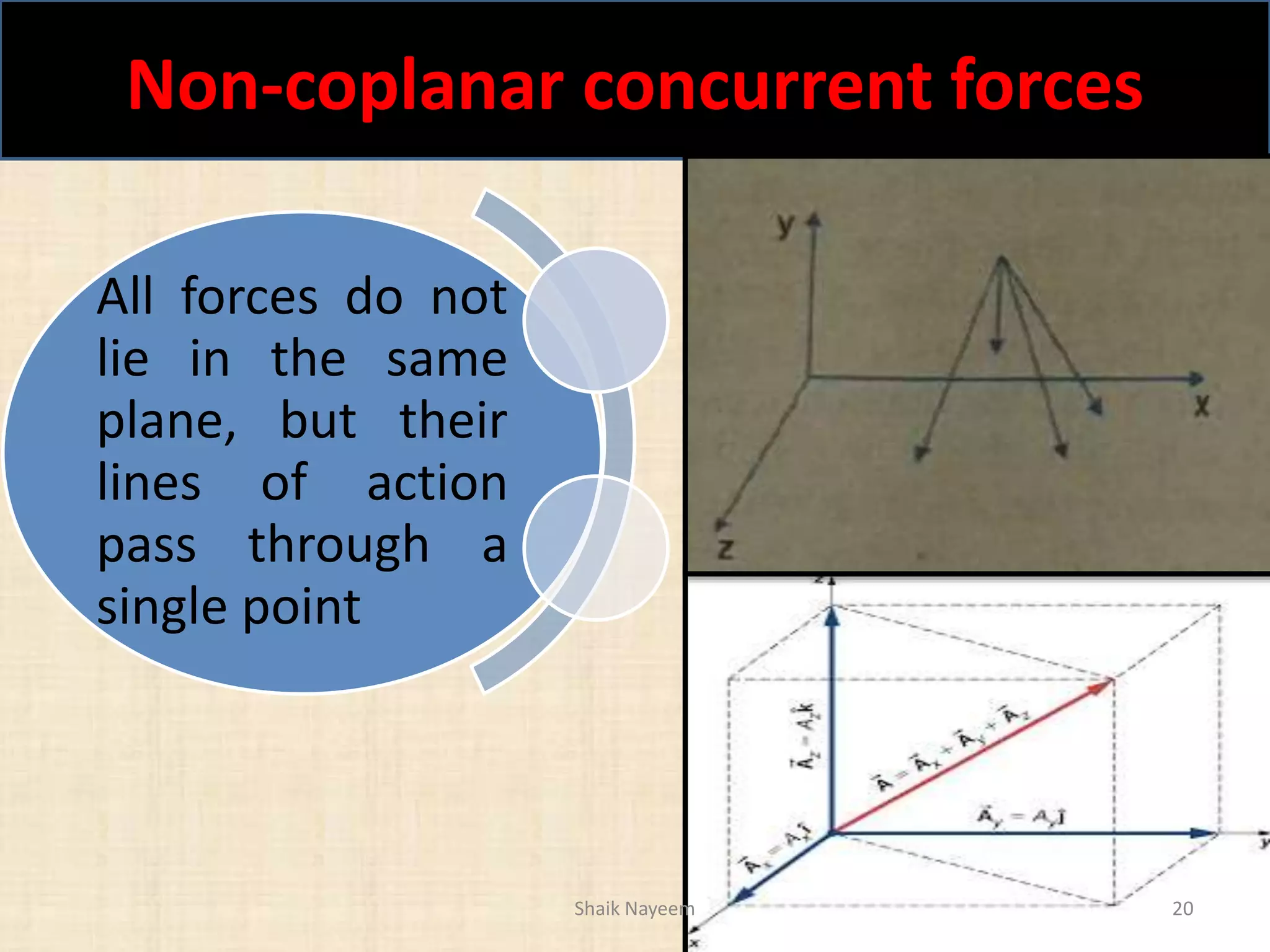
Non-coplanar concurrent forces
Non-coplanar non-concurrent forces
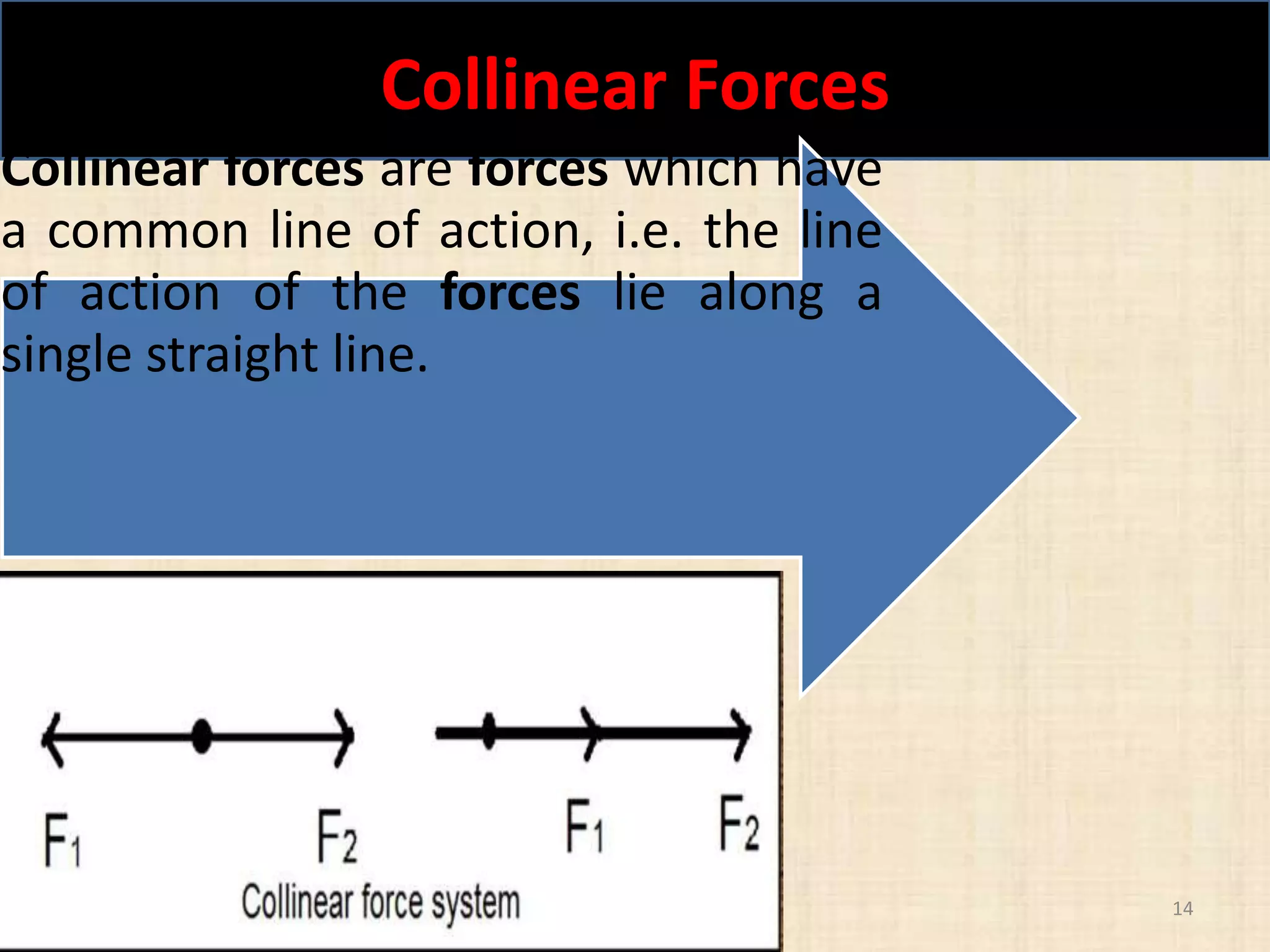
Collinear Forces
Shaik Nayeem 14
Collinear forces are forces which have
a common line of action, i.e. the line
of action of the forces lie along a
single straight line.
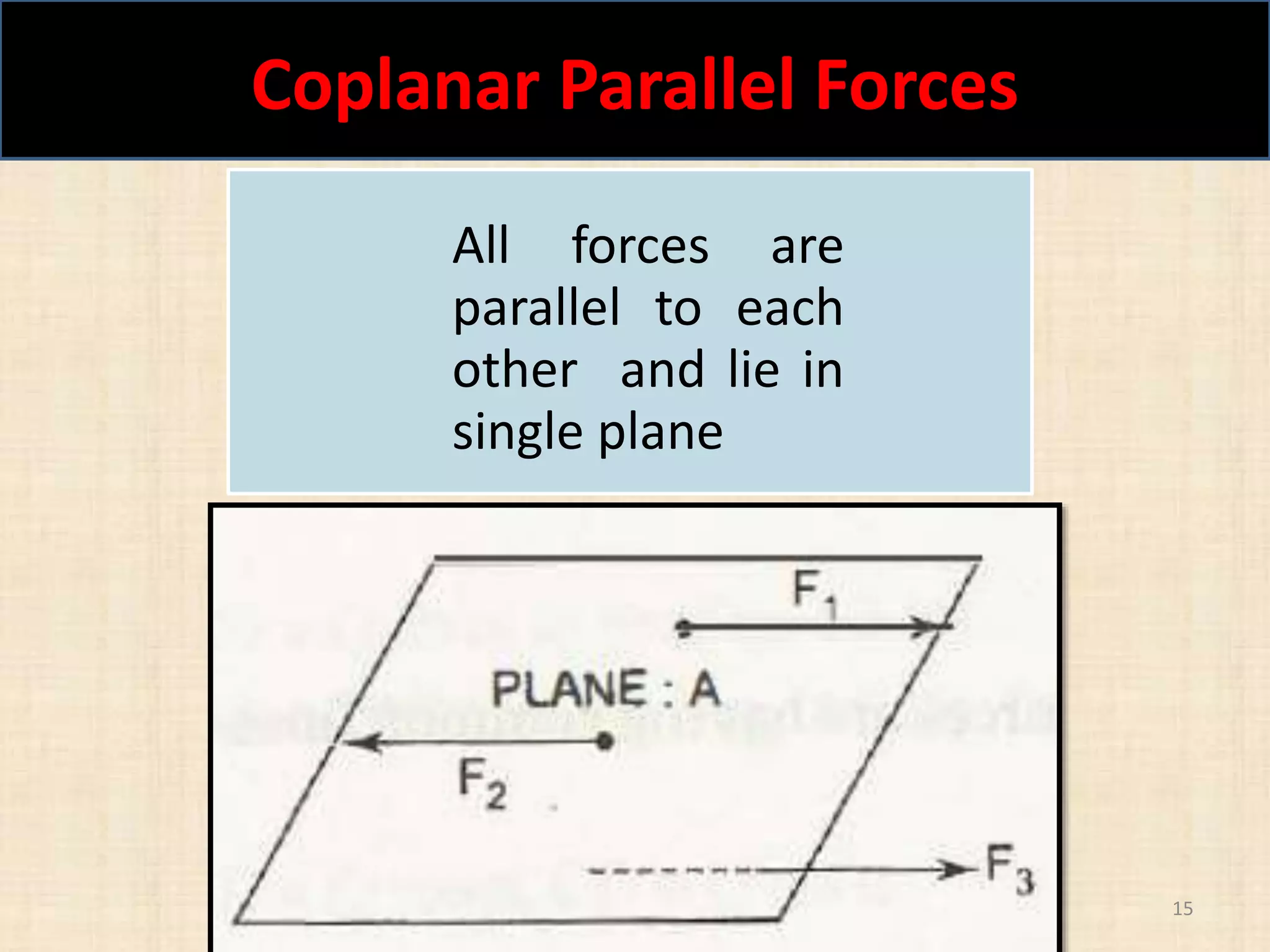
Coplanar Parallel Forces
Shaik Nayeem 15
All forces are
parallel to each
other and lie in
single plane
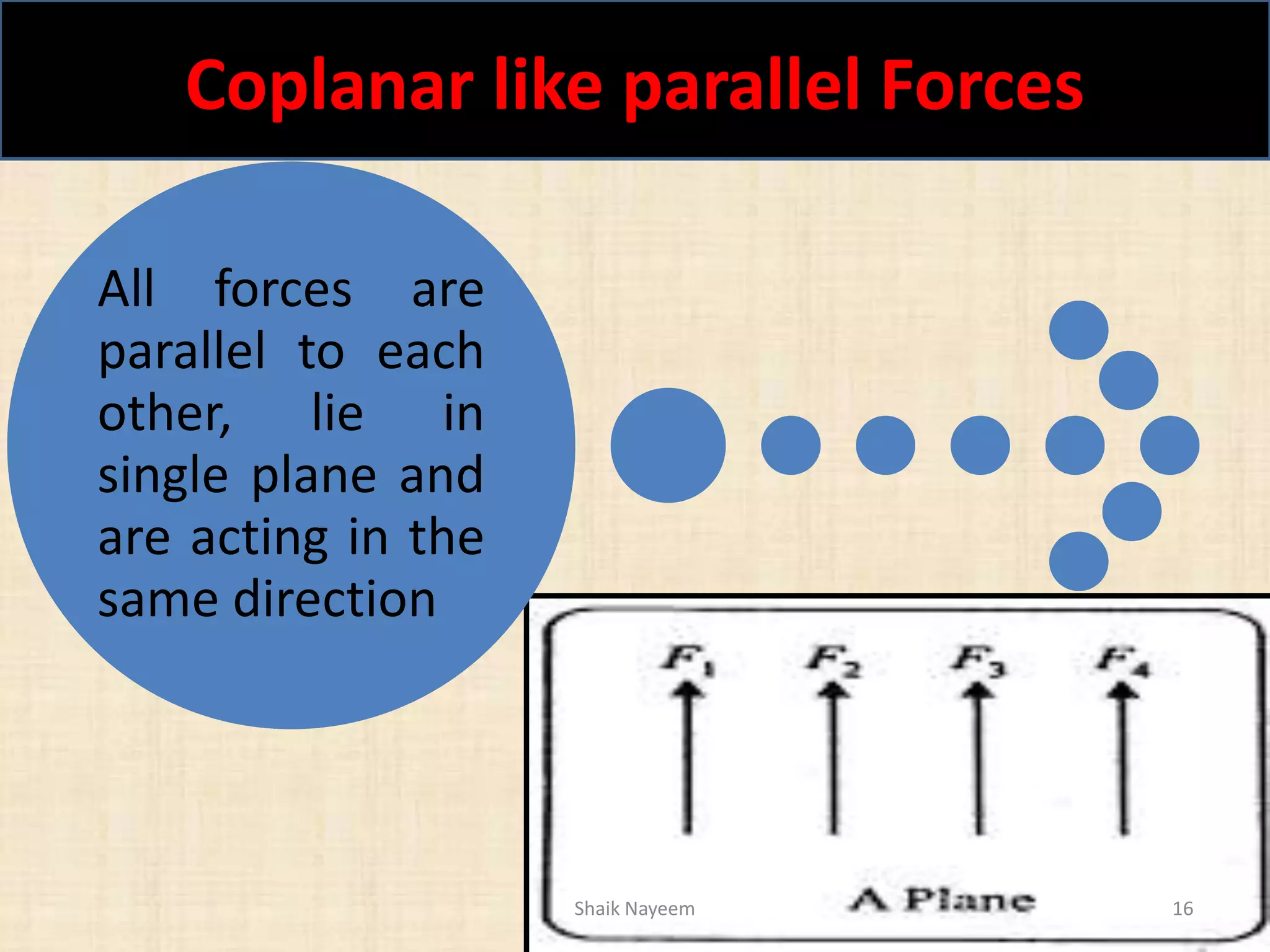
Coplanar like parallel Forces
Shaik Nayeem 16
All forces are
parallel to each
other, lie in
single plane and
are acting in the
same direction
Coplanar concurrent Forces
Shaik Nayeem 17
Line of action of all
forces pass through
a single point and
forces lie in the
same plane
F1
F3
F2
Coplanar non- concurrent Forces
Shaik Nayeem 18
All forces do not
meet at a point,
but lie in a
single plane
Non-coplanar parallel forces
Shaik Nayeem 19
All the forces are
parallel to each
other, but not in
same plane
Non-coplanar concurrent forces
Shaik Nayeem 20
All forces do not
lie in the same
plane, but their
lines of action
pass through a
single point
Non-coplanar non-concurrent forces
Shaik Nayeem 21
All forces do not
lie in the same
plane and their
lines of action do
not pass through
a single point
Idealisations in Mechanics
Shaik Nayeem 22
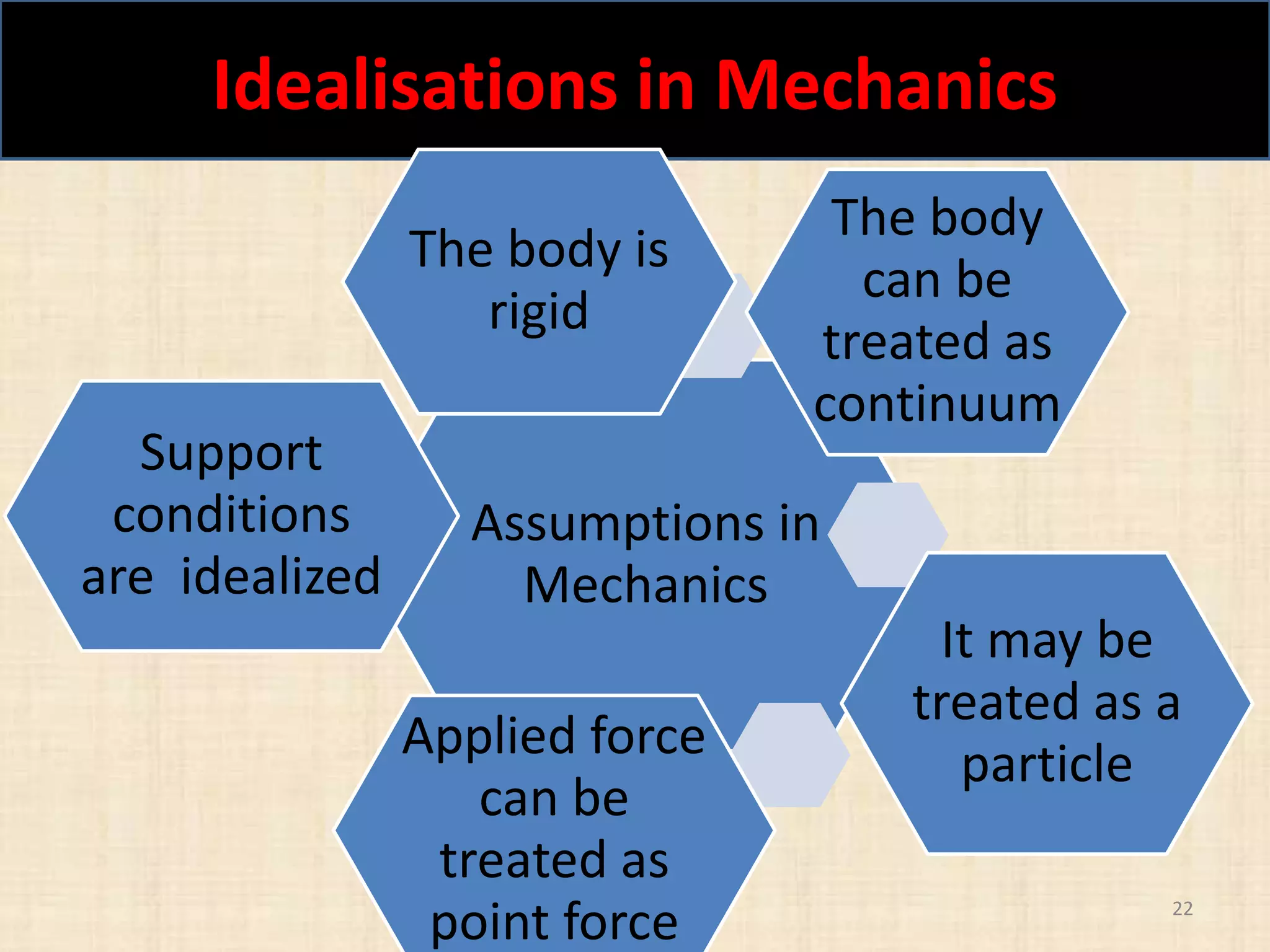
Assumptions in
Mechanics
The body is
rigid
The body
can be
treated as
continuum
It may be
treated as a
particleApplied force
can be
treated as
point force
Support
conditions
are idealized
Shaik Nayeem 23
Thank You
Shaik Nayeem

Derived laws and system of forces

  • 1.
    Shaik Nayeem Engineering Mechanics Introduction:Derived Laws and System of forces 1 Shaik Nayeem
  • 2.
    • Derived Laws •Triangle Law of Forces • Polygon law of forces • Units in Mechanics • System of Forces • Idealisations in Mechanics Contents
  • 3.
    Derived Laws Shaik Nayeem3 Derived Laws Triangle law of forces Polygon law of forces
  • 4.
    Triangle Law ofForces Shaik Nayeem 4  It is derived from the parallelogram law of forces  Triangle law of forces is states that “if two forces are acting on a body are represented one after another by the sides of the triangle , their resultant is represented by the closing side of triangle taken from first point to the last point”
  • 5.
    Polygon law offorces Shaik Nayeem 5  States that “if number of concurrent forces acting simultaneously on a body are represented in magnitude and direction by the sides of the polygon, taken in order, then the resultant is represented in magnitude and direction by the closing side of the polygon , taken from first point to last point”
  • 6.
    Polygon law offorces(Cont…) Shaik Nayeem 6
  • 7.
    Units in Mechanics ShaikNayeem 7 Fundamental Units Length(L) Mass(M) Time(S) Derived Units:  Sometimes, the units are also expressed in other units( which are derived from fundamental units) known as derived units ex: units of area, velocity, acceleration, pressure etc
  • 8.
    Units in Mechanics(Cont…) Shaik Nayeem 8 SystemofUnits Meter-Kilogramme-Second (MKS) System Centimetre- Gramme –Second (CGS) System Foot- Pound- Second (FPS) System
  • 9.
    Units in Mechanics(Cont…) Shaik Nayeem 9 Some quantities are expressed in MKS units as:
  • 10.
    Units in Mechanics(Cont…) ShaikNayeem 10  Another type of system of unit is SI( International System) units  SI:- Meter-Kilogramme – Second  The difference between MKS and SI is mainly in selecting the unit of force
  • 11.
    Units in Mechanics(Cont…) ShaikNayeem 11  Force ∝ 𝑀𝑎𝑠𝑠 𝑋 𝐴𝑐𝑐𝑒𝑙𝑒𝑟𝑎𝑡𝑖𝑜𝑛  Force = k X Mass X Acceleration  In SI units: a=1 m /𝒔𝒆𝒄 𝟐 Force units are: kg-m/𝑠𝑒𝑐2 is called “Newton”  In MKS units: a=g = 9.81 m /𝒔𝒆𝒄 𝟐 Force in MKS units: kg-wt is called kilogramme weight  1kg-wt = 9.81 Newton
  • 12.
    Units in Mechanics ShaikNayeem 12 Prefixes and Symbols of multiplying factors in SI:
  • 13.
    System of Forces ShaikNayeem 13 SystemofForces Collinear Forces Coplanar Parallel Forces Coplanar like parallel Forces Coplanar concurrent Forces Coplanar non- concurrent Forces Non-coplanar parallel forces Non-coplanar concurrent forces Non-coplanar non-concurrent forces
  • 14.
    Collinear Forces Shaik Nayeem14 Collinear forces are forces which have a common line of action, i.e. the line of action of the forces lie along a single straight line.
  • 15.
    Coplanar Parallel Forces ShaikNayeem 15 All forces are parallel to each other and lie in single plane
  • 16.
    Coplanar like parallelForces Shaik Nayeem 16 All forces are parallel to each other, lie in single plane and are acting in the same direction
  • 17.
    Coplanar concurrent Forces ShaikNayeem 17 Line of action of all forces pass through a single point and forces lie in the same plane F1 F3 F2
  • 18.
    Coplanar non- concurrentForces Shaik Nayeem 18 All forces do not meet at a point, but lie in a single plane
  • 19.
    Non-coplanar parallel forces ShaikNayeem 19 All the forces are parallel to each other, but not in same plane
  • 20.
    Non-coplanar concurrent forces ShaikNayeem 20 All forces do not lie in the same plane, but their lines of action pass through a single point
  • 21.
    Non-coplanar non-concurrent forces ShaikNayeem 21 All forces do not lie in the same plane and their lines of action do not pass through a single point
  • 22.
    Idealisations in Mechanics ShaikNayeem 22 Assumptions in Mechanics The body is rigid The body can be treated as continuum It may be treated as a particleApplied force can be treated as point force Support conditions are idealized
  • 23.
    Shaik Nayeem 23 ThankYou Shaik Nayeem