Shaik Nayeem
Engineering Mechanics
Introduction: Basic Terminologies and
Fundamental Laws of Mechanics
1
Shaik Nayeem
• Basic Terminologies in Mechanics
• Fundamental Laws of Mechanics
• Newton’s First Law
• Newton’s Second Law
• Newton’s Third Law
• Newton’s Law of Gravitation
• Law of Transmissibility of Forces
• Parallelogram Law of Forces
Contents
Basic Terminologies in Mechanics
Shaik Nayeem 3
MASS:
∎Quantity of matter possessed by a body
∎Its value doesn’t change
TIME:
∎Measure of successive events
∎Successive event selected as the rotation of
earth on its own axis
SPACE:
∎ Geometric region in which study of body is
done
∎ Determined through a pre-determined point
Basic Terminologies in Mechanics(Cont…)
Shaik Nayeem 4
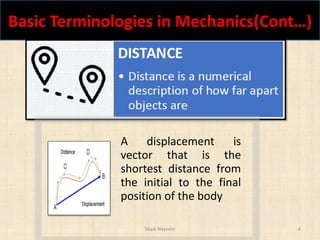
A displacement is
vector that is the
shortest distance from
the initial to the final
position of the body
Basic Terminologies in Mechanics(Cont…)
Shaik Nayeem 5
Basic Terminologies in Mechanics(Cont…)
Shaik Nayeem 6
Basic Terminologies in Mechanics(Cont…)
Shaik Nayeem 7
Basic Terminologies in Mechanics(Cont…)
Shaik Nayeem 8
Continuum:
 Bodies or systems to be a continuous form of
matter
 It means that we do not consider the gaps/spaces
between the atoms or molecules that are actually
present
Basic Terminologies in Mechanics(Cont…)
Shaik Nayeem 9
Fundamental Laws of Mechanics
Shaik Nayeem 10
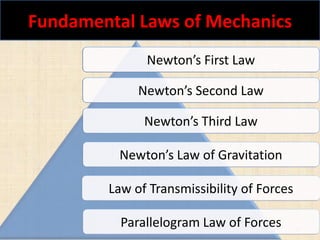
Newton’s First Law
Newton’s Second Law
Newton’s Third Law
Newton’s Law of Gravitation
Law of Transmissibility of Forces
Parallelogram Law of Forces
Newton’s First Law
Shaik Nayeem 11
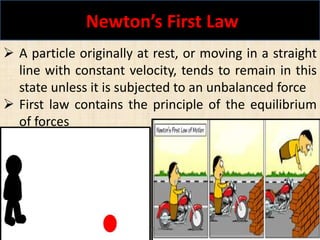
 A particle originally at rest, or moving in a straight
line with constant velocity, tends to remain in this
state unless it is subjected to an unbalanced force
 First law contains the principle of the equilibrium
of forces
Newton’s Second Law
Shaik Nayeem 12
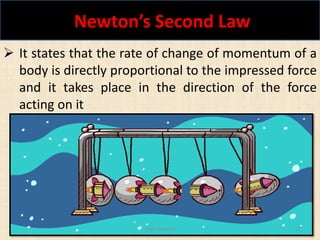
 It states that the rate of change of momentum of a
body is directly proportional to the impressed force
and it takes place in the direction of the force
acting on it
Newton’s Second Law(Cont…)
Shaik Nayeem 13
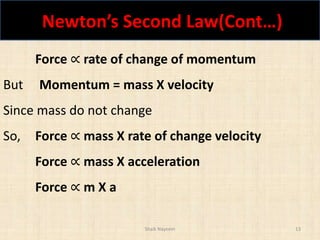
Force ∝ rate of change of momentum
But Momentum = mass X velocity
Since mass do not change
So, Force ∝ mass X rate of change velocity
Force ∝ mass X acceleration
Force ∝ m X a
Problem:1
Shaik Nayeem 14
Newton’s Third Law
Shaik Nayeem 15
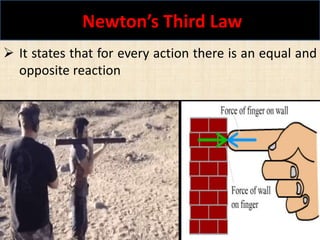
 It states that for every action there is an equal and
opposite reaction
Newton’s Third Law(Cont…)
Shaik Nayeem 16
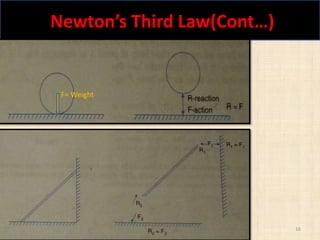
F= Weight
Newton’s Law of Gravitation
Shaik Nayeem 17
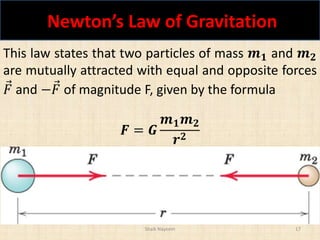
This law states that two particles of mass 𝒎 𝟏 and 𝒎 𝟐
are mutually attracted with equal and opposite forces
𝐹 and − 𝐹 of magnitude F, given by the formula
𝑭 = 𝑮
𝒎 𝟏 𝒎 𝟐
𝒓 𝟐
Newton’s Law of Gravitation(Cont…)
Shaik Nayeem 18
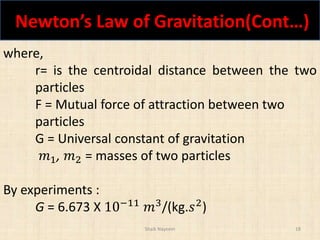
where,
r= is the centroidal distance between the two
particles
F = Mutual force of attraction between two
particles
G = Universal constant of gravitation
𝑚1, 𝑚2 = masses of two particles
By experiments :
G = 6.673 X 10⁻¹¹
𝑚3
/(kg.𝑠2
)
Newton’s Law of Gravitation(Cont…)
Shaik Nayeem 19
Weight of a body (gravitational force acting on a
body) is calculated as:
 If a particle is located at or near the surface of the
earth, the only significant force is gravitational
force between the earth and the particle
 The force F exerted by the Earth on the particle is
then defined as the weight W of the particle( i.e
F=W )
 Particle having mass 𝑚1 = m
Newton’s Law of Gravitation(Cont…)
Shaik Nayeem 20
 Assuming earth to be a nonrotating sphere of
constant density and having mass 𝑚2= 𝑀𝑒
r = distance between the earth’s center and the
particle
We known that, 𝐹 = 𝐺
𝑚1 𝑚2
𝑟2
Substituting , 𝐹 = 𝐺
𝑚𝑀 𝑒
𝑟2
Let g = 𝐺
𝑀 𝑒
𝑟2 = acceleration due to gravity (9.81 m/𝑠2
)
Replacing F with W, then
W= mg
W= Weight of a body or Particle
Law of Transmissibility of Forces
Shaik Nayeem 21
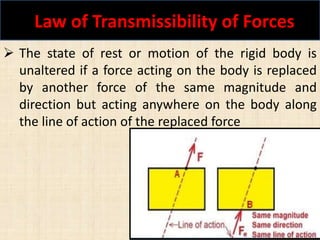
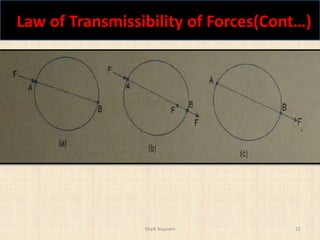
 The state of rest or motion of the rigid body is
unaltered if a force acting on the body is replaced
by another force of the same magnitude and
direction but acting anywhere on the body along
the line of action of the replaced force
Law of Transmissibility of Forces(Cont…)
Shaik Nayeem 22
Parallelogram Law of Forces
Shaik Nayeem 23
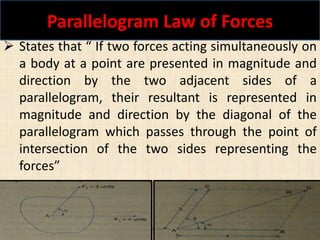
 States that “ If two forces acting simultaneously on
a body at a point are presented in magnitude and
direction by the two adjacent sides of a
parallelogram, their resultant is represented in
magnitude and direction by the diagonal of the
parallelogram which passes through the point of
intersection of the two sides representing the
forces”
Shaik Nayeem 24
Thank You
Shaik Nayeem

Basic terminologies and fundamental laws engineering mechanics

  • 1.
    Shaik Nayeem Engineering Mechanics Introduction:Basic Terminologies and Fundamental Laws of Mechanics 1 Shaik Nayeem
  • 2.
    • Basic Terminologiesin Mechanics • Fundamental Laws of Mechanics • Newton’s First Law • Newton’s Second Law • Newton’s Third Law • Newton’s Law of Gravitation • Law of Transmissibility of Forces • Parallelogram Law of Forces Contents
  • 3.
    Basic Terminologies inMechanics Shaik Nayeem 3 MASS: ∎Quantity of matter possessed by a body ∎Its value doesn’t change TIME: ∎Measure of successive events ∎Successive event selected as the rotation of earth on its own axis SPACE: ∎ Geometric region in which study of body is done ∎ Determined through a pre-determined point
  • 4.
    Basic Terminologies inMechanics(Cont…) Shaik Nayeem 4 A displacement is vector that is the shortest distance from the initial to the final position of the body
  • 5.
    Basic Terminologies inMechanics(Cont…) Shaik Nayeem 5
  • 6.
    Basic Terminologies inMechanics(Cont…) Shaik Nayeem 6
  • 7.
    Basic Terminologies inMechanics(Cont…) Shaik Nayeem 7
  • 8.
    Basic Terminologies inMechanics(Cont…) Shaik Nayeem 8 Continuum:  Bodies or systems to be a continuous form of matter  It means that we do not consider the gaps/spaces between the atoms or molecules that are actually present
  • 9.
    Basic Terminologies inMechanics(Cont…) Shaik Nayeem 9
  • 10.
    Fundamental Laws ofMechanics Shaik Nayeem 10 Newton’s First Law Newton’s Second Law Newton’s Third Law Newton’s Law of Gravitation Law of Transmissibility of Forces Parallelogram Law of Forces
  • 11.
    Newton’s First Law ShaikNayeem 11  A particle originally at rest, or moving in a straight line with constant velocity, tends to remain in this state unless it is subjected to an unbalanced force  First law contains the principle of the equilibrium of forces
  • 12.
    Newton’s Second Law ShaikNayeem 12  It states that the rate of change of momentum of a body is directly proportional to the impressed force and it takes place in the direction of the force acting on it
  • 13.
    Newton’s Second Law(Cont…) ShaikNayeem 13 Force ∝ rate of change of momentum But Momentum = mass X velocity Since mass do not change So, Force ∝ mass X rate of change velocity Force ∝ mass X acceleration Force ∝ m X a
  • 14.
  • 15.
    Newton’s Third Law ShaikNayeem 15  It states that for every action there is an equal and opposite reaction
  • 16.
  • 17.
    Newton’s Law ofGravitation Shaik Nayeem 17 This law states that two particles of mass 𝒎 𝟏 and 𝒎 𝟐 are mutually attracted with equal and opposite forces 𝐹 and − 𝐹 of magnitude F, given by the formula 𝑭 = 𝑮 𝒎 𝟏 𝒎 𝟐 𝒓 𝟐
  • 18.
    Newton’s Law ofGravitation(Cont…) Shaik Nayeem 18 where, r= is the centroidal distance between the two particles F = Mutual force of attraction between two particles G = Universal constant of gravitation 𝑚1, 𝑚2 = masses of two particles By experiments : G = 6.673 X 10⁻¹¹ 𝑚3 /(kg.𝑠2 )
  • 19.
    Newton’s Law ofGravitation(Cont…) Shaik Nayeem 19 Weight of a body (gravitational force acting on a body) is calculated as:  If a particle is located at or near the surface of the earth, the only significant force is gravitational force between the earth and the particle  The force F exerted by the Earth on the particle is then defined as the weight W of the particle( i.e F=W )  Particle having mass 𝑚1 = m
  • 20.
    Newton’s Law ofGravitation(Cont…) Shaik Nayeem 20  Assuming earth to be a nonrotating sphere of constant density and having mass 𝑚2= 𝑀𝑒 r = distance between the earth’s center and the particle We known that, 𝐹 = 𝐺 𝑚1 𝑚2 𝑟2 Substituting , 𝐹 = 𝐺 𝑚𝑀 𝑒 𝑟2 Let g = 𝐺 𝑀 𝑒 𝑟2 = acceleration due to gravity (9.81 m/𝑠2 ) Replacing F with W, then W= mg W= Weight of a body or Particle
  • 21.
    Law of Transmissibilityof Forces Shaik Nayeem 21  The state of rest or motion of the rigid body is unaltered if a force acting on the body is replaced by another force of the same magnitude and direction but acting anywhere on the body along the line of action of the replaced force
  • 22.
    Law of Transmissibilityof Forces(Cont…) Shaik Nayeem 22
  • 23.
    Parallelogram Law ofForces Shaik Nayeem 23  States that “ If two forces acting simultaneously on a body at a point are presented in magnitude and direction by the two adjacent sides of a parallelogram, their resultant is represented in magnitude and direction by the diagonal of the parallelogram which passes through the point of intersection of the two sides representing the forces”
  • 24.
    Shaik Nayeem 24 ThankYou Shaik Nayeem