Post-Mid Term
Financial Accounting for Managers
PART-I (Depreciation and Financial Statement)
C.A. (Dr.) Pramod Kumar Pandey
DEPRECIATION
DEPRECIATION
 Decrease in value of Non-Current Assets like Building, Machinery,
Furniture etc. is called Depreciation
 It is a method for spreading the cost of assets over its useful life.
 Depreciation is charged to give effect to Matching Concept because
Depreciation shows portion of cost of assets used to generate
revenue in Business
 Deprecation is a non-cash expenditure
Causes for Depreciation
• Wear and tear due to actual use
• Efflux of time
• Obsolescence due to new inventions and technology
• Physical reasons like rust, moisture etc.
• Irregular repairs and maintenance
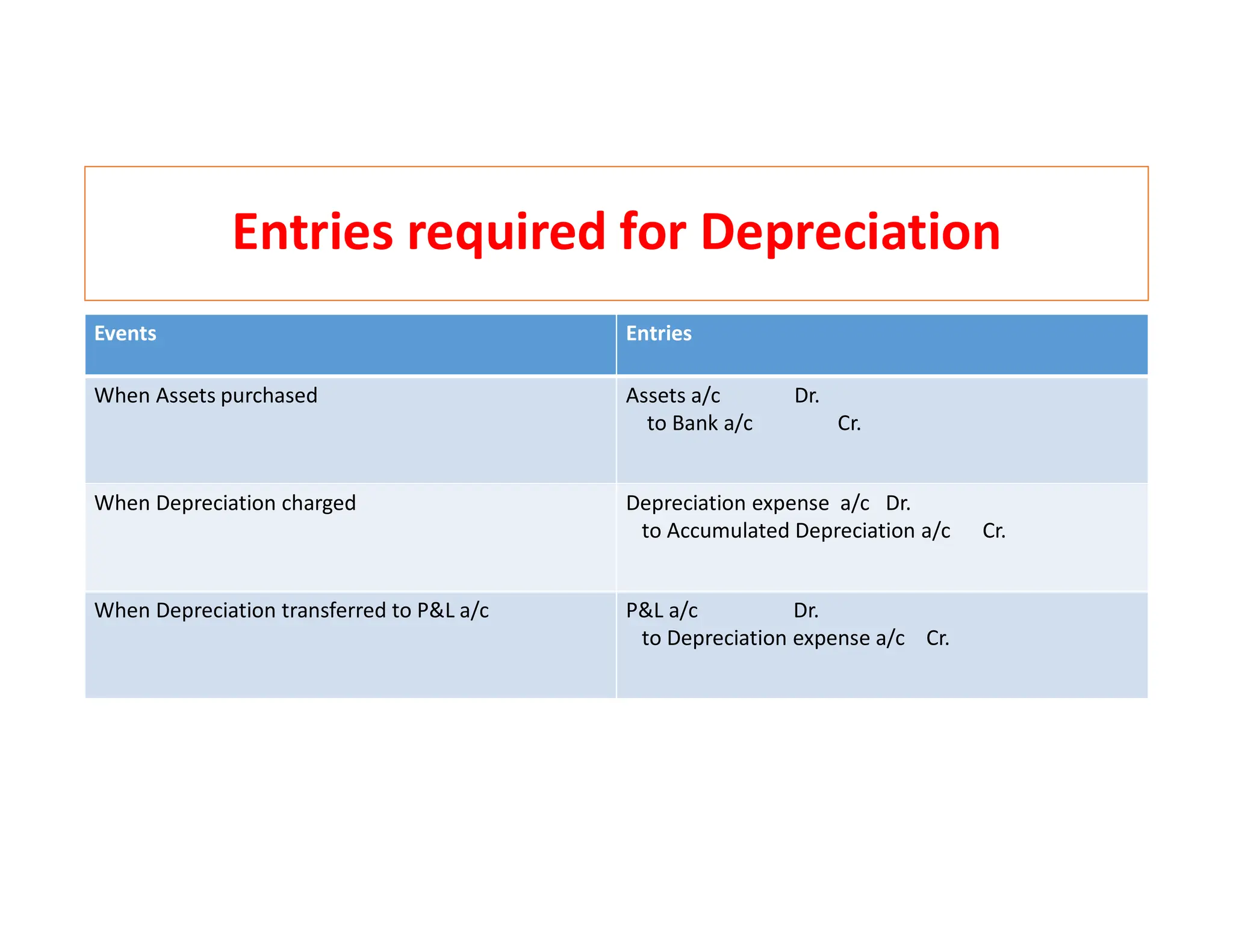
Entries required for Depreciation
Events Entries
When Assets purchased Assets a/c Dr.
to Bank a/c Cr.
When Depreciation charged Depreciation expense a/c Dr.
to Accumulated Depreciation a/c Cr.
When Depreciation transferred to P&L a/c P&L a/c Dr.
to Depreciation expense a/c Cr.
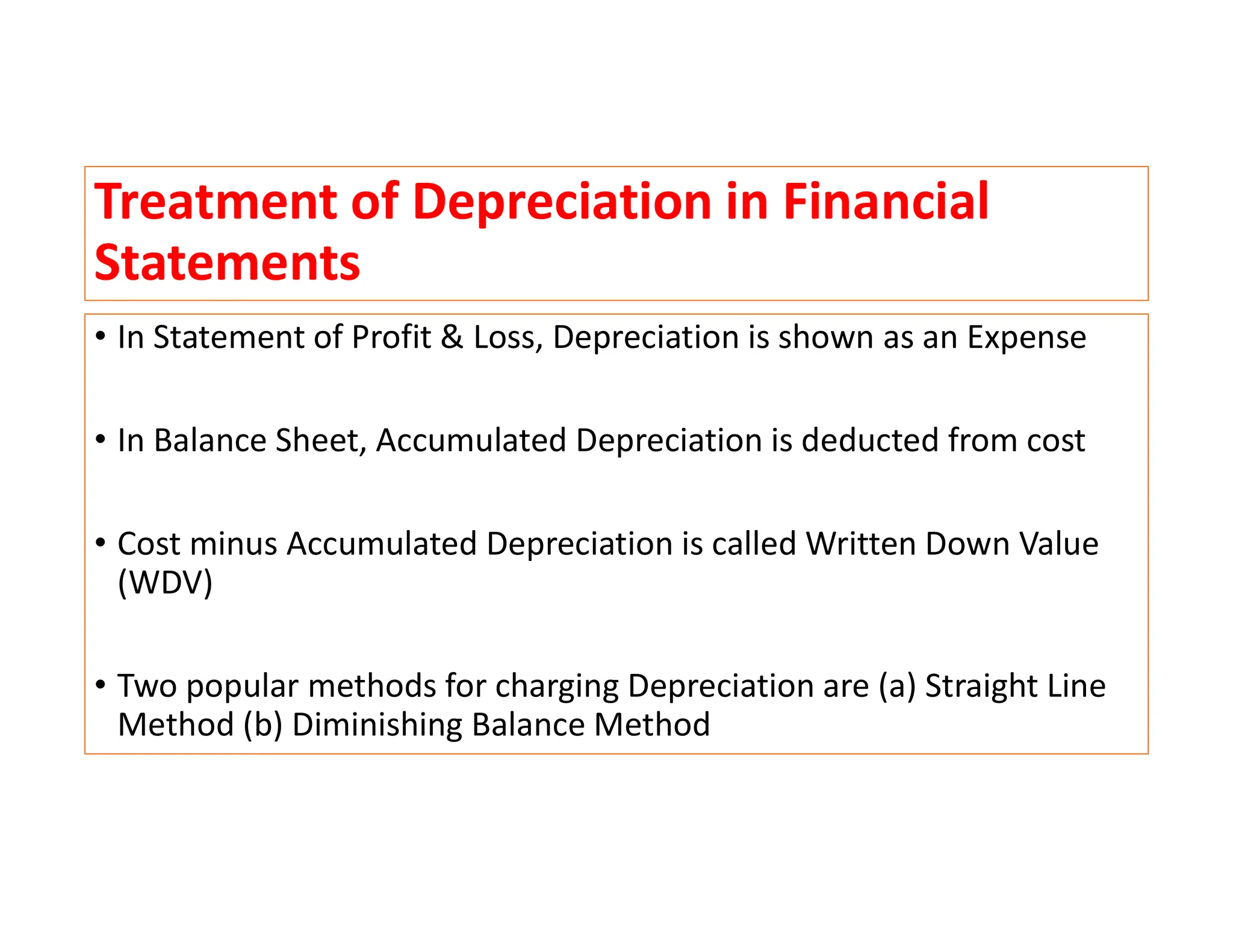
Treatment of Depreciation in Financial
Statements
• In Statement of Profit & Loss, Depreciation is shown as an Expense
• In Balance Sheet, Accumulated Depreciation is deducted from cost
• Cost minus Accumulated Depreciation is called Written Down Value
(WDV)
• Two popular methods for charging Depreciation are (a) Straight Line
Method (b) Diminishing Balance Method
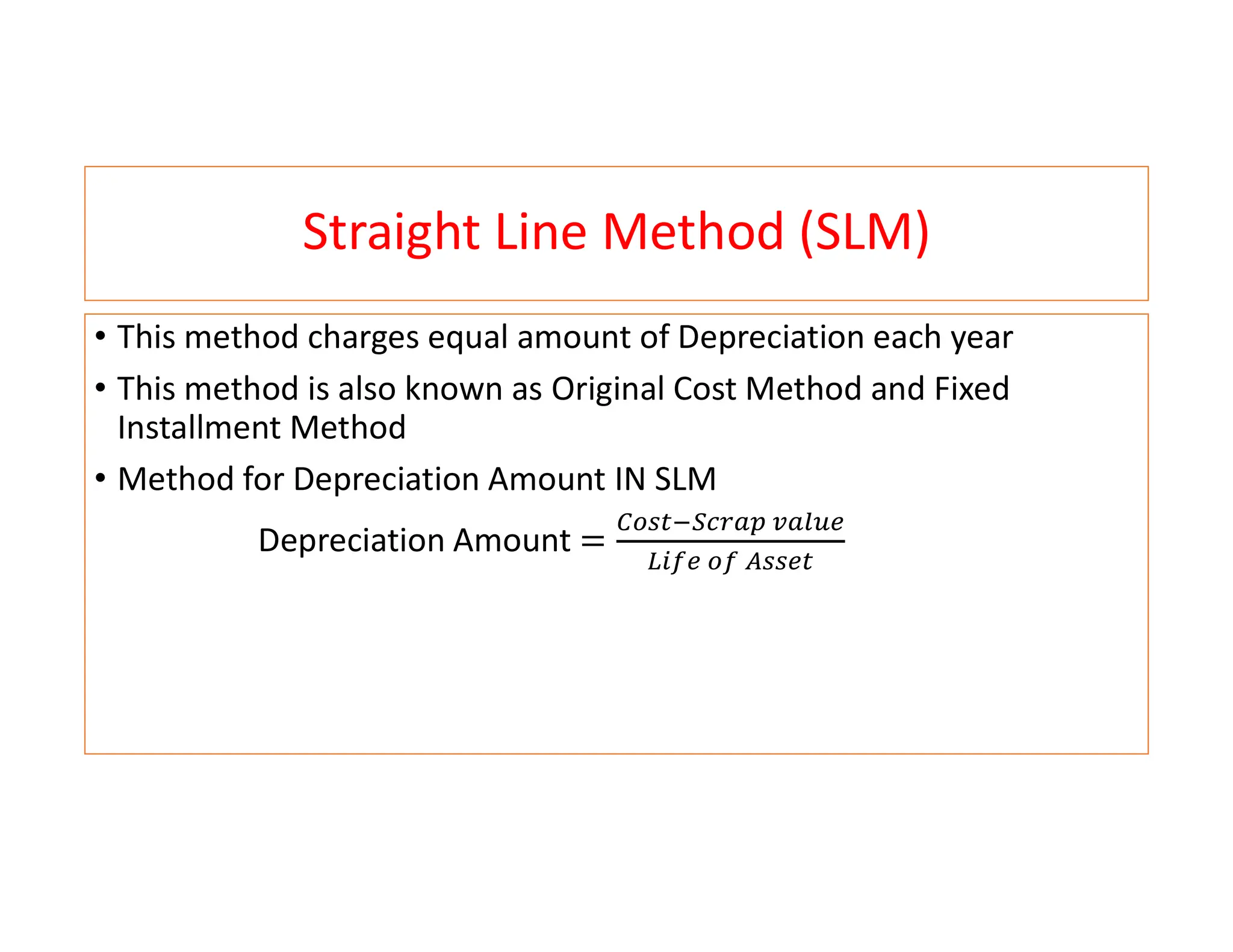
Straight Line Method (SLM)
• This method charges equal amount of Depreciation each year
• This method is also known as Original Cost Method and Fixed
Installment Method
• Method for Depreciation Amount IN SLM
Depreciation Amount
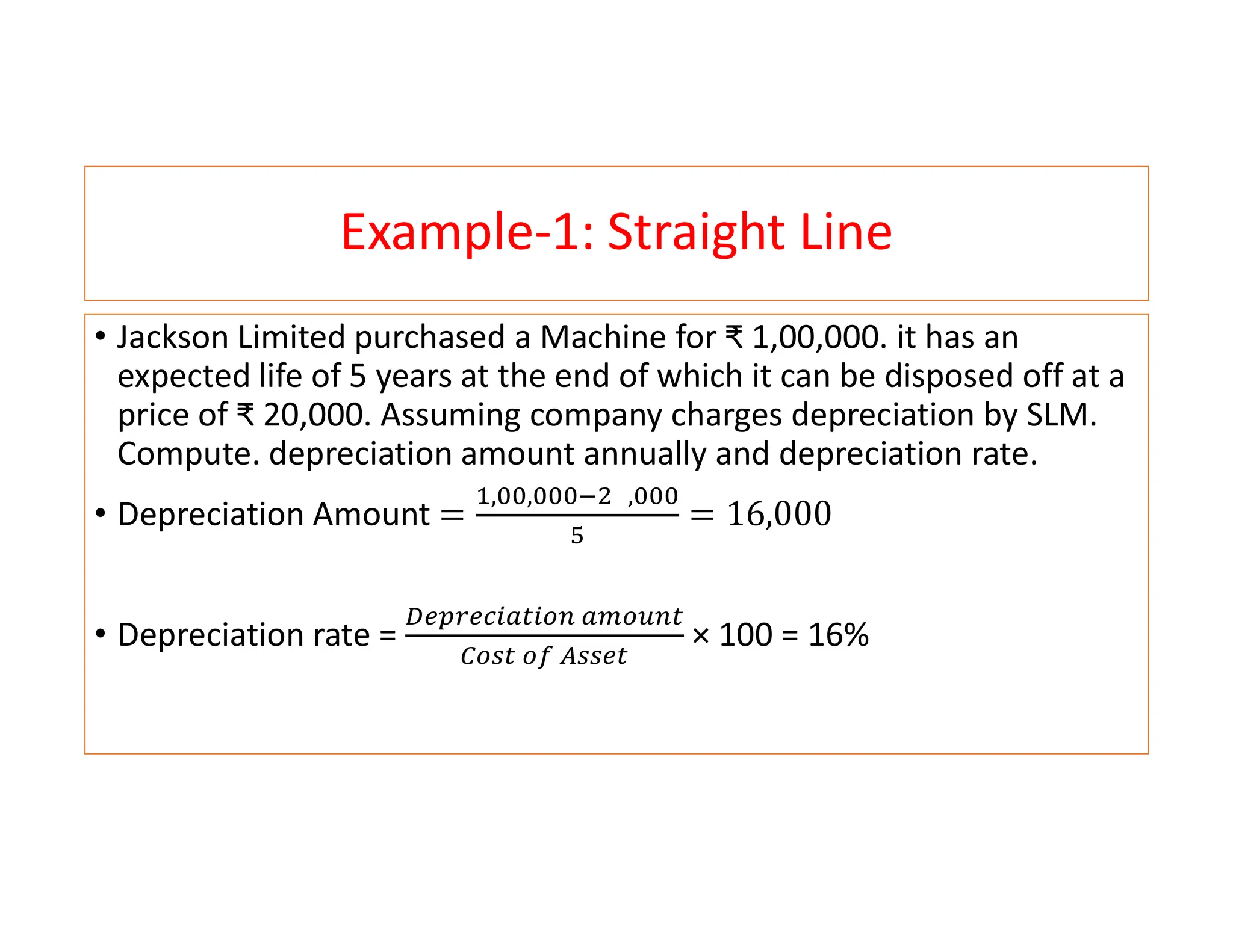
Example-1: Straight Line
• Jackson Limited purchased a Machine for ₹ 1,00,000. it has an
expected life of 5 years at the end of which it can be disposed off at a
price of ₹ 20,000. Assuming company charges depreciation by SLM.
Compute. depreciation amount annually and depreciation rate.
• Depreciation Amount
, , ,
• Depreciation rate = × 100 = 16%
Example-2: Straight Line
X Ltd. Purchased a machine for Rs. 4,00,000 on 1st April, 2015.
it has life of 5 years with zero scrap value. Assuming Company
charges Depreciation on Straight line basis, calculate
Depreciation for all the five years.
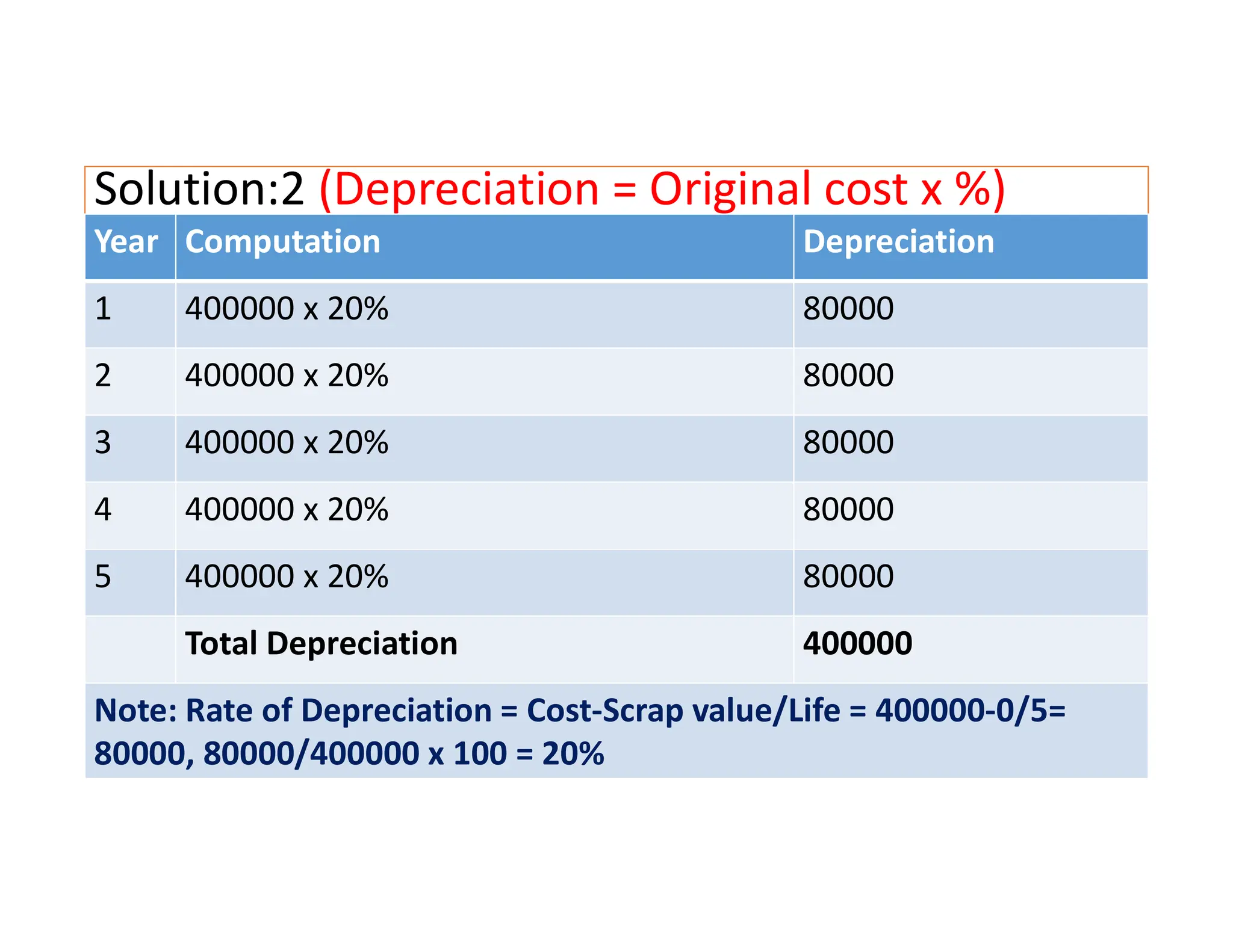
Solution:2 (Depreciation = Original cost x %)
Year Computation Depreciation
1 400000 x 20% 80000
2 400000 x 20% 80000
3 400000 x 20% 80000
4 400000 x 20% 80000
5 400000 x 20% 80000
Total Depreciation 400000
Note: Rate of Depreciation = Cost-Scrap value/Life = 400000-0/5=
80000, 80000/400000 x 100 = 20%
Diminishing Balance Method
• This method is also called Reducing balance method
• Under this method depreciation amount reduces each year
• Depreciation is charged on (Original Cost – Accumulated Depreciation) x
rate %
• As compared to SLM, this method charges less depreciation. Thus a
Company will be able to show higher profits if it follows Diminishing
Balance Method as compared to SLM.
Example-1: Diminishing Balance Method
X Ltd. Purchased a machine for Rs. 4,00,000 on 1st April, 2015.
it has life of 5 years with zero scrap value. Assuming Company
charges Depreciation on Diminishing Balance Method@ 20%
each year, calculate Depreciation for all the five years.
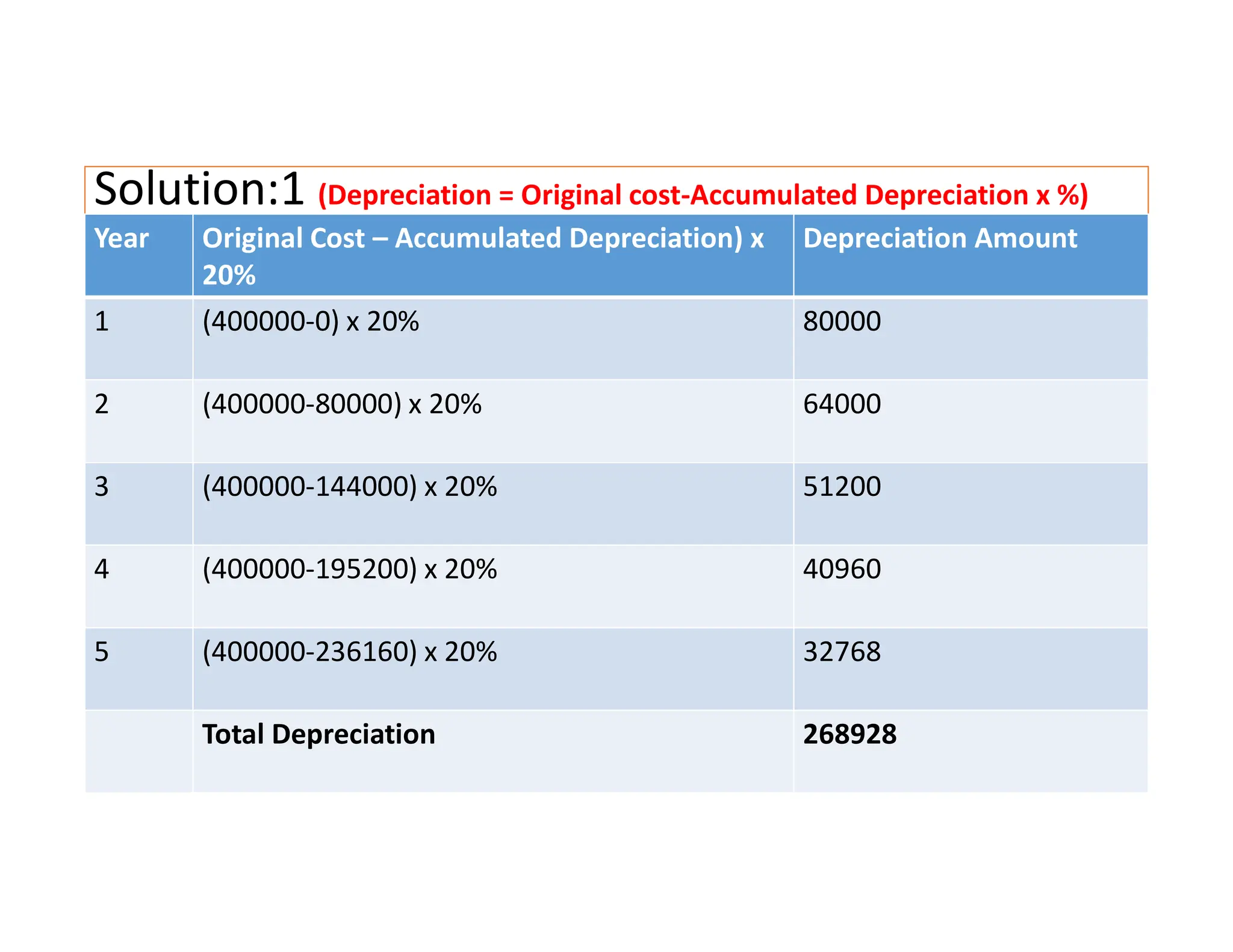
Solution:1 (Depreciation = Original cost-Accumulated Depreciation x %)
Year Original Cost – Accumulated Depreciation) x
20%
Depreciation Amount
1 (400000-0) x 20% 80000
2 (400000-80000) x 20% 64000
3 (400000-144000) x 20% 51200
4 (400000-195200) x 20% 40960
5 (400000-236160) x 20% 32768
Total Depreciation 268928
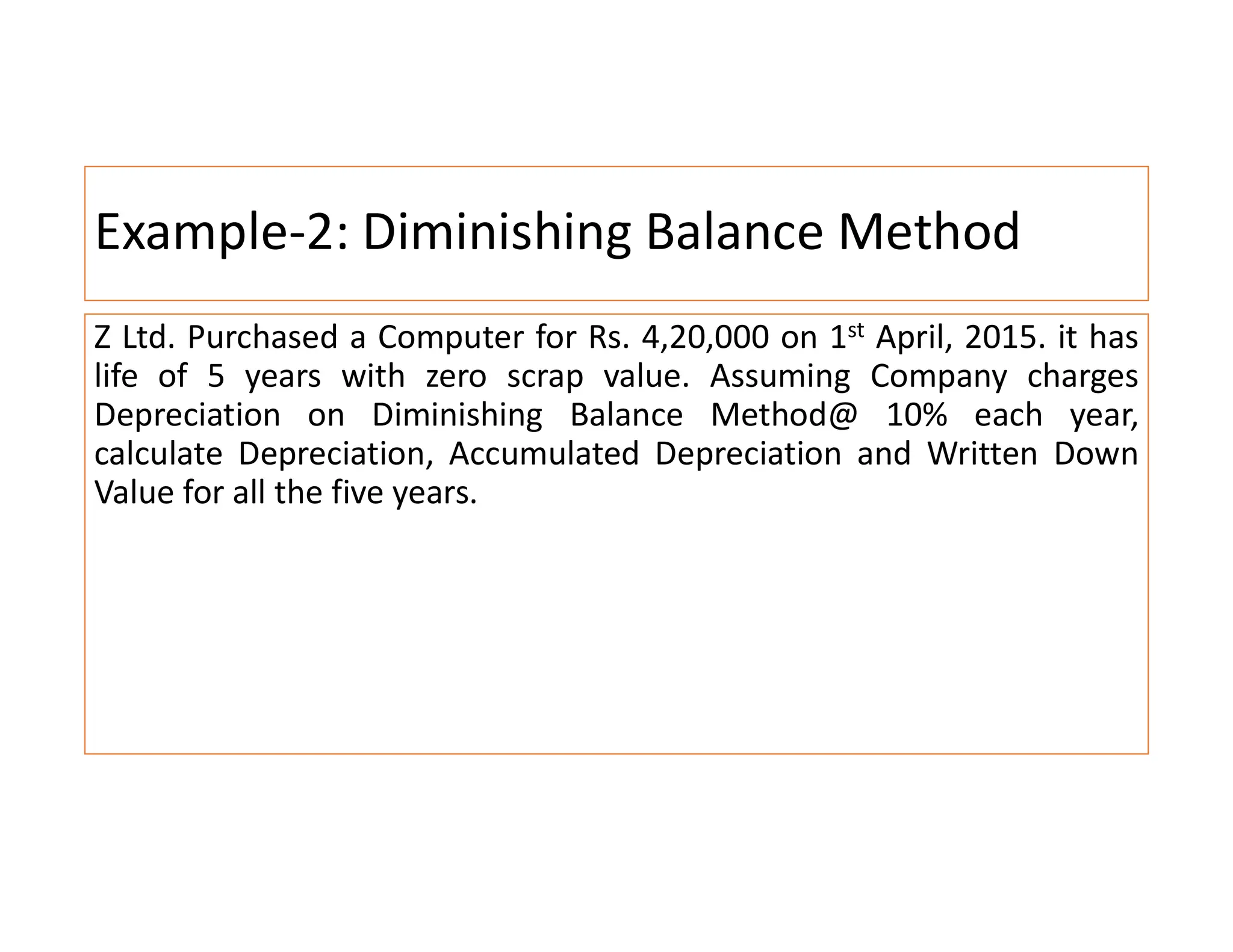
Example-2: Diminishing Balance Method
Z Ltd. Purchased a Computer for Rs. 4,20,000 on 1st April, 2015. it has
life of 5 years with zero scrap value. Assuming Company charges
Depreciation on Diminishing Balance Method@ 10% each year,
calculate Depreciation, Accumulated Depreciation and Written Down
Value for all the five years.
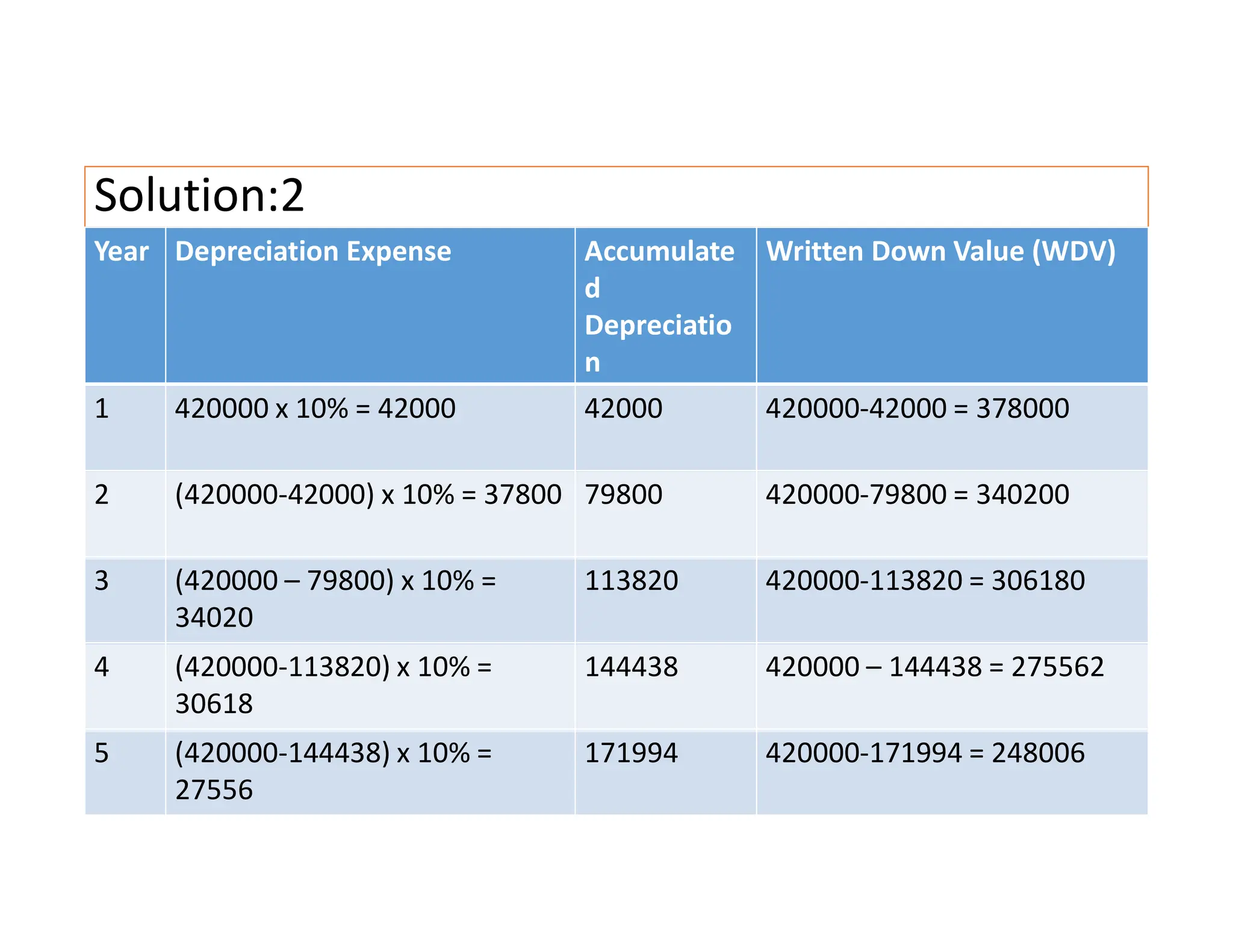
Solution:2
Year Depreciation Expense Accumulate
d
Depreciatio
n
Written Down Value (WDV)
1 420000 x 10% = 42000 42000 420000-42000 = 378000
2 (420000-42000) x 10% = 37800 79800 420000-79800 = 340200
3 (420000 – 79800) x 10% =
34020
113820 420000-113820 = 306180
4 (420000-113820) x 10% =
30618
144438 420000 – 144438 = 275562
5 (420000-144438) x 10% =
27556
171994 420000-171994 = 248006
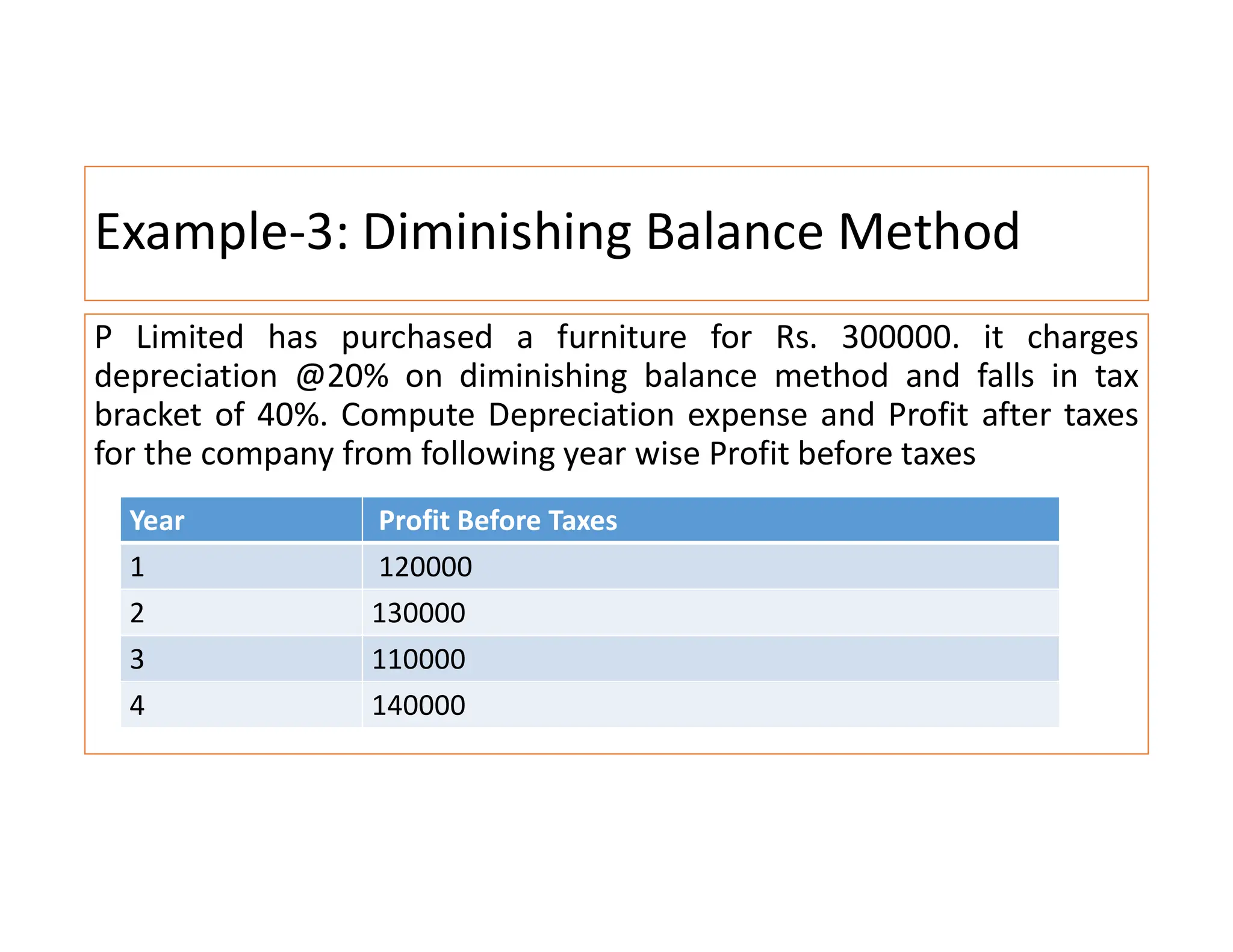
Example-3: Diminishing Balance Method
P Limited has purchased a furniture for Rs. 300000. it charges
depreciation @20% on diminishing balance method and falls in tax
bracket of 40%. Compute Depreciation expense and Profit after taxes
for the company from following year wise Profit before taxes
Year Profit Before Taxes
1 120000
2 130000
3 110000
4 140000
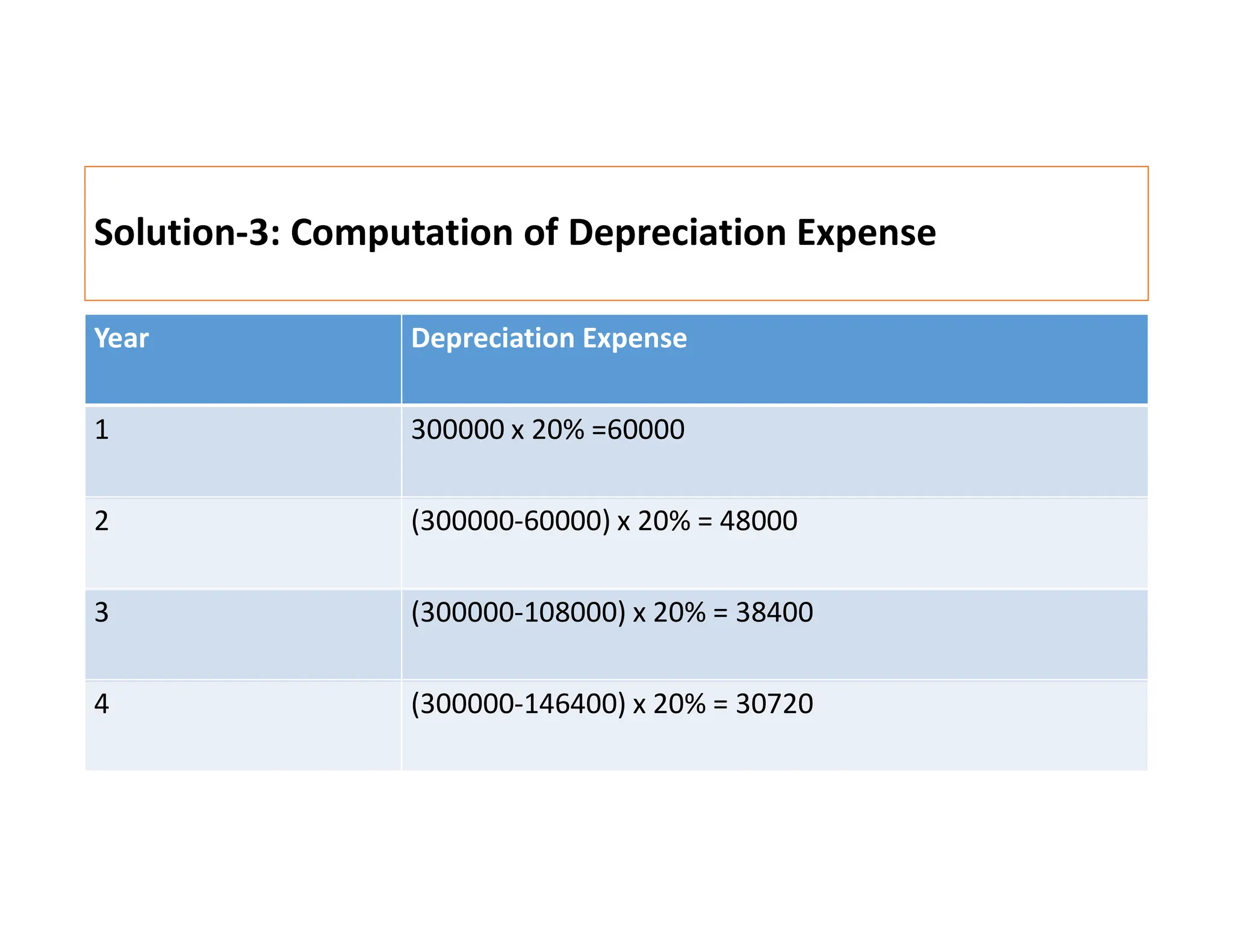
Solution-3: Computation of Depreciation Expense
Year Depreciation Expense
1 300000 x 20% =60000
2 (300000-60000) x 20% = 48000
3 (300000-108000) x 20% = 38400
4 (300000-146400) x 20% = 30720
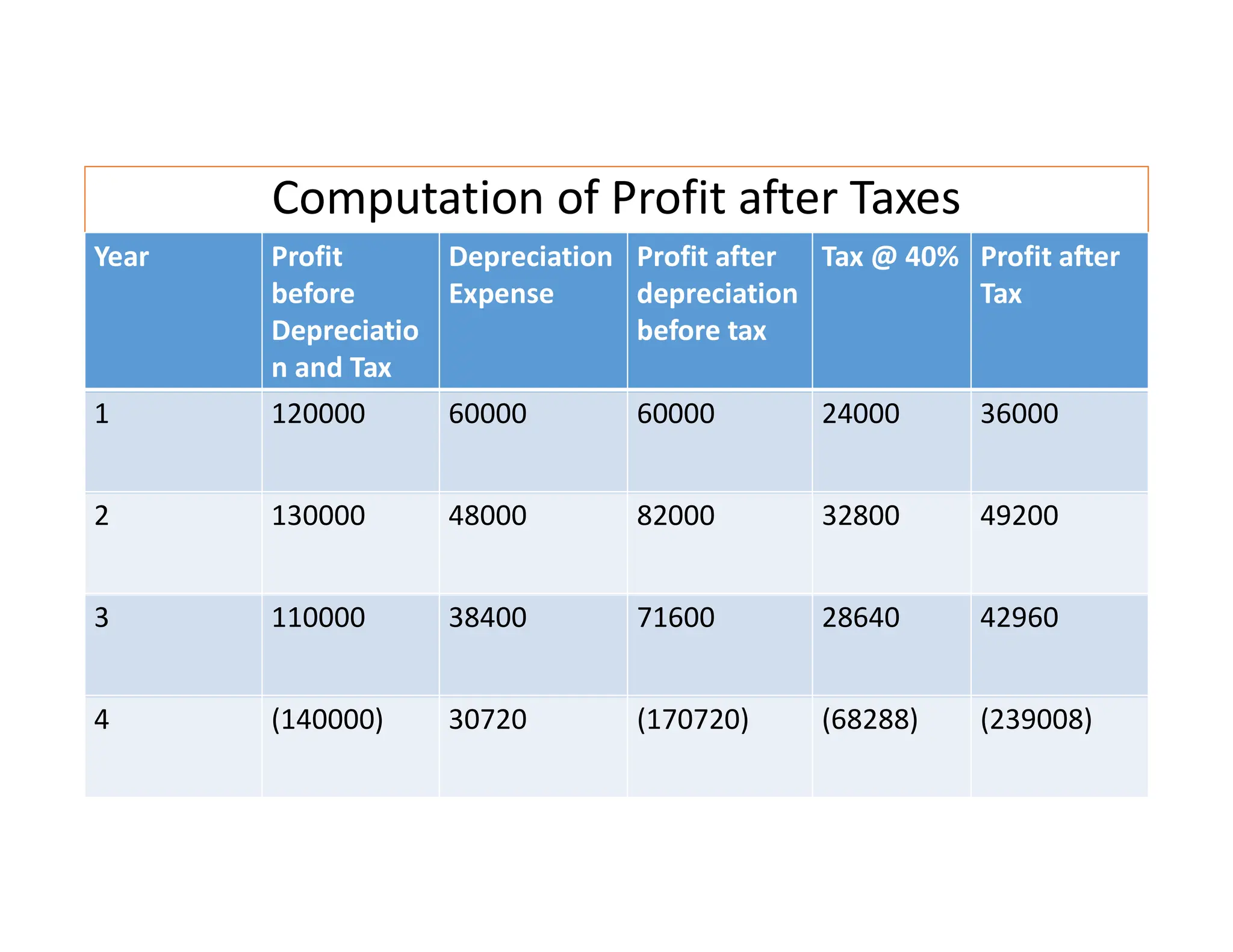
Computation of Profit after Taxes
Year Profit
before
Depreciatio
n and Tax
Depreciation
Expense
Profit after
depreciation
before tax
Tax @ 40% Profit after
Tax
1 120000 60000 60000 24000 36000
2 130000 48000 82000 32800 49200
3 110000 38400 71600 28640 42960
4 (140000) 30720 (170720) (68288) (239008)
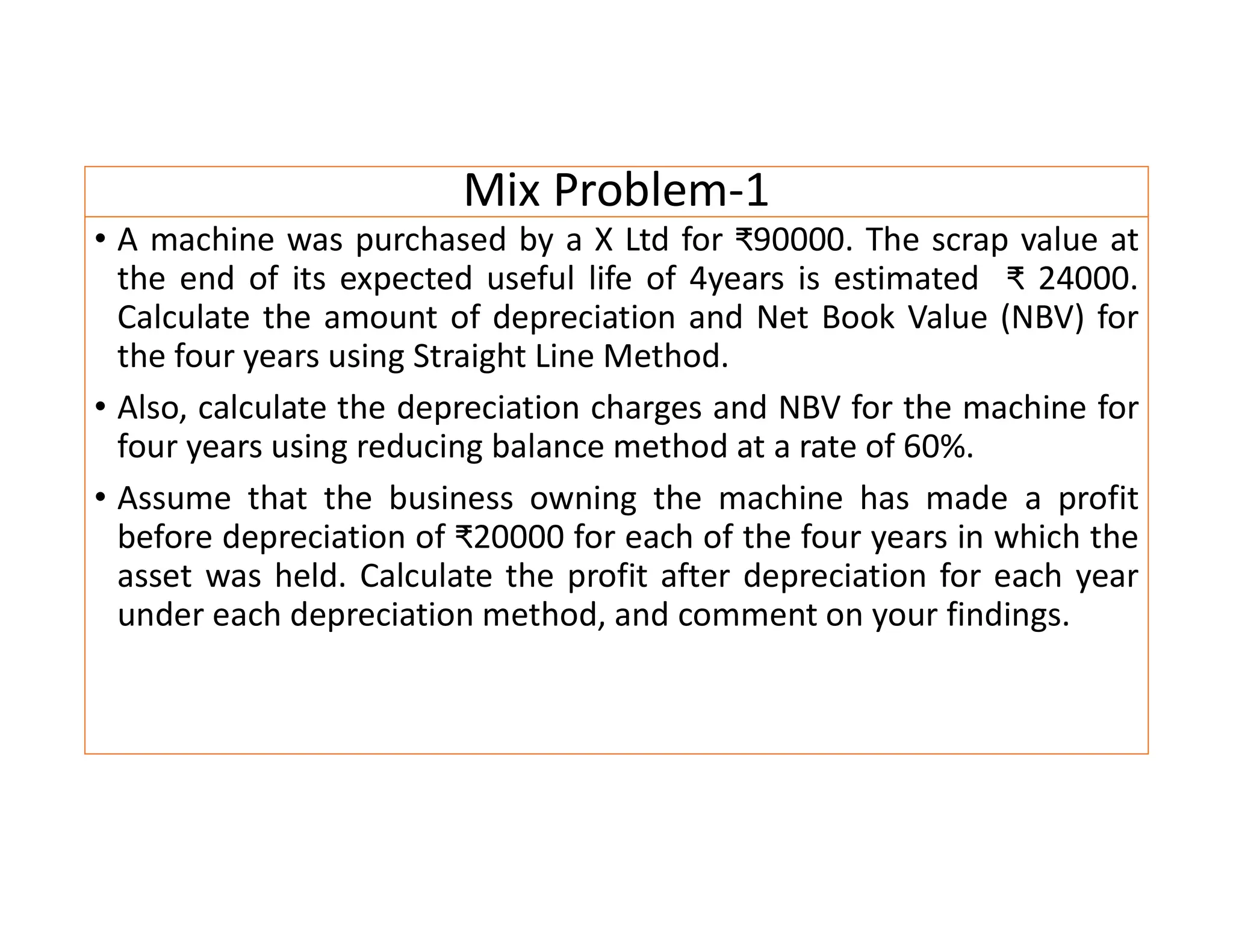
Mix Problem-1
• A machine was purchased by a X Ltd for ₹90000. The scrap value at
the end of its expected useful life of 4years is estimated ₹ 24000.
Calculate the amount of depreciation and Net Book Value (NBV) for
the four years using Straight Line Method.
• Also, calculate the depreciation charges and NBV for the machine for
four years using reducing balance method at a rate of 60%.
• Assume that the business owning the machine has made a profit
before depreciation of ₹20000 for each of the four years in which the
asset was held. Calculate the profit after depreciation for each year
under each depreciation method, and comment on your findings.
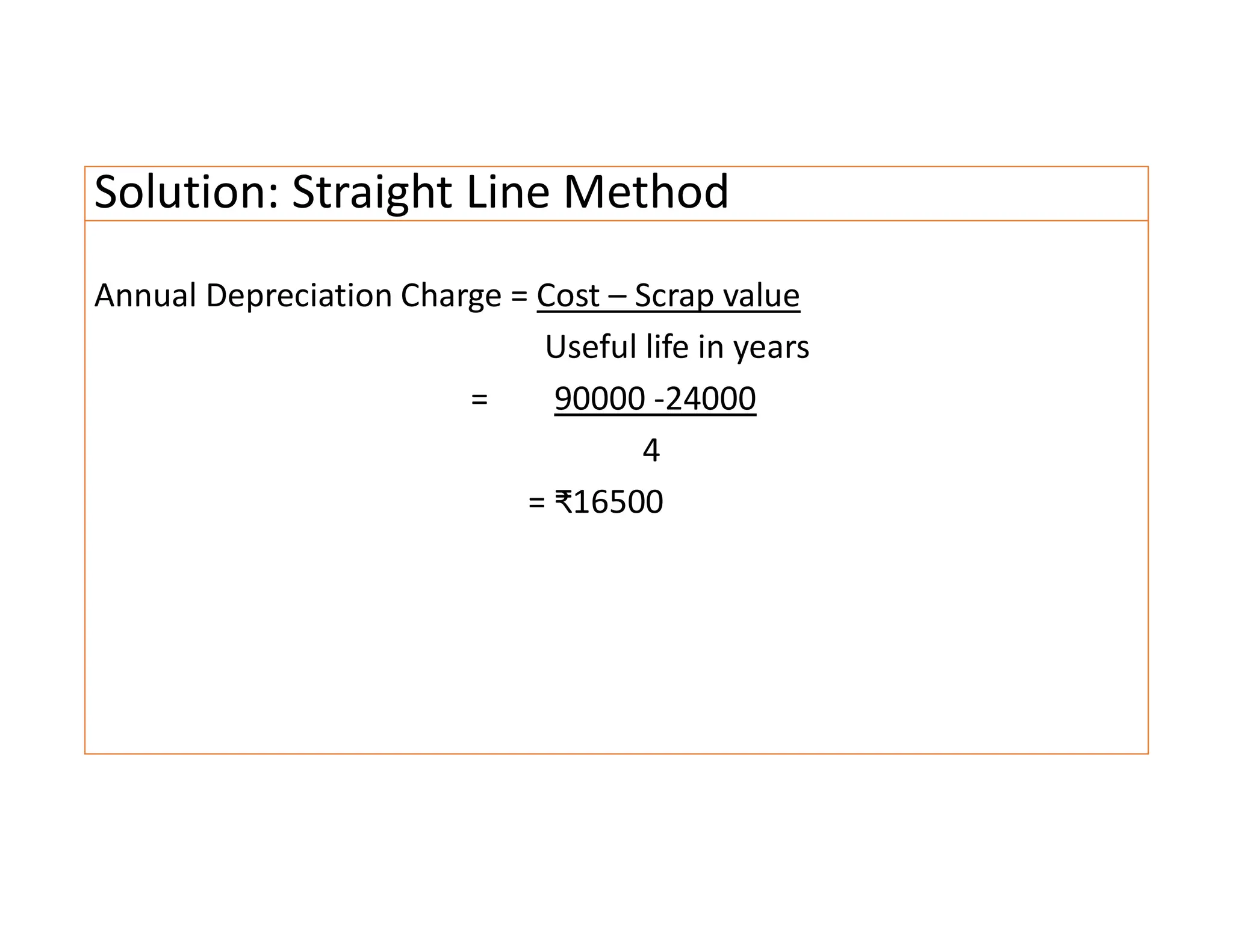
Solution: Straight Line Method
Annual Depreciation Charge = Cost – Scrap value
Useful life in years
= 90000 -24000
4
= ₹16500
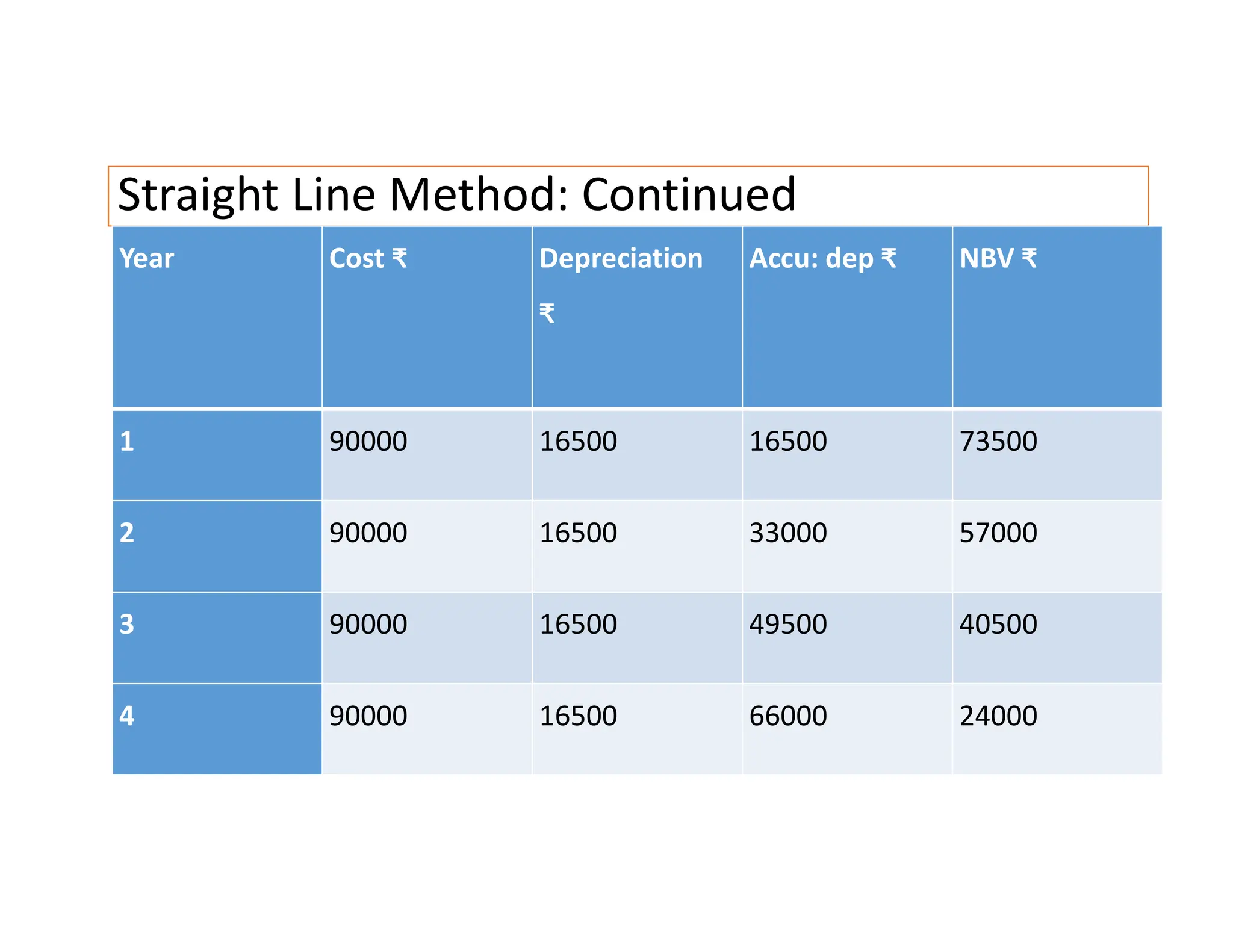
Straight Line Method: Continued
Year Cost ₹ Depreciation
₹
Accu: dep ₹ NBV ₹
1 90000 16500 16500 73500
2 90000 16500 33000 57000
3 90000 16500 49500 40500
4 90000 16500 66000 24000
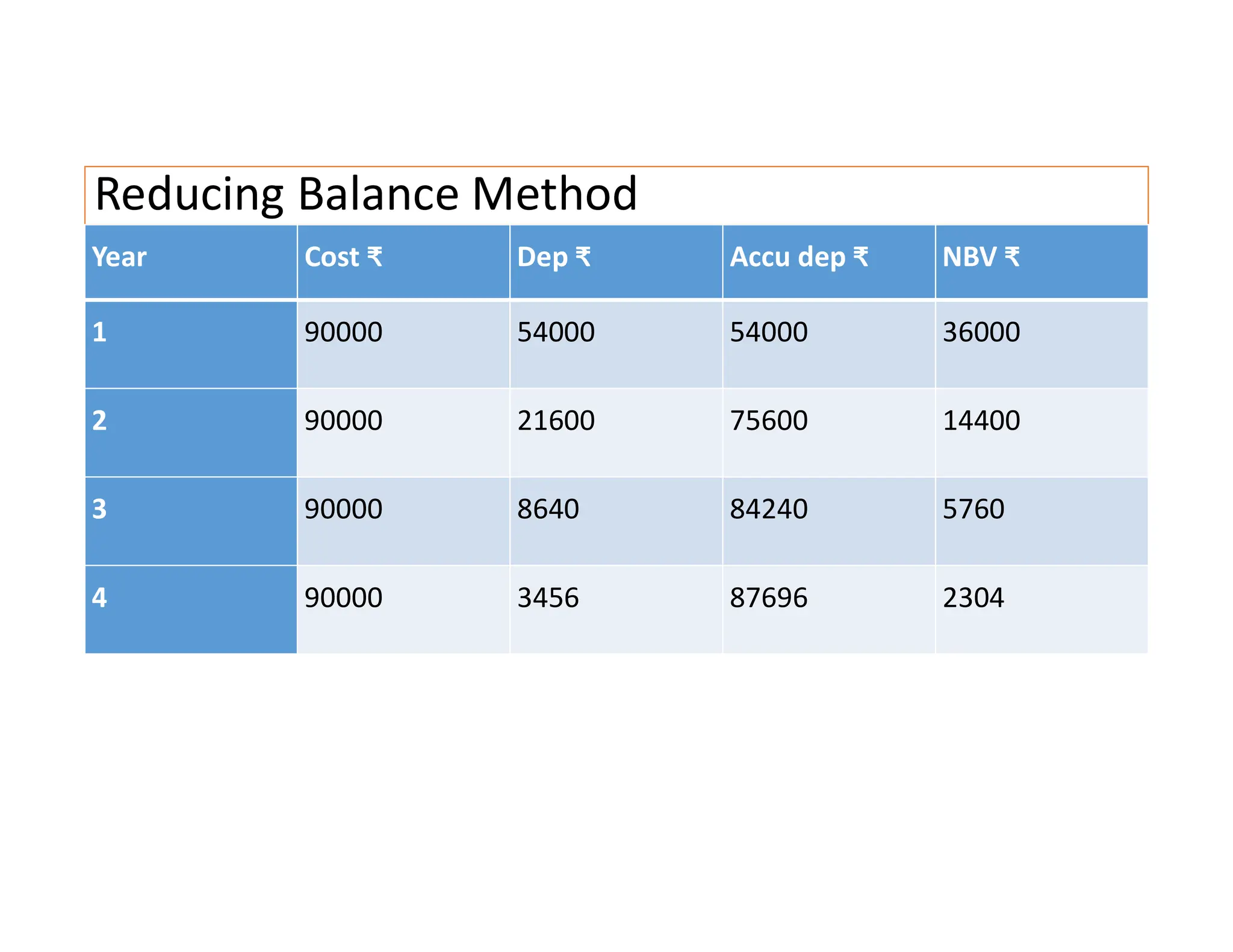
Reducing Balance Method
Year Cost ₹ Dep ₹ Accu dep ₹ NBV ₹
1 90000 54000 54000 36000
2 90000 21600 75600 14400
3 90000 8640 84240 5760
4 90000 3456 87696 2304
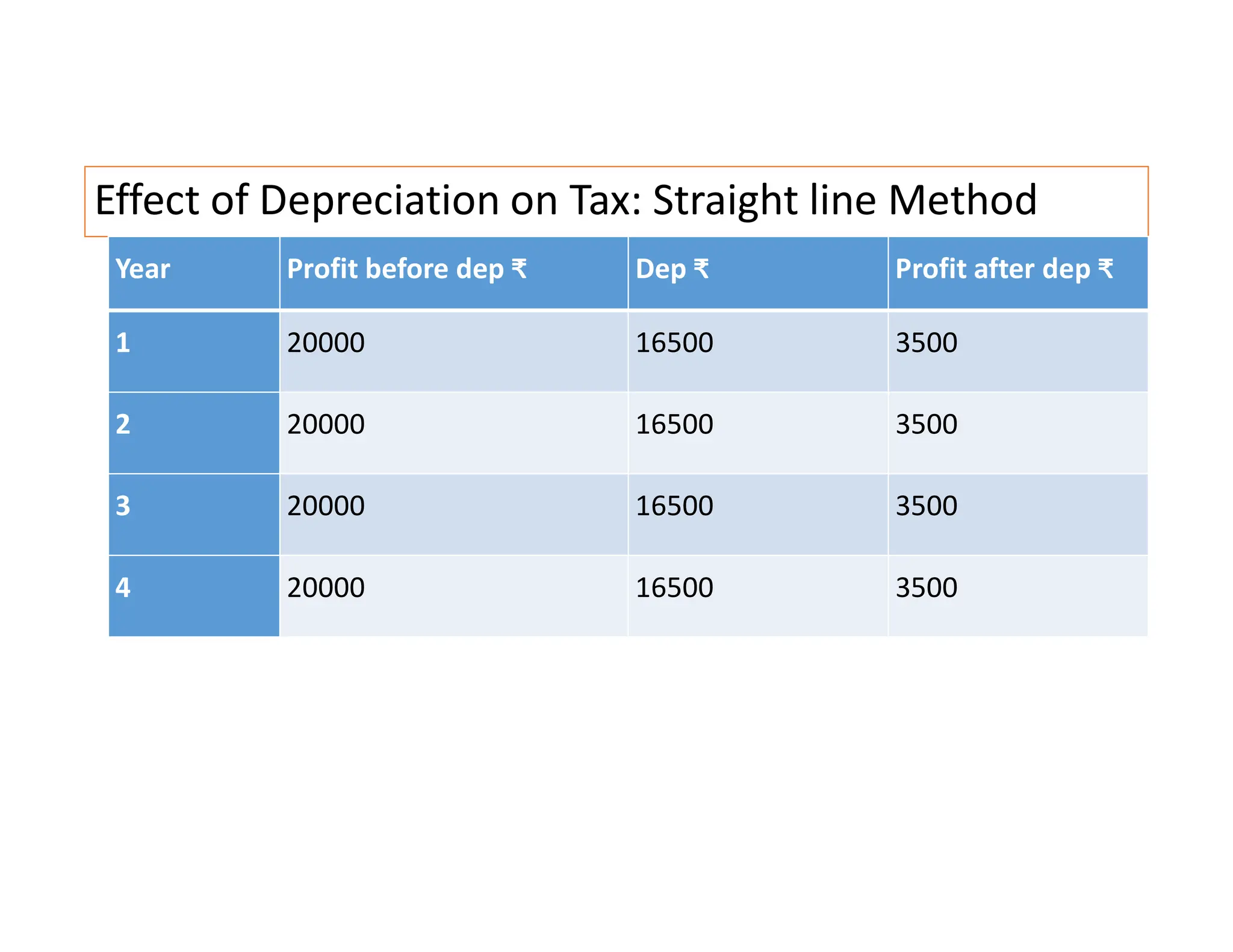
Effect of Depreciation on Tax: Straight line Method
Year Profit before dep ₹ Dep ₹ Profit after dep ₹
1 20000 16500 3500
2 20000 16500 3500
3 20000 16500 3500
4 20000 16500 3500
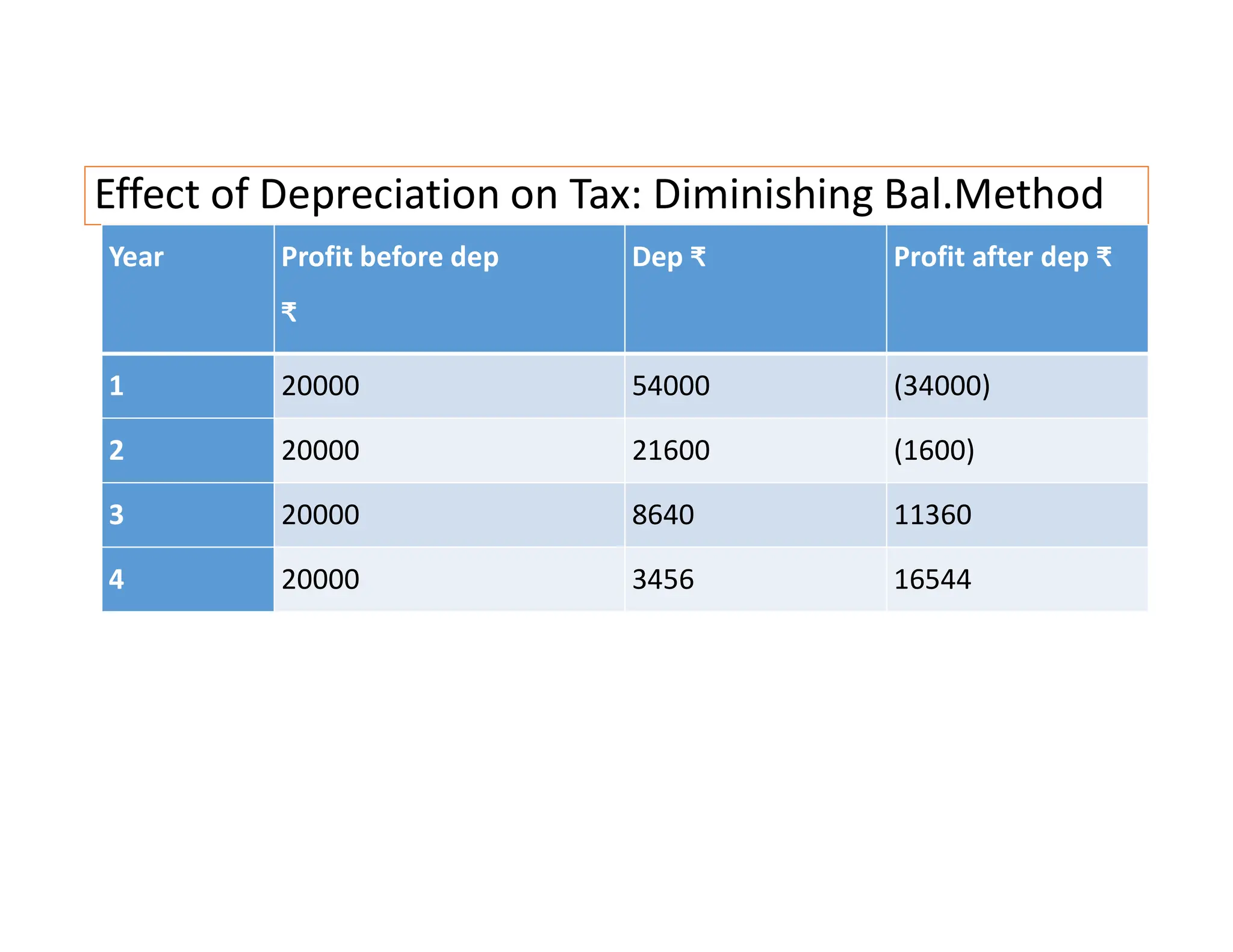
Effect of Depreciation on Tax: Diminishing Bal.Method
Year Profit before dep
₹
Dep ₹ Profit after dep ₹
1 20000 54000 (34000)
2 20000 21600 (1600)
3 20000 8640 11360
4 20000 3456 16544
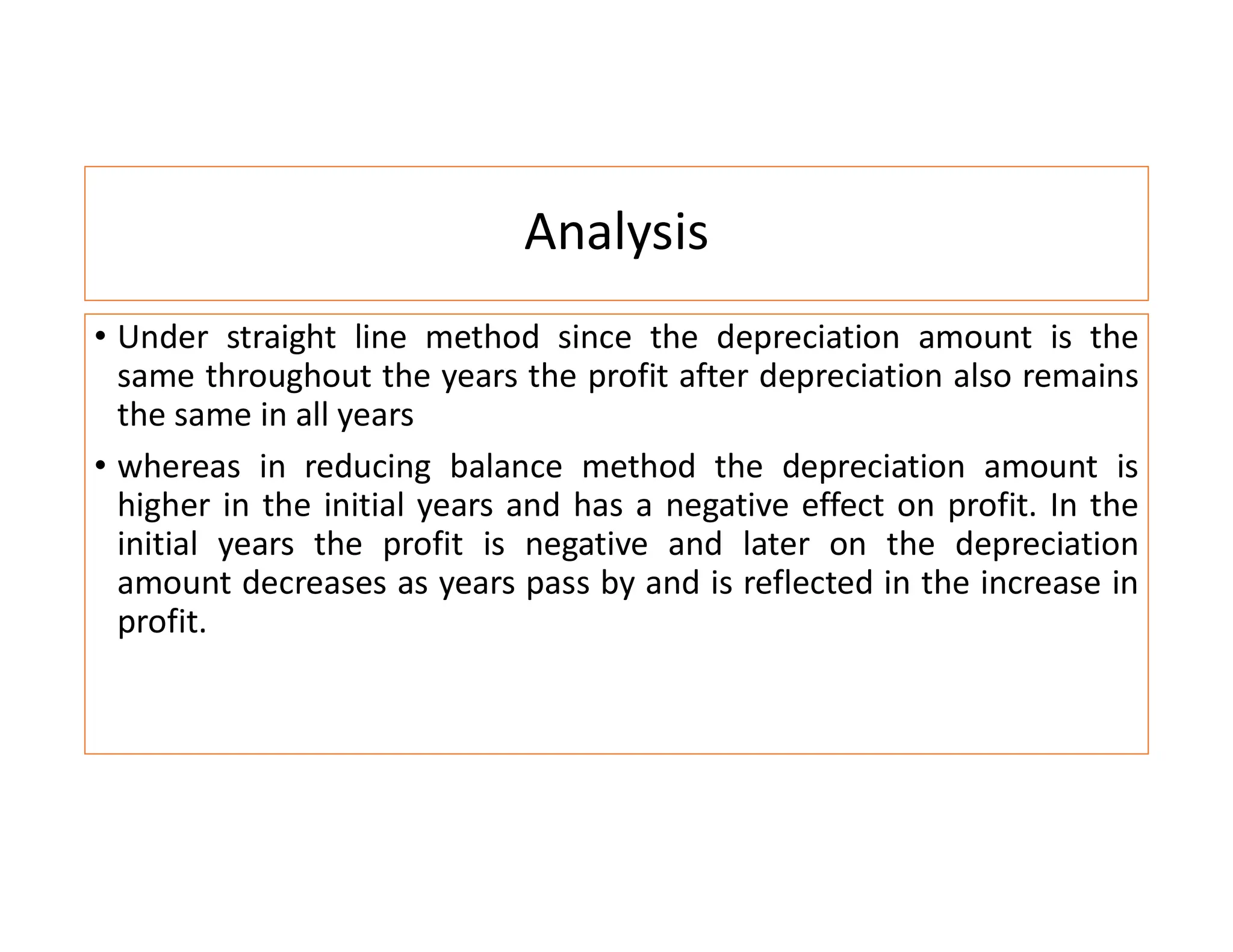
Analysis
• Under straight line method since the depreciation amount is the
same throughout the years the profit after depreciation also remains
the same in all years
• whereas in reducing balance method the depreciation amount is
higher in the initial years and has a negative effect on profit. In the
initial years the profit is negative and later on the depreciation
amount decreases as years pass by and is reflected in the increase in
profit.
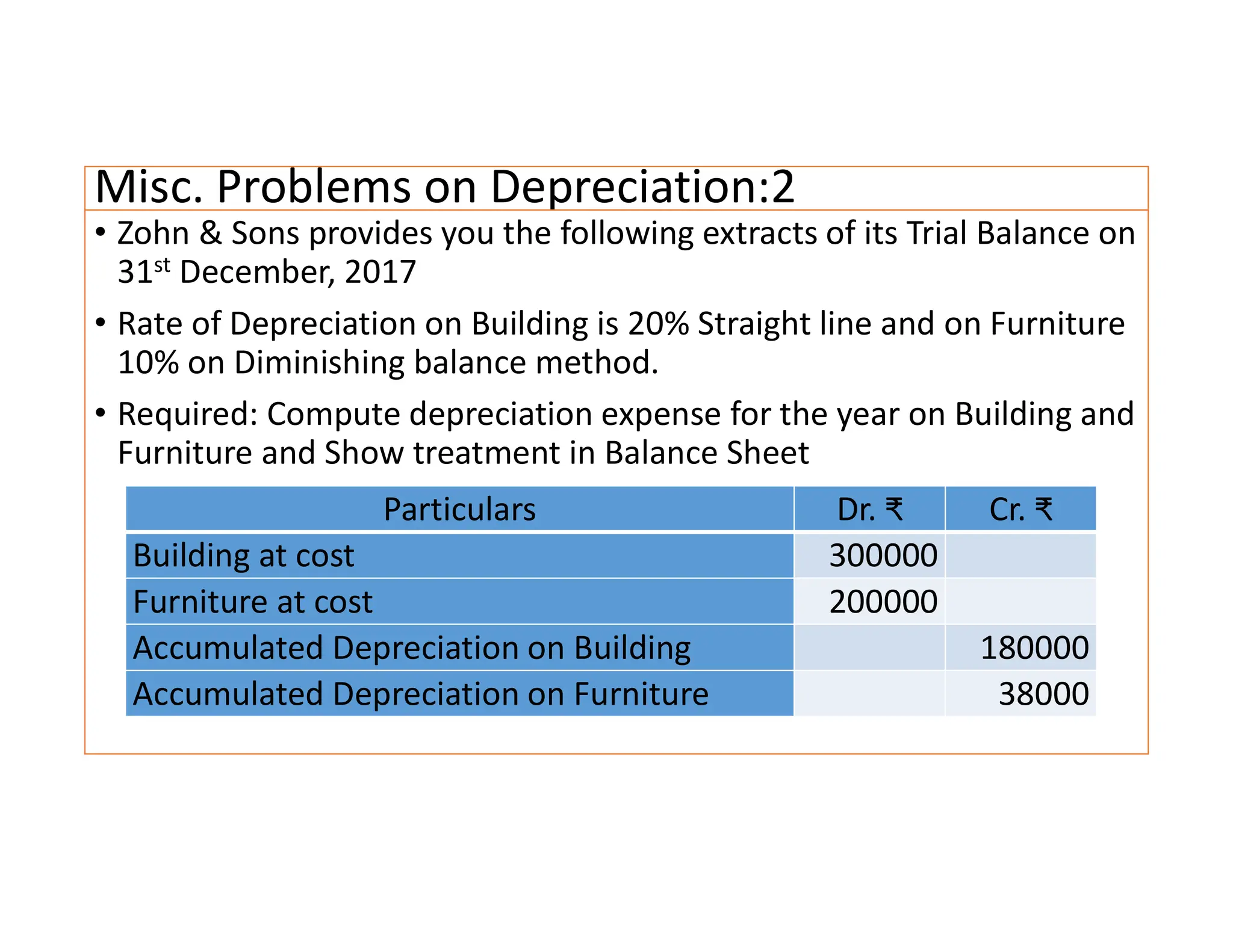
Misc. Problems on Depreciation:2
• Zohn & Sons provides you the following extracts of its Trial Balance on
31st December, 2017
• Rate of Depreciation on Building is 20% Straight line and on Furniture
10% on Diminishing balance method.
• Required: Compute depreciation expense for the year on Building and
Furniture and Show treatment in Balance Sheet
Particulars Dr. ₹ Cr. ₹
Building at cost 300000
Furniture at cost 200000
Accumulated Depreciation on Building 180000
Accumulated Depreciation on Furniture 38000
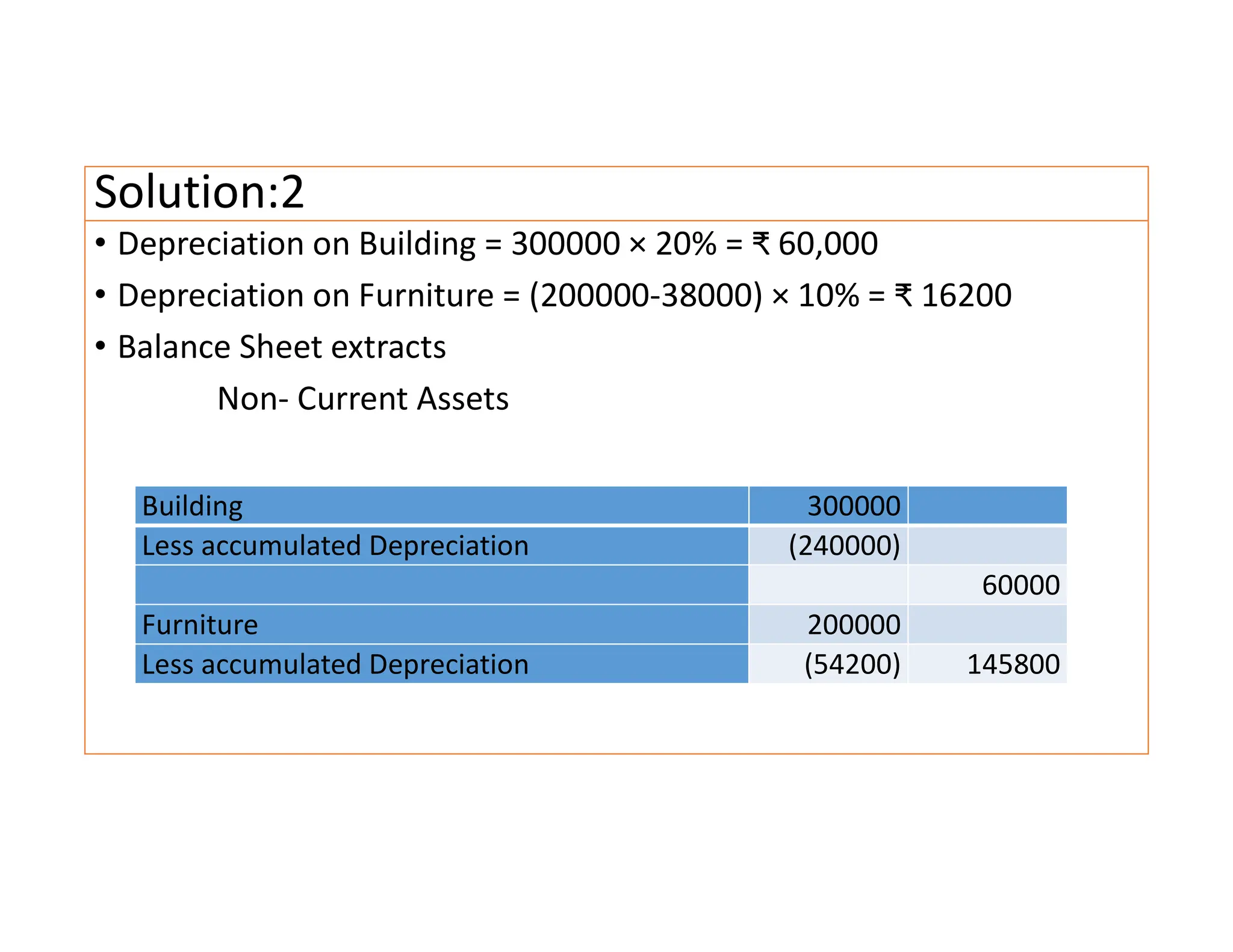
Solution:2
• Depreciation on Building = 300000 × 20% = ₹ 60,000
• Depreciation on Furniture = (200000-38000) × 10% = ₹ 16200
• Balance Sheet extracts
Non- Current Assets
Building 300000
Less accumulated Depreciation (240000)
60000
Furniture 200000
Less accumulated Depreciation (54200) 145800
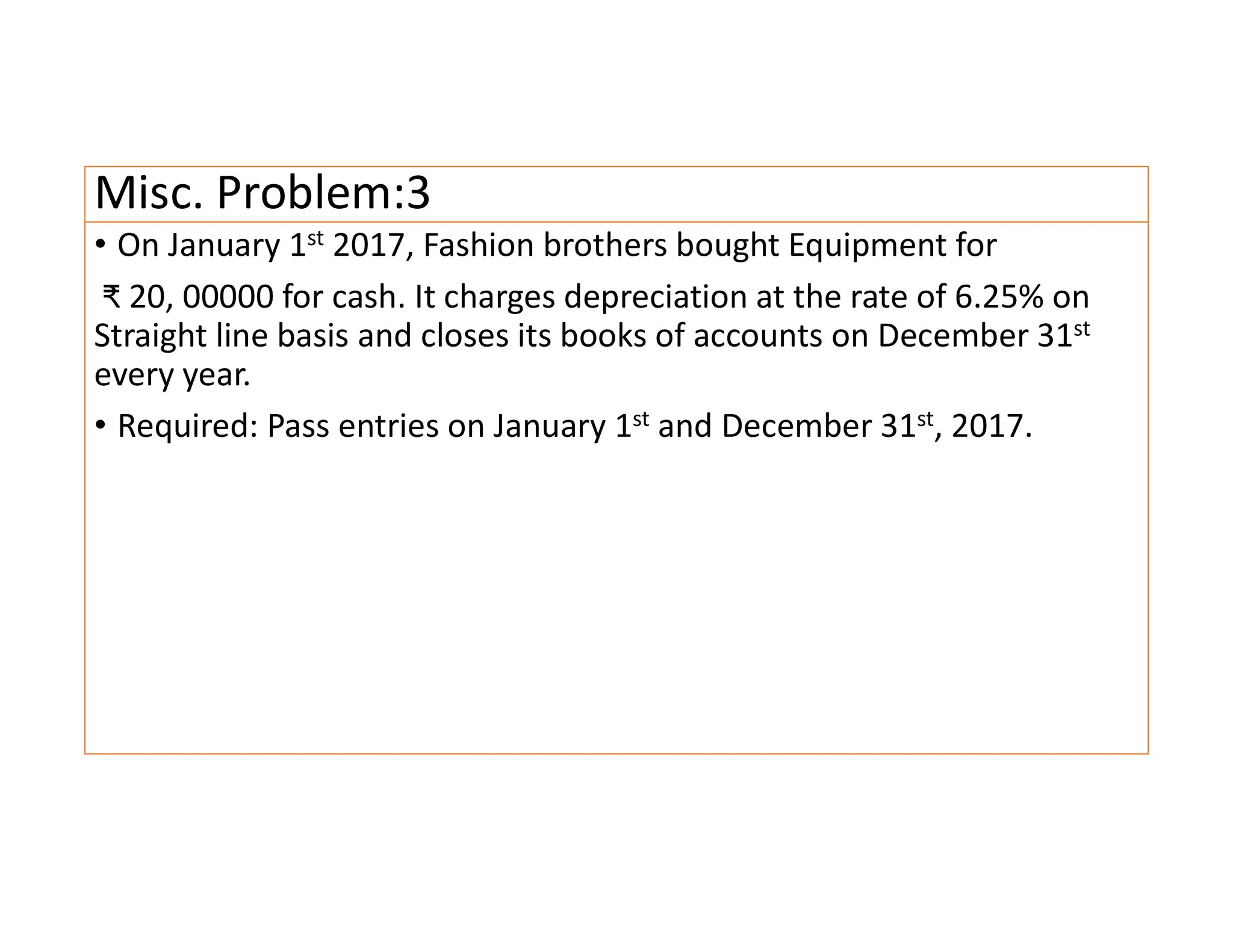
Misc. Problem:3
• On January 1st 2017, Fashion brothers bought Equipment for
₹ 20, 00000 for cash. It charges depreciation at the rate of 6.25% on
Straight line basis and closes its books of accounts on December 31st
every year.
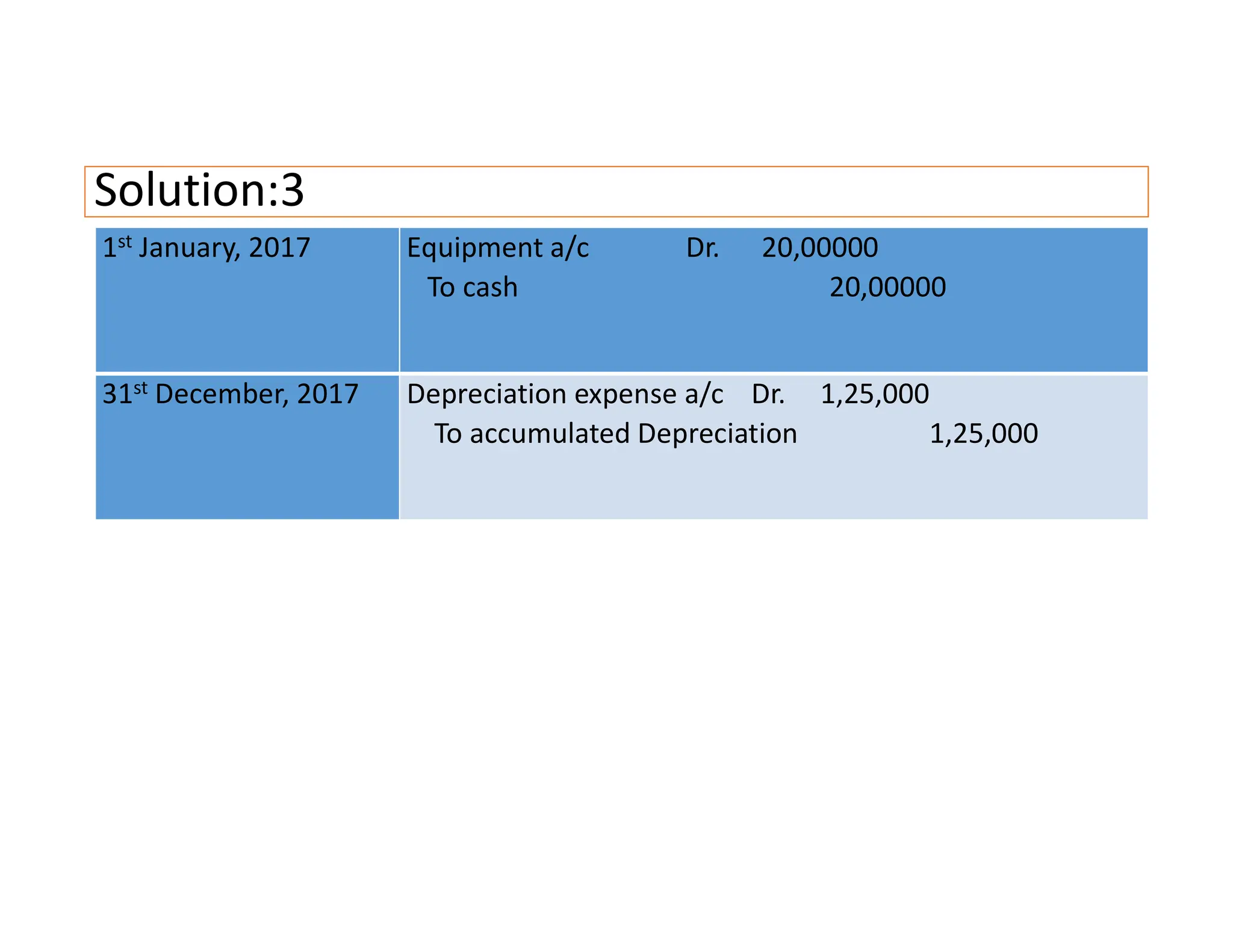
• Required: Pass entries on January 1st and December 31st, 2017.
Solution:3
1st January, 2017 Equipment a/c Dr. 20,00000
To cash 20,00000
31st December, 2017 Depreciation expense a/c Dr. 1,25,000
To accumulated Depreciation 1,25,000
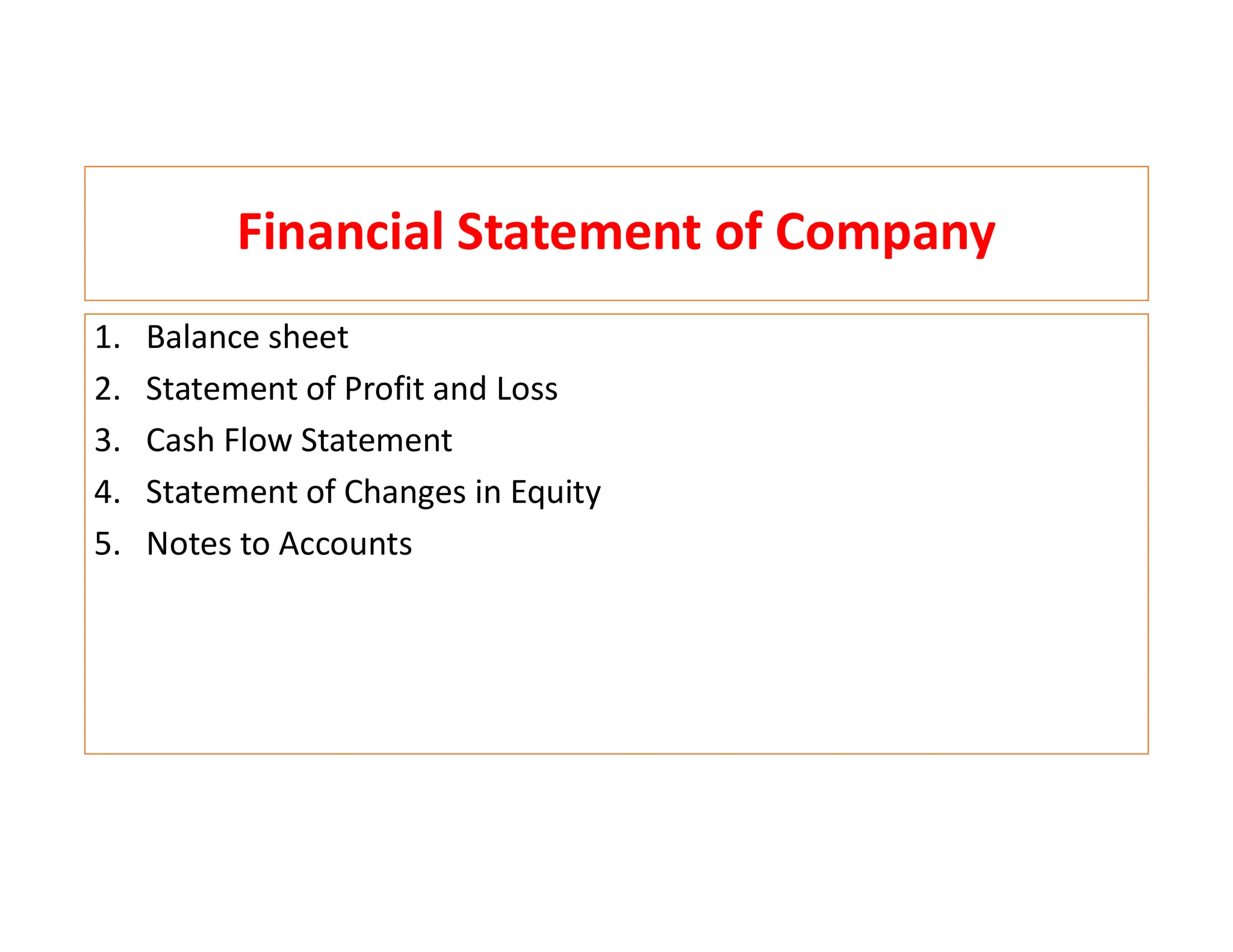
Financial Statement of Company
1. Balance sheet
2. Statement of Profit and Loss
3. Cash Flow Statement
4. Statement of Changes in Equity
5. Notes to Accounts
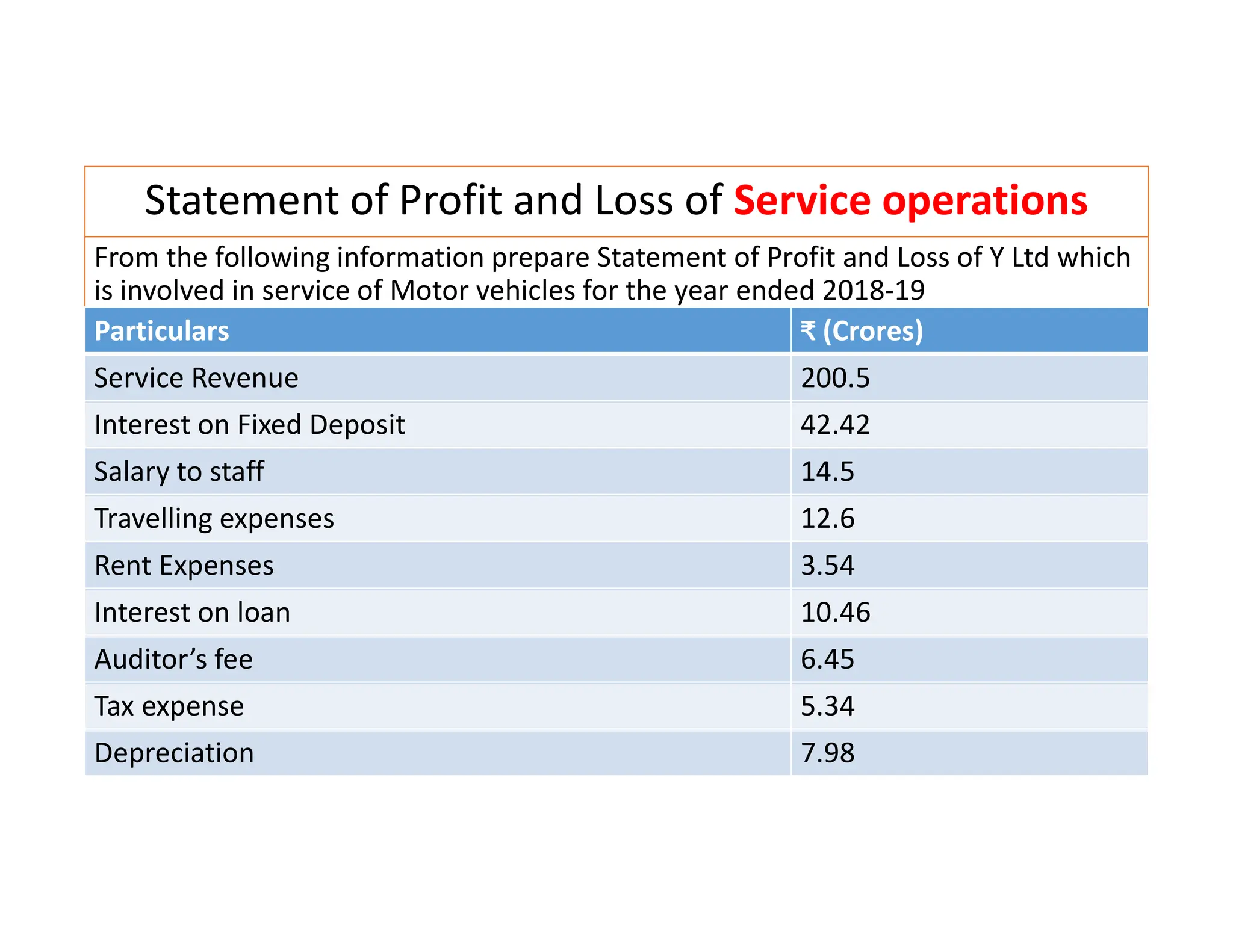
Statement of Profit and Loss of Service operations
From the following information prepare Statement of Profit and Loss of Y Ltd which
is involved in service of Motor vehicles for the year ended 2018-19
Particulars ₹ (Crores)
Service Revenue 200.5
Interest on Fixed Deposit 42.42
Salary to staff 14.5
Travelling expenses 12.6
Rent Expenses 3.54
Interest on loan 10.46
Auditor’s fee 6.45
Tax expense 5.34
Depreciation 7.98
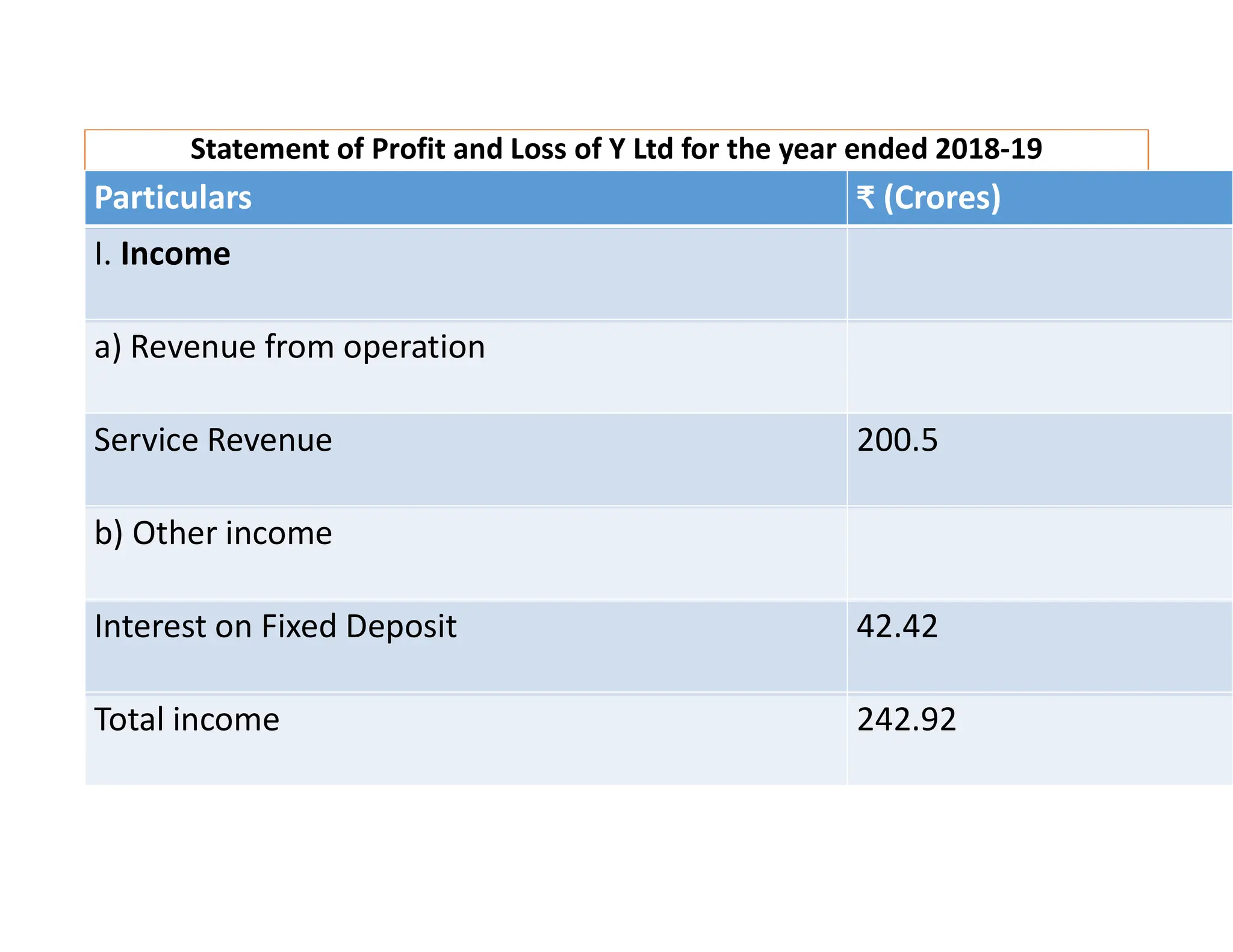
Statement of Profit and Loss of Y Ltd for the year ended 2018-19
Particulars ₹ (Crores)
I. Income
a) Revenue from operation
Service Revenue 200.5
b) Other income
Interest on Fixed Deposit 42.42
Total income 242.92
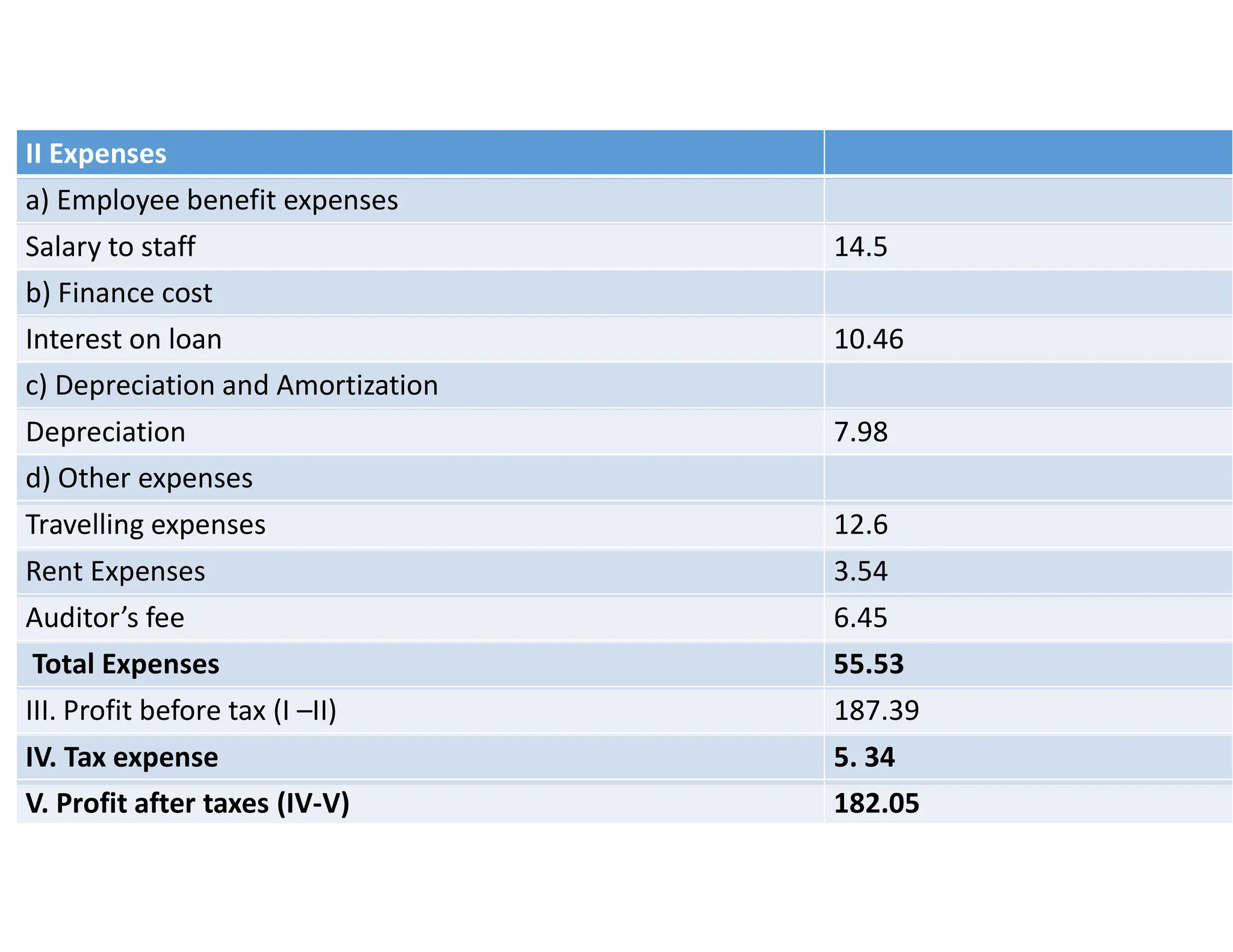
II Expenses
a) Employee benefit expenses
Salary to staff 14.5
b) Finance cost
Interest on loan 10.46
c) Depreciation and Amortization
Depreciation 7.98
d) Other expenses
Travelling expenses 12.6
Rent Expenses 3.54
Auditor’s fee 6.45
Total Expenses 55.53
III. Profit before tax (I –II) 187.39
IV. Tax expense 5. 34
V. Profit after taxes (IV-V) 182.05
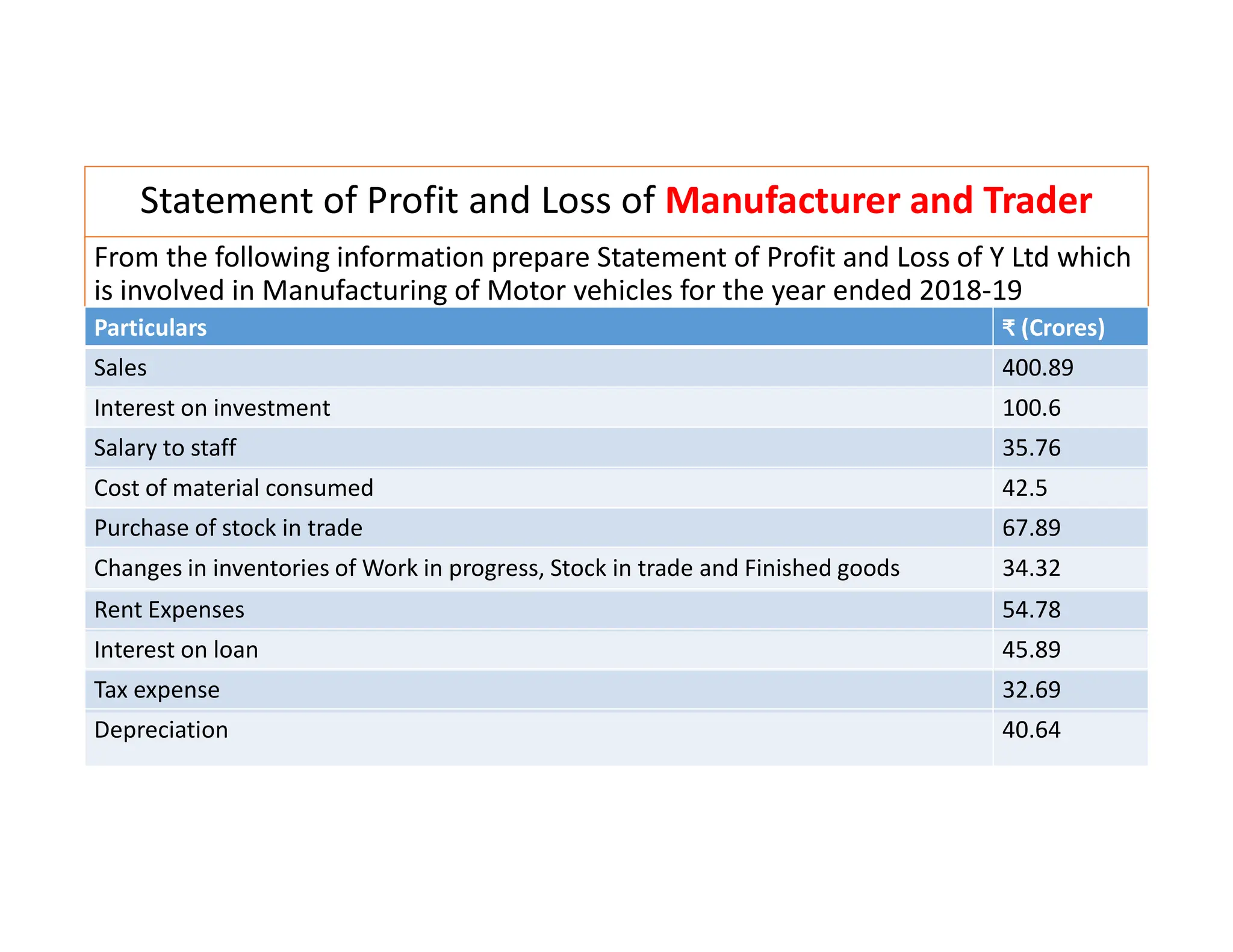
Statement of Profit and Loss of Manufacturer and Trader
From the following information prepare Statement of Profit and Loss of Y Ltd which
is involved in Manufacturing of Motor vehicles for the year ended 2018-19
Particulars ₹ (Crores)
Sales 400.89
Interest on investment 100.6
Salary to staff 35.76
Cost of material consumed 42.5
Purchase of stock in trade 67.89
Changes in inventories of Work in progress, Stock in trade and Finished goods 34.32
Rent Expenses 54.78
Interest on loan 45.89
Tax expense 32.69
Depreciation 40.64
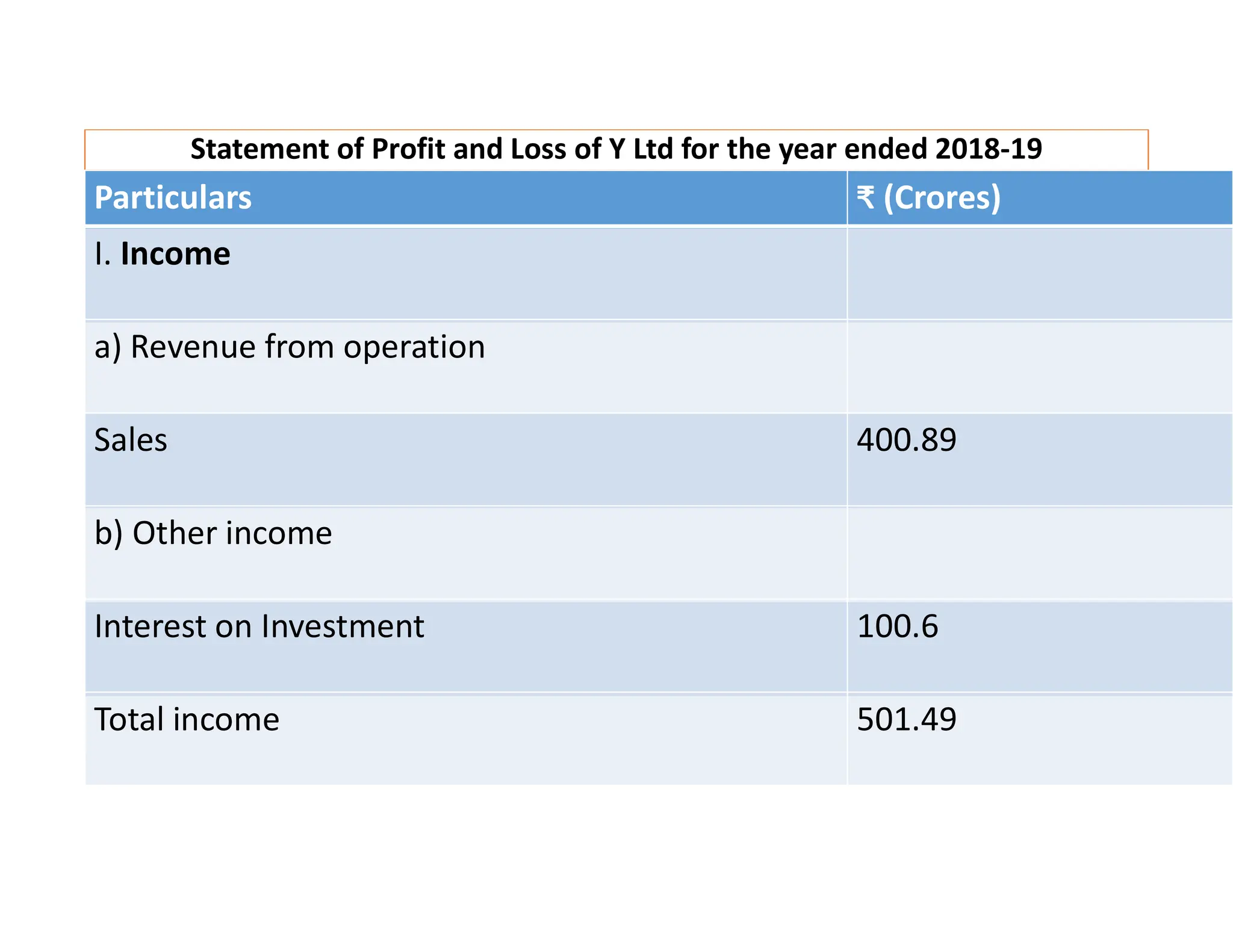
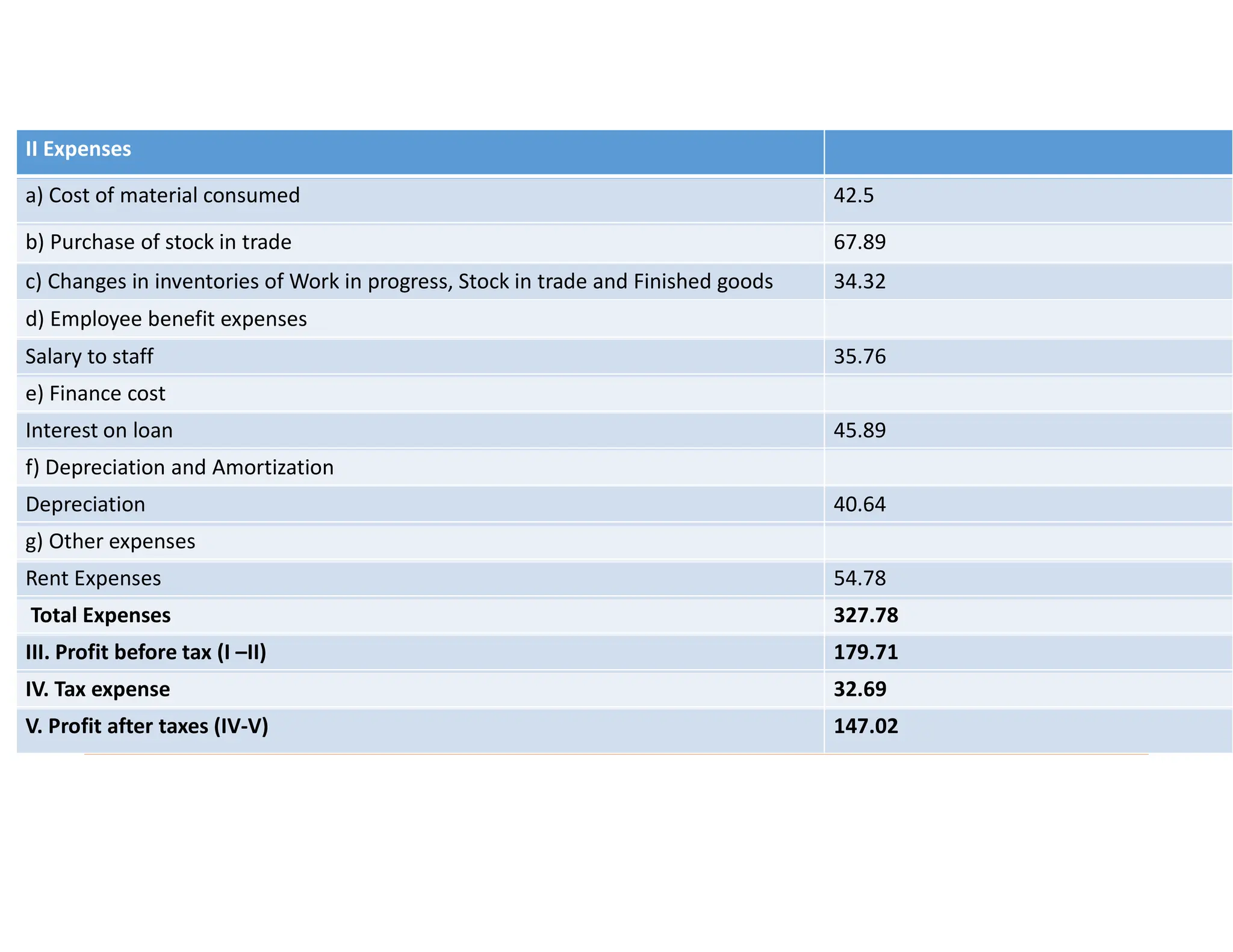
Statement of Profit and Loss of Y Ltd for the year ended 2018-19
Particulars ₹ (Crores)
I. Income
a) Revenue from operation
Sales 400.89
b) Other income
Interest on Investment 100.6
Total income 501.49
II Expenses
a) Cost of material consumed 42.5
b) Purchase of stock in trade 67.89
c) Changes in inventories of Work in progress, Stock in trade and Finished goods 34.32
d) Employee benefit expenses
Salary to staff 35.76
e) Finance cost
Interest on loan 45.89
f) Depreciation and Amortization
Depreciation 40.64
g) Other expenses
Rent Expenses 54.78
Total Expenses 327.78
III. Profit before tax (I –II) 179.71
IV. Tax expense 32.69
V. Profit after taxes (IV-V) 147.02
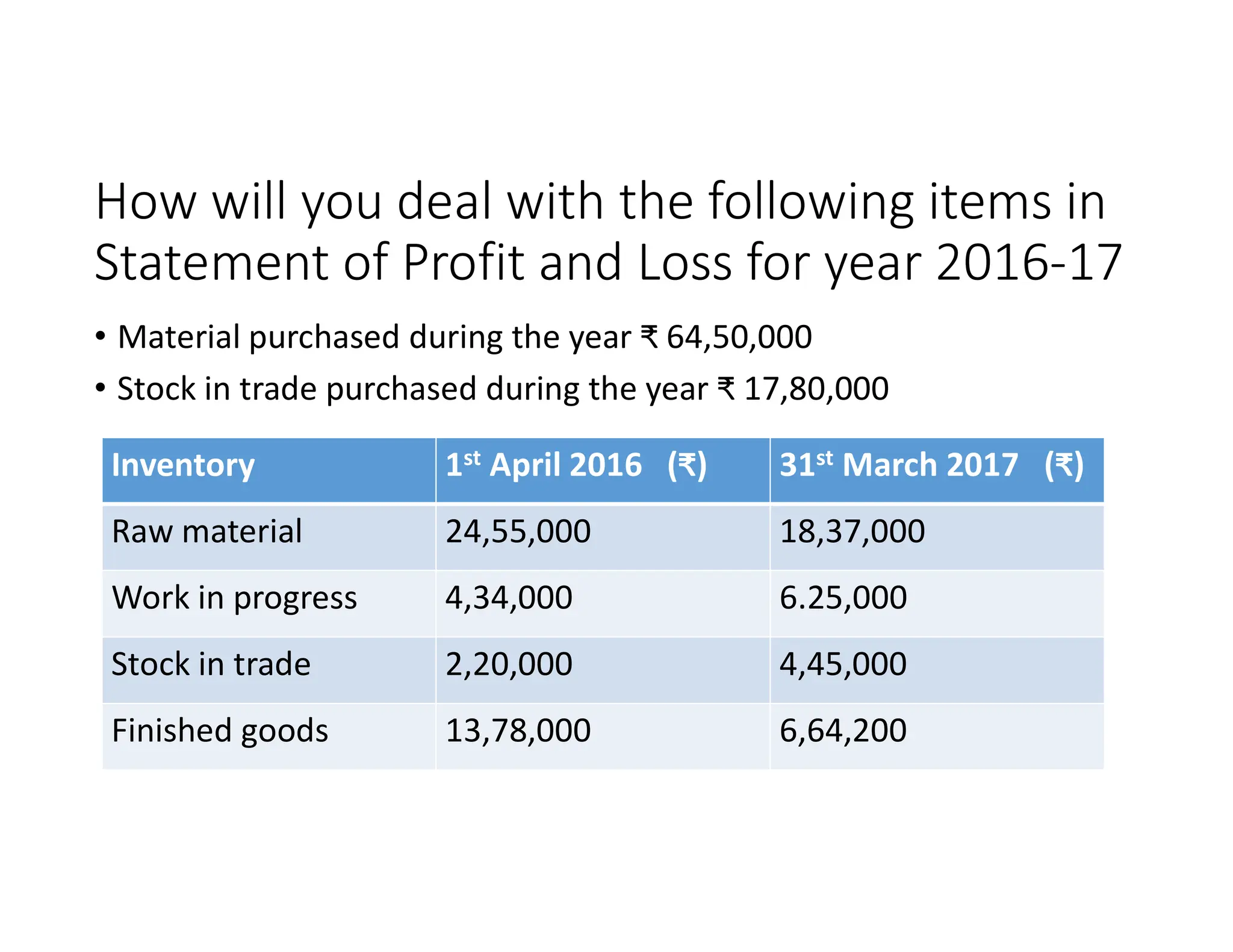
How will you deal with the following items in
Statement of Profit and Loss for year 2016-17
• Material purchased during the year ₹ 64,50,000
• Stock in trade purchased during the year ₹ 17,80,000
Inventory 1st April 2016 (₹) 31st March 2017 (₹)
Raw material 24,55,000 18,37,000
Work in progress 4,34,000 6.25,000
Stock in trade 2,20,000 4,45,000
Finished goods 13,78,000 6,64,200
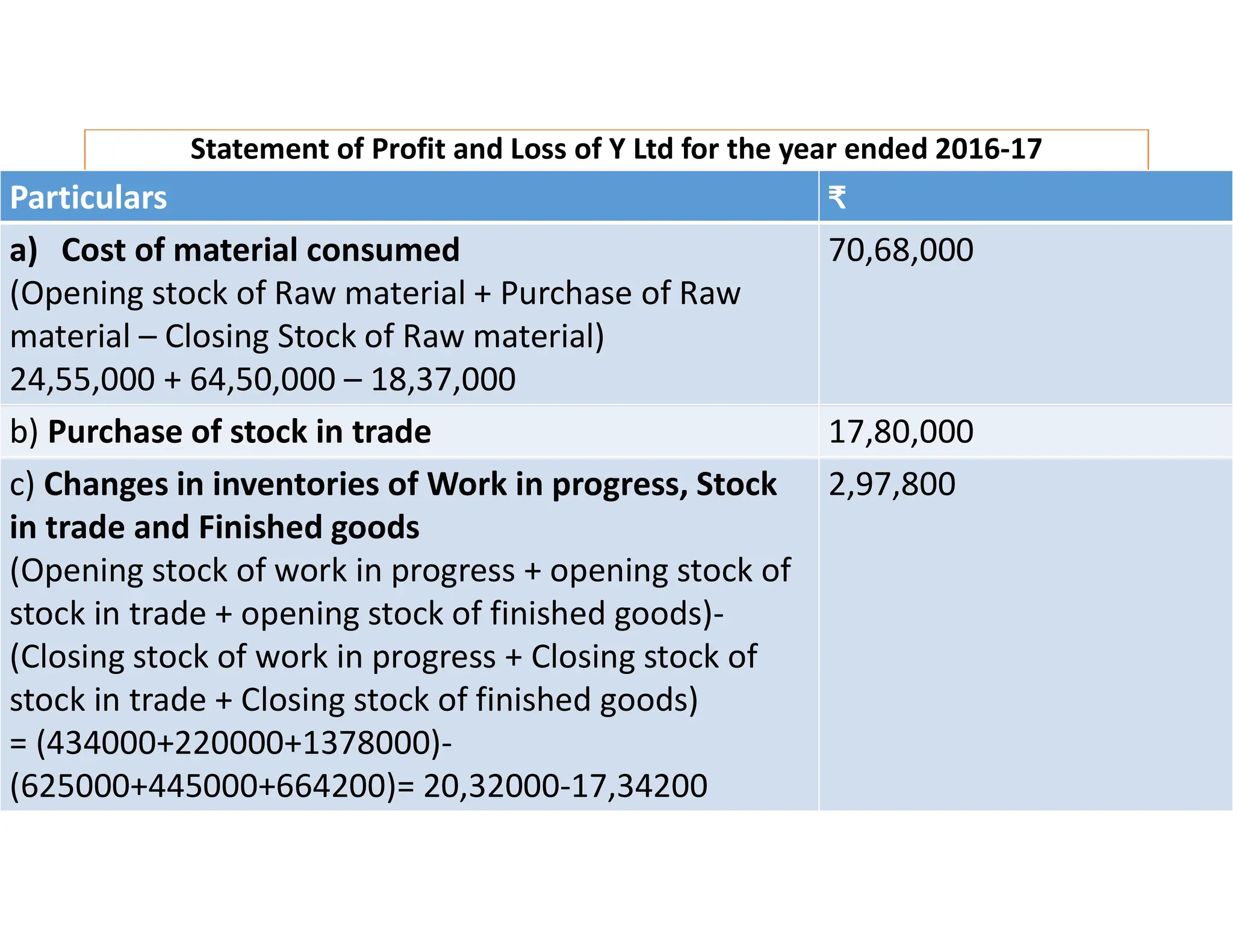
Statement of Profit and Loss of Y Ltd for the year ended 2016-17
Particulars ₹
a) Cost of material consumed
(Opening stock of Raw material + Purchase of Raw
material – Closing Stock of Raw material)
24,55,000 + 64,50,000 – 18,37,000
70,68,000
b) Purchase of stock in trade 17,80,000
c) Changes in inventories of Work in progress, Stock
in trade and Finished goods
(Opening stock of work in progress + opening stock of
stock in trade + opening stock of finished goods)-
(Closing stock of work in progress + Closing stock of
stock in trade + Closing stock of finished goods)
= (434000+220000+1378000)-
(625000+445000+664200)= 20,32000-17,34200
2,97,800
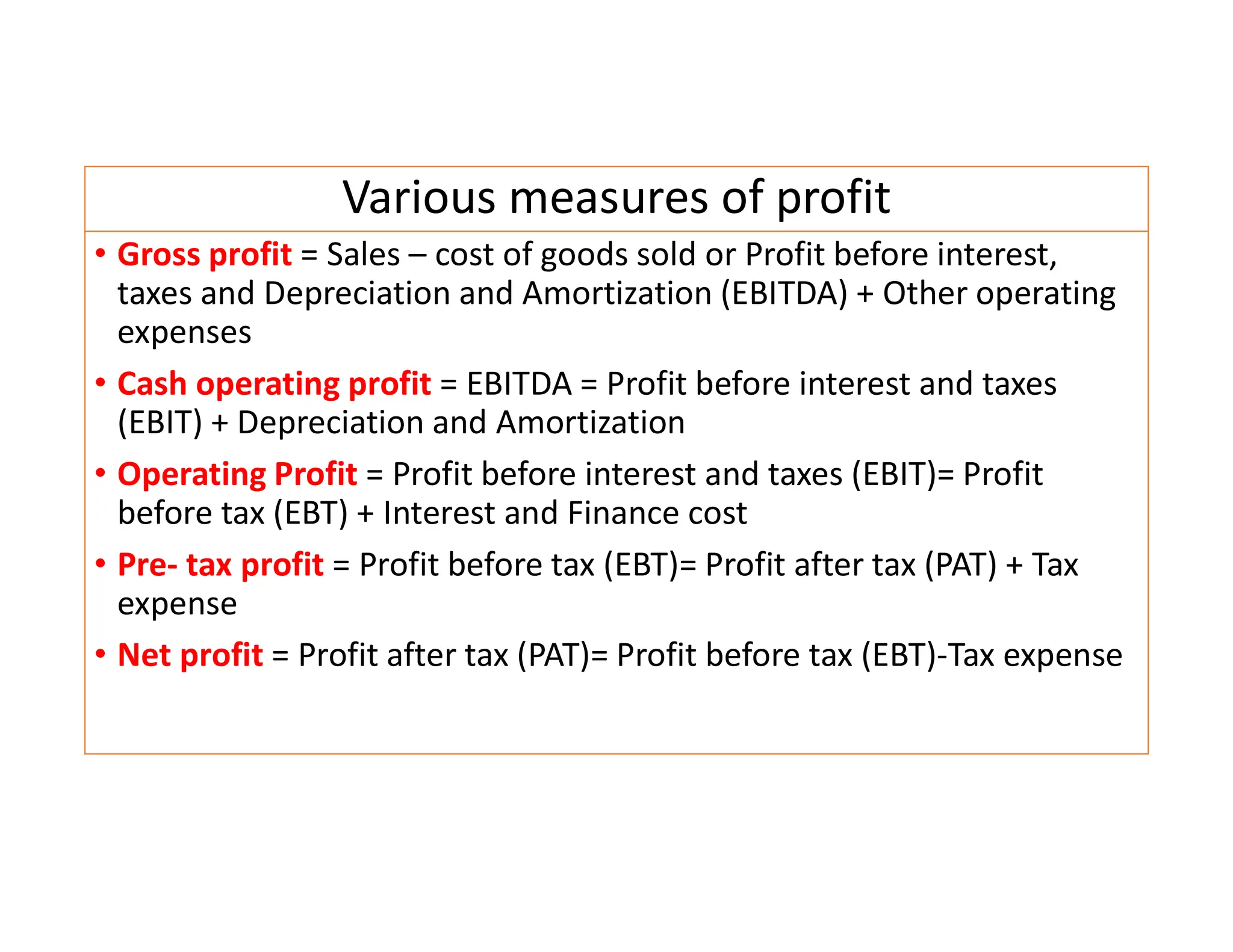
Various measures of profit
• Gross profit = Sales – cost of goods sold or Profit before interest,
taxes and Depreciation and Amortization (EBITDA) + Other operating
expenses
• Cash operating profit = EBITDA = Profit before interest and taxes
(EBIT) + Depreciation and Amortization
• Operating Profit = Profit before interest and taxes (EBIT)= Profit
before tax (EBT) + Interest and Finance cost
• Pre- tax profit = Profit before tax (EBT)= Profit after tax (PAT) + Tax
expense
• Net profit = Profit after tax (PAT)= Profit before tax (EBT)-Tax expense
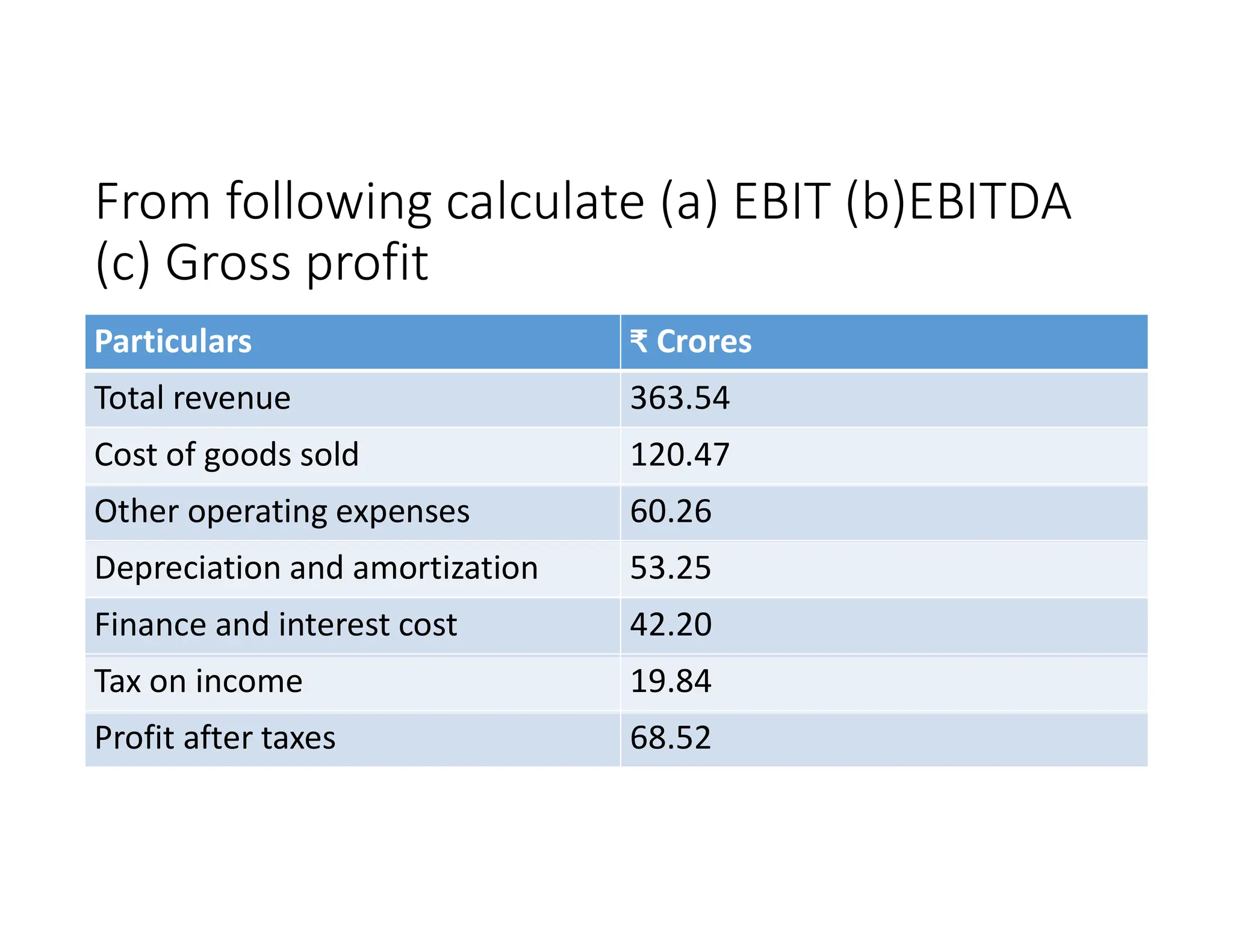
From following calculate (a) EBIT (b)EBITDA
(c) Gross profit
Particulars ₹ Crores
Total revenue 363.54
Cost of goods sold 120.47
Other operating expenses 60.26
Depreciation and amortization 53.25
Finance and interest cost 42.20
Tax on income 19.84
Profit after taxes 68.52
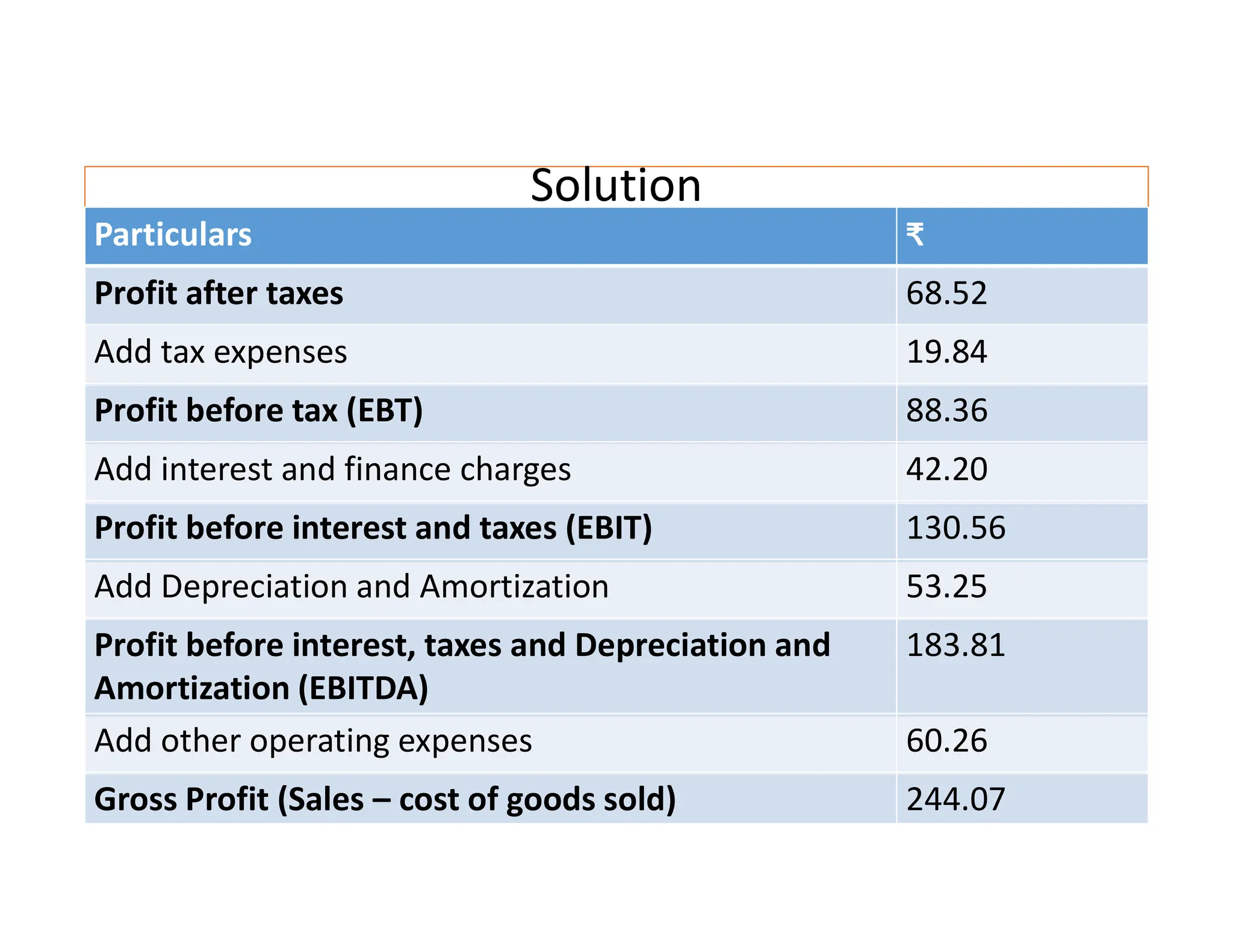
Solution
Particulars ₹
Profit after taxes 68.52
Add tax expenses 19.84
Profit before tax (EBT) 88.36
Add interest and finance charges 42.20
Profit before interest and taxes (EBIT) 130.56
Add Depreciation and Amortization 53.25
Profit before interest, taxes and Depreciation and
Amortization (EBITDA)
183.81
Add other operating expenses 60.26
Gross Profit (Sales – cost of goods sold) 244.07
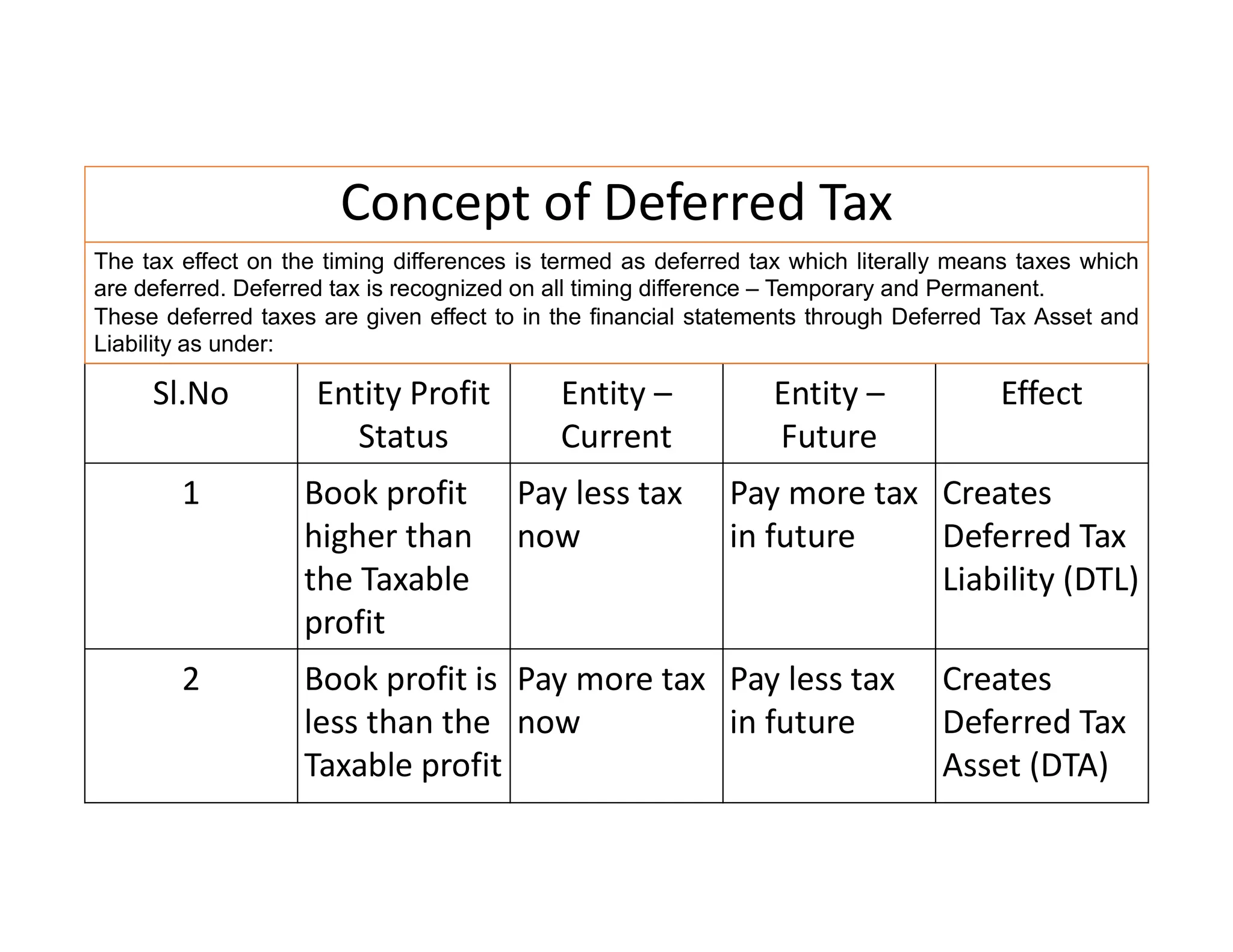
Concept of Deferred Tax
Sl.No Entity Profit
Status
Entity –
Current
Entity –
Future
Effect
1 Book profit
higher than
the Taxable
profit
Pay less tax
now
Pay more tax
in future
Creates
Deferred Tax
Liability (DTL)
2 Book profit is
less than the
Taxable profit
Pay more tax
now
Pay less tax
in future
Creates
Deferred Tax
Asset (DTA)
The tax effect on the timing differences is termed as deferred tax which literally means taxes which
are deferred. Deferred tax is recognized on all timing difference – Temporary and Permanent.
These deferred taxes are given effect to in the financial statements through Deferred Tax Asset and
Liability as under:
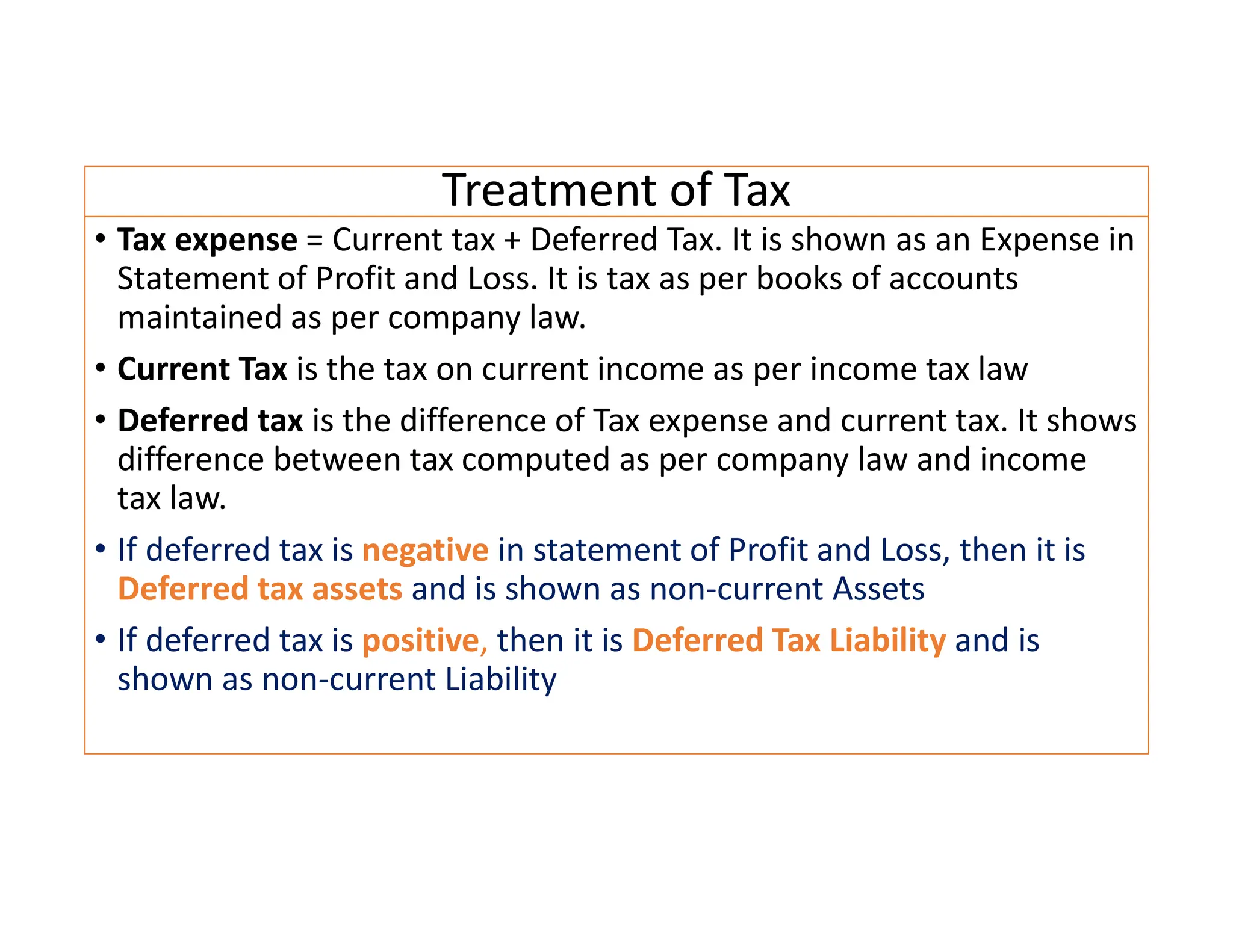
Treatment of Tax
• Tax expense = Current tax + Deferred Tax. It is shown as an Expense in
Statement of Profit and Loss. It is tax as per books of accounts
maintained as per company law.
• Current Tax is the tax on current income as per income tax law
• Deferred tax is the difference of Tax expense and current tax. It shows
difference between tax computed as per company law and income
tax law.
• If deferred tax is negative in statement of Profit and Loss, then it is
Deferred tax assets and is shown as non-current Assets
• If deferred tax is positive, then it is Deferred Tax Liability and is
shown as non-current Liability
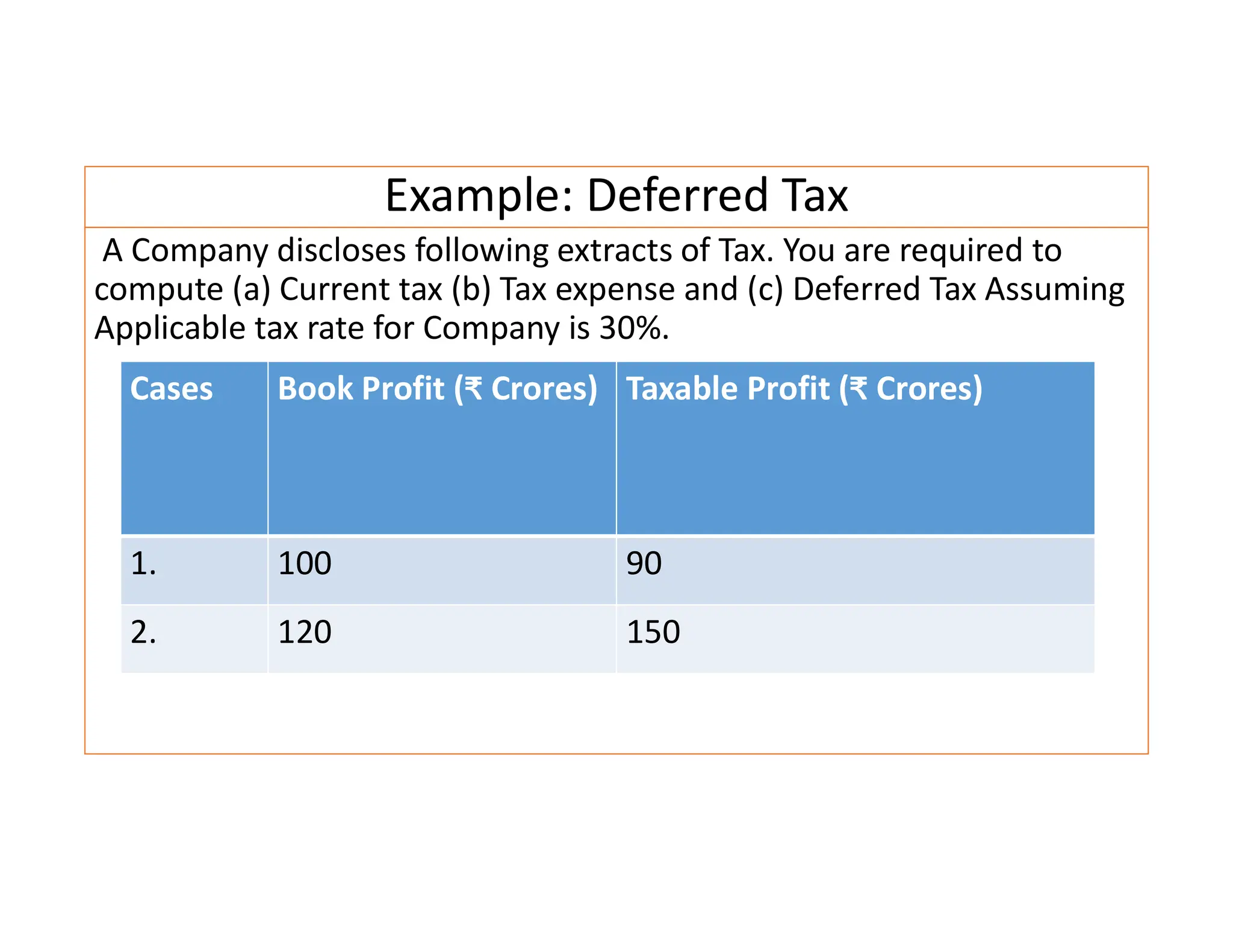
Example: Deferred Tax
A Company discloses following extracts of Tax. You are required to
compute (a) Current tax (b) Tax expense and (c) Deferred Tax Assuming
Applicable tax rate for Company is 30%.
Cases Book Profit (₹ Crores) Taxable Profit (₹ Crores)
1. 100 90
2. 120 150
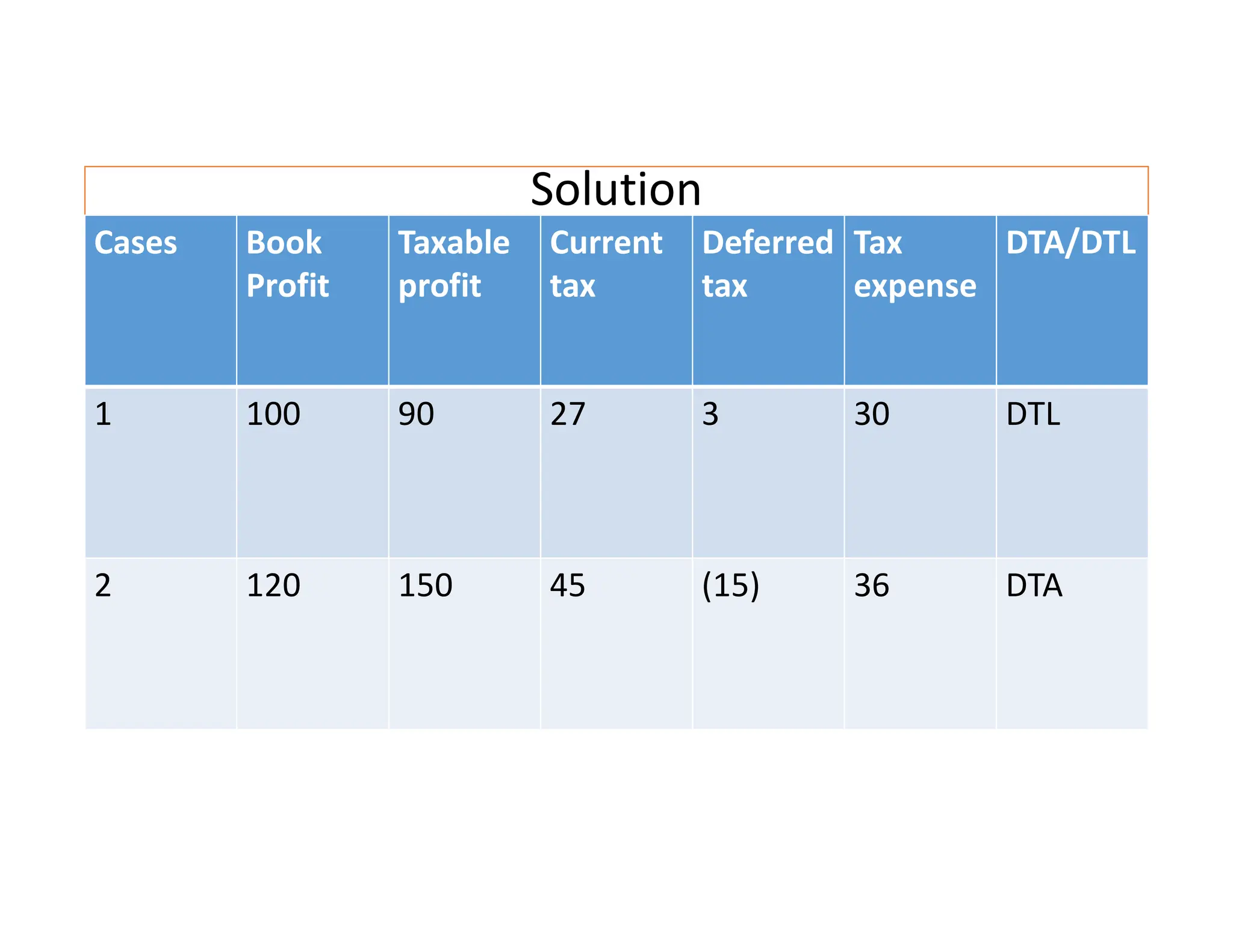
Solution
Cases Book
Profit
Taxable
profit
Current
tax
Deferred
tax
Tax
expense
DTA/DTL
1 100 90 27 3 30 DTL
2 120 150 45 (15) 36 DTA
Balance sheet
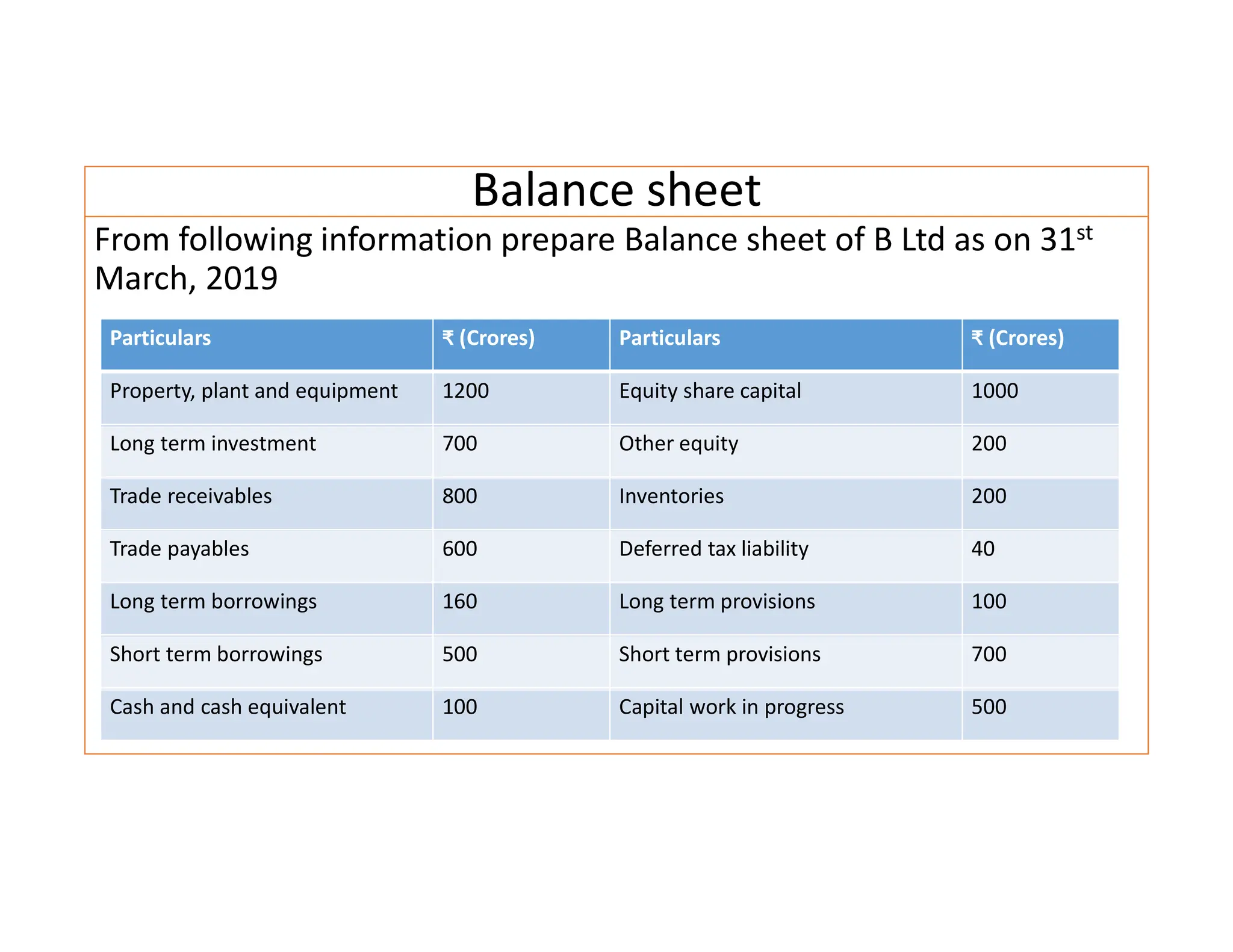
From following information prepare Balance sheet of B Ltd as on 31st
March, 2019
Particulars ₹ (Crores) Particulars ₹ (Crores)
Property, plant and equipment 1200 Equity share capital 1000
Long term investment 700 Other equity 200
Trade receivables 800 Inventories 200
Trade payables 600 Deferred tax liability 40
Long term borrowings 160 Long term provisions 100
Short term borrowings 500 Short term provisions 700
Cash and cash equivalent 100 Capital work in progress 500
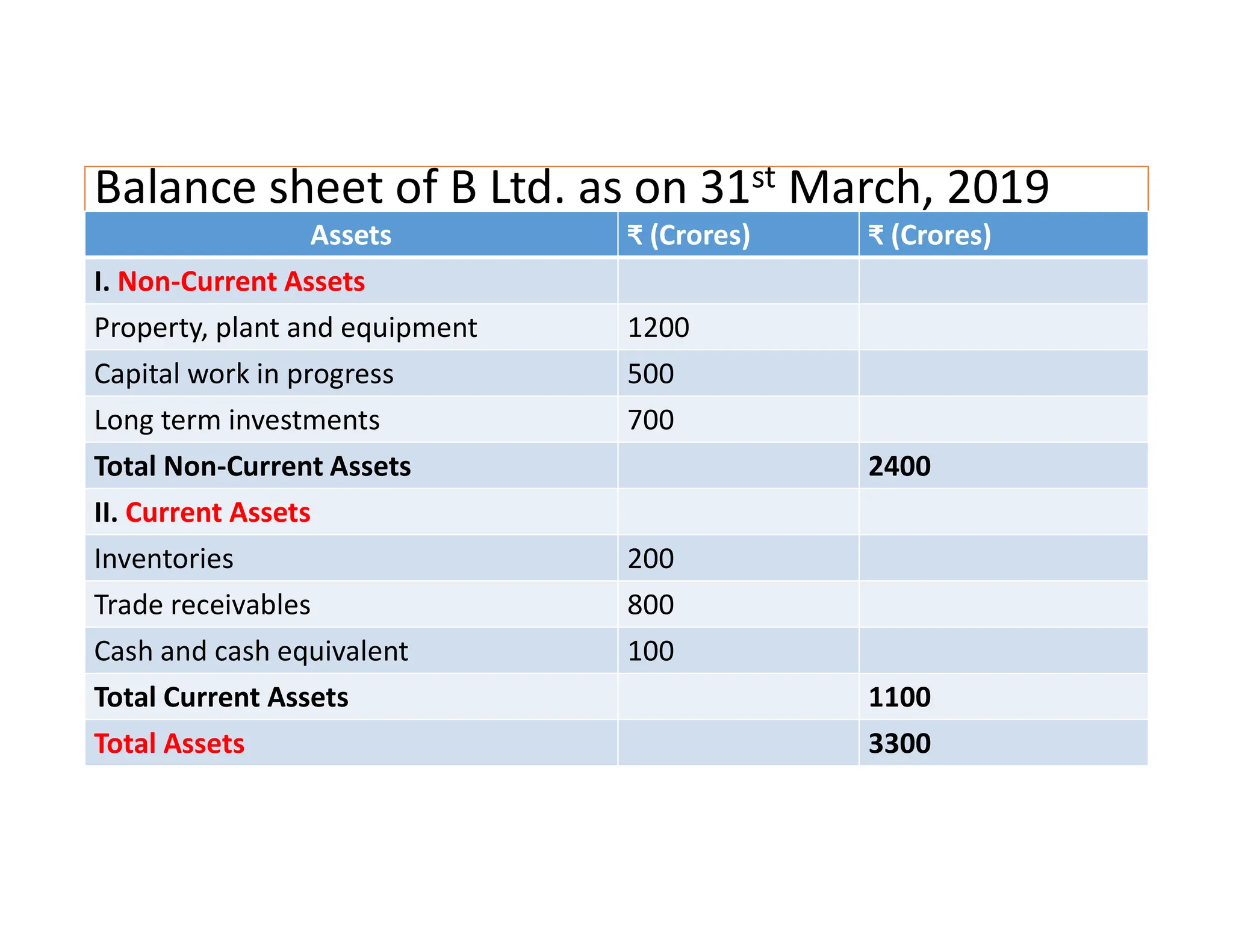
Balance sheet of B Ltd. as on 31st March, 2019
Assets ₹ (Crores) ₹ (Crores)
I. Non-Current Assets
Property, plant and equipment 1200
Capital work in progress 500
Long term investments 700
Total Non-Current Assets 2400
II. Current Assets
Inventories 200
Trade receivables 800
Cash and cash equivalent 100
Total Current Assets 1100
Total Assets 3300
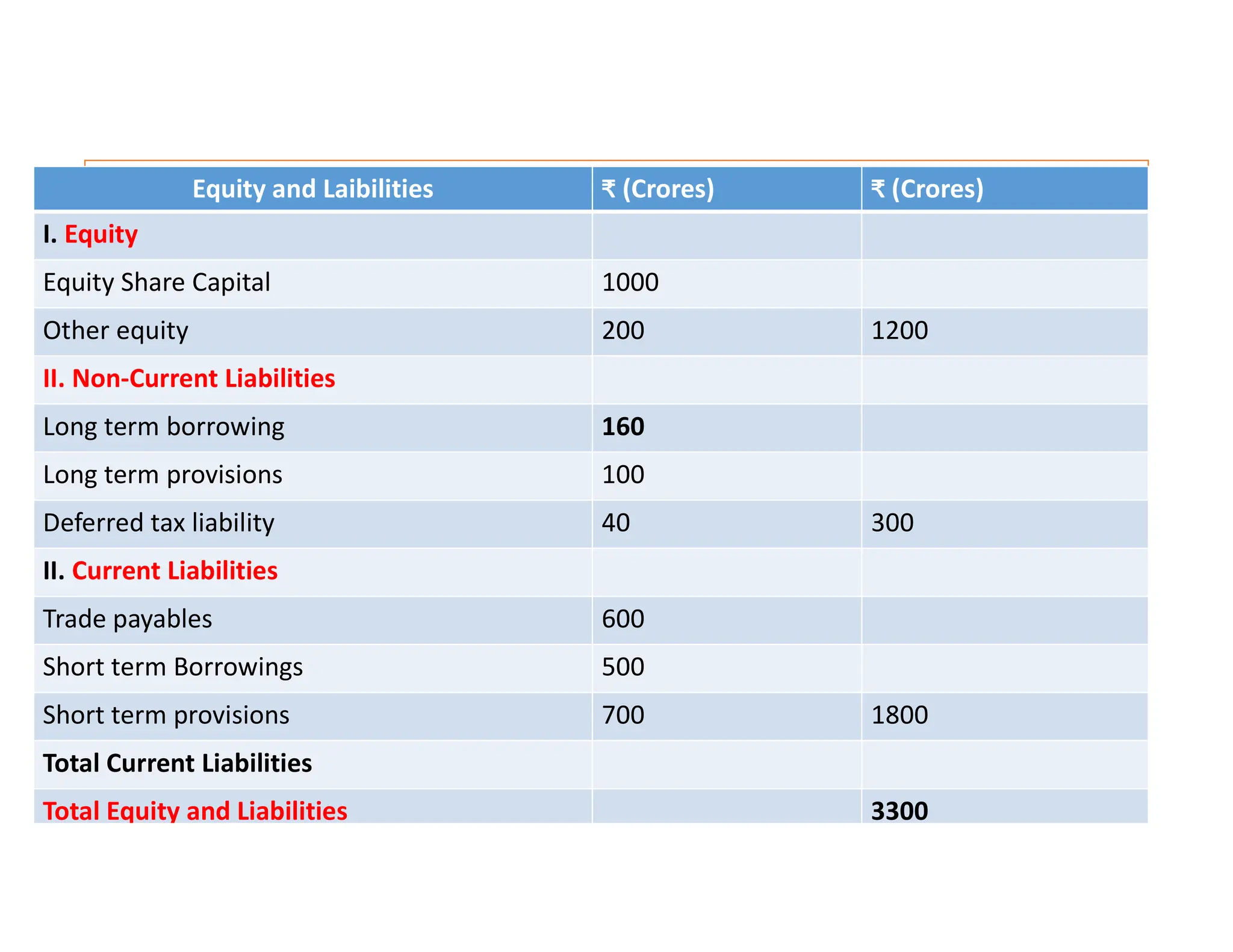
Equity and Laibilities ₹ (Crores) ₹ (Crores)
I. Equity
Equity Share Capital 1000
Other equity 200 1200
II. Non-Current Liabilities
Long term borrowing 160
Long term provisions 100
Deferred tax liability 40 300
II. Current Liabilities
Trade payables 600
Short term Borrowings 500
Short term provisions 700 1800
Total Current Liabilities
Total Equity and Liabilities 3300
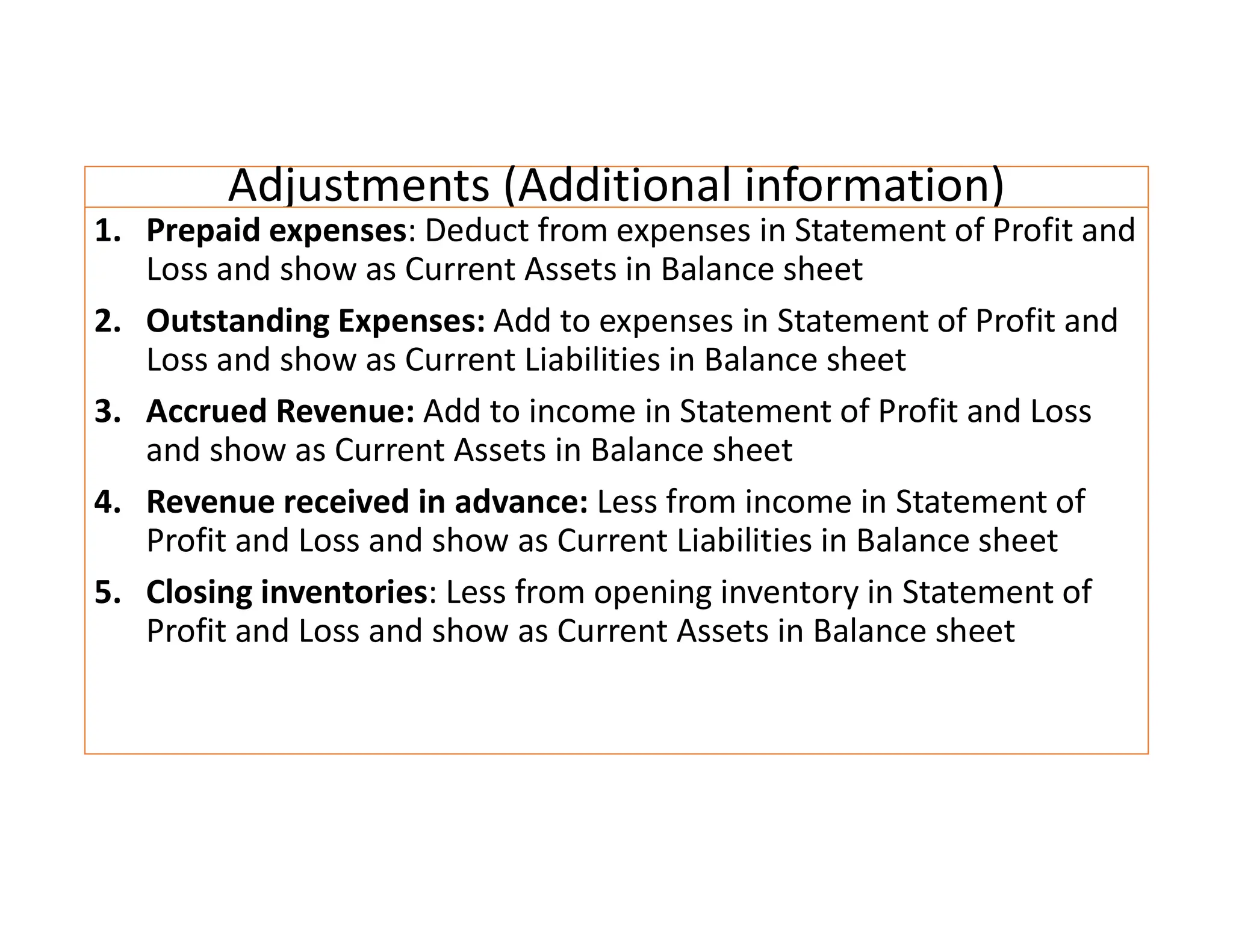
Adjustments (Additional information)
1. Prepaid expenses: Deduct from expenses in Statement of Profit and
Loss and show as Current Assets in Balance sheet
2. Outstanding Expenses: Add to expenses in Statement of Profit and
Loss and show as Current Liabilities in Balance sheet
3. Accrued Revenue: Add to income in Statement of Profit and Loss
and show as Current Assets in Balance sheet
4. Revenue received in advance: Less from income in Statement of
Profit and Loss and show as Current Liabilities in Balance sheet
5. Closing inventories: Less from opening inventory in Statement of
Profit and Loss and show as Current Assets in Balance sheet
Adjustments continued
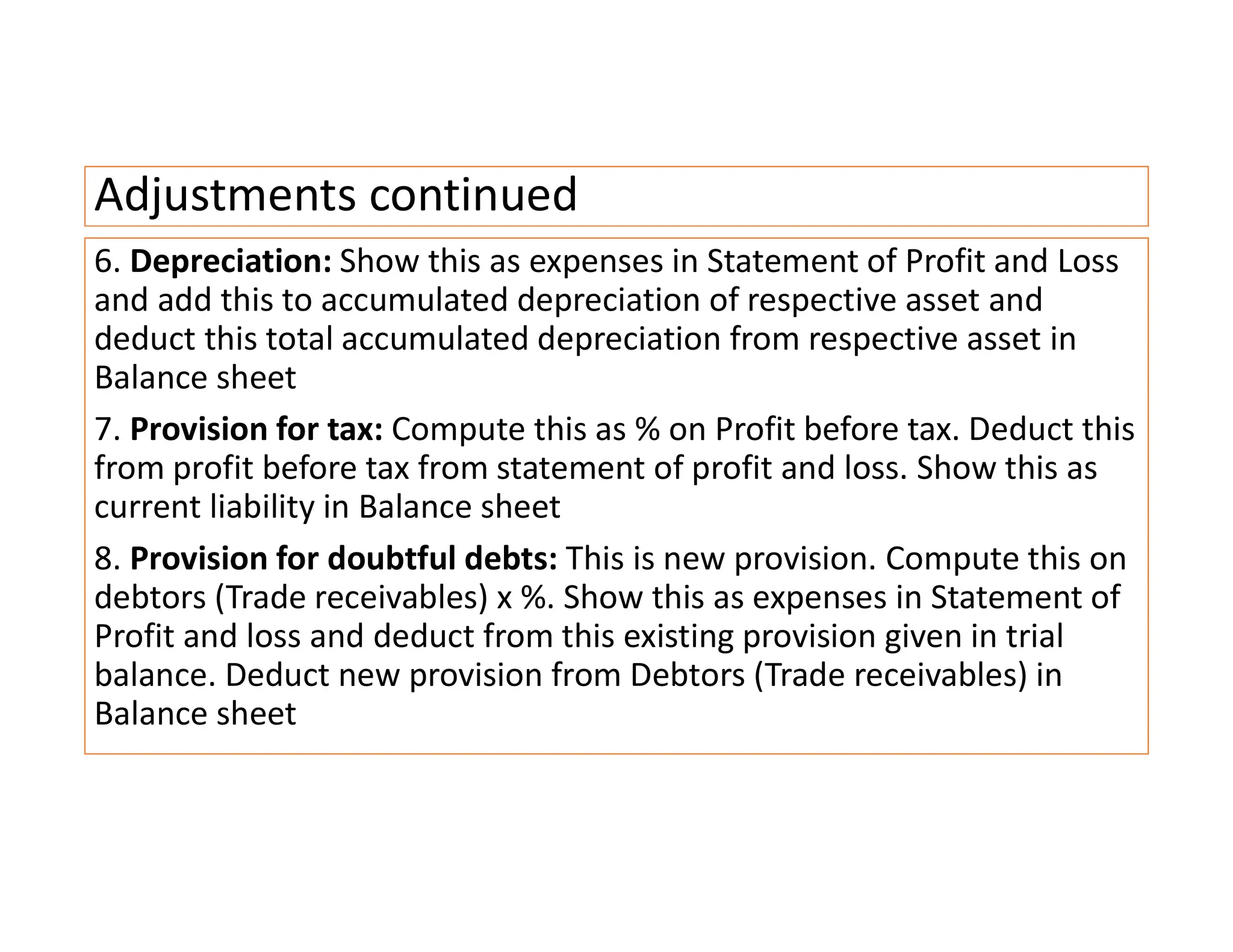
6. Depreciation: Show this as expenses in Statement of Profit and Loss
and add this to accumulated depreciation of respective asset and
deduct this total accumulated depreciation from respective asset in
Balance sheet
7. Provision for tax: Compute this as % on Profit before tax. Deduct this
from profit before tax from statement of profit and loss. Show this as
current liability in Balance sheet
8. Provision for doubtful debts: This is new provision. Compute this on
debtors (Trade receivables) x %. Show this as expenses in Statement of
Profit and loss and deduct from this existing provision given in trial
balance. Deduct new provision from Debtors (Trade receivables) in
Balance sheet
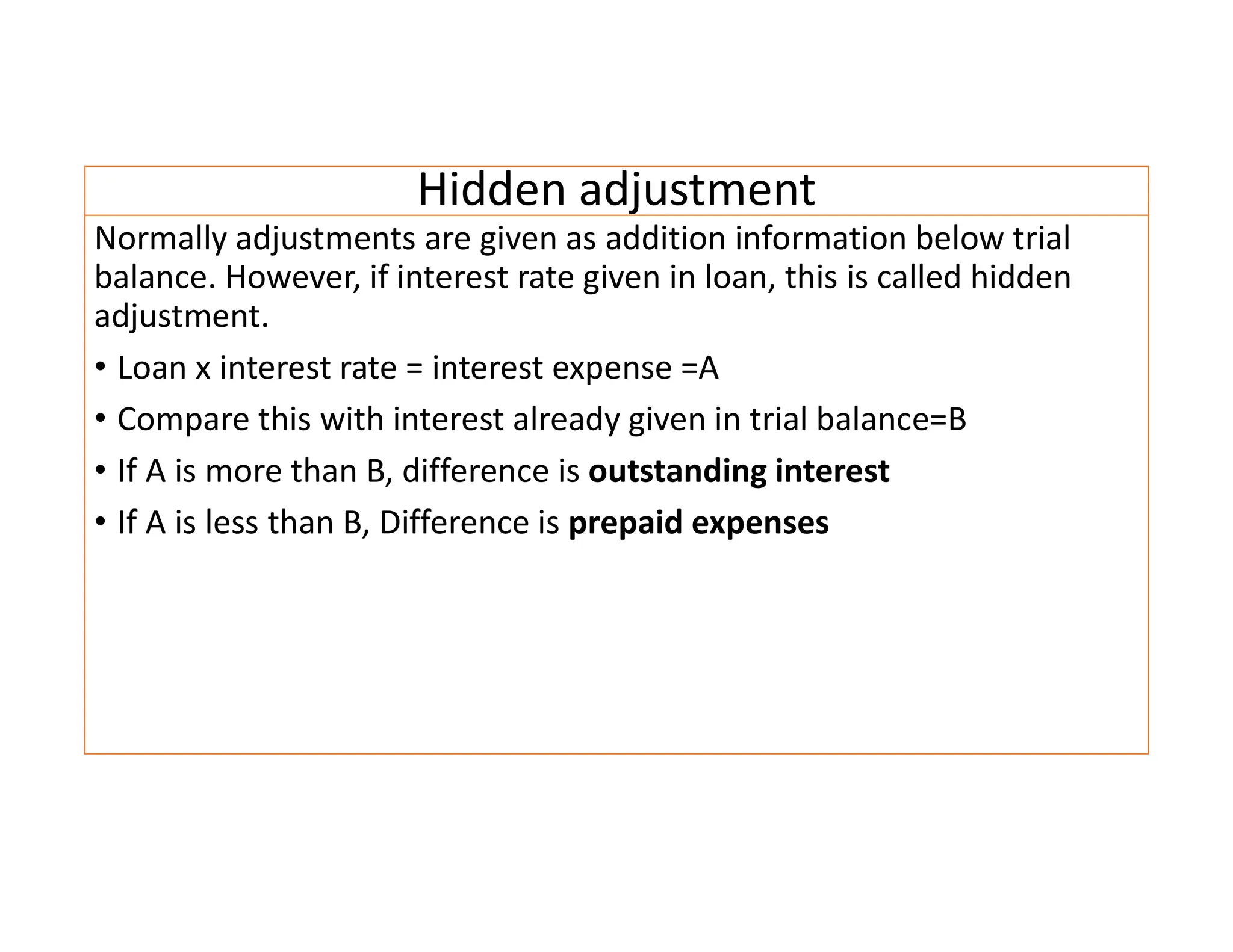
Hidden adjustment
Normally adjustments are given as addition information below trial
balance. However, if interest rate given in loan, this is called hidden
adjustment.
• Loan x interest rate = interest expense =A
• Compare this with interest already given in trial balance=B
• If A is more than B, difference is outstanding interest
• If A is less than B, Difference is prepaid expenses
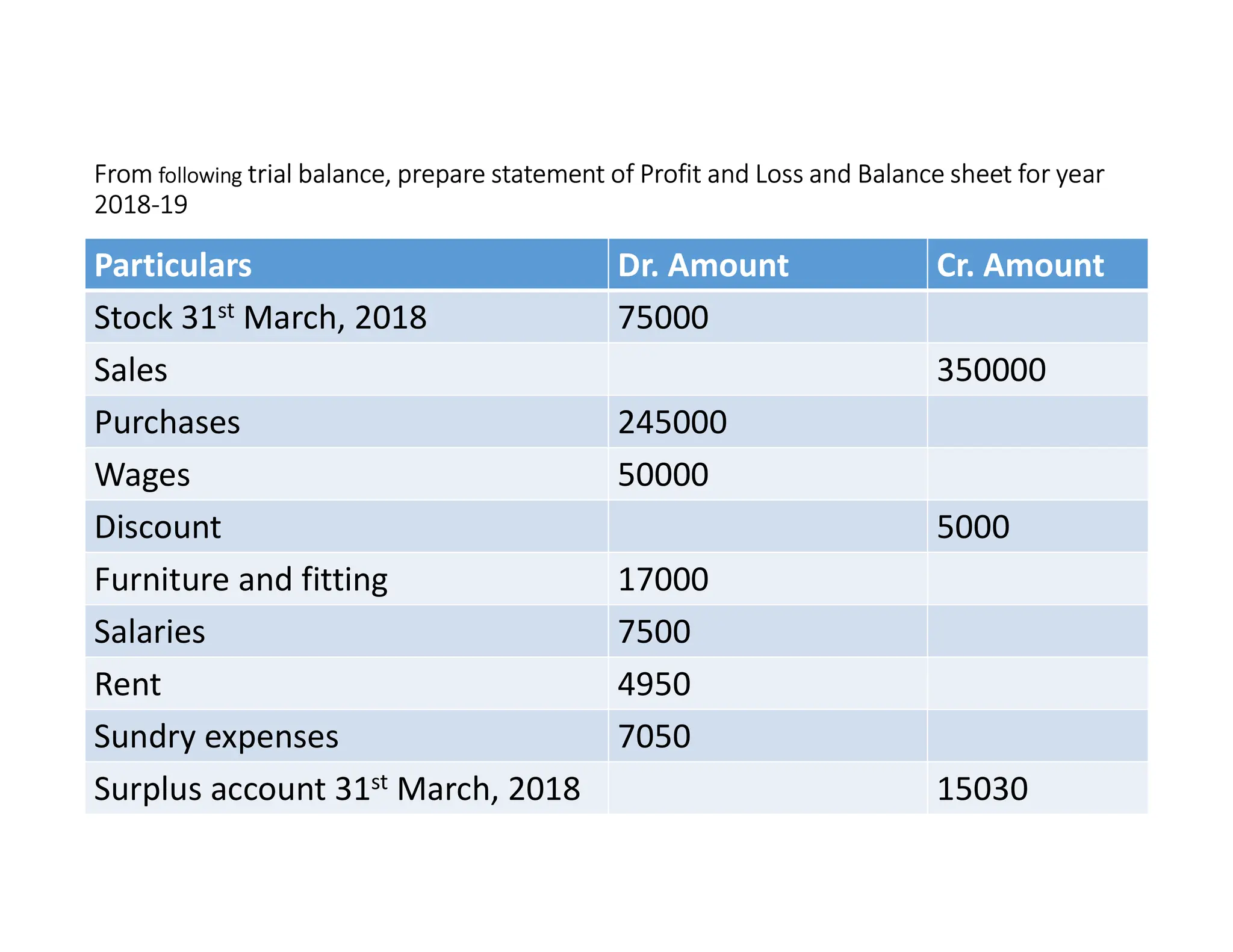
From following trial balance, prepare statement of Profit and Loss and Balance sheet for year
2018-19
Particulars Dr. Amount Cr. Amount
Stock 31st March, 2018 75000
Sales 350000
Purchases 245000
Wages 50000
Discount 5000
Furniture and fitting 17000
Salaries 7500
Rent 4950
Sundry expenses 7050
Surplus account 31st March, 2018 15030
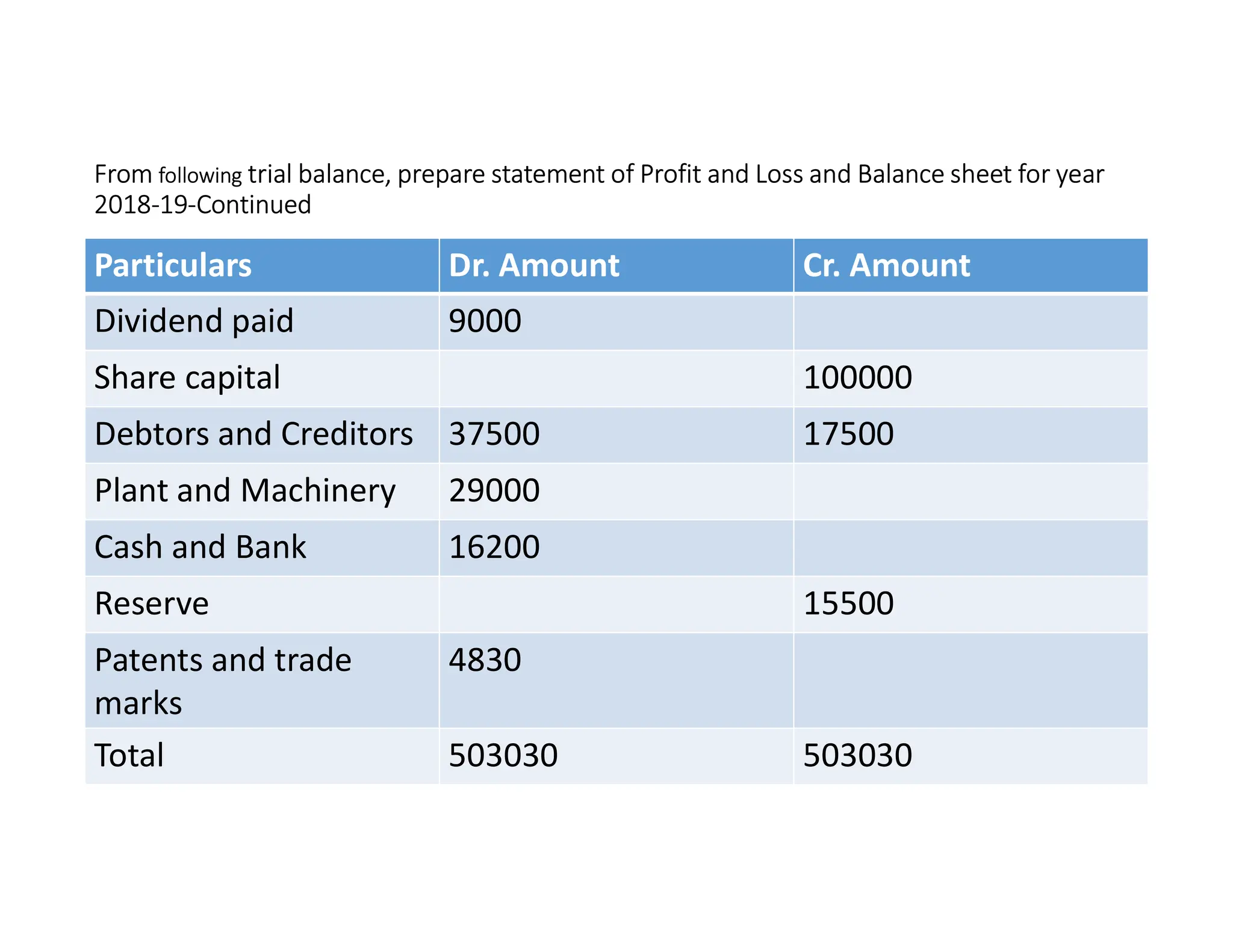
From following trial balance, prepare statement of Profit and Loss and Balance sheet for year
2018-19-Continued
Particulars Dr. Amount Cr. Amount
Dividend paid 9000
Share capital 100000
Debtors and Creditors 37500 17500
Plant and Machinery 29000
Cash and Bank 16200
Reserve 15500
Patents and trade
marks
4830
Total 503030 503030
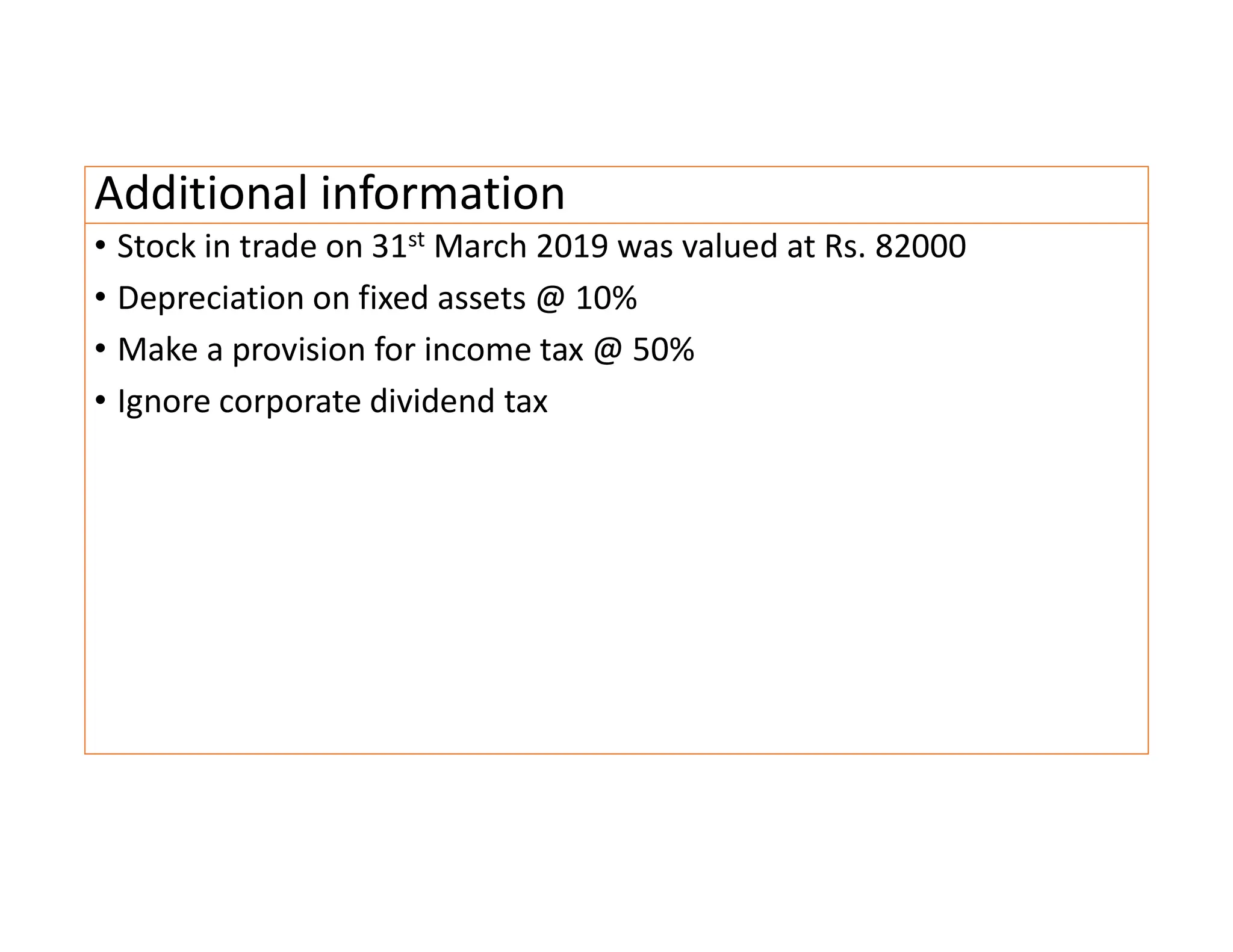
Additional information
• Stock in trade on 31st March 2019 was valued at Rs. 82000
• Depreciation on fixed assets @ 10%
• Make a provision for income tax @ 50%
• Ignore corporate dividend tax
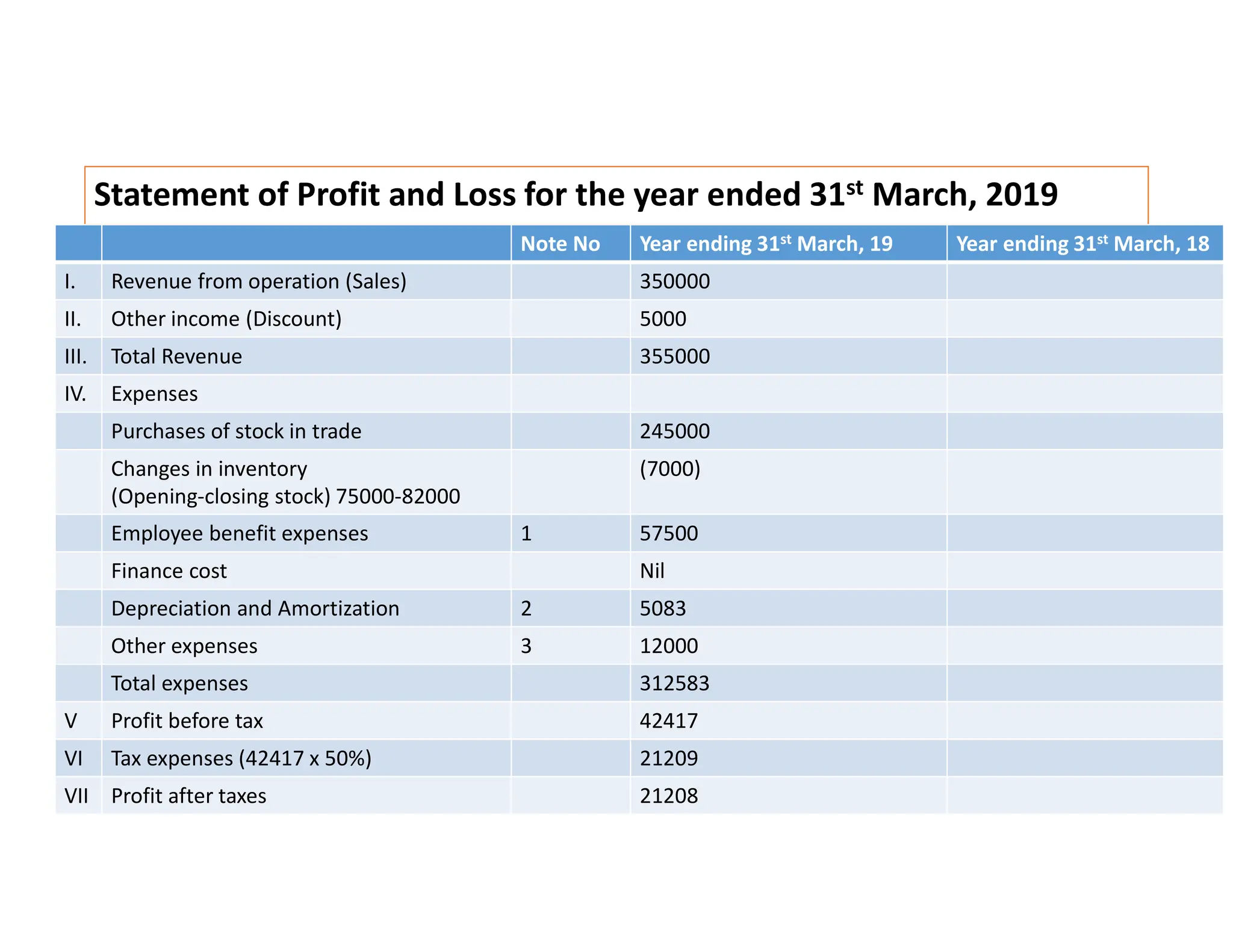
Statement of Profit and Loss for the year ended 31st March, 2019
Note No Year ending 31st March, 19 Year ending 31st March, 18
I. Revenue from operation (Sales) 350000
II. Other income (Discount) 5000
III. Total Revenue 355000
IV. Expenses
Purchases of stock in trade 245000
Changes in inventory
(Opening-closing stock) 75000-82000
(7000)
Employee benefit expenses 1 57500
Finance cost Nil
Depreciation and Amortization 2 5083
Other expenses 3 12000
Total expenses 312583
V Profit before tax 42417
VI Tax expenses (42417 x 50%) 21209
VII Profit after taxes 21208
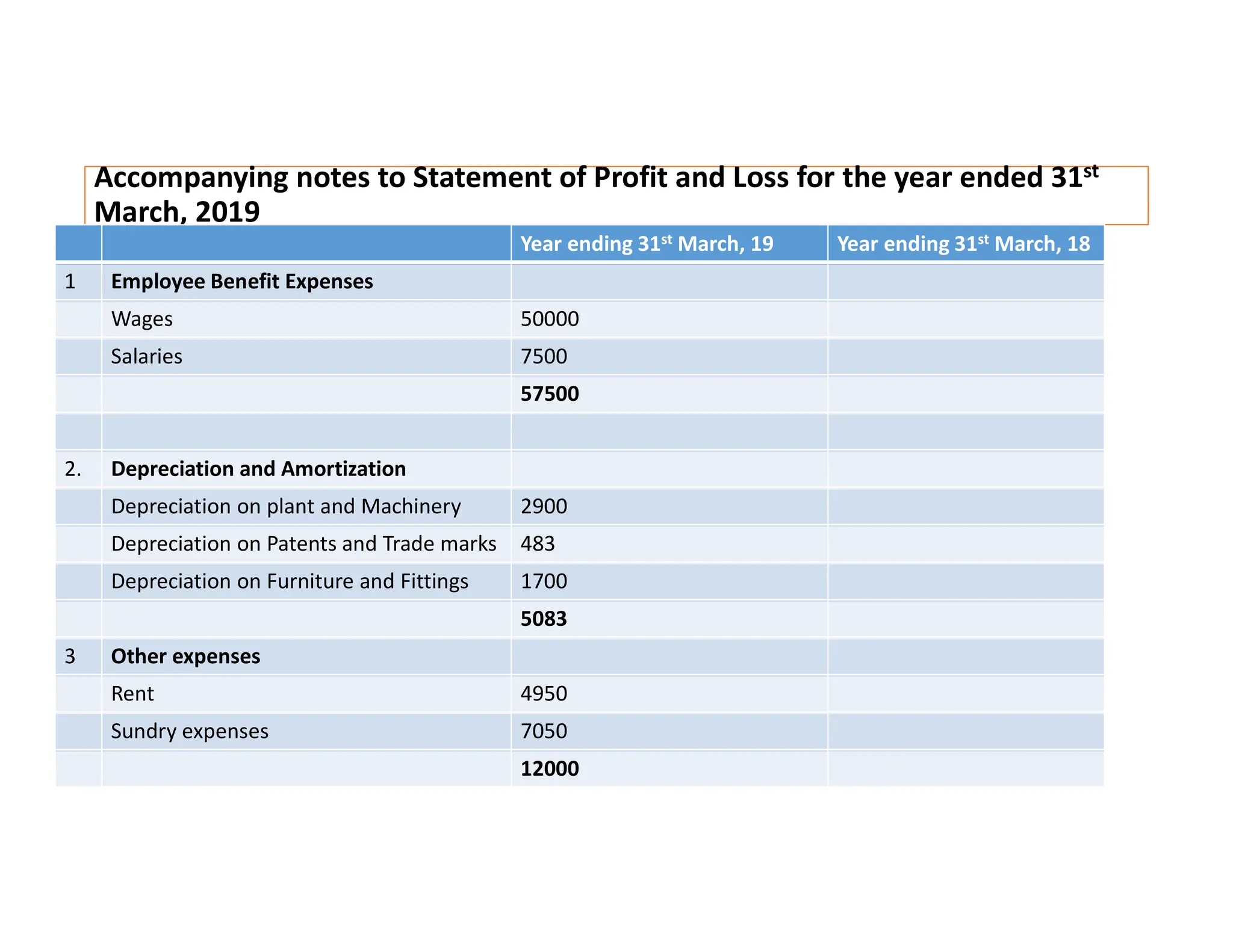
Accompanying notes to Statement of Profit and Loss for the year ended 31st
March, 2019
Year ending 31st March, 19 Year ending 31st March, 18
1 Employee Benefit Expenses
Wages 50000
Salaries 7500
57500
2. Depreciation and Amortization
Depreciation on plant and Machinery 2900
Depreciation on Patents and Trade marks 483
Depreciation on Furniture and Fittings 1700
5083
3 Other expenses
Rent 4950
Sundry expenses 7050
12000
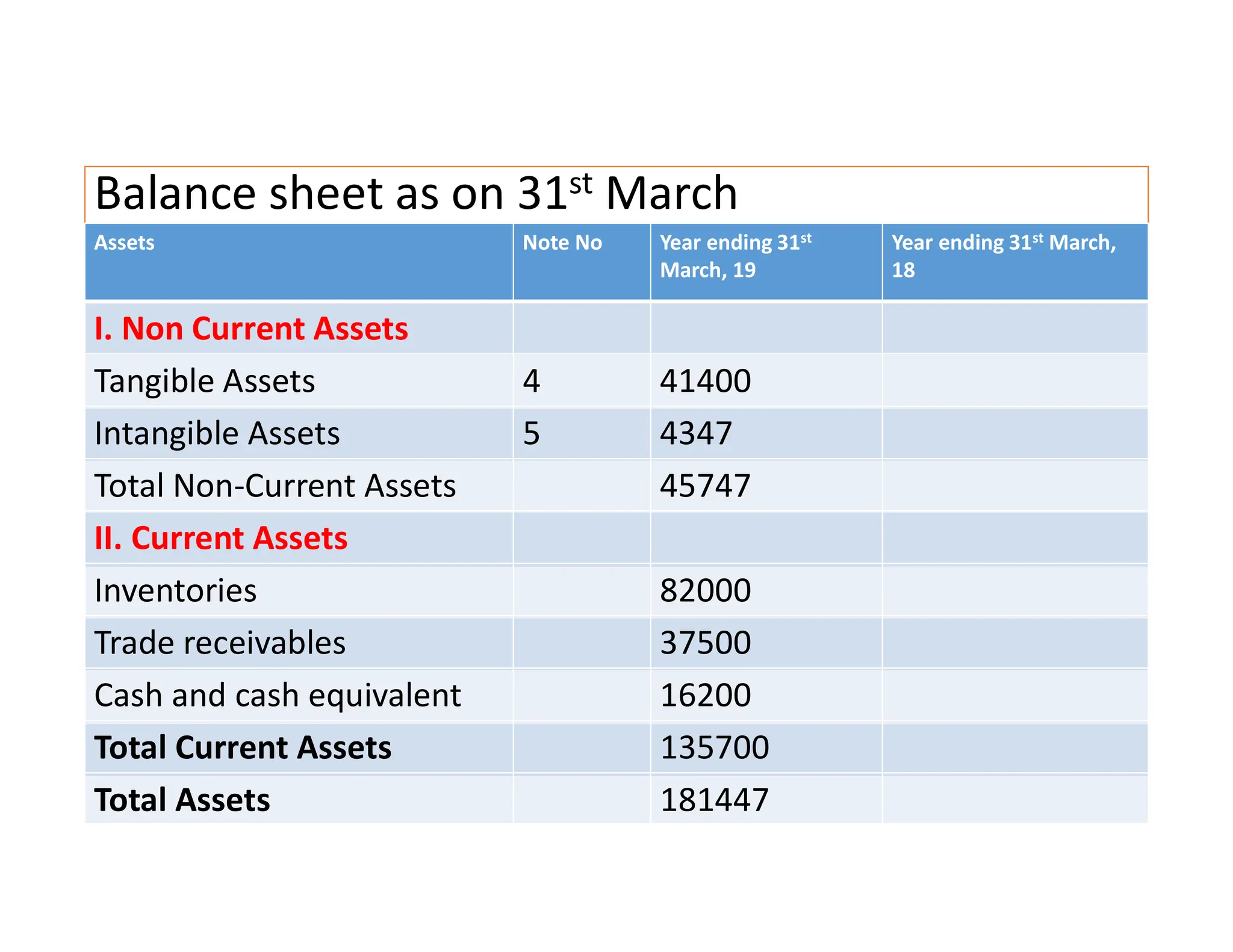
Balance sheet as on 31st March
Assets Note No Year ending 31st
March, 19
Year ending 31st March,
18
I. Non Current Assets
Tangible Assets 4 41400
Intangible Assets 5 4347
Total Non-Current Assets 45747
II. Current Assets
Inventories 82000
Trade receivables 37500
Cash and cash equivalent 16200
Total Current Assets 135700
Total Assets 181447
Balance sheet as on 31st March
Equity and Liabilities Note No Year ending 31st
March, 19
Year ending 31st March,
18
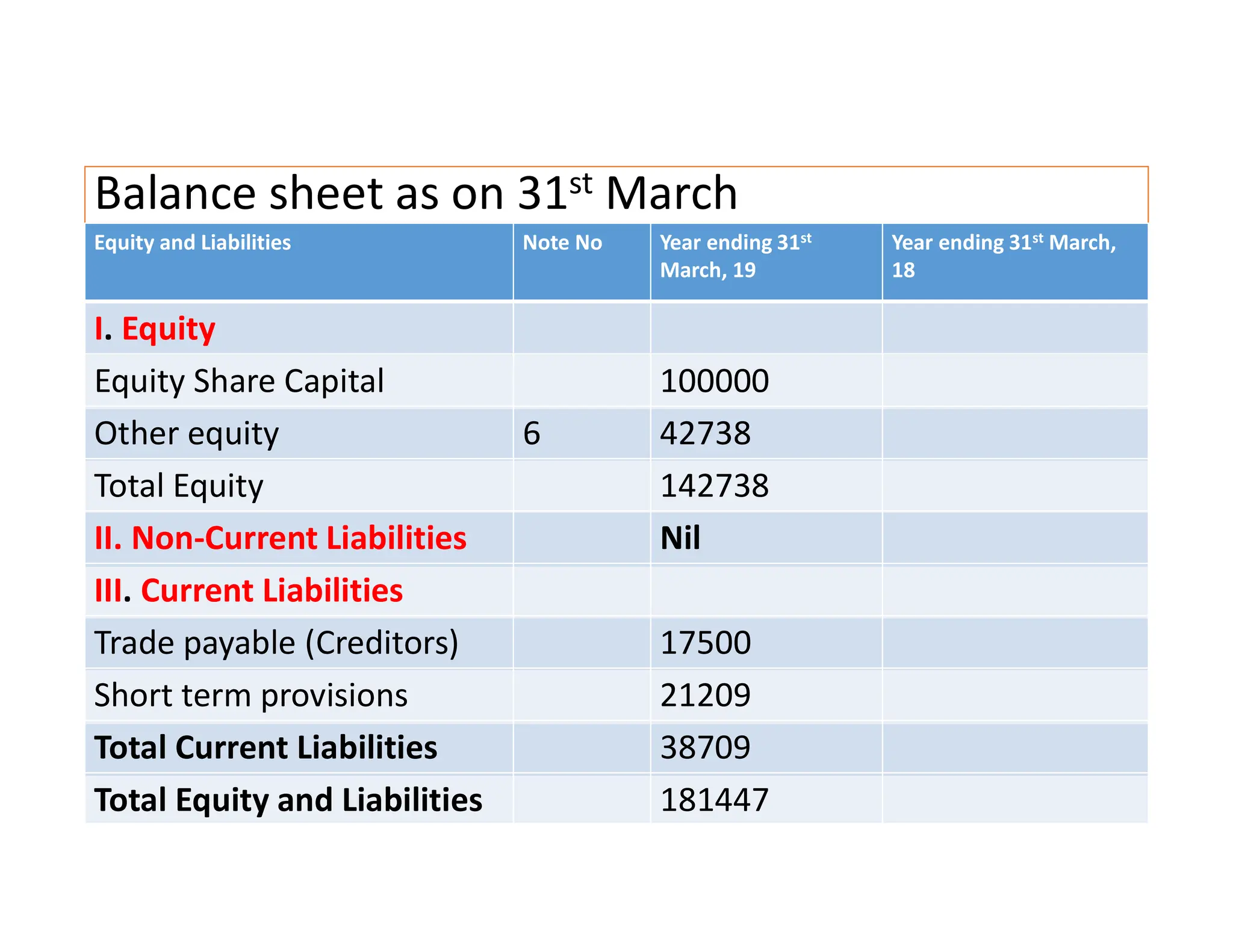
I. Equity
Equity Share Capital 100000
Other equity 6 42738
Total Equity 142738
II. Non-Current Liabilities Nil
III. Current Liabilities
Trade payable (Creditors) 17500
Short term provisions 21209
Total Current Liabilities 38709
Total Equity and Liabilities 181447
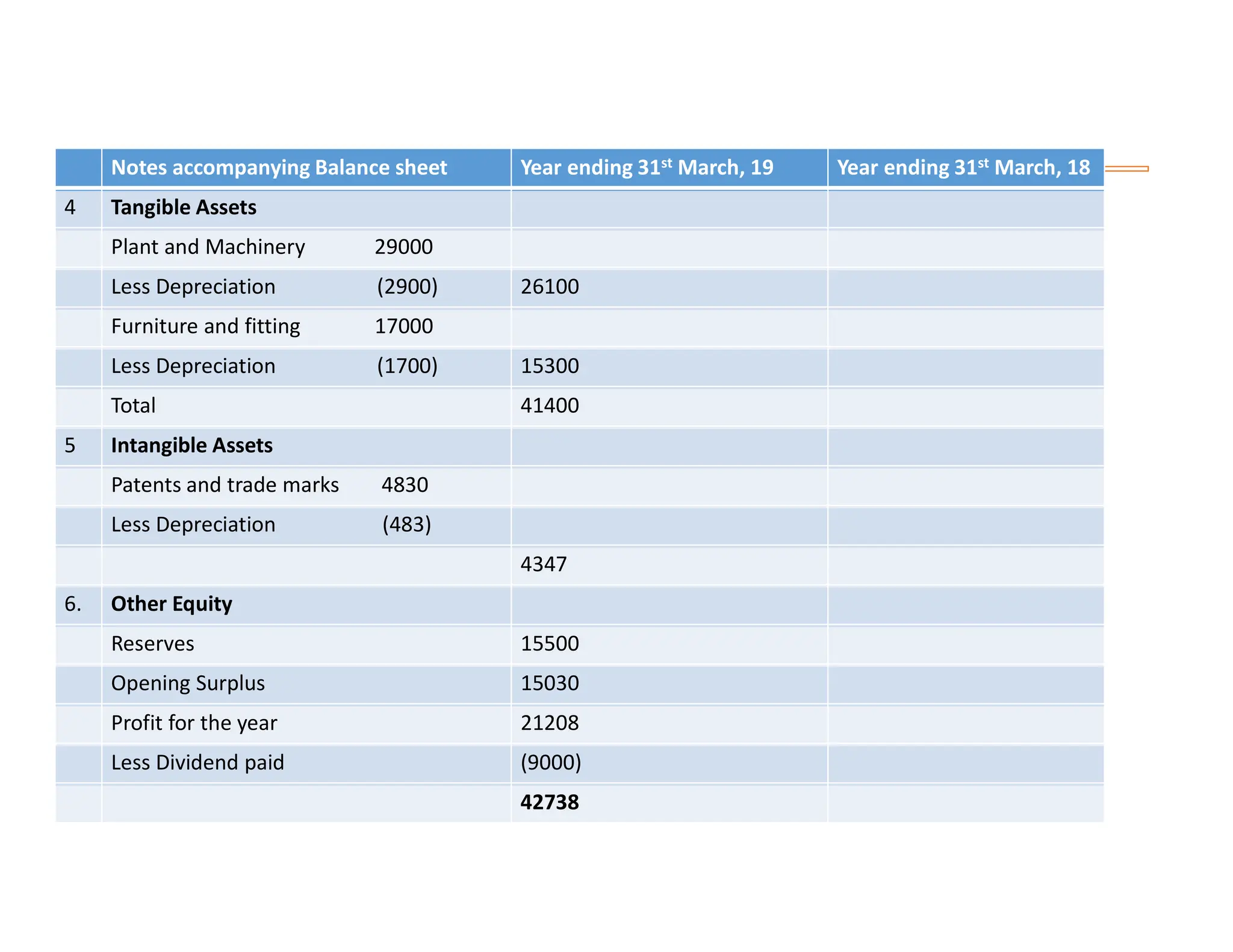
Notes accompanying Balance sheet Year ending 31st March, 19 Year ending 31st March, 18
4 Tangible Assets
Plant and Machinery 29000
Less Depreciation (2900) 26100
Furniture and fitting 17000
Less Depreciation (1700) 15300
Total 41400
5 Intangible Assets
Patents and trade marks 4830
Less Depreciation (483)
4347
6. Other Equity
Reserves 15500
Opening Surplus 15030
Profit for the year 21208
Less Dividend paid (9000)
42738
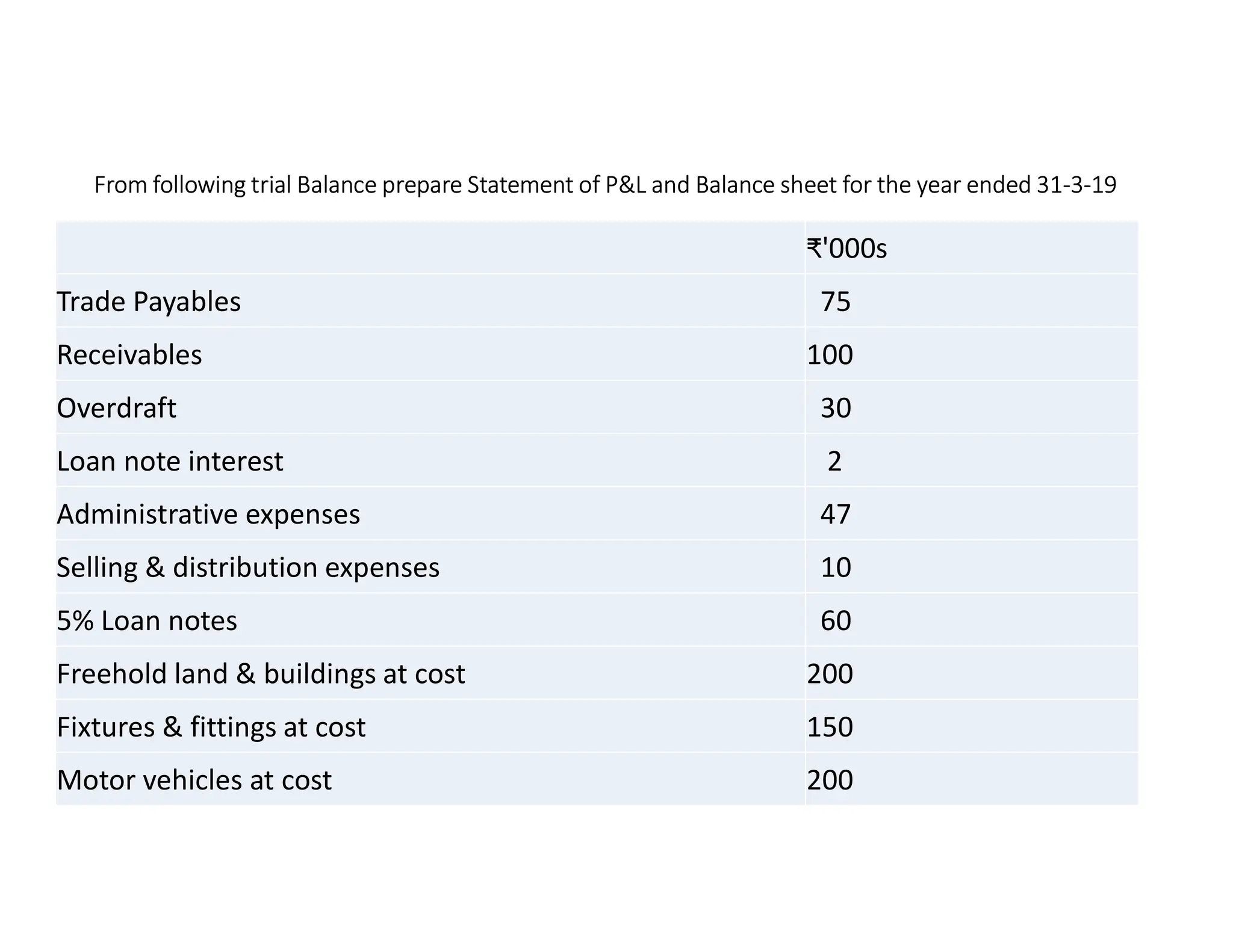
From following trial Balance prepare Statement of P&L and Balance sheet for the year ended 31-3-19
₹'000s
Trade Payables 75
Receivables 100
Overdraft 30
Loan note interest 2
Administrative expenses 47
Selling & distribution expenses 10
5% Loan notes 60
Freehold land & buildings at cost 200
Fixtures & fittings at cost 150
Motor vehicles at cost 200
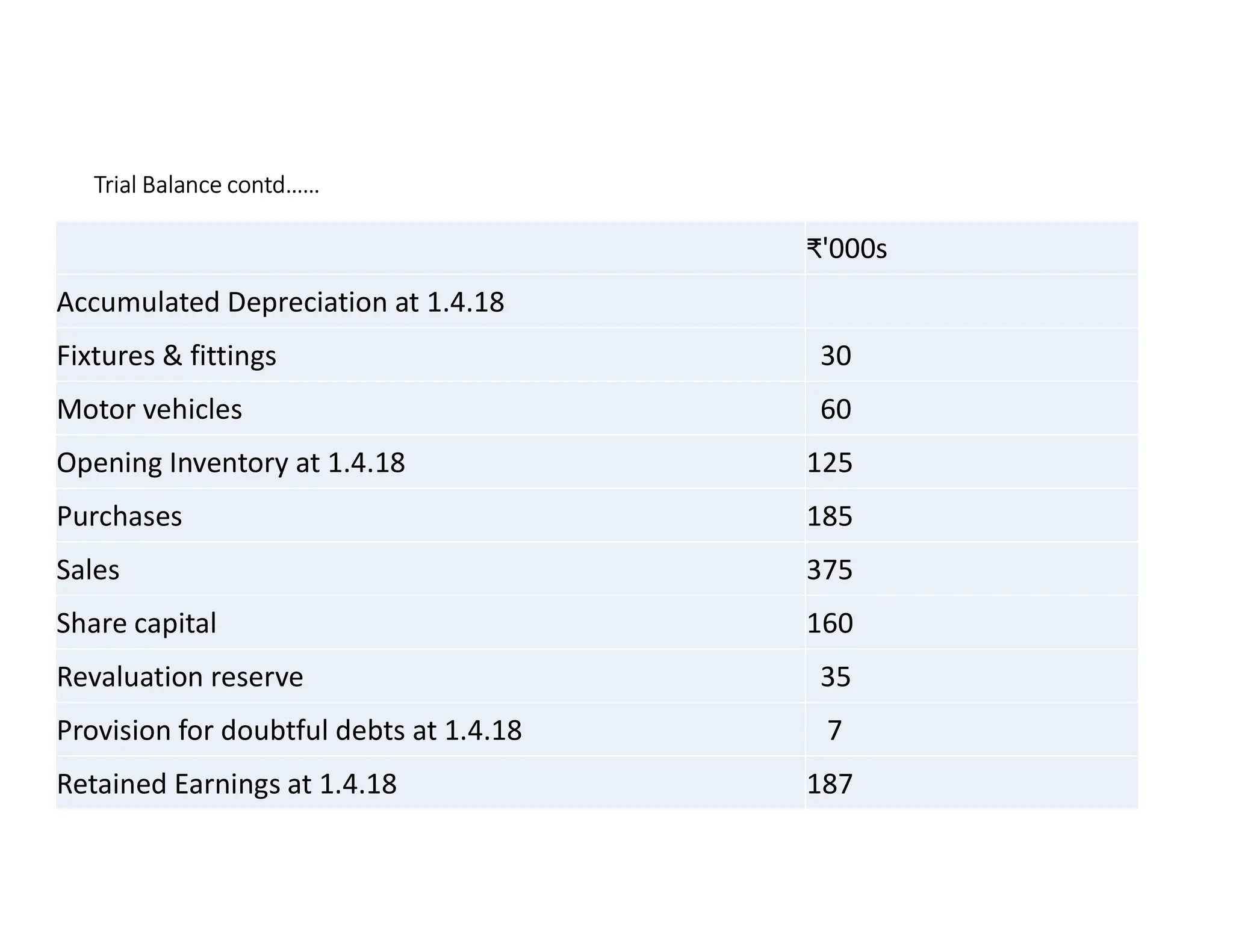
Trial Balance contd……
₹'000s
Accumulated Depreciation at 1.4.18
Fixtures & fittings 30
Motor vehicles 60
Opening Inventory at 1.4.18 125
Purchases 185
Sales 375
Share capital 160
Revaluation reserve 35
Provision for doubtful debts at 1.4.18 7
Retained Earnings at 1.4.18 187
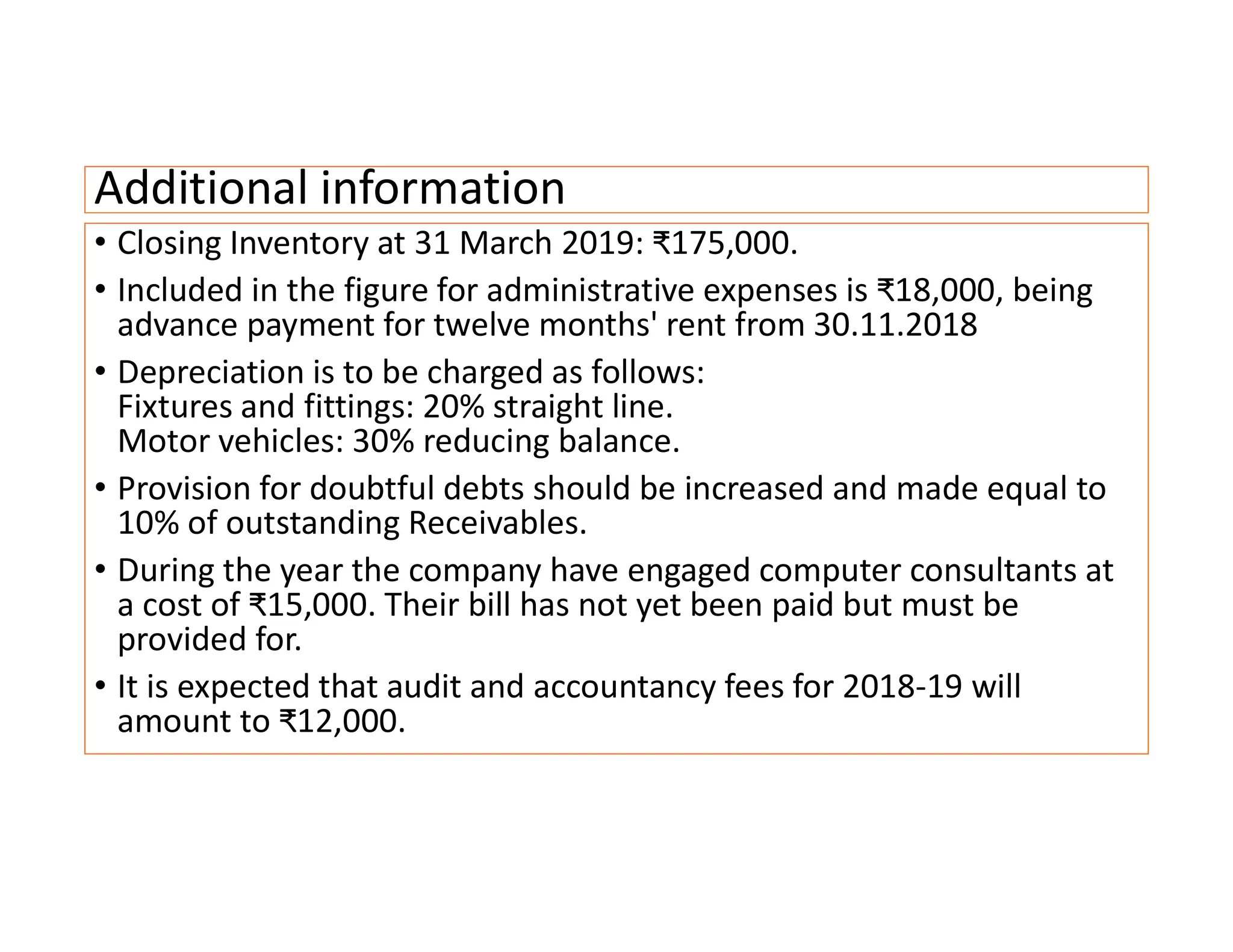
Additional information
• Closing Inventory at 31 March 2019: ₹175,000.
• Included in the figure for administrative expenses is ₹18,000, being
advance payment for twelve months' rent from 30.11.2018
• Depreciation is to be charged as follows:
Fixtures and fittings: 20% straight line.
Motor vehicles: 30% reducing balance.
• Provision for doubtful debts should be increased and made equal to
10% of outstanding Receivables.
• During the year the company have engaged computer consultants at
a cost of ₹15,000. Their bill has not yet been paid but must be
provided for.
• It is expected that audit and accountancy fees for 2018-19 will
amount to ₹12,000.
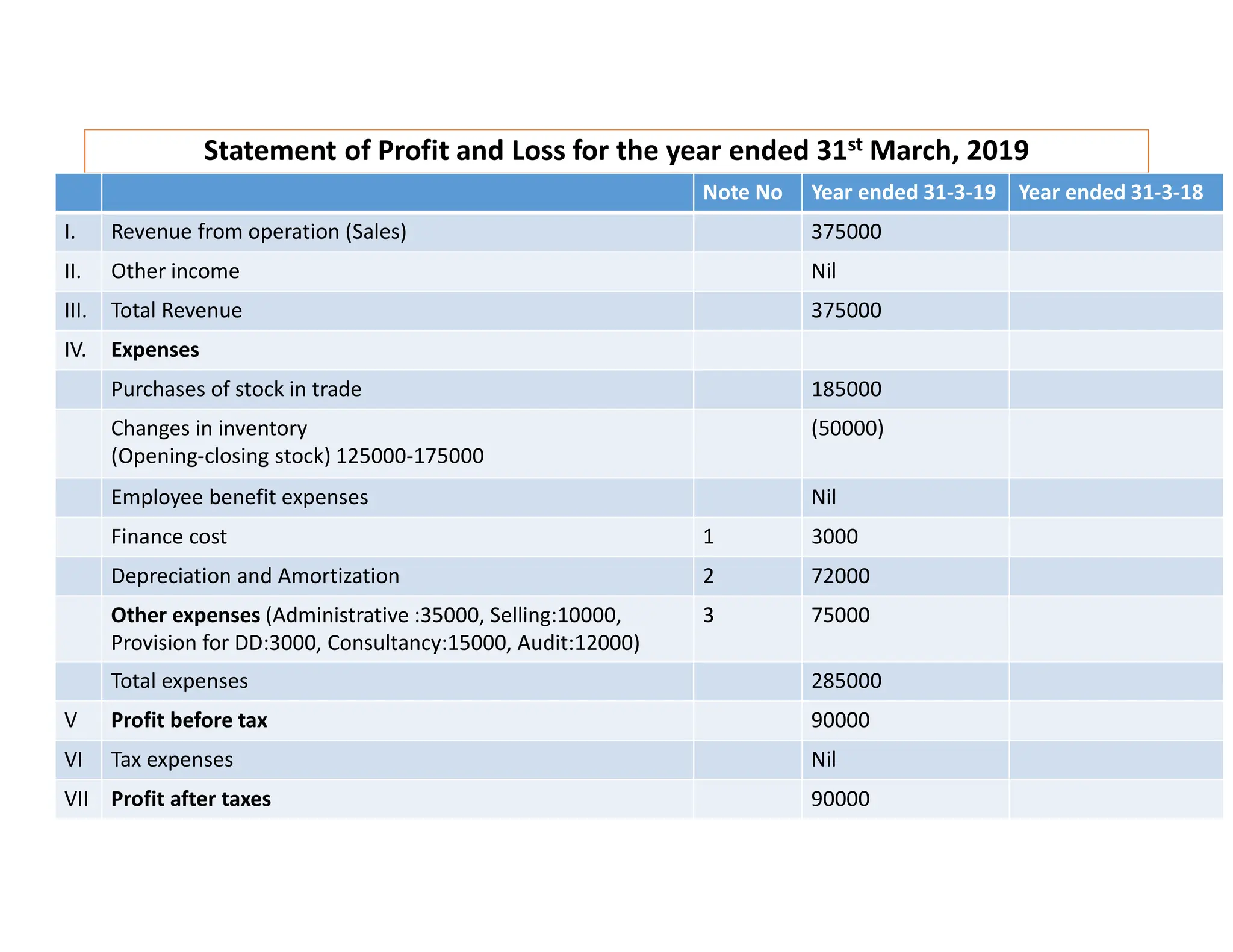
Statement of Profit and Loss for the year ended 31st March, 2019
Note No Year ended 31-3-19 Year ended 31-3-18
I. Revenue from operation (Sales) 375000
II. Other income Nil
III. Total Revenue 375000
IV. Expenses
Purchases of stock in trade 185000
Changes in inventory
(Opening-closing stock) 125000-175000
(50000)
Employee benefit expenses Nil
Finance cost 1 3000
Depreciation and Amortization 2 72000
Other expenses (Administrative :35000, Selling:10000,
Provision for DD:3000, Consultancy:15000, Audit:12000)
3 75000
Total expenses 285000
V Profit before tax 90000
VI Tax expenses Nil
VII Profit after taxes 90000
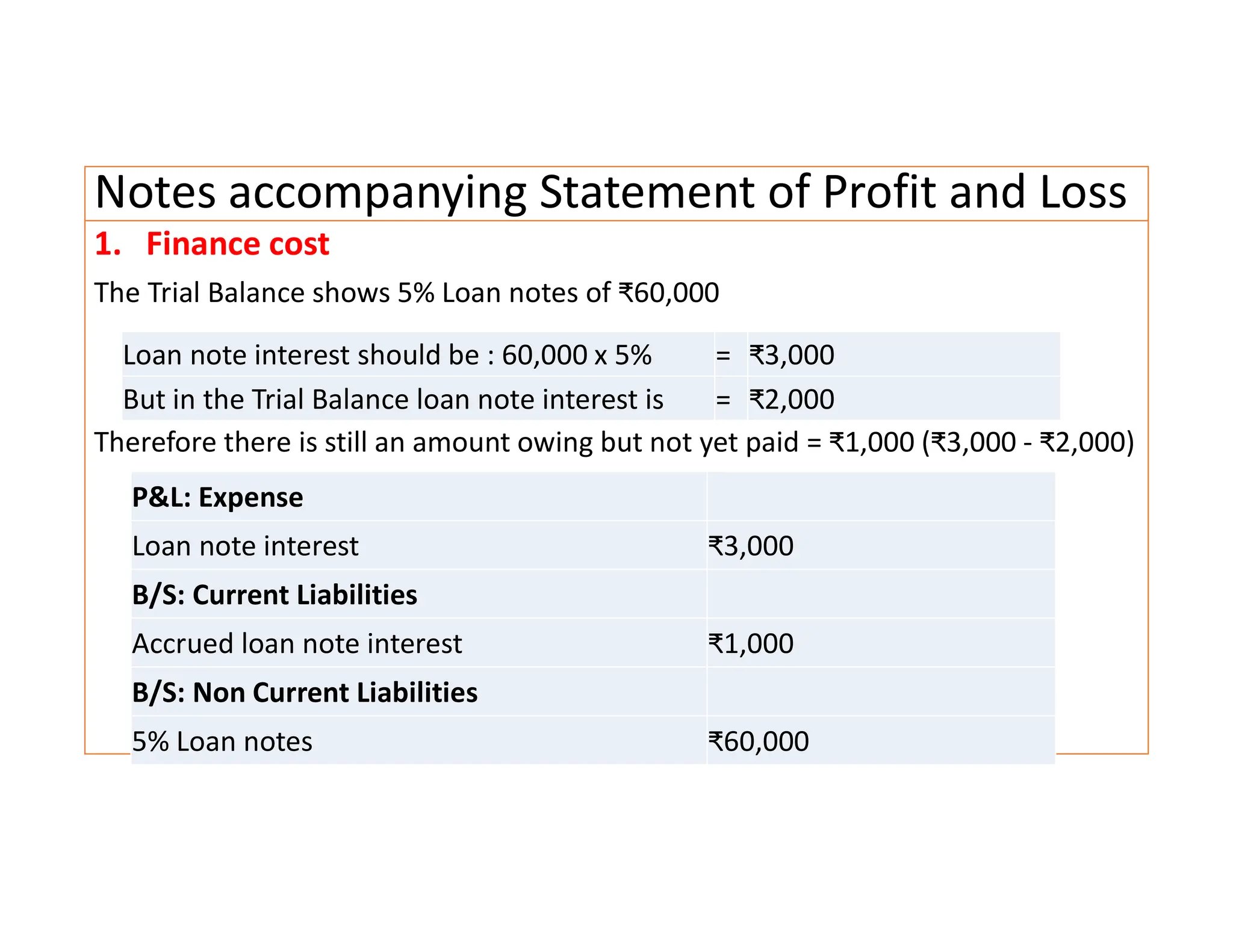
Notes accompanying Statement of Profit and Loss
1. Finance cost
The Trial Balance shows 5% Loan notes of ₹60,000
Therefore there is still an amount owing but not yet paid = ₹1,000 (₹3,000 - ₹2,000)
Loan note interest should be : 60,000 x 5% = ₹3,000
But in the Trial Balance loan note interest is = ₹2,000
P&L: Expense
Loan note interest ₹3,000
B/S: Current Liabilities
Accrued loan note interest ₹1,000
B/S: Non Current Liabilities
5% Loan notes ₹60,000
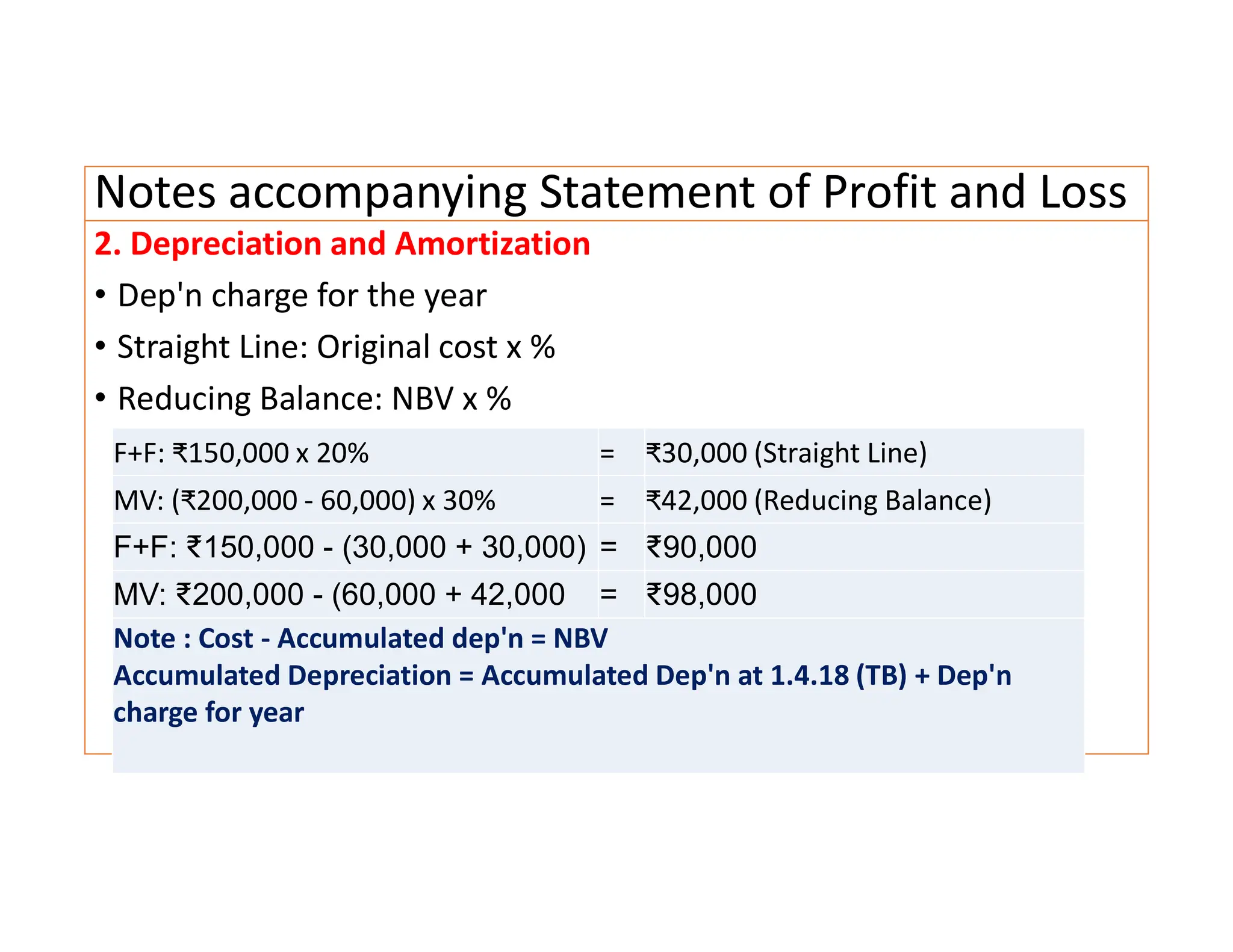
Notes accompanying Statement of Profit and Loss
2. Depreciation and Amortization
• Dep'n charge for the year
• Straight Line: Original cost x %
• Reducing Balance: NBV x %
F+F: ₹150,000 x 20% = ₹30,000 (Straight Line)
MV: (₹200,000 - 60,000) x 30% = ₹42,000 (Reducing Balance)
F+F: ₹150,000 - (30,000 + 30,000) = ₹90,000
MV: ₹200,000 - (60,000 + 42,000 = ₹98,000
Note : Cost - Accumulated dep'n = NBV
Accumulated Depreciation = Accumulated Dep'n at 1.4.18 (TB) + Dep'n
charge for year
Notes accompanying Statement of Profit and Loss
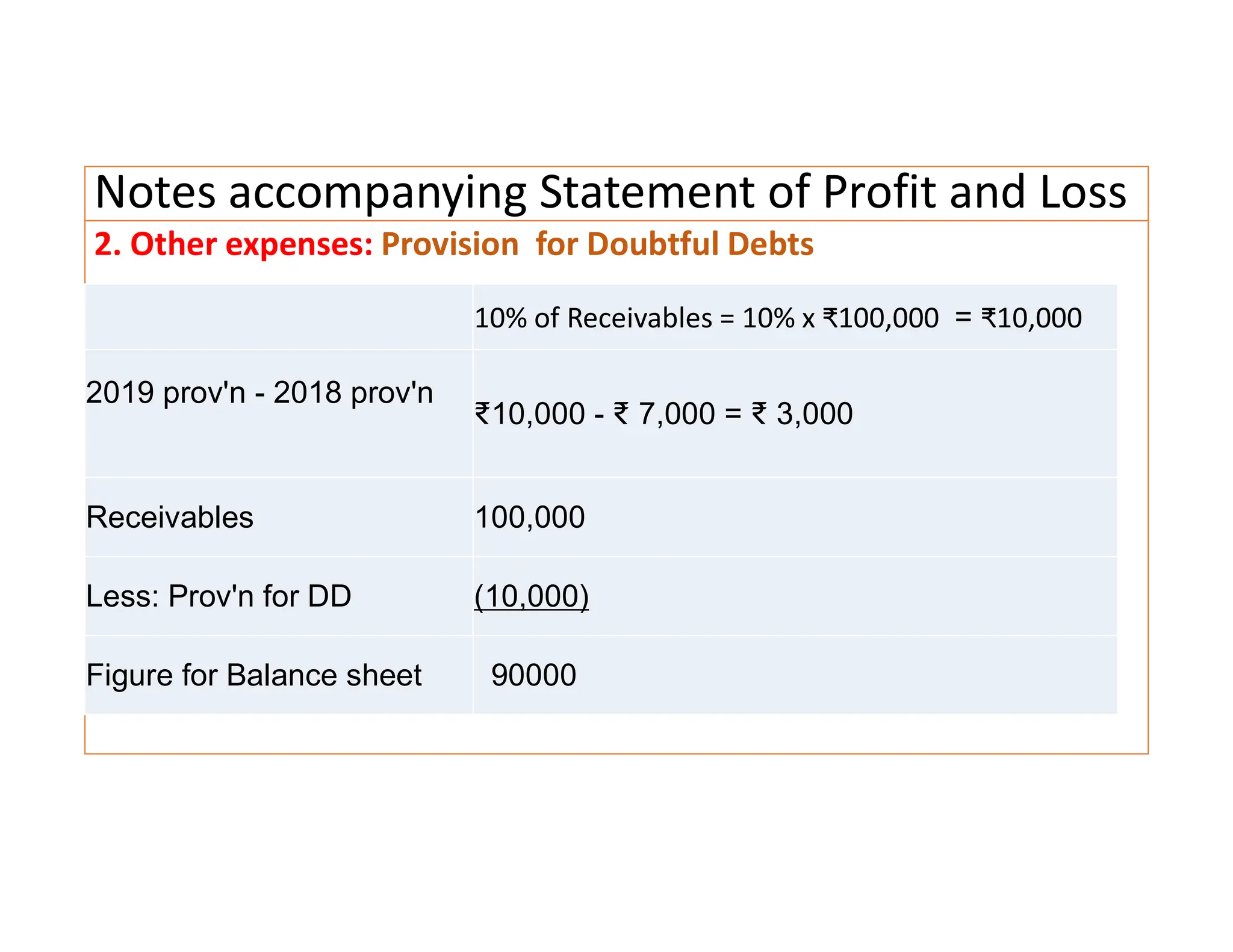
2. Other expenses: Provision for Doubtful Debts
10% of Receivables = 10% x ₹100,000 = ₹10,000
2019 prov'n - 2018 prov'n
₹10,000 - ₹ 7,000 = ₹ 3,000
Receivables 100,000
Less: Prov'n for DD (10,000)
Figure for Balance sheet 90000
Notes accompanying Statement of Profit and Loss
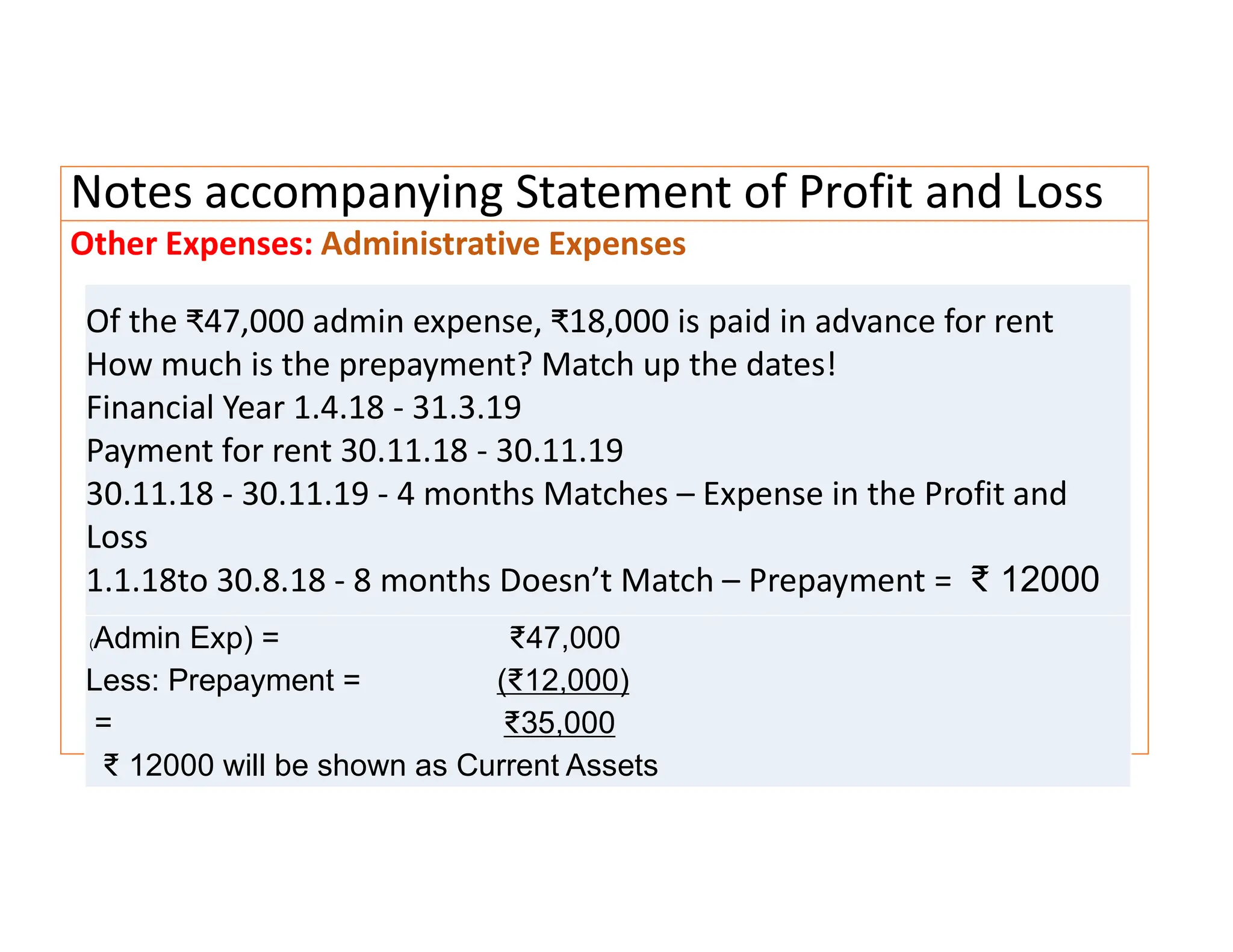
Other Expenses: Administrative Expenses
Of the ₹47,000 admin expense, ₹18,000 is paid in advance for rent
How much is the prepayment? Match up the dates!
Financial Year 1.4.18 - 31.3.19
Payment for rent 30.11.18 - 30.11.19
30.11.18 - 30.11.19 - 4 months Matches – Expense in the Profit and
Loss
1.1.18to 30.8.18 - 8 months Doesn’t Match – Prepayment = ₹ 12000
(Admin Exp) = ₹47,000
Less: Prepayment = (₹12,000)
= ₹35,000
₹ 12000 will be shown as Current Assets
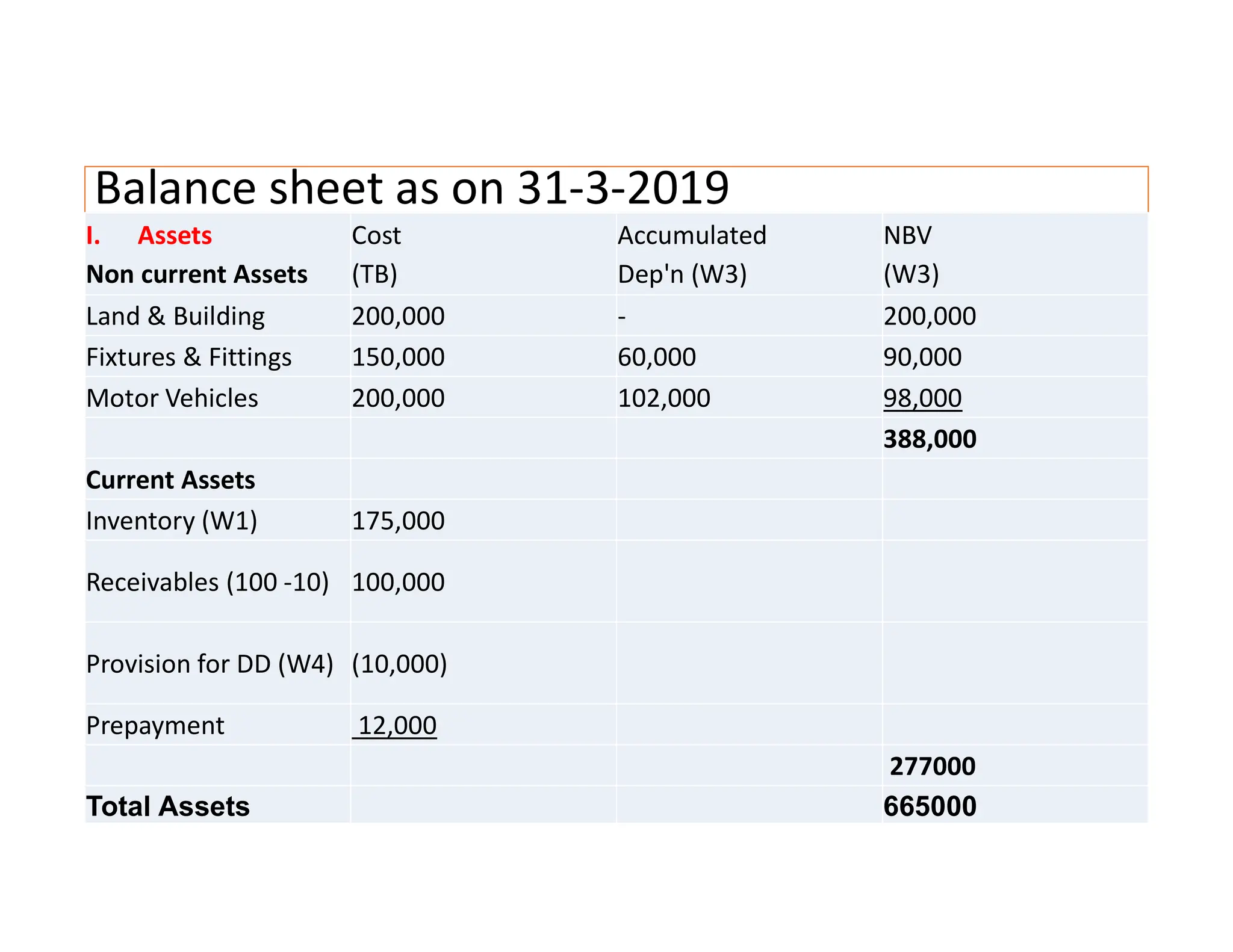
Balance sheet as on 31-3-2019
I. Assets
Non current Assets
Cost
(TB)
Accumulated
Dep'n (W3)
NBV
(W3)
Land & Building 200,000 - 200,000
Fixtures & Fittings 150,000 60,000 90,000
Motor Vehicles 200,000 102,000 98,000
388,000
Current Assets
Inventory (W1) 175,000
Receivables (100 -10) 100,000
Provision for DD (W4) (10,000)
Prepayment 12,000
277000
Total Assets 665000
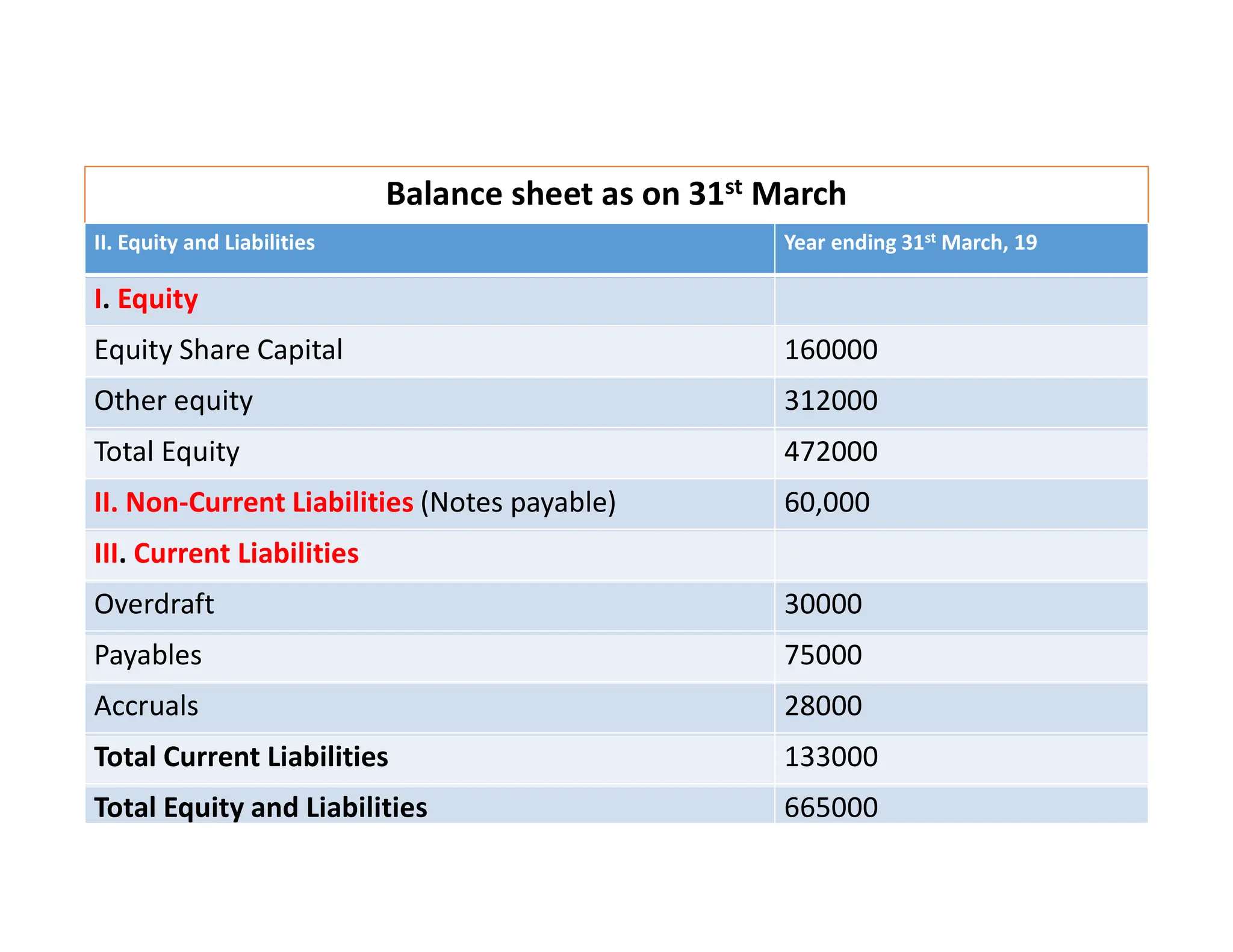
Balance sheet as on 31st March
II. Equity and Liabilities Year ending 31st March, 19
I. Equity
Equity Share Capital 160000
Other equity 312000
Total Equity 472000
II. Non-Current Liabilities (Notes payable) 60,000
III. Current Liabilities
Overdraft 30000
Payables 75000
Accruals 28000
Total Current Liabilities 133000
Total Equity and Liabilities 665000

Depreciation & preparation of Financial Statements.pdf

  • 1.
    Post-Mid Term Financial Accountingfor Managers PART-I (Depreciation and Financial Statement) C.A. (Dr.) Pramod Kumar Pandey
  • 2.
  • 3.
    DEPRECIATION  Decrease invalue of Non-Current Assets like Building, Machinery, Furniture etc. is called Depreciation  It is a method for spreading the cost of assets over its useful life.  Depreciation is charged to give effect to Matching Concept because Depreciation shows portion of cost of assets used to generate revenue in Business  Deprecation is a non-cash expenditure
  • 4.
    Causes for Depreciation •Wear and tear due to actual use • Efflux of time • Obsolescence due to new inventions and technology • Physical reasons like rust, moisture etc. • Irregular repairs and maintenance
  • 5.
    Entries required forDepreciation Events Entries When Assets purchased Assets a/c Dr. to Bank a/c Cr. When Depreciation charged Depreciation expense a/c Dr. to Accumulated Depreciation a/c Cr. When Depreciation transferred to P&L a/c P&L a/c Dr. to Depreciation expense a/c Cr.
  • 6.
    Treatment of Depreciationin Financial Statements • In Statement of Profit & Loss, Depreciation is shown as an Expense • In Balance Sheet, Accumulated Depreciation is deducted from cost • Cost minus Accumulated Depreciation is called Written Down Value (WDV) • Two popular methods for charging Depreciation are (a) Straight Line Method (b) Diminishing Balance Method
  • 7.
    Straight Line Method(SLM) • This method charges equal amount of Depreciation each year • This method is also known as Original Cost Method and Fixed Installment Method • Method for Depreciation Amount IN SLM Depreciation Amount
  • 8.
    Example-1: Straight Line •Jackson Limited purchased a Machine for ₹ 1,00,000. it has an expected life of 5 years at the end of which it can be disposed off at a price of ₹ 20,000. Assuming company charges depreciation by SLM. Compute. depreciation amount annually and depreciation rate. • Depreciation Amount , , , • Depreciation rate = × 100 = 16%
  • 9.
    Example-2: Straight Line XLtd. Purchased a machine for Rs. 4,00,000 on 1st April, 2015. it has life of 5 years with zero scrap value. Assuming Company charges Depreciation on Straight line basis, calculate Depreciation for all the five years.
  • 10.
    Solution:2 (Depreciation =Original cost x %) Year Computation Depreciation 1 400000 x 20% 80000 2 400000 x 20% 80000 3 400000 x 20% 80000 4 400000 x 20% 80000 5 400000 x 20% 80000 Total Depreciation 400000 Note: Rate of Depreciation = Cost-Scrap value/Life = 400000-0/5= 80000, 80000/400000 x 100 = 20%
  • 11.
    Diminishing Balance Method •This method is also called Reducing balance method • Under this method depreciation amount reduces each year • Depreciation is charged on (Original Cost – Accumulated Depreciation) x rate % • As compared to SLM, this method charges less depreciation. Thus a Company will be able to show higher profits if it follows Diminishing Balance Method as compared to SLM.
  • 12.
    Example-1: Diminishing BalanceMethod X Ltd. Purchased a machine for Rs. 4,00,000 on 1st April, 2015. it has life of 5 years with zero scrap value. Assuming Company charges Depreciation on Diminishing Balance Method@ 20% each year, calculate Depreciation for all the five years.
  • 13.
    Solution:1 (Depreciation =Original cost-Accumulated Depreciation x %) Year Original Cost – Accumulated Depreciation) x 20% Depreciation Amount 1 (400000-0) x 20% 80000 2 (400000-80000) x 20% 64000 3 (400000-144000) x 20% 51200 4 (400000-195200) x 20% 40960 5 (400000-236160) x 20% 32768 Total Depreciation 268928
  • 14.
    Example-2: Diminishing BalanceMethod Z Ltd. Purchased a Computer for Rs. 4,20,000 on 1st April, 2015. it has life of 5 years with zero scrap value. Assuming Company charges Depreciation on Diminishing Balance Method@ 10% each year, calculate Depreciation, Accumulated Depreciation and Written Down Value for all the five years.
  • 15.
    Solution:2 Year Depreciation ExpenseAccumulate d Depreciatio n Written Down Value (WDV) 1 420000 x 10% = 42000 42000 420000-42000 = 378000 2 (420000-42000) x 10% = 37800 79800 420000-79800 = 340200 3 (420000 – 79800) x 10% = 34020 113820 420000-113820 = 306180 4 (420000-113820) x 10% = 30618 144438 420000 – 144438 = 275562 5 (420000-144438) x 10% = 27556 171994 420000-171994 = 248006
  • 16.
    Example-3: Diminishing BalanceMethod P Limited has purchased a furniture for Rs. 300000. it charges depreciation @20% on diminishing balance method and falls in tax bracket of 40%. Compute Depreciation expense and Profit after taxes for the company from following year wise Profit before taxes Year Profit Before Taxes 1 120000 2 130000 3 110000 4 140000
  • 17.
    Solution-3: Computation ofDepreciation Expense Year Depreciation Expense 1 300000 x 20% =60000 2 (300000-60000) x 20% = 48000 3 (300000-108000) x 20% = 38400 4 (300000-146400) x 20% = 30720
  • 18.
    Computation of Profitafter Taxes Year Profit before Depreciatio n and Tax Depreciation Expense Profit after depreciation before tax Tax @ 40% Profit after Tax 1 120000 60000 60000 24000 36000 2 130000 48000 82000 32800 49200 3 110000 38400 71600 28640 42960 4 (140000) 30720 (170720) (68288) (239008)
  • 19.
    Mix Problem-1 • Amachine was purchased by a X Ltd for ₹90000. The scrap value at the end of its expected useful life of 4years is estimated ₹ 24000. Calculate the amount of depreciation and Net Book Value (NBV) for the four years using Straight Line Method. • Also, calculate the depreciation charges and NBV for the machine for four years using reducing balance method at a rate of 60%. • Assume that the business owning the machine has made a profit before depreciation of ₹20000 for each of the four years in which the asset was held. Calculate the profit after depreciation for each year under each depreciation method, and comment on your findings.
  • 20.
    Solution: Straight LineMethod Annual Depreciation Charge = Cost – Scrap value Useful life in years = 90000 -24000 4 = ₹16500
  • 21.
    Straight Line Method:Continued Year Cost ₹ Depreciation ₹ Accu: dep ₹ NBV ₹ 1 90000 16500 16500 73500 2 90000 16500 33000 57000 3 90000 16500 49500 40500 4 90000 16500 66000 24000
  • 22.
    Reducing Balance Method YearCost ₹ Dep ₹ Accu dep ₹ NBV ₹ 1 90000 54000 54000 36000 2 90000 21600 75600 14400 3 90000 8640 84240 5760 4 90000 3456 87696 2304
  • 23.
    Effect of Depreciationon Tax: Straight line Method Year Profit before dep ₹ Dep ₹ Profit after dep ₹ 1 20000 16500 3500 2 20000 16500 3500 3 20000 16500 3500 4 20000 16500 3500
  • 24.
    Effect of Depreciationon Tax: Diminishing Bal.Method Year Profit before dep ₹ Dep ₹ Profit after dep ₹ 1 20000 54000 (34000) 2 20000 21600 (1600) 3 20000 8640 11360 4 20000 3456 16544
  • 25.
    Analysis • Under straightline method since the depreciation amount is the same throughout the years the profit after depreciation also remains the same in all years • whereas in reducing balance method the depreciation amount is higher in the initial years and has a negative effect on profit. In the initial years the profit is negative and later on the depreciation amount decreases as years pass by and is reflected in the increase in profit.
  • 26.
    Misc. Problems onDepreciation:2 • Zohn & Sons provides you the following extracts of its Trial Balance on 31st December, 2017 • Rate of Depreciation on Building is 20% Straight line and on Furniture 10% on Diminishing balance method. • Required: Compute depreciation expense for the year on Building and Furniture and Show treatment in Balance Sheet Particulars Dr. ₹ Cr. ₹ Building at cost 300000 Furniture at cost 200000 Accumulated Depreciation on Building 180000 Accumulated Depreciation on Furniture 38000
  • 27.
    Solution:2 • Depreciation onBuilding = 300000 × 20% = ₹ 60,000 • Depreciation on Furniture = (200000-38000) × 10% = ₹ 16200 • Balance Sheet extracts Non- Current Assets Building 300000 Less accumulated Depreciation (240000) 60000 Furniture 200000 Less accumulated Depreciation (54200) 145800
  • 28.
    Misc. Problem:3 • OnJanuary 1st 2017, Fashion brothers bought Equipment for ₹ 20, 00000 for cash. It charges depreciation at the rate of 6.25% on Straight line basis and closes its books of accounts on December 31st every year. • Required: Pass entries on January 1st and December 31st, 2017.
  • 29.
    Solution:3 1st January, 2017Equipment a/c Dr. 20,00000 To cash 20,00000 31st December, 2017 Depreciation expense a/c Dr. 1,25,000 To accumulated Depreciation 1,25,000
  • 30.
  • 31.
    Financial Statement ofCompany 1. Balance sheet 2. Statement of Profit and Loss 3. Cash Flow Statement 4. Statement of Changes in Equity 5. Notes to Accounts
  • 32.
    Statement of Profitand Loss of Service operations From the following information prepare Statement of Profit and Loss of Y Ltd which is involved in service of Motor vehicles for the year ended 2018-19 Particulars ₹ (Crores) Service Revenue 200.5 Interest on Fixed Deposit 42.42 Salary to staff 14.5 Travelling expenses 12.6 Rent Expenses 3.54 Interest on loan 10.46 Auditor’s fee 6.45 Tax expense 5.34 Depreciation 7.98
  • 33.
    Statement of Profitand Loss of Y Ltd for the year ended 2018-19 Particulars ₹ (Crores) I. Income a) Revenue from operation Service Revenue 200.5 b) Other income Interest on Fixed Deposit 42.42 Total income 242.92
  • 34.
    II Expenses a) Employeebenefit expenses Salary to staff 14.5 b) Finance cost Interest on loan 10.46 c) Depreciation and Amortization Depreciation 7.98 d) Other expenses Travelling expenses 12.6 Rent Expenses 3.54 Auditor’s fee 6.45 Total Expenses 55.53 III. Profit before tax (I –II) 187.39 IV. Tax expense 5. 34 V. Profit after taxes (IV-V) 182.05
  • 35.
    Statement of Profitand Loss of Manufacturer and Trader From the following information prepare Statement of Profit and Loss of Y Ltd which is involved in Manufacturing of Motor vehicles for the year ended 2018-19 Particulars ₹ (Crores) Sales 400.89 Interest on investment 100.6 Salary to staff 35.76 Cost of material consumed 42.5 Purchase of stock in trade 67.89 Changes in inventories of Work in progress, Stock in trade and Finished goods 34.32 Rent Expenses 54.78 Interest on loan 45.89 Tax expense 32.69 Depreciation 40.64
  • 36.
    Statement of Profitand Loss of Y Ltd for the year ended 2018-19 Particulars ₹ (Crores) I. Income a) Revenue from operation Sales 400.89 b) Other income Interest on Investment 100.6 Total income 501.49
  • 37.
    II Expenses a) Costof material consumed 42.5 b) Purchase of stock in trade 67.89 c) Changes in inventories of Work in progress, Stock in trade and Finished goods 34.32 d) Employee benefit expenses Salary to staff 35.76 e) Finance cost Interest on loan 45.89 f) Depreciation and Amortization Depreciation 40.64 g) Other expenses Rent Expenses 54.78 Total Expenses 327.78 III. Profit before tax (I –II) 179.71 IV. Tax expense 32.69 V. Profit after taxes (IV-V) 147.02
  • 38.
    How will youdeal with the following items in Statement of Profit and Loss for year 2016-17 • Material purchased during the year ₹ 64,50,000 • Stock in trade purchased during the year ₹ 17,80,000 Inventory 1st April 2016 (₹) 31st March 2017 (₹) Raw material 24,55,000 18,37,000 Work in progress 4,34,000 6.25,000 Stock in trade 2,20,000 4,45,000 Finished goods 13,78,000 6,64,200
  • 39.
    Statement of Profitand Loss of Y Ltd for the year ended 2016-17 Particulars ₹ a) Cost of material consumed (Opening stock of Raw material + Purchase of Raw material – Closing Stock of Raw material) 24,55,000 + 64,50,000 – 18,37,000 70,68,000 b) Purchase of stock in trade 17,80,000 c) Changes in inventories of Work in progress, Stock in trade and Finished goods (Opening stock of work in progress + opening stock of stock in trade + opening stock of finished goods)- (Closing stock of work in progress + Closing stock of stock in trade + Closing stock of finished goods) = (434000+220000+1378000)- (625000+445000+664200)= 20,32000-17,34200 2,97,800
  • 40.
    Various measures ofprofit • Gross profit = Sales – cost of goods sold or Profit before interest, taxes and Depreciation and Amortization (EBITDA) + Other operating expenses • Cash operating profit = EBITDA = Profit before interest and taxes (EBIT) + Depreciation and Amortization • Operating Profit = Profit before interest and taxes (EBIT)= Profit before tax (EBT) + Interest and Finance cost • Pre- tax profit = Profit before tax (EBT)= Profit after tax (PAT) + Tax expense • Net profit = Profit after tax (PAT)= Profit before tax (EBT)-Tax expense
  • 41.
    From following calculate(a) EBIT (b)EBITDA (c) Gross profit Particulars ₹ Crores Total revenue 363.54 Cost of goods sold 120.47 Other operating expenses 60.26 Depreciation and amortization 53.25 Finance and interest cost 42.20 Tax on income 19.84 Profit after taxes 68.52
  • 42.
    Solution Particulars ₹ Profit aftertaxes 68.52 Add tax expenses 19.84 Profit before tax (EBT) 88.36 Add interest and finance charges 42.20 Profit before interest and taxes (EBIT) 130.56 Add Depreciation and Amortization 53.25 Profit before interest, taxes and Depreciation and Amortization (EBITDA) 183.81 Add other operating expenses 60.26 Gross Profit (Sales – cost of goods sold) 244.07
  • 43.
    Concept of DeferredTax Sl.No Entity Profit Status Entity – Current Entity – Future Effect 1 Book profit higher than the Taxable profit Pay less tax now Pay more tax in future Creates Deferred Tax Liability (DTL) 2 Book profit is less than the Taxable profit Pay more tax now Pay less tax in future Creates Deferred Tax Asset (DTA) The tax effect on the timing differences is termed as deferred tax which literally means taxes which are deferred. Deferred tax is recognized on all timing difference – Temporary and Permanent. These deferred taxes are given effect to in the financial statements through Deferred Tax Asset and Liability as under:
  • 44.
    Treatment of Tax •Tax expense = Current tax + Deferred Tax. It is shown as an Expense in Statement of Profit and Loss. It is tax as per books of accounts maintained as per company law. • Current Tax is the tax on current income as per income tax law • Deferred tax is the difference of Tax expense and current tax. It shows difference between tax computed as per company law and income tax law. • If deferred tax is negative in statement of Profit and Loss, then it is Deferred tax assets and is shown as non-current Assets • If deferred tax is positive, then it is Deferred Tax Liability and is shown as non-current Liability
  • 45.
    Example: Deferred Tax ACompany discloses following extracts of Tax. You are required to compute (a) Current tax (b) Tax expense and (c) Deferred Tax Assuming Applicable tax rate for Company is 30%. Cases Book Profit (₹ Crores) Taxable Profit (₹ Crores) 1. 100 90 2. 120 150
  • 46.
  • 47.
    Balance sheet From followinginformation prepare Balance sheet of B Ltd as on 31st March, 2019 Particulars ₹ (Crores) Particulars ₹ (Crores) Property, plant and equipment 1200 Equity share capital 1000 Long term investment 700 Other equity 200 Trade receivables 800 Inventories 200 Trade payables 600 Deferred tax liability 40 Long term borrowings 160 Long term provisions 100 Short term borrowings 500 Short term provisions 700 Cash and cash equivalent 100 Capital work in progress 500
  • 48.
    Balance sheet ofB Ltd. as on 31st March, 2019 Assets ₹ (Crores) ₹ (Crores) I. Non-Current Assets Property, plant and equipment 1200 Capital work in progress 500 Long term investments 700 Total Non-Current Assets 2400 II. Current Assets Inventories 200 Trade receivables 800 Cash and cash equivalent 100 Total Current Assets 1100 Total Assets 3300
  • 49.
    Equity and Laibilities₹ (Crores) ₹ (Crores) I. Equity Equity Share Capital 1000 Other equity 200 1200 II. Non-Current Liabilities Long term borrowing 160 Long term provisions 100 Deferred tax liability 40 300 II. Current Liabilities Trade payables 600 Short term Borrowings 500 Short term provisions 700 1800 Total Current Liabilities Total Equity and Liabilities 3300
  • 50.
    Adjustments (Additional information) 1.Prepaid expenses: Deduct from expenses in Statement of Profit and Loss and show as Current Assets in Balance sheet 2. Outstanding Expenses: Add to expenses in Statement of Profit and Loss and show as Current Liabilities in Balance sheet 3. Accrued Revenue: Add to income in Statement of Profit and Loss and show as Current Assets in Balance sheet 4. Revenue received in advance: Less from income in Statement of Profit and Loss and show as Current Liabilities in Balance sheet 5. Closing inventories: Less from opening inventory in Statement of Profit and Loss and show as Current Assets in Balance sheet
  • 51.
    Adjustments continued 6. Depreciation:Show this as expenses in Statement of Profit and Loss and add this to accumulated depreciation of respective asset and deduct this total accumulated depreciation from respective asset in Balance sheet 7. Provision for tax: Compute this as % on Profit before tax. Deduct this from profit before tax from statement of profit and loss. Show this as current liability in Balance sheet 8. Provision for doubtful debts: This is new provision. Compute this on debtors (Trade receivables) x %. Show this as expenses in Statement of Profit and loss and deduct from this existing provision given in trial balance. Deduct new provision from Debtors (Trade receivables) in Balance sheet
  • 52.
    Hidden adjustment Normally adjustmentsare given as addition information below trial balance. However, if interest rate given in loan, this is called hidden adjustment. • Loan x interest rate = interest expense =A • Compare this with interest already given in trial balance=B • If A is more than B, difference is outstanding interest • If A is less than B, Difference is prepaid expenses
  • 53.
    From following trialbalance, prepare statement of Profit and Loss and Balance sheet for year 2018-19 Particulars Dr. Amount Cr. Amount Stock 31st March, 2018 75000 Sales 350000 Purchases 245000 Wages 50000 Discount 5000 Furniture and fitting 17000 Salaries 7500 Rent 4950 Sundry expenses 7050 Surplus account 31st March, 2018 15030
  • 54.
    From following trialbalance, prepare statement of Profit and Loss and Balance sheet for year 2018-19-Continued Particulars Dr. Amount Cr. Amount Dividend paid 9000 Share capital 100000 Debtors and Creditors 37500 17500 Plant and Machinery 29000 Cash and Bank 16200 Reserve 15500 Patents and trade marks 4830 Total 503030 503030
  • 55.
    Additional information • Stockin trade on 31st March 2019 was valued at Rs. 82000 • Depreciation on fixed assets @ 10% • Make a provision for income tax @ 50% • Ignore corporate dividend tax
  • 56.
    Statement of Profitand Loss for the year ended 31st March, 2019 Note No Year ending 31st March, 19 Year ending 31st March, 18 I. Revenue from operation (Sales) 350000 II. Other income (Discount) 5000 III. Total Revenue 355000 IV. Expenses Purchases of stock in trade 245000 Changes in inventory (Opening-closing stock) 75000-82000 (7000) Employee benefit expenses 1 57500 Finance cost Nil Depreciation and Amortization 2 5083 Other expenses 3 12000 Total expenses 312583 V Profit before tax 42417 VI Tax expenses (42417 x 50%) 21209 VII Profit after taxes 21208
  • 57.
    Accompanying notes toStatement of Profit and Loss for the year ended 31st March, 2019 Year ending 31st March, 19 Year ending 31st March, 18 1 Employee Benefit Expenses Wages 50000 Salaries 7500 57500 2. Depreciation and Amortization Depreciation on plant and Machinery 2900 Depreciation on Patents and Trade marks 483 Depreciation on Furniture and Fittings 1700 5083 3 Other expenses Rent 4950 Sundry expenses 7050 12000
  • 58.
    Balance sheet ason 31st March Assets Note No Year ending 31st March, 19 Year ending 31st March, 18 I. Non Current Assets Tangible Assets 4 41400 Intangible Assets 5 4347 Total Non-Current Assets 45747 II. Current Assets Inventories 82000 Trade receivables 37500 Cash and cash equivalent 16200 Total Current Assets 135700 Total Assets 181447
  • 59.
    Balance sheet ason 31st March Equity and Liabilities Note No Year ending 31st March, 19 Year ending 31st March, 18 I. Equity Equity Share Capital 100000 Other equity 6 42738 Total Equity 142738 II. Non-Current Liabilities Nil III. Current Liabilities Trade payable (Creditors) 17500 Short term provisions 21209 Total Current Liabilities 38709 Total Equity and Liabilities 181447
  • 60.
    Notes accompanying Balancesheet Year ending 31st March, 19 Year ending 31st March, 18 4 Tangible Assets Plant and Machinery 29000 Less Depreciation (2900) 26100 Furniture and fitting 17000 Less Depreciation (1700) 15300 Total 41400 5 Intangible Assets Patents and trade marks 4830 Less Depreciation (483) 4347 6. Other Equity Reserves 15500 Opening Surplus 15030 Profit for the year 21208 Less Dividend paid (9000) 42738
  • 61.
    From following trialBalance prepare Statement of P&L and Balance sheet for the year ended 31-3-19 ₹'000s Trade Payables 75 Receivables 100 Overdraft 30 Loan note interest 2 Administrative expenses 47 Selling & distribution expenses 10 5% Loan notes 60 Freehold land & buildings at cost 200 Fixtures & fittings at cost 150 Motor vehicles at cost 200
  • 62.
    Trial Balance contd…… ₹'000s AccumulatedDepreciation at 1.4.18 Fixtures & fittings 30 Motor vehicles 60 Opening Inventory at 1.4.18 125 Purchases 185 Sales 375 Share capital 160 Revaluation reserve 35 Provision for doubtful debts at 1.4.18 7 Retained Earnings at 1.4.18 187
  • 63.
    Additional information • ClosingInventory at 31 March 2019: ₹175,000. • Included in the figure for administrative expenses is ₹18,000, being advance payment for twelve months' rent from 30.11.2018 • Depreciation is to be charged as follows: Fixtures and fittings: 20% straight line. Motor vehicles: 30% reducing balance. • Provision for doubtful debts should be increased and made equal to 10% of outstanding Receivables. • During the year the company have engaged computer consultants at a cost of ₹15,000. Their bill has not yet been paid but must be provided for. • It is expected that audit and accountancy fees for 2018-19 will amount to ₹12,000.
  • 64.
    Statement of Profitand Loss for the year ended 31st March, 2019 Note No Year ended 31-3-19 Year ended 31-3-18 I. Revenue from operation (Sales) 375000 II. Other income Nil III. Total Revenue 375000 IV. Expenses Purchases of stock in trade 185000 Changes in inventory (Opening-closing stock) 125000-175000 (50000) Employee benefit expenses Nil Finance cost 1 3000 Depreciation and Amortization 2 72000 Other expenses (Administrative :35000, Selling:10000, Provision for DD:3000, Consultancy:15000, Audit:12000) 3 75000 Total expenses 285000 V Profit before tax 90000 VI Tax expenses Nil VII Profit after taxes 90000
  • 65.
    Notes accompanying Statementof Profit and Loss 1. Finance cost The Trial Balance shows 5% Loan notes of ₹60,000 Therefore there is still an amount owing but not yet paid = ₹1,000 (₹3,000 - ₹2,000) Loan note interest should be : 60,000 x 5% = ₹3,000 But in the Trial Balance loan note interest is = ₹2,000 P&L: Expense Loan note interest ₹3,000 B/S: Current Liabilities Accrued loan note interest ₹1,000 B/S: Non Current Liabilities 5% Loan notes ₹60,000
  • 66.
    Notes accompanying Statementof Profit and Loss 2. Depreciation and Amortization • Dep'n charge for the year • Straight Line: Original cost x % • Reducing Balance: NBV x % F+F: ₹150,000 x 20% = ₹30,000 (Straight Line) MV: (₹200,000 - 60,000) x 30% = ₹42,000 (Reducing Balance) F+F: ₹150,000 - (30,000 + 30,000) = ₹90,000 MV: ₹200,000 - (60,000 + 42,000 = ₹98,000 Note : Cost - Accumulated dep'n = NBV Accumulated Depreciation = Accumulated Dep'n at 1.4.18 (TB) + Dep'n charge for year
  • 67.
    Notes accompanying Statementof Profit and Loss 2. Other expenses: Provision for Doubtful Debts 10% of Receivables = 10% x ₹100,000 = ₹10,000 2019 prov'n - 2018 prov'n ₹10,000 - ₹ 7,000 = ₹ 3,000 Receivables 100,000 Less: Prov'n for DD (10,000) Figure for Balance sheet 90000
  • 68.
    Notes accompanying Statementof Profit and Loss Other Expenses: Administrative Expenses Of the ₹47,000 admin expense, ₹18,000 is paid in advance for rent How much is the prepayment? Match up the dates! Financial Year 1.4.18 - 31.3.19 Payment for rent 30.11.18 - 30.11.19 30.11.18 - 30.11.19 - 4 months Matches – Expense in the Profit and Loss 1.1.18to 30.8.18 - 8 months Doesn’t Match – Prepayment = ₹ 12000 (Admin Exp) = ₹47,000 Less: Prepayment = (₹12,000) = ₹35,000 ₹ 12000 will be shown as Current Assets
  • 69.
    Balance sheet ason 31-3-2019 I. Assets Non current Assets Cost (TB) Accumulated Dep'n (W3) NBV (W3) Land & Building 200,000 - 200,000 Fixtures & Fittings 150,000 60,000 90,000 Motor Vehicles 200,000 102,000 98,000 388,000 Current Assets Inventory (W1) 175,000 Receivables (100 -10) 100,000 Provision for DD (W4) (10,000) Prepayment 12,000 277000 Total Assets 665000
  • 70.
    Balance sheet ason 31st March II. Equity and Liabilities Year ending 31st March, 19 I. Equity Equity Share Capital 160000 Other equity 312000 Total Equity 472000 II. Non-Current Liabilities (Notes payable) 60,000 III. Current Liabilities Overdraft 30000 Payables 75000 Accruals 28000 Total Current Liabilities 133000 Total Equity and Liabilities 665000