DEPARTMENTALIZATION.
Presented by:
Md Nafiz Ahmmed ID# 20212105
DEPARTMENTALIZATION
PRESENTATION AGENDA
Today we will focus on Departmentalization
01 What is Departmentalization
Types of Departmentalization
02
03 Advantages & Disadvantages of different types
of Departmentalization
DEPARTMENTALIZATION
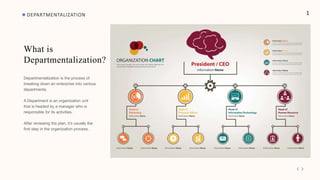
Departmentalization is the process of
breaking down an enterprise into various
departments.
A Department is an organization unit
that is headed by a manager who is
responsible for its activities.
After reviewing the plan, it’s usually the
first step in the organization process.
1
What is
Departmentalization?
DEPARTMENTALIZATION
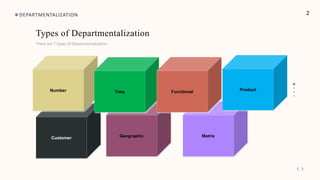
Types of Departmentalization
There are 7 types of Departmentalization
2
Customer Geographic Matrix
Number Product
Time Functional
DEPARTMENTALIZATION
01
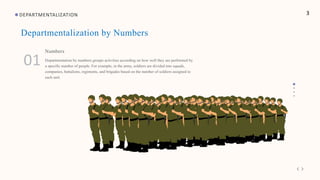
Numbers
Departmentation by numbers groups activities according on how well they are performed by
a specific number of people. For example, in the army, soldiers are divided into squads,
companies, battalions, regiments, and brigades based on the number of soldiers assigned to
each unit.
Departmentalization by Numbers
3
DEPARTMENTALIZATION
Advantages & Disadvantages of Departmentalization by Numbers
4
Advantages Disadvantages
 Quite popular in military.
 It is useful when it is the number of people that is critical
to finish a task.
 It has diminished as a result of advanced technology and
the demand for specialized and diverse talents.
 Another explanation is that groups comprised of specialist
workers are more efficient than those comprised of a large
number of people.
 Numbering departments is only beneficial at the lowest
level of the organization.
 Department by number does not offer satisfactory results.
DEPARTMENTALIZATION
02
Time
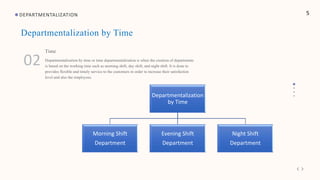
Departmentalization by time or time departmentalization is when the creation of departments
is based on the working time such as morning shift, day shift, and night shift. It is done to
provides flexible and timely service to the customers in order to increase their satisfaction
level and also the employees.
Departmentalization by Time
5
Departmentalization
by Time
Morning Shift
Department
Evening Shift
Department
Night Shift
Department
DEPARTMENTALIZATION
Advantages & Disadvantages of Departmentalization by Time
6
Advantages Disadvantages
 It helps to increase the production capacity within the
limited resources.
 Departmentalization by time creates employee satisfaction.
 In departmentation by the time, there may be coordination
between various departments becomes challenging.
 High possibility of making duplications of efforts and
resources across divisions and departments.
 High chances of shifting the responsibility of one
department to other departments.
 Less effective interdepartmental communication.
 Enables customer satisfaction by providing services
throughout 24 hours.
 This method is flexible and adaptable in changing working
environments.
 Facilitates coordination by grouping members into shifts,
thus students or part-timers can work.
 Provides full responsibility to shift head to complete the
activities which improve product/ service efficiency.
 It ensures the effective utilization of specialized skills and
types of equipment.
 It is only appropriate for public utility enterprises where
the work is round the clock.
 The technical problem in one shift may create problems for
the entire shift.
 Lacking of supervision during a particular shift such as at
night.
DEPARTMENTALIZATION
03
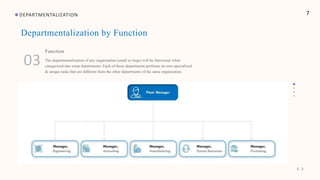
Function
The departmentalization of any organization (small or large) will be functional when
categorized into some departments. Each of those departments performs its own specialized
& unique tasks that are different from the other departments of the same organization.
Departmentalization by Function
7
DEPARTMENTALIZATION
Advantages & Disadvantages of Departmentalization by Function
8
Advantages Disadvantages
 This kind of departmentalization will logically reflect the
functions performed to maintain various primary functions’
superiority & dignity.
 Slow decision making
 More bureaucratic
 Because if it, the organization’s overall objectives becomes
de-emphasized.
 Difficulty in the monitoring of the company’s
accountability & performance.
 It pursues the occupational specialization principle.
 It makes the subordinate’s training & supervision simple.
 With its help, the man sitting at its top position becomes
proficient in maintaining tight organizational control.
 Because of it, each of the departments having different
functional areas is overseen by experts in those functional
areas.
 Because of it, each departmental coordination activity
becomes manageable.
 The key personnel’s viewpoints get overspecialized or
narrowed because if it.
 The functional & departmental coordination gets reduced by
it.
 The profit attaining responsibility of the organization
remains at the top.
 It results in slow adaptation to environmental changes.
 The general managers’ development gets limited.
DEPARTMENTALIZATION
04
Product
The department which is created on the basis of the nature of a product or product line is
called departmentalization by product. Here a separate department is created for a single
product or product line and all functions like production, finance, marketing, personnel etc.
are brought together under the concerned department .
Departmentalization by Product
9
DEPARTMENTALIZATION
Advantages & Disadvantages of Departmentalization by Product
10
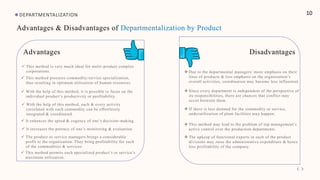
Advantages Disadvantages
 This method is very much ideal for multi-product complex
corporations.  Due to the departmental managers’ more emphasis on their
lines of products & less emphasis on the organization’s
overall activities, coordination may become less influential.
 Since every department is independent of the perspective of
its responsibilities, there are chances that conflict may
occur between them.
 This method procures commodity/service specialization,
thus resulting in optimum utilization of human resources.
 With the help of this method, it is possible to focus on the
individual product’s productivity or profitability.
 With the help of this method, each & every activity
correlated with each commodity can be effortlessly
integrated & coordinated.
 It enhances the speed & cogency of one’s decision-making.
 It increases the potency of one’s monitoring & evaluation.
 If there is less demand for the commodity or service,
underutilization of plant facilities may happen.
 This method may lead to the problem of top management’s
active control over the production departments.
 The upkeep of functional experts in each of the product
divisions may raise the administrative expenditure & hence
less profitability of the company.
 The product or service managers brings a considerable
profit to the organization. They bring profitability for each
of the commodities & services.
 This method permits each specialized product’s or service’s
maximum utilization.
DEPARTMENTALIZATION
05
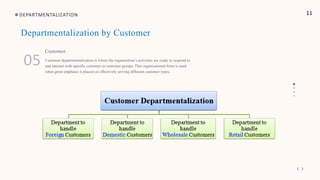
Customer
Customer departmentalization is where the organization’s activities are ready to respond to
and interact with specific customer or customer groups. This organizational form is used
when great emphasis is placed on effectively serving different customer types.
Departmentalization by Customer
11
DEPARTMENTALIZATION
Advantages & Disadvantages of Departmentalization by Customer
12
Advantages Disadvantages
 Encourages concentration on customer needs.
 May be difficult to coordinate operations between
competing customer demands.
 Requires managers and staff expert in customers’ problems.
 Gives customers feeling that they have an understanding
supplier (banker).
 Develops expertness in the customer area.
 Saves customers’ time.  Customer groups may not always be clearly defined.
DEPARTMENTALIZATION
06
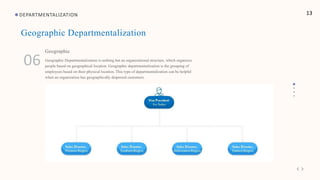
Geographic
Geographic Departmentalization is nothing but an organizational structure, which organizes
people based on geographical location. Geographic departmentalization is the grouping of
employees based on their physical location. This type of departmentalization can be helpful
when an organization has geographically dispersed customers.
Geographic Departmentalization
13
DEPARTMENTALIZATION
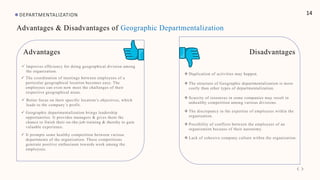
Advantages & Disadvantages of Geographic Departmentalization
14
Advantages Disadvantages
 Improves efficiency for doing geographical division among
the organization.
 Duplication of activities may happen.
 The structure of Geographic departmentalization is more
costly than other types of departmentalization.
 The coordination of meetings between employees of a
particular geographical location becomes easy. The
employees can even now meet the challenges of their
respective geographical areas.
 Geographic departmentalization brings leadership
opportunities. It provides managers & gives them the
chance to finish their on-the-job training & thereby to gain
valuable experience.
 Better focus on their specific location’s objectives, which
leads to the company’s profit.
 Scarcity of resources in some companies may result in
unhealthy competition among various divisions.
 It prompts some healthy competition between various
departments of the organization. These competitions
generate positive enthusiasm towards work among the
employees.
 The discrepancy in the expertise of employees within the
organization.
 Possibility of conflicts between the employees of an
organization because of their autonomy.
 Lack of cohesive company culture within the organization.
DEPARTMENTALIZATION
07
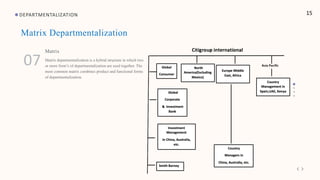
Matrix
Matrix departmentalization is a hybrid structure in which two
or more form’s of departmentalization are used together. The
most common matrix combines product and functional forms
of departmentalization.
Matrix Departmentalization
15
DEPARTMENTALIZATION
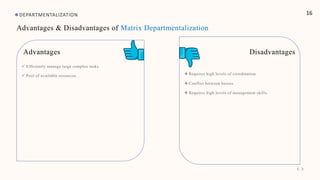
Advantages & Disadvantages of Matrix Departmentalization
16
Advantages Disadvantages
 Efficiently manage large complex tasks.
 Requires high levels of coordination.
 Conflict between bosses.
 Pool of available resources.
 Requires high levels of management skills.
THANK YOU.
If you have any question, please feel free to ask!

Departmentalization.pptx

  • 1.
  • 2.
    DEPARTMENTALIZATION PRESENTATION AGENDA Today wewill focus on Departmentalization 01 What is Departmentalization Types of Departmentalization 02 03 Advantages & Disadvantages of different types of Departmentalization
  • 3.
    DEPARTMENTALIZATION Departmentalization is theprocess of breaking down an enterprise into various departments. A Department is an organization unit that is headed by a manager who is responsible for its activities. After reviewing the plan, it’s usually the first step in the organization process. 1 What is Departmentalization?
  • 4.
    DEPARTMENTALIZATION Types of Departmentalization Thereare 7 types of Departmentalization 2 Customer Geographic Matrix Number Product Time Functional
  • 5.
    DEPARTMENTALIZATION 01 Numbers Departmentation by numbersgroups activities according on how well they are performed by a specific number of people. For example, in the army, soldiers are divided into squads, companies, battalions, regiments, and brigades based on the number of soldiers assigned to each unit. Departmentalization by Numbers 3
  • 6.
    DEPARTMENTALIZATION Advantages & Disadvantagesof Departmentalization by Numbers 4 Advantages Disadvantages  Quite popular in military.  It is useful when it is the number of people that is critical to finish a task.  It has diminished as a result of advanced technology and the demand for specialized and diverse talents.  Another explanation is that groups comprised of specialist workers are more efficient than those comprised of a large number of people.  Numbering departments is only beneficial at the lowest level of the organization.  Department by number does not offer satisfactory results.
  • 7.
    DEPARTMENTALIZATION 02 Time Departmentalization by timeor time departmentalization is when the creation of departments is based on the working time such as morning shift, day shift, and night shift. It is done to provides flexible and timely service to the customers in order to increase their satisfaction level and also the employees. Departmentalization by Time 5 Departmentalization by Time Morning Shift Department Evening Shift Department Night Shift Department
  • 8.
    DEPARTMENTALIZATION Advantages & Disadvantagesof Departmentalization by Time 6 Advantages Disadvantages  It helps to increase the production capacity within the limited resources.  Departmentalization by time creates employee satisfaction.  In departmentation by the time, there may be coordination between various departments becomes challenging.  High possibility of making duplications of efforts and resources across divisions and departments.  High chances of shifting the responsibility of one department to other departments.  Less effective interdepartmental communication.  Enables customer satisfaction by providing services throughout 24 hours.  This method is flexible and adaptable in changing working environments.  Facilitates coordination by grouping members into shifts, thus students or part-timers can work.  Provides full responsibility to shift head to complete the activities which improve product/ service efficiency.  It ensures the effective utilization of specialized skills and types of equipment.  It is only appropriate for public utility enterprises where the work is round the clock.  The technical problem in one shift may create problems for the entire shift.  Lacking of supervision during a particular shift such as at night.
  • 9.
    DEPARTMENTALIZATION 03 Function The departmentalization ofany organization (small or large) will be functional when categorized into some departments. Each of those departments performs its own specialized & unique tasks that are different from the other departments of the same organization. Departmentalization by Function 7
  • 10.
    DEPARTMENTALIZATION Advantages & Disadvantagesof Departmentalization by Function 8 Advantages Disadvantages  This kind of departmentalization will logically reflect the functions performed to maintain various primary functions’ superiority & dignity.  Slow decision making  More bureaucratic  Because if it, the organization’s overall objectives becomes de-emphasized.  Difficulty in the monitoring of the company’s accountability & performance.  It pursues the occupational specialization principle.  It makes the subordinate’s training & supervision simple.  With its help, the man sitting at its top position becomes proficient in maintaining tight organizational control.  Because of it, each of the departments having different functional areas is overseen by experts in those functional areas.  Because of it, each departmental coordination activity becomes manageable.  The key personnel’s viewpoints get overspecialized or narrowed because if it.  The functional & departmental coordination gets reduced by it.  The profit attaining responsibility of the organization remains at the top.  It results in slow adaptation to environmental changes.  The general managers’ development gets limited.
  • 11.
    DEPARTMENTALIZATION 04 Product The department whichis created on the basis of the nature of a product or product line is called departmentalization by product. Here a separate department is created for a single product or product line and all functions like production, finance, marketing, personnel etc. are brought together under the concerned department . Departmentalization by Product 9
  • 12.
    DEPARTMENTALIZATION Advantages & Disadvantagesof Departmentalization by Product 10 Advantages Disadvantages  This method is very much ideal for multi-product complex corporations.  Due to the departmental managers’ more emphasis on their lines of products & less emphasis on the organization’s overall activities, coordination may become less influential.  Since every department is independent of the perspective of its responsibilities, there are chances that conflict may occur between them.  This method procures commodity/service specialization, thus resulting in optimum utilization of human resources.  With the help of this method, it is possible to focus on the individual product’s productivity or profitability.  With the help of this method, each & every activity correlated with each commodity can be effortlessly integrated & coordinated.  It enhances the speed & cogency of one’s decision-making.  It increases the potency of one’s monitoring & evaluation.  If there is less demand for the commodity or service, underutilization of plant facilities may happen.  This method may lead to the problem of top management’s active control over the production departments.  The upkeep of functional experts in each of the product divisions may raise the administrative expenditure & hence less profitability of the company.  The product or service managers brings a considerable profit to the organization. They bring profitability for each of the commodities & services.  This method permits each specialized product’s or service’s maximum utilization.
  • 13.
    DEPARTMENTALIZATION 05 Customer Customer departmentalization iswhere the organization’s activities are ready to respond to and interact with specific customer or customer groups. This organizational form is used when great emphasis is placed on effectively serving different customer types. Departmentalization by Customer 11
  • 14.
    DEPARTMENTALIZATION Advantages & Disadvantagesof Departmentalization by Customer 12 Advantages Disadvantages  Encourages concentration on customer needs.  May be difficult to coordinate operations between competing customer demands.  Requires managers and staff expert in customers’ problems.  Gives customers feeling that they have an understanding supplier (banker).  Develops expertness in the customer area.  Saves customers’ time.  Customer groups may not always be clearly defined.
  • 15.
    DEPARTMENTALIZATION 06 Geographic Geographic Departmentalization isnothing but an organizational structure, which organizes people based on geographical location. Geographic departmentalization is the grouping of employees based on their physical location. This type of departmentalization can be helpful when an organization has geographically dispersed customers. Geographic Departmentalization 13
  • 16.
    DEPARTMENTALIZATION Advantages & Disadvantagesof Geographic Departmentalization 14 Advantages Disadvantages  Improves efficiency for doing geographical division among the organization.  Duplication of activities may happen.  The structure of Geographic departmentalization is more costly than other types of departmentalization.  The coordination of meetings between employees of a particular geographical location becomes easy. The employees can even now meet the challenges of their respective geographical areas.  Geographic departmentalization brings leadership opportunities. It provides managers & gives them the chance to finish their on-the-job training & thereby to gain valuable experience.  Better focus on their specific location’s objectives, which leads to the company’s profit.  Scarcity of resources in some companies may result in unhealthy competition among various divisions.  It prompts some healthy competition between various departments of the organization. These competitions generate positive enthusiasm towards work among the employees.  The discrepancy in the expertise of employees within the organization.  Possibility of conflicts between the employees of an organization because of their autonomy.  Lack of cohesive company culture within the organization.
  • 17.
    DEPARTMENTALIZATION 07 Matrix Matrix departmentalization isa hybrid structure in which two or more form’s of departmentalization are used together. The most common matrix combines product and functional forms of departmentalization. Matrix Departmentalization 15
  • 18.
    DEPARTMENTALIZATION Advantages & Disadvantagesof Matrix Departmentalization 16 Advantages Disadvantages  Efficiently manage large complex tasks.  Requires high levels of coordination.  Conflict between bosses.  Pool of available resources.  Requires high levels of management skills.
  • 19.
    THANK YOU. If youhave any question, please feel free to ask!