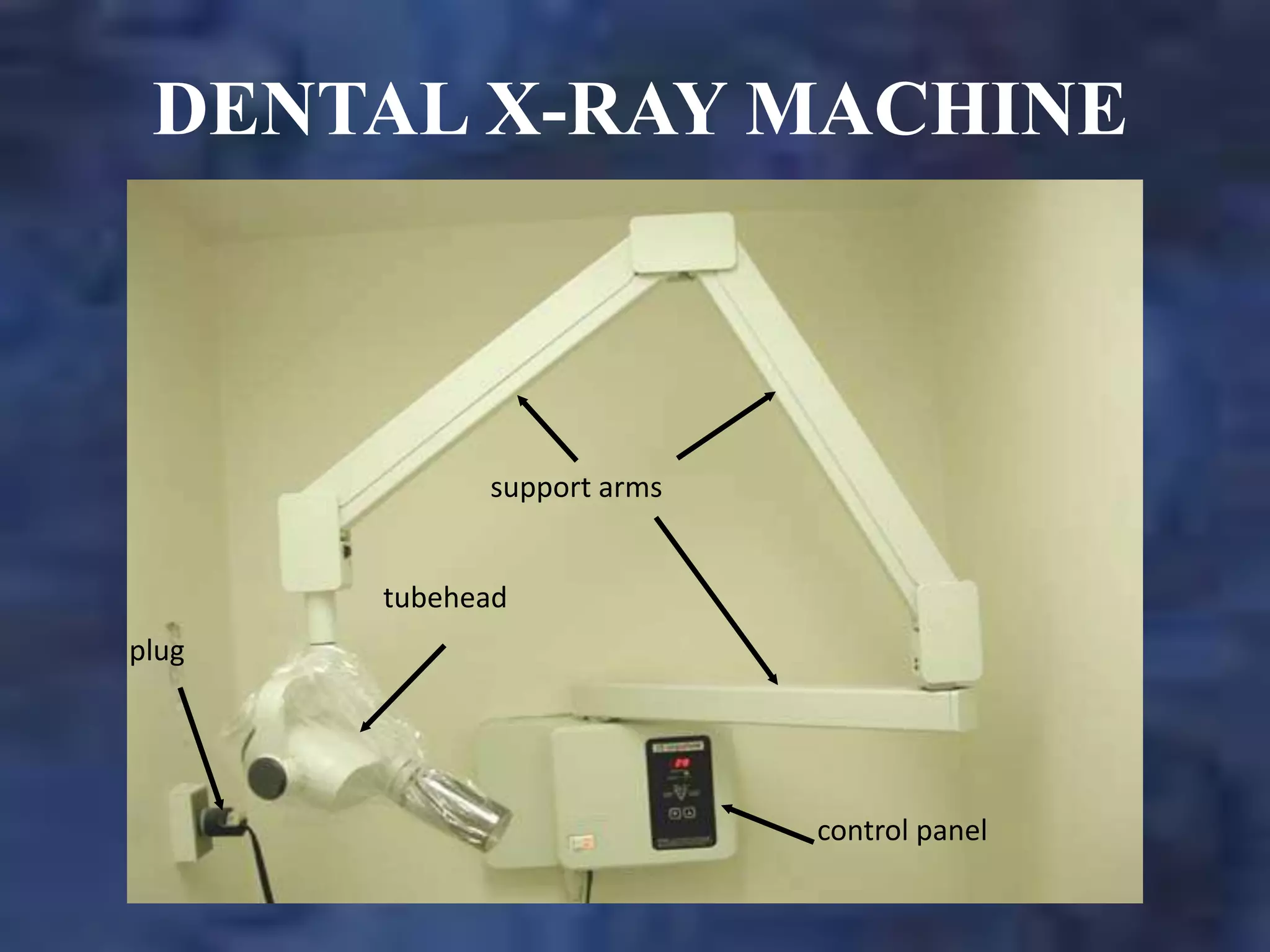
tubehead
control panel
support arms
plug
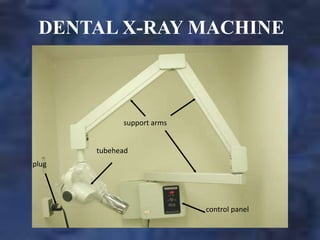
DENTAL X-RAY MACHINE
Dental X-ray Machine
Support arms
Electrical connector (plug)
Tubehead
Control panel
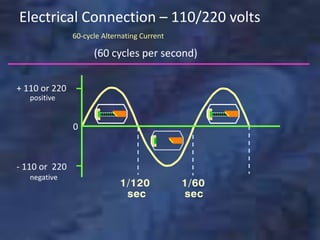
+ 110 or 220
- 110 or 220
positive
negative
0
60-cycle Alternating Current
Electrical Connection – 110/220 volts
(60 cycles per second)
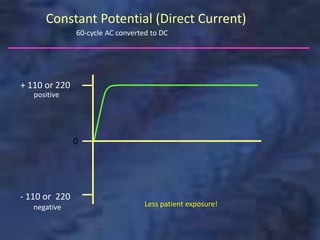
Constant Potential (Direct Current)
+ 110 or 220
- 110 or 220
positive
negative
0
Less patient exposure!
60-cycle AC converted to DC
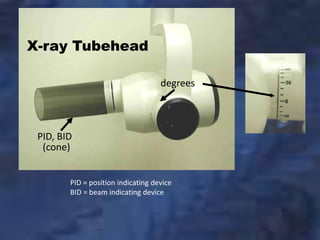
PID, BID
(cone)
PID = position indicating device
BID = beam indicating device
X-ray Tubehead
degrees
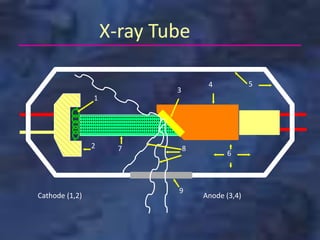
X-ray Tube
9
2
1
7
6
3
4 5
8
Cathode (1,2) Anode (3,4)
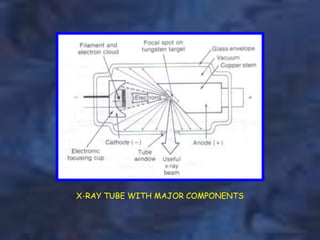
X-RAY TUBE WITH MAJOR COMPONENTS
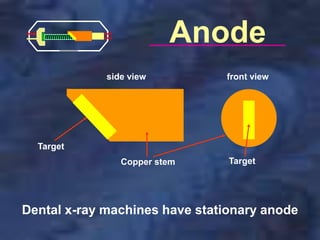
Anode
Dental x-ray machines have stationary anode
Copper stem
Target
side view front view
Target
(tungsten)
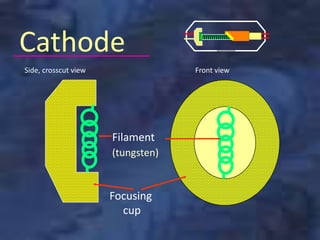
Cathode
Focusing
cup
Filament
Side, crosscut view Front view
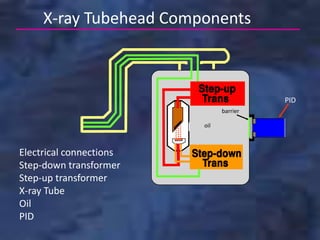
X-ray Tubehead Components
barrier
PID
oil
Electrical connections
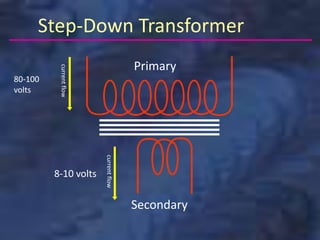
Step-down transformer
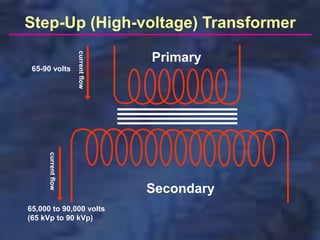
Step-up transformer
X-ray Tube
Oil
PID
exposure
button
filter
filament
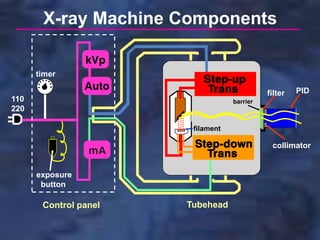
X-ray Machine Components
barrier
PID
110
220
timer
collimator
Control panel Tubehead
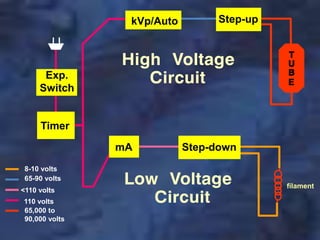
filament
110 volts
8-10 volts
65,000 to
90,000 volts
65-90 volts
<110 volts
kVp/Auto Step-up
Exp.
Switch
Timer
mA Step-down
Step-Down Transformer
Primary
Secondary
80-100
volts
current
flow
8-10 volts
current
flow
Step-Up (High-voltage) Transformer
Primary
Secondary
65-90 volts
current
flow
65,000 to 90,000 volts
(65 kVp to 90 kVp)
current
flow
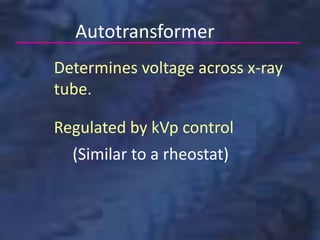
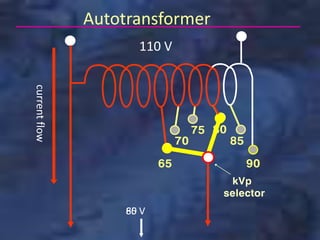
Autotransformer
Determines voltage across x-ray
tube.
Regulated by kVp control
(Similar to a rheostat)
110 V
65 V
current
flow
Autotransformer
80 V
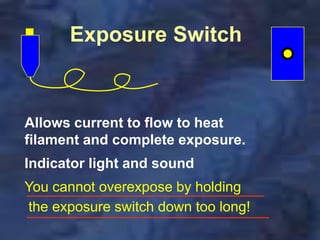
You cannot overexpose by holding
the exposure switch down too long!
Allows current to flow to heat
filament and complete exposure.
Exposure Switch
Indicator light and sound
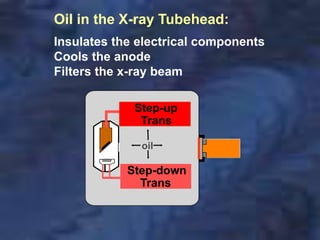
Insulates the electrical components
Cools the anode
Filters the x-ray beam
oil
Step-up
Trans
Step-down
Trans
Oil in the X-ray Tubehead:
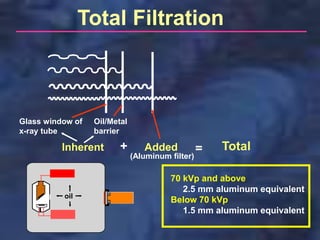
Filtration
The process of removing
low-energy x-rays from
the x-ray beam
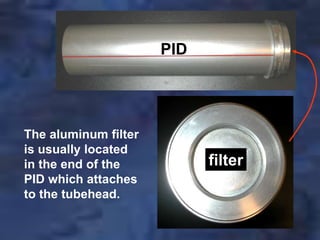
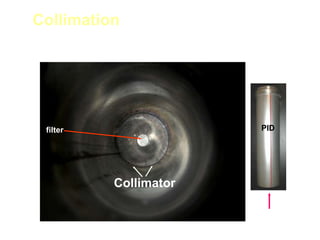
filter
PID
The aluminum filter
is usually located
in the end of the
PID which attaches
to the tubehead.
Inherent
Glass window of
x-ray tube
Added
(Aluminum filter)
Total
Total Filtration
Oil/Metal
barrier
oil
70 kVp and above
2.5 mm aluminum equivalent
Below 70 kVp
1.5 mm aluminum equivalent
+ =
Collimation: Regulates the size
and/or shape of the x-ray beam.
filter
Collimator
PID
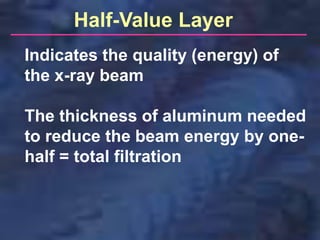
Half-Value Layer
Indicates the quality (energy) of
the x-ray beam
The thickness of aluminum needed
to reduce the beam energy by one-
half = total filtration
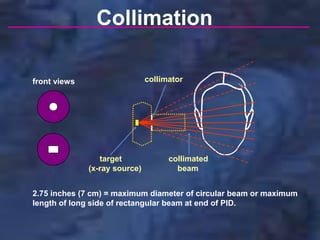
collimated
beam
collimator
target
(x-ray source)
front views
Collimation
2.75 inches (7 cm) = maximum diameter of circular beam or maximum
length of long side of rectangular beam at end of PID.
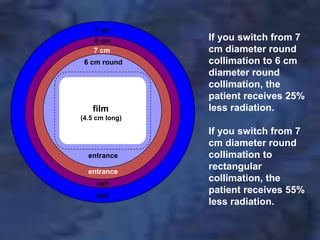
Purpose of Collimation
Decrease area covered (less
patient exposure)
Decrease scatter radiation
6 cm round
film
(4.5 cm long)
entrance
entrance
exit
exit
6 cm
7 cm
If you switch from 7
cm diameter round
collimation to 6 cm
diameter round
collimation, the
patient receives 25%
less radiation.
If you switch from 7
cm diameter round
collimation to
rectangular
collimation, the
patient receives 55%
less radiation.
7 cm
Line Focus Principle
Apparent (effective)
focal spot size
Actual focal spot
size
Target
Cathode
(-)
Anode
(+)
PID
Line Focus Principle
Apparent (effective) focal spot
size (looking at target surface
through PID)
Actual focal spot size
(looking perpendicular to
the target surface)
PID
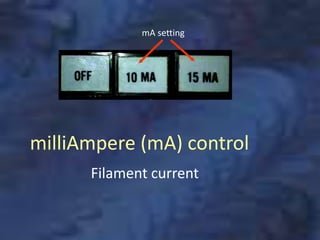
milliAmpere (mA) control
mA setting
Filament current
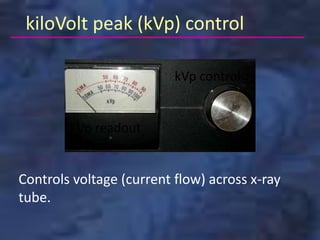
kiloVolt peak (kVp) control
kVp control
kVp readout
Controls voltage (current flow) across x-ray
tube.
DENTAL XRAY MACHINE.ppt

DENTAL XRAY MACHINE.ppt