K O F I N T I B A F F O U R A B O A G Y E
S U N D A Y N A N C Y E R E I B I
DENTAL WAXES
INTRODUCTION
• Waxes are thermoplastic materials which are
normally solids at room temperature but melt,
without decomposition, to form mobile liquids.
• The waxes used in dentistry normally consist of two
or more components which may be natural or
synthetic waxes, resins, oils, fats and pigments.
• Blending is carried out to produce a material with
the required properties for a specific application.
• They are, essentially, soft substances with poor
mechanical properties.
• Their primary uses in dentistry are to form
patterns of appliances prior to casting.
• The wax pattern defines the shape and size of
the resulting appliance.
REQUIREMENTS OF WAX-PATTERN
MATERIALS
• The wax pattern must conform to the exact size,
shape and contour of the appliance which is to
be constructed.
• No dimensional change should take place in the
wax pattern once it has been formed.
• After formation of the casting mould, it should be
possible to remove the wax by boiling out or
burning without leaving a residue.
• The wax should be uniform when softened
• The color should contrast with die materials or
prepared teeth.
• The wax should not fragment into flakes or
similar surface particles when it is molded after
softening.
COMPOSITION OF WAXES
• Dental waxes are a blend of natural and
synthetic materials.
• Natural waxes may be of mineral, animal or
vegetable origin.
• Synthetic waxes are nitrogenous derivatives of
fatty acids or polymers of ethylene oxide
NATURAL COMPONENTS
• Mineral: Paraffin wax and microcrystalline wax are
hydrocarbons obtained from petroleum residues
following distillation.
• Animal: Beeswax is derived from honeycombs and
consists of a partially crystalline natural polyester. It
is often blended with paraffin wax to render the
material less brittle.
• Plant: Carnauba wax and candelilla wax are derived
from trees and plants. They are blended with paraffin
wax in order to control the softening temperature.
CLASSIFICATIONS
• The wide variety of dental waxes can be classified into two
groups, those used primarily in the clinic and those used in
commercial dental laboratories.
• Clinical products include bite registration wax, disclosing wax
(also known as pressure indicating paste), utility waxes for
altering and adapting impression trays, and low-melting type
I inlay waxes used in the mouth for direct-waxing processes
for pattern production.
• Laboratory products include boxing wax , baseplate wax ,
sticky wax , beading wax, utility wax, and hard, medium, and
soft type II inlay-type waxes for making patterns on patients’
models using the indirect wax technique .
CLASSIFICATIONS
• Dental waxes can also be classified in one of
three types
• Pattern wax (inlay, casting, and baseplate
types)
• Processing wax (boxing, utility, and sticky
types)
• Impression wax (bite registration and
correction types)
PROPERTIES OF WAXES
Can be grouped mainly under thermal and
mechanical properties.
• Mechanical properties
• Flow value: determines the mouldability and
stability of a wax. It depends on temperature,
force applied and the period of application.
Materials should, ideally, exhibit considerable flow
at the moulding temperature but should show little
or no flow at mouth temperature or room
temperature so that they are not easily distorted.
• Brittleness: depending on the procedure,
waxes may be brittle or tough. In some cases,
for example denture waxes, toughness is
required since the wax denture base may have
to be removed from a slightly undercut cast
many times without fracturing. In other cases,
such as inlay waxes, brittleness is preferred in
order that the wax will fracture rather than
distort on removal from an undercut cavity.
THERMAL PROPERTIES
• Melting point: some waxes begin to melt at 37oC. Others
melt above 40oC. Paraffin (40-70oC), microcrystalline (60-
90oC), bee wax (65-70oC)
• Solid–solid transition temperature: sometimes referred to as
the softening temperature. This involves a change in crystal
structure, accompanied by a change in mechanical
properties i.e. the wax is converted from a relatively brittle
solid to a much softer, mouldable form. For many
applications of waxes the softening temperature should be
just above mouth temperature so that the material may be
introduced into the mouth in a mouldable state but will
become relatively rigid at mouth temperature.
• Thermal conduction: Waxes are very poor thermal
conductors and must be maintained above the solid-solid
transition temperature for long enough to allow thorough
softening to occur throughout the material before moulding is
attempted.
• The coefficient of thermal expansion: higher in waxes than
that of any dental material. This is a potential source of error
in dental procedures as it may lead to thermal contractions.
For example, a wax pattern would shrink considerably on
cooling from its solidification temperature to room
temperature.
• The low thermal conductivity values of the materials result in
solidification of the surface layers of the wax well before the
bulk becomes rigid. This reduces the magnitude of the
thermal contraction and produces significant internal
stresses. Dimensional changes may occur due to the
stresses.
• Solutions:
• In order to achieve even heating it is important that the wax
should be held in the warm rising air above the flame and not in
the flame itself.
• Heating in warm water causes more regular softening.
• The ideal method for softening wax is to use a wax annealer.
This is a thermostatically controlled oven which keeps the wax
at a constant temperature, just above the softening point, ready
for use.
MANIPULATION OF INLAY WAXES
• To manipulate inlay wax, dry heat is preferred to the use
of a water bath. Using a water bath can result in the
inclusion of droplets of water, which can splatter on
flaming, smear the wax surface during polishing, and
distort the pattern during temperature changes.
USES
• Impression wax: used to create accurate representation
of oral structures to help design and construct
prostheses
• Carding and boxing-in wax: These are waxes with a flow
value at room temperature. They are easily mouldable
without the need for heating. They are used by
manufacturers to attach artificial teeth to the mounts on
which they are supplied. Also used in the dental
laboratory for ā€˜box in’ impressions prior to casting.
• Sticky wax: It is used in the laboratory for a variety of
applications where joining is required. For example, joining
together metal parts prior to soldering and joining fragments
of a broken denture prior to the repair of procedure.
• Modelling wax: consist mainly of mixtures of paraffin wax
and beeswax and have melting points in the range 49–58ĀŗC.
It is used as a pattern material and for the registration of jaw
relationships in the construction of dentures. For example,
artificial teeth are mounted on the wax rim and to check the
suitability of the wax denture at the ā€˜try in’ stage.
• Type 1 soft wax
• Type 2 hard wax
• Type 3 extra hard
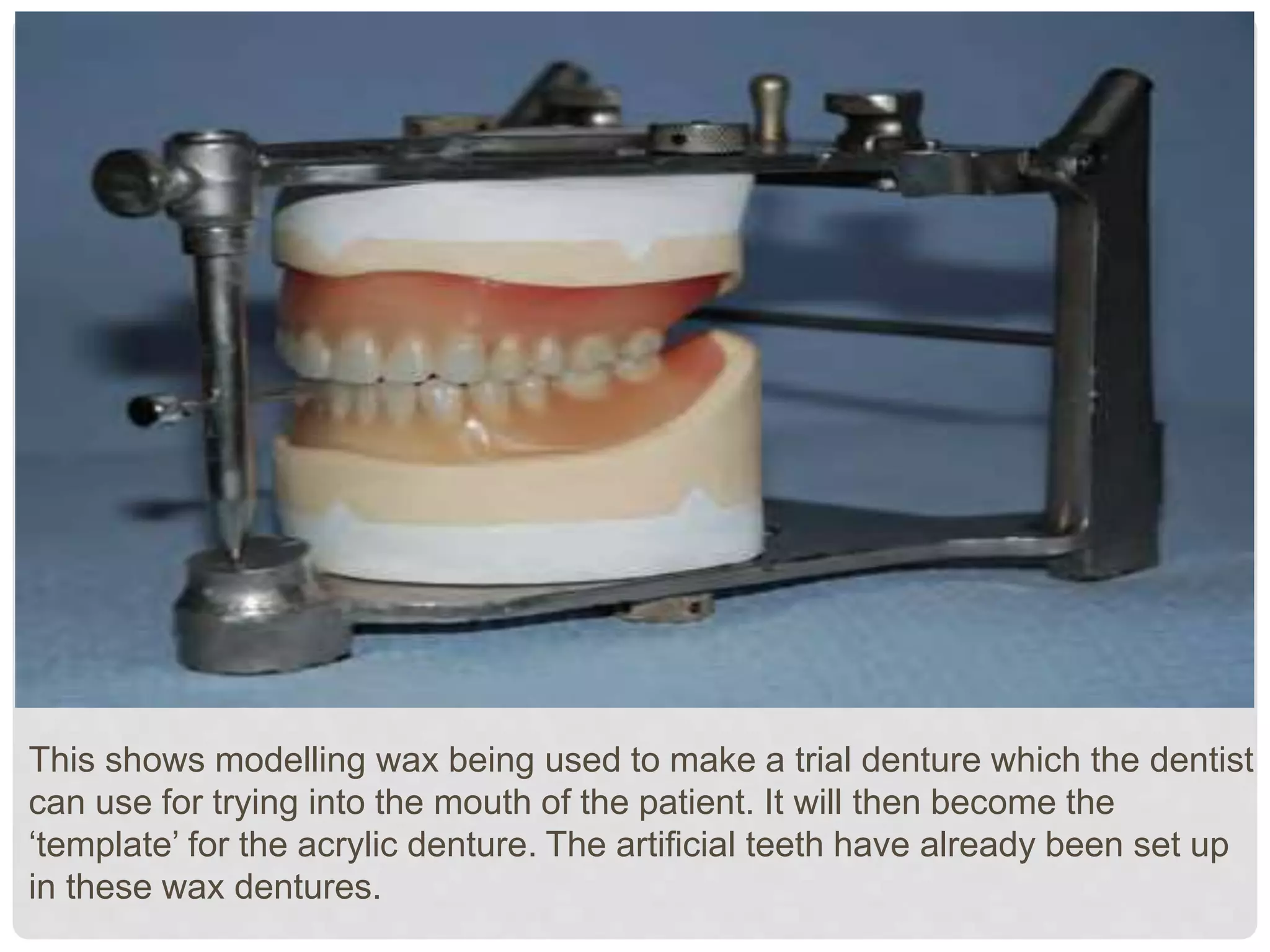
This shows modelling wax being used to make a trial denture which the dentist
can use for trying into the mouth of the patient. It will then become the
ā€˜template’ for the acrylic denture. The artificial teeth have already been set up
in these wax dentures.
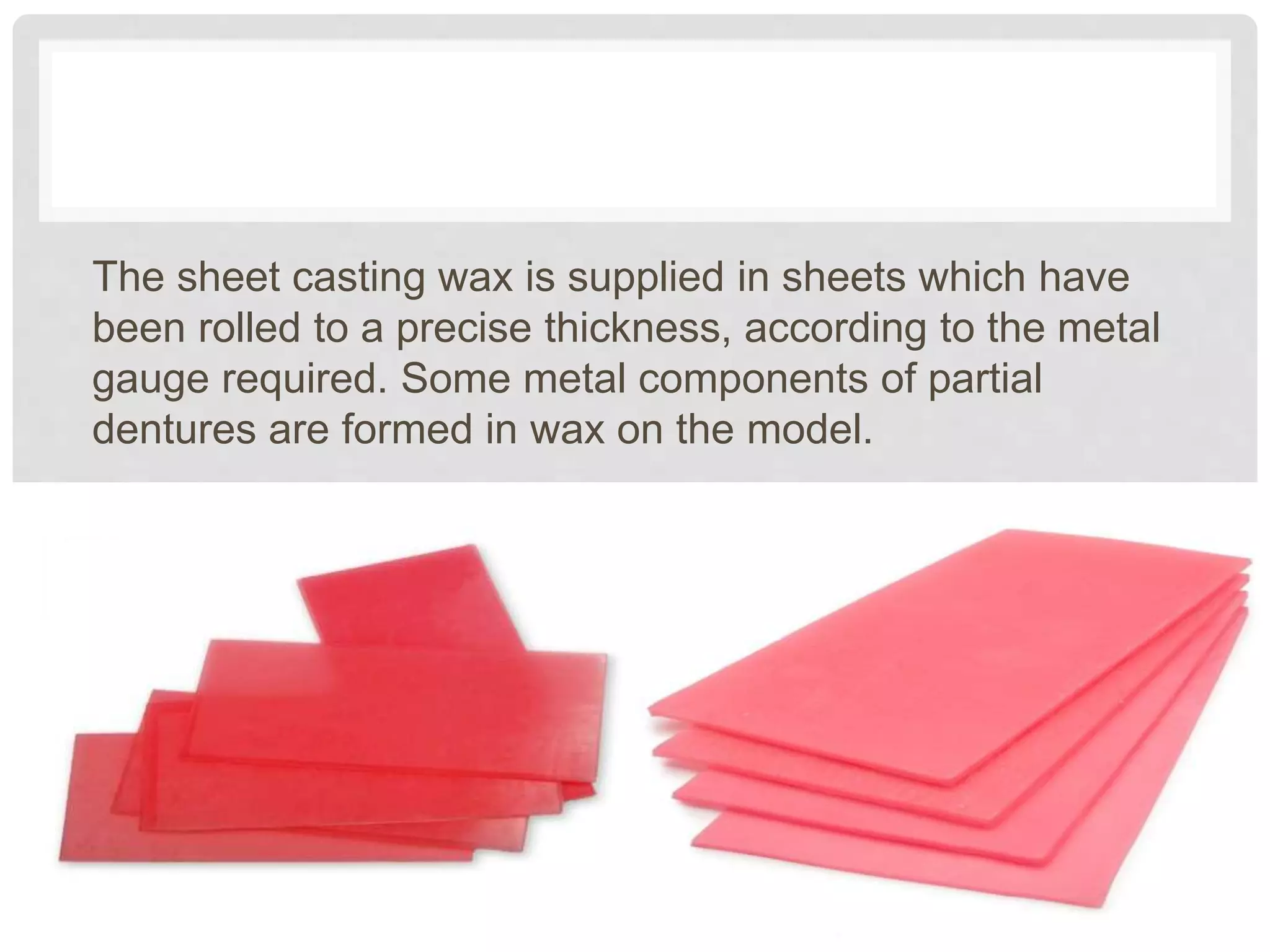
The sheet casting wax is supplied in sheets which have
been rolled to a precise thickness, according to the metal
gauge required. Some metal components of partial
dentures are formed in wax on the model.
• In lay waxes: The composition of in lay wax is similar to
that of modelling wax. They used for the preparation of
in lay patterns either by the;
• Direct technique (in the mouth)
• Indirect technique (outside the mouth)
• Inlay waxes are also used widely in the dental laboratory
to prepare casting patterns for metallic restorations,
either crowns or bridges.
ADVANTAGES OF WAXES
• Easily manipulated
• Excesses easily removed by boiling or burning
without leaving a residue
• Does not irritate soft tissues
• Can be used to relieve pain and irritation caused
by orthodontic appliances
DISADVANTAGES OF WAX
• Poor thermal conduction and high coefficient of
thermal expansion can lead to
• High internal stresses
• Dimensional changes
• Errors in dental procedures as due to thermal
contractions which may affect the accuracy of
restorative materials
REFERENCES
• Applied dental materials. – 9th ed. / J.F. McCabe, A.W.G.
Walls.
• Phillips’ science of dental materials / Kenneth J.
Anusavice, Chiayi Shen, H. Ralph Rawls.—12th ed.
Dental Waxes

Dental Waxes

  • 1.
    K O FI N T I B A F F O U R A B O A G Y E S U N D A Y N A N C Y E R E I B I DENTAL WAXES
  • 2.
    INTRODUCTION • Waxes arethermoplastic materials which are normally solids at room temperature but melt, without decomposition, to form mobile liquids. • The waxes used in dentistry normally consist of two or more components which may be natural or synthetic waxes, resins, oils, fats and pigments. • Blending is carried out to produce a material with the required properties for a specific application.
  • 3.
    • They are,essentially, soft substances with poor mechanical properties. • Their primary uses in dentistry are to form patterns of appliances prior to casting. • The wax pattern defines the shape and size of the resulting appliance.
  • 4.
    REQUIREMENTS OF WAX-PATTERN MATERIALS •The wax pattern must conform to the exact size, shape and contour of the appliance which is to be constructed. • No dimensional change should take place in the wax pattern once it has been formed. • After formation of the casting mould, it should be possible to remove the wax by boiling out or burning without leaving a residue.
  • 5.
    • The waxshould be uniform when softened • The color should contrast with die materials or prepared teeth. • The wax should not fragment into flakes or similar surface particles when it is molded after softening.
  • 6.
    COMPOSITION OF WAXES •Dental waxes are a blend of natural and synthetic materials. • Natural waxes may be of mineral, animal or vegetable origin. • Synthetic waxes are nitrogenous derivatives of fatty acids or polymers of ethylene oxide
  • 7.
    NATURAL COMPONENTS • Mineral:Paraffin wax and microcrystalline wax are hydrocarbons obtained from petroleum residues following distillation. • Animal: Beeswax is derived from honeycombs and consists of a partially crystalline natural polyester. It is often blended with paraffin wax to render the material less brittle. • Plant: Carnauba wax and candelilla wax are derived from trees and plants. They are blended with paraffin wax in order to control the softening temperature.
  • 8.
    CLASSIFICATIONS • The widevariety of dental waxes can be classified into two groups, those used primarily in the clinic and those used in commercial dental laboratories. • Clinical products include bite registration wax, disclosing wax (also known as pressure indicating paste), utility waxes for altering and adapting impression trays, and low-melting type I inlay waxes used in the mouth for direct-waxing processes for pattern production. • Laboratory products include boxing wax , baseplate wax , sticky wax , beading wax, utility wax, and hard, medium, and soft type II inlay-type waxes for making patterns on patients’ models using the indirect wax technique .
  • 9.
    CLASSIFICATIONS • Dental waxescan also be classified in one of three types • Pattern wax (inlay, casting, and baseplate types) • Processing wax (boxing, utility, and sticky types) • Impression wax (bite registration and correction types)
  • 10.
    PROPERTIES OF WAXES Canbe grouped mainly under thermal and mechanical properties. • Mechanical properties • Flow value: determines the mouldability and stability of a wax. It depends on temperature, force applied and the period of application. Materials should, ideally, exhibit considerable flow at the moulding temperature but should show little or no flow at mouth temperature or room temperature so that they are not easily distorted.
  • 11.
    • Brittleness: dependingon the procedure, waxes may be brittle or tough. In some cases, for example denture waxes, toughness is required since the wax denture base may have to be removed from a slightly undercut cast many times without fracturing. In other cases, such as inlay waxes, brittleness is preferred in order that the wax will fracture rather than distort on removal from an undercut cavity.
  • 12.
    THERMAL PROPERTIES • Meltingpoint: some waxes begin to melt at 37oC. Others melt above 40oC. Paraffin (40-70oC), microcrystalline (60- 90oC), bee wax (65-70oC) • Solid–solid transition temperature: sometimes referred to as the softening temperature. This involves a change in crystal structure, accompanied by a change in mechanical properties i.e. the wax is converted from a relatively brittle solid to a much softer, mouldable form. For many applications of waxes the softening temperature should be just above mouth temperature so that the material may be introduced into the mouth in a mouldable state but will become relatively rigid at mouth temperature.
  • 13.
    • Thermal conduction:Waxes are very poor thermal conductors and must be maintained above the solid-solid transition temperature for long enough to allow thorough softening to occur throughout the material before moulding is attempted. • The coefficient of thermal expansion: higher in waxes than that of any dental material. This is a potential source of error in dental procedures as it may lead to thermal contractions. For example, a wax pattern would shrink considerably on cooling from its solidification temperature to room temperature.
  • 14.
    • The lowthermal conductivity values of the materials result in solidification of the surface layers of the wax well before the bulk becomes rigid. This reduces the magnitude of the thermal contraction and produces significant internal stresses. Dimensional changes may occur due to the stresses. • Solutions: • In order to achieve even heating it is important that the wax should be held in the warm rising air above the flame and not in the flame itself. • Heating in warm water causes more regular softening. • The ideal method for softening wax is to use a wax annealer. This is a thermostatically controlled oven which keeps the wax at a constant temperature, just above the softening point, ready for use.
  • 15.
    MANIPULATION OF INLAYWAXES • To manipulate inlay wax, dry heat is preferred to the use of a water bath. Using a water bath can result in the inclusion of droplets of water, which can splatter on flaming, smear the wax surface during polishing, and distort the pattern during temperature changes.
  • 16.
    USES • Impression wax:used to create accurate representation of oral structures to help design and construct prostheses • Carding and boxing-in wax: These are waxes with a flow value at room temperature. They are easily mouldable without the need for heating. They are used by manufacturers to attach artificial teeth to the mounts on which they are supplied. Also used in the dental laboratory for ā€˜box in’ impressions prior to casting.
  • 18.
    • Sticky wax:It is used in the laboratory for a variety of applications where joining is required. For example, joining together metal parts prior to soldering and joining fragments of a broken denture prior to the repair of procedure. • Modelling wax: consist mainly of mixtures of paraffin wax and beeswax and have melting points in the range 49–58ĀŗC. It is used as a pattern material and for the registration of jaw relationships in the construction of dentures. For example, artificial teeth are mounted on the wax rim and to check the suitability of the wax denture at the ā€˜try in’ stage. • Type 1 soft wax • Type 2 hard wax • Type 3 extra hard
  • 19.
    This shows modellingwax being used to make a trial denture which the dentist can use for trying into the mouth of the patient. It will then become the ā€˜template’ for the acrylic denture. The artificial teeth have already been set up in these wax dentures.
  • 20.
    The sheet castingwax is supplied in sheets which have been rolled to a precise thickness, according to the metal gauge required. Some metal components of partial dentures are formed in wax on the model.
  • 21.
    • In laywaxes: The composition of in lay wax is similar to that of modelling wax. They used for the preparation of in lay patterns either by the; • Direct technique (in the mouth) • Indirect technique (outside the mouth) • Inlay waxes are also used widely in the dental laboratory to prepare casting patterns for metallic restorations, either crowns or bridges.
  • 22.
    ADVANTAGES OF WAXES •Easily manipulated • Excesses easily removed by boiling or burning without leaving a residue • Does not irritate soft tissues • Can be used to relieve pain and irritation caused by orthodontic appliances
  • 23.
    DISADVANTAGES OF WAX •Poor thermal conduction and high coefficient of thermal expansion can lead to • High internal stresses • Dimensional changes • Errors in dental procedures as due to thermal contractions which may affect the accuracy of restorative materials
  • 24.
    REFERENCES • Applied dentalmaterials. – 9th ed. / J.F. McCabe, A.W.G. Walls. • Phillips’ science of dental materials / Kenneth J. Anusavice, Chiayi Shen, H. Ralph Rawls.—12th ed.

Editor's Notes

  • #14Ā Following moulding, the waxes are allowed to cool. During this cooling period they may undergo potentially significant contraction due to the high values of coefficient of expansion exhibited by these products. The thermal contraction may not be fully exhibited immediately after cooling. The low thermal conductivity values of the materials result in solidification of the surface layers of the wax well before the bulk becomes rigid. This reduces the magnitude of the thermal contraction and produces significant internal stresses. Dimensional changes may occur due to relief of the stresses. This is more likely to occur at elevated temperatures. Greater stresses may be incorporated if the wax is not properly softened before moulding.
  • #17Ā In dentistry, the building up of vertical walls, usually in wax, around a dental impression after beading, to produce the desired size and form of the dental cast, and to preserve certain landmarks of the impression.
  • #21Ā In manipulating this wax it is important that the thickness is maintained