













PRESENTED BY:
Dr. Pratistha Ghimire
PG Resident, 1ST Year
Department of Prosthodontics
and Crown-bridge
Contents
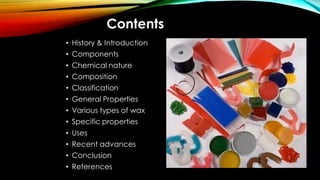
• History & Introduction
• Components
• Chemical nature
• Composition
• Classification
• General Properties
• Various types of wax
• Specific properties
• Uses
• Recent advances
• Conclusion
• References
History
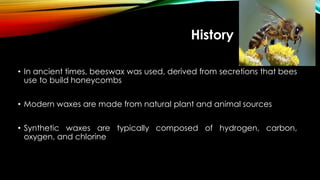
• In ancient times, beeswax was used, derived from secretions that bees
use to build honeycombs
• Modern waxes are made from natural plant and animal sources
• Synthetic waxes are typically composed of hydrogen, carbon,
oxygen, and chlorine
Introduction
• The wide variety of dental waxes can be classified into two groups:
1. Those used primarily in the clinic
2. Those used in commercial dental laboratories
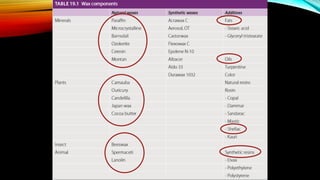
Components of dental waxes
• Dental waxes contain:
1. Natural Waxes
2. Synthetic Waxes
3. Additives
Chemical nature of waxes
• Natural waxes are long chain, complex combinations of organic
compounds of reasonably high molecular weight
• The two principal groups of organic compounds contained in waxes
are:
 Hydrocarbons, e.g. saturated alkanes
 Esters, e.g. myricyl palmitate (bees wax)
• Some waxes, in addition, contain free alcohol and acids
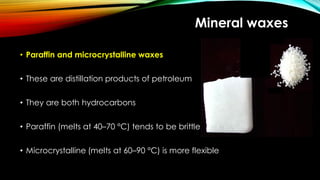
Mineral waxes
• Paraffin and microcrystalline waxes
• These are distillation products of petroleum
• They are both hydrocarbons
• Paraffin (melts at 40–70 °C) tends to be brittle
• Microcrystalline (melts at 60–90 °C) is more flexible
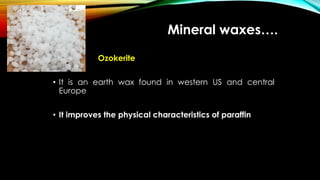
Mineral waxes….
Ozokerite
• It is an earth wax found in western US and central
Europe
• It improves the physical characteristics of paraffin
Mineral waxes….
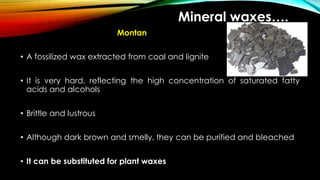
Montan
• A fossilized wax extracted from coal and lignite
• It is very hard, reflecting the high concentration of saturated fatty
acids and alcohols
• Brittle and lustrous
• Although dark brown and smelly, they can be purified and bleached
• It can be substituted for plant waxes
Mineral waxes….
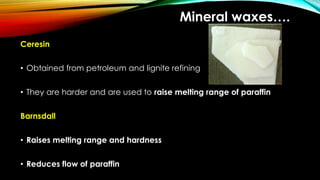
Ceresin
• Obtained from petroleum and lignite refining
• They are harder and are used to raise melting range of paraffin
Barnsdall
• Raises melting range and hardness
• Reduces flow of paraffin
Plant waxes
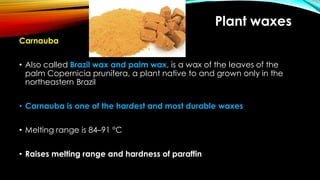
Carnauba
• Also called Brazil wax and palm wax, is a wax of the leaves of the
palm Copernicia prunifera, a plant native to and grown only in the
northeastern Brazil
• Carnauba is one of the hardest and most durable waxes
• Melting range is 84–91 °C
• Raises melting range and hardness of paraffin
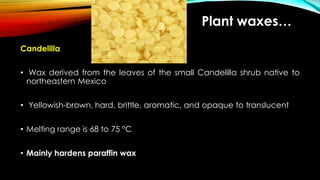
Candelilla
• Wax derived from the leaves of the small Candelilla shrub native to
northeastern Mexico
• Yellowish-brown, hard, brittle, aromatic, and opaque to translucent
• Melting range is 68 to 75 °C
• Mainly hardens paraffin wax
Plant waxes…
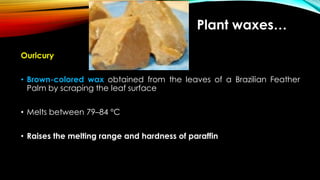
Ouricury
• Brown-colored wax obtained from the leaves of a Brazilian Feather
Palm by scraping the leaf surface
• Melts between 79–84 °C
• Raises the melting range and hardness of paraffin
Plant waxes…
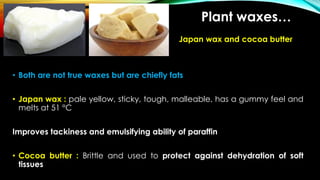
Japan wax and cocoa butter
• Both are not true waxes but are chiefly fats
• Japan wax : pale yellow, sticky, tough, malleable, has a gummy feel and
melts at 51 °C
Improves tackiness and emulsifying ability of paraffin
• Cocoa butter : Brittle and used to protect against dehydration of soft
tissues
Plant waxes…
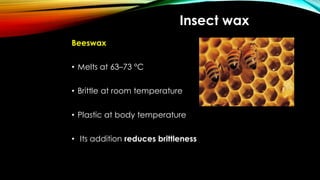
Insect wax
Beeswax
• Melts at 63–73 °C
• Brittle at room temperature
• Plastic at body temperature
• Its addition reduces brittleness
Insect wax…
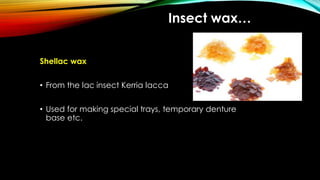
Shellac wax
• From the lac insect Kerria lacca
• Used for making special trays, temporary denture
base etc.
Animal wax
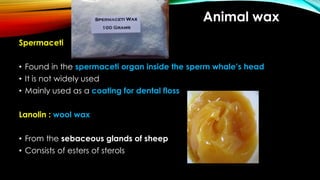
Spermaceti
• Found in the spermaceti organ inside the sperm whale’s head
• It is not widely used
• Mainly used as a coating for dental floss
Lanolin : wool wax
• From the sebaceous glands of sheep
• Consists of esters of sterols
Synthetic waxes
• Synthetic waxes are chemically synthesized from natural wax
molecules
• Prepared under controlled conditions to give standardized reliable
results
• Highly refined unlike natural waxes which are frequently
contaminated
• More homogeneous than pure natural waxes
• Their use is still limited
Wax additives
Gums
• Viscous, amorphous exudates from plants that harden when exposed
to air
• Complex substances mainly made of carbohydrates
• Either dissolve in water or form sticky, viscous liquids
• E.g. gum Arabic and tragacanth
Wax additives….Resins
• Exudates of certain trees and plants (except shellac which is from
insects)
• Complex, amorphous mixtures of organic substances
• Insoluble in water
• Improve toughness
• Used to make varnishes (by dissolving in an organic solvent)
Synthetic resins : They are also used
Wax additives….
Fats
• Tasteless, odorless and colorless substances
• Similar to wax but have lower melting temperatures and are softer
• Chemically composed of glycerides
• E.g. beef tallow and butter
• Increase melting range and hardness of waxes
Wax additives….
Oils
• Lower the melting point of paraffin
• Hydrocarbon oils : soften waxes
• Silicone oils : improve ease of polishing of waxes
Composition of Dental Wax
• The primary components of dental waxes are derived from synthetic
waxes and natural waxes
• Coloring agents are added for contrast of wax patterns against tooth,
die, and model surfaces
• Some formulations contain a compatible filler to control expansion
and shrinkage of the wax product
Classification of dental waxes
According to origin
• Mineral
• Plant
• Insect
• Animal
According to Use
General properties
1. Melting range
2. Thermal expansion
3. Mechanical properties
4. Flow
5. Residual stresses
6. Ductility
Melting range
• Waxes have melting ranges rather than melting points
• E.g. Paraffin : 44- 62oC, Carnauba: 50- 90oC
• Significance: Mixing of waxes may change their melting
range
• Melting range varies depending on its use
Thermal expansion
• Waxes expand when subjected to a rise in temperature and
contract as the temperature is decreased
Coefficient of thermal expansion and its importance
• Dental waxes and their components have the largest CTE among the
materials used in restorative dentistry
• Temperature changes in wax patterns after removal from the mouth
can produce inaccuracies in the finished restoration
• Waxes are somewhat elastic in nature and tend to return to their
original shape after deformation (Elastic memory)
Mechanical properties
• The elastic modulus, proportional limit and compressive strength of
waxes are low compared to other dental materials
• These properties are strongly dependent on the temperature
• The temperature is inversely proportional to the mechanical
properties of the dental waxes
Flow
• It is a measure of a wax’s ability to deform under light forces and is
analogous to creep
• An important property, especially in inlay waxes
• Results from the slippage of wax molecules over each other
• When melted, the wax should flow readily into all the parts of the
die
• Flow increases as the melting point of the wax is approached
Flow is dependent on:
1. Temperature of the wax
2. Force applied
3. The length of time the force is applied
Ito M, Yamagishi T, Oshida Y, Munoz CA. Effect of selected physical properties of waxes on investments and casting shrinkage.
The Journal of prosthetic dentistry. 1996 Feb 1;75(2):211-6.
Effect of selected physical properties of waxes on
investments and casting shrinkage
Ito et al investigated the relationship between flow characteristics,
bending strength, and softening temperature of paraffin and dental inlay
waxes to casting shrinkage
They found that the casting shrinkage decreased as the flow of the wax
pattern increased
It is of great importance to select the type of wax which has the most
desirable properties for the margin and the occlusal portions
They also concluded that, to accurately fabricate castings, it is
necessary to understand the physical properties of the chosen waxes
Residual stress
• Regardless of the method used to make a wax pattern, residual
stresses will exist in the completed pattern
• The stress may be compressive or tensile in nature
Ductility
• Ductility increases as the temperature of the wax is increased
In general:
• Waxes with low melting points have greater ductility than those with
high melting points
PATTERN WAXES
Pattern waxes
• Many dental restorations or prostheses are first made with pattern
waxes
• The wax is later replaced with more durable material
• All pattern waxes have two major qualities which cause serious
problems in their use:
1. Thermal change in dimension
2. Tendency to warp or distort on standing
Inlay Casting Wax
• Among the oldest waxes in dentistry
USES
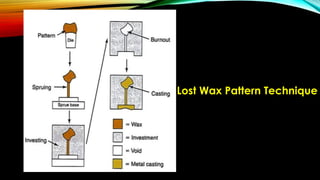
• The pattern for inlays, crowns and FPDs is first made in wax and then
replaced by metal during casting
Direct and Indirect Techniques
• If the pattern is made directly in the tooth (in the mouth), it is
said to be prepared by direct technique (Type 1 wax)
• If it is prepared on a replica of the tooth (die), it is called
indirect technique (Type 2 wax)
Lost Wax Pattern Technique
Ideal Requirements of Inlay Casting Waxes
1. When softened, the wax should be uniform, there should be no
graininess or hard spots in the plastic material
2. The color should contrast with the die - helps in identifying and
finishing of margins
3. The wax should not flake or crumble when the wax is softened
4. The wax should not chip during carving
Ideal Requirements of Inlay Casting Waxes...
5. During burnout (500 °C), it should vaporize completely without residue
6. The wax pattern should be completely rigid and dimensionally stable
at all times until it is eliminated
7. The wax should have good flow when heated and set rigidly when
cooled
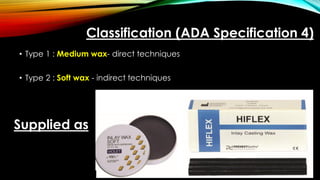
Classification (ADA Specification 4)
• Type 1 : Medium wax- direct techniques
• Type 2 : Soft wax - indirect techniques
Supplied as
Composition
• Paraffin wax
• Gum dammar
• Carnauba or Candelilla
• Coloring agents
Paraffin wax (40–60%)
• Main ingredient
• Used to establish the melting point
• Paraffin wax flakes trimmed do not give a smooth surface, so other waxes are
added to modify
Gum dammar (1%)
• Dammar resin (a natural derivative from pine tree) improves the smoothness
during molding and makes it more resistant to cracking and flaking
• Also increases toughness of the wax and enhances the luster of the surface
Carnauba wax (25%)
• Increases melting point of wax
• Combined with paraffin to decrease the flow at mouth temperature
• Acceptable odor and gives glossiness to the wax surface
Candelilla wax
• Added to replace carnauba wax
• Contributes the same qualities as carnauba wax, but its melting point is
lower and is not as hard as carnauba wax
Synthetic waxes
• In modern inlay waxes, carnauba wax is often replaced partly by certain
synthetic waxes
• Because of their high melting point, more paraffin can be incorporated and
the general working qualities are improved
Properties of Inlay Wax
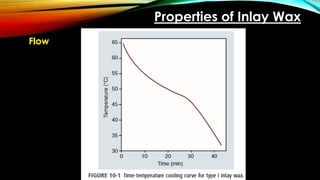
Flow
Properties of Inlay Wax
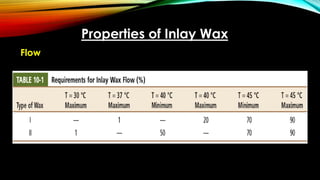
Flow
Properties of Inlay Wax
Thermal properties
Thermal conductivity
• The thermal conductivity of these waxes is low
• It takes time to heat the wax uniformly and to cool it to body or room
temperature
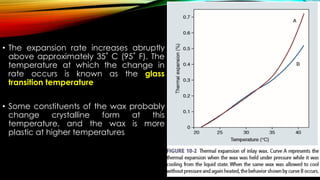
Coefficient of thermal expansion : High CTE
• It has a linear expansion of 0.7% with increase in temperature of 20 °C (36˚ F)
• Contract as much as 0.35% when it is cooled from 37˚ to 25˚ C (99˚ to 77˚ F)
• The expansion rate increases abruptly
above approximately 35˚ C (95˚ F). The
temperature at which the change in
rate occurs is known as the glass
transition temperature
• Some constituents of the wax probably
change crystalline form at this
temperature, and the wax is more
plastic at higher temperatures
Wax distortion
Wax distortion is the most serious problem in inlay wax
It is due to release of stresses in the pattern caused due to:
1. Contraction on cooling
2. Occluded gas bubbles
3. Change of shape of the wax during molding
4. From manipulation—carving, pooling, removal, etc.
Thus, the amount of residual stress is dependent on:
• The method of forming the pattern
• Its handling
• Length of time and, temperature of storage of the wax pattern
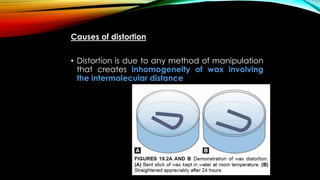
Causes of distortion
• Distortion is due to any method of manipulation
that creates inhomogeneity of wax involving
the intermolecular distance
Distortion of the wax can occur:
• If wax is not at uniform temperature when inserted in the cavity, some
parts of the wax pattern may thermally contract more than others
when stresses are introduced
• If wax is not held under uniform pressure during cooling
• If fresh wax is melted and added in an area of deficiency, the added
wax will introduce stresses during cooling
• During carving, some molecules of wax will be disturbed and stresses
will result
• To avoid the distortion
1. Minimal carving and change in temperature
2. Minimal storage of pattern. Invest immediately
3. Store it in a refrigerator if necessary
Manipulation of Inlay Wax
• Wax stick is held over the visible flame and rotated, taking care not to volatilize
the wax
• The softened wax is shaped approximately to the form of the prepared cavity
• After the wax is inserted into the cavity, it is held under finger pressure while it
solidifies
• The wax should be allowed to cool gradually to mouth temperature
• Dry heat is preferred to the use of a water bath
The latter can result in the inclusion of droplets of water, which can
splatter on flaming, smear the wax surface during polishing, and
distort the pattern during temperature changes
For direct technique
• To fabricate indirect patterns, the die should be lubricated, preferably
with a lubricant containing a wetting agent
• The melted wax is added in layers with a spatula / waxing instrument
overfilling the cavity, and then carved to the proper contour
• When the margins are being carved, care should be taken to avoid
abrading any surface of the stone die
Manipulation of Inlay Wax…
Polishing
Done with a silk/ other fine cloth rubbing toward the margins
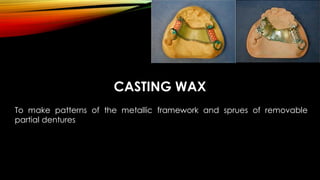
CASTING WAX
To make patterns of the metallic framework and sprues of removable
partial dentures
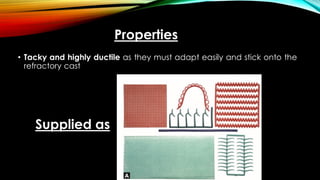
Properties
• Tacky and highly ductile as they must adapt easily and stick onto the
refractory cast
Supplied as
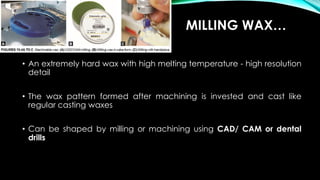
MILLING WAX
Also known as machinable wax
• An extremely hard wax with high melting temperature - high resolution
detail
• The wax pattern formed after machining is invested and cast like
regular casting waxes
• Can be shaped by milling or machining using CAD/ CAM or dental
drills
MILLING WAX…
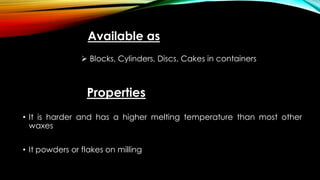
Available as
 Blocks, Cylinders, Discs, Cakes in containers
Properties
• It is harder and has a higher melting temperature than most other
waxes
• It powders or flakes on milling
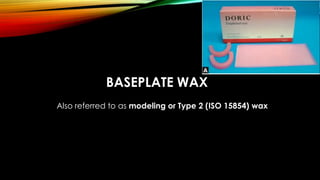
BASEPLATE WAX
Also referred to as modeling or Type 2 (ISO 15854) wax
Uses
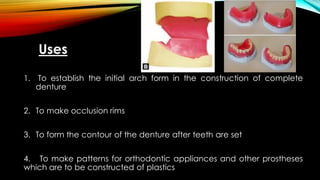
1. To establish the initial arch form in the construction of complete
denture
2. To make occlusion rims
3. To form the contour of the denture after teeth are set
4. To make patterns for orthodontic appliances and other prostheses
which are to be constructed of plastics
Properties
Ideally,
• Should be easy to carve
• Should not chip and break at try-in
• Should boil out without leaving any oily residue
Classification (ADA specification 24)
• Type I : Soft — for building veneers
• Type II : Medium — to use in mouths in normal climates
• Type III : Hard — for use in tropical climates
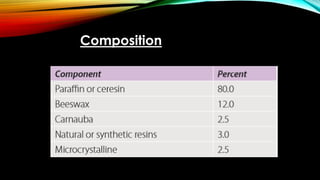
Composition
PROCESSING WAXES
Used mainly as accessory aids in the construction of a variety of
restorations and appliances, either clinically or in the laboratory
Beading and boxing
wax
Utility wax Sticky wax
Boxing wax and Beading wax
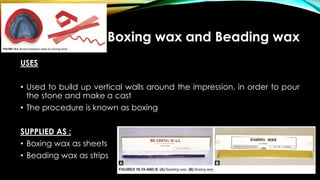
USES
• Used to build up vertical walls around the impression, in order to pour
the stone and make a cast
• The procedure is known as boxing
SUPPLIED AS :
• Boxing wax as sheets
• Beading wax as strips
Advantages of Beading and Boxing
1. Preserves the extensions and landmarks
2. Determines the thickness of the borders
3. Controls the form and thickness of the base of the cast
4. Conserves the stone
Properties
• They are pliable and can be adapted easily
• A slight tackiness allows it to stick to the impression
Technique
• Beading wax is adapted around the periphery
• This wax should be approximately 4 mm wide and 3–4 mm below the
borders of the impression
• The height is adjusted until a boxing wax strip extends approximately
13 mm above the highest point on the impression
• Stone is vibrated into the boxed impression
UTILITY WAX
• COMPOSITION:
• Beeswax
• Petroleum
• Other soft waxes in varying proportions
• SUPPLIED AS:
• It is available in the form of sticks and sheets
Properties
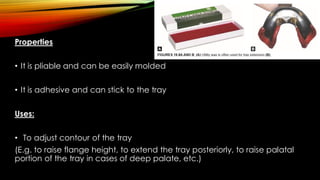
• It is pliable and can be easily molded
• It is adhesive and can stick to the tray
Uses:
• To adjust contour of the tray
(E.g. to raise flange height, to extend the tray posteriorly, to raise palatal
portion of the tray in cases of deep palate, etc.)
STICKY WAX
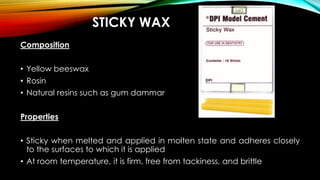
Composition
• Yellow beeswax
• Rosin
• Natural resins such as gum dammar
Properties
• Sticky when melted and applied in molten state and adheres closely
to the surfaces to which it is applied
• At room temperature, it is firm, free from tackiness, and brittle
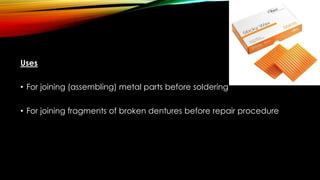
Uses
• For joining (assembling) metal parts before soldering
• For joining fragments of broken dentures before repair procedure
CARDING WAX
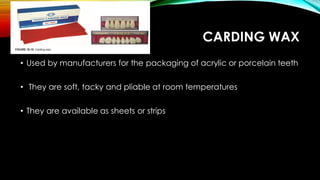
• Used by manufacturers for the packaging of acrylic or porcelain teeth
• They are soft, tacky and pliable at room temperatures
• They are available as sheets or strips
SHELLAC
• Shellac was once extensively used in dentistry to fabricate temporary
denture bases and custom trays
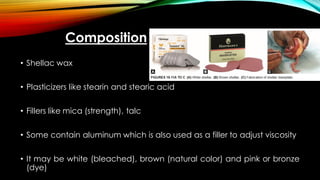
Composition
• Shellac wax
• Plasticizers like stearin and stearic acid
• Fillers like mica (strength), talc
• Some contain aluminum which is also used as a filler to adjust viscosity
• It may be white (bleached), brown (natural color) and pink or bronze
(dye)
• Heating of the shellac in water above 70 °C - leaching of the
plasticizers
• Heating over flame above 100 °C - polymerization with release of
water (characterized by bubbling)
• This results in a marked increase in its viscosity (becomes stiffer)
Manipulation
• Being a thermoplastic material, it is manipulated by softening with
heat to adapt, cut and shape it
Drawbacks
• Again being a thermoplastic material, it is affected by heat and is,
therefore, potentially unstable and subject to distortion
• It is now largely replaced by resins which are more stable
IMPRESSION WAXES
Generally used in combination with other impression materials
such as polysulfide rubber, ZOE, or dental impression compound
A. Corrective wax
(Dental impression wax)
Composition
• Paraffin
• Ceresin
• Beeswax
Uses
• It is used to register the soft tissues details
1. To make functional impression of Class I and II removable partial
dentures
2. To record the posterior palatal seal (Fluid Wax Technique)
3. Functional impression for obturators
Properties
• The flow at 37 °C is 100%
• These waxes are subject to distortion during removal from the mouth
• They should be poured immediately
Types
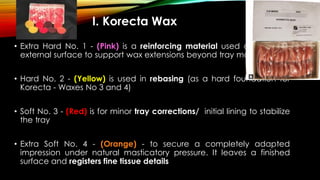
1. Korecta wax (No. 4) (extra soft - orange)
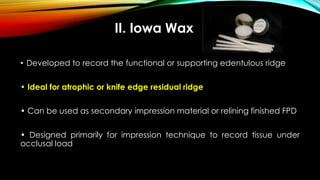
2. Iowa wax (white) —Available as 6 inch sticks or in a small container
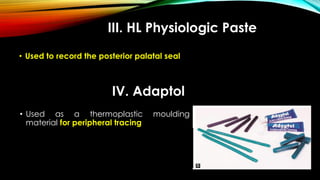
3. H-L physiologic paste (yellow-white)
4. Adaptol (green)
Mouth temperature waxes
I. Korecta Wax
• Extra Hard No. 1 - (Pink) is a reinforcing material used only on the
external surface to support wax extensions beyond tray margins
• Hard No. 2 - (Yellow) is used in rebasing (as a hard foundation for
Korecta - Waxes No 3 and 4)
• Soft No. 3 - (Red) is for minor tray corrections/ initial lining to stabilize
the tray
• Extra Soft No. 4 - (Orange) - to secure a completely adapted
impression under natural masticatory pressure. It leaves a finished
surface and registers fine tissue details
II. Iowa Wax
• Developed to record the functional or supporting edentulous ridge
• Ideal for atrophic or knife edge residual ridge
• Can be used as secondary impression material or relining finished FPD
• Designed primarily for impression technique to record tissue under
occlusal load
III. HL Physiologic Paste
• Used to record the posterior palatal seal
IV. Adaptol
• Used as a thermoplastic moulding
material for peripheral tracing
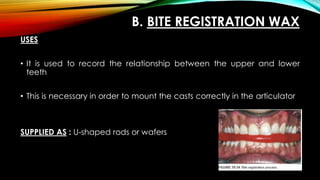
B. BITE REGISTRATION WAX
USES
• It is used to record the relationship between the upper and lower
teeth
• This is necessary in order to mount the casts correctly in the articulator
SUPPLIED AS : U-shaped rods or wafers
Composition
• Beeswax or paraffin or ceresin
• Some contain aluminum or copper particles
Properties
• Flow at 37 0 C ranges from 2.5 % to 22 %
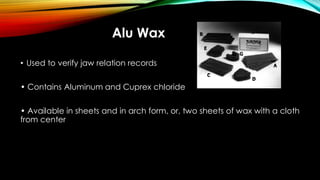
Alu Wax
• Used to verify jaw relation records
• Contains Aluminum and Cuprex chloride
• Available in sheets and in arch form, or, two sheets of wax with a cloth
from center
Bite Wafers
• Designed for a fast precise record
• Used for checking occlusal relationships
• Copper particles provide uniform flow of heat and
soften quickly
• Wafers having a foil laminated center (Laminated bite
wafers)
RECENT ADVANCES
Conventionally, the wax patterns are prepared manually and then
casted, but there are newer advancements in the preparation of wax
patterns
1. CAD CAM machines: The wax pattern is produced using the milling
technique based on a virtual model created from the digital data
that are obtained from the oral cavity
2. Rapid prototyping technique known as the 3D-printing , is being used
to design and print a wax pattern for a restoration. Later, the wax
pattern is cast in the same conventional manner
The advantages of these technologies: High precision of the patterns
fabricated, reduced laboratory time and turn over of the restorations
fabricated
Comparison the Marginal and Internal Fit of Metal Copings Cast from Wax
Patterns Fabricated by CAD/CAM and Conventional Wax up Techniques
Vojdani M, Torabi K, Farjood E, Khaledi AA. Comparison the marginal and internal fit of metal copings cast from wax patterns fabricated
by CAD/CAM and conventional wax up techniques. Journal of Dentistry. 2013 Sep;14(3):118.
Conventional method of wax-pattern fabrication produced copings with
significantly better marginal and internal fit than CAD/CAM (machine-milled)
technique
Cross-sectional technique after cementation and embedding (internal
microscopic examination) was used for measuring marginal and internal gaps
The CAD/CAM group had significantly larger gaps at all measured areas than
conventional group (p< 0.001), especially the AMD and MG, which were
254.45 ±25.09 and 157.37±20.63 for CAD/CAM group and; 88.08±10.66 and
69.54±15.60 for conventional Group respectively
Although CAD/CAM technology has already changed dentistry, it needs
some improvement in scanning procedure, data processing,
manufacturing techniques and material processing to be a competitive
alternative for conventional method of fabrications
Conclusion
• Waxes are among the most popular and useful of dental materials
• They are economical, suited for many purposes
• Proper knowledge of certain critical characteristics – effect of heating
on flow, thermal expansion, distortion, etc. will enable easy, effective
and efficient handling of the wax
• The alteration of its properties by modifying the compositions make it
versatile and useful for most applications
References
• Phillips' science of dental materials- 12th and 13th edition
• Restorative dental materials 11th edition – Robert G. Craig and John M. Powers
• Basic dental materials- John J. Manopallil – 4th edition
• Sheriff AH, Nittla PP. Dental Waxes–A Review. Research Journal of Pharmacy and Technology. 2019 Nov
30;12(11):5589-94
• Ito M, Yamagishi T, Oshida Y, Munoz CA. Effect of selected physical properties of waxes on investments and
casting shrinkage. The Journal of prosthetic dentistry. 1996 Feb 1;75(2):211-6
• Zeltser C, Lewinstein I, Grajower R. Fit of crown wax patterns after removal from the die. The Journal of
Prosthetic Dentistry. 1985 Mar 1;53(3):344-6.
• Vojdani M, Torabi K, Farjood E, Khaledi AA. Comparison the marginal and internal fit of metal copings cast from
wax patterns fabricated by CAD/CAM and conventional wax up techniques. Journal of Dentistry. 2013
Sep;14(3):118

Dental Waxes

  • 1.
    PRESENTED BY: Dr. PratisthaGhimire PG Resident, 1ST Year Department of Prosthodontics and Crown-bridge
  • 2.
    Contents • History &Introduction • Components • Chemical nature • Composition • Classification • General Properties • Various types of wax • Specific properties • Uses • Recent advances • Conclusion • References
  • 3.
    History • In ancienttimes, beeswax was used, derived from secretions that bees use to build honeycombs • Modern waxes are made from natural plant and animal sources • Synthetic waxes are typically composed of hydrogen, carbon, oxygen, and chlorine
  • 4.
    Introduction • The widevariety of dental waxes can be classified into two groups: 1. Those used primarily in the clinic 2. Those used in commercial dental laboratories
  • 5.
    Components of dentalwaxes • Dental waxes contain: 1. Natural Waxes 2. Synthetic Waxes 3. Additives
  • 7.
    Chemical nature ofwaxes • Natural waxes are long chain, complex combinations of organic compounds of reasonably high molecular weight • The two principal groups of organic compounds contained in waxes are:  Hydrocarbons, e.g. saturated alkanes  Esters, e.g. myricyl palmitate (bees wax) • Some waxes, in addition, contain free alcohol and acids
  • 8.
    Mineral waxes • Paraffinand microcrystalline waxes • These are distillation products of petroleum • They are both hydrocarbons • Paraffin (melts at 40–70 °C) tends to be brittle • Microcrystalline (melts at 60–90 °C) is more flexible
  • 9.
    Mineral waxes…. Ozokerite • Itis an earth wax found in western US and central Europe • It improves the physical characteristics of paraffin
  • 10.
    Mineral waxes…. Montan • Afossilized wax extracted from coal and lignite • It is very hard, reflecting the high concentration of saturated fatty acids and alcohols • Brittle and lustrous • Although dark brown and smelly, they can be purified and bleached • It can be substituted for plant waxes
  • 11.
    Mineral waxes…. Ceresin • Obtainedfrom petroleum and lignite refining • They are harder and are used to raise melting range of paraffin Barnsdall • Raises melting range and hardness • Reduces flow of paraffin
  • 12.
    Plant waxes Carnauba • Alsocalled Brazil wax and palm wax, is a wax of the leaves of the palm Copernicia prunifera, a plant native to and grown only in the northeastern Brazil • Carnauba is one of the hardest and most durable waxes • Melting range is 84–91 °C • Raises melting range and hardness of paraffin
  • 13.
    Candelilla • Wax derivedfrom the leaves of the small Candelilla shrub native to northeastern Mexico • Yellowish-brown, hard, brittle, aromatic, and opaque to translucent • Melting range is 68 to 75 °C • Mainly hardens paraffin wax Plant waxes…
  • 14.
    Ouricury • Brown-colored waxobtained from the leaves of a Brazilian Feather Palm by scraping the leaf surface • Melts between 79–84 °C • Raises the melting range and hardness of paraffin Plant waxes…
  • 15.
    Japan wax andcocoa butter • Both are not true waxes but are chiefly fats • Japan wax : pale yellow, sticky, tough, malleable, has a gummy feel and melts at 51 °C Improves tackiness and emulsifying ability of paraffin • Cocoa butter : Brittle and used to protect against dehydration of soft tissues Plant waxes…
  • 16.
    Insect wax Beeswax • Meltsat 63–73 °C • Brittle at room temperature • Plastic at body temperature • Its addition reduces brittleness
  • 17.
    Insect wax… Shellac wax •From the lac insect Kerria lacca • Used for making special trays, temporary denture base etc.
  • 18.
    Animal wax Spermaceti • Foundin the spermaceti organ inside the sperm whale’s head • It is not widely used • Mainly used as a coating for dental floss Lanolin : wool wax • From the sebaceous glands of sheep • Consists of esters of sterols
  • 19.
    Synthetic waxes • Syntheticwaxes are chemically synthesized from natural wax molecules • Prepared under controlled conditions to give standardized reliable results • Highly refined unlike natural waxes which are frequently contaminated • More homogeneous than pure natural waxes • Their use is still limited
  • 20.
    Wax additives Gums • Viscous,amorphous exudates from plants that harden when exposed to air • Complex substances mainly made of carbohydrates • Either dissolve in water or form sticky, viscous liquids • E.g. gum Arabic and tragacanth
  • 21.
    Wax additives….Resins • Exudatesof certain trees and plants (except shellac which is from insects) • Complex, amorphous mixtures of organic substances • Insoluble in water • Improve toughness • Used to make varnishes (by dissolving in an organic solvent) Synthetic resins : They are also used
  • 22.
    Wax additives…. Fats • Tasteless,odorless and colorless substances • Similar to wax but have lower melting temperatures and are softer • Chemically composed of glycerides • E.g. beef tallow and butter • Increase melting range and hardness of waxes
  • 23.
    Wax additives…. Oils • Lowerthe melting point of paraffin • Hydrocarbon oils : soften waxes • Silicone oils : improve ease of polishing of waxes
  • 24.
    Composition of DentalWax • The primary components of dental waxes are derived from synthetic waxes and natural waxes • Coloring agents are added for contrast of wax patterns against tooth, die, and model surfaces • Some formulations contain a compatible filler to control expansion and shrinkage of the wax product
  • 25.
  • 26.
    According to origin •Mineral • Plant • Insect • Animal
  • 27.
  • 28.
    General properties 1. Meltingrange 2. Thermal expansion 3. Mechanical properties 4. Flow 5. Residual stresses 6. Ductility
  • 29.
    Melting range • Waxeshave melting ranges rather than melting points • E.g. Paraffin : 44- 62oC, Carnauba: 50- 90oC • Significance: Mixing of waxes may change their melting range • Melting range varies depending on its use
  • 30.
    Thermal expansion • Waxesexpand when subjected to a rise in temperature and contract as the temperature is decreased Coefficient of thermal expansion and its importance • Dental waxes and their components have the largest CTE among the materials used in restorative dentistry • Temperature changes in wax patterns after removal from the mouth can produce inaccuracies in the finished restoration • Waxes are somewhat elastic in nature and tend to return to their original shape after deformation (Elastic memory)
  • 31.
    Mechanical properties • Theelastic modulus, proportional limit and compressive strength of waxes are low compared to other dental materials • These properties are strongly dependent on the temperature • The temperature is inversely proportional to the mechanical properties of the dental waxes
  • 32.
    Flow • It isa measure of a wax’s ability to deform under light forces and is analogous to creep • An important property, especially in inlay waxes • Results from the slippage of wax molecules over each other • When melted, the wax should flow readily into all the parts of the die • Flow increases as the melting point of the wax is approached
  • 33.
    Flow is dependenton: 1. Temperature of the wax 2. Force applied 3. The length of time the force is applied
  • 34.
    Ito M, YamagishiT, Oshida Y, Munoz CA. Effect of selected physical properties of waxes on investments and casting shrinkage. The Journal of prosthetic dentistry. 1996 Feb 1;75(2):211-6. Effect of selected physical properties of waxes on investments and casting shrinkage Ito et al investigated the relationship between flow characteristics, bending strength, and softening temperature of paraffin and dental inlay waxes to casting shrinkage They found that the casting shrinkage decreased as the flow of the wax pattern increased It is of great importance to select the type of wax which has the most desirable properties for the margin and the occlusal portions They also concluded that, to accurately fabricate castings, it is necessary to understand the physical properties of the chosen waxes
  • 35.
    Residual stress • Regardlessof the method used to make a wax pattern, residual stresses will exist in the completed pattern • The stress may be compressive or tensile in nature
  • 36.
    Ductility • Ductility increasesas the temperature of the wax is increased In general: • Waxes with low melting points have greater ductility than those with high melting points
  • 37.
  • 38.
    Pattern waxes • Manydental restorations or prostheses are first made with pattern waxes • The wax is later replaced with more durable material • All pattern waxes have two major qualities which cause serious problems in their use: 1. Thermal change in dimension 2. Tendency to warp or distort on standing
  • 39.
    Inlay Casting Wax •Among the oldest waxes in dentistry USES • The pattern for inlays, crowns and FPDs is first made in wax and then replaced by metal during casting
  • 40.
    Direct and IndirectTechniques • If the pattern is made directly in the tooth (in the mouth), it is said to be prepared by direct technique (Type 1 wax) • If it is prepared on a replica of the tooth (die), it is called indirect technique (Type 2 wax)
  • 41.
  • 42.
    Ideal Requirements ofInlay Casting Waxes 1. When softened, the wax should be uniform, there should be no graininess or hard spots in the plastic material 2. The color should contrast with the die - helps in identifying and finishing of margins 3. The wax should not flake or crumble when the wax is softened 4. The wax should not chip during carving
  • 43.
    Ideal Requirements ofInlay Casting Waxes... 5. During burnout (500 °C), it should vaporize completely without residue 6. The wax pattern should be completely rigid and dimensionally stable at all times until it is eliminated 7. The wax should have good flow when heated and set rigidly when cooled
  • 44.
    Classification (ADA Specification4) • Type 1 : Medium wax- direct techniques • Type 2 : Soft wax - indirect techniques Supplied as
  • 45.
    Composition • Paraffin wax •Gum dammar • Carnauba or Candelilla • Coloring agents
  • 46.
    Paraffin wax (40–60%) •Main ingredient • Used to establish the melting point • Paraffin wax flakes trimmed do not give a smooth surface, so other waxes are added to modify Gum dammar (1%) • Dammar resin (a natural derivative from pine tree) improves the smoothness during molding and makes it more resistant to cracking and flaking • Also increases toughness of the wax and enhances the luster of the surface
  • 47.
    Carnauba wax (25%) •Increases melting point of wax • Combined with paraffin to decrease the flow at mouth temperature • Acceptable odor and gives glossiness to the wax surface Candelilla wax • Added to replace carnauba wax • Contributes the same qualities as carnauba wax, but its melting point is lower and is not as hard as carnauba wax Synthetic waxes • In modern inlay waxes, carnauba wax is often replaced partly by certain synthetic waxes • Because of their high melting point, more paraffin can be incorporated and the general working qualities are improved
  • 48.
  • 49.
  • 50.
    Properties of InlayWax Thermal properties Thermal conductivity • The thermal conductivity of these waxes is low • It takes time to heat the wax uniformly and to cool it to body or room temperature Coefficient of thermal expansion : High CTE • It has a linear expansion of 0.7% with increase in temperature of 20 °C (36˚ F) • Contract as much as 0.35% when it is cooled from 37˚ to 25˚ C (99˚ to 77˚ F)
  • 51.
    • The expansionrate increases abruptly above approximately 35˚ C (95˚ F). The temperature at which the change in rate occurs is known as the glass transition temperature • Some constituents of the wax probably change crystalline form at this temperature, and the wax is more plastic at higher temperatures
  • 52.
    Wax distortion Wax distortionis the most serious problem in inlay wax It is due to release of stresses in the pattern caused due to: 1. Contraction on cooling 2. Occluded gas bubbles 3. Change of shape of the wax during molding 4. From manipulation—carving, pooling, removal, etc.
  • 53.
    Thus, the amountof residual stress is dependent on: • The method of forming the pattern • Its handling • Length of time and, temperature of storage of the wax pattern
  • 54.
    Causes of distortion •Distortion is due to any method of manipulation that creates inhomogeneity of wax involving the intermolecular distance
  • 55.
    Distortion of thewax can occur: • If wax is not at uniform temperature when inserted in the cavity, some parts of the wax pattern may thermally contract more than others when stresses are introduced • If wax is not held under uniform pressure during cooling • If fresh wax is melted and added in an area of deficiency, the added wax will introduce stresses during cooling • During carving, some molecules of wax will be disturbed and stresses will result
  • 56.
    • To avoidthe distortion 1. Minimal carving and change in temperature 2. Minimal storage of pattern. Invest immediately 3. Store it in a refrigerator if necessary
  • 57.
    Manipulation of InlayWax • Wax stick is held over the visible flame and rotated, taking care not to volatilize the wax • The softened wax is shaped approximately to the form of the prepared cavity • After the wax is inserted into the cavity, it is held under finger pressure while it solidifies • The wax should be allowed to cool gradually to mouth temperature • Dry heat is preferred to the use of a water bath The latter can result in the inclusion of droplets of water, which can splatter on flaming, smear the wax surface during polishing, and distort the pattern during temperature changes For direct technique
  • 58.
    • To fabricateindirect patterns, the die should be lubricated, preferably with a lubricant containing a wetting agent • The melted wax is added in layers with a spatula / waxing instrument overfilling the cavity, and then carved to the proper contour • When the margins are being carved, care should be taken to avoid abrading any surface of the stone die Manipulation of Inlay Wax… Polishing Done with a silk/ other fine cloth rubbing toward the margins
  • 59.
    CASTING WAX To makepatterns of the metallic framework and sprues of removable partial dentures
  • 60.
    Properties • Tacky andhighly ductile as they must adapt easily and stick onto the refractory cast Supplied as
  • 61.
    MILLING WAX Also knownas machinable wax
  • 62.
    • An extremelyhard wax with high melting temperature - high resolution detail • The wax pattern formed after machining is invested and cast like regular casting waxes • Can be shaped by milling or machining using CAD/ CAM or dental drills MILLING WAX…
  • 63.
    Available as  Blocks,Cylinders, Discs, Cakes in containers Properties • It is harder and has a higher melting temperature than most other waxes • It powders or flakes on milling
  • 64.
    BASEPLATE WAX Also referredto as modeling or Type 2 (ISO 15854) wax
  • 65.
    Uses 1. To establishthe initial arch form in the construction of complete denture 2. To make occlusion rims 3. To form the contour of the denture after teeth are set 4. To make patterns for orthodontic appliances and other prostheses which are to be constructed of plastics
  • 66.
    Properties Ideally, • Should beeasy to carve • Should not chip and break at try-in • Should boil out without leaving any oily residue
  • 67.
    Classification (ADA specification24) • Type I : Soft — for building veneers • Type II : Medium — to use in mouths in normal climates • Type III : Hard — for use in tropical climates
  • 68.
  • 69.
    PROCESSING WAXES Used mainlyas accessory aids in the construction of a variety of restorations and appliances, either clinically or in the laboratory Beading and boxing wax Utility wax Sticky wax
  • 70.
    Boxing wax andBeading wax USES • Used to build up vertical walls around the impression, in order to pour the stone and make a cast • The procedure is known as boxing SUPPLIED AS : • Boxing wax as sheets • Beading wax as strips
  • 71.
    Advantages of Beadingand Boxing 1. Preserves the extensions and landmarks 2. Determines the thickness of the borders 3. Controls the form and thickness of the base of the cast 4. Conserves the stone
  • 72.
    Properties • They arepliable and can be adapted easily • A slight tackiness allows it to stick to the impression
  • 73.
    Technique • Beading waxis adapted around the periphery • This wax should be approximately 4 mm wide and 3–4 mm below the borders of the impression • The height is adjusted until a boxing wax strip extends approximately 13 mm above the highest point on the impression • Stone is vibrated into the boxed impression
  • 74.
    UTILITY WAX • COMPOSITION: •Beeswax • Petroleum • Other soft waxes in varying proportions • SUPPLIED AS: • It is available in the form of sticks and sheets
  • 75.
    Properties • It ispliable and can be easily molded • It is adhesive and can stick to the tray Uses: • To adjust contour of the tray (E.g. to raise flange height, to extend the tray posteriorly, to raise palatal portion of the tray in cases of deep palate, etc.)
  • 76.
    STICKY WAX Composition • Yellowbeeswax • Rosin • Natural resins such as gum dammar Properties • Sticky when melted and applied in molten state and adheres closely to the surfaces to which it is applied • At room temperature, it is firm, free from tackiness, and brittle
  • 77.
    Uses • For joining(assembling) metal parts before soldering • For joining fragments of broken dentures before repair procedure
  • 78.
    CARDING WAX • Usedby manufacturers for the packaging of acrylic or porcelain teeth • They are soft, tacky and pliable at room temperatures • They are available as sheets or strips
  • 79.
    SHELLAC • Shellac wasonce extensively used in dentistry to fabricate temporary denture bases and custom trays
  • 80.
    Composition • Shellac wax •Plasticizers like stearin and stearic acid • Fillers like mica (strength), talc • Some contain aluminum which is also used as a filler to adjust viscosity • It may be white (bleached), brown (natural color) and pink or bronze (dye)
  • 81.
    • Heating ofthe shellac in water above 70 °C - leaching of the plasticizers • Heating over flame above 100 °C - polymerization with release of water (characterized by bubbling) • This results in a marked increase in its viscosity (becomes stiffer)
  • 82.
    Manipulation • Being athermoplastic material, it is manipulated by softening with heat to adapt, cut and shape it Drawbacks • Again being a thermoplastic material, it is affected by heat and is, therefore, potentially unstable and subject to distortion • It is now largely replaced by resins which are more stable
  • 83.
    IMPRESSION WAXES Generally usedin combination with other impression materials such as polysulfide rubber, ZOE, or dental impression compound
  • 84.
    A. Corrective wax (Dentalimpression wax) Composition • Paraffin • Ceresin • Beeswax
  • 85.
    Uses • It isused to register the soft tissues details 1. To make functional impression of Class I and II removable partial dentures 2. To record the posterior palatal seal (Fluid Wax Technique) 3. Functional impression for obturators
  • 86.
    Properties • The flowat 37 °C is 100% • These waxes are subject to distortion during removal from the mouth • They should be poured immediately
  • 87.
    Types 1. Korecta wax(No. 4) (extra soft - orange) 2. Iowa wax (white) —Available as 6 inch sticks or in a small container 3. H-L physiologic paste (yellow-white) 4. Adaptol (green) Mouth temperature waxes
  • 88.
    I. Korecta Wax •Extra Hard No. 1 - (Pink) is a reinforcing material used only on the external surface to support wax extensions beyond tray margins • Hard No. 2 - (Yellow) is used in rebasing (as a hard foundation for Korecta - Waxes No 3 and 4) • Soft No. 3 - (Red) is for minor tray corrections/ initial lining to stabilize the tray • Extra Soft No. 4 - (Orange) - to secure a completely adapted impression under natural masticatory pressure. It leaves a finished surface and registers fine tissue details
  • 89.
    II. Iowa Wax •Developed to record the functional or supporting edentulous ridge • Ideal for atrophic or knife edge residual ridge • Can be used as secondary impression material or relining finished FPD • Designed primarily for impression technique to record tissue under occlusal load
  • 90.
    III. HL PhysiologicPaste • Used to record the posterior palatal seal IV. Adaptol • Used as a thermoplastic moulding material for peripheral tracing
  • 91.
    B. BITE REGISTRATIONWAX USES • It is used to record the relationship between the upper and lower teeth • This is necessary in order to mount the casts correctly in the articulator SUPPLIED AS : U-shaped rods or wafers
  • 92.
    Composition • Beeswax orparaffin or ceresin • Some contain aluminum or copper particles Properties • Flow at 37 0 C ranges from 2.5 % to 22 %
  • 93.
    Alu Wax • Usedto verify jaw relation records • Contains Aluminum and Cuprex chloride • Available in sheets and in arch form, or, two sheets of wax with a cloth from center
  • 94.
    Bite Wafers • Designedfor a fast precise record • Used for checking occlusal relationships • Copper particles provide uniform flow of heat and soften quickly • Wafers having a foil laminated center (Laminated bite wafers)
  • 95.
    RECENT ADVANCES Conventionally, thewax patterns are prepared manually and then casted, but there are newer advancements in the preparation of wax patterns
  • 96.
    1. CAD CAMmachines: The wax pattern is produced using the milling technique based on a virtual model created from the digital data that are obtained from the oral cavity 2. Rapid prototyping technique known as the 3D-printing , is being used to design and print a wax pattern for a restoration. Later, the wax pattern is cast in the same conventional manner The advantages of these technologies: High precision of the patterns fabricated, reduced laboratory time and turn over of the restorations fabricated
  • 97.
    Comparison the Marginaland Internal Fit of Metal Copings Cast from Wax Patterns Fabricated by CAD/CAM and Conventional Wax up Techniques Vojdani M, Torabi K, Farjood E, Khaledi AA. Comparison the marginal and internal fit of metal copings cast from wax patterns fabricated by CAD/CAM and conventional wax up techniques. Journal of Dentistry. 2013 Sep;14(3):118. Conventional method of wax-pattern fabrication produced copings with significantly better marginal and internal fit than CAD/CAM (machine-milled) technique Cross-sectional technique after cementation and embedding (internal microscopic examination) was used for measuring marginal and internal gaps The CAD/CAM group had significantly larger gaps at all measured areas than conventional group (p< 0.001), especially the AMD and MG, which were 254.45 ±25.09 and 157.37±20.63 for CAD/CAM group and; 88.08±10.66 and 69.54±15.60 for conventional Group respectively
  • 98.
    Although CAD/CAM technologyhas already changed dentistry, it needs some improvement in scanning procedure, data processing, manufacturing techniques and material processing to be a competitive alternative for conventional method of fabrications
  • 99.
    Conclusion • Waxes areamong the most popular and useful of dental materials • They are economical, suited for many purposes • Proper knowledge of certain critical characteristics – effect of heating on flow, thermal expansion, distortion, etc. will enable easy, effective and efficient handling of the wax • The alteration of its properties by modifying the compositions make it versatile and useful for most applications
  • 100.
    References • Phillips' scienceof dental materials- 12th and 13th edition • Restorative dental materials 11th edition – Robert G. Craig and John M. Powers • Basic dental materials- John J. Manopallil – 4th edition • Sheriff AH, Nittla PP. Dental Waxes–A Review. Research Journal of Pharmacy and Technology. 2019 Nov 30;12(11):5589-94 • Ito M, Yamagishi T, Oshida Y, Munoz CA. Effect of selected physical properties of waxes on investments and casting shrinkage. The Journal of prosthetic dentistry. 1996 Feb 1;75(2):211-6 • Zeltser C, Lewinstein I, Grajower R. Fit of crown wax patterns after removal from the die. The Journal of Prosthetic Dentistry. 1985 Mar 1;53(3):344-6. • Vojdani M, Torabi K, Farjood E, Khaledi AA. Comparison the marginal and internal fit of metal copings cast from wax patterns fabricated by CAD/CAM and conventional wax up techniques. Journal of Dentistry. 2013 Sep;14(3):118