





Infectio
n
Control
Dr Abhisek Guria
Dept of Conservative Dentistry & Endodontics
• Infection
• Infection control
• History
• Objectives
• Mode of transmission
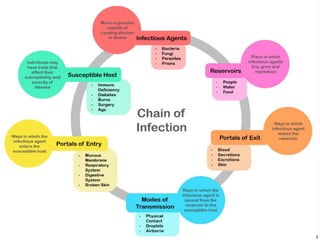
• Chain of infection
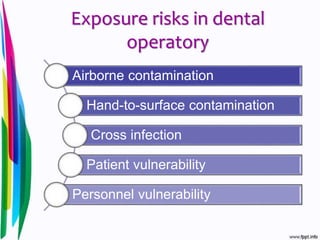
• Exposure risks in dental operatory
– Airborne contamination
– Hand-to-surface contamination
– Cross infection
– Patient vulnerability
– Personnel vulnerability
• Infection control programs
• Categories of task in relation to risk
• OSHA regulation on bloodborne pathogens
• CDC Guidelines for Infection Control
• General principle of infection control
 Identifying high risk patients and source ofinfection.
 Universal protection
 Routine hand washing
 Protective barriertechnique
 Immunization
 Prevent environmentalcontamination
 Use of sharp instruments and needles
 Handling biopsy specimen
 Prosthodontic consideration
 Infection control during radiography
 Biomedical waste management
• Needle stick injury
• Infectious disease in concern in dental practice
– Viral infection
– Bacterial infection
– Fungal infection
– Parasitic infection
• Sterilization and Disinfection
• History
• Critical, semi-critical & non-critical instruments
• Principles of sterilization
• Factors that affect the efficacy of disinfection and
sterilization
– Types of organisms
– Number of organisms
– Concentration of disinfecting agent
– Presence of organic material (e.g., serum, blood)
– Nature (composition) of surface to bedisinfected
– Contact time
– Temperature
– pH
– Biofilms
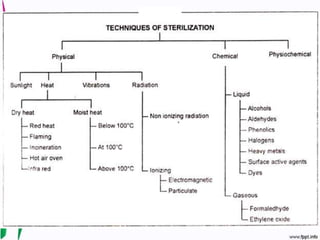
• Techniques of sterilization
• Physical
– Sunlight
– Heat
• Dry heat
• Moist heat
– Vibration
– Radiation
• Ionizing
• Non-ionizing
• Chemical
– Liquid
– Gaseous
• Physiochemical
• Conclusion
• Referrences
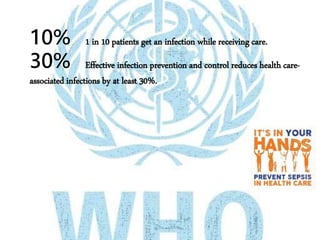
10% 1 in 10 patients get an infection while receiving care.
30% Effective infection prevention and control reduces health care-
associated infections by at least 30%.
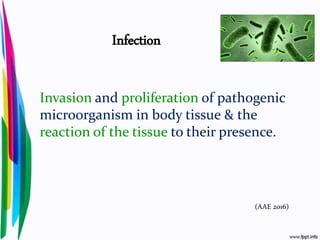
Infection
Invasion and proliferation of pathogenic
microorganism in body tissue & the
reaction of the tissue to their presence.
(AAE 2016)
Infection control
It refers to policies and procedures
used to minimize risk of spreading
infection, especially in hospitals and
human and animal health care
facilities.
Medical dictionary
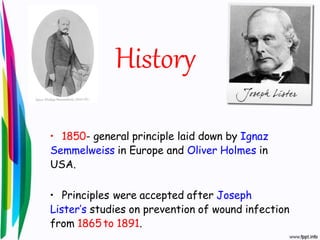
History
• 1850- general principle laid down by Ignaz
Semmelweiss in Europe and Oliver Holmes in
USA.
• Principles were accepted after Joseph
Lister’s studies on prevention of wound infection
from 1865to 1891.
Objectives
I. Reduction in spread of infection
II. Breaking the chain of infection and
eliminating cross contamination.
III. Safe practice for all members of the
dental team.
IV. Ensuring and showing to patients that
they are well protected from risks of
infectious disease.
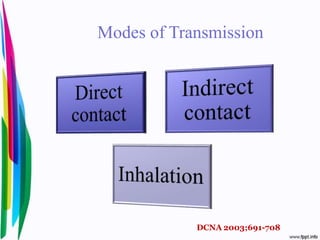
Modes of Transmission
DCNA 2003;691-708
Exposure risks in dental
operatory
Airborne contamination
Hand-to-surface contamination
Cross infection
Patient vulnerability
Personnel vulnerability
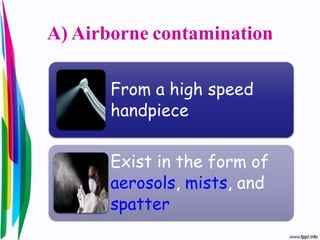
A) Airborne contamination
From a high speed
handpiece
Exist in the form of
aerosols, mists, and
spatter
 Aerosols are invisible particles ranging from
5- 50 microns
J Am Dent Assoc 96:801–804, 1978
Tend to settle gradually from air after 5-15 min
J Am Dent Assoc 125;579-84;1994
Remain suspended in air for hours
Can carry any respiratory pathogens to
the lungs.
J Dent Rest 48;49 -56,1969
Aerosol
Spatter
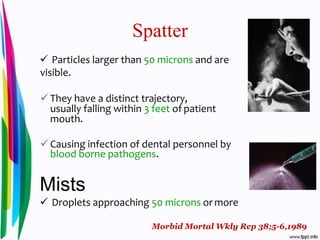
 Particles larger than 50 microns and are
visible.
 They have a distinct trajectory,
usually falling within 3 feet of patient
mouth.
 Causing infection of dental personnel by
blood borne pathogens.
Mists
 Droplets approaching 50 microns or more
Morbid Mortal Wkly Rep 38;5-6,1989
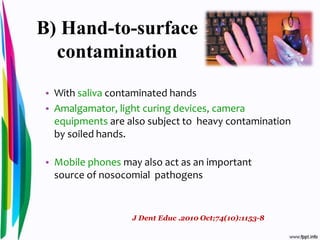
B) Hand-to-surface
contamination
• With saliva contaminated hands
• Amalgamator, light curing devices, camera
equipments are also subject to heavy contamination
by soiled hands.
• Mobile phones may also act as an important
source of nosocomial pathogens
J Dent Educ .2010 Oct;74(10):1153-8
C) Cross infection
• “The transmission of infectious agents between
patients and staff within a clinical environment”
• From person to person contact or via
contaminated objects.
• The major route through intact skin or mucosa
due to accidents involving sharps, or direct
inoculation onto cuts and abrasions in the skin.
D) Patient vulnerability
• Nine cluster cases of dentist-to-patient
transmission of HBV and one cluster case of
HIV has been well documented since 1971.
• In 1999, a group of six patients was found to be
with same strain of HIV virus that infected the
Florida dentist who treated them.
E) Personnel vulnerability
 Exposure of saliva, blood, and possible injury
from sharp instrumentation while treating
patients
 They are more vulnerable to infections if
they have not had proper immunizations or
used the protective barriers
J Am dent assoc 110;629-33;1985
Infection control programs
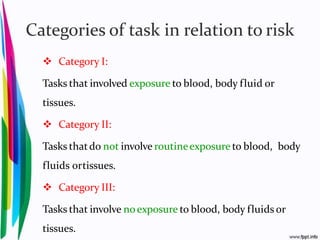
Categories of task in relation to risk
 Category I:
Tasks that involved exposure to blood, body fluid or
tissues.
 Category II:
Tasks thatdo not involve routineexposure to blood, body
fluids ortissues.
 Category III:
Tasks that involve noexposure to blood, body fluids or
tissues.
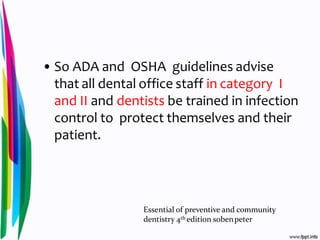
• So ADA and OSHA guidelines advise
that all dental office staff in category I
and II and dentists be trained in infection
control to protect themselves and their
patient.
Essential of preventive and community
dentistry 4th edition sobenpeter
OSHA regulation on blood borne
pathogens
1. Establish an exposure controlplan
2. Employers mustupdatethe planannually
3. Implement the use of universal precautions
4. Identify and use engineering controls
5. Identifyand ensurethe useof work practice
controls
6. Provide personal protective equipment (PPE),
suchas gloves, gowns, eye protection
7. Makeavailable hepatitis B vaccinations toall
workers with occupational exposure
8. Make available post-exposure evaluationand
follow- uptoanyoccupationallyexposed worker.
9. Use labelsand signs tocommunicate hazards
10. Maintain worker medical and trainingrecords
CDC Guidelines for Infection Control in
Dental Health-Care Settings --- 2003
1. Applicationof standard precautions rather
than universal precautions
2. Work restrictions for health-care personnel (HCP)
infectedwith or occupationally exposed to infectious
diseases;
3. Management of occupational exposures to
bloodborne pathogens, including post-exposure
prophylaxis.
4. Selection and useof devices with features
designed to prevent sharps injury;
5. hand-hygiene products and surgical handantisepsis;
6. contact dermatitis and latexhypersensitivity;
7. sterilization of unwrapped instruments;
8. dental water-qualityconcerns
9. dental radiology;
10. aseptic technique for parenteralmedications;
11. preprocedural mouth rinsing forpatients;
12. oral surgical procedures;
13. laser/electrosurgery
14. tuberculosis (TB) prevention;
15. infection-control program evaluation;and
16. research considerations.
GENERAL PRINCIPLES FOR
INFECTION CONTROL
1. Identifying high risk patients and source ofinfection.
2. Universal protection
3. Prevent environmental contamination
4. Use of sharp instruments and needles
5. Handling biopsy specimen
6. Prosthodontic consideration
7. Infection control during radiography
8. Biomedical waste management
9. others
1. Identifying high risk patients
and source of infection
 Understaning the disease and their root
of transmission
 Using the CDC recommended question
 Screening every new patient by taking proper
medical history and oralexamination.
 update patients’s medicalhistory.
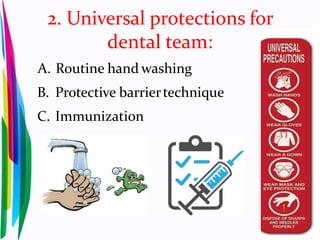
2. Universal protections for
dental team:
A. Routine hand washing
B. Protective barriertechnique
C. Immunization
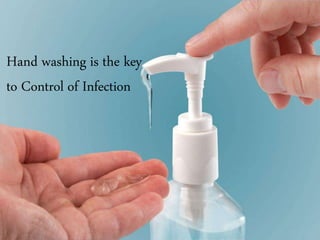
Hand washing is the key
to Control of Infection
Indications for Hand Hygiene
1. when hands are visiblysoiled.
2. After barehanded touching
3. Before and after treating each patient.
4. Before donning gloves
5. Immediately after removing gloves.
Before Decontaminating Hands
a. Cuts and Abrasions must be covered with a
waterproof dressing
b. Remove all jewellery and watches.
c. Fingernails should be kept short and clean.
d. Nail art and nail varnish should not be worn
e. Roll up yoursleeves
What to Wash your Hands with?
 Visiblysoiled orpotentiallygrossly contaminated.
 Liquid soap andwater
 Dried thoroughlywith agood qualitypaper towel.
 Contaminated.
 Alcohol hand gel.
Guidelines for Infection Control in Dental Health CareSettings
Sharon K. Dickinson, CDA, CDPMA, RDA; Richard D. Bebermeyer, DDS, MBA
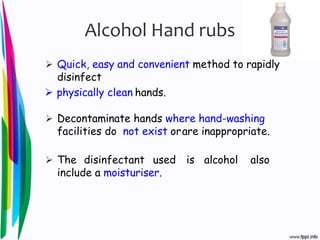
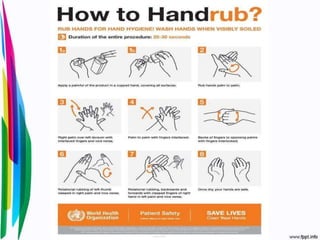
Alcohol Hand rubs
 Quick, easy and convenient method to rapidly
disinfect
 physically clean hands.
 Decontaminate hands where hand-washing
facilities do not exist orare inappropriate.
 The disinfectant used is alcohol also
include a moisturiser.
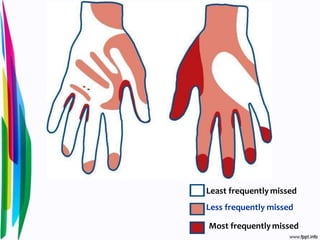
Least frequently missed
Less frequently missed
Most frequently missed
B. Personal
protective equipment
(PPE)
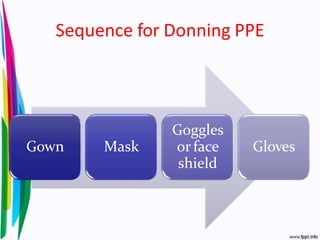
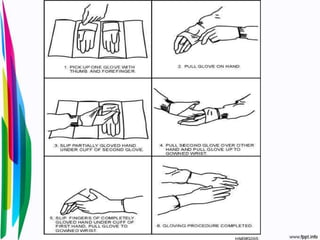
Sequence for Donning PPE
Gown Mask
Goggles
or face
shield
Gloves
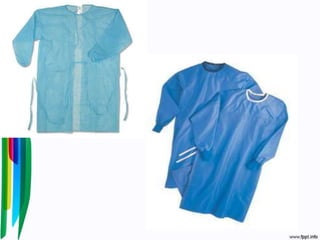
Protective Clothing- gown
 Worn overstreet clothes to protect them from
contamination.
 wear long sleevedgown
 To be changed between every patient.
 Protective clothingcan include: reusable or
disposable gown, laboratory coat,or uniform.
 Clean orstarile.
How to put a Gown?
• Select theappropriate type for the
task and the right size for you.
• The opening of the gown should be in
theback.
• Secure thegown at the neck and waist
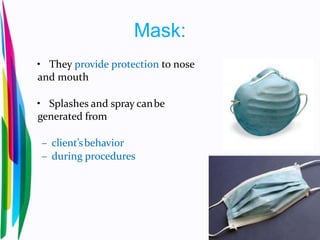
Mask:
• They provide protection to nose
and mouth
• Splashes and spray canbe
generated from
– client’sbehavior
– during procedures
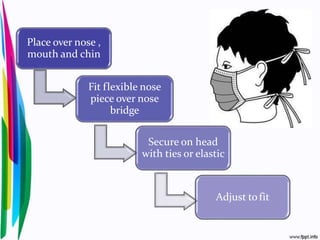
Place over nose ,
mouth and chin
Fit flexible nose
piece over nose
bridge
Secure on head
with ties or elastic
Adjust tofit
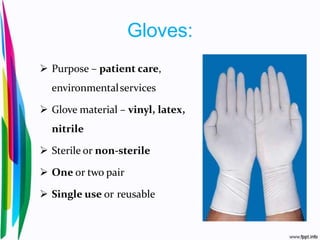
Gloves:
 Purpose – patient care,
environmentalservices
 Glove material – vinyl, latex,
nitrile
 Sterile or non-sterile
 One or two pair
 Single use or reusable
Do’s and Don’ts of Glove Use
• Weara new pairforeach patient.
• Ensureappropriategloves in thecorrect sizes
• Changegloves
– During use if tornand when heavilysoiled (evenduring use
on the same patient)
– After use on each patient
• Discard in appropriate receptacle
• Never wash orreusedisposableglove.
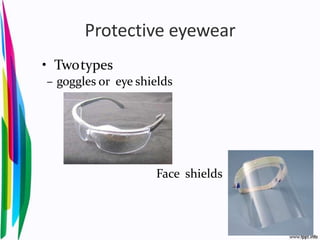
Protective eyewear
• Twotypes
– goggles or eye shields
Face shields
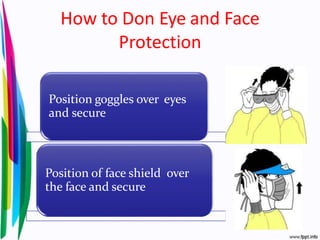
How to Don Eye and Face
Protection
Position goggles over eyes
and secure
Position of face shield over
the face and secure
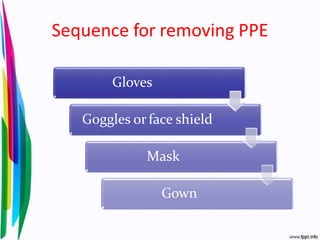
Sequence for removing PPE
Gloves
Goggles orface shield
Mask
Gown
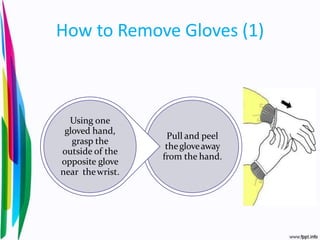
How to Remove Gloves (1)
Pull and peel
thegloveaway
from the hand.
Using one
gloved hand,
grasp the
outside of the
opposite glove
near thewrist.
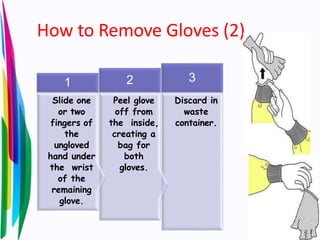
How to Remove Gloves (2)
Discard in
waste
container.
3
Peel glove
off from
the inside,
creating a
bag for
both
gloves.
2
Slide one
or two
fingers of
the
ungloved
hand under
the wrist
of the
remaining
glove.
1
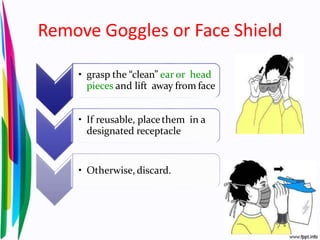
Remove Goggles or Face Shield
• grasp the “clean” ear or head
pieces and lift away from face
• If reusable, placethem in a
designated receptacle
• Otherwise, discard.
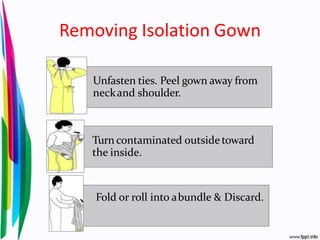
Removing Isolation Gown
Unfasten ties. Peel gown away from
neckand shoulder.
Turn contaminated outside toward
the inside.
Fold or roll into abundle & Discard.
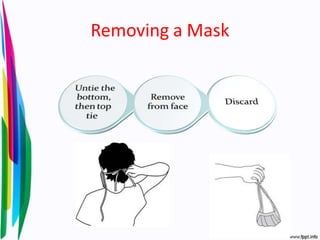
Removing a Mask
C. Immunization
procedure
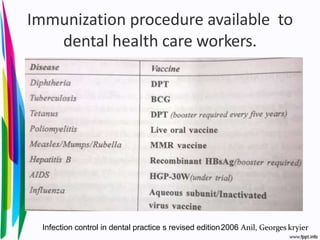
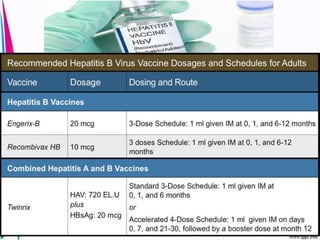
Immunization procedure available to
dental health care workers.
Infection control in dental practice s revised edition2006 Anil, Georges kryier
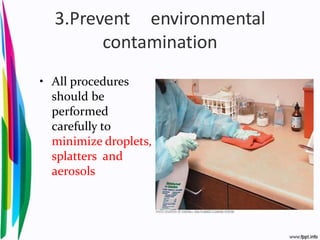
3.Prevent environmental
contamination
• All procedures
should be
performed
carefully to
minimize droplets,
splatters and
aerosols
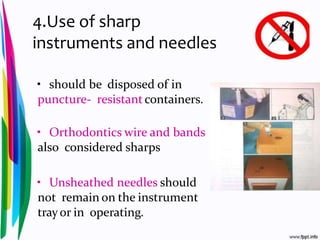
4.Use of sharp
instruments and needles
• should be disposed of in
puncture- resistant containers.
• Orthodontics wire and bands
also considered sharps
• Unsheathed needles should
not remain on the instrument
trayor in operating.
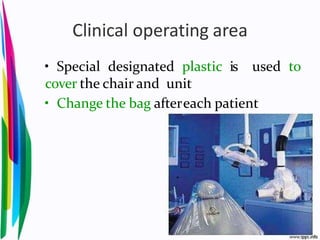
Clinical operating area
• Special designated plastic is used to
cover the chair and unit
• Change the bag aftereach patient
5. Handling biopsy specimens
• Should put insturdy containers with
secure lidto prevent leaking during
transportation.
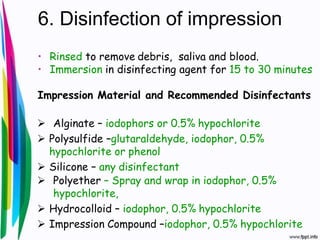
6. Disinfection of impression
• Rinsed to remove debris, saliva and blood.
• Immersion in disinfecting agent for 15 to 30 minutes
Impression Material and Recommended Disinfectants
 Alginate – iodophors or 0.5% hypochlorite
 Polysulfide –glutaraldehyde, iodophor, 0.5%
hypochlorite or phenol
 Silicone – any disinfectant
 Polyether – Spray and wrap in iodophor, 0.5%
hypochlorite,
 Hydrocolloid – iodophor, 0.5% hypochlorite
 Impression Compound –iodophor, 0.5% hypochlorite
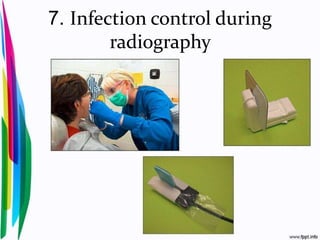
7. Infection control during
radiography
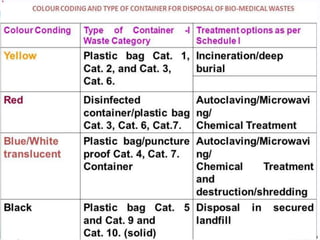
8. Waste disposal in health
care setting
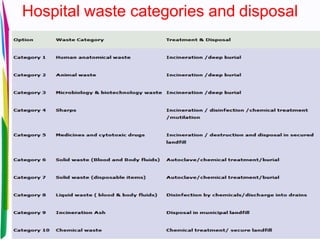
Hospital waste categories and disposal
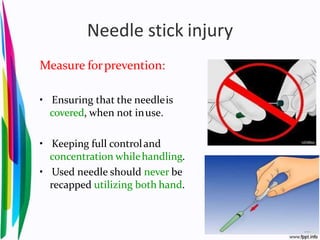
Needle stick injury
Measure forprevention:
• Ensuring that the needleis
covered, when not inuse.
• Keeping full controland
concentration whilehandling.
• Used needle should never be
recapped utilizing both hand.
• An uncapped needleorsyringeshould not be passed
from assistant tosurgeon.
• Needle should not be purposely bent orbroken by
hand.
• Needlecan safely re-capped by helpof forceps tograsp
thecap.
Post-accidental management:
• Remove thegloves
• Wash the site with running waterand soap
• Inform the patient about theincident
• Totake blood specimens of both
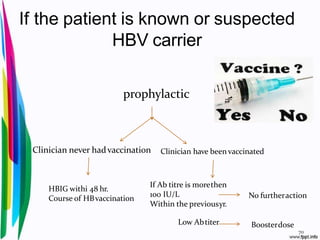
If the patient is known or suspected
HBV carrier
prophylactic
Clinician never hadvaccination
HBIG withi 48 hr.
Course of HBvaccination
Clinician have beenvaccinated
If Ab titre is morethen
100 IU/L
Within the previousyr.
No furtheraction
Low Abtiter Boosterdose
70
• Presently, there is noprophylaxis for HCV.
• Monitoring the liver functionand testing for
anti-HCVantibody.
• May respond favorably, if treated at the
earliestsign of infection.
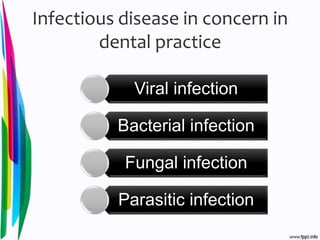
Infectious disease in concern in
dental practice
Viral infection
Bacterial infection
Fungal infection
Parasitic infection
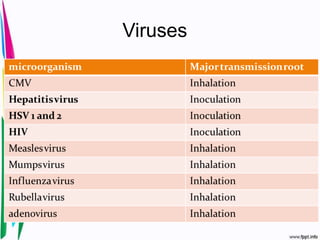
Viruses
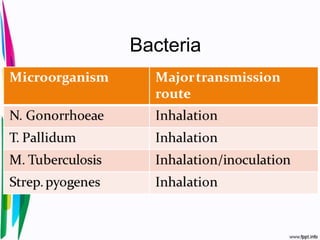
Bacteria
• Fungal infection: Candidiasis
• Parasitic infection: Pneumocystic carini
infection
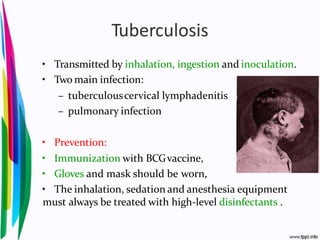
Tuberculosis
• Transmitted by inhalation, ingestion and inoculation.
• Two main infection:
– tuberculouscervical lymphadenitis
– pulmonary infection
• Prevention:
• Immunization with BCGvaccine,
• Gloves and mask should be worn,
• The inhalation, sedation and anesthesia equipment
must always be treated with high-level disinfectants .
Tuberculosis (TB) Precautions
for Outpatient Dental Settings
CDC 2005
• Administrative Controls
• Environmental Controls
• Respiratory Protection Controls
Administrative Controls
 managing TB infection control program
 annual risk assessment
 promptly identifying and isolating patients with
suspected or confirmed TB disease for medical
evaluation or urgent dental treatment
 Instruct patients to cover mouth when coughing and/or
wear a surgical mask
 Ensure that dental health care personnel (DHCP) are
educated regarding signs and symptoms of TB
 When hiring DHCP, ensure that they are screened
 Postpone urgent dental treatment
Environmental Controls
• Use airborne infection isolation room to provide
urgent dental treatment to patients with suspected or
confirmed infectious TB
• In settings with high volume of patients with
suspected or confirmed TB, use high-efficiency
particulate air filters or ultraviolet germicidal
irradiation
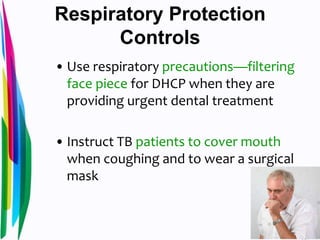
Respiratory Protection
Controls
• Use respiratory precautions—filtering
face piece for DHCP when they are
providing urgent dental treatment
• Instruct TB patients to cover mouth
when coughing and to wear a surgical
mask
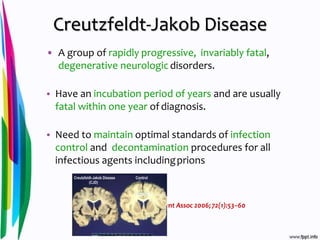
Creutzfeldt-Jakob Disease
• A group of rapidly progressive, invariably fatal,
degenerative neurologic disorders.
• Have an incubation period of years and are usually
fatal within one year ofdiagnosis.
• Need to maintain optimal standards of infection
control and decontamination procedures for all
infectious agents includingprions
J Can Dent Assoc 2006;72(1):53–60
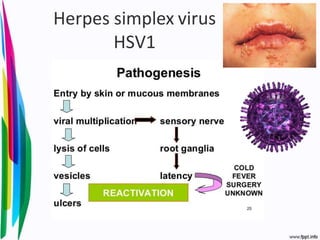
Herpes simplex virus
HSV1
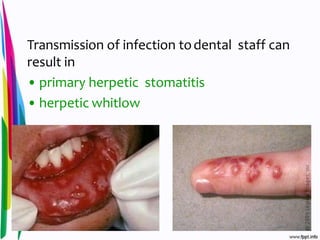
Transmission of infection todental staff can
result in
• primary herpetic stomatitis
• herpetic whitlow
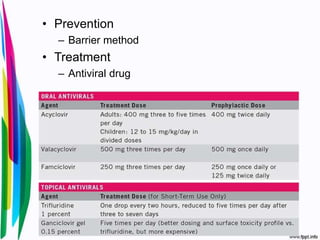
• Prevention
– Barrier method
• Treatment
– Antiviral drug
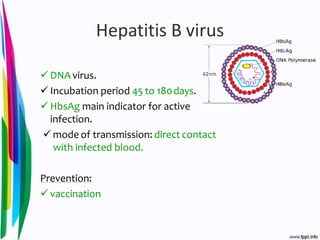
Hepatitis B virus
 DNA virus.
 Incubation period 45 to 180days.
 HbsAg main indicator for active
infection.
 mode of transmission: direct contact
with infected blood.
Prevention:
 vaccination
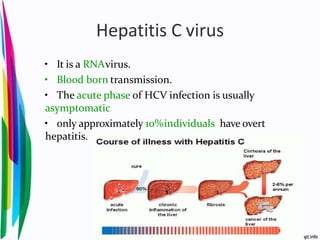
Hepatitis C virus
• It is a RNAvirus.
• Blood born transmission.
• The acute phase of HCV infection is usually
asymptomatic
• only approximately 10%individuals have overt
hepatitis.
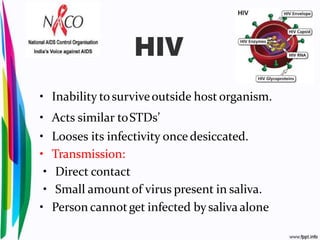
HIV
• Inability tosurviveoutside host organism.
• Acts similar toSTDs’
• Looses its infectivity once desiccated.
• Transmission:
• Direct contact
• Small amount of virus present in saliva.
• Person cannotget infected bysaliva alone
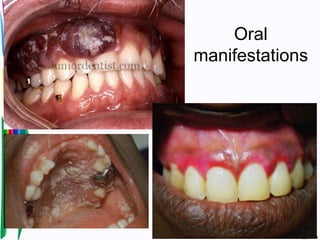
Oral
manifestations
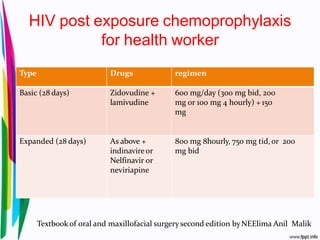
HIV post exposure chemoprophylaxis
for health worker
Type Drugs regimen
Basic (28 days) Zidovudine +
lamivudine
600 mg/day (300 mg bid, 200
mg or 100 mg 4 hourly) +150
mg
Expanded (28 days) As above +
indinavireor
Nelfinavir or
neviriapine
800 mg 8hourly, 750 mg tid,or 200
mg bid
Textbookof oral and maxillofacial surgerysecond edition byNEElima Anil Malik
• Sterilization: Process by which an
articles, surface or medium is freed of all
microorganism either in vegetative or
spore form.
• Disinfection : Process which reduces the
number of viable microorganism to an
acceptable level but may not inactivate some
virus and bacterial spores.
• Antiseptic : Chemical which can be safely
applied to skin or mucus membrane
surfaces and used for preventing infection
by inhibiting growth of bacteria.
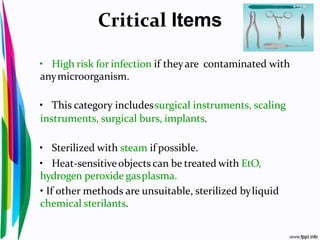
Critical Items
• High risk for infection if theyare contaminated with
anymicroorganism.
• This category includessurgical instruments, scaling
instruments, surgical burs, implants.
• Sterilized with steam if possible.
• Heat-sensitiveobjects can be treated with EtO,
hydrogen peroxide gasplasma.
• If other methods are unsuitable, sterilized byliquid
chemical sterilants.
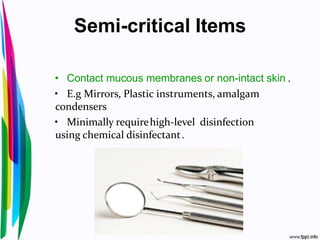
Semi-critical Items
• Contact mucous membranes or non-intact skin .
• E.g Mirrors, Plastic instruments, amalgam
condensers
• Minimally requirehigh-level disinfection
using chemical disinfectant.
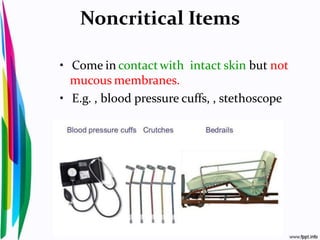
Noncritical Items
• Come in contactwith intact skin but not
mucous membranes.
• E.g. , blood pressure cuffs, , stethoscope
Changes in Disinfection and
Sterilization Since 1981
First, formaldehyde-alcohol has been deleted asa
recommended chemical sterilant or high-level
disinfectant
Second, several new chemical sterilants have been
added, including hydrogen peroxide, peracetic acid,
and hydrogen peroxide incombination.
Third, 3% phenolics and iodophors have been deleted
as high-level disinfectants.
• Fourth, isopropyl alcohol and ethyl alcohol have been
deleted as high-level disinfectants .
• Fifth, a 1:16 dilution of 2.0% glutaraldehyde, 7.05% phenol, 1.20%
sodium phenate has been deleted as a high-level disinfectant.
• Sixth, the exposure time required to achieve high-level
disinfection has been changed from 10-30 minutes to12 minutes or
more.
• Guideline for Disinfection and Sterilization in HealthcareFacilities, 2008
• William A. Rutala, Ph.D., M.P.H.1,2, David J. Weber, M.D., M.P.H.1,2,
Principles of sterilization
All used instrument should
thoroughly cleaned.
The sterilizing agent to be in contact
with every surface of each item.
All sterilizing equipment must be
regularly serviced and maintained.
Follow the manufacturer’s
instruction.
Factors that affect the efficacy of
disinfection and sterilization
• Types of organisms
• Number of organisms
• Concentration of disinfectingagent
• Presence of organic material (e.g., serum, blood)
• Nature (composition) of surface to bedisinfected
• Contact time
• Temperature
• pH
• Biofilms
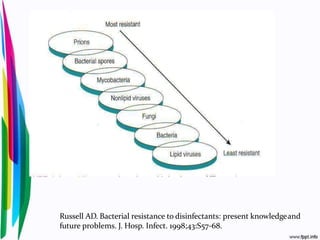
Russell AD. Bacterial resistance to disinfectants: present knowledgeand
future problems. J. Hosp. Infect. 1998;43:S57-68.
Number of organisms
• Microbial load: the total number of
organisms which determine the exposure
time of killing agent
• notall organisms dieat the same time
• higher numbers of organisms require longer
exposure
Concentration of disinfecting agent
• a properconcentration of disinfecting agents
ensure the activation of target organisms
• povidone-iodine should be diluted with water
before use because there is not enough free
iodine to kill microorganisms in concentrated
solution
Presence of organic material
(such as blood, mucus, pus)
• Affects killing activity by inactivating the
disinfecting agent
• bycoating the surface to be treated, prevents full
contact between object and agent
• For optimal killing activity, instruments and
surfaces should be cleansed with excess organic
material before disinfection !!!
Nature (composition) of
surface to be disinfected
• Some medical instruments are
manufactured of biomaterials that exclude
the use of certain disinfection and
sterlization methods
• Endoscopic instruments cannot be
sterilized by heat in an autoclave
Contact time
• The amountof time a disinfectant or sterilant is in
contact with theobject is critical.
• Betadine must be incontact with object forat least 1
to 2 min to kill microorganism.
• The spores of bacteria and fungi needa
much longer time
• Determine whether it is disinfecting or sterilizing the
object.
Temperature
• Disinfectants are generally used at room
temp. (20-220c)
• Their activity is increased by an increased
temp.
• Decreased by a drop in temp
Biofilms
• Communities of microorganisms
• Can be on a surface of either inanimateor
animate objects
• Make disinfection moredifficult
• The concentration of the disinfectantand the
contact time need to be increased
pH
• An increase in pH improves the antimicrobial
activity of some disinfectants but decreases the
antimicrobial activity of others
• The pH influences the antimicrobial activity
by altering the disinfectant moleculeor the cell
surface
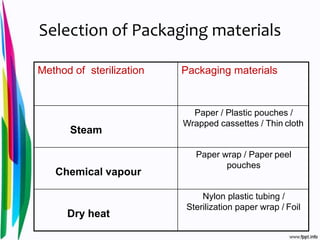
Selection of Packaging materials
Method of sterilization Packaging materials
Steam
Paper / Plastic pouches /
Wrapped cassettes / Thin cloth
Chemical vapour
Paper wrap / Paper peel
pouches
Dry heat
Nylon plastic tubing /
Sterilization paper wrap / Foil
Sunlight
• Appreciable bactericidal activity
• Primary action due to ultraviolet rays
• Semple and Greg studied that typhoid
bacilli exposed to the sun on pieces of
whiteclothwere killed in 2 hours whereas
in dark theywerealive after sixdays
Drying
• Moisture is essential for growthof bacteria
• Drying in air has deletorius effect on some
bacteria
• Unreliable method
• Spores areunaffected
Heat
• Most reliable method
• Method of choice unlesscontraindicated
• Factors influencing heat sterilization:
1. Nature of heat (Dry / Moist)
2. Temperature and time
3. Number of microorganisms
4. Characteristics of microorganisms
5. Type of material to besterilize
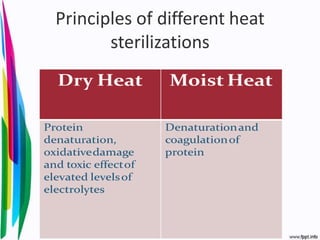
Principles of different heat
sterilizations
Dry heat sterilization
• It involves heating airwith transferof heat
energy from the air to theinstrument
• Advantage : the instrumentdo not rust, low
cost
• Disadvantage: time consuming and high
temperature require.
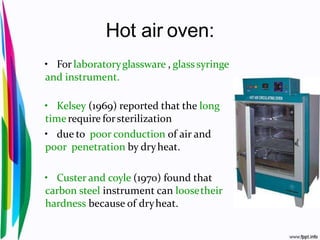
Hot air oven:
• For laboratoryglassware , glasssyringe
and instrument.
• Kelsey (1969) reported that the long
timerequire forsterilization
• due to poor conduction of air and
poor penetration by dryheat.
• Custer and coyle (1970) found that
carbon steel instrument can loosetheir
hardness because of dryheat.
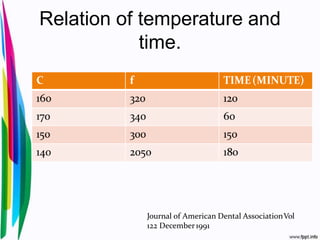
Relation of temperature and
time.
Journal of American Dental AssociationVol
122 December1991
Moist heat sterilization :
AUTOCLAVE
• Steam sterilization involves heating water to
generate steam in closeschamber.
• Known for destruction of all forms of
microorganism
• high penetrating capacityand give upa large
amount of latent heat.
Advantages
• The results are consistently good, and reliable
• The instrumentcan bewrapped priortosterilization
• Timeefficient
• Good penetration
Disadvantages:
• Blunting and corrosion of sharp instrument
• Damage to certain rubber goods
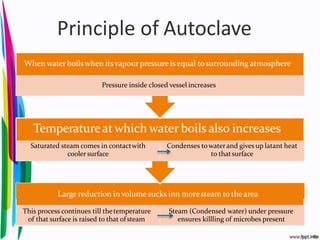
Principle of Autoclave
Large reduction in volume sucks inn moresteam to thearea
This process continues till thetemperature
of that surface is raised to that ofsteam
Steam (Condensed water) under pressure
ensures killling of microbes present
Temperatureat which water boils also increases
Saturated steam comes in contactwith
cooler surface
Condenses towaterand gives up latant heat
to thatsurface
When water boilswhen itsvapourpressure is equal tosurrounding atmosphere
Pressure inside closed vessel increases
121
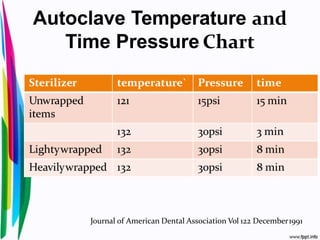
Autoclave Temperature and
Time Pressure Chart
Journal of American Dental Association Vol 122 December1991
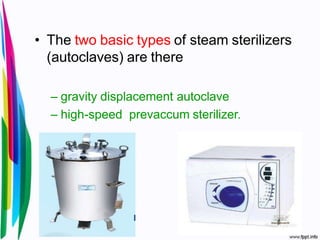
• The two basic types of steam sterilizers
(autoclaves) are there
– gravity displacement autoclave
– high-speed prevaccum sterilizer.
The gravity displacement
autoclave
• primarily used to process laboratory media, water,
pharmaceuticalproducts, regulated medical waste,
and nonporous articles whose surfaces have direct
steam contact.
Advantage :
• there is nearly instantaneous steam penetration
even into porous loads.
• The Bowie-Dick test is used todetect air leaks and
inadequate air removal
Flash Sterilization
• Sterilization of an unwrapped object at 1320C for 3
minutes at 27-28 lbs. of pressure in agravity
displacement sterilizer.
(Underwood and Perkins )
• is a modificationof conventional steam sterilization.
• Uses
• For processing cleaned patient-care items that
cannotbe packaged, sterilized, and stored before
use
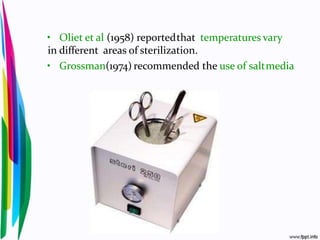
Glass beads sterilization:
• This method employs a heat transfer device. The
temperature achieved is of 220*c.
• The media used areglass beads, molten metal orsalt
kept in acup.
• Use forsmall instrument like endodontic files,
burs, rotary instruments
• Sterilization time 10sec.
• Oliet et al (1958) reportedthat temperatures vary
in different areas of sterilization.
• Grossman(1974) recommended the use of saltmedia
Individual endodontic instruments
sterilization
• Proper steam autoclaving reliably produced completely
sterile instruments.
• Salt sterilization and glutaraldehyde solutions may
not be adequate sterilization methods for
endodontic hand files and should not be relied on
to provide completely sterile instruments
• Journal of Endodontics; 1996;22; 6; 321-322.
• Files sterilized by autoclave and lasers were
completely sterile. Those sterilized by glass
bead were 90% sterile and those with
glutaraldehyde were 80% sterile.
• J Indian Soc Pedod Prevent Dent ;28;1;2010
• Glass slab by swabbing with tincture of thimerosal,
followed bya double swabbing with alcohol.
• Gutta-percha cones may be kept in sterile screw capped
vials containing alcohol.
• To sterilize gutta-percha cone freshly removed from
the box- immerse in 5.2% sodium hypochlorite for 1
min, then rinse with hydrogen peroxide and dry
between 2 layers of sterile gauze.
• Silver cones are sterilized by passing them through a
flame 3-4 times or by immersion in hot salt sterilizer for
5secs.
• Rubber dam is sterilized by ethylene oxide.
• Carbon steel instruments and burs are best sterilized
by dry heator chemiclave.
• Sterilization dental cements, calcium sulphate is done
by gamma radiation
Low-temperature sterilization
• Ethyleneoxide (ETO) (has been widely used as a low-
temperature sterilant since the 1950s.
• gas concentration (450 to 1200 mg/l);
• temperature (37 to 63oC);
• relative humidity (40 to 80%)
• exposure time (1 to 6 hours)
Association for the Advancement of MedicalInstrumentation.
Ethyleneoxidesterilization in healthcare facilities: Safetyand
effectiveness. AAMI. Arlington, VA, 1999.
Mode of Action
• Result of alkylation of protein, DNA, and RNA.
• ETO inactivates all microorganisms .
• although bacterial spores (especially B. atrophaeus)
more resistant than other microorganisms.
• For this reason B. atrophaeus is the recommended
biological indicator.
• Uses.
•sterilize critical items that are moisture or heat
sensitive and cannot be sterilized by steam
sterilization.
Hydrogen Peroxide Gas
Plasma
• Mode of Action
•inactivates microorganisms primarily by the
combined use of hydrogen peroxide gas and the
generation of free radicals during the plasma phase of
the cycle.
• Uses :
• Materials and devices that cannot tolerate high
temperatures and humidity
• some plastics, electrical devices, and corrosion-
susceptible metal alloys,
Irradiation:
– Ionizing radiation
– Non ionizing radiation
Ionizing radiation:
• Includex-ray , gamma rays, and high speed electron.
• It is effective forheat labile items.
• greater penetrationproperties.
• The lethal action isdue toeffecton the DNA of
nucleusand on theothervital cell compound.
• Tosterilizedisposable material.
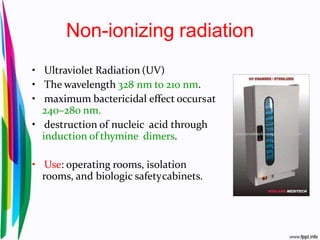
Non-ionizing radiation
• Ultraviolet Radiation (UV)
• The wavelength 328 nm to 210 nm.
• maximum bactericidal effect occursat
240–280 nm.
• destruction of nucleic acid through
induction of thymine dimers.
• Use: operating rooms, isolation
rooms, and biologic safetycabinets.
Infrared:
• Another form of dry heatsterilization
• Mostcommonly use to purify air, such
as in the operating room
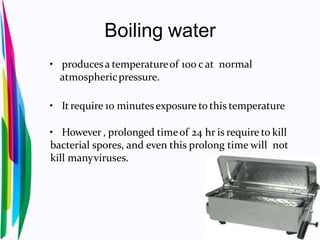
Boiling water
• producesa temperatureof 100 cat normal
atmosphericpressure.
• It require 10 minutesexposure to this temperature
• However , prolonged timeof 24 hr is require to kill
bacterial spores, and even this prolong time will not
kill manyviruses.
STERILIZATION CONTROL
• Toensure that potentially infectiousagents
are destroyed by adequate sterilization
regimes
Three levels:
• physical: measuring device control (temp.,time,
pressure)
• chemical: substances that undergoacolourchange or
have melting points within the sterilizing range
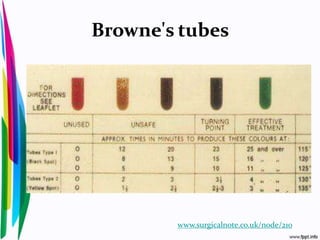
• Browne's tubes, Bowie Dick tape
givean immediate indication of a successful or non-
successful sterilization
Browne's tubes
www.surgicalnote.co.uk/node/210
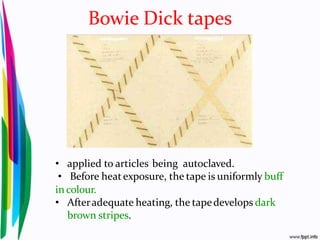
Bowie Dick tapes
• applied to articles being autoclaved.
• Before heatexposure, the tape is uniformly buff
in colour.
• Afteradequate heating, the tapedevelops dark
brown stripes.
Biological:
• Bacillus stearothermophilus spores
• survivessteam heatat 121ºC for 5 min. and is killed
at 121ºC in 13 min.
• determine theadequacyof steamor chemical
vapor sterilization
• Bacillus subtilis spores
• validateand determine theadequacyof ethylene
oxide or dry heatsterilization
CHEMICAL
DISINFECTION
Properties of an ideal
disinfectant.
• Broad spectrum
• Fast acting
• Not affected by environmental factors
• Nontoxic
• Surface compatibility
• Easy to use
• Odorless
• Economical
• Solubility
• Stability
• Environmentally friendly
ALCOHOL
•two water-soluble chemical compounds—ethyl
alcohol and isopropyl alcohol
• rapidly bactericidal rather than bacteriostatic
against vegetative forms of bacteria
• tuberculocidal, fungicidal, and virucidal but do not
destroy bacterial spores.
•Their cidal activity drops sharply when diluted below
50% concentration, and the optimum bactericidal
concentration is 60%–90% solutions in water.
Mode of Action
• Denaturation of proteins.
• Microbicidal activity:
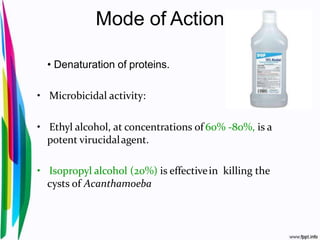
• Ethyl alcohol, at concentrations of 60% -80%, is a
potent virucidalagent.
• Isopropyl alcohol (20%) is effectivein killing the
cysts of Acanthamoeba
PHENOLS
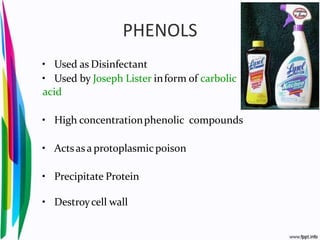
• Used as Disinfectant
• Used by Joseph Lister inform of carbolic
acid
• High concentrationphenolic compounds
• Actsas a protoplasmicpoison
• Precipitate Protein
• Destroycell wall
• Lipophillic virus aresusceptible
• Spores areresistant
• Twoor more syntheticphenols in combination
• Action against hydrophilicviruses
• Accepted by ADA forsurface disinfectant on
precleaned surfaces
Aldehydes
• Formaldehyde or glutaraldehyde
• Denaturate proteins and nucleicacids
• Irritate mucosa, skin contact may result inflammations
orallergic eczemas
• broad-sepctrum: againts bacteria, fungi, and
viruses
• chemo sterilizer in higher concentrations
• Application: -disinfection of surfaces and objects
• Sterilizer of choice for heat-sensitive medical equipment
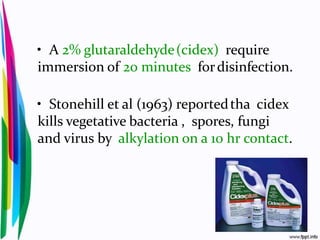
• A 2% glutaraldehyde(cidex) require
immersion of 20 minutes fordisinfection.
• Stonehill et al (1963) reportedtha cidex
kills vegetative bacteria , spores, fungi
and virus by alkylation on a 10 hr contact.
Chloride compound:
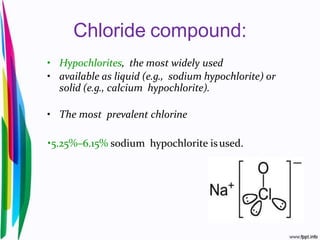
• Hypochlorites, the most widely used
• available as liquid (e.g., sodium hypochlorite) or
solid (e.g., calcium hypochlorite).
• The most prevalent chlorine
•5.25%–6.15% sodium hypochlorite isused.
Advantages
• They have a broad spectrumof antimicrobial
activity,
•do not leave toxic residues,
•unaffected by water hardness
• inexpensive and fastacting,
• remove dried or fixed organisms and biofilms from
surfaces.
Hydrogen peroxide:
• Producing destructive hydroxyl free radicals
• A 0.5% accelerated hydrogen peroxide demonstrated
bactericidal and virucidal activity in 1 minute and
mycobactericidal and fungicidal activity in 5 minutes
• Commercially available 3% hydrogen peroxide is a
stable and effective disinfectant
IODOPHORS
• Iodine can penetrate the cell wall of microorganisms
quickly
• the lethal effects are believed to result from
disruptionof proteinand nucleicacid structure and
synthesis.
• Iodophors are bactericidal, mycobactericidal, and
virucidal but can require prolonged contact times to
kill certain fungi and bacterialspores
STORAGE AND CARE OF
STERILE INSTRUMENTS
• Storage areas should be dust proof, dry,
well ventilated and easily accessible for
routine dental use.
• Sterile materials should be stored atleast
8-10 inches from the floor, atleast 18
inches from the ceiling, and atleast 2
inches from the outside walls.
• Items are not stored in any location
where they can become wet.
• Items should be positioned so that
packaged items are not crushed,
bent, compressed or punctured.
• Ultra violet chambers and formalin
chambers are now commonly used
for storage of instruments.
Conclusion
• Infection control measures in dentistry are most vital
for mutual health safety of patient and health care
professionals.
• There are several key players and elements to
achieve the highest standard of infection control.
These include the Dental health care professionals
and the patients.
• Rigid implementation of evidences based infection
control measures should be strictly followed in
dental practice.
“Whatever is touched is contaminated”
Thank You..

Infection controle in dentistry

  • 1.
    Infectio n Control Dr Abhisek Guria Deptof Conservative Dentistry & Endodontics
  • 2.
    • Infection • Infectioncontrol • History • Objectives • Mode of transmission • Chain of infection • Exposure risks in dental operatory – Airborne contamination – Hand-to-surface contamination – Cross infection – Patient vulnerability – Personnel vulnerability
  • 3.
    • Infection controlprograms • Categories of task in relation to risk • OSHA regulation on bloodborne pathogens • CDC Guidelines for Infection Control • General principle of infection control  Identifying high risk patients and source ofinfection.  Universal protection  Routine hand washing  Protective barriertechnique  Immunization  Prevent environmentalcontamination  Use of sharp instruments and needles
  • 4.
     Handling biopsyspecimen  Prosthodontic consideration  Infection control during radiography  Biomedical waste management • Needle stick injury • Infectious disease in concern in dental practice – Viral infection – Bacterial infection – Fungal infection – Parasitic infection • Sterilization and Disinfection • History
  • 5.
    • Critical, semi-critical& non-critical instruments • Principles of sterilization • Factors that affect the efficacy of disinfection and sterilization – Types of organisms – Number of organisms – Concentration of disinfecting agent – Presence of organic material (e.g., serum, blood) – Nature (composition) of surface to bedisinfected – Contact time – Temperature – pH – Biofilms
  • 6.
    • Techniques ofsterilization • Physical – Sunlight – Heat • Dry heat • Moist heat – Vibration – Radiation • Ionizing • Non-ionizing • Chemical – Liquid – Gaseous • Physiochemical • Conclusion • Referrences
  • 7.
    10% 1 in10 patients get an infection while receiving care. 30% Effective infection prevention and control reduces health care- associated infections by at least 30%.
  • 8.
    Infection Invasion and proliferationof pathogenic microorganism in body tissue & the reaction of the tissue to their presence. (AAE 2016)
  • 9.
    Infection control It refersto policies and procedures used to minimize risk of spreading infection, especially in hospitals and human and animal health care facilities. Medical dictionary
  • 10.
    History • 1850- generalprinciple laid down by Ignaz Semmelweiss in Europe and Oliver Holmes in USA. • Principles were accepted after Joseph Lister’s studies on prevention of wound infection from 1865to 1891.
  • 11.
    Objectives I. Reduction inspread of infection II. Breaking the chain of infection and eliminating cross contamination. III. Safe practice for all members of the dental team. IV. Ensuring and showing to patients that they are well protected from risks of infectious disease.
  • 12.
  • 14.
    Exposure risks indental operatory Airborne contamination Hand-to-surface contamination Cross infection Patient vulnerability Personnel vulnerability
  • 15.
    A) Airborne contamination Froma high speed handpiece Exist in the form of aerosols, mists, and spatter
  • 16.
     Aerosols areinvisible particles ranging from 5- 50 microns J Am Dent Assoc 96:801–804, 1978 Tend to settle gradually from air after 5-15 min J Am Dent Assoc 125;579-84;1994 Remain suspended in air for hours Can carry any respiratory pathogens to the lungs. J Dent Rest 48;49 -56,1969 Aerosol
  • 17.
    Spatter  Particles largerthan 50 microns and are visible.  They have a distinct trajectory, usually falling within 3 feet of patient mouth.  Causing infection of dental personnel by blood borne pathogens. Mists  Droplets approaching 50 microns or more Morbid Mortal Wkly Rep 38;5-6,1989
  • 18.
    B) Hand-to-surface contamination • Withsaliva contaminated hands • Amalgamator, light curing devices, camera equipments are also subject to heavy contamination by soiled hands. • Mobile phones may also act as an important source of nosocomial pathogens J Dent Educ .2010 Oct;74(10):1153-8
  • 19.
    C) Cross infection •“The transmission of infectious agents between patients and staff within a clinical environment” • From person to person contact or via contaminated objects. • The major route through intact skin or mucosa due to accidents involving sharps, or direct inoculation onto cuts and abrasions in the skin.
  • 20.
    D) Patient vulnerability •Nine cluster cases of dentist-to-patient transmission of HBV and one cluster case of HIV has been well documented since 1971. • In 1999, a group of six patients was found to be with same strain of HIV virus that infected the Florida dentist who treated them.
  • 21.
    E) Personnel vulnerability Exposure of saliva, blood, and possible injury from sharp instrumentation while treating patients  They are more vulnerable to infections if they have not had proper immunizations or used the protective barriers J Am dent assoc 110;629-33;1985
  • 22.
  • 23.
    Categories of taskin relation to risk  Category I: Tasks that involved exposure to blood, body fluid or tissues.  Category II: Tasks thatdo not involve routineexposure to blood, body fluids ortissues.  Category III: Tasks that involve noexposure to blood, body fluids or tissues.
  • 24.
    • So ADAand OSHA guidelines advise that all dental office staff in category I and II and dentists be trained in infection control to protect themselves and their patient. Essential of preventive and community dentistry 4th edition sobenpeter
  • 25.
    OSHA regulation onblood borne pathogens 1. Establish an exposure controlplan 2. Employers mustupdatethe planannually 3. Implement the use of universal precautions 4. Identify and use engineering controls 5. Identifyand ensurethe useof work practice controls
  • 26.
    6. Provide personalprotective equipment (PPE), suchas gloves, gowns, eye protection 7. Makeavailable hepatitis B vaccinations toall workers with occupational exposure 8. Make available post-exposure evaluationand follow- uptoanyoccupationallyexposed worker. 9. Use labelsand signs tocommunicate hazards 10. Maintain worker medical and trainingrecords
  • 27.
    CDC Guidelines forInfection Control in Dental Health-Care Settings --- 2003 1. Applicationof standard precautions rather than universal precautions 2. Work restrictions for health-care personnel (HCP) infectedwith or occupationally exposed to infectious diseases; 3. Management of occupational exposures to bloodborne pathogens, including post-exposure prophylaxis. 4. Selection and useof devices with features designed to prevent sharps injury;
  • 28.
    5. hand-hygiene productsand surgical handantisepsis; 6. contact dermatitis and latexhypersensitivity; 7. sterilization of unwrapped instruments; 8. dental water-qualityconcerns 9. dental radiology; 10. aseptic technique for parenteralmedications; 11. preprocedural mouth rinsing forpatients; 12. oral surgical procedures; 13. laser/electrosurgery 14. tuberculosis (TB) prevention; 15. infection-control program evaluation;and 16. research considerations.
  • 29.
    GENERAL PRINCIPLES FOR INFECTIONCONTROL 1. Identifying high risk patients and source ofinfection. 2. Universal protection 3. Prevent environmental contamination 4. Use of sharp instruments and needles 5. Handling biopsy specimen 6. Prosthodontic consideration 7. Infection control during radiography 8. Biomedical waste management 9. others
  • 30.
    1. Identifying highrisk patients and source of infection  Understaning the disease and their root of transmission  Using the CDC recommended question  Screening every new patient by taking proper medical history and oralexamination.  update patients’s medicalhistory.
  • 31.
    2. Universal protectionsfor dental team: A. Routine hand washing B. Protective barriertechnique C. Immunization
  • 32.
    Hand washing isthe key to Control of Infection
  • 33.
    Indications for HandHygiene 1. when hands are visiblysoiled. 2. After barehanded touching 3. Before and after treating each patient. 4. Before donning gloves 5. Immediately after removing gloves.
  • 34.
    Before Decontaminating Hands a.Cuts and Abrasions must be covered with a waterproof dressing b. Remove all jewellery and watches. c. Fingernails should be kept short and clean. d. Nail art and nail varnish should not be worn e. Roll up yoursleeves
  • 35.
    What to Washyour Hands with?  Visiblysoiled orpotentiallygrossly contaminated.  Liquid soap andwater  Dried thoroughlywith agood qualitypaper towel.  Contaminated.  Alcohol hand gel. Guidelines for Infection Control in Dental Health CareSettings Sharon K. Dickinson, CDA, CDPMA, RDA; Richard D. Bebermeyer, DDS, MBA
  • 36.
    Alcohol Hand rubs Quick, easy and convenient method to rapidly disinfect  physically clean hands.  Decontaminate hands where hand-washing facilities do not exist orare inappropriate.  The disinfectant used is alcohol also include a moisturiser.
  • 37.
    Least frequently missed Lessfrequently missed Most frequently missed
  • 39.
  • 40.
    Sequence for DonningPPE Gown Mask Goggles or face shield Gloves
  • 41.
    Protective Clothing- gown Worn overstreet clothes to protect them from contamination.  wear long sleevedgown  To be changed between every patient.  Protective clothingcan include: reusable or disposable gown, laboratory coat,or uniform.  Clean orstarile.
  • 43.
    How to puta Gown? • Select theappropriate type for the task and the right size for you. • The opening of the gown should be in theback. • Secure thegown at the neck and waist
  • 44.
    Mask: • They provideprotection to nose and mouth • Splashes and spray canbe generated from – client’sbehavior – during procedures
  • 45.
    Place over nose, mouth and chin Fit flexible nose piece over nose bridge Secure on head with ties or elastic Adjust tofit
  • 46.
    Gloves:  Purpose –patient care, environmentalservices  Glove material – vinyl, latex, nitrile  Sterile or non-sterile  One or two pair  Single use or reusable
  • 47.
    Do’s and Don’tsof Glove Use • Weara new pairforeach patient. • Ensureappropriategloves in thecorrect sizes • Changegloves – During use if tornand when heavilysoiled (evenduring use on the same patient) – After use on each patient • Discard in appropriate receptacle • Never wash orreusedisposableglove.
  • 49.
    Protective eyewear • Twotypes –goggles or eye shields Face shields
  • 50.
    How to DonEye and Face Protection Position goggles over eyes and secure Position of face shield over the face and secure
  • 51.
    Sequence for removingPPE Gloves Goggles orface shield Mask Gown
  • 52.
    How to RemoveGloves (1) Pull and peel thegloveaway from the hand. Using one gloved hand, grasp the outside of the opposite glove near thewrist.
  • 53.
    How to RemoveGloves (2) Discard in waste container. 3 Peel glove off from the inside, creating a bag for both gloves. 2 Slide one or two fingers of the ungloved hand under the wrist of the remaining glove. 1
  • 54.
    Remove Goggles orFace Shield • grasp the “clean” ear or head pieces and lift away from face • If reusable, placethem in a designated receptacle • Otherwise, discard.
  • 55.
    Removing Isolation Gown Unfastenties. Peel gown away from neckand shoulder. Turn contaminated outside toward the inside. Fold or roll into abundle & Discard.
  • 56.
  • 57.
  • 58.
    Immunization procedure availableto dental health care workers. Infection control in dental practice s revised edition2006 Anil, Georges kryier
  • 59.
    3.Prevent environmental contamination • Allprocedures should be performed carefully to minimize droplets, splatters and aerosols
  • 60.
    4.Use of sharp instrumentsand needles • should be disposed of in puncture- resistant containers. • Orthodontics wire and bands also considered sharps • Unsheathed needles should not remain on the instrument trayor in operating.
  • 61.
    Clinical operating area •Special designated plastic is used to cover the chair and unit • Change the bag aftereach patient
  • 62.
    5. Handling biopsyspecimens • Should put insturdy containers with secure lidto prevent leaking during transportation.
  • 63.
    6. Disinfection ofimpression • Rinsed to remove debris, saliva and blood. • Immersion in disinfecting agent for 15 to 30 minutes Impression Material and Recommended Disinfectants  Alginate – iodophors or 0.5% hypochlorite  Polysulfide –glutaraldehyde, iodophor, 0.5% hypochlorite or phenol  Silicone – any disinfectant  Polyether – Spray and wrap in iodophor, 0.5% hypochlorite,  Hydrocolloid – iodophor, 0.5% hypochlorite  Impression Compound –iodophor, 0.5% hypochlorite
  • 64.
    7. Infection controlduring radiography
  • 65.
    8. Waste disposalin health care setting
  • 66.
  • 68.
    Needle stick injury Measureforprevention: • Ensuring that the needleis covered, when not inuse. • Keeping full controland concentration whilehandling. • Used needle should never be recapped utilizing both hand.
  • 69.
    • An uncappedneedleorsyringeshould not be passed from assistant tosurgeon. • Needle should not be purposely bent orbroken by hand. • Needlecan safely re-capped by helpof forceps tograsp thecap. Post-accidental management: • Remove thegloves • Wash the site with running waterand soap • Inform the patient about theincident • Totake blood specimens of both
  • 70.
    If the patientis known or suspected HBV carrier prophylactic Clinician never hadvaccination HBIG withi 48 hr. Course of HBvaccination Clinician have beenvaccinated If Ab titre is morethen 100 IU/L Within the previousyr. No furtheraction Low Abtiter Boosterdose 70
  • 71.
    • Presently, thereis noprophylaxis for HCV. • Monitoring the liver functionand testing for anti-HCVantibody. • May respond favorably, if treated at the earliestsign of infection.
  • 72.
    Infectious disease inconcern in dental practice Viral infection Bacterial infection Fungal infection Parasitic infection
  • 73.
  • 74.
  • 75.
    • Fungal infection:Candidiasis • Parasitic infection: Pneumocystic carini infection
  • 76.
    Tuberculosis • Transmitted byinhalation, ingestion and inoculation. • Two main infection: – tuberculouscervical lymphadenitis – pulmonary infection • Prevention: • Immunization with BCGvaccine, • Gloves and mask should be worn, • The inhalation, sedation and anesthesia equipment must always be treated with high-level disinfectants .
  • 77.
    Tuberculosis (TB) Precautions forOutpatient Dental Settings CDC 2005 • Administrative Controls • Environmental Controls • Respiratory Protection Controls
  • 78.
    Administrative Controls  managingTB infection control program  annual risk assessment  promptly identifying and isolating patients with suspected or confirmed TB disease for medical evaluation or urgent dental treatment  Instruct patients to cover mouth when coughing and/or wear a surgical mask  Ensure that dental health care personnel (DHCP) are educated regarding signs and symptoms of TB  When hiring DHCP, ensure that they are screened  Postpone urgent dental treatment
  • 79.
    Environmental Controls • Useairborne infection isolation room to provide urgent dental treatment to patients with suspected or confirmed infectious TB • In settings with high volume of patients with suspected or confirmed TB, use high-efficiency particulate air filters or ultraviolet germicidal irradiation
  • 80.
    Respiratory Protection Controls • Userespiratory precautions—filtering face piece for DHCP when they are providing urgent dental treatment • Instruct TB patients to cover mouth when coughing and to wear a surgical mask
  • 81.
    Creutzfeldt-Jakob Disease • Agroup of rapidly progressive, invariably fatal, degenerative neurologic disorders. • Have an incubation period of years and are usually fatal within one year ofdiagnosis. • Need to maintain optimal standards of infection control and decontamination procedures for all infectious agents includingprions J Can Dent Assoc 2006;72(1):53–60
  • 82.
  • 83.
    Transmission of infectiontodental staff can result in • primary herpetic stomatitis • herpetic whitlow
  • 84.
    • Prevention – Barriermethod • Treatment – Antiviral drug
  • 85.
    Hepatitis B virus DNA virus.  Incubation period 45 to 180days.  HbsAg main indicator for active infection.  mode of transmission: direct contact with infected blood. Prevention:  vaccination
  • 87.
    Hepatitis C virus •It is a RNAvirus. • Blood born transmission. • The acute phase of HCV infection is usually asymptomatic • only approximately 10%individuals have overt hepatitis.
  • 88.
    HIV • Inability tosurviveoutsidehost organism. • Acts similar toSTDs’ • Looses its infectivity once desiccated. • Transmission: • Direct contact • Small amount of virus present in saliva. • Person cannotget infected bysaliva alone
  • 89.
  • 90.
    HIV post exposurechemoprophylaxis for health worker Type Drugs regimen Basic (28 days) Zidovudine + lamivudine 600 mg/day (300 mg bid, 200 mg or 100 mg 4 hourly) +150 mg Expanded (28 days) As above + indinavireor Nelfinavir or neviriapine 800 mg 8hourly, 750 mg tid,or 200 mg bid Textbookof oral and maxillofacial surgerysecond edition byNEElima Anil Malik
  • 92.
    • Sterilization: Processby which an articles, surface or medium is freed of all microorganism either in vegetative or spore form. • Disinfection : Process which reduces the number of viable microorganism to an acceptable level but may not inactivate some virus and bacterial spores.
  • 93.
    • Antiseptic :Chemical which can be safely applied to skin or mucus membrane surfaces and used for preventing infection by inhibiting growth of bacteria.
  • 94.
    Critical Items • Highrisk for infection if theyare contaminated with anymicroorganism. • This category includessurgical instruments, scaling instruments, surgical burs, implants. • Sterilized with steam if possible. • Heat-sensitiveobjects can be treated with EtO, hydrogen peroxide gasplasma. • If other methods are unsuitable, sterilized byliquid chemical sterilants.
  • 95.
    Semi-critical Items • Contactmucous membranes or non-intact skin . • E.g Mirrors, Plastic instruments, amalgam condensers • Minimally requirehigh-level disinfection using chemical disinfectant.
  • 96.
    Noncritical Items • Comein contactwith intact skin but not mucous membranes. • E.g. , blood pressure cuffs, , stethoscope
  • 97.
    Changes in Disinfectionand Sterilization Since 1981 First, formaldehyde-alcohol has been deleted asa recommended chemical sterilant or high-level disinfectant Second, several new chemical sterilants have been added, including hydrogen peroxide, peracetic acid, and hydrogen peroxide incombination. Third, 3% phenolics and iodophors have been deleted as high-level disinfectants.
  • 98.
    • Fourth, isopropylalcohol and ethyl alcohol have been deleted as high-level disinfectants . • Fifth, a 1:16 dilution of 2.0% glutaraldehyde, 7.05% phenol, 1.20% sodium phenate has been deleted as a high-level disinfectant. • Sixth, the exposure time required to achieve high-level disinfection has been changed from 10-30 minutes to12 minutes or more. • Guideline for Disinfection and Sterilization in HealthcareFacilities, 2008 • William A. Rutala, Ph.D., M.P.H.1,2, David J. Weber, M.D., M.P.H.1,2,
  • 99.
    Principles of sterilization Allused instrument should thoroughly cleaned. The sterilizing agent to be in contact with every surface of each item. All sterilizing equipment must be regularly serviced and maintained. Follow the manufacturer’s instruction.
  • 100.
    Factors that affectthe efficacy of disinfection and sterilization • Types of organisms • Number of organisms • Concentration of disinfectingagent • Presence of organic material (e.g., serum, blood) • Nature (composition) of surface to bedisinfected • Contact time • Temperature • pH • Biofilms
  • 101.
    Russell AD. Bacterialresistance to disinfectants: present knowledgeand future problems. J. Hosp. Infect. 1998;43:S57-68.
  • 102.
    Number of organisms •Microbial load: the total number of organisms which determine the exposure time of killing agent • notall organisms dieat the same time • higher numbers of organisms require longer exposure
  • 103.
    Concentration of disinfectingagent • a properconcentration of disinfecting agents ensure the activation of target organisms • povidone-iodine should be diluted with water before use because there is not enough free iodine to kill microorganisms in concentrated solution
  • 104.
    Presence of organicmaterial (such as blood, mucus, pus) • Affects killing activity by inactivating the disinfecting agent • bycoating the surface to be treated, prevents full contact between object and agent • For optimal killing activity, instruments and surfaces should be cleansed with excess organic material before disinfection !!!
  • 105.
    Nature (composition) of surfaceto be disinfected • Some medical instruments are manufactured of biomaterials that exclude the use of certain disinfection and sterlization methods • Endoscopic instruments cannot be sterilized by heat in an autoclave
  • 106.
    Contact time • Theamountof time a disinfectant or sterilant is in contact with theobject is critical. • Betadine must be incontact with object forat least 1 to 2 min to kill microorganism. • The spores of bacteria and fungi needa much longer time • Determine whether it is disinfecting or sterilizing the object.
  • 107.
    Temperature • Disinfectants aregenerally used at room temp. (20-220c) • Their activity is increased by an increased temp. • Decreased by a drop in temp
  • 108.
    Biofilms • Communities ofmicroorganisms • Can be on a surface of either inanimateor animate objects • Make disinfection moredifficult • The concentration of the disinfectantand the contact time need to be increased
  • 109.
    pH • An increasein pH improves the antimicrobial activity of some disinfectants but decreases the antimicrobial activity of others • The pH influences the antimicrobial activity by altering the disinfectant moleculeor the cell surface
  • 111.
    Selection of Packagingmaterials Method of sterilization Packaging materials Steam Paper / Plastic pouches / Wrapped cassettes / Thin cloth Chemical vapour Paper wrap / Paper peel pouches Dry heat Nylon plastic tubing / Sterilization paper wrap / Foil
  • 112.
    Sunlight • Appreciable bactericidalactivity • Primary action due to ultraviolet rays • Semple and Greg studied that typhoid bacilli exposed to the sun on pieces of whiteclothwere killed in 2 hours whereas in dark theywerealive after sixdays
  • 113.
    Drying • Moisture isessential for growthof bacteria • Drying in air has deletorius effect on some bacteria • Unreliable method • Spores areunaffected
  • 114.
    Heat • Most reliablemethod • Method of choice unlesscontraindicated • Factors influencing heat sterilization: 1. Nature of heat (Dry / Moist) 2. Temperature and time 3. Number of microorganisms 4. Characteristics of microorganisms 5. Type of material to besterilize
  • 115.
    Principles of differentheat sterilizations
  • 116.
    Dry heat sterilization •It involves heating airwith transferof heat energy from the air to theinstrument • Advantage : the instrumentdo not rust, low cost • Disadvantage: time consuming and high temperature require.
  • 117.
    Hot air oven: •For laboratoryglassware , glasssyringe and instrument. • Kelsey (1969) reported that the long timerequire forsterilization • due to poor conduction of air and poor penetration by dryheat. • Custer and coyle (1970) found that carbon steel instrument can loosetheir hardness because of dryheat.
  • 118.
    Relation of temperatureand time. Journal of American Dental AssociationVol 122 December1991
  • 119.
    Moist heat sterilization: AUTOCLAVE • Steam sterilization involves heating water to generate steam in closeschamber. • Known for destruction of all forms of microorganism • high penetrating capacityand give upa large amount of latent heat.
  • 120.
    Advantages • The resultsare consistently good, and reliable • The instrumentcan bewrapped priortosterilization • Timeefficient • Good penetration Disadvantages: • Blunting and corrosion of sharp instrument • Damage to certain rubber goods
  • 121.
    Principle of Autoclave Largereduction in volume sucks inn moresteam to thearea This process continues till thetemperature of that surface is raised to that ofsteam Steam (Condensed water) under pressure ensures killling of microbes present Temperatureat which water boils also increases Saturated steam comes in contactwith cooler surface Condenses towaterand gives up latant heat to thatsurface When water boilswhen itsvapourpressure is equal tosurrounding atmosphere Pressure inside closed vessel increases 121
  • 122.
    Autoclave Temperature and TimePressure Chart Journal of American Dental Association Vol 122 December1991
  • 123.
    • The twobasic types of steam sterilizers (autoclaves) are there – gravity displacement autoclave – high-speed prevaccum sterilizer.
  • 124.
    The gravity displacement autoclave •primarily used to process laboratory media, water, pharmaceuticalproducts, regulated medical waste, and nonporous articles whose surfaces have direct steam contact. Advantage : • there is nearly instantaneous steam penetration even into porous loads. • The Bowie-Dick test is used todetect air leaks and inadequate air removal
  • 125.
    Flash Sterilization • Sterilizationof an unwrapped object at 1320C for 3 minutes at 27-28 lbs. of pressure in agravity displacement sterilizer. (Underwood and Perkins ) • is a modificationof conventional steam sterilization. • Uses • For processing cleaned patient-care items that cannotbe packaged, sterilized, and stored before use
  • 126.
    Glass beads sterilization: •This method employs a heat transfer device. The temperature achieved is of 220*c. • The media used areglass beads, molten metal orsalt kept in acup. • Use forsmall instrument like endodontic files, burs, rotary instruments • Sterilization time 10sec.
  • 127.
    • Oliet etal (1958) reportedthat temperatures vary in different areas of sterilization. • Grossman(1974) recommended the use of saltmedia
  • 128.
    Individual endodontic instruments sterilization •Proper steam autoclaving reliably produced completely sterile instruments. • Salt sterilization and glutaraldehyde solutions may not be adequate sterilization methods for endodontic hand files and should not be relied on to provide completely sterile instruments • Journal of Endodontics; 1996;22; 6; 321-322. • Files sterilized by autoclave and lasers were completely sterile. Those sterilized by glass bead were 90% sterile and those with glutaraldehyde were 80% sterile. • J Indian Soc Pedod Prevent Dent ;28;1;2010
  • 129.
    • Glass slabby swabbing with tincture of thimerosal, followed bya double swabbing with alcohol. • Gutta-percha cones may be kept in sterile screw capped vials containing alcohol. • To sterilize gutta-percha cone freshly removed from the box- immerse in 5.2% sodium hypochlorite for 1 min, then rinse with hydrogen peroxide and dry between 2 layers of sterile gauze.
  • 130.
    • Silver conesare sterilized by passing them through a flame 3-4 times or by immersion in hot salt sterilizer for 5secs. • Rubber dam is sterilized by ethylene oxide. • Carbon steel instruments and burs are best sterilized by dry heator chemiclave. • Sterilization dental cements, calcium sulphate is done by gamma radiation
  • 131.
    Low-temperature sterilization • Ethyleneoxide(ETO) (has been widely used as a low- temperature sterilant since the 1950s. • gas concentration (450 to 1200 mg/l); • temperature (37 to 63oC); • relative humidity (40 to 80%) • exposure time (1 to 6 hours) Association for the Advancement of MedicalInstrumentation. Ethyleneoxidesterilization in healthcare facilities: Safetyand effectiveness. AAMI. Arlington, VA, 1999.
  • 132.
    Mode of Action •Result of alkylation of protein, DNA, and RNA. • ETO inactivates all microorganisms . • although bacterial spores (especially B. atrophaeus) more resistant than other microorganisms. • For this reason B. atrophaeus is the recommended biological indicator. • Uses. •sterilize critical items that are moisture or heat sensitive and cannot be sterilized by steam sterilization.
  • 133.
    Hydrogen Peroxide Gas Plasma •Mode of Action •inactivates microorganisms primarily by the combined use of hydrogen peroxide gas and the generation of free radicals during the plasma phase of the cycle. • Uses : • Materials and devices that cannot tolerate high temperatures and humidity • some plastics, electrical devices, and corrosion- susceptible metal alloys,
  • 134.
  • 135.
    Ionizing radiation: • Includex-ray, gamma rays, and high speed electron. • It is effective forheat labile items. • greater penetrationproperties. • The lethal action isdue toeffecton the DNA of nucleusand on theothervital cell compound. • Tosterilizedisposable material.
  • 136.
    Non-ionizing radiation • UltravioletRadiation (UV) • The wavelength 328 nm to 210 nm. • maximum bactericidal effect occursat 240–280 nm. • destruction of nucleic acid through induction of thymine dimers. • Use: operating rooms, isolation rooms, and biologic safetycabinets.
  • 137.
    Infrared: • Another formof dry heatsterilization • Mostcommonly use to purify air, such as in the operating room
  • 138.
    Boiling water • producesatemperatureof 100 cat normal atmosphericpressure. • It require 10 minutesexposure to this temperature • However , prolonged timeof 24 hr is require to kill bacterial spores, and even this prolong time will not kill manyviruses.
  • 139.
    STERILIZATION CONTROL • Toensurethat potentially infectiousagents are destroyed by adequate sterilization regimes Three levels: • physical: measuring device control (temp.,time, pressure) • chemical: substances that undergoacolourchange or have melting points within the sterilizing range • Browne's tubes, Bowie Dick tape givean immediate indication of a successful or non- successful sterilization
  • 140.
  • 141.
    Bowie Dick tapes •applied to articles being autoclaved. • Before heatexposure, the tape is uniformly buff in colour. • Afteradequate heating, the tapedevelops dark brown stripes.
  • 142.
    Biological: • Bacillus stearothermophilusspores • survivessteam heatat 121ºC for 5 min. and is killed at 121ºC in 13 min. • determine theadequacyof steamor chemical vapor sterilization • Bacillus subtilis spores • validateand determine theadequacyof ethylene oxide or dry heatsterilization
  • 143.
  • 144.
    Properties of anideal disinfectant. • Broad spectrum • Fast acting • Not affected by environmental factors • Nontoxic • Surface compatibility • Easy to use • Odorless • Economical • Solubility • Stability • Environmentally friendly
  • 145.
    ALCOHOL •two water-soluble chemicalcompounds—ethyl alcohol and isopropyl alcohol • rapidly bactericidal rather than bacteriostatic against vegetative forms of bacteria • tuberculocidal, fungicidal, and virucidal but do not destroy bacterial spores. •Their cidal activity drops sharply when diluted below 50% concentration, and the optimum bactericidal concentration is 60%–90% solutions in water.
  • 146.
    Mode of Action •Denaturation of proteins. • Microbicidal activity: • Ethyl alcohol, at concentrations of 60% -80%, is a potent virucidalagent. • Isopropyl alcohol (20%) is effectivein killing the cysts of Acanthamoeba
  • 147.
    PHENOLS • Used asDisinfectant • Used by Joseph Lister inform of carbolic acid • High concentrationphenolic compounds • Actsas a protoplasmicpoison • Precipitate Protein • Destroycell wall
  • 148.
    • Lipophillic virusaresusceptible • Spores areresistant • Twoor more syntheticphenols in combination • Action against hydrophilicviruses • Accepted by ADA forsurface disinfectant on precleaned surfaces
  • 149.
    Aldehydes • Formaldehyde orglutaraldehyde • Denaturate proteins and nucleicacids • Irritate mucosa, skin contact may result inflammations orallergic eczemas • broad-sepctrum: againts bacteria, fungi, and viruses • chemo sterilizer in higher concentrations • Application: -disinfection of surfaces and objects • Sterilizer of choice for heat-sensitive medical equipment
  • 150.
    • A 2%glutaraldehyde(cidex) require immersion of 20 minutes fordisinfection. • Stonehill et al (1963) reportedtha cidex kills vegetative bacteria , spores, fungi and virus by alkylation on a 10 hr contact.
  • 151.
    Chloride compound: • Hypochlorites,the most widely used • available as liquid (e.g., sodium hypochlorite) or solid (e.g., calcium hypochlorite). • The most prevalent chlorine •5.25%–6.15% sodium hypochlorite isused.
  • 152.
    Advantages • They havea broad spectrumof antimicrobial activity, •do not leave toxic residues, •unaffected by water hardness • inexpensive and fastacting, • remove dried or fixed organisms and biofilms from surfaces.
  • 153.
    Hydrogen peroxide: • Producingdestructive hydroxyl free radicals • A 0.5% accelerated hydrogen peroxide demonstrated bactericidal and virucidal activity in 1 minute and mycobactericidal and fungicidal activity in 5 minutes • Commercially available 3% hydrogen peroxide is a stable and effective disinfectant
  • 154.
    IODOPHORS • Iodine canpenetrate the cell wall of microorganisms quickly • the lethal effects are believed to result from disruptionof proteinand nucleicacid structure and synthesis. • Iodophors are bactericidal, mycobactericidal, and virucidal but can require prolonged contact times to kill certain fungi and bacterialspores
  • 155.
    STORAGE AND CAREOF STERILE INSTRUMENTS • Storage areas should be dust proof, dry, well ventilated and easily accessible for routine dental use. • Sterile materials should be stored atleast 8-10 inches from the floor, atleast 18 inches from the ceiling, and atleast 2 inches from the outside walls.
  • 156.
    • Items arenot stored in any location where they can become wet. • Items should be positioned so that packaged items are not crushed, bent, compressed or punctured. • Ultra violet chambers and formalin chambers are now commonly used for storage of instruments.
  • 157.
    Conclusion • Infection controlmeasures in dentistry are most vital for mutual health safety of patient and health care professionals. • There are several key players and elements to achieve the highest standard of infection control. These include the Dental health care professionals and the patients. • Rigid implementation of evidences based infection control measures should be strictly followed in dental practice. “Whatever is touched is contaminated”
  • 158.

Editor's Notes

  • #11 The concept of asepsis and it role in the prevention of infection control was put forward nearly two century ago. Infection control procedure, although well recognized in general medicine and surgery, were late in coming to dentistry. Several factors changed the perception of infection control in dental profession, first was that blood and saliva could be vectors for viral infection. Second was AIDS pandemic.
  • #13 Direct contact with blood or body fluids Indirect contact with a contaminated instrument or surface Contact of mucosa of the eyes, nose, or mouth with droplets or spatter Inhalation of airborne microorganisms
  • #14 infectious diseases result from the interaction of agent, host, and environment. More specifically, transmission occurs when the agent leaves its reservoir or host through a portal of exit, is conveyed by some mode of transmission, and enters through an appropriate portal of entry to infect a susceptible host. This sequence is sometimes called the chain of infection. For example, the reservoir of Clostridium botulinum is soil, but the source of most botulism infections is improperly canned food containing C. botulinum spores.
  • #17 Both aerosols and mists produced by cough of patient with unrecognized active pulmonary or Pharyngeal tuberculosis are likely to transmit the infection.
  • #19 With saliva contaminated hands, the dentist could repeatedly contact or handle unprotected Operatory surfaces during treatment if not careful. Amalgamator, light curing devices, camera equipments are also subject to heavy contamination by soiled hands. Mobile phones may also act as an important source of nosocomial pathogens J Dent Educ .2010 Oct;74(10):1153-8 Contamination free maintenance of these items is a priority objective today.
  • #20  The major route of cross infection in Conservative Dentistry and Endodontics is via infection through intact skin or mucosa due to accidents involving sharps, or direct inoculation onto cuts and abrasions in the skin.
  • #21 Although infection risks for dental patients have not been as well investigated as those of hospital patients, they appear to be low. Nine cluster cases of dentist-to-patient transmission of HB and one cluster case of HIV has been well documented since 1971. In 1999, a group of six patients was found to be with same strain of HIV virus that infected the Florida dentist who treated them. Surveillance Report 10;26;1998
  • #22 When dental personnel experience exposure of saliva, blood, and possible injury from sharp instrumentation while treating patients, they are more vulnerable to infections if they have not had proper immunizations or used the protective barriers. J Am dent assoc 110;629-33;1985
  • #31 Understaning the disease and their root of transmission that has high susceptibility. Using the CDC recommended question for taking a medical history. Screening every new patient by taking proper medical history and oral examination. Continuing to update patients’s medical history.
  • #32 All infected patient cannot identified on the basis of medical history, physical examination and laboratory examination. Hence, the philosophy is that to consider all patients to be infected with pathogenic organisms. Hence it recommended that certain basis infection control procedure must be followed routinely for all patients, referred to as Universal Protection
  • #34 when hands are visibly soiled. After barehanded touching of inanimate objects likely to be contaminated by blood, saliva, or respiratory secretions. Before and after treating each patient. Before donning gloves Immediately after removing gloves.
  • #42 Protective garments are worn over street clothes to protect them from contamination. wear long sleeved gown Gowns are to be changed between every patient.
  • #45 They provide protection to nose and mouth from likely splashes and sprays of blood or body fluids. Splashes and spray can be generated from a client’s behavior (e.g. coughing or sneezing) or during procedures (e.g. suctioning, irrigation or cleaning equipment).
  • #47 must be worn by dental health care workers when there is potential for contacting blood, blood contaminated saliva, or mucous membrane.
  • #51 Position goggles over eyes and secure to the head using the ear pieces or headband. Position of face shield over the face and secure on brow with handle band adjust to fit comfortably
  • #55 Using ungloved hands, grasp the “clean” ear or head pieces and lift away from face. If reusable, place them in a designated receptacle for subsequent reprocessing. Otherwise, discard.
  • #58 Immunization procedure The dental health care workers are at a greater risk than the general population, of acuquiring hepatitis B and AIDS through contact with patient.
  • #64 Before disinfection, dental impressions must be rinsed to remove debris, saliva and blood. Disinfection of impressions is done by immersion in compatible disinfecting agent for 15 to 30 minutes depending on manufacturer’s recommendation for proper disinfection. Type of Impression Material and Recommended Disinfectants Alginate – Immerse in iodophors or 0.5% hypochlorite Polysulfide – Immerse in glutaraldehyde, iodophor, 0.5% hypochlorite or phenolic Silicone – Immersion in any disinfectant Polyether – Spray and wrap in iodophor, 0.5% hypochlorite, phenolic disinfectants. Hydrocolloid – Immerse in iodophor, 0.5% hypochlorite Impression Compound – Immerse in iodophor, 0.5% hypochlorite
  • #65 The staff working in radiology department usually, is not aware of the medical history . Hence ,it is essential to take certain precaution
  • #79 Assign responsibility for managing TB infection control program Conduct annual risk assessment Develop written TB infection control policies for promptly identifying and isolating patients with suspected or confirmed TB disease for medical evaluation or urgent dental treatment
  • #80 Use airborne infection isolation room to provide urgent dental treatment to patients with suspected or confirmed infectious TB In settings with high volume of patients with suspected or confirmed TB, use high-efficiency particulate air filters or ultraviolet germicidal irradiation
  • #81 Use respiratory precautions—at least an N95 filtering face piece (disposable)—for DHCP when they are providing urgent dental treatment to patients with suspected or confirmed TB Instruct TB patients to cover mouth when coughing and to wear a surgical mask
  • #82 an incubation period (time between infection and signs of disease)
  • #87 enzyme-linked immunosorbent assay (ELISA) units (ELU)
  • #89 Inability to survive outside host organism. Acts similar to STDs’ Looses its infectivity once desiccated. Transmission: Direct contact between infected host and mucosal surface or epithelial wound. Small amount of virus present in saliva. Person cannot get infected by saliva alone
  • #95 Critical items confer a high risk for infection if they are contaminated with any microorganism. This category includes surgical instruments, scaling instruments, surgical burs, implants. sterilized with steam if possible. Heat-sensitive objects can be treated with EtO, hydrogen peroxide gas plasma. if other methods are unsuitable, sterilized by liquid chemical sterilants.
  • #107 Betadine(alcohol and iodine)
  • #110 An increase in pH improves the antimicrobial activity of some disinfectants (e.g., glutaraldehyde, quaternary ammonium compounds) but decreases the antimicrobial activity of others (e.g., phenols, hypochlorites, and iodine). The pH influences the antimicrobial activity by altering the disinfectant molecule or the cell surface
  • #119 Spore testing should be done once a week to verify proper functioning of the sterilization with the help of bacillus atrophaeus strips.
  • #125 To minimize corrosive action of steam on metals, crawford and oldenburg (1967) recommended the addition of ammonia to the autoclave. Accepted dental therapeutics (1977) recommendeds use of dicyclo hyxyl ammonium nitrate or cyclo hexylamine and decylamine Bertlotti and hurts (1978) recommended 2 percent sodium nitrate.
  • #132 Overview ETO is a colorless gas that is flammable and explosive.
  • #134 Overview. New sterilization technology based on plasma was patented in 1987 and marketed in the United States in 1993.
  • #141 Browne's tubes are glass tubes that contain heat sensitive dyes. These change colour after sufficient time at the desired temperature. Before heat exposure, the contents of the tube appear red. As heating progresses, the colour changes to green. Only when the tube is green sterilisation conditions can be considered adequate.
  • #145 Broad spectrum: should have a wide antimicrobial spectrum Fast acting: should produce a rapid kill Not affected by environmental factors: should be active in the presence of organic matter (e.g., blood, sputum, feces) and compatible with soaps, detergents, and other chemicals encountered in use Nontoxic: should not be harmful to the user or patient Surface compatibility: should not corrode instruments and metallic surfaces and should not cause the deterioration of cloth, rubber, plastics, and other materials Residual effect on treated surfaces: should leave an antimicrobial film on the treated surface Easy to use with clear label directions . Odorless: should have a pleasant odor or no odor to facilitate its routine use Economical: should not be prohibitively high in cost Solubility: should be soluble in water Stability: should be stable in concentrate and use- dilution Cleaner: should have good cleaning properties Environmentally friendly: should not damage the environment on disposal
  • #150 formaldehyde ( HCHO)the most imporatant is a water- soluble gas -formalin (35% solution of this gas in water) or glutaraldehyde (disinfectant and sterilizer!!!) denaturat proteins and nucleic acids irritate mucosa, skin contact may result inflamations or allergic eczemas broad-sepctrum: againts bacteria, fungi, and viruses chemosterilizerin higher concetrations (sporicidial) Application: -disinfectionof surfaces and objects (plastic and rubber items) sterilizerof choice for heat-sensitive medical equipment
  • #154 Hydrogen peroxide works by producing destructive hydroxyl free radicals that can attack membrane lipids, DNA, and other essential cell components. A 0.5% accelerated hydrogen peroxide demonstrated bactericidal and virucidal activity in 1 minute and mycobactericidal and fungicidal activity in 5 minutes . Commercially available 3% hydrogen peroxide is a stable and effective disinfectant
  • #155 Iodine solutions or tinctures long have been used by health professionals primarily as antiseptics on skin or tissue . Iodine can penetrate the cell wall of microorganisms quickly, and the lethal effects are believed to result from disruption of protein and nucleic acid structure and synthesis. iodophors are bactericidal, mycobactericidal, and virucidal but can require prolonged contact times to kill certain fungi and bacterial spores