Demystifying 
Sexually Transmitted 
Infections (STIs) 
Dr Ravi Gokhale 
Consultant Physician GUM and HIV
Session will cover 
• New integrated Sexual Health Service 
• Myths about STIs 
• Myths about HIV 
• STI preventions
You can't get an STI if your partner 
is a virgin 
FALSE 
•Many STIs spread through any type of sexual activity, 
including skin to skin contact and oral sex. The partner 
might not have had vaginal sex, but may have had oral sex 
with someone (and still consider themselves a virgin), they 
would have been at risk of an STI 
•However, this will be true if the partner has not had any 
type of sex
If there are no symptoms, there is no 
STI 
FALSE 
•The majority of STIs do not cause symptoms. Sometimes 
symptoms are so mild to the point whereby more urgent 
problems that STI could be mistaken for something else. For 
example chlamydia or gonorrhoea symptoms could be 
mistaken for urinary tract infection
My partner has had a negative test 
for everything. I don’t need to worry 
about anything! 
FALSE 
•Up to 50% of partners of patients with an STI have a 
negative STI test. Most STIs do not cause any 
symptoms. An infection could have been acquired 
previous partners without knowing. The only way to be 
reliably sure of a being negative for STIs is to be tested.
Men who go to GUM clinics have to 
have an ‘umbrella test’ for STIs 
FALSE 
•Men’s urine samples are used to test for chlamydia and 
gonorrhoea if they have no symptoms. When symptoms 
are present very small swabs are used which cause very 
little or no discomfort
You can get an STI by using sex toys 
TRUE 
•You can get an STI by using sex toys or other objects, if 
previously used by someone with an STI. A new condom 
should be used on sex toys or other objects for each 
person that uses them, to prevent catching or passing on 
STIs.
I always use a condoms surely I do 
not need a test? 
MAY BE TRUE if condoms are used every type of sex 
•If someone has received or given oral or anal sex without 
condoms there is an STI risk and they should have a 
sexual health screen .
Women who have sex with women 
can get STIs 
TRUE 
•If a woman has an STI and has sex with another woman, 
the infection can be passed on through vaginal fluid 
(including fluid on shared sex toys), blood or close body 
contact.
You can get an STI from a toilet seat 
FALSE 
• STIs are not generally passed through coming in 
contact with toilet seat as the organisms do not survive 
for very long outside the body.
STIs can go undetected for years 
TRUE 
•50-70% of people with chlamydia have no symptoms, and 
it's sometimes called the silent disease. People with HIV 
can look and feel healthy for years after they are infected. 
Syphilis can also be present for years as sometimes the 
symptoms are not noticed
You cannot get an STI through oral 
sex 
FALSE 
• During oral sex STI can be passed on from one partner 
to another 
• Chlamydia, gonorrhoea, herpes and syphilis can each 
spread through oral sex. Presence of blood raises the 
risk of HIV, hepatitis B and hepatitis C
How do I make oral sex safer? 
• Reducing the number of partners with whom you have 
oral sex. 
• Avoiding oral sex with ejaculation reduces the risk of HIV 
(and possibly other infections) 
• Insertive fellatio (being sucked) is lower risk than 
receptive fellatio (sucking a penis). 
• Avoid brushing teeth or flossing before having oral sex. 
• Avoid oral sex if you have oral cuts or sores, or a sore 
throat. 
• Use condoms for fellatio.
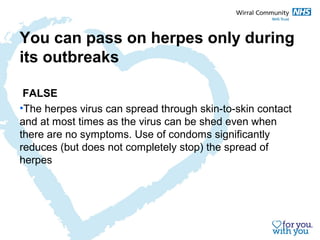
Images from Derma.net
You can pass on herpes only during 
its outbreaks 
FALSE 
•The herpes virus can spread through skin-to-skin contact 
and at most times as the virus can be shed even when 
there are no symptoms. Use of condoms significantly 
reduces (but does not completely stop) the spread of 
herpes
STIs and pregnancy 
• It is important for pregnant women to consider being 
checked for STIs. They can cause women to go into 
labour too early and may complicate delivery. 
• Many STIs can be passed from mother to baby during 
pregnancy, childbirth or after the baby is born. 
• The effect of an STI on a baby can include stillbirth, low 
birth weight, neurological problems, blindness, liver 
disease and serious infection. There are treatments to 
minimise these risks. 
• Treatment during pregnancy can cure some STIs and 
reduce the risk of passing the infection to your baby.
HIV
HIV and AIDs are the same thing 
FALSE 
•If someone is living with HIV it means that they have HIV 
virus in their body. A person is considered to have AIDs if 
their immune system is so weak that it can no longer cope 
with a variety of diseases which it will normally cope with
It takes months before you can have 
a test and get the results to find out 
if you have HIV 
FALSE 
•Testing for HIV has advanced in recent years. It is now 
possible to get an HIV test with an accurate result from 
four weeks after potential infection. Results can be 
returned between 20 minutes and two weeks, depending 
on the type of test taken.
My HIV test results won't be kept 
confidential 
I have to tell my insurance that I have 
had an HIV test
I have had an HIV test because my 
blood was taken and tested in 
hospital/my GP surgery 
FALSE 
•Blood test at a hospital or in a GP surgery will not 
automatically test for HIV. Patients are usually told if 
HIV is one of the conditions they plan to test for when 
they do blood tests. If HIV testing is not mentioned, it 
should not be assumed an HIV test will have been done. 
Without having an HIV test, it possible to have 
undiagnosed HIV.
Only drug users and gay men can 
catch HIV 
FALSE 
•Over the past 10 years, more heterosexual men and 
women have been diagnosed with HIV than gay men 
and drug users put together. It is true that gay men are 
particularly affected by HIV as a group but HIV can still 
affect anyone and there are many heterosexuals living 
with HIV in the UK. 
•The majority of new HIV diagnoses in 2010 were 
acquired through heterosexual sex and approximately a 
third of people with HIV in the UK are women. Anyone 
who has sex without a condom or shares needles when 
injecting drugs may be at risk of HIV, and should 
therefore be tested.
You can get HIV or a STI from 
getting a tattoo or through body 
piercing 
TRUE 
•There can be a risk for HIV or another blood-borne 
infection like hepatitis B or C, if the instruments used for 
piercing or tattooing either are not sterilised or disinfected 
between clients. Any instrument used to pierce or cut the 
skin should be single use only
If both partners have HIV condom use 
is still necessary. 
TRUE 
•Evidence shows that there may be 
different strains of HIV. If both partners are 
diagnosed with HIV it may not be the 
same strain, so condoms are important to 
prevent cross-infection and the passing of 
other sexually transmitted infections.
You cannot have a baby if you or 
your partner is HIV positive 
FALSE 
•If someone living with HIV decides to have a baby there 
are options and steps that can be taken to ensure HIV is 
not passed on to a negative partner or to the baby. In the 
UK there is <1% chance of mother passing on HIV to the 
baby if the right steps are taken
How is HIV passed on? 
Infected body fluids 
•Semen 
•Vaginal secretions 
•Rectal secretions 
•Blood (mother to child in pregnancy) 
•Breast milk 
•Infected needles or syringes 
•Other drug equipment 
•NOT through casual day to day contact like 
kissing, spitting or sharing cups and plates
Protection against HIV infection 
• Using condoms for oral, vaginal, 
anal sex or dental dam 
• Not sharing needles, syringes or 
other injecting equipment
I can not use condoms because I am too big, I am 
allergic, they make me less sensitive, they cut off 
my circulation 
• Not using condoms is only an excuse that may result in catching 
an STI 
• There are different sizes and makes of condoms for any 
preference. Latex-free condoms are also available for those who 
are allergic to latex. 
• It is important to chose the right size. A range of condoms can be 
tried to find out which type fits best. Condoms are more likely to 
split if too tight. 
• The girth (thickness/width) of the penis may be more important 
than penis length. 
• To find what fits best, measure round the erect penis using a strip 
of paper to find the correct diameter of condom.
What is safer sex? 
• Safer sex means having sex with less risk of transmission 
(catching or passing on) a sexually transmitted infection (STI). 
• STIs include HIV, syphilis, chlamydia, gonorrhoea, trichomonas, 
Herpes simplex (Herpes simplex virus/HSV), hepatitis B, and 
warts (human papilloma virus/HPV). 
• The risk of catching each infection is different, and also varies 
according to the type of sex you are having (such as oral, vaginal 
or anal sex). 
For example 
• Herpes is often passed on through oral sex, but HIV is rarely 
passed on this way. 
• Anal sex carries the highest risk of passing on infections such as 
HIV and hepatitis, followed by vaginal and then oral sex. 
• Non-penetrative sex (such as body rubbing and mutual 
masturbation) carries the lowest risk, but some infections (such 
as warts and herpes) can be passed on in this way.
Condom 
Promotion
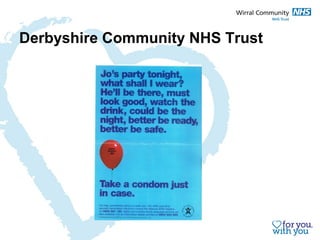
Derbyshire Community NHS Trust
Demystifying sexually transmitted infections

Demystifying sexually transmitted infections

  • 1.
    Demystifying Sexually Transmitted Infections (STIs) Dr Ravi Gokhale Consultant Physician GUM and HIV
  • 2.
    Session will cover • New integrated Sexual Health Service • Myths about STIs • Myths about HIV • STI preventions
  • 3.
    You can't getan STI if your partner is a virgin FALSE •Many STIs spread through any type of sexual activity, including skin to skin contact and oral sex. The partner might not have had vaginal sex, but may have had oral sex with someone (and still consider themselves a virgin), they would have been at risk of an STI •However, this will be true if the partner has not had any type of sex
  • 4.
    If there areno symptoms, there is no STI FALSE •The majority of STIs do not cause symptoms. Sometimes symptoms are so mild to the point whereby more urgent problems that STI could be mistaken for something else. For example chlamydia or gonorrhoea symptoms could be mistaken for urinary tract infection
  • 5.
    My partner hashad a negative test for everything. I don’t need to worry about anything! FALSE •Up to 50% of partners of patients with an STI have a negative STI test. Most STIs do not cause any symptoms. An infection could have been acquired previous partners without knowing. The only way to be reliably sure of a being negative for STIs is to be tested.
  • 6.
    Men who goto GUM clinics have to have an ‘umbrella test’ for STIs FALSE •Men’s urine samples are used to test for chlamydia and gonorrhoea if they have no symptoms. When symptoms are present very small swabs are used which cause very little or no discomfort
  • 7.
    You can getan STI by using sex toys TRUE •You can get an STI by using sex toys or other objects, if previously used by someone with an STI. A new condom should be used on sex toys or other objects for each person that uses them, to prevent catching or passing on STIs.
  • 8.
    I always usea condoms surely I do not need a test? MAY BE TRUE if condoms are used every type of sex •If someone has received or given oral or anal sex without condoms there is an STI risk and they should have a sexual health screen .
  • 9.
    Women who havesex with women can get STIs TRUE •If a woman has an STI and has sex with another woman, the infection can be passed on through vaginal fluid (including fluid on shared sex toys), blood or close body contact.
  • 10.
    You can getan STI from a toilet seat FALSE • STIs are not generally passed through coming in contact with toilet seat as the organisms do not survive for very long outside the body.
  • 11.
    STIs can goundetected for years TRUE •50-70% of people with chlamydia have no symptoms, and it's sometimes called the silent disease. People with HIV can look and feel healthy for years after they are infected. Syphilis can also be present for years as sometimes the symptoms are not noticed
  • 12.
    You cannot getan STI through oral sex FALSE • During oral sex STI can be passed on from one partner to another • Chlamydia, gonorrhoea, herpes and syphilis can each spread through oral sex. Presence of blood raises the risk of HIV, hepatitis B and hepatitis C
  • 13.
    How do Imake oral sex safer? • Reducing the number of partners with whom you have oral sex. • Avoiding oral sex with ejaculation reduces the risk of HIV (and possibly other infections) • Insertive fellatio (being sucked) is lower risk than receptive fellatio (sucking a penis). • Avoid brushing teeth or flossing before having oral sex. • Avoid oral sex if you have oral cuts or sores, or a sore throat. • Use condoms for fellatio.
  • 15.
  • 16.
    You can passon herpes only during its outbreaks FALSE •The herpes virus can spread through skin-to-skin contact and at most times as the virus can be shed even when there are no symptoms. Use of condoms significantly reduces (but does not completely stop) the spread of herpes
  • 17.
    STIs and pregnancy • It is important for pregnant women to consider being checked for STIs. They can cause women to go into labour too early and may complicate delivery. • Many STIs can be passed from mother to baby during pregnancy, childbirth or after the baby is born. • The effect of an STI on a baby can include stillbirth, low birth weight, neurological problems, blindness, liver disease and serious infection. There are treatments to minimise these risks. • Treatment during pregnancy can cure some STIs and reduce the risk of passing the infection to your baby.
  • 18.
  • 19.
    HIV and AIDsare the same thing FALSE •If someone is living with HIV it means that they have HIV virus in their body. A person is considered to have AIDs if their immune system is so weak that it can no longer cope with a variety of diseases which it will normally cope with
  • 20.
    It takes monthsbefore you can have a test and get the results to find out if you have HIV FALSE •Testing for HIV has advanced in recent years. It is now possible to get an HIV test with an accurate result from four weeks after potential infection. Results can be returned between 20 minutes and two weeks, depending on the type of test taken.
  • 21.
    My HIV testresults won't be kept confidential I have to tell my insurance that I have had an HIV test
  • 22.
    I have hadan HIV test because my blood was taken and tested in hospital/my GP surgery FALSE •Blood test at a hospital or in a GP surgery will not automatically test for HIV. Patients are usually told if HIV is one of the conditions they plan to test for when they do blood tests. If HIV testing is not mentioned, it should not be assumed an HIV test will have been done. Without having an HIV test, it possible to have undiagnosed HIV.
  • 23.
    Only drug usersand gay men can catch HIV FALSE •Over the past 10 years, more heterosexual men and women have been diagnosed with HIV than gay men and drug users put together. It is true that gay men are particularly affected by HIV as a group but HIV can still affect anyone and there are many heterosexuals living with HIV in the UK. •The majority of new HIV diagnoses in 2010 were acquired through heterosexual sex and approximately a third of people with HIV in the UK are women. Anyone who has sex without a condom or shares needles when injecting drugs may be at risk of HIV, and should therefore be tested.
  • 24.
    You can getHIV or a STI from getting a tattoo or through body piercing TRUE •There can be a risk for HIV or another blood-borne infection like hepatitis B or C, if the instruments used for piercing or tattooing either are not sterilised or disinfected between clients. Any instrument used to pierce or cut the skin should be single use only
  • 25.
    If both partnershave HIV condom use is still necessary. TRUE •Evidence shows that there may be different strains of HIV. If both partners are diagnosed with HIV it may not be the same strain, so condoms are important to prevent cross-infection and the passing of other sexually transmitted infections.
  • 26.
    You cannot havea baby if you or your partner is HIV positive FALSE •If someone living with HIV decides to have a baby there are options and steps that can be taken to ensure HIV is not passed on to a negative partner or to the baby. In the UK there is <1% chance of mother passing on HIV to the baby if the right steps are taken
  • 27.
    How is HIVpassed on? Infected body fluids •Semen •Vaginal secretions •Rectal secretions •Blood (mother to child in pregnancy) •Breast milk •Infected needles or syringes •Other drug equipment •NOT through casual day to day contact like kissing, spitting or sharing cups and plates
  • 28.
    Protection against HIVinfection • Using condoms for oral, vaginal, anal sex or dental dam • Not sharing needles, syringes or other injecting equipment
  • 29.
    I can notuse condoms because I am too big, I am allergic, they make me less sensitive, they cut off my circulation • Not using condoms is only an excuse that may result in catching an STI • There are different sizes and makes of condoms for any preference. Latex-free condoms are also available for those who are allergic to latex. • It is important to chose the right size. A range of condoms can be tried to find out which type fits best. Condoms are more likely to split if too tight. • The girth (thickness/width) of the penis may be more important than penis length. • To find what fits best, measure round the erect penis using a strip of paper to find the correct diameter of condom.
  • 31.
    What is safersex? • Safer sex means having sex with less risk of transmission (catching or passing on) a sexually transmitted infection (STI). • STIs include HIV, syphilis, chlamydia, gonorrhoea, trichomonas, Herpes simplex (Herpes simplex virus/HSV), hepatitis B, and warts (human papilloma virus/HPV). • The risk of catching each infection is different, and also varies according to the type of sex you are having (such as oral, vaginal or anal sex). For example • Herpes is often passed on through oral sex, but HIV is rarely passed on this way. • Anal sex carries the highest risk of passing on infections such as HIV and hepatitis, followed by vaginal and then oral sex. • Non-penetrative sex (such as body rubbing and mutual masturbation) carries the lowest risk, but some infections (such as warts and herpes) can be passed on in this way.
  • 32.
  • 33.

Editor's Notes

  • #15 What has he brought back?