











































































NEGOTIATE
#LIKEABOSS
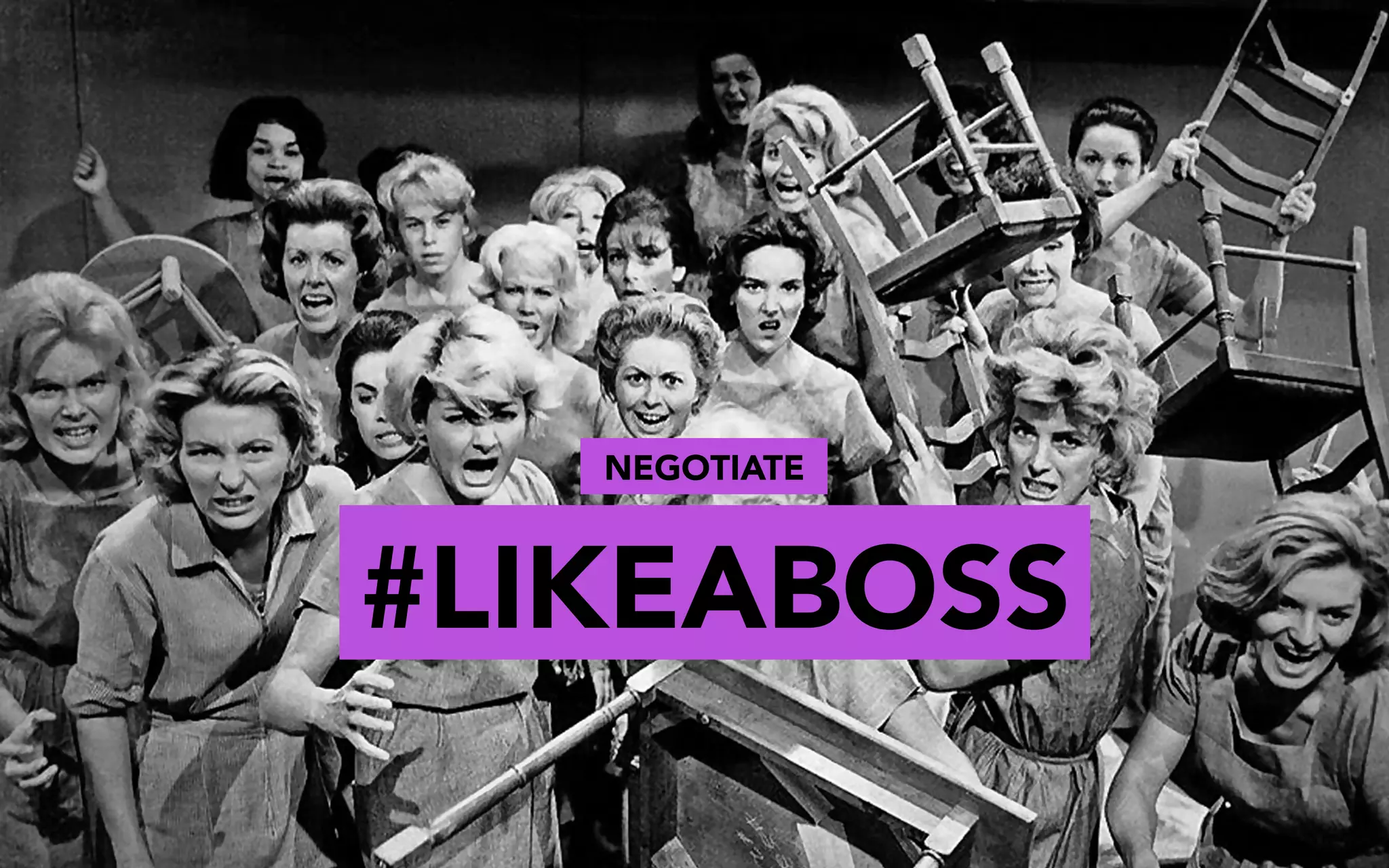
This is society’s idea of negotiating.
If you don’t look or feel like that, it’s no wonder
negotiating might make you nervous!
But, it doesn’t matter what side of the table
you’re on… it will come up eventually.
And you will need to BRING IT!
That’s why we’re here today.
(Or, how to channel your inner Alicia Florrick.)
Let’s talk about negotiation.
WHO ARE WE?
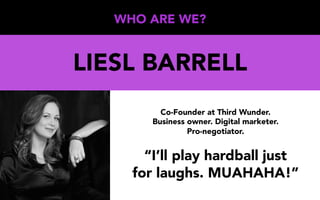
LIESL BARRELL
Co-Founder at Third Wunder.
Business owner. Digital marketer.
Pro-negotiator.
ā€œI’ll play hardball just
for laughs. MUAHAHA!ā€
WHO ARE WE?
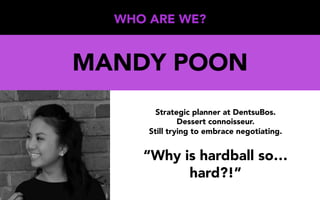
MANDY POON
Strategic planner at DentsuBos.
Dessert connoisseur.
Still trying to embrace negotiating.
ā€œWhy is hardball so…
hard?!ā€
Before we start…
Let’s get a few things out of the way.
ā€œNegotiation starts
with the offer.ā€
COMMON
MISCONCEPTION
ACTUALLY…
Negotiation starts from the earliest point of
contact in your relationship with the
person on the other side.
ā€œI’m happy with what I
have, why should I listen
to your offer?ā€
COMMON
MISCONCEPTION
ACTUALLY…
Hearing current market information is always
good preparation for when you’re ready to
negotiate… and you can always refer the
opportunity to someone else. Win win!
ā€œIt’s just a few
thousand dollarsā€¦ā€
COMMON
MISCONCEPTION
ACTUALLY…
Let’s use a hypothetical.
Mandy and Liesl, both 30 years old, receive
identical $100,000 salary offers from the same
company. Mandy manages to negotiate a 7.4%
salary increase (to $107,400). Liesl accepts the
initial offer of $100,000.
Getting More of What You Want by Margaret A. Neale and Thomas Z. Lys
ACTUALLY…
If Mandy and Liesl both stay at the company for
35 years, and both receive identical 5% raises
each year…
Mandy could retire at 65, while Liesl would
have to retire at 73 to be as wealthy as Mandy
at retirement.
Getting More of What You Want by Margaret A. Neale and Thomas Z. Lys
COMMON
MISCONCEPTION
ā€œIf I negotiate,
they’ll move on.ā€
ACTUALLY…
Negotiations are usually expected.
Negotiating parties generally have
contingency ā€œwiggle roomā€ā€“
you just need to find out what that is.
ā€œIf I negotiate,
it’ll hurt me later.ā€
COMMON
MISCONCEPTION
ACTUALLY…
If you negotiate well – in good faith,
with good humour – it can often bring
you more respect for laying it on the line.
ā€œI got what I asked for,
why negotiate?ā€
COMMON
MISCONCEPTION
ACTUALLY…
Because there’s always something
more that you can negotiate for.
Negotiation is about creating
win-win scenarios for all parties involved,
while getting more of what you want.
#WWAD?
FIGURE OUT
WHAT MATTERS
1
Negotiation is a journey.
With partners, future employers, realtors…
But especially with yourself.
It can get a
little deep.
But it’s important
to figure out what
you’d be fighting
for, and why.
What do I want?
Why do I want it?
Who do I
want to
become?
ā€œWhen alternatives are on a
par, it may matter very much
which you choose, but one
alternative isn't better than
the other…
That's why the choice is hard.
When we choose between
options that are on a par…
We can put our very selves
behind an option.
Here's where I stand.
Here's who I am.ā€
ā€œWhen we create reasons
for ourselves to become
this kind of person rather
than that, we
wholeheartedly become
the people that we are.ā€
Ruth Chang
ā€œHow to make hard choicesā€ (TED Talk)
After the
soul-searching,
it’s time to define
your objectives.
You have to be able to
communicate what you
want in terms of
tangibles.
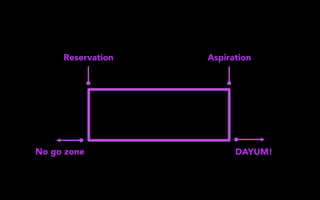
Your sandbox
•  Must-haves
•  Values that must
be respected
•  Aspiration &
reservation
Reservation Aspiration
No go zone DAYUM!
Up next,
research.
You have to validate the
things that you want,
find out where you can
play, and come up with
alternatives for
anticipated objections.
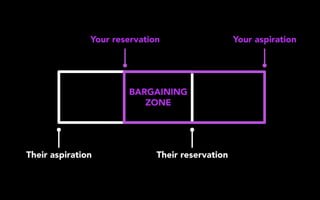
Their sandbox
•  Expectations
•  Conventions
•  Guidelines
•  Environment
•  Aspiration &
reservation
Your reservation Your aspiration
Their aspiration Their reservation
BARGAINING
ZONE
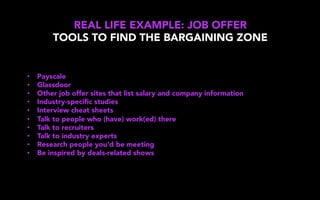
REAL LIFE EXAMPLE: JOB OFFER
TOOLS TO FIND THE BARGAINING ZONE
•  Payscale
•  Glassdoor
•  Other job offer sites that list salary and company information
•  Industry-specific studies
•  Interview cheat sheets
•  Talk to people who (have) work(ed) there
•  Talk to recruiters
•  Talk to industry experts
•  Research people you’d be meeting
•  Be inspired by deals-related shows
FIGURE OUT
WHAT MATTERS
Soul-search: who you are & who you want to become
Define your objectives with tangibles
Research to determine the bargaining zone
#WWAD
DON’T WANT IT
SO BAD
2
When you think like you have alternatives
you’re in the best negotiating position.
(even when you don’t),
But you actually do
have alternatives!
You have the option of the
life you have now. And the
opportunities that you will
find elsewhere, at another
time.
Your willingness to
walk away is the
greatest leverage that
you can have.
DON’T WANT IT
SO BAD
You negotiate best when
you’re willing to walk away
#WWAD
PRACTICE
FEARLESSNESS
3
If you have a real-world chance to
take and embrace the opportunity to practice.
negotiate with real stakes at hand,
(It’s rarer than you think.)
Chats with your cell
phone provider, visits to a
market while on vacation
in Thailand, or even
telemarketing calls can
become opportunities to
increase your confidence
with negotiating.
They’re also helpful
to find the
negotiation voice
and tactics that are
most genuine and
natural for you.
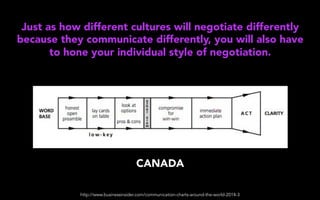
Just as how different cultures will negotiate differently
because they communicate differently, you will also have
to hone your individual style of negotiation.
CANADA
http://www.businessinsider.com/communication-charts-around-the-world-2014-3
Just as how different cultures will negotiate differently
because they communicate differently, you will also have
to hone your individual style of negotiation.
CHINA
http://www.businessinsider.com/communication-charts-around-the-world-2014-3
Just as how different cultures will negotiate differently
because they communicate differently, you will also have
to hone your individual style of negotiation.
ITALY
http://www.businessinsider.com/communication-charts-around-the-world-2014-3
To find your voice and style, it might help
to channel an alter-ego.
DEMANDY
LETHAL
It’s not just the language
and your negotiating
voice that you have to be
confident with.
There is also another
negotiation side effect:
parallel universes.
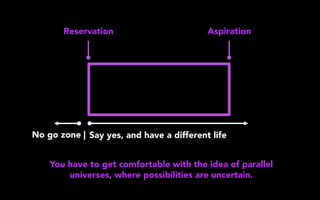
Reservation Aspiration
No go zone | Say yes, and have a different life
You have to get comfortable with the idea of parallel
universes, where possibilities are uncertain.
PRACTICE
FEARLESSNESS
Take all opportunities – big or small – to up your confidence
Find your true voice and the tactics that work for you
Get comfortable with straddling parallel universes
#WWAD
GET READY
4
If you plan to walk into something where you
anticipate negotiation, always arrive prepared.
One of the
best tools for
preparing is
role play.
Always role play with a peer or mentor:
someone who has expertise in or
understanding of what you’re going
through, and who would be able to
provide constructive feedback.
HOW ROLE PLAY HELPS
•  Takes the edge off
•  Brings the things that matter
to you to the surface
•  Starting point to structuring
your arguments
•  Helps you realize your
discomforts or problem areas
•  Helps you practice timing
•  With the right person, you’ll
get helpful feedback
Don’t forget to bring these guys
to the role play party.
DEMANDY
LETHAL
Then, write down
your research-based
plan of attack.
Even if you won’t use a
script, writing will help
structure your thoughts
and package the points
you want to make.
GET READY
Never walk into any negotiation unprepared
Role play with a mentor
Pull data that will support your points
Plan and structure what you will say
#WWAD
5
WIN AT
GAME TIME
Before you go into it…
Think of it as a dance, not a battle.
Build a narrative.
Start with the positives:
how perfectly you
connected with the
opportunity, how this
would be a win-win
scenario for everyone.
Hook the other side in,
and get them rooting
for you!
Then, logically go
through your points of
negotiation. Clarify that
getting some wiggle
room would make it an
easy yes.
Play to the
medium.
Negotiating in person,
over the phone, or even
via email are all very
different scenarios. Be
sure to proceed
accordingly.
Just because something
is serious, doesn’t mean
you can’t inject a little
humour. Humour will
help bridge the gap, and
cut through
awkwardness & tension.
Remember:
humour is ok!
Be comfortable
with silence.
Allow the other side
time to react. Listen
carefully. Don’t be
afraid of pauses.
People have a tendency
of trying to fill silences
– and sometimes, that
leads to information
that can be leveraged.
Don’t let that be you!
Sometimes, it’s better
not being the first to
speak.
Know where you
stand.
Are you their first choice?
Do they have other options?
Do YOU have other options?
Gauge. This makes a huge
difference in terms of how
firm you are, and what you
negotiate for.
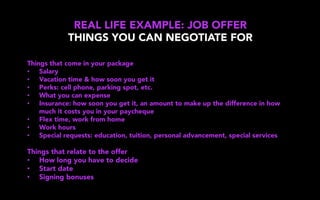
REAL LIFE EXAMPLE: JOB OFFER
THINGS YOU CAN NEGOTIATE FOR
Things that come in your package
•  Salary
•  Vacation time & how soon you get it
•  Perks: cell phone, parking spot, etc.
•  What you can expense
•  Insurance: how soon you get it, an amount to make up the difference in how
much it costs you in your paycheque
•  Flex time, work from home
•  Work hours
•  Special requests: education, tuition, personal advancement, special services
Things that relate to the offer
•  How long you have to decide
•  Start date
•  Signing bonuses
If you are given an offer that requires relocation, please make sure you do your
research thoroughly! This means looking into things like cost of living
differences, working visas, taxes, moving expenses, costs of flights home.
There will also be more up for negotiation (not always offered upfront), but be
sure to ask:
•  Visa sponsorship
•  Relocation allowance (moving expenses, lump sum for new home)
•  Temporary housing
•  Permanent housing
•  Plane/train tickets to your new home, for you and your SO
•  Home visit allowances
•  Assistance from accountants, tax lawyers, real estate agents
REAL LIFE EXAMPLE: JOB OFFER
THINGS YOU CAN NEGOTIATE FOR
Know when
to stop.
While you should walk
away happy, a negotiation
cannot drag on forever.
Keep your word if you use
language like ā€œI’ll accept,
ifā€¦ā€, and your needs are
met.
It’s like an audition
for your future
relationship.
Not only are you auditioning –
so is the other party. You will
learn a lot about each other in
this highly charged moment.
Be cognizant of the messages
you send, and receive.
WIN AT
GAME TIME
Build your terms into a narrative.
Listen, and don’t talk too much.
Gauge where you stand, and know when to stop.
#WWAD
Some other things you should know…
Push your luck.
In a negotiation, there’s always a certain amount
of bluffing. Just remember, there are things you
should never fudge. #integrity!
Follow your gut.
If you see any red flags, something makes you
uncomfortable, or it seems just to good to be
true, remember: you are not obligated to say
yes, just because you negotiated.
You’ve done the homework and know what you
want, but don’t position them as your needs.
Position them as elements that will make both
parties win. Always circle back to the benefit.
Spin things to value.
Determine how high-stakes this is for you.
Understand the person you’re negotiating with,
and the resources they might have available.
Also, if you need to be a good negotiator for
your role, you can likely go harder.
Know how hard
you can go.
Buy as much time
as you need.
There may be major life decisions at stake!
ā€œSleep on itā€ is an expression for a reason.
And know this: if you’re getting pressured,
there’s probably a reason.
Whether it’s tears, anger, yelling, laughter – it’s
ok to be emotionally invested in something.
Don’t apologize for your emotion. Instead, relay
how passionate you are and how much you care.
Negotiation can bring out
the best or worst in us.
The last thing we’ll leave you with…
Some phrases to keep in your back pocket.
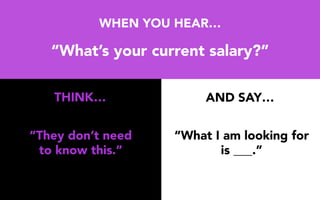
WHEN YOU HEAR…
ā€œWhat’s your current salary?ā€
ā€œThey don’t need
to know this.ā€
ā€œWhat I am looking for
is ___.ā€
THINK… AND SAY…
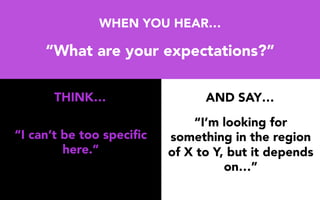
WHEN YOU HEAR…
ā€œWhat are your expectations?ā€
ā€œI can’t be too specific
here.ā€
ā€œI’m looking for
something in the region
of X to Y, but it depends
onā€¦ā€
THINK… AND SAY…
WHEN YOU HEAR…
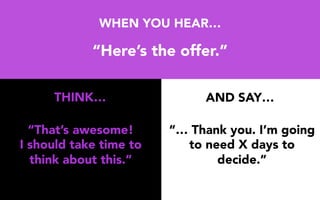
ā€œHere’s the offer.ā€
ā€œThat’s awesome!
I should take time to
think about this.ā€
ā€œā€¦ Thank you. I’m going
to need X days to
decide.ā€
THINK… AND SAY…
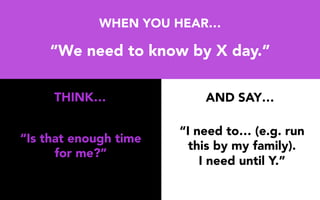
WHEN YOU HEAR…
ā€œWe need to know by X day.ā€
ā€œIs that enough time
for me?ā€
ā€œI need to… (e.g. run
this by my family).
I need until Y.ā€
THINK… AND SAY…
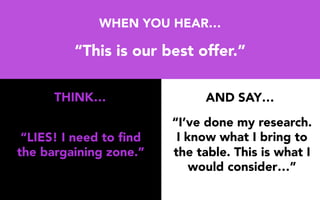
WHEN YOU HEAR…
ā€œThis is our best offer.ā€
ā€œLIES! I need to find
the bargaining zone.ā€
ā€œI’ve done my research.
I know what I bring to
the table. This is what I
would considerā€¦ā€
THINK… AND SAY…
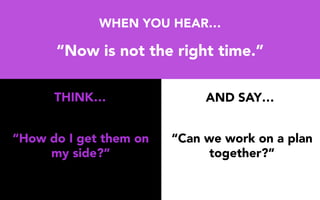
WHEN YOU HEAR…
ā€œNow is not the right time.ā€
ā€œHow do I get them on
my side?ā€
ā€œCan we work on a plan
together?ā€
THINK… AND SAY…
Negotiations don’t have to be scary.
Rejection isn’t always bad.
If you don’t ask, you’ll never know.
THANK YOU
BONUS!
THE BOSS ROUND
You’re the
boss.
What are the specific
things you should
consider when you
negotiate in this
position?
Whom you
Negotiating on behalf of others
can be one of the most powerful
things you can do. (You may find
it even easier to rave about
someone other than yourself!)
It is also a great way to hone
your negotiating skills, while
testing your relationship with
your superiors.
negotiate for
has changed.
Come with a
Take the time to brainstorm,
because you’ll always have to be
ready for alternatives.
As the boss, people come to you
for solutions. You can’t give
everyone what they want, but at
least you’ll have a plan to make
sure they’re satisfied.
backup plan.
Find and know
Sometimes, asking for certain
things can very political.
Reinforcement from other
trusted sources can help you
build your case, and strengthen
your negotiation.
your allies.
Timing is
You know the situation at your
company: financials, wins,
losses, concerns, when key
decisions are normally made.
To increase the chance of things
going your way, make sure you
pick the right time.
everything.
Be fair.
The way you negotiate (or don’t)
may deeply impact others. Be fair
in what you offer, how you react to
negotiations, and when you choose
to negotiate on others’ behalves.
Getting someone down to a
below-standard salary is not
necessarily a win. Neither is
waiting for a star employee to
come with his/her hand out.
While your bottom line matters,
the individuals for whom you are
responsible are even more
important.

Negotiate #LIKEABOSS

  • 1.
  • 2.
    This is society’sidea of negotiating.
  • 6.
    If you don’tlook or feel like that, it’s no wonder negotiating might make you nervous!
  • 7.
    But, it doesn’tmatter what side of the table you’re on… it will come up eventually. And you will need to BRING IT! That’s why we’re here today.
  • 8.
    (Or, how tochannel your inner Alicia Florrick.) Let’s talk about negotiation.
  • 9.
    WHO ARE WE? LIESLBARRELL Co-Founder at Third Wunder. Business owner. Digital marketer. Pro-negotiator. ā€œI’ll play hardball just for laughs. MUAHAHA!ā€
  • 10.
    WHO ARE WE? MANDYPOON Strategic planner at DentsuBos. Dessert connoisseur. Still trying to embrace negotiating. ā€œWhy is hardball so… hard?!ā€
  • 11.
    Before we start… Let’sget a few things out of the way.
  • 12.
    ā€œNegotiation starts with theoffer.ā€ COMMON MISCONCEPTION
  • 13.
    ACTUALLY… Negotiation starts fromthe earliest point of contact in your relationship with the person on the other side.
  • 14.
    ā€œI’m happy withwhat I have, why should I listen to your offer?ā€ COMMON MISCONCEPTION
  • 15.
    ACTUALLY… Hearing current marketinformation is always good preparation for when you’re ready to negotiate… and you can always refer the opportunity to someone else. Win win!
  • 16.
    ā€œIt’s just afew thousand dollarsā€¦ā€ COMMON MISCONCEPTION
  • 17.
    ACTUALLY… Let’s use ahypothetical. Mandy and Liesl, both 30 years old, receive identical $100,000 salary offers from the same company. Mandy manages to negotiate a 7.4% salary increase (to $107,400). Liesl accepts the initial offer of $100,000. Getting More of What You Want by Margaret A. Neale and Thomas Z. Lys
  • 18.
    ACTUALLY… If Mandy andLiesl both stay at the company for 35 years, and both receive identical 5% raises each year… Mandy could retire at 65, while Liesl would have to retire at 73 to be as wealthy as Mandy at retirement. Getting More of What You Want by Margaret A. Neale and Thomas Z. Lys
  • 19.
  • 20.
    ACTUALLY… Negotiations are usuallyexpected. Negotiating parties generally have contingency ā€œwiggle roomā€ā€“ you just need to find out what that is.
  • 21.
    ā€œIf I negotiate, it’llhurt me later.ā€ COMMON MISCONCEPTION
  • 22.
    ACTUALLY… If you negotiatewell – in good faith, with good humour – it can often bring you more respect for laying it on the line.
  • 23.
    ā€œI got whatI asked for, why negotiate?ā€ COMMON MISCONCEPTION
  • 24.
    ACTUALLY… Because there’s alwayssomething more that you can negotiate for.
  • 25.
    Negotiation is aboutcreating win-win scenarios for all parties involved, while getting more of what you want.
  • 26.
  • 27.
  • 28.
    Negotiation is ajourney. With partners, future employers, realtors… But especially with yourself.
  • 29.
    It can geta little deep. But it’s important to figure out what you’d be fighting for, and why.
  • 30.
    What do Iwant? Why do I want it? Who do I want to become?
  • 31.
    ā€œWhen alternatives areon a par, it may matter very much which you choose, but one alternative isn't better than the other… That's why the choice is hard. When we choose between options that are on a par… We can put our very selves behind an option. Here's where I stand. Here's who I am.ā€
  • 32.
    ā€œWhen we createreasons for ourselves to become this kind of person rather than that, we wholeheartedly become the people that we are.ā€ Ruth Chang ā€œHow to make hard choicesā€ (TED Talk)
  • 33.
    After the soul-searching, it’s timeto define your objectives. You have to be able to communicate what you want in terms of tangibles.
  • 34.
    Your sandbox •  Must-haves • Values that must be respected •  Aspiration & reservation
  • 35.
  • 36.
    Up next, research. You haveto validate the things that you want, find out where you can play, and come up with alternatives for anticipated objections.
  • 37.
    Their sandbox •  Expectations • Conventions •  Guidelines •  Environment •  Aspiration & reservation
  • 38.
    Your reservation Youraspiration Their aspiration Their reservation BARGAINING ZONE
  • 39.
    REAL LIFE EXAMPLE:JOB OFFER TOOLS TO FIND THE BARGAINING ZONE •  Payscale •  Glassdoor •  Other job offer sites that list salary and company information •  Industry-specific studies •  Interview cheat sheets •  Talk to people who (have) work(ed) there •  Talk to recruiters •  Talk to industry experts •  Research people you’d be meeting •  Be inspired by deals-related shows
  • 40.
    FIGURE OUT WHAT MATTERS Soul-search:who you are & who you want to become Define your objectives with tangibles Research to determine the bargaining zone #WWAD
  • 41.
  • 42.
    When you thinklike you have alternatives you’re in the best negotiating position. (even when you don’t),
  • 43.
    But you actuallydo have alternatives! You have the option of the life you have now. And the opportunities that you will find elsewhere, at another time.
  • 44.
    Your willingness to walkaway is the greatest leverage that you can have.
  • 45.
    DON’T WANT IT SOBAD You negotiate best when you’re willing to walk away #WWAD
  • 46.
  • 47.
    If you havea real-world chance to take and embrace the opportunity to practice. negotiate with real stakes at hand, (It’s rarer than you think.)
  • 48.
    Chats with yourcell phone provider, visits to a market while on vacation in Thailand, or even telemarketing calls can become opportunities to increase your confidence with negotiating.
  • 49.
    They’re also helpful tofind the negotiation voice and tactics that are most genuine and natural for you.
  • 50.
    Just as howdifferent cultures will negotiate differently because they communicate differently, you will also have to hone your individual style of negotiation. CANADA http://www.businessinsider.com/communication-charts-around-the-world-2014-3
  • 51.
    Just as howdifferent cultures will negotiate differently because they communicate differently, you will also have to hone your individual style of negotiation. CHINA http://www.businessinsider.com/communication-charts-around-the-world-2014-3
  • 52.
    Just as howdifferent cultures will negotiate differently because they communicate differently, you will also have to hone your individual style of negotiation. ITALY http://www.businessinsider.com/communication-charts-around-the-world-2014-3
  • 53.
    To find yourvoice and style, it might help to channel an alter-ego. DEMANDY LETHAL
  • 54.
    It’s not justthe language and your negotiating voice that you have to be confident with. There is also another negotiation side effect: parallel universes.
  • 55.
    Reservation Aspiration No gozone | Say yes, and have a different life You have to get comfortable with the idea of parallel universes, where possibilities are uncertain.
  • 56.
    PRACTICE FEARLESSNESS Take all opportunities– big or small – to up your confidence Find your true voice and the tactics that work for you Get comfortable with straddling parallel universes #WWAD
  • 57.
  • 58.
    If you planto walk into something where you anticipate negotiation, always arrive prepared.
  • 59.
    One of the besttools for preparing is role play.
  • 60.
    Always role playwith a peer or mentor: someone who has expertise in or understanding of what you’re going through, and who would be able to provide constructive feedback.
  • 61.
    HOW ROLE PLAYHELPS •  Takes the edge off •  Brings the things that matter to you to the surface •  Starting point to structuring your arguments •  Helps you realize your discomforts or problem areas •  Helps you practice timing •  With the right person, you’ll get helpful feedback
  • 62.
    Don’t forget tobring these guys to the role play party. DEMANDY LETHAL
  • 63.
    Then, write down yourresearch-based plan of attack. Even if you won’t use a script, writing will help structure your thoughts and package the points you want to make.
  • 64.
    GET READY Never walkinto any negotiation unprepared Role play with a mentor Pull data that will support your points Plan and structure what you will say #WWAD
  • 65.
  • 66.
    Before you gointo it… Think of it as a dance, not a battle.
  • 67.
    Build a narrative. Startwith the positives: how perfectly you connected with the opportunity, how this would be a win-win scenario for everyone.
  • 68.
    Hook the otherside in, and get them rooting for you! Then, logically go through your points of negotiation. Clarify that getting some wiggle room would make it an easy yes.
  • 69.
    Play to the medium. Negotiatingin person, over the phone, or even via email are all very different scenarios. Be sure to proceed accordingly.
  • 70.
    Just because something isserious, doesn’t mean you can’t inject a little humour. Humour will help bridge the gap, and cut through awkwardness & tension. Remember: humour is ok!
  • 71.
    Be comfortable with silence. Allowthe other side time to react. Listen carefully. Don’t be afraid of pauses.
  • 72.
    People have atendency of trying to fill silences – and sometimes, that leads to information that can be leveraged. Don’t let that be you! Sometimes, it’s better not being the first to speak.
  • 73.
    Know where you stand. Areyou their first choice? Do they have other options? Do YOU have other options? Gauge. This makes a huge difference in terms of how firm you are, and what you negotiate for.
  • 74.
    REAL LIFE EXAMPLE:JOB OFFER THINGS YOU CAN NEGOTIATE FOR Things that come in your package •  Salary •  Vacation time & how soon you get it •  Perks: cell phone, parking spot, etc. •  What you can expense •  Insurance: how soon you get it, an amount to make up the difference in how much it costs you in your paycheque •  Flex time, work from home •  Work hours •  Special requests: education, tuition, personal advancement, special services Things that relate to the offer •  How long you have to decide •  Start date •  Signing bonuses
  • 75.
    If you aregiven an offer that requires relocation, please make sure you do your research thoroughly! This means looking into things like cost of living differences, working visas, taxes, moving expenses, costs of flights home. There will also be more up for negotiation (not always offered upfront), but be sure to ask: •  Visa sponsorship •  Relocation allowance (moving expenses, lump sum for new home) •  Temporary housing •  Permanent housing •  Plane/train tickets to your new home, for you and your SO •  Home visit allowances •  Assistance from accountants, tax lawyers, real estate agents REAL LIFE EXAMPLE: JOB OFFER THINGS YOU CAN NEGOTIATE FOR
  • 76.
    Know when to stop. Whileyou should walk away happy, a negotiation cannot drag on forever. Keep your word if you use language like ā€œI’ll accept, ifā€¦ā€, and your needs are met.
  • 77.
    It’s like anaudition for your future relationship. Not only are you auditioning – so is the other party. You will learn a lot about each other in this highly charged moment. Be cognizant of the messages you send, and receive.
  • 78.
    WIN AT GAME TIME Buildyour terms into a narrative. Listen, and don’t talk too much. Gauge where you stand, and know when to stop. #WWAD
  • 79.
    Some other thingsyou should know…
  • 80.
    Push your luck. Ina negotiation, there’s always a certain amount of bluffing. Just remember, there are things you should never fudge. #integrity!
  • 81.
    Follow your gut. Ifyou see any red flags, something makes you uncomfortable, or it seems just to good to be true, remember: you are not obligated to say yes, just because you negotiated.
  • 82.
    You’ve done thehomework and know what you want, but don’t position them as your needs. Position them as elements that will make both parties win. Always circle back to the benefit. Spin things to value.
  • 83.
    Determine how high-stakesthis is for you. Understand the person you’re negotiating with, and the resources they might have available. Also, if you need to be a good negotiator for your role, you can likely go harder. Know how hard you can go.
  • 84.
    Buy as muchtime as you need. There may be major life decisions at stake! ā€œSleep on itā€ is an expression for a reason. And know this: if you’re getting pressured, there’s probably a reason.
  • 85.
    Whether it’s tears,anger, yelling, laughter – it’s ok to be emotionally invested in something. Don’t apologize for your emotion. Instead, relay how passionate you are and how much you care. Negotiation can bring out the best or worst in us.
  • 86.
    The last thingwe’ll leave you with… Some phrases to keep in your back pocket.
  • 87.
    WHEN YOU HEAR… ā€œWhat’syour current salary?ā€ ā€œThey don’t need to know this.ā€ ā€œWhat I am looking for is ___.ā€ THINK… AND SAY…
  • 88.
    WHEN YOU HEAR… ā€œWhatare your expectations?ā€ ā€œI can’t be too specific here.ā€ ā€œI’m looking for something in the region of X to Y, but it depends onā€¦ā€ THINK… AND SAY…
  • 89.
    WHEN YOU HEAR… ā€œHere’sthe offer.ā€ ā€œThat’s awesome! I should take time to think about this.ā€ ā€œā€¦ Thank you. I’m going to need X days to decide.ā€ THINK… AND SAY…
  • 90.
    WHEN YOU HEAR… ā€œWeneed to know by X day.ā€ ā€œIs that enough time for me?ā€ ā€œI need to… (e.g. run this by my family). I need until Y.ā€ THINK… AND SAY…
  • 91.
    WHEN YOU HEAR… ā€œThisis our best offer.ā€ ā€œLIES! I need to find the bargaining zone.ā€ ā€œI’ve done my research. I know what I bring to the table. This is what I would considerā€¦ā€ THINK… AND SAY…
  • 92.
    WHEN YOU HEAR… ā€œNowis not the right time.ā€ ā€œHow do I get them on my side?ā€ ā€œCan we work on a plan together?ā€ THINK… AND SAY…
  • 93.
    Negotiations don’t haveto be scary. Rejection isn’t always bad. If you don’t ask, you’ll never know.
  • 94.
  • 95.
  • 96.
    You’re the boss. What arethe specific things you should consider when you negotiate in this position?
  • 97.
    Whom you Negotiating onbehalf of others can be one of the most powerful things you can do. (You may find it even easier to rave about someone other than yourself!) It is also a great way to hone your negotiating skills, while testing your relationship with your superiors. negotiate for has changed.
  • 98.
    Come with a Takethe time to brainstorm, because you’ll always have to be ready for alternatives. As the boss, people come to you for solutions. You can’t give everyone what they want, but at least you’ll have a plan to make sure they’re satisfied. backup plan.
  • 99.
    Find and know Sometimes,asking for certain things can very political. Reinforcement from other trusted sources can help you build your case, and strengthen your negotiation. your allies.
  • 100.
    Timing is You knowthe situation at your company: financials, wins, losses, concerns, when key decisions are normally made. To increase the chance of things going your way, make sure you pick the right time. everything.
  • 101.
    Be fair. The wayyou negotiate (or don’t) may deeply impact others. Be fair in what you offer, how you react to negotiations, and when you choose to negotiate on others’ behalves. Getting someone down to a below-standard salary is not necessarily a win. Neither is waiting for a star employee to come with his/her hand out. While your bottom line matters, the individuals for whom you are responsible are even more important.