1
The AI Workshop – By iTronics
Demo1: Use Numpy.
2
The AI Workshop – By iTronics
Be able to use numpy functions and numpy matrix/vector operations
Understand the concept of "broadcasting"
Be able to vectorize code
Demo 1: Use Numpy
Objecifs???
3
The AI Workshop – By iTronics
Numpy is the main package for scientific computing in Python.
Demo 1: Use Numpy
What is numpy???
4
The AI Workshop – By iTronics
It is maintained by a large community (www.numpy.org).
Demo 1: Use Numpy
Value of numpy???
5
The AI Workshop – By iTronics
They are several key numpy functions such as:
np.exp, np.log, and np.reshape.
Demo 1: Use Numpy
How to use numpy???
6
The AI Workshop – By iTronics
Demo 1: Use Numpy
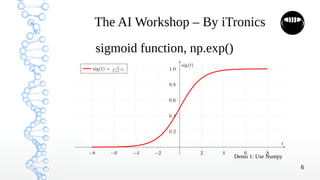
sigmoid function, np.exp()
7
The AI Workshop – By iTronics
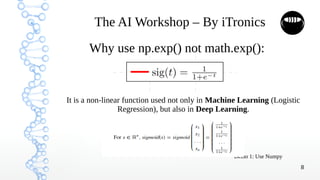
It is a non-linear function used not only in Machine Learning (Logistic
Regression), but also in Deep Learning.
Demo 1: Use Numpy
We do use sigmoid in:
8
The AI Workshop – By iTronics
It is a non-linear function used not only in Machine Learning (Logistic
Regression), but also in Deep Learning.
Demo 1: Use Numpy
Why use np.exp() not math.exp():
9
The AI Workshop – By iTronics
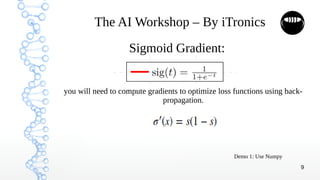
you will need to compute gradients to optimize loss functions using back-
propagation.
Demo 1: Use Numpy
Sigmoid Gradient:
10
The AI Workshop – By iTronics
Two common numpy functions used in deep learning are np.shape and
np.reshape().
X.shape is used to get the shape (dimension) of a matrix/vector X.
X.reshape(...) is used to reshape X into some other dimension.
Demo 1: Use Numpy
Reshaping Array:
11
The AI Workshop – By iTronics
Demo 1: Use Numpy
Reshape an image:
12
The AI Workshop – By iTronics
Demo 1: Use Numpy
Broadcasting and the softmax function:
13
The AI Workshop – By iTronics
Demo 1: Use Numpy
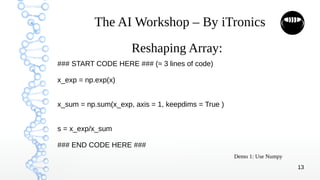
Reshaping Array:
### START CODE HERE ### (≈ 3 lines of code)
x_exp = np.exp(x)
x_sum = np.sum(x_exp, axis = 1, keepdims = True )
s = x_exp/x_sum
### END CODE HERE ###
14
The AI Workshop – By iTronics
Demo 1: Use Numpy
What you need to remember::
-np.exp(x) works for any np.array x and applies the
exponential function to every coordinate
-the sigmoid function and its gradient
-image2vector is commonly used in deep learning
-np.reshape is widely used. In the future, you'll see that
keeping your matrix/vector dimensions straight will go toward
eliminating a lot of bugs.
-numpy has efficient built-in functions
-broadcasting is extremely useful
15
The AI Workshop – By iTronics
Question ???
16
The AI Workshop – By iTronics
Merci pour votre aimable attention.

Demo1 use numpy

  • 1.
    1 The AI Workshop– By iTronics Demo1: Use Numpy.
  • 2.
    2 The AI Workshop– By iTronics Be able to use numpy functions and numpy matrix/vector operations Understand the concept of "broadcasting" Be able to vectorize code Demo 1: Use Numpy Objecifs???
  • 3.
    3 The AI Workshop– By iTronics Numpy is the main package for scientific computing in Python. Demo 1: Use Numpy What is numpy???
  • 4.
    4 The AI Workshop– By iTronics It is maintained by a large community (www.numpy.org). Demo 1: Use Numpy Value of numpy???
  • 5.
    5 The AI Workshop– By iTronics They are several key numpy functions such as: np.exp, np.log, and np.reshape. Demo 1: Use Numpy How to use numpy???
  • 6.
    6 The AI Workshop– By iTronics Demo 1: Use Numpy sigmoid function, np.exp()
  • 7.
    7 The AI Workshop– By iTronics It is a non-linear function used not only in Machine Learning (Logistic Regression), but also in Deep Learning. Demo 1: Use Numpy We do use sigmoid in:
  • 8.
    8 The AI Workshop– By iTronics It is a non-linear function used not only in Machine Learning (Logistic Regression), but also in Deep Learning. Demo 1: Use Numpy Why use np.exp() not math.exp():
  • 9.
    9 The AI Workshop– By iTronics you will need to compute gradients to optimize loss functions using back- propagation. Demo 1: Use Numpy Sigmoid Gradient:
  • 10.
    10 The AI Workshop– By iTronics Two common numpy functions used in deep learning are np.shape and np.reshape(). X.shape is used to get the shape (dimension) of a matrix/vector X. X.reshape(...) is used to reshape X into some other dimension. Demo 1: Use Numpy Reshaping Array:
  • 11.
    11 The AI Workshop– By iTronics Demo 1: Use Numpy Reshape an image:
  • 12.
    12 The AI Workshop– By iTronics Demo 1: Use Numpy Broadcasting and the softmax function:
  • 13.
    13 The AI Workshop– By iTronics Demo 1: Use Numpy Reshaping Array: ### START CODE HERE ### (≈ 3 lines of code) x_exp = np.exp(x) x_sum = np.sum(x_exp, axis = 1, keepdims = True ) s = x_exp/x_sum ### END CODE HERE ###
  • 14.
    14 The AI Workshop– By iTronics Demo 1: Use Numpy What you need to remember:: -np.exp(x) works for any np.array x and applies the exponential function to every coordinate -the sigmoid function and its gradient -image2vector is commonly used in deep learning -np.reshape is widely used. In the future, you'll see that keeping your matrix/vector dimensions straight will go toward eliminating a lot of bugs. -numpy has efficient built-in functions -broadcasting is extremely useful
  • 15.
    15 The AI Workshop– By iTronics Question ???
  • 16.
    16 The AI Workshop– By iTronics Merci pour votre aimable attention.