Interprets data presented in different kinds of line graphs
(single line graph)
M5SP-IVh-3.5/Page 65 of 109
1.Drill
Drill on skip counting by 2s, 5s, 10s,
etc.
2.Review
Conduct a review on reading a
temperature.
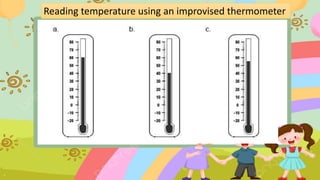
Reading temperature using an improvised thermometer
Motivation
How many of you are observant with the day’s
temperature?
Why does a weatherman inform us about temperature
readings?
Why do you think there is a need to check the day’s
temperature from time to time?
“Singing the GRAPHS Song”
Ask:
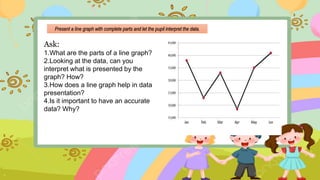
1.What are the parts of a line graph?
2.Looking at the data, can you
interpret what is presented by the
graph? How?
3.How does a line graph help in data
presentation?
4.Is it important to have an accurate
data? Why?
Present a line graph with complete parts and let the pupil interpret the data.
Group the pupils into four.
Give activity sheets involving line graph to each group
for interpretation.
Ask each group to work together in interpreting the
data on the graph. Once finished, the assign member
will post their work on the board and discuss their
answer.
Performing Activities
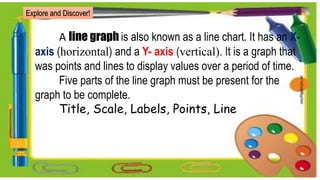
A line graph is also known as a line chart. It has an X-
axis (horizontal) and a Y- axis (vertical). It is a graph that
was points and lines to display values over a period of time.
Five parts of the line graph must be present for the
graph to be complete.
Title, Scale, Labels, Points, Line
Explore and Discover!
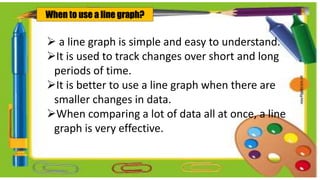
 a line graph is simple and easy to understand.
It is used to track changes over short and long
periods of time.
It is better to use a line graph when there are
smaller changes in data.
When comparing a lot of data all at once, a line
graph is very effective.
When to use a line graph?
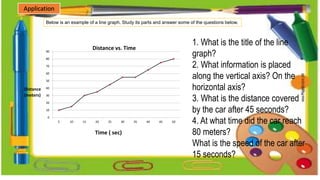
Below is an example of a line graph. Study its parts and answer some of the questions below.
0
10
20
30
40
50
60
70
80
90
5 10 15 20 25 30 35 40 45 50
Distance vs. Time
Distance
(meters)
Time ( sec)
1. What is the title of the line
graph?
2. What information is placed
along the vertical axis? On the
horizontal axis?
3. What is the distance covered
by the car after 45 seconds?
4. At what time did the car reach
80 meters?
What is the speed of the car after
15 seconds?
Application
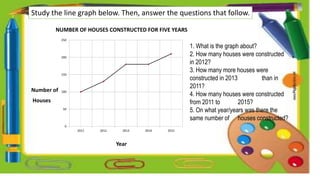
Study the line graph below. Then, answer the questions that follow.
0
50
100
150
200
250
2011 2012 2013 2014 2015
NUMBER OF HOUSES CONSTRUCTED FOR FIVE YEARS
Number of
Houses
Year
1. What is the graph about?
2. How many houses were constructed
in 2012?
3. How many more houses were
constructed in 2013 than in
2011?
4. How many houses were constructed
from 2011 to 2015?
5. On what year/years was there the
same number of houses constructed?
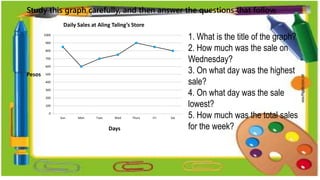
Study this graph carefully, and then answer the questions that follow.
0
100
200
300
400
500
600
700
800
900
1000
Sun Mon Tues Wed Thurs Fri Sat
Daily Sales at Aling Taling’s Store
Pesos
Days
1. What is the title of the graph?
2. How much was the sale on
Wednesday?
3. On what day was the highest
sale?
4. On what day was the sale
lowest?
5. How much was the total sales
for the week?
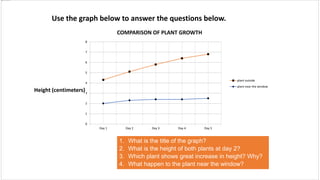
Use the graph below to answer the questions below.
0
1
2
3
4
5
6
7
8
Day 1 Day 2 Day 3 Day 4 Day 5
plant outside
plant near the window
COMPARISON OF PLANT GROWTH
Height (centimeters)
1. What is the title of the graph?
2. What is the height of both plants at day 2?
3. Which plant shows great increase in height? Why?
4. What happen to the plant near the window?
•A line graph has a title, scale, labels, points, and line•
Changes in the data presented are easily seen on a line
graph.
•To read and interpret the data presented in a line graph, we
usually compare the data in terms of size and amount.
What are the parts of a line graph? Why?
Generalization
Why it is useful?
Line graph are used to track changes over
short and long periods of time.
How do we interpret data presented on a line graph?
To read and interpret the data presented in
a line graph, we usually compare the data
in terms of size and amount
The horizontal scale across the bottom and the
vertical scale along the side tell us how much
or how many. The points or dots on the graph
represents the X,Y, coordinates or ordered
pairs. The line segments connecting the points
give estimated values between the points.
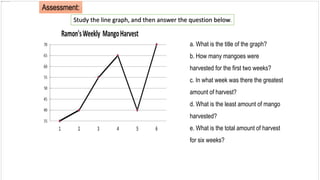
a. What is the title of the graph?
b. How many mangoes were
harvested for the first two weeks?
c. In what week was there the greatest
amount of harvest?
d. What is the least amount of mango
harvested?
e. What is the total amount of harvest
for six weeks?
Study the line graph, and then answer the question below.
Assessment:
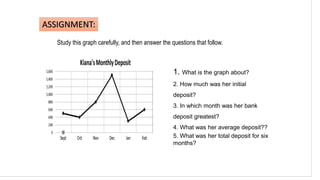
Study this graph carefully, and then answer the questions that follow.
1. What is the graph about?
2. How much was her initial
deposit?
3. In which month was her bank
deposit greatest?
4. What was her average deposit??
5. What was her total deposit for six
months?
ASSIGNMENT:
Thank you for
listening..
God Bless Us!

Demo in Math 5 PPT.pptx melba tag-ulo elem school

  • 1.
    Interprets data presentedin different kinds of line graphs (single line graph) M5SP-IVh-3.5/Page 65 of 109
  • 2.
    1.Drill Drill on skipcounting by 2s, 5s, 10s, etc. 2.Review Conduct a review on reading a temperature.
  • 3.
    Reading temperature usingan improvised thermometer
  • 4.
    Motivation How many ofyou are observant with the day’s temperature? Why does a weatherman inform us about temperature readings? Why do you think there is a need to check the day’s temperature from time to time? “Singing the GRAPHS Song”
  • 6.
    Ask: 1.What are theparts of a line graph? 2.Looking at the data, can you interpret what is presented by the graph? How? 3.How does a line graph help in data presentation? 4.Is it important to have an accurate data? Why? Present a line graph with complete parts and let the pupil interpret the data.
  • 7.
    Group the pupilsinto four. Give activity sheets involving line graph to each group for interpretation. Ask each group to work together in interpreting the data on the graph. Once finished, the assign member will post their work on the board and discuss their answer. Performing Activities
  • 9.
    A line graphis also known as a line chart. It has an X- axis (horizontal) and a Y- axis (vertical). It is a graph that was points and lines to display values over a period of time. Five parts of the line graph must be present for the graph to be complete. Title, Scale, Labels, Points, Line Explore and Discover!
  • 10.
     a linegraph is simple and easy to understand. It is used to track changes over short and long periods of time. It is better to use a line graph when there are smaller changes in data. When comparing a lot of data all at once, a line graph is very effective. When to use a line graph?
  • 11.
    Below is anexample of a line graph. Study its parts and answer some of the questions below. 0 10 20 30 40 50 60 70 80 90 5 10 15 20 25 30 35 40 45 50 Distance vs. Time Distance (meters) Time ( sec) 1. What is the title of the line graph? 2. What information is placed along the vertical axis? On the horizontal axis? 3. What is the distance covered by the car after 45 seconds? 4. At what time did the car reach 80 meters? What is the speed of the car after 15 seconds? Application
  • 12.
    Study the linegraph below. Then, answer the questions that follow. 0 50 100 150 200 250 2011 2012 2013 2014 2015 NUMBER OF HOUSES CONSTRUCTED FOR FIVE YEARS Number of Houses Year 1. What is the graph about? 2. How many houses were constructed in 2012? 3. How many more houses were constructed in 2013 than in 2011? 4. How many houses were constructed from 2011 to 2015? 5. On what year/years was there the same number of houses constructed?
  • 13.
    Study this graphcarefully, and then answer the questions that follow. 0 100 200 300 400 500 600 700 800 900 1000 Sun Mon Tues Wed Thurs Fri Sat Daily Sales at Aling Taling’s Store Pesos Days 1. What is the title of the graph? 2. How much was the sale on Wednesday? 3. On what day was the highest sale? 4. On what day was the sale lowest? 5. How much was the total sales for the week?
  • 14.
    Use the graphbelow to answer the questions below. 0 1 2 3 4 5 6 7 8 Day 1 Day 2 Day 3 Day 4 Day 5 plant outside plant near the window COMPARISON OF PLANT GROWTH Height (centimeters) 1. What is the title of the graph? 2. What is the height of both plants at day 2? 3. Which plant shows great increase in height? Why? 4. What happen to the plant near the window?
  • 15.
    •A line graphhas a title, scale, labels, points, and line• Changes in the data presented are easily seen on a line graph. •To read and interpret the data presented in a line graph, we usually compare the data in terms of size and amount. What are the parts of a line graph? Why? Generalization
  • 16.
    Why it isuseful? Line graph are used to track changes over short and long periods of time. How do we interpret data presented on a line graph? To read and interpret the data presented in a line graph, we usually compare the data in terms of size and amount
  • 17.
    The horizontal scaleacross the bottom and the vertical scale along the side tell us how much or how many. The points or dots on the graph represents the X,Y, coordinates or ordered pairs. The line segments connecting the points give estimated values between the points.
  • 18.
    a. What isthe title of the graph? b. How many mangoes were harvested for the first two weeks? c. In what week was there the greatest amount of harvest? d. What is the least amount of mango harvested? e. What is the total amount of harvest for six weeks? Study the line graph, and then answer the question below. Assessment:
  • 19.
    Study this graphcarefully, and then answer the questions that follow. 1. What is the graph about? 2. How much was her initial deposit? 3. In which month was her bank deposit greatest? 4. What was her average deposit?? 5. What was her total deposit for six months? ASSIGNMENT:
  • 20.