Objective of today’s class
• Context
• Learning outcomes
–Detail the types of cybersecurity risk
–Be aware of the environment
–Actively engage in discussion
We are
here
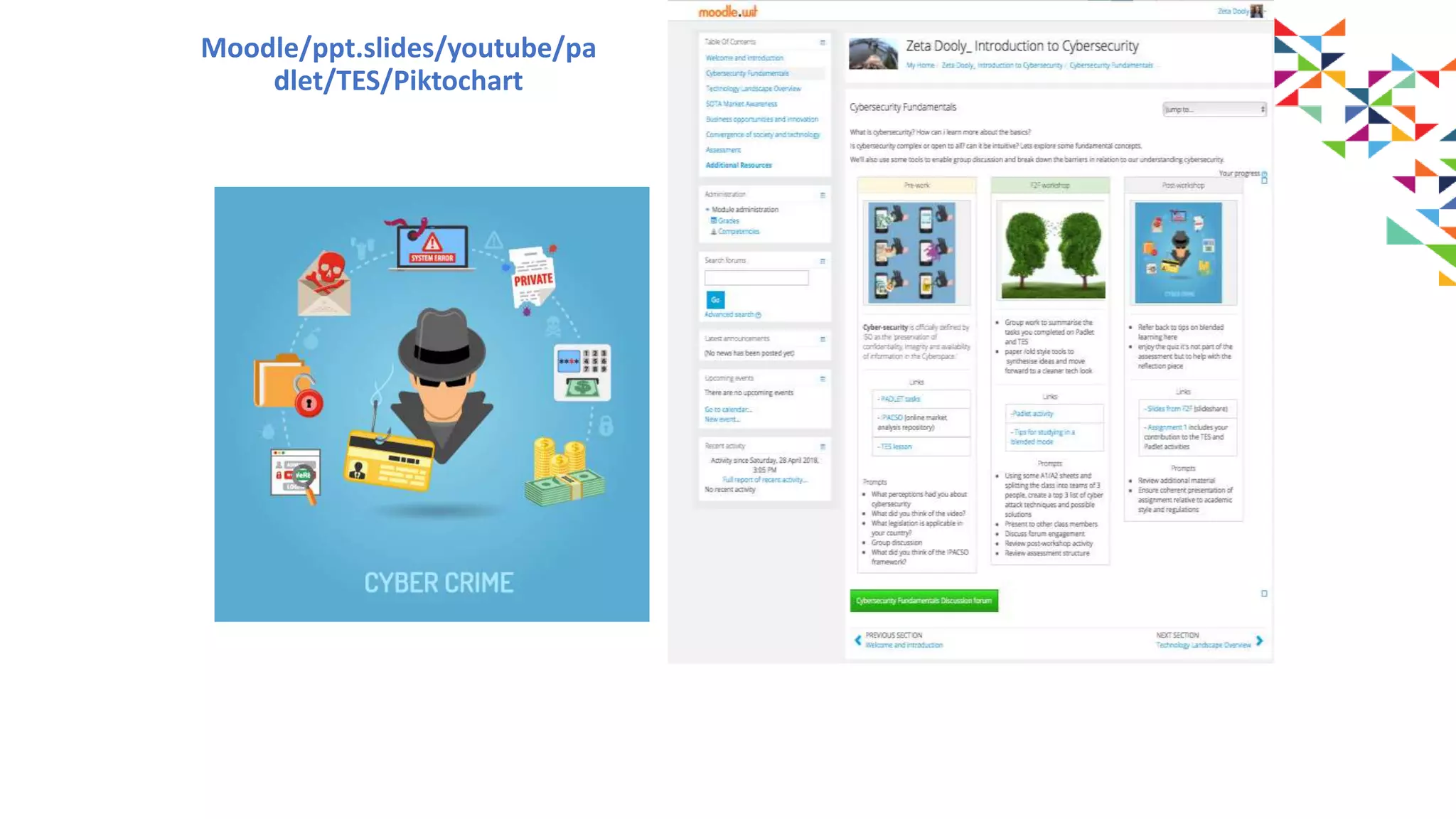
Moodle/ppt.slides/youtube/pa
dlet/TES/Piktochart
Introduction
• Link to previous lesson
• New material
– What we plan to cover and how
– Listen to the cybersecurity clip on Youtube
– In groups complete 5 main points to summarise content
• Next week
– Read the articles on moodle
– Follow-up with assignment (part of continuous
assessment)
• CyberCrime V CyberSecurity
– Threats
– Vulnerabilities
– Cyber attacks
– Protection of critical infrastructure
• Society
– Digital Native
– Digital Immigrant
– Technophobe
4
Setting the scene
Main Content
• Resources
–Moodle
–Movie on how to use piktochart
–Books, papers, websites, video clips
–Group discussion
• New material
–What we plan to cover and how
• Take 10 minutes to discuss the youtube clip
with your partner
• Extract main themes in Cybersecurity
• Prioritise in relation to what you think is most
critical to address in Ireland/Europe/Globally
• Take 5 mins to summarise and present to class
01/05/2018
Main Content
• Resources
–Moodle
–Movie on how to use piktochart
–Books, papers, websites, video clips
–Group discussion
• New material
–What we plan to cover and how
Tes lesson link
• includes youtube clip
• quiz, link to papers How to create a piktochart
• Take 10 minutes to discuss the youtube clip
with your partner
• Extract main themes link with Cybersecurity
• Use this and moodle material to prepare a
piktochart and present to class next week
(5mins)
01/05/2018
Summary
• What did we cover
• Key messages
• Questions
• What’s next
• Thanks for coming – look at what you’ve achieved
Evaluation mechanism
• Teacher perspective
• Analyse teaching method applied
• Success factors/areas to improve
• Problem /solution identification
• Future planning
• Student perspective
• What was the ‘muddiest point”
• Complete Brookfield’s Critical
Incident Questionnaire
01/05/2018 11

Delivery material

  • 1.
    Objective of today’sclass • Context • Learning outcomes –Detail the types of cybersecurity risk –Be aware of the environment –Actively engage in discussion We are here
  • 2.
  • 3.
    Introduction • Link toprevious lesson • New material – What we plan to cover and how – Listen to the cybersecurity clip on Youtube – In groups complete 5 main points to summarise content • Next week – Read the articles on moodle – Follow-up with assignment (part of continuous assessment)
  • 4.
    • CyberCrime VCyberSecurity – Threats – Vulnerabilities – Cyber attacks – Protection of critical infrastructure • Society – Digital Native – Digital Immigrant – Technophobe 4 Setting the scene
  • 5.
    Main Content • Resources –Moodle –Movieon how to use piktochart –Books, papers, websites, video clips –Group discussion • New material –What we plan to cover and how
  • 6.
    • Take 10minutes to discuss the youtube clip with your partner • Extract main themes in Cybersecurity • Prioritise in relation to what you think is most critical to address in Ireland/Europe/Globally • Take 5 mins to summarise and present to class 01/05/2018
  • 7.
    Main Content • Resources –Moodle –Movieon how to use piktochart –Books, papers, websites, video clips –Group discussion • New material –What we plan to cover and how
  • 8.
    Tes lesson link •includes youtube clip • quiz, link to papers How to create a piktochart
  • 9.
    • Take 10minutes to discuss the youtube clip with your partner • Extract main themes link with Cybersecurity • Use this and moodle material to prepare a piktochart and present to class next week (5mins) 01/05/2018
  • 10.
    Summary • What didwe cover • Key messages • Questions • What’s next • Thanks for coming – look at what you’ve achieved
  • 11.
    Evaluation mechanism • Teacherperspective • Analyse teaching method applied • Success factors/areas to improve • Problem /solution identification • Future planning • Student perspective • What was the ‘muddiest point” • Complete Brookfield’s Critical Incident Questionnaire 01/05/2018 11

Editor's Notes

  • #12 The “Muddiest Point” is a teaching assessment technique developed by Dr. Frederick Mosteller, a Harvard University professor of statistics, in 1989. A simple classroom assessment tool that requires little preparation time for the instructor and only a few minutes of time for the students. The muddiest point is used to assess what students are having trouble understanding during a class or part of a class. Ask high /low points of class and what you/student gained