Digital Learning Objects
Laura Wimberley, PhD, MLIS
Online Learning

• Physical distance

• Technology (usually a computer) to
  access learning materials

• Technology to interact with the instructor
  and with other learners

• Support for learners
Digital Learning Objects

•   Delivered online
•   Educational
•   Modular
•   Reusable

• Open
• Practice
• Assessment
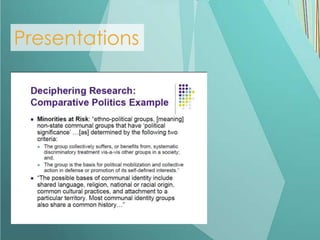
Presentations
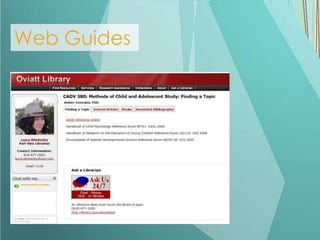
Web Guides
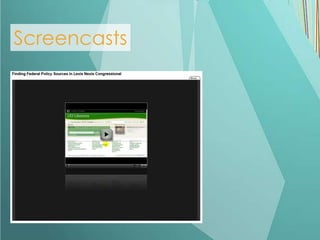
Screencasts
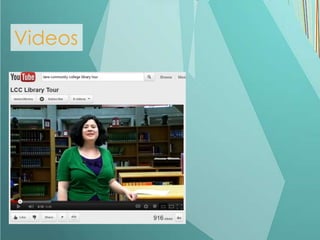
Videos
@CSUN

• Lecture capture
• Quizzes
• Virtual exhibits
The Future

•   More open access resources

•   More participation by reputable,
    traditional universities

•   More hybrid courses
Information Literacy DLOs

•   Peer review

•   Finding books & articles from citations

•   Primary sources – what they are & how
    to find them

•   Copyright & public domain
Near Future

•   Mixed media objects

•   Curated open access digital learning
    objects
The Future: Primary Sources

•   Supreme Court cases

•   Oviatt Special Collections
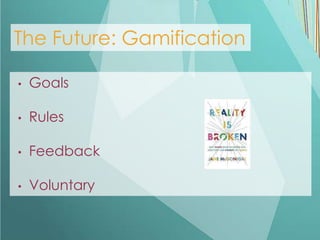
The Future: Gamification

•   Goals

•   Rules

•   Feedback

•   Voluntary
The Future: Digital Humanities

•   Text mining

•   GIS data integration


•   Students as knowledge creators
Questions?

www.laurawimberley.org/dlo
References
Anderson, T. (2008). The theory and practice of online learning. Edmonton:
    AU Press. Retrieved April 24, 2012, from
    http://www.aupress.ca/books/120146/ebook/01_Anderson_2008-
    Theory_and_Practice_of_Online_Learning.pdf
Mackey, T.P. & Jacobson, T.E. (2011). Teaching information literacy online.
    New York: Neal-Schuman.
McGonigal, J. (2011). Reality is broken: Why games make us better and
    how they can change the world. New York: Penguin.
Wiley, D. A. (2002). The instructional use of learning objects. Bloomington,
    Ind: Agency for Instructional Technology. Retrieved April 24, 2012, from
    http://reusability.org/read/
Background image Creative Commons
 2009 by flickr user Gwen Vanhees

Digital Learning Objects

  • 1.
    Digital Learning Objects LauraWimberley, PhD, MLIS
  • 2.
    Online Learning • Physicaldistance • Technology (usually a computer) to access learning materials • Technology to interact with the instructor and with other learners • Support for learners
  • 3.
    Digital Learning Objects • Delivered online • Educational • Modular • Reusable • Open • Practice • Assessment
  • 4.
  • 5.
  • 6.
  • 7.
  • 8.
    @CSUN • Lecture capture •Quizzes • Virtual exhibits
  • 9.
    The Future • More open access resources • More participation by reputable, traditional universities • More hybrid courses
  • 10.
    Information Literacy DLOs • Peer review • Finding books & articles from citations • Primary sources – what they are & how to find them • Copyright & public domain
  • 11.
    Near Future • Mixed media objects • Curated open access digital learning objects
  • 12.
    The Future: PrimarySources • Supreme Court cases • Oviatt Special Collections
  • 13.
    The Future: Gamification • Goals • Rules • Feedback • Voluntary
  • 14.
    The Future: DigitalHumanities • Text mining • GIS data integration • Students as knowledge creators
  • 15.
  • 16.
    References Anderson, T. (2008).The theory and practice of online learning. Edmonton: AU Press. Retrieved April 24, 2012, from http://www.aupress.ca/books/120146/ebook/01_Anderson_2008- Theory_and_Practice_of_Online_Learning.pdf Mackey, T.P. & Jacobson, T.E. (2011). Teaching information literacy online. New York: Neal-Schuman. McGonigal, J. (2011). Reality is broken: Why games make us better and how they can change the world. New York: Penguin. Wiley, D. A. (2002). The instructional use of learning objects. Bloomington, Ind: Agency for Instructional Technology. Retrieved April 24, 2012, from http://reusability.org/read/
  • 17.
    Background image CreativeCommons 2009 by flickr user Gwen Vanhees