Lecture 1
COMP SCI 7328 Concepts in Cyber Security
Introduction
Lecturer: Faheem Ullah (faheem.ullah@adelaide.edu.au)
Welcome to COMP SCI 7328 Concepts
in Cyber Security
• In this session, we will:
– Discuss the course structure and assessments
– Shed light on the history of cybersecurity
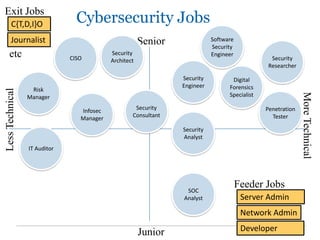
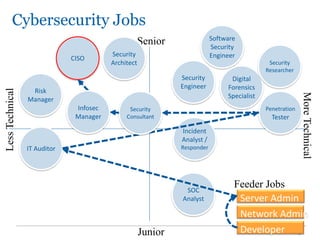
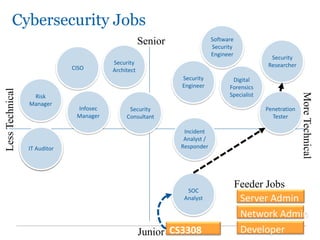
– Discuss cyber security career paths, relevant jobs, and skillsets
2
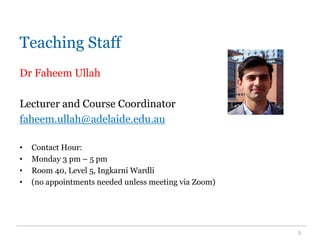
Teaching Staff
Dr Faheem Ullah
Lecturer and Course Coordinator
faheem.ullah@adelaide.edu.au
• Contact Hour:
• Monday 3 pm – 5 pm
• Room 40, Level 5, Ingkarni Wardli
• (no appointments needed unless meeting via Zoom)
3
About Me
Career
• Lecturer in Cyber Security, The University of Adelaide, (Mar 2022 –Present)
• Postdoctoral Researcher, The University of Adelaide, (Mar 2020 –Feb 2022)
• PhD Student, The University of Adelaide, (Aug 2016 –Feb 2020)
Research & Teaching Interests
• Cyber Security
• Big Data Analytics
• Software Engineering
4
Course Learning Objectives
• CLO 1: Outline and interpret cybersecurity principles and
approaches.
• CLO 2: Apply knowledge of security principles, and security risk
management strategies in real-life scenarios.
• CLO 3: Reflect on the impact and relevance of cyber security.
• CLO 4: Discuss the key concepts related to cyber security using
appropriate terminology.
5
Course Structure
• Cyber Security Goals
• Penetration Testing
• Security & Cryptography
• Security Principles
• Security Risk Assessment
• Security Operation Centre
• Ethical and Legal Issues in Cyber Security
• Human Factors in Cyber Security
• Security Vulnerability Disclosure
• Incident Response
• Career in Cyber Security
6
Course Organization
• One-hour lecture/discussion
• Tuesday 2 pm – 3 pm
• Face-to-face and online
• Engineering & Mathematics, EM105, Teaching Room
• Echo 360 (live streamed + recorded)
• One-hour workshop
– Friday 3 pm – 4 pm
– Zoom (no recordings)
– Engineering North, N218, Teaching Room
– Discuss and execute various tasks
7
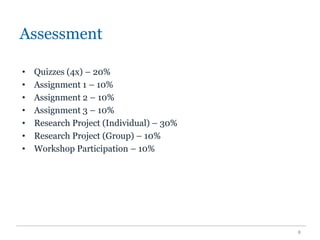
Assessment
• Quizzes (4x) – 20%
• Assignment 1 – 10%
• Assignment 2 – 10%
• Assignment 3 – 10%
• Research Project (Individual) – 30%
• Research Project (Group) – 10%
• Workshop Participation – 10%
8
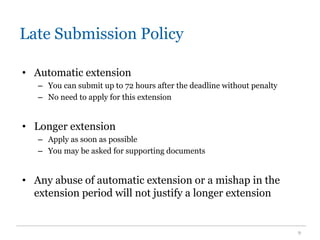
Late Submission Policy
• Automatic extension
– You can submit up to 72 hours after the deadline without penalty
– No need to apply for this extension
• Longer extension
– Apply as soon as possible
– You may be asked for supporting documents
• Any abuse of automatic extension or a mishap in the
extension period will not justify a longer extension
9
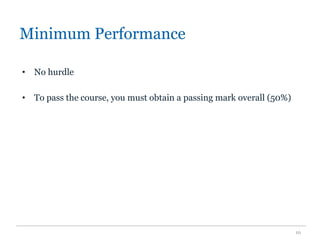
Minimum Performance
• No hurdle
• To pass the course, you must obtain a passing mark overall (50%)
10
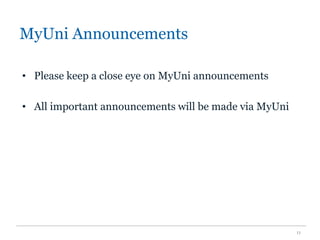
MyUni Announcements
• Please keep a close eye on MyUni announcements
• All important announcements will be made via MyUni
11
Why get into cyber security?
• High demand
– Increased reliance on digital technologies
– Systems/people remain vulnerable
– Cybercrimes remains profitable
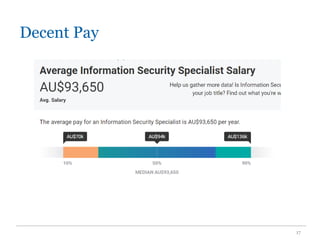
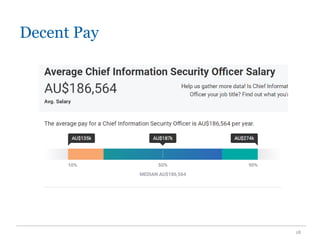
• Well paid
• Fun
12
Worldwide cybercrime cost hit $6 trillion annually
In 2021, 4 million unfilled jobs in cyber security globally
Source: https://www.varonis.com/blog/cybersecurity-statistics
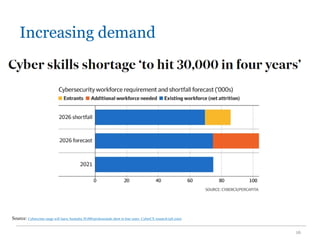
Increasing demand
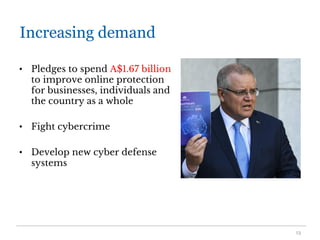
• Pledges to spend A$1.67 billion
to improve online protection
for businesses, individuals and
the country as a whole
• Fight cybercrime
• Develop new cyber defense
systems
13
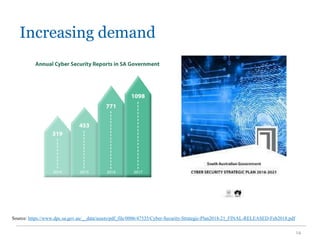
Increasing demand
14
Source: https://www.dpc.sa.gov.au/__data/assets/pdf_file/0006/47535/Cyber-Security-Strategic-Plan2018-21_FINAL-RELEASED-Feb2018.pdf
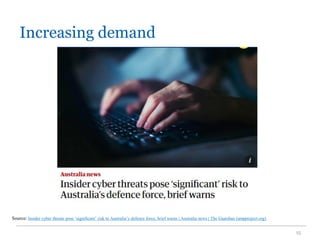
Increasing demand
15
Source: Insider cyber threats pose ‘significant’ risk to Australia’s defence force, brief warns | Australia news | The Guardian (ampproject.org)
Increasing demand
16
Source: Cybercrime surge will leave Australia 30,000 professionals short in four years: CyberCX research (afr.com)
Decent Pay
17
Decent Pay
18
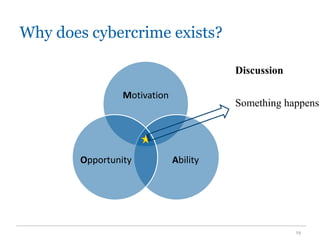
Why does cybercrime exists?
19
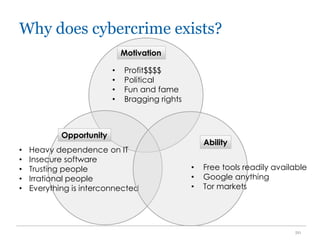
Motivation
Ability
Opportunity
Something happens
Discussion
Why does cybercrime exists?
20
Motivation
• Profit$$$$
• Political
• Fun and fame
• Bragging rights
Opportunity
• Heavy dependence on IT
• Insecure software
• Trusting people
• Irrational people
• Everything is interconnected
Ability
• Free tools readily available
• Google anything
• Tor markets
Why does cybercrime exists?
21
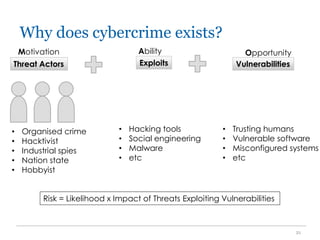
Threat Actors
• Organised crime
• Hacktivist
• Industrial spies
• Nation state
• Hobbyist
Vulnerabilities
• Trusting humans
• Vulnerable software
• Misconfigured systems
• etc
Exploits
• Hacking tools
• Social engineering
• Malware
• etc
Motivation Ability Opportunity
Risk = Likelihood x Impact of Threats Exploiting Vulnerabilities
Why bad guys are winning?
22
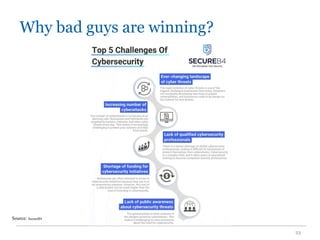
• Lack of security importance at the executive level
• Insecure software
• Humans remain vulnerable
• COVID played its part too
• etc
Why bad guys are winning?
23
Source: SecureB4
Cybersecurity Jobs
24
More
Technical
Less
Technical
Senior
Junior
Digital
Forensics
Specialist
Penetration
Tester
SOC
Analyst
IT Auditor
CISO
Security
Architect
Security
Engineer
Security
Researcher
Risk
Manager
Developer
Network Admin
Server Admin
Feeder Jobs
Infosec
Manager
Security
Consultant
Security
Analyst
C{T,D,I}O
Exit Jobs
Journalist
etc
Software
Security
Engineer
Cybersecurity Jobs
25
More
Technical
Less
Technical
Senior
Junior
Digital
Forensics
Specialist
Penetration
Tester
SOC
Analyst
IT Auditor
CISO
Incident
Analyst /
Responder
Security
Architect
Security
Engineer
Security
Researcher
Risk
Manager
Developer
Network Admin
Server Admin
Feeder Jobs
Security
Consultant
Infosec
Manager
Software
Security
Engineer
Cybersecurity Jobs
26
More
Technical
Less
Technical
Senior
Junior
Digital
Forensics
Specialist
Penetration
Tester
SOC
Analyst
IT Auditor
CISO
Incident
Analyst /
Responder
Security
Architect
Security
Engineer
Security
Researcher
Risk
Manager
Developer
Network Admin
Server Admin
Feeder Jobs
CS3308
Software
Security
Engineer
IT Auditor
Security
Consultant
Infosec
Manager
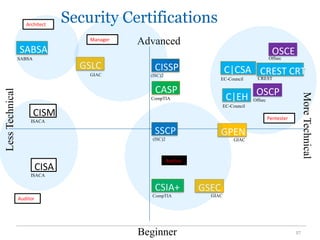
Security Certifications
27
More
Technical
Less
Technical
Advanced
Beginner
CISSP
CISA
CISM
CSIA+
C|EH
SABSA OSCE
CREST CRT
OSCP
CASP
SSCP
GSEC
ISACA
ISACA
(ISC)2
(ISC)2
CompTIA GIAC
EC-Council
Offsec
Offsec
CREST
SABSA
GPEN
GIAC
GSLC
GIAC
CompTIA
C|CSA
EC-Council
Architect
Auditor
Manager
Analyst
Pentester
Hacking - Definition
28
“Hacking is an attempt to exploit a computer system or a private
network inside a computer. Simply put, it is the unauthorized
access to or control over computer network security systems for
some illicit purpose.”
The Economic Times
https://economictimes.indiatimes.com/definition/hacking
Different Hats
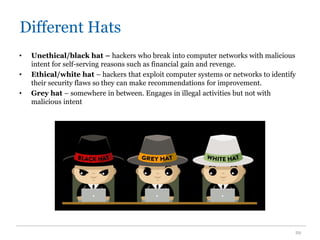
• Unethical/black hat – hackers who break into computer networks with malicious
intent for self-serving reasons such as financial gain and revenge.
• Ethical/white hat – hackers that exploit computer systems or networks to identify
their security flaws so they can make recommendations for improvement.
• Grey hat – somewhere in between. Engages in illegal activities but not with
malicious intent
29
Brief History of Hacking (Enigma machine)
30
1939
Source: https://en.wikipedia.org/wiki/Bombe
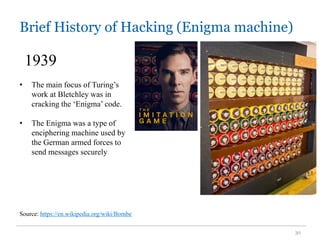
• The main focus of Turing’s
work at Bletchley was in
cracking the ‘Enigma’ code.
• The Enigma was a type of
enciphering machine used by
the German armed forces to
send messages securely
Brief History of Hacking (Morris worm)
31
Source: https://en.wikipedia.org/wiki/Morris_worm
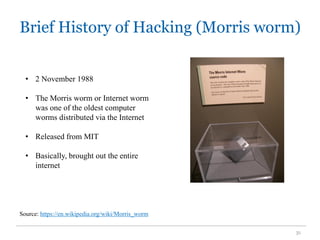
• 2 November 1988
• The Morris worm or Internet worm
was one of the oldest computer
worms distributed via the Internet
• Released from MIT
• Basically, brought out the entire
internet
Brief History of Hacking (ILOVEYOU)
32
Source: https://en.wikipedia.org/wiki/ILOVEYOU
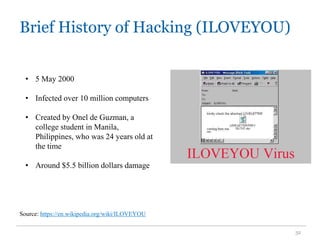
• 5 May 2000
• Infected over 10 million computers
• Created by Onel de Guzman, a
college student in Manila,
Philippines, who was 24 years old at
the time
• Around $5.5 billion dollars damage
Brief History of Hacking (Mirai)
33
https://en.wikipedia.org/wiki/Mirai_(malware)
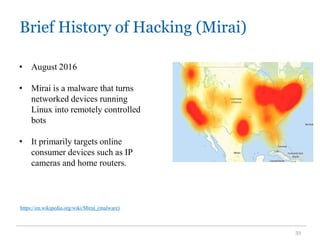
• August 2016
• Mirai is a malware that turns
networked devices running
Linux into remotely controlled
bots
• It primarily targets online
consumer devices such as IP
cameras and home routers.
Summary
34
• Cyber criminals are everywhere
• Good cyber security talent in demand (also
software developers who can write secure
code)
• Cyber security is a great career option
• Start learning early and get experience

Concepts of Cyber Security lecture note.pdf

  • 1.
    Lecture 1 COMP SCI7328 Concepts in Cyber Security Introduction Lecturer: Faheem Ullah (faheem.ullah@adelaide.edu.au)
  • 2.
    Welcome to COMPSCI 7328 Concepts in Cyber Security • In this session, we will: – Discuss the course structure and assessments – Shed light on the history of cybersecurity – Discuss cyber security career paths, relevant jobs, and skillsets 2
  • 3.
    Teaching Staff Dr FaheemUllah Lecturer and Course Coordinator faheem.ullah@adelaide.edu.au • Contact Hour: • Monday 3 pm – 5 pm • Room 40, Level 5, Ingkarni Wardli • (no appointments needed unless meeting via Zoom) 3
  • 4.
    About Me Career • Lecturerin Cyber Security, The University of Adelaide, (Mar 2022 –Present) • Postdoctoral Researcher, The University of Adelaide, (Mar 2020 –Feb 2022) • PhD Student, The University of Adelaide, (Aug 2016 –Feb 2020) Research & Teaching Interests • Cyber Security • Big Data Analytics • Software Engineering 4
  • 5.
    Course Learning Objectives •CLO 1: Outline and interpret cybersecurity principles and approaches. • CLO 2: Apply knowledge of security principles, and security risk management strategies in real-life scenarios. • CLO 3: Reflect on the impact and relevance of cyber security. • CLO 4: Discuss the key concepts related to cyber security using appropriate terminology. 5
  • 6.
    Course Structure • CyberSecurity Goals • Penetration Testing • Security & Cryptography • Security Principles • Security Risk Assessment • Security Operation Centre • Ethical and Legal Issues in Cyber Security • Human Factors in Cyber Security • Security Vulnerability Disclosure • Incident Response • Career in Cyber Security 6
  • 7.
    Course Organization • One-hourlecture/discussion • Tuesday 2 pm – 3 pm • Face-to-face and online • Engineering & Mathematics, EM105, Teaching Room • Echo 360 (live streamed + recorded) • One-hour workshop – Friday 3 pm – 4 pm – Zoom (no recordings) – Engineering North, N218, Teaching Room – Discuss and execute various tasks 7
  • 8.
    Assessment • Quizzes (4x)– 20% • Assignment 1 – 10% • Assignment 2 – 10% • Assignment 3 – 10% • Research Project (Individual) – 30% • Research Project (Group) – 10% • Workshop Participation – 10% 8
  • 9.
    Late Submission Policy •Automatic extension – You can submit up to 72 hours after the deadline without penalty – No need to apply for this extension • Longer extension – Apply as soon as possible – You may be asked for supporting documents • Any abuse of automatic extension or a mishap in the extension period will not justify a longer extension 9
  • 10.
    Minimum Performance • Nohurdle • To pass the course, you must obtain a passing mark overall (50%) 10
  • 11.
    MyUni Announcements • Pleasekeep a close eye on MyUni announcements • All important announcements will be made via MyUni 11
  • 12.
    Why get intocyber security? • High demand – Increased reliance on digital technologies – Systems/people remain vulnerable – Cybercrimes remains profitable • Well paid • Fun 12 Worldwide cybercrime cost hit $6 trillion annually In 2021, 4 million unfilled jobs in cyber security globally Source: https://www.varonis.com/blog/cybersecurity-statistics
  • 13.
    Increasing demand • Pledgesto spend A$1.67 billion to improve online protection for businesses, individuals and the country as a whole • Fight cybercrime • Develop new cyber defense systems 13
  • 14.
  • 15.
    Increasing demand 15 Source: Insidercyber threats pose ‘significant’ risk to Australia’s defence force, brief warns | Australia news | The Guardian (ampproject.org)
  • 16.
    Increasing demand 16 Source: Cybercrimesurge will leave Australia 30,000 professionals short in four years: CyberCX research (afr.com)
  • 17.
  • 18.
  • 19.
    Why does cybercrimeexists? 19 Motivation Ability Opportunity Something happens Discussion
  • 20.
    Why does cybercrimeexists? 20 Motivation • Profit$$$$ • Political • Fun and fame • Bragging rights Opportunity • Heavy dependence on IT • Insecure software • Trusting people • Irrational people • Everything is interconnected Ability • Free tools readily available • Google anything • Tor markets
  • 21.
    Why does cybercrimeexists? 21 Threat Actors • Organised crime • Hacktivist • Industrial spies • Nation state • Hobbyist Vulnerabilities • Trusting humans • Vulnerable software • Misconfigured systems • etc Exploits • Hacking tools • Social engineering • Malware • etc Motivation Ability Opportunity Risk = Likelihood x Impact of Threats Exploiting Vulnerabilities
  • 22.
    Why bad guysare winning? 22 • Lack of security importance at the executive level • Insecure software • Humans remain vulnerable • COVID played its part too • etc
  • 23.
    Why bad guysare winning? 23 Source: SecureB4
  • 24.
  • 25.
    Cybersecurity Jobs 25 More Technical Less Technical Senior Junior Digital Forensics Specialist Penetration Tester SOC Analyst IT Auditor CISO Incident Analyst/ Responder Security Architect Security Engineer Security Researcher Risk Manager Developer Network Admin Server Admin Feeder Jobs Security Consultant Infosec Manager Software Security Engineer
  • 26.
    Cybersecurity Jobs 26 More Technical Less Technical Senior Junior Digital Forensics Specialist Penetration Tester SOC Analyst IT Auditor CISO Incident Analyst/ Responder Security Architect Security Engineer Security Researcher Risk Manager Developer Network Admin Server Admin Feeder Jobs CS3308 Software Security Engineer IT Auditor Security Consultant Infosec Manager
  • 27.
    Security Certifications 27 More Technical Less Technical Advanced Beginner CISSP CISA CISM CSIA+ C|EH SABSA OSCE CRESTCRT OSCP CASP SSCP GSEC ISACA ISACA (ISC)2 (ISC)2 CompTIA GIAC EC-Council Offsec Offsec CREST SABSA GPEN GIAC GSLC GIAC CompTIA C|CSA EC-Council Architect Auditor Manager Analyst Pentester
  • 28.
    Hacking - Definition 28 “Hackingis an attempt to exploit a computer system or a private network inside a computer. Simply put, it is the unauthorized access to or control over computer network security systems for some illicit purpose.” The Economic Times https://economictimes.indiatimes.com/definition/hacking
  • 29.
    Different Hats • Unethical/blackhat – hackers who break into computer networks with malicious intent for self-serving reasons such as financial gain and revenge. • Ethical/white hat – hackers that exploit computer systems or networks to identify their security flaws so they can make recommendations for improvement. • Grey hat – somewhere in between. Engages in illegal activities but not with malicious intent 29
  • 30.
    Brief History ofHacking (Enigma machine) 30 1939 Source: https://en.wikipedia.org/wiki/Bombe • The main focus of Turing’s work at Bletchley was in cracking the ‘Enigma’ code. • The Enigma was a type of enciphering machine used by the German armed forces to send messages securely
  • 31.
    Brief History ofHacking (Morris worm) 31 Source: https://en.wikipedia.org/wiki/Morris_worm • 2 November 1988 • The Morris worm or Internet worm was one of the oldest computer worms distributed via the Internet • Released from MIT • Basically, brought out the entire internet
  • 32.
    Brief History ofHacking (ILOVEYOU) 32 Source: https://en.wikipedia.org/wiki/ILOVEYOU • 5 May 2000 • Infected over 10 million computers • Created by Onel de Guzman, a college student in Manila, Philippines, who was 24 years old at the time • Around $5.5 billion dollars damage
  • 33.
    Brief History ofHacking (Mirai) 33 https://en.wikipedia.org/wiki/Mirai_(malware) • August 2016 • Mirai is a malware that turns networked devices running Linux into remotely controlled bots • It primarily targets online consumer devices such as IP cameras and home routers.
  • 34.
    Summary 34 • Cyber criminalsare everywhere • Good cyber security talent in demand (also software developers who can write secure code) • Cyber security is a great career option • Start learning early and get experience