
Delegate
Delegate
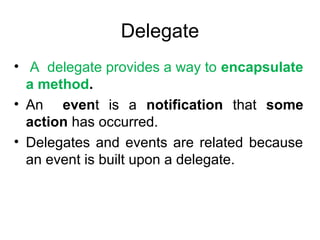
• A delegate provides a way to encapsulate
a method.
• An event is a notification that some
action has occurred.
• Delegates and events are related because
an event is built upon a delegate.
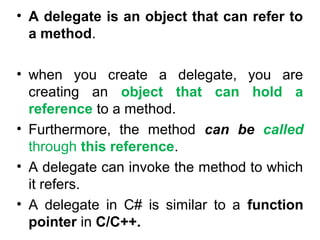
• A delegate is an object that can refer to
a method.
• when you create a delegate, you are
creating an object that can hold a
reference to a method.
• Furthermore, the method can be called
through this reference.
• A delegate can invoke the method to which
it refers.
• A delegate in C# is similar to a function
pointer in C/C++.
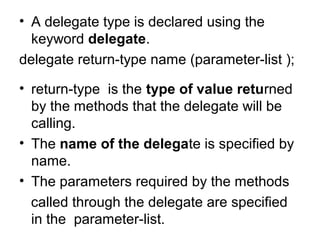
• A delegate type is declared using the
keyword delegate.
delegate return-type name (parameter-list );
• return-type is the type of value returned
by the methods that the delegate will be
calling.
• The name of the delegate is specified by
name.
• The parameters required by the methods
called through the delegate are specified
in the parameter-list.
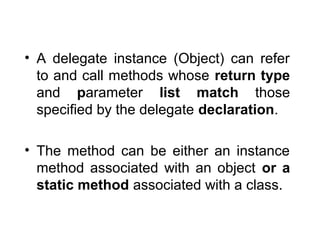
• A delegate instance (Object) can refer
to and call methods whose return type
and parameter list match those
specified by the delegate declaration.
• The method can be either an instance
method associated with an object or a
static method associated with a class.
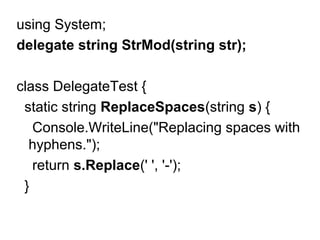
using System;
delegate string StrMod(string str);
class DelegateTest {
static string ReplaceSpaces(string s) {
Console.WriteLine("Replacing spaces with
hyphens.");
return s.Replace(' ', '-');
}
static string RemoveSpaces(string s) {
string temp = "";
int i;
Console.WriteLine("Removing spaces.")
for(i=0; i < s.Length; i++)
if(s[i] != ' ') temp += s[i];
return temp;
}
static string Reverse(string s) {
string temp = "";
int i, j;
Console.WriteLine("Reversing string.");
for(j=0, i=s.Length-1; i >= 0; i--, j++)
temp += s[i];
return temp;
}
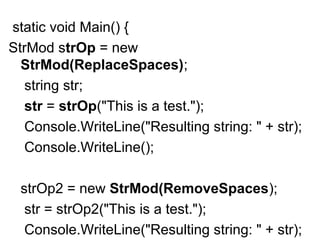
static void Main() {
StrMod strOp = new
StrMod(ReplaceSpaces);
string str;
str = strOp("This is a test.");
Console.WriteLine("Resulting string: " + str);
Console.WriteLine();
strOp2 = new StrMod(RemoveSpaces);
str = strOp2("This is a test.");
Console.WriteLine("Resulting string: " + str);
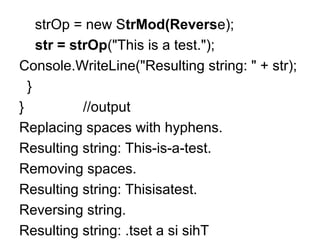
strOp = new StrMod(Reverse);
str = strOp("This is a test.");
Console.WriteLine("Resulting string: " + str);
}
}
//output
Replacing spaces with hyphens.
Resulting string: This-is-a-test.
Removing spaces.
Resulting string: Thisisatest.
Reversing string.
Resulting string: .tset a si sihT
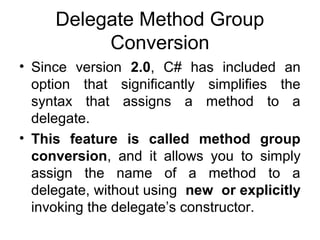
Delegate Method Group
Conversion
• Since version 2.0, C# has included an
option that significantly simplifies the
syntax that assigns a method to a
delegate.
• This feature is called method group
conversion, and it allows you to simply
assign the name of a method to a
delegate, without using new or explicitly
invoking the delegate’s constructor.
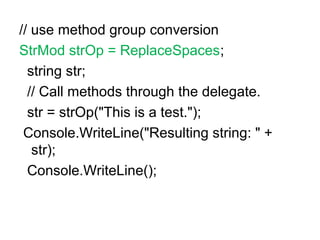
// use method group conversion
StrMod strOp = ReplaceSpaces;
string str;
// Call methods through the delegate.
str = strOp("This is a test.");
Console.WriteLine("Resulting string: " +
str);
Console.WriteLine();
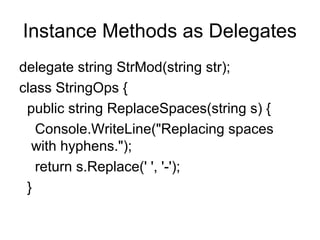
Instance Methods as Delegates
delegate string StrMod(string str);
class StringOps {
public string ReplaceSpaces(string s) {
Console.WriteLine("Replacing spaces
with hyphens.");
return s.Replace(' ', '-');
}
public string RemoveSpaces(string s) {
string temp = "";
int i;
Console.WriteLine("Removing spaces.");
for(i=0; i < s.Length; i++)
if(s[i] != ' ') temp += s[i];
return temp;
}
public string Reverse(string s) {
string temp = "";
int i, j;
Console.WriteLine("Reversing string.");
for(j=0, i=s.Length-1; i >= 0; i--, j++)
temp += s[i];
return temp;
}
}
class DelegateTest {
static void Main() {
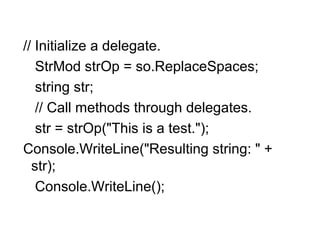
StringOps so = new StringOps();
// Initialize a delegate.
StrMod strOp = so.ReplaceSpaces;
string str;
// Call methods through delegates.
str = strOp("This is a test.");
Console.WriteLine("Resulting string: " +
str);
Console.WriteLine();
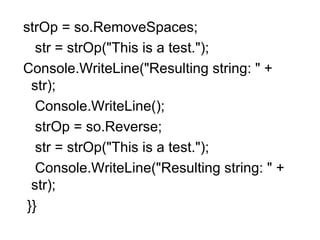
strOp = so.RemoveSpaces;
str = strOp("This is a test.");
Console.WriteLine("Resulting string: " +
str);
Console.WriteLine();
strOp = so.Reverse;
str = strOp("This is a test.");
Console.WriteLine("Resulting string: " +
str);
}}
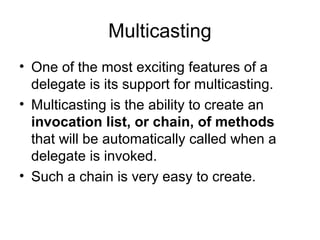
Multicasting
• One of the most exciting features of a
delegate is its support for multicasting.
• Multicasting is the ability to create an
invocation list, or chain, of methods
that will be automatically called when a
delegate is invoked.
• Such a chain is very easy to create.
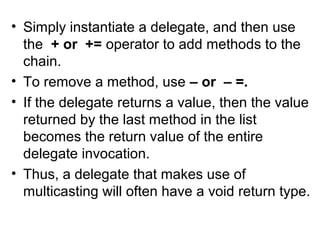
• Simply instantiate a delegate, and then use
the + or += operator to add methods to the
chain.
• To remove a method, use – or – =.
• If the delegate returns a value, then the value
returned by the last method in the list
becomes the return value of the entire
delegate invocation.
• Thus, a delegate that makes use of
multicasting will often have a void return type.
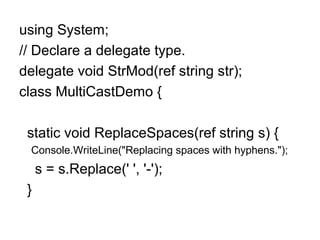
using System;
// Declare a delegate type.
delegate void StrMod(ref string str);
class MultiCastDemo {
static void ReplaceSpaces(ref string s) {
Console.WriteLine("Replacing spaces with hyphens.");

s = s.Replace(' ', '-');
}
static void RemoveSpaces(ref string s) {
string temp = "";
int i;
Console.WriteLine("Removing spaces.");
for(i=0; i < s.Length; i++)
if(s[i] != ' ') temp += s[i];
s = temp;
}
static void Reverse(ref string s) {
string temp = "";
int i, j;
Console.WriteLine("Reversing string.");
for(j=0, i=s.Length-1; i >= 0; i--, j++)
temp += s[i];
s = temp;
}
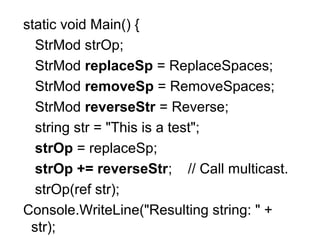
static void Main() {
StrMod strOp;
StrMod replaceSp = ReplaceSpaces;
StrMod removeSp = RemoveSpaces;
StrMod reverseStr = Reverse;
string str = "This is a test";
strOp = replaceSp;
strOp += reverseStr; // Call multicast.
strOp(ref str);
Console.WriteLine("Resulting string: " +
str);
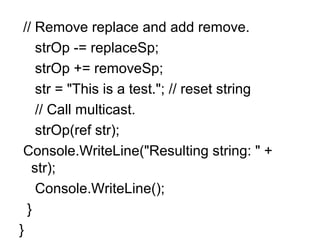
// Remove replace and add remove.
strOp -= replaceSp;
strOp += removeSp;
str = "This is a test."; // reset string
// Call multicast.
strOp(ref str);
Console.WriteLine("Resulting string: " +
str);
Console.WriteLine();
}
}
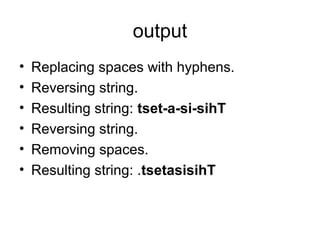
output
•
•
•
•
•
•

Replacing spaces with hyphens.
Reversing string.
Resulting string: tset-a-si-sihT
Reversing string.
Removing spaces.
Resulting string: .tsetasisihT
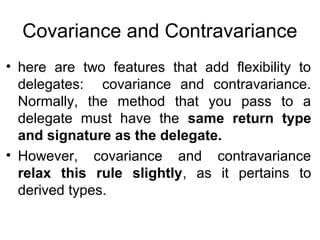
Covariance and Contravariance
• here are two features that add flexibility to
delegates: covariance and contravariance.
Normally, the method that you pass to a
delegate must have the same return type
and signature as the delegate.
• However, covariance and contravariance
relax this rule slightly, as it pertains to
derived types.
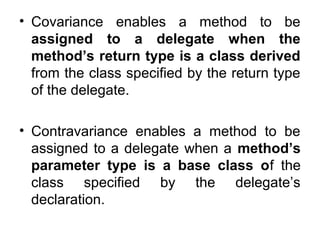
• Covariance enables a method to be
assigned to a delegate when the
method’s return type is a class derived
from the class specified by the return type
of the delegate.
• Contravariance enables a method to be
assigned to a delegate when a method’s
parameter type is a base class of the
class specified by the delegate’s
declaration.
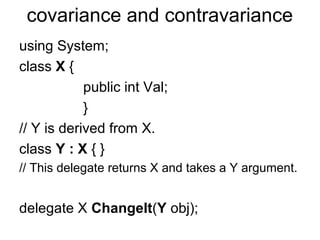
covariance and contravariance
using System;
class X {
public int Val;
}
// Y is derived from X.
class Y : X { }
// This delegate returns X and takes a Y argument.

delegate X ChangeIt(Y obj);
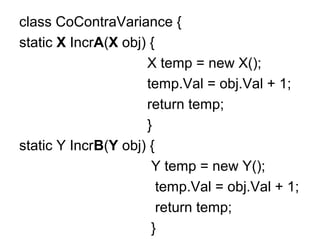
class CoContraVariance {
static X IncrA(X obj) {
X temp = new X();
temp.Val = obj.Val + 1;
return temp;
}
static Y IncrB(Y obj) {
Y temp = new Y();
temp.Val = obj.Val + 1;
return temp;
}
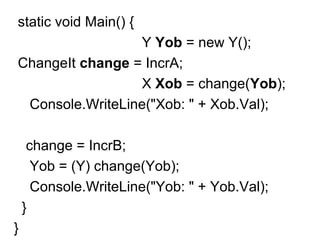
static void Main() {
Y Yob = new Y();
ChangeIt change = IncrA;
X Xob = change(Yob);
Console.WriteLine("Xob: " + Xob.Val);
change = IncrB;
Yob = (Y) change(Yob);
Console.WriteLine("Yob: " + Yob.Val);
}
}
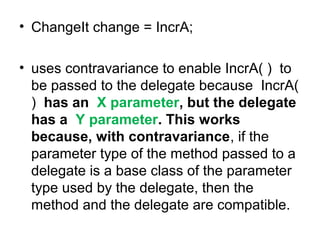
• ChangeIt change = IncrA;
• uses contravariance to enable IncrA( ) to
be passed to the delegate because IncrA(
) has an X parameter, but the delegate
has a Y parameter. This works
because, with contravariance, if the
parameter type of the method passed to a
delegate is a base class of the parameter
type used by the delegate, then the
method and the delegate are compatible.
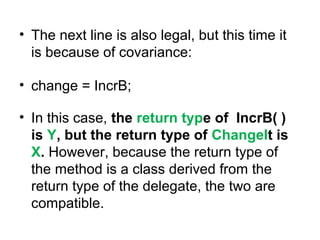
• The next line is also legal, but this time it
is because of covariance:
• change = IncrB;
• In this case, the return type of IncrB( )
is Y, but the return type of ChangeIt is
X. However, because the return type of
the method is a class derived from the
return type of the delegate, the two are
compatible.
Anonymous Method

Delegate

  • 1.
  • 2.
    Delegate • A delegateprovides a way to encapsulate a method. • An event is a notification that some action has occurred. • Delegates and events are related because an event is built upon a delegate.
  • 3.
    • A delegateis an object that can refer to a method. • when you create a delegate, you are creating an object that can hold a reference to a method. • Furthermore, the method can be called through this reference. • A delegate can invoke the method to which it refers. • A delegate in C# is similar to a function pointer in C/C++.
  • 4.
    • A delegatetype is declared using the keyword delegate. delegate return-type name (parameter-list ); • return-type is the type of value returned by the methods that the delegate will be calling. • The name of the delegate is specified by name. • The parameters required by the methods called through the delegate are specified in the parameter-list.
  • 5.
    • A delegateinstance (Object) can refer to and call methods whose return type and parameter list match those specified by the delegate declaration. • The method can be either an instance method associated with an object or a static method associated with a class.
  • 6.
    using System; delegate stringStrMod(string str); class DelegateTest { static string ReplaceSpaces(string s) { Console.WriteLine("Replacing spaces with hyphens."); return s.Replace(' ', '-'); }
  • 7.
    static string RemoveSpaces(strings) { string temp = ""; int i; Console.WriteLine("Removing spaces.") for(i=0; i < s.Length; i++) if(s[i] != ' ') temp += s[i]; return temp; }
  • 8.
    static string Reverse(strings) { string temp = ""; int i, j; Console.WriteLine("Reversing string."); for(j=0, i=s.Length-1; i >= 0; i--, j++) temp += s[i]; return temp; }
  • 9.
    static void Main(){ StrMod strOp = new StrMod(ReplaceSpaces); string str; str = strOp("This is a test."); Console.WriteLine("Resulting string: " + str); Console.WriteLine(); strOp2 = new StrMod(RemoveSpaces); str = strOp2("This is a test."); Console.WriteLine("Resulting string: " + str);
  • 10.
    strOp = newStrMod(Reverse); str = strOp("This is a test."); Console.WriteLine("Resulting string: " + str); } } //output Replacing spaces with hyphens. Resulting string: This-is-a-test. Removing spaces. Resulting string: Thisisatest. Reversing string. Resulting string: .tset a si sihT
  • 12.
    Delegate Method Group Conversion •Since version 2.0, C# has included an option that significantly simplifies the syntax that assigns a method to a delegate. • This feature is called method group conversion, and it allows you to simply assign the name of a method to a delegate, without using new or explicitly invoking the delegate’s constructor.
  • 13.
    // use methodgroup conversion StrMod strOp = ReplaceSpaces; string str; // Call methods through the delegate. str = strOp("This is a test."); Console.WriteLine("Resulting string: " + str); Console.WriteLine();
  • 15.
    Instance Methods asDelegates delegate string StrMod(string str); class StringOps { public string ReplaceSpaces(string s) { Console.WriteLine("Replacing spaces with hyphens."); return s.Replace(' ', '-'); }
  • 16.
    public string RemoveSpaces(strings) { string temp = ""; int i; Console.WriteLine("Removing spaces."); for(i=0; i < s.Length; i++) if(s[i] != ' ') temp += s[i]; return temp; }
  • 17.
    public string Reverse(strings) { string temp = ""; int i, j; Console.WriteLine("Reversing string."); for(j=0, i=s.Length-1; i >= 0; i--, j++) temp += s[i]; return temp; } } class DelegateTest { static void Main() { StringOps so = new StringOps();
  • 18.
    // Initialize adelegate. StrMod strOp = so.ReplaceSpaces; string str; // Call methods through delegates. str = strOp("This is a test."); Console.WriteLine("Resulting string: " + str); Console.WriteLine();
  • 19.
    strOp = so.RemoveSpaces; str= strOp("This is a test."); Console.WriteLine("Resulting string: " + str); Console.WriteLine(); strOp = so.Reverse; str = strOp("This is a test."); Console.WriteLine("Resulting string: " + str); }}
  • 21.
    Multicasting • One ofthe most exciting features of a delegate is its support for multicasting. • Multicasting is the ability to create an invocation list, or chain, of methods that will be automatically called when a delegate is invoked. • Such a chain is very easy to create.
  • 22.
    • Simply instantiatea delegate, and then use the + or += operator to add methods to the chain. • To remove a method, use – or – =. • If the delegate returns a value, then the value returned by the last method in the list becomes the return value of the entire delegate invocation. • Thus, a delegate that makes use of multicasting will often have a void return type.
  • 23.
    using System; // Declarea delegate type. delegate void StrMod(ref string str); class MultiCastDemo { static void ReplaceSpaces(ref string s) { Console.WriteLine("Replacing spaces with hyphens."); s = s.Replace(' ', '-'); }
  • 24.
    static void RemoveSpaces(refstring s) { string temp = ""; int i; Console.WriteLine("Removing spaces."); for(i=0; i < s.Length; i++) if(s[i] != ' ') temp += s[i]; s = temp; }
  • 25.
    static void Reverse(refstring s) { string temp = ""; int i, j; Console.WriteLine("Reversing string."); for(j=0, i=s.Length-1; i >= 0; i--, j++) temp += s[i]; s = temp; }
  • 26.
    static void Main(){ StrMod strOp; StrMod replaceSp = ReplaceSpaces; StrMod removeSp = RemoveSpaces; StrMod reverseStr = Reverse; string str = "This is a test"; strOp = replaceSp; strOp += reverseStr; // Call multicast. strOp(ref str); Console.WriteLine("Resulting string: " + str);
  • 27.
    // Remove replaceand add remove. strOp -= replaceSp; strOp += removeSp; str = "This is a test."; // reset string // Call multicast. strOp(ref str); Console.WriteLine("Resulting string: " + str); Console.WriteLine(); } }
  • 28.
    output • • • • • • Replacing spaces withhyphens. Reversing string. Resulting string: tset-a-si-sihT Reversing string. Removing spaces. Resulting string: .tsetasisihT
  • 30.
    Covariance and Contravariance •here are two features that add flexibility to delegates: covariance and contravariance. Normally, the method that you pass to a delegate must have the same return type and signature as the delegate. • However, covariance and contravariance relax this rule slightly, as it pertains to derived types.
  • 31.
    • Covariance enablesa method to be assigned to a delegate when the method’s return type is a class derived from the class specified by the return type of the delegate. • Contravariance enables a method to be assigned to a delegate when a method’s parameter type is a base class of the class specified by the delegate’s declaration.
  • 32.
    covariance and contravariance usingSystem; class X { public int Val; } // Y is derived from X. class Y : X { } // This delegate returns X and takes a Y argument. delegate X ChangeIt(Y obj);
  • 33.
    class CoContraVariance { staticX IncrA(X obj) { X temp = new X(); temp.Val = obj.Val + 1; return temp; } static Y IncrB(Y obj) { Y temp = new Y(); temp.Val = obj.Val + 1; return temp; }
  • 34.
    static void Main(){ Y Yob = new Y(); ChangeIt change = IncrA; X Xob = change(Yob); Console.WriteLine("Xob: " + Xob.Val); change = IncrB; Yob = (Y) change(Yob); Console.WriteLine("Yob: " + Yob.Val); } }
  • 35.
    • ChangeIt change= IncrA; • uses contravariance to enable IncrA( ) to be passed to the delegate because IncrA( ) has an X parameter, but the delegate has a Y parameter. This works because, with contravariance, if the parameter type of the method passed to a delegate is a base class of the parameter type used by the delegate, then the method and the delegate are compatible.
  • 36.
    • The nextline is also legal, but this time it is because of covariance: • change = IncrB; • In this case, the return type of IncrB( ) is Y, but the return type of ChangeIt is X. However, because the return type of the method is a class derived from the return type of the delegate, the two are compatible.
  • 37.