Class 10
Computer Application
Chapter 3
User Defined Methods
in java
Presented by,
Siva Shankari Rajan,
CPSV
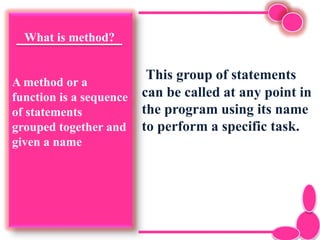
What is method?
A method or a
function is a sequence
of statements
grouped together and
given a name
This group of statements
can be called at any point in
the program using its name
to perform a specific task.
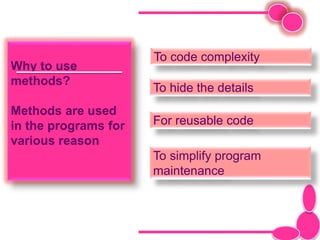
Why to use
methods?
Methods are used
in the programs for
various reason
To code complexity
To hide the details
For reusable code
To simplify program
maintenance
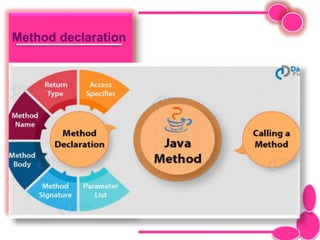
Method declaration
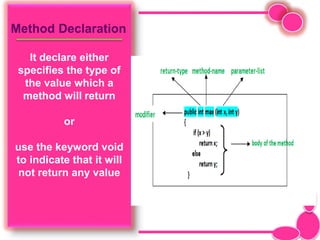
Method Declaration
It declare either
specifies the type of
the value which a
method will return
or
use the keyword void
to indicate that it will
not return any value
Method Declaration
A method consists of
two parts:
• Header part
• Body part.
The method header is the
first line of the function
declaration or definition.
The method body contains a
set of statements for related
operations written in curly
brackets.
Method Declaration
Header part :
1. Modifier
2. Return type
3. Method name
4. Parameter list
 Modifier tells the compiler how to
call the method.
 Return type specifies the type of
value returned from a function.
 Function name is the name
assigned to the method.
 Parameter list is comma-
separated list of variables of a
function.
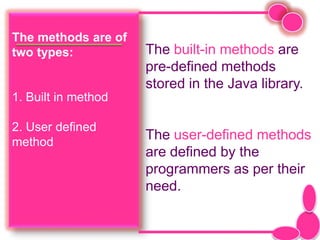
The methods are of
two types:
1. Built in method
2. User defined
method
The built-in methods are
pre-defined methods
stored in the Java library.
The user-defined methods
are defined by the
programmers as per their
need.
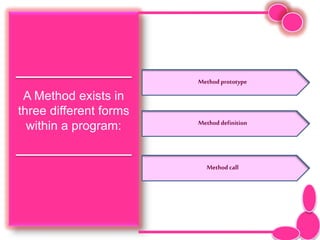
A Method exists in
three different forms
within a program:
Method prototype
Method definition
Method call
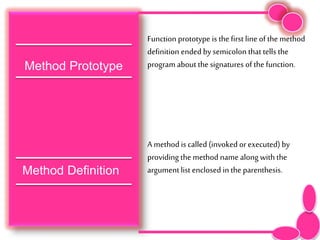
Method Prototype
Method Definition
Function prototype is the first line of the method
definition ended by semicolon that tells the
program about the signatures of the function.
A method is called (invokedorexecuted)by
providing the method name along with the
argument list enclosed in the parenthesis.
Method Call
A method is called (invokedorexecuted)by
providing the method name along with the
argument list enclosed in the parenthesis.
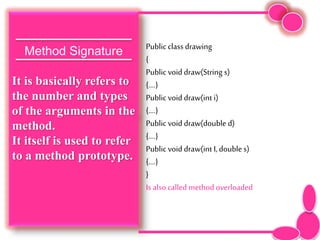
Method Signature
It is basically refers to
the number and types
of the arguments in the
method.
It itself is used to refer
to a method prototype.
Public class drawing
{
Public void draw(String s)
{….}
Public void draw(int i)
{….}
Public void draw(double d)
{….}
Public void draw(int I, double s)
{….}
}
Is also called method overloaded
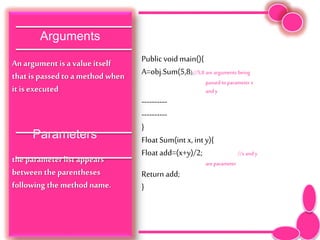
Arguments
An argumentis a value itself
that is passed to a method when
it is executed
Parameters
the parameter list appears
between the parentheses
following the method name.
Public void main(){
A=obj.Sum(5,8);//5,8 arearguments being
passed toparameter x
andy
----------
----------
}
Float Sum(int x, int y){
Float add=(x+y)/2; //x andy
areparameter
Return add;
}
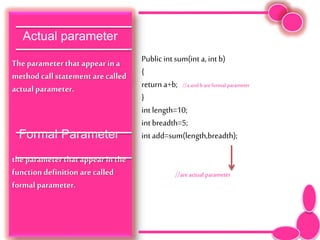
Actual parameter
Theparameter that appear in a
method call statement arecalled
actual parameter.
Formal Parameter
the parameter that appear in the
function definition are called
formal parameter.
Public int sum(int a, int b)
{
return a+b; //a andbareformal parameter
}
int length=10;
int breadth=5;
int add=sum(length,breadth);
//areactual parameter
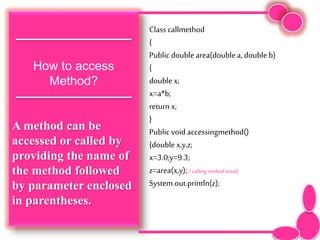
How to access
Method?
A method can be
accessed or called by
providing the name of
the method followed
by parameter enclosed
in parentheses.
Class callmethod
{
Public double area(double a, double b)
{
double x;
x=a*b;
return x;
}
Public void accessingmethod()
{double x,y,z;
x=3.0;y=9.3;
z=area(x,y);//calling method area()
System.out.println(z);
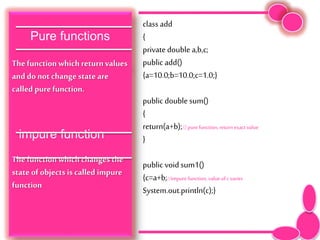
Pure functions
Thefunction which returnvalues
and do not change state are
called purefunction.
impure function
Thefunction which changesthe
state of objects is called impure
function
class add
{
private double a,b,c;
public add()
{a=10.0;b=10.0;c=1.0;}
public double sum()
{
return(a+b);// purefunction, return exact value
}
public void sum1()
{c=a+b;//impurefunction, value ofcvaries
System.out.println(c);}
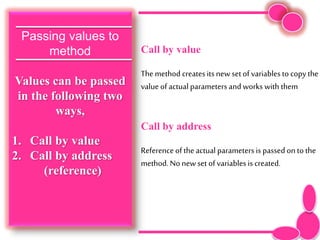
Passing values to
method
Values can be passed
in the following two
ways,
1. Call by value
2. Call by address
(reference)
Call by value
Themethod createsits newset of variables to copy the
value of actual parameters andworks with them
Call by address
Reference of the actual parameters is passed on to the
method. No newset ofvariables is created.
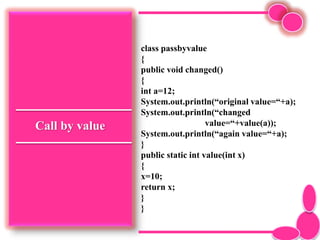
Call by value
class passbyvalue
{
public void changed()
{
int a=12;
System.out.println(“original value=“+a);
System.out.println(“changed
value=“+value(a));
System.out.println(“again value=“+a);
}
public static int value(int x)
{
x=10;
return x;
}
}
Call by Reference
class Test
{
int x;
Test(int i) { x = i; }
Test() { x = 0; }
}
class Main {
public static void main(String[] args) {
Test t = new Test(5); // t is a reference
change(t);
System.out.println(t.x);
}
public static void change(Test t)
{
t = new Test();
t.x = 10;
}
}
RecursiveMethod
Recursionin java is a
process in which a method
calls itself continuously.
It makes the code compact
but complex to understand.
public class RecursionExample1 {
static void p(){
System.out.println("hello");
p();
}
public static void main(String[] args) {
p();
}
}
Method overloading
Method overloading
means that there are
more than one
function doing
different kinds of jobs
but have same name.
this process is also
known as
polymorphism.
Public class calc
{
Public void sum(int s,int v)
{System.out.println(s+v);
}
Public void sum(int I, int j,int k)
{
System.out.println(i+j+k);
}
Public static void main(string args[])
{
calc ob=new calc();
Ob.sum(7,8);
Ob.sum(4,5,7);}
}
Thanks for watching

Class 10

  • 1.
    Class 10 Computer Application Chapter3 User Defined Methods in java Presented by, Siva Shankari Rajan, CPSV
  • 2.
    What is method? Amethod or a function is a sequence of statements grouped together and given a name This group of statements can be called at any point in the program using its name to perform a specific task.
  • 3.
    Why to use methods? Methodsare used in the programs for various reason To code complexity To hide the details For reusable code To simplify program maintenance
  • 4.
  • 5.
    Method Declaration It declareeither specifies the type of the value which a method will return or use the keyword void to indicate that it will not return any value
  • 6.
    Method Declaration A methodconsists of two parts: • Header part • Body part. The method header is the first line of the function declaration or definition. The method body contains a set of statements for related operations written in curly brackets.
  • 7.
    Method Declaration Header part: 1. Modifier 2. Return type 3. Method name 4. Parameter list  Modifier tells the compiler how to call the method.  Return type specifies the type of value returned from a function.  Function name is the name assigned to the method.  Parameter list is comma- separated list of variables of a function.
  • 8.
    The methods areof two types: 1. Built in method 2. User defined method The built-in methods are pre-defined methods stored in the Java library. The user-defined methods are defined by the programmers as per their need.
  • 9.
    A Method existsin three different forms within a program: Method prototype Method definition Method call
  • 10.
    Method Prototype Method Definition Functionprototype is the first line of the method definition ended by semicolon that tells the program about the signatures of the function. A method is called (invokedorexecuted)by providing the method name along with the argument list enclosed in the parenthesis.
  • 11.
    Method Call A methodis called (invokedorexecuted)by providing the method name along with the argument list enclosed in the parenthesis.
  • 12.
    Method Signature It isbasically refers to the number and types of the arguments in the method. It itself is used to refer to a method prototype. Public class drawing { Public void draw(String s) {….} Public void draw(int i) {….} Public void draw(double d) {….} Public void draw(int I, double s) {….} } Is also called method overloaded
  • 13.
    Arguments An argumentis avalue itself that is passed to a method when it is executed Parameters the parameter list appears between the parentheses following the method name. Public void main(){ A=obj.Sum(5,8);//5,8 arearguments being passed toparameter x andy ---------- ---------- } Float Sum(int x, int y){ Float add=(x+y)/2; //x andy areparameter Return add; }
  • 14.
    Actual parameter Theparameter thatappear in a method call statement arecalled actual parameter. Formal Parameter the parameter that appear in the function definition are called formal parameter. Public int sum(int a, int b) { return a+b; //a andbareformal parameter } int length=10; int breadth=5; int add=sum(length,breadth); //areactual parameter
  • 15.
    How to access Method? Amethod can be accessed or called by providing the name of the method followed by parameter enclosed in parentheses. Class callmethod { Public double area(double a, double b) { double x; x=a*b; return x; } Public void accessingmethod() {double x,y,z; x=3.0;y=9.3; z=area(x,y);//calling method area() System.out.println(z);
  • 16.
    Pure functions Thefunction whichreturnvalues and do not change state are called purefunction. impure function Thefunction which changesthe state of objects is called impure function class add { private double a,b,c; public add() {a=10.0;b=10.0;c=1.0;} public double sum() { return(a+b);// purefunction, return exact value } public void sum1() {c=a+b;//impurefunction, value ofcvaries System.out.println(c);}
  • 17.
    Passing values to method Valuescan be passed in the following two ways, 1. Call by value 2. Call by address (reference) Call by value Themethod createsits newset of variables to copy the value of actual parameters andworks with them Call by address Reference of the actual parameters is passed on to the method. No newset ofvariables is created.
  • 18.
    Call by value classpassbyvalue { public void changed() { int a=12; System.out.println(“original value=“+a); System.out.println(“changed value=“+value(a)); System.out.println(“again value=“+a); } public static int value(int x) { x=10; return x; } }
  • 19.
    Call by Reference classTest { int x; Test(int i) { x = i; } Test() { x = 0; } } class Main { public static void main(String[] args) { Test t = new Test(5); // t is a reference change(t); System.out.println(t.x); } public static void change(Test t) { t = new Test(); t.x = 10; } }
  • 20.
    RecursiveMethod Recursionin java isa process in which a method calls itself continuously. It makes the code compact but complex to understand. public class RecursionExample1 { static void p(){ System.out.println("hello"); p(); } public static void main(String[] args) { p(); } }
  • 21.
    Method overloading Method overloading meansthat there are more than one function doing different kinds of jobs but have same name. this process is also known as polymorphism. Public class calc { Public void sum(int s,int v) {System.out.println(s+v); } Public void sum(int I, int j,int k) { System.out.println(i+j+k); } Public static void main(string args[]) { calc ob=new calc(); Ob.sum(7,8); Ob.sum(4,5,7);} }
  • 22.