“If you cut down a
forest, it doesn't
matter how many
sawmills you have
if there are no
more trees.” ~ Susan George
By : Sophia Elsadig
Valeria Castillo
Marium Khan
Biology- 5B 2/18
• Deforestation is the “action or process of
clearing of forests” (Merrium Webster).
• Deforestation occurs due to various reasons.
Agriculture, urban development, cattle ranching,
subsistence farming, logging, and natural
disasters such as forest fires, are some of these
reasons.
• Forests cover about 30-31% of our planet, but 46-
58 thousands of square miles are lost each year
to deforestation. To put in perspective that
equates to about 36 football fields per minute.
Throughout the majority of
history, most people we’re
hunter gatherers that were
nomadic.They followed their
food sources.The introduction
of agriculture greatly increased
deforestation, because people
could now settle down in one
area to produce crops.
Industrialization is another
major contributor to
deforestation.The increase of
urban lifestyle increased the
need to cut down trees.
A few known areas with the highest deforestation rates
in world are:
1) The Philippines- The islands that make up the
Philippines used to be completely forested.
Currently about 35% of those forests remain.
2) Ghana- At one point about two-thirds of Ghana was
covered with a forest, but as time went by less than
10% of that forest remains.
3) Honduras- A long time ago Honduras was entirely
covered with trees, with half a percent of the land not
forested. But today about half of that remains (52%).
Between 1990- 2005, Honduras saw a decline of
about 37% in its forest cover.
Climate change- Trees act as sponges that absorb harmful
greenhouse gasses, such as carbon dioxide. Fewer trees means
more gasses free in the atmosphere, thus contributing to the
ongoing climate change and global warming. About 15% of
greenhouse gasses are the result of deforestation.
Biodiversity- Tropical rainforests are home to about 70% of
the worlds plant and animal species.When trees are cleared,
the animals and plant inhabiting the area are left without a
home and this can lead to endangerment and even extinction.
Water Cycle- Without trees in an area to evaporate ground
water and produce water vapor, the water cycle in the area is
disrupted and this can create drier climate.
Soil- In tropical rainforests the nutrients is mainly located
within the trees and vegetation occupying the area.The soil
does not contain an abundance of nutrients. So when forests are
cleared it is very hard for the ecosystem to rebuild itself, due to
the lack of nutrients in the soil.This leads to soil erosion, and
runoff.
• Loss of species
• Soil Erosion
• Humans
• Animals
• Also affects some cycles:
• The water cycle
• The oxygen cycle
• The carbon cycle
About 70% of the world’s plants and animals
live in forests. But due to deforestation they are
losing their habitats.When they loose their
habitat this leads to an extinction of species.
This has many consequences
for medical research and
the human population that
relies on the animals and
plants.
Lonely monkey! 
• Trees play such an important
role in the water cycle by
containing water in their
roots and then releasing it
into the atmosphere.
• In the Amazon, more than
half of the water in the
ecosystem is contained in
the plants.Without the plants
than the climate may
become dryer.
How will this happen
without trees?
 World Wildlife Fund (WWF) has targeted zero net
deforestation by 2020.
-Countries need to commit to reducing gross forest-
based greenhouse gas emissions by at least
75% by 2020
Achievements by countries:
 the Amazon Regional Protected Area
(ARPA) Programme, and the three-country
Heart of Borneo initiative.
 The Zero Deforestation Law –introduced by Paraguay in
2004 has dropped the rate of deforestation in the Atlantic
Forests by an incredible 85%.
http://wwf.panda.org/what_we_do/how_we_w
ork/conservation/forests/zeronetdeforestation/
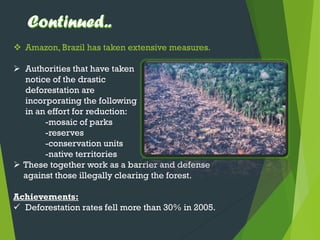
 Amazon, Brazil has taken extensive measures.
 Authorities that have taken
notice of the drastic
deforestation are
incorporating the following
in an effort for reduction:
-mosaic of parks
-reserves
-conservation units
-native territories
 These together work as a barrier and defense
against those illegally clearing the forest.
Achievements:
 Deforestation rates fell more than 30% in 2005.
Reaching the goal of zero net deforestation can be done by:
 Getting both private and public sectors involved.
Including producer, consumer, financiers and local
stakeholders in places threatened by deforestation.
 Reducing emissions from deforestation and forest
degradation by getting countries to sign an agreement,
in exchange for incentives (as done in the ‘REDD’s
program’)
 Implementing land-use policies, to keep track of who’s
using the land
 Protection and sustainable management of forests
 Promoting responsible consumption and production of
forest-related goods and agricultural commodities. (i.e.
reuse, reduce and recycle)
Work Cited
“Brazil's Greed, Deforestation and Environmental Genocide Worsens : The Canadian National
Newspaper." Brazil's Greed, Deforestation and The Environmental Genocide
Worsens : The Canadian National Newspaper. The Guardian, n.d. Web. 16 Feb.
2014.
"Cost of Deforestation in Kenya Far Exceeds Gains from Forestry and Logging, UN Joint Study
Finds." UN News Center. UN, 05 Nov. 2012. Web. 16 Feb. 2014.
“Deforestation in the Amazon." Theguardian.com. Guardian News and Media, 24 Oct. 2007.
Web. 16 Feb. 2014.
"Deforestation: Solved via Carbon Markets?" Environmental Defense Fund. Environmental
Defense Fund, n.d. Web. 16 Feb. 2014.
"Deforestation: Solved via Carbon Markets?" Environmental Defense Fund. N.p., n.d. Web. 16
Feb. 2014.
"Recycling Stock Photos, Illustrations, and Vector Art." Recycling Stock Photos, Recycling Stock
Photography, Recycling Stock Images : Shutterstock.com. N.p., n.d. Web. 16 Feb.
2014.
Wallace, Scott. "Farming the Amazon." National Geographic. National Geographic, n.d. Web.
16 Feb. 2014.
"Zero Net Deforestation." WWF. WWF, n.d. Web. 16 Feb. 2014.
Cesareo, Kerry, and Linda K. Walker. "Deforestation." WorldWildlife.org. World Wildlife
Fund, n.d. Web. 18 Feb. 2014.
"Deforestation." National Geographic. National Geographic Society, n.d. Web. 16 Feb. 2014.
"Tropical Deforestation : Feature Articles." Tropical Deforestation : Feature Articles. Earth
Observatory Project, n.d. Web. 18 Feb. 2014.
Work Cited continued..
Szalay, Jessie. "Deforestation: Facts, Causes & Effects." LiveScience.
TechMedia Network, 06 Mar. 2013. Web. 17 Feb. 2014.
"10 Countries With the Highest Deforestation Rates in the World."
TreeHugger. N.p., n.d. Web. 19 Feb. 2014.

Deforestation: Environmental Problems

  • 1.
    “If you cutdown a forest, it doesn't matter how many sawmills you have if there are no more trees.” ~ Susan George By : Sophia Elsadig Valeria Castillo Marium Khan Biology- 5B 2/18
  • 2.
    • Deforestation isthe “action or process of clearing of forests” (Merrium Webster). • Deforestation occurs due to various reasons. Agriculture, urban development, cattle ranching, subsistence farming, logging, and natural disasters such as forest fires, are some of these reasons. • Forests cover about 30-31% of our planet, but 46- 58 thousands of square miles are lost each year to deforestation. To put in perspective that equates to about 36 football fields per minute.
  • 3.
    Throughout the majorityof history, most people we’re hunter gatherers that were nomadic.They followed their food sources.The introduction of agriculture greatly increased deforestation, because people could now settle down in one area to produce crops. Industrialization is another major contributor to deforestation.The increase of urban lifestyle increased the need to cut down trees.
  • 4.
    A few knownareas with the highest deforestation rates in world are: 1) The Philippines- The islands that make up the Philippines used to be completely forested. Currently about 35% of those forests remain. 2) Ghana- At one point about two-thirds of Ghana was covered with a forest, but as time went by less than 10% of that forest remains. 3) Honduras- A long time ago Honduras was entirely covered with trees, with half a percent of the land not forested. But today about half of that remains (52%). Between 1990- 2005, Honduras saw a decline of about 37% in its forest cover.
  • 5.
    Climate change- Treesact as sponges that absorb harmful greenhouse gasses, such as carbon dioxide. Fewer trees means more gasses free in the atmosphere, thus contributing to the ongoing climate change and global warming. About 15% of greenhouse gasses are the result of deforestation. Biodiversity- Tropical rainforests are home to about 70% of the worlds plant and animal species.When trees are cleared, the animals and plant inhabiting the area are left without a home and this can lead to endangerment and even extinction. Water Cycle- Without trees in an area to evaporate ground water and produce water vapor, the water cycle in the area is disrupted and this can create drier climate. Soil- In tropical rainforests the nutrients is mainly located within the trees and vegetation occupying the area.The soil does not contain an abundance of nutrients. So when forests are cleared it is very hard for the ecosystem to rebuild itself, due to the lack of nutrients in the soil.This leads to soil erosion, and runoff.
  • 6.
    • Loss ofspecies • Soil Erosion • Humans • Animals • Also affects some cycles: • The water cycle • The oxygen cycle • The carbon cycle
  • 7.
    About 70% ofthe world’s plants and animals live in forests. But due to deforestation they are losing their habitats.When they loose their habitat this leads to an extinction of species. This has many consequences for medical research and the human population that relies on the animals and plants. Lonely monkey! 
  • 8.
    • Trees playsuch an important role in the water cycle by containing water in their roots and then releasing it into the atmosphere. • In the Amazon, more than half of the water in the ecosystem is contained in the plants.Without the plants than the climate may become dryer. How will this happen without trees?
  • 9.
     World WildlifeFund (WWF) has targeted zero net deforestation by 2020. -Countries need to commit to reducing gross forest- based greenhouse gas emissions by at least 75% by 2020 Achievements by countries:  the Amazon Regional Protected Area (ARPA) Programme, and the three-country Heart of Borneo initiative.  The Zero Deforestation Law –introduced by Paraguay in 2004 has dropped the rate of deforestation in the Atlantic Forests by an incredible 85%. http://wwf.panda.org/what_we_do/how_we_w ork/conservation/forests/zeronetdeforestation/
  • 10.
     Amazon, Brazilhas taken extensive measures.  Authorities that have taken notice of the drastic deforestation are incorporating the following in an effort for reduction: -mosaic of parks -reserves -conservation units -native territories  These together work as a barrier and defense against those illegally clearing the forest. Achievements:  Deforestation rates fell more than 30% in 2005.
  • 11.
    Reaching the goalof zero net deforestation can be done by:  Getting both private and public sectors involved. Including producer, consumer, financiers and local stakeholders in places threatened by deforestation.  Reducing emissions from deforestation and forest degradation by getting countries to sign an agreement, in exchange for incentives (as done in the ‘REDD’s program’)  Implementing land-use policies, to keep track of who’s using the land  Protection and sustainable management of forests  Promoting responsible consumption and production of forest-related goods and agricultural commodities. (i.e. reuse, reduce and recycle)
  • 13.
    Work Cited “Brazil's Greed,Deforestation and Environmental Genocide Worsens : The Canadian National Newspaper." Brazil's Greed, Deforestation and The Environmental Genocide Worsens : The Canadian National Newspaper. The Guardian, n.d. Web. 16 Feb. 2014. "Cost of Deforestation in Kenya Far Exceeds Gains from Forestry and Logging, UN Joint Study Finds." UN News Center. UN, 05 Nov. 2012. Web. 16 Feb. 2014. “Deforestation in the Amazon." Theguardian.com. Guardian News and Media, 24 Oct. 2007. Web. 16 Feb. 2014. "Deforestation: Solved via Carbon Markets?" Environmental Defense Fund. Environmental Defense Fund, n.d. Web. 16 Feb. 2014. "Deforestation: Solved via Carbon Markets?" Environmental Defense Fund. N.p., n.d. Web. 16 Feb. 2014. "Recycling Stock Photos, Illustrations, and Vector Art." Recycling Stock Photos, Recycling Stock Photography, Recycling Stock Images : Shutterstock.com. N.p., n.d. Web. 16 Feb. 2014. Wallace, Scott. "Farming the Amazon." National Geographic. National Geographic, n.d. Web. 16 Feb. 2014. "Zero Net Deforestation." WWF. WWF, n.d. Web. 16 Feb. 2014. Cesareo, Kerry, and Linda K. Walker. "Deforestation." WorldWildlife.org. World Wildlife Fund, n.d. Web. 18 Feb. 2014. "Deforestation." National Geographic. National Geographic Society, n.d. Web. 16 Feb. 2014. "Tropical Deforestation : Feature Articles." Tropical Deforestation : Feature Articles. Earth Observatory Project, n.d. Web. 18 Feb. 2014.
  • 14.
    Work Cited continued.. Szalay,Jessie. "Deforestation: Facts, Causes & Effects." LiveScience. TechMedia Network, 06 Mar. 2013. Web. 17 Feb. 2014. "10 Countries With the Highest Deforestation Rates in the World." TreeHugger. N.p., n.d. Web. 19 Feb. 2014.