Defining “Waste” As it Applies to Service OrganizationsAnything that does not add value to the customer is a waste. Waste only adds to time and cost.And the definition of “waste” in a service organization is quite similar to its definition in Lean manufacturing.When you look at a process, this customer could be an external customer/end user (consumer) for a process that has an impact on customers. For an internal process of an organization, this refers to an internal customer. Examples of the process of the former types include: sales, marketing, production, etc. The examples of the process in the later bucket includes HR activities and may referancetraining, recruitment, administration, etc.
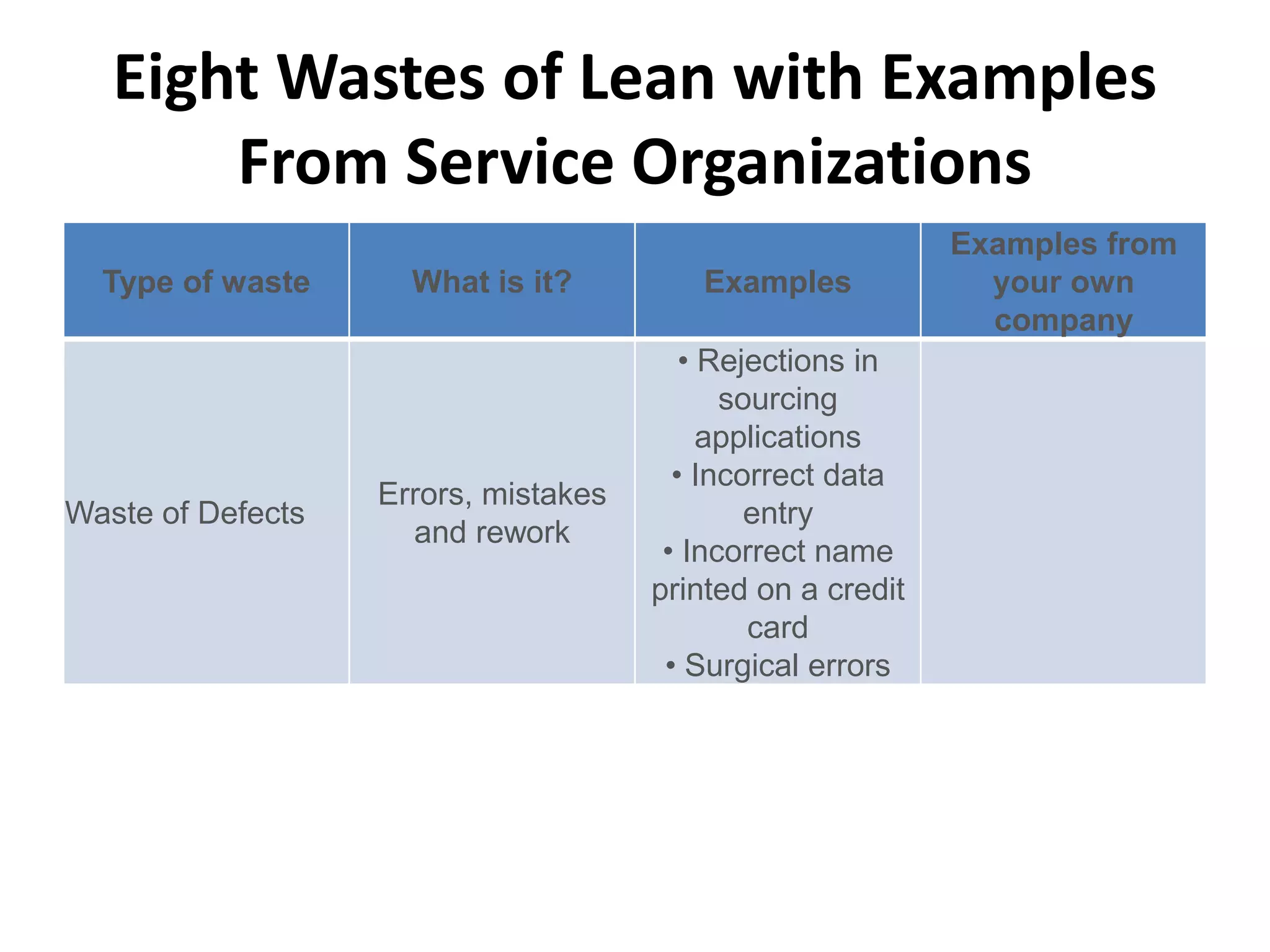
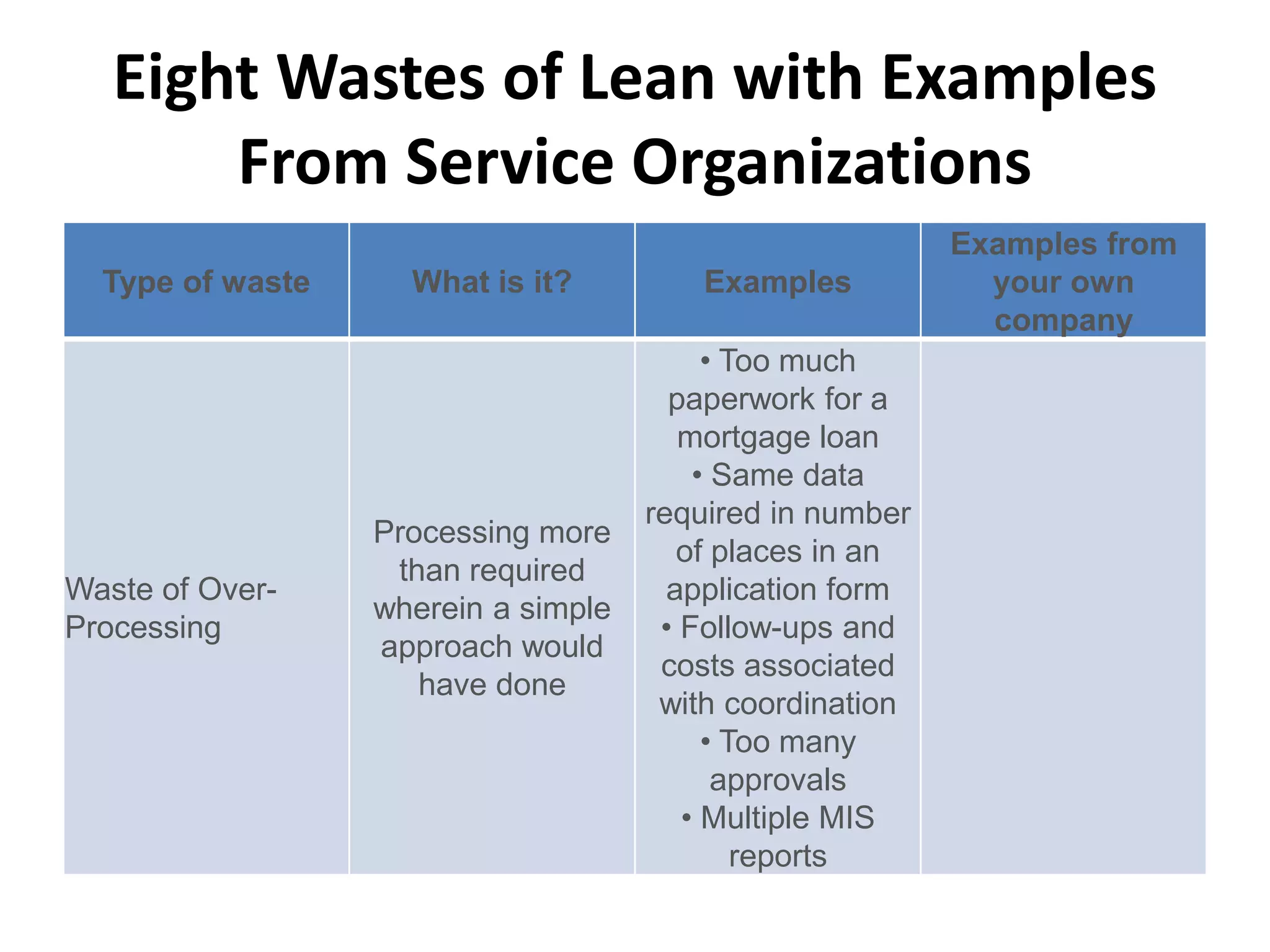
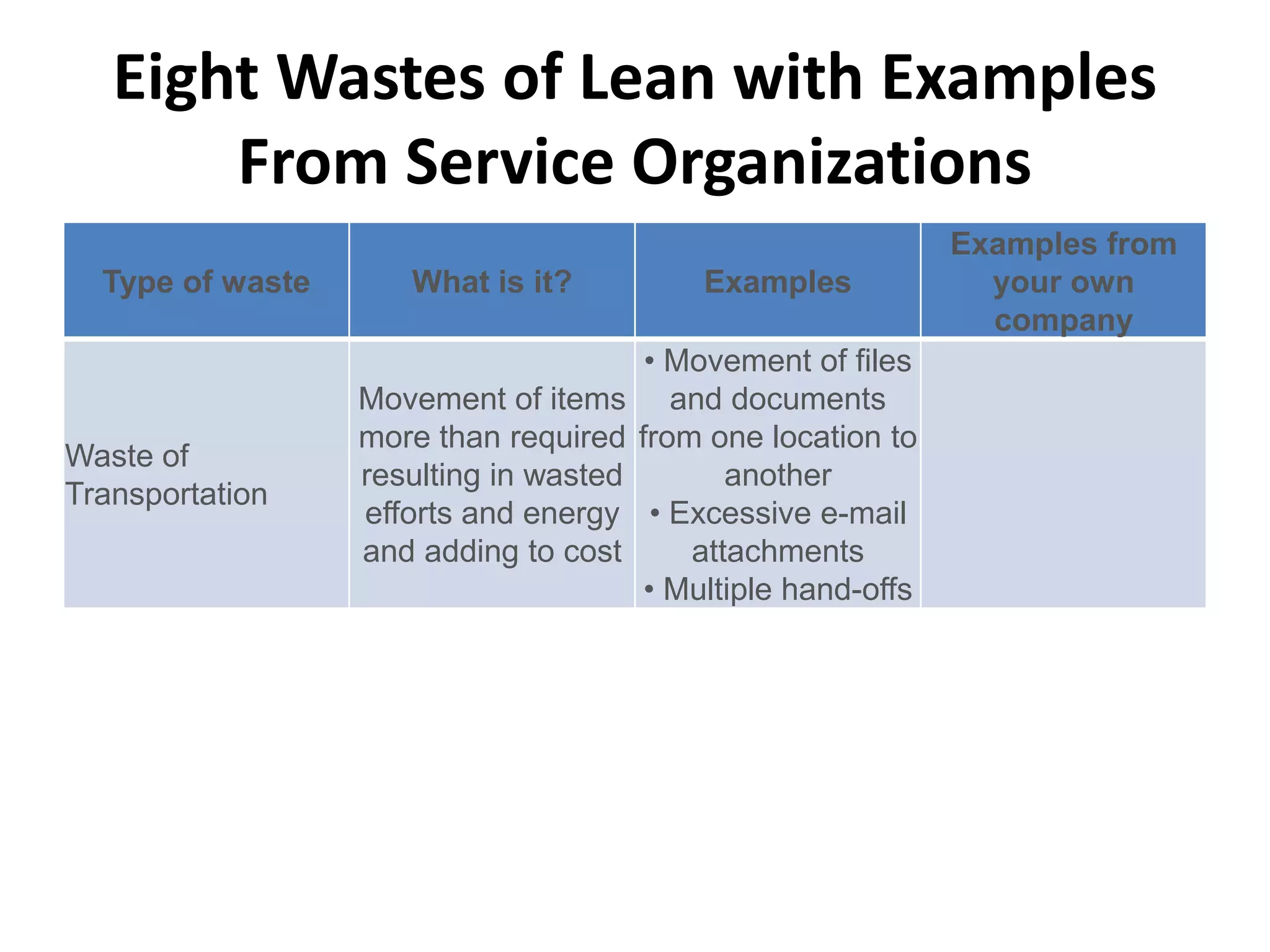
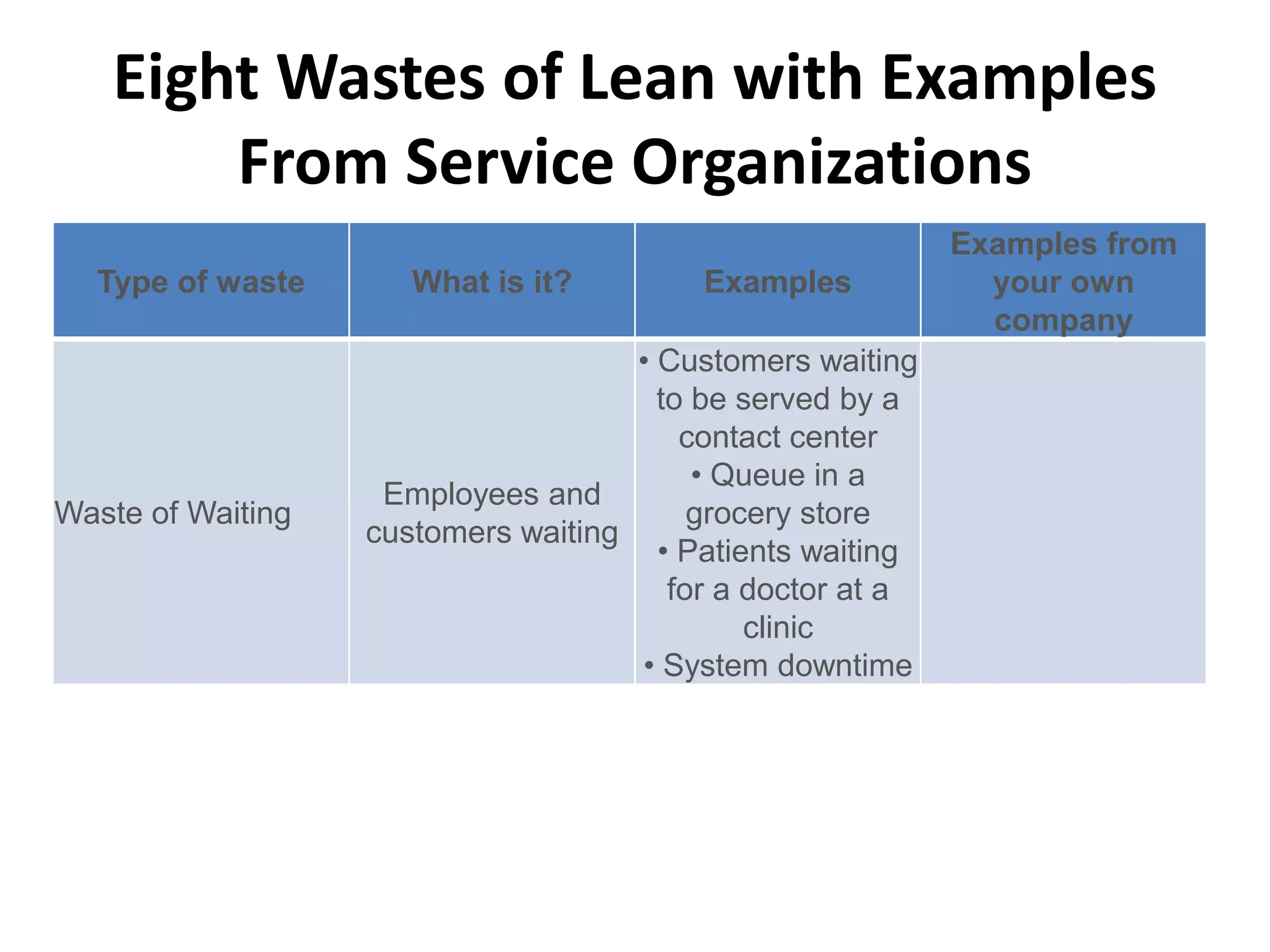
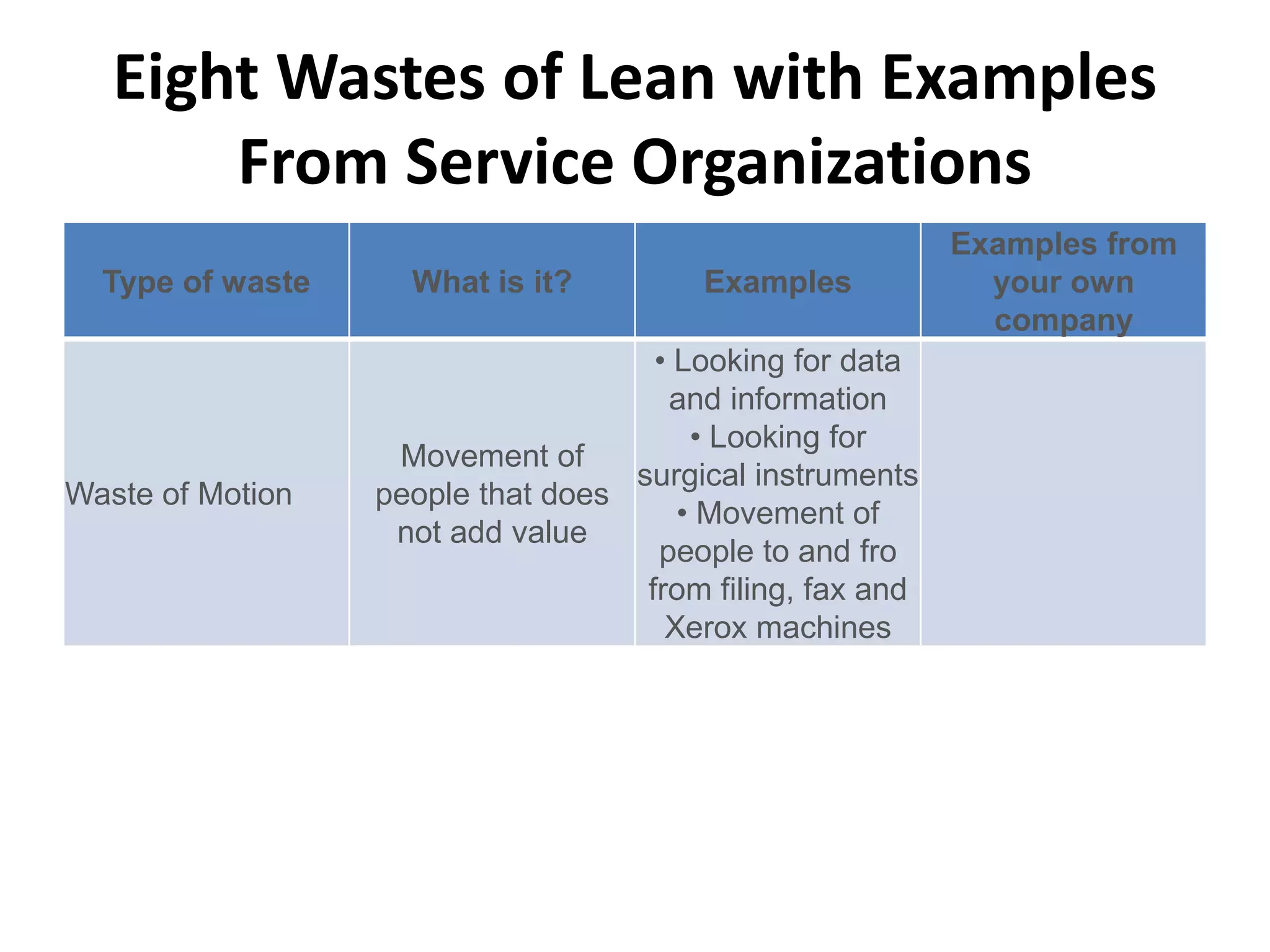
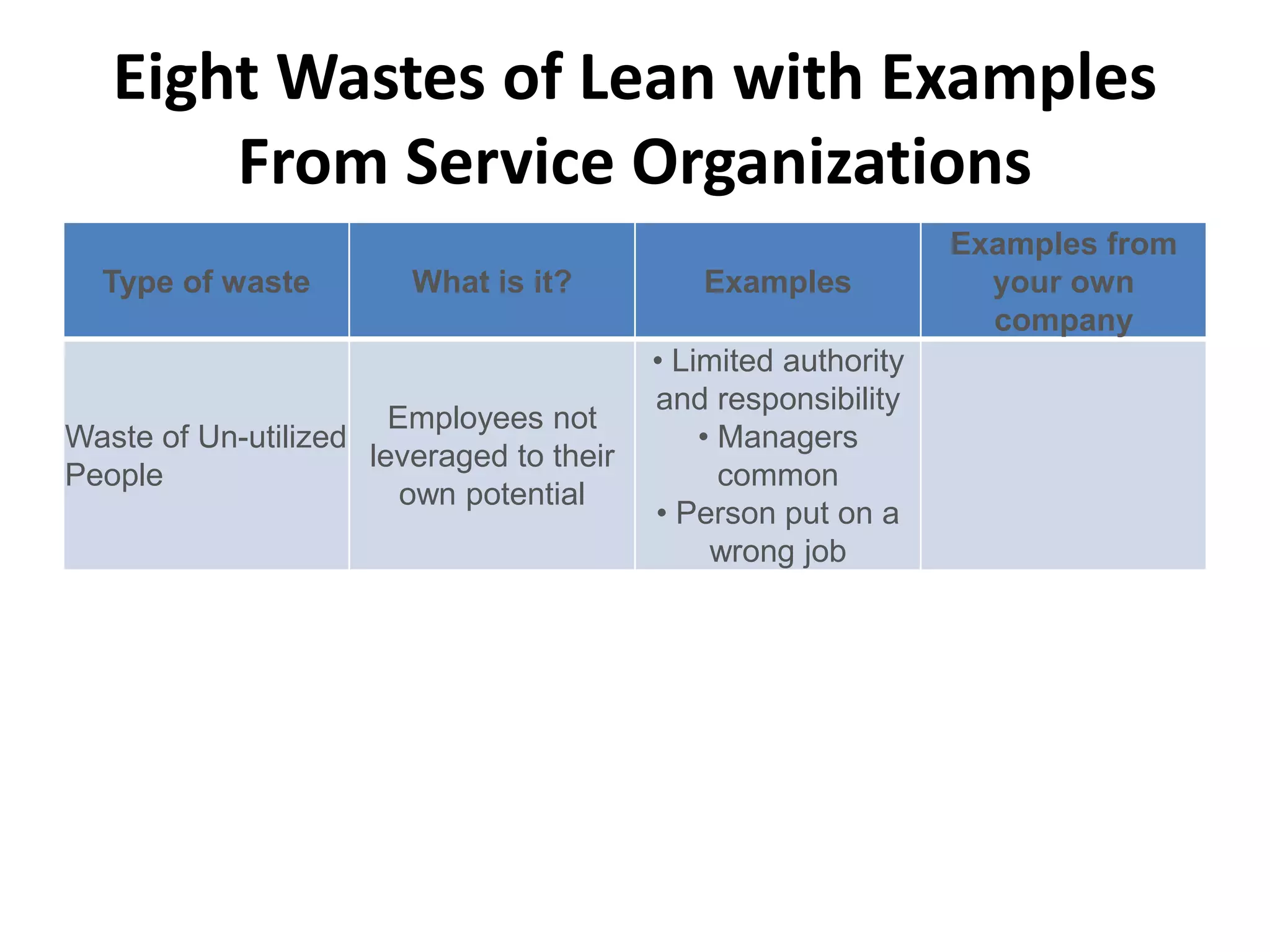
Defining “Waste” As it Applies to Service OrganizationsThe Eight Wastes of LeanKudos to TaichiOhno, the father of Toyota Production System. His eight wastes of Lean have a universal application. Despite what some practitioners may say or write, the eight wastes of Lean are applicable not just in Lean manufacturing but also in services. Take any context and you'll see for yourself the applicability of the wastes as expressed by Ohno.The following tables summarizes the eight wastes of Lean with examples from services. I have kept a column empty for you to fill with the ones that are visible in your own company.
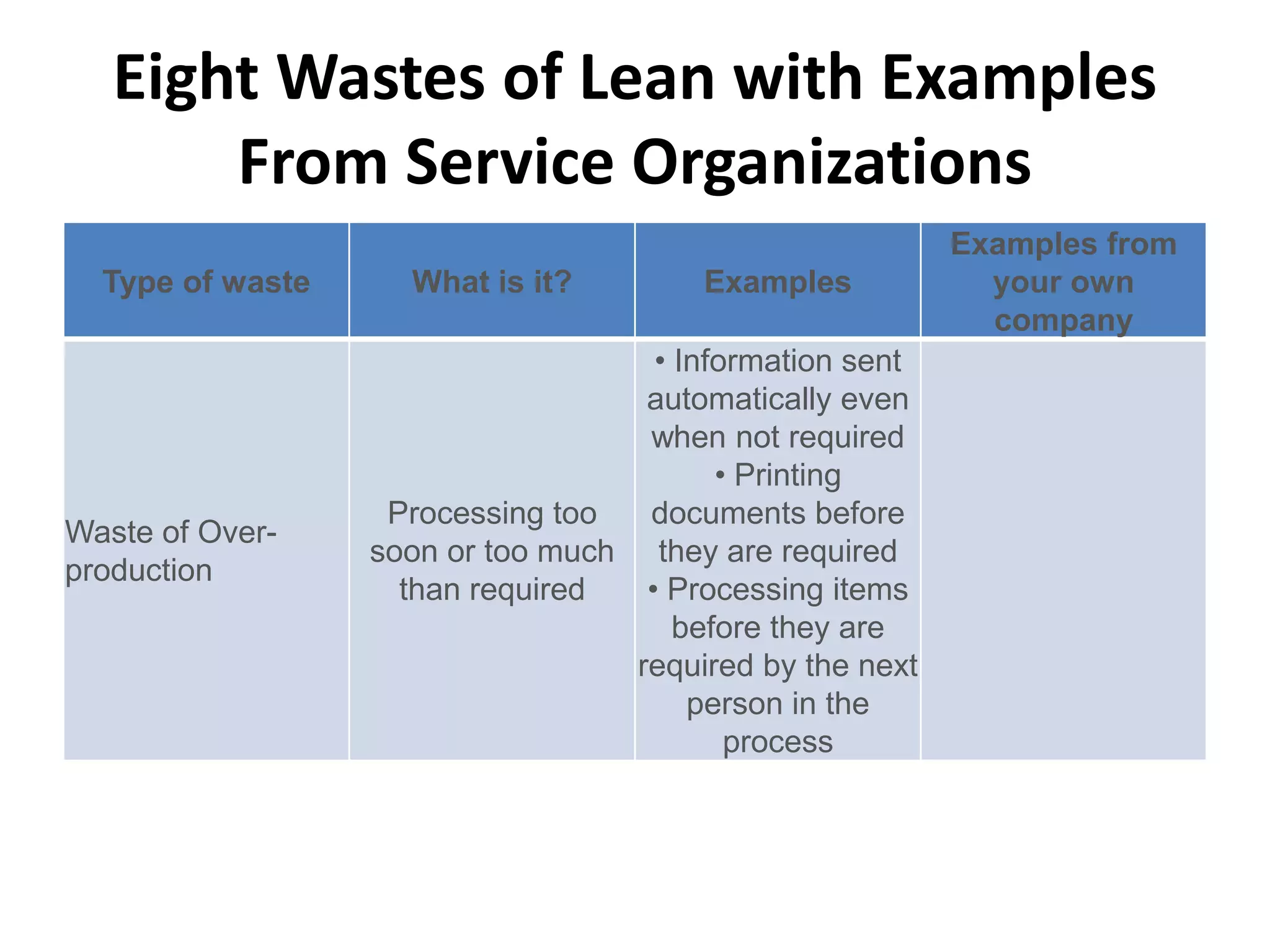
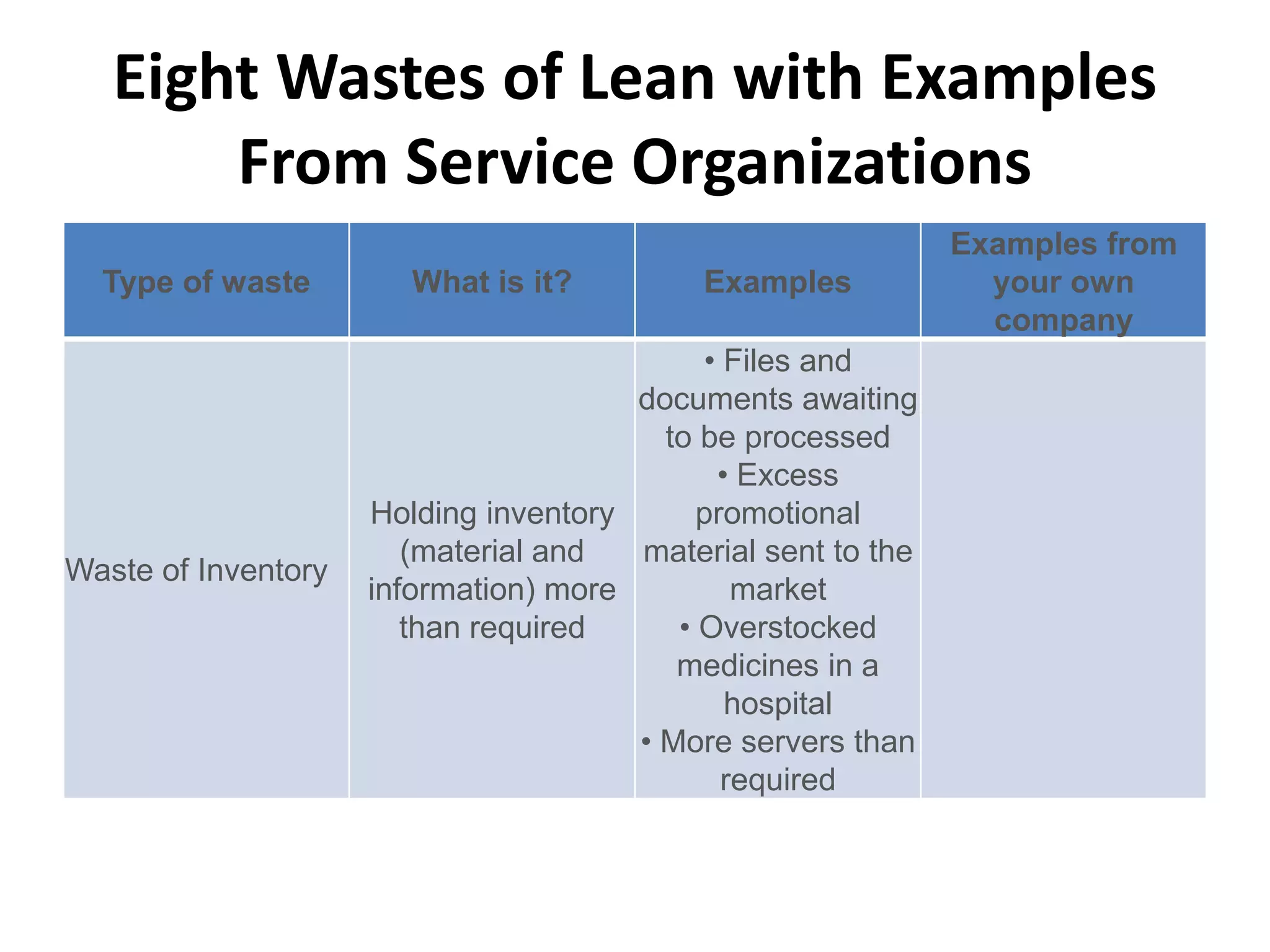
Eight Wastes of Lean with Examples From Service Organizations
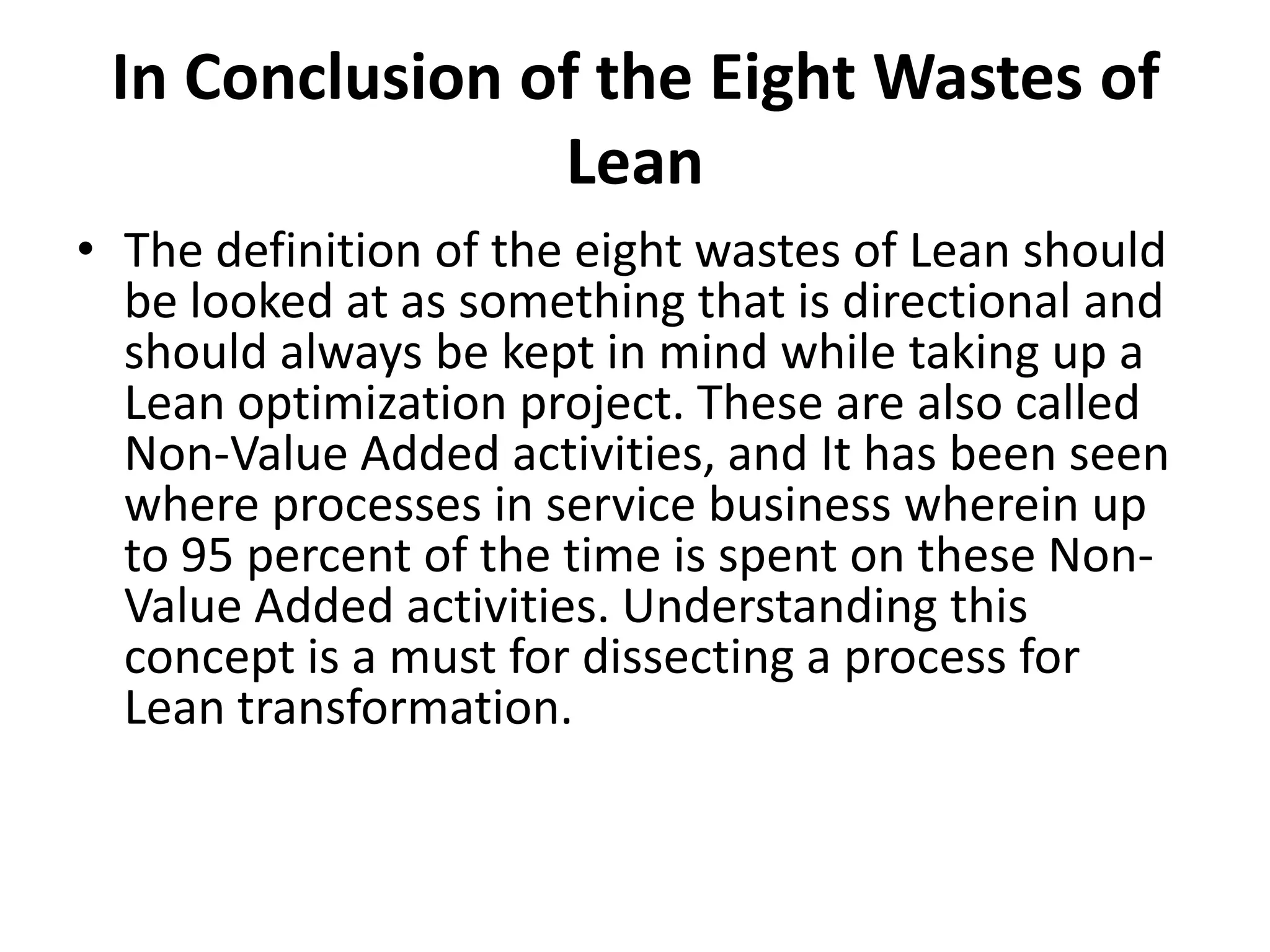
In Conclusion of the Eight Wastes of LeanThe definition of the eight wastes of Lean should be looked at as something that is directional and should always be kept in mind while taking up a Lean optimization project. These are also called Non-Value Added activities, and It has been seen where processes in service business wherein up to 95 percent of the time is spent on these Non-Value Added activities. Understanding this concept is a must for dissecting a process for Lean transformation.
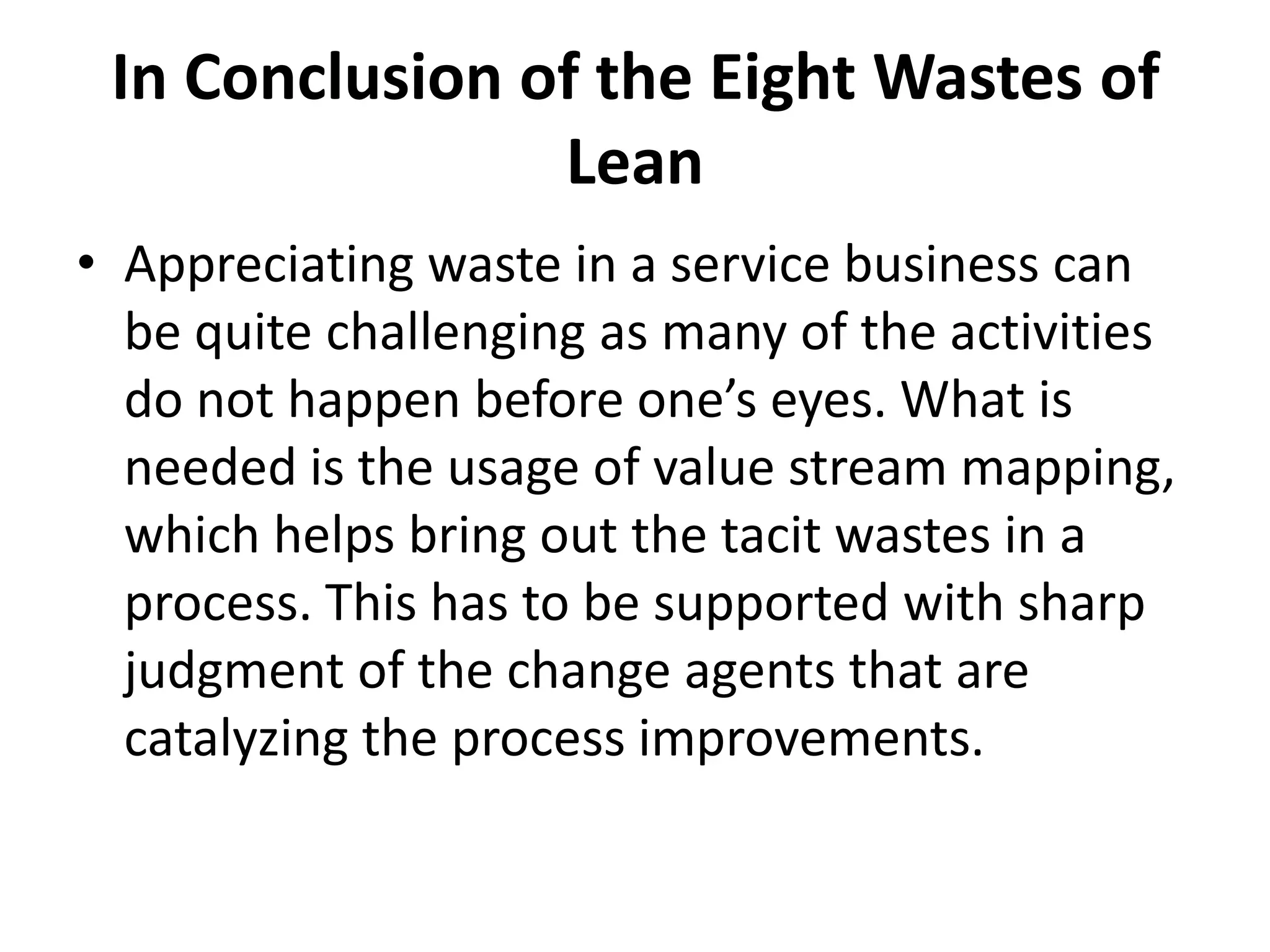
In Conclusion of the Eight Wastes of LeanAppreciating waste in a service business can be quite challenging as many of the activities do not happen before one’s eyes. What is needed is the usage of value stream mapping, which helps bring out the tacit wastes in a process. This has to be supported with sharp judgment of the change agents that are catalyzing the process improvements.

Lean for HR - Defining Wast In Service Org

  • 1.
    Defining “Waste” Asit Applies to Service OrganizationsAnything that does not add value to the customer is a waste. Waste only adds to time and cost.And the definition of “waste” in a service organization is quite similar to its definition in Lean manufacturing.When you look at a process, this customer could be an external customer/end user (consumer) for a process that has an impact on customers. For an internal process of an organization, this refers to an internal customer. Examples of the process of the former types include: sales, marketing, production, etc. The examples of the process in the later bucket includes HR activities and may referancetraining, recruitment, administration, etc.
  • 2.
    Defining “Waste” Asit Applies to Service OrganizationsThe Eight Wastes of LeanKudos to TaichiOhno, the father of Toyota Production System. His eight wastes of Lean have a universal application. Despite what some practitioners may say or write, the eight wastes of Lean are applicable not just in Lean manufacturing but also in services. Take any context and you'll see for yourself the applicability of the wastes as expressed by Ohno.The following tables summarizes the eight wastes of Lean with examples from services. I have kept a column empty for you to fill with the ones that are visible in your own company.
  • 3.
    Eight Wastes ofLean with Examples From Service Organizations
  • 4.
    Eight Wastes ofLean with Examples From Service Organizations
  • 5.
    Eight Wastes ofLean with Examples From Service Organizations
  • 6.
    Eight Wastes ofLean with Examples From Service Organizations
  • 7.
    Eight Wastes ofLean with Examples From Service Organizations
  • 8.
    Eight Wastes ofLean with Examples From Service Organizations
  • 9.
    Eight Wastes ofLean with Examples From Service Organizations
  • 10.
    Eight Wastes ofLean with Examples From Service Organizations
  • 11.
    In Conclusion ofthe Eight Wastes of LeanThe definition of the eight wastes of Lean should be looked at as something that is directional and should always be kept in mind while taking up a Lean optimization project. These are also called Non-Value Added activities, and It has been seen where processes in service business wherein up to 95 percent of the time is spent on these Non-Value Added activities. Understanding this concept is a must for dissecting a process for Lean transformation.
  • 12.
    In Conclusion ofthe Eight Wastes of LeanAppreciating waste in a service business can be quite challenging as many of the activities do not happen before one’s eyes. What is needed is the usage of value stream mapping, which helps bring out the tacit wastes in a process. This has to be supported with sharp judgment of the change agents that are catalyzing the process improvements.