INTROTOLEANPRINCIPLES
Are you structured for profitable growth?
do what counts.W H I T E
P A P E R
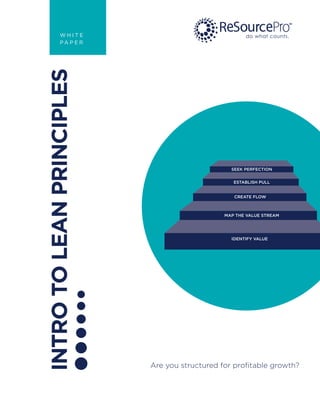
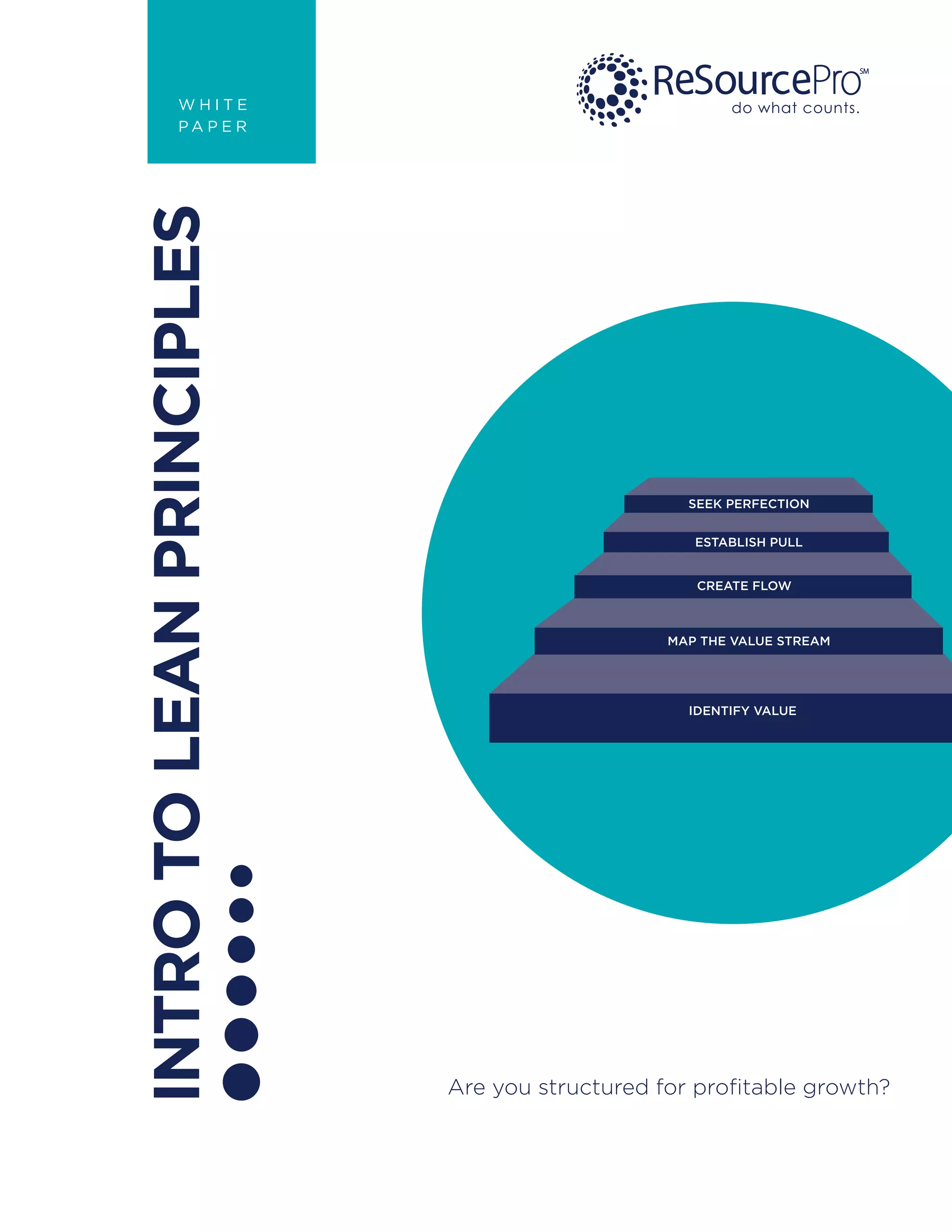
IDENTIFY VALUE
MAP THE VALUE STREAM
CREATE FLOW
ESTABLISH PULL
SEEK PERFECTION
All insurance organizations are
subject to the ebb and flow of
market conditions, and many are
constantly tasked with doing more
with less. While these organizations
may not control the market and its
pricing fluctuations, they can
manage their costs and in turn their
bottom line.
The traditional way of looking at
cost has been Cost + Profit =
Revenue. In certain, inevitable
market conditions, insurance
organizations do not control price
or commission percentages, and
they see their profits diminish as
their costs increase. Desperate
times do not always call for
desperate measures, but they
certainly require innovative thinking.
ReSource Pro's Innovation Advisory
Council (IAC)* has found that the
principles of Lean theory bring a
new perspective to this equation.
LOOKING AT
COSTS WITH
LEAN EYES
When insurance
organizations do
not control the price
in the marketplace,
focus is shifted to
the cost of doing
business.
Looking at cost through
“Lean” eyes, Revenue -
Cost = Profit. This equation
puts the control back into
the insurance organization's
hands, allowing them to
control their costs and
maintain profits while
riding the wave of
low prices.
There are many ways to start looking at
lowering costs. Some are more drastic
than others, some take longer to
implement than others, and unfortunately,
some come with hefty price tags that
make these solutions more of a long term
investment than an immediate fix.
This is why ReSource Pro decided to
invest in Lean techniques that promote
quick, small changes, and generate
incremental improvements that build up to
big impacts in the long run. In an age
where most businesses desire immediate
solutions, Lean can meet that demand by
showing quantifiable returns in a short
period of time.
See more @ ReSourcePro.com*
WHAT IS LEAN?
WASTE NOT
Lean is a management practice that
considers the expenditure of resources for
any goal other than the creation of value
for the end customer to be wasteful, and
thus a target for elimination. In more basic
terms, more value with less work. Lean
Theory has developed from Toyota's
philosophy of Lean Manufacturing that
revolves around wasteful, necessary, and
value-added work performed during a
process.
Value-added work is what an
organization's customers are willing to
pay for. This work is essential to the
product or service produced and
delivered to the customer, so it doesn't
include things like re-work or error
correction. Unfortunately, if we analyzed
the work done in many insurance
organizations, we would find that much of
what occurs is ineffective, inefficient, and
constitutes more than 50% of work done.
Other necessary work, or incidental work
under present conditions, may be
essential for executing tasks directly
related to producing products or
services. However, it adds no direct value
from the customer's perspective. This
type of work may include work required
by the organization to meet business or
regulatory requirements, such as
completing FDA-required audits, activities
required by law, statute or contract, input
or documentation required by a carrier,
OFAC checking, and processes to limit
E&O risk.
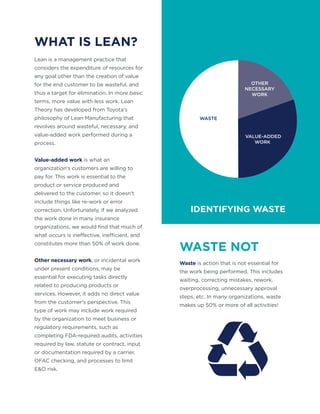
Waste is action that is not essential for
the work being performed. This includes
waiting, correcting mistakes, rework,
overprocessing, unnecessary approval
steps, etc. In many organizations, waste
makes up 50% or more of all activities!
VALUE-ADDED
WORK
WASTE
OTHER
NECESSARY
WORK
IDENTIFYING WASTE
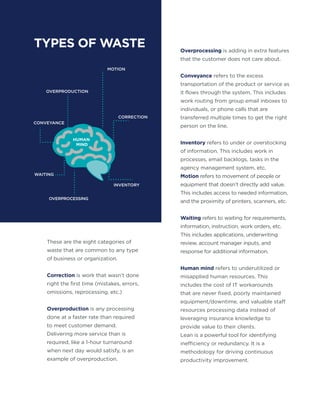
MOTION
OVERPRODUCTION
CORRECTION
CONVEYANCE
WAITING
OVERPROCESSING
INVENTORY
HUMAN
MIND
TYPES OF WASTE
These are the eight categories of
waste that are common to any type
of business or organization.
Correction is work that wasn’t done
right the first time (mistakes, errors,
omissions, reprocessing, etc.)
Overproduction is any processing
done at a faster rate than required
to meet customer demand.
Delivering more service than is
required, like a 1-hour turnaround
when next day would satisfy, is an
example of overproduction.
Overprocessing is adding in extra features
that the customer does not care about.
Conveyance refers to the excess
transportation of the product or service as
it flows through the system. This includes
work routing from group email inboxes to
individuals, or phone calls that are
transferred multiple times to get the right
person on the line.
Inventory refers to under or overstocking
of information. This includes work in
processes, email backlogs, tasks in the
agency management system, etc.
Motion refers to movement of people or
equipment that doesn’t directly add value.
This includes access to needed information,
and the proximity of printers, scanners, etc.
Waiting refers to waiting for requirements,
information, instruction, work orders, etc.
This includes applications, underwriting
review, account manager inputs, and
response for additional information.
Human mind refers to underutilized or
misapplied human resources. This
includes the cost of IT workarounds
that are never fixed, poorly maintained
equipment/downtime, and valuable staff
resources processing data instead of
leveraging insurance knowledge to
provide value to their clients.
Lean is a powerful tool for identifying
inefficiency or redundancy. It is a
methodology for driving continuous
productivity improvement.
Innovation does
not happen when
everything around
us is great. The best
innovation takes place
when we are forced
to change.
- Lisa Bodell
Founder and CEO, futurethink
WHY LEAN?
WHY NOW?
A LEAN LEAP
MADE IN A CRISIS
We believe this is the time to stand out
from the crowd, crash competition, and
build for the future. This is not the time
for big spending, it is time to cut costs
by re-engineering processes and
redeploying people to do more value
work. Restructure teams for growth.
Focus the organization on what is valued
by customers, delegate necessary work,
and eliminate waste.
Now, more than ever, is the time for
insurance organizations to advance their
Lean transformation towards operations
excellence. Lean protects profit margins
by improving quality and productivity,
strengthens ties with customers by
improving service, and converts
orders-to-cash faster by reducing
lead times. Most importantly, Lean
gives the organization an enduring
competitive advantage.
Taiichi Ohno pushed the Toyota
Production System through the
entire Toyota Motor Company
in 1950 during the great crisis
that left Toyota on the brink of
bankruptcy. It was post WWII,
Japan's resources were limited,
and there was no room for
waste. The Toyota Production
System, a Lean-based
methodology, rescued
Toyota and took the
company to new heights.
Here are a few ways that Lean transformation
can be advanced across an enterprise:
Developing employees as problem solvers
through coaching initiatives
Changing management culture from
command and control to fact-based
and flexible
Transitioning from a tools-based
implementation path to a course that
applies Lean management as a complete
business system
Changing how the organization thinks and
conducts business on a daily basis
“
”
do what counts.
RESOURCE PRO
1180 Avenue of the Americas
16th floor
New York, New York 10036
888.577.7552
www.resourcepro.com
W H I T E
P A P E R

Intro to lean principles

  • 1.
    INTROTOLEANPRINCIPLES Are you structuredfor profitable growth? do what counts.W H I T E P A P E R IDENTIFY VALUE MAP THE VALUE STREAM CREATE FLOW ESTABLISH PULL SEEK PERFECTION
  • 2.
    All insurance organizationsare subject to the ebb and flow of market conditions, and many are constantly tasked with doing more with less. While these organizations may not control the market and its pricing fluctuations, they can manage their costs and in turn their bottom line. The traditional way of looking at cost has been Cost + Profit = Revenue. In certain, inevitable market conditions, insurance organizations do not control price or commission percentages, and they see their profits diminish as their costs increase. Desperate times do not always call for desperate measures, but they certainly require innovative thinking. ReSource Pro's Innovation Advisory Council (IAC)* has found that the principles of Lean theory bring a new perspective to this equation. LOOKING AT COSTS WITH LEAN EYES When insurance organizations do not control the price in the marketplace, focus is shifted to the cost of doing business. Looking at cost through “Lean” eyes, Revenue - Cost = Profit. This equation puts the control back into the insurance organization's hands, allowing them to control their costs and maintain profits while riding the wave of low prices. There are many ways to start looking at lowering costs. Some are more drastic than others, some take longer to implement than others, and unfortunately, some come with hefty price tags that make these solutions more of a long term investment than an immediate fix. This is why ReSource Pro decided to invest in Lean techniques that promote quick, small changes, and generate incremental improvements that build up to big impacts in the long run. In an age where most businesses desire immediate solutions, Lean can meet that demand by showing quantifiable returns in a short period of time. See more @ ReSourcePro.com*
  • 3.
    WHAT IS LEAN? WASTENOT Lean is a management practice that considers the expenditure of resources for any goal other than the creation of value for the end customer to be wasteful, and thus a target for elimination. In more basic terms, more value with less work. Lean Theory has developed from Toyota's philosophy of Lean Manufacturing that revolves around wasteful, necessary, and value-added work performed during a process. Value-added work is what an organization's customers are willing to pay for. This work is essential to the product or service produced and delivered to the customer, so it doesn't include things like re-work or error correction. Unfortunately, if we analyzed the work done in many insurance organizations, we would find that much of what occurs is ineffective, inefficient, and constitutes more than 50% of work done. Other necessary work, or incidental work under present conditions, may be essential for executing tasks directly related to producing products or services. However, it adds no direct value from the customer's perspective. This type of work may include work required by the organization to meet business or regulatory requirements, such as completing FDA-required audits, activities required by law, statute or contract, input or documentation required by a carrier, OFAC checking, and processes to limit E&O risk. Waste is action that is not essential for the work being performed. This includes waiting, correcting mistakes, rework, overprocessing, unnecessary approval steps, etc. In many organizations, waste makes up 50% or more of all activities! VALUE-ADDED WORK WASTE OTHER NECESSARY WORK IDENTIFYING WASTE
  • 4.
    MOTION OVERPRODUCTION CORRECTION CONVEYANCE WAITING OVERPROCESSING INVENTORY HUMAN MIND TYPES OF WASTE Theseare the eight categories of waste that are common to any type of business or organization. Correction is work that wasn’t done right the first time (mistakes, errors, omissions, reprocessing, etc.) Overproduction is any processing done at a faster rate than required to meet customer demand. Delivering more service than is required, like a 1-hour turnaround when next day would satisfy, is an example of overproduction. Overprocessing is adding in extra features that the customer does not care about. Conveyance refers to the excess transportation of the product or service as it flows through the system. This includes work routing from group email inboxes to individuals, or phone calls that are transferred multiple times to get the right person on the line. Inventory refers to under or overstocking of information. This includes work in processes, email backlogs, tasks in the agency management system, etc. Motion refers to movement of people or equipment that doesn’t directly add value. This includes access to needed information, and the proximity of printers, scanners, etc. Waiting refers to waiting for requirements, information, instruction, work orders, etc. This includes applications, underwriting review, account manager inputs, and response for additional information. Human mind refers to underutilized or misapplied human resources. This includes the cost of IT workarounds that are never fixed, poorly maintained equipment/downtime, and valuable staff resources processing data instead of leveraging insurance knowledge to provide value to their clients. Lean is a powerful tool for identifying inefficiency or redundancy. It is a methodology for driving continuous productivity improvement.
  • 5.
    Innovation does not happenwhen everything around us is great. The best innovation takes place when we are forced to change. - Lisa Bodell Founder and CEO, futurethink WHY LEAN? WHY NOW? A LEAN LEAP MADE IN A CRISIS We believe this is the time to stand out from the crowd, crash competition, and build for the future. This is not the time for big spending, it is time to cut costs by re-engineering processes and redeploying people to do more value work. Restructure teams for growth. Focus the organization on what is valued by customers, delegate necessary work, and eliminate waste. Now, more than ever, is the time for insurance organizations to advance their Lean transformation towards operations excellence. Lean protects profit margins by improving quality and productivity, strengthens ties with customers by improving service, and converts orders-to-cash faster by reducing lead times. Most importantly, Lean gives the organization an enduring competitive advantage. Taiichi Ohno pushed the Toyota Production System through the entire Toyota Motor Company in 1950 during the great crisis that left Toyota on the brink of bankruptcy. It was post WWII, Japan's resources were limited, and there was no room for waste. The Toyota Production System, a Lean-based methodology, rescued Toyota and took the company to new heights. Here are a few ways that Lean transformation can be advanced across an enterprise: Developing employees as problem solvers through coaching initiatives Changing management culture from command and control to fact-based and flexible Transitioning from a tools-based implementation path to a course that applies Lean management as a complete business system Changing how the organization thinks and conducts business on a daily basis “ ”
  • 6.
    do what counts. RESOURCEPRO 1180 Avenue of the Americas 16th floor New York, New York 10036 888.577.7552 www.resourcepro.com W H I T E P A P E R