Unsafe acts & conditions and
near miss
Presented by:
Faiz Mohammad
Khan
M.Tech-HSE (11)
Defining Key Performance
Indicators
Key Performance Indicator
 It is industry jargon for a type of performance
measurement. An organization may use KPIs to
evaluate its success, or to evaluate the success of a
particular activity in which it is engaged.
 Sometimes success is defined in terms of making
progress toward strategic goals, but often success is
simply the repeated, periodic achievement of some
level of operational goal (e.g. zero defects, 10/10
customer satisfaction, etc.).
Key Performance Indicator
 There should only be a small number of KPIs but they
should provide a credible measurement as to trends.
Generally they will be normalized.
 For example, rather than simply reporting the number
of process safety incidents, it is more useful to report
the number of incidents per employee. Doing so
facilitates comparisons between different sites and
organizations.
Categorization of Indicators
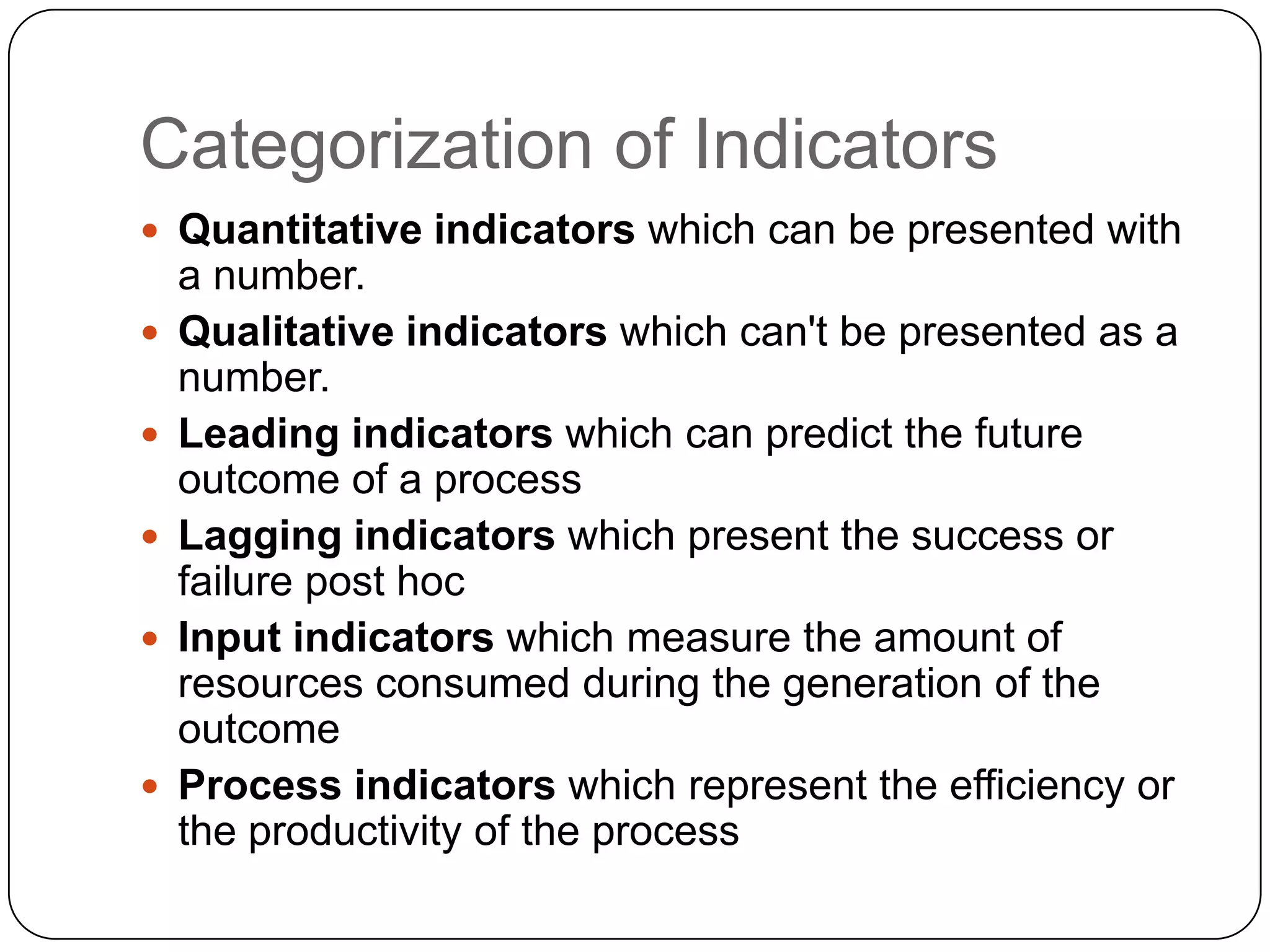
 Quantitative indicators which can be presented with
a number.
 Qualitative indicators which can't be presented as a
number.
 Leading indicators which can predict the future
outcome of a process
 Lagging indicators which present the success or
failure post hoc
 Input indicators which measure the amount of
resources consumed during the generation of the
outcome
 Process indicators which represent the efficiency or
the productivity of the process
Cont.
 Output indicators which reflect the outcome or
results of the process activities
 Practical indicators that interface with existing
company processes.
 Directional indicators specifying whether an
organization is getting better or not.
 Actionable indicators are sufficiently in an
organization's control to affect change.
 Financial indicators used in performance
measurement and when looking at an operating
index.
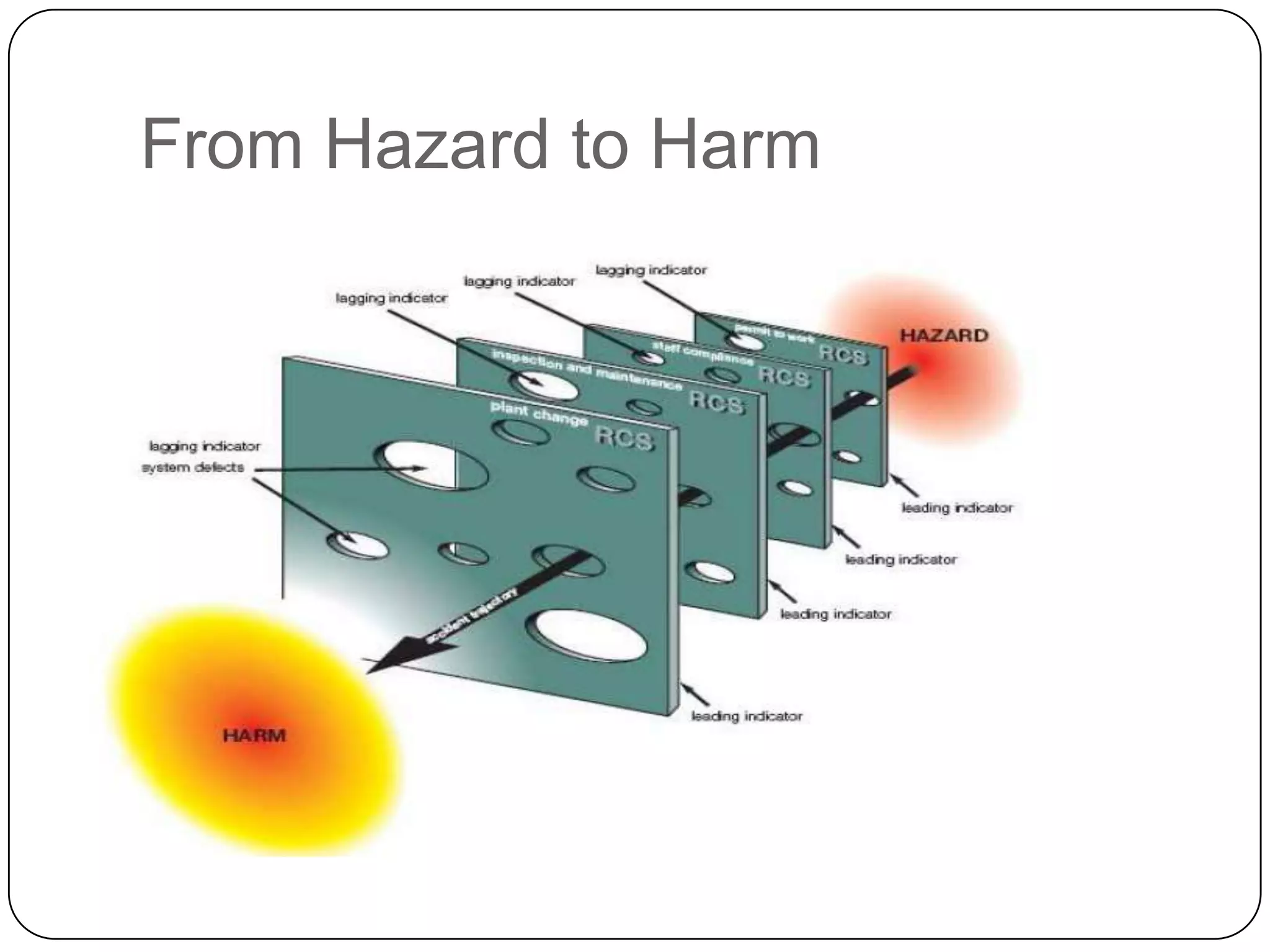
From Hazard to Harm
Lagging Indicator
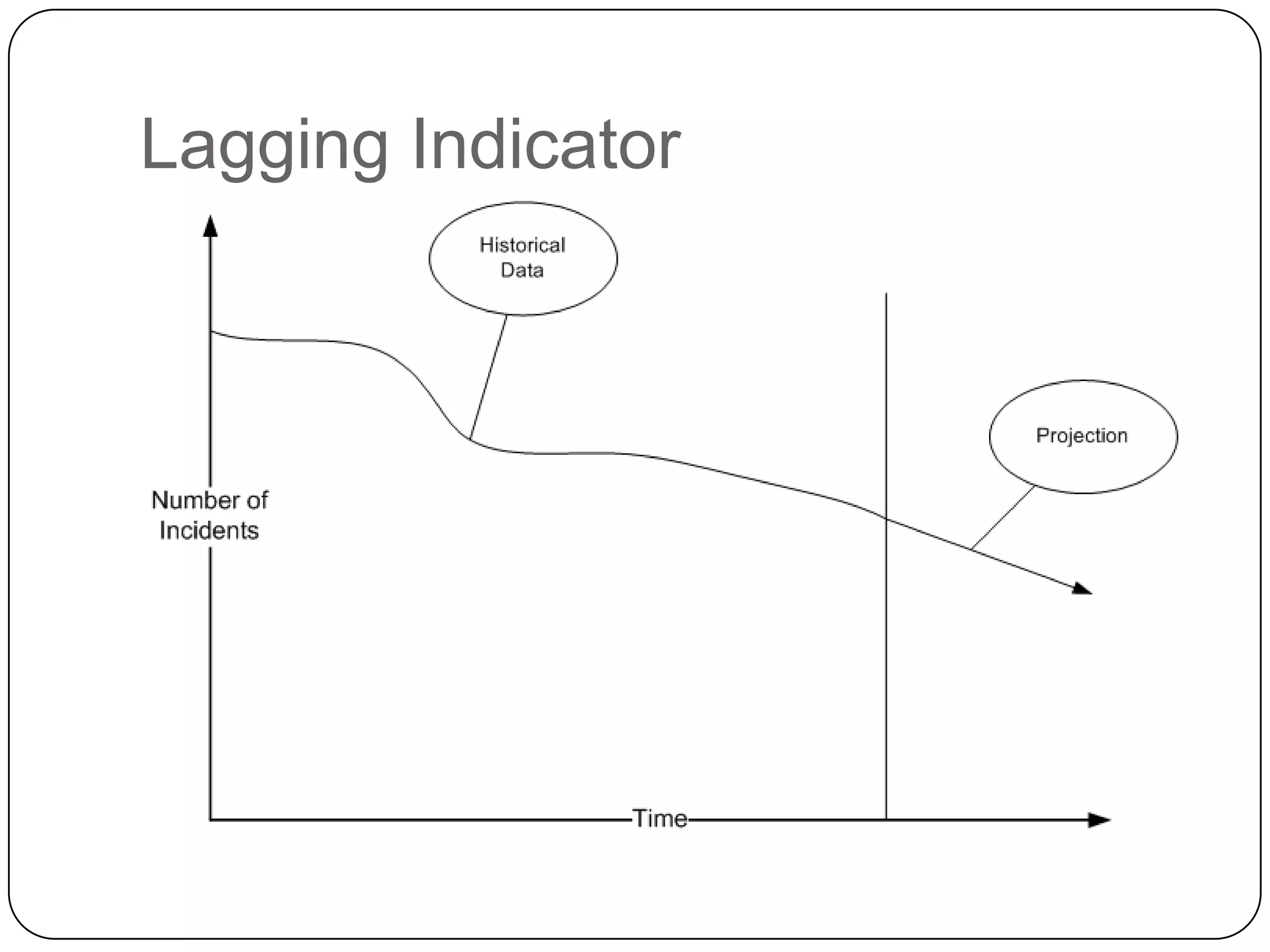
 Lagging (sometimes called trailing) indicators are
widely used to measure performance — particularly
for occupational safety and equipment reliability.
These indicators include well-established parameters
such as near misses, lost time accidents, first aid
cases and recordable injuries.
 Lagging indicators are widely used because,
assuming that there are enough events to ensure
statistical significance, they allow management to
establish baselines, measure trends and to compare
results with other facilities and companies.
Lagging Indicator
Cont.
One oil company, for example, has set the following
KPIs for itself (some are monthly, others quarterly and
the remainder annual)-
 Fatalities;
 Days away from work;
 Recordable injuries (as a function of exposure hours);
 Recordable illnesses;
 Spills from primary containment (even if secondary
containment was effective);
 Spills affecting the environment (failure of all
containment barriers);
 Volume of oil spilled that is not recovered;
OSHA Recordable Rate
Companies in the United States pay particular attention
to the OSHA recordable rate. An OSHA recordable
injury is an occupational injury or illness that meets one
of the following criteria:
 Death;
 Loss of consciousness;
 Days away from work;
 Restricted work activity or job transfer; or
 Medical treatment beyond first aid.
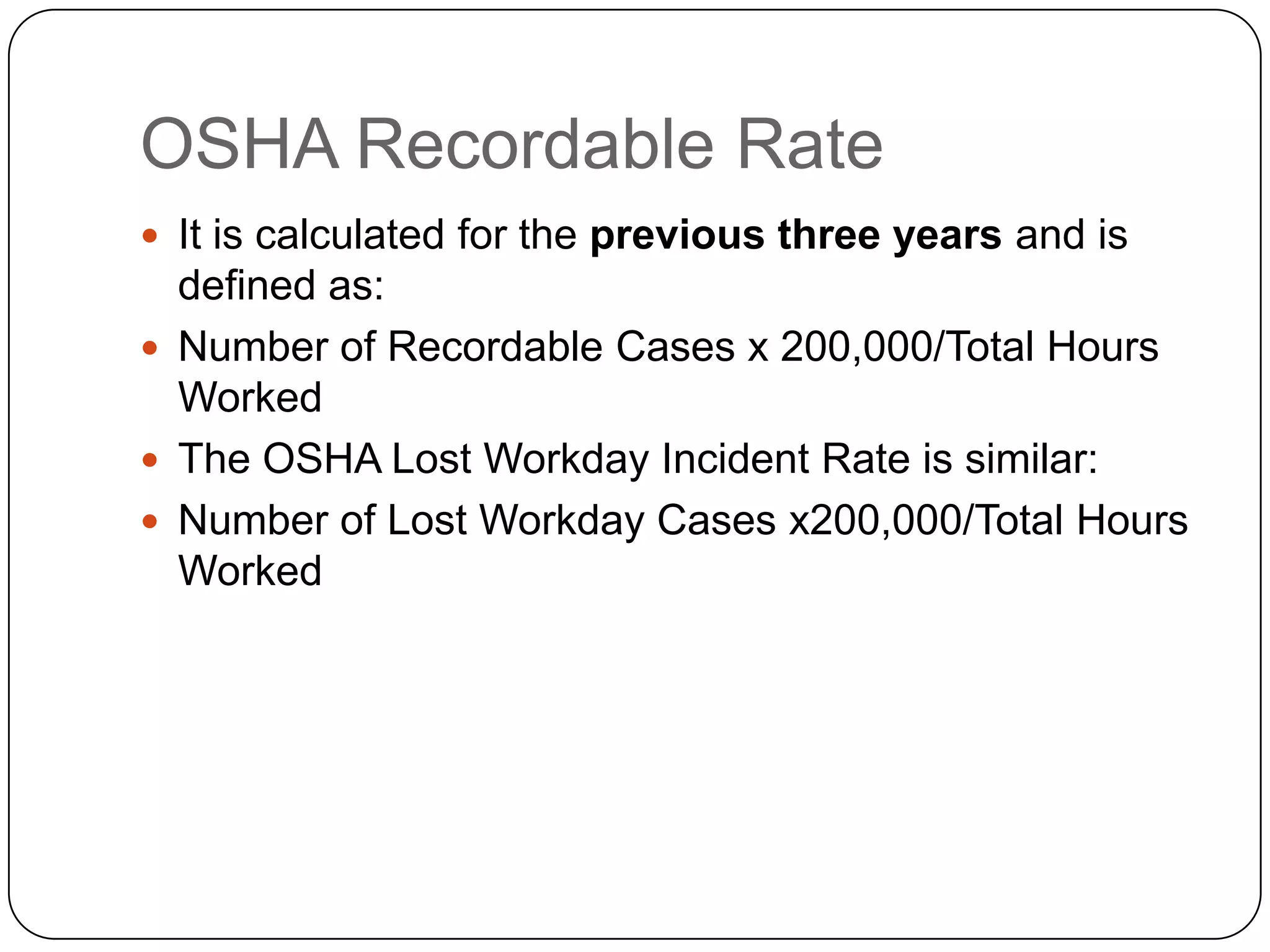
OSHA Recordable Rate
 It is calculated for the previous three years and is
defined as:
 Number of Recordable Cases x 200,000/Total Hours
Worked
 The OSHA Lost Workday Incident Rate is similar:
 Number of Lost Workday Cases x200,000/Total Hours
Worked
OSHA Recordable Rate
 A lost workday - equivalent to a lost time injury - is
one where an individual misses more than one day of
work due to an injury sustained while at work is
another widely used criterion for measuring
occupational safety.
Process Safety
 It is difficult to identify effective lagging indicators for
use with process safety. The most obvious difficulty is
that major process safety incidents do not occur
frequently enough to develop a statistically significant
trend.
 If many facilities and companies pool their data it may
be possible to that some trending results can be
developed. However, such results are always open to
doubt, not least because different organizations
define terms differently.
Process Safety
 For example, the Baker report (Baker 2007) provides
a list of events that fall under the term “fire”. That list
includes “a fault in a motor control centre”. It is
questionable as to how many organizations would call
such an event a “fire” unless it resulted in flames
and/or smoke.
Process Safety
 An additional difficulty is that many process safety
events — particularly those that are near misses —
may simply not be recognized for what they are.
 For example, an operator and a mechanic may fix a
leaking pump seal, not realizing how close they were
to having a major accident.
Leading Indicator
 Leading indicators are forward-looking. They provide
management with an assessment of their process
safety program.
 Most leading indicators measure some type of activity,
although minor incidents, such as the leaking control
valve discussed before, could also fall into the leading
indicator category.
Leading Indicator
 The following are some examples of leading indicators.
 Number of field visits and inspections;
 Number of safety audits;
 Number of safety communications and safety meetings;
 Percentage of incidents investigated;
 Number of near miss responses;
 Number of positive rewards and recognition given; and
 Safety communications;
 Claims reporting analysis;
 Safety committee activities; and
 Number of safe/unsafe behaviors/acts observed.
API RP 754
 Following the fire and explosion at BP’s Texas City
refinery in Texas City, Texas, the Chemical Safety
Board (CSB) conducted an investigation. One of the
recommendations from that investigation called for the
American Petroleum Institute (API) and the United
Steel Workers (USW) to work together to develop an
ANSI standard for leading and lagging indicators.
 Although the USW later withdrew from the program the
API continued with the development of a standard which
became Recommended Practice 754, Process Safety
Indicators for the Refining and Petrochemical Industries.
It was published in April 2010 (API 2010).
Tiers
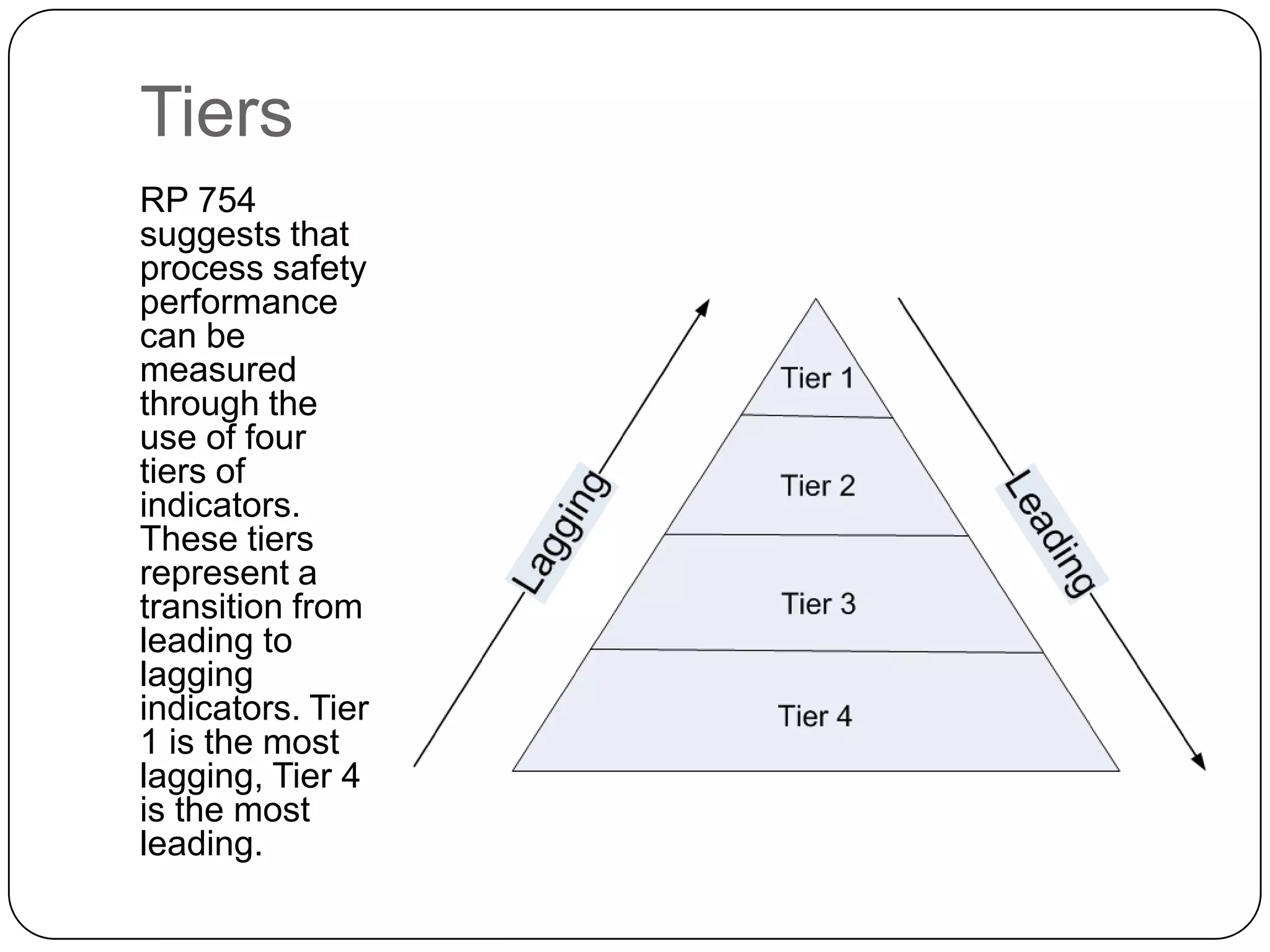
RP 754
suggests that
process safety
performance
can be
measured
through the
use of four
tiers of
indicators.
These tiers
represent a
transition from
leading to
lagging
indicators. Tier
1 is the most
lagging, Tier 4
is the most
leading.
Tiers
 Events in the bottom section occur more frequently
than in the top section and generally have a lower
consequence. It is assumed that there is a direct
correlation between the tiers, i.e., that a shift in
performance at one level will have a corresponding
change at the level above. However, it is important to
watch for false assumptions.
 For example, a newly invigorated incident reporting
program may lead to more Tier 4 incidents being
recorded, even if there has been no actual
performance change.
Tiers
 Tiers 1 and 2 are suitable for nationwide public reporting,
and thus have a tightly defined scope. Any Tier 1 or Tier 2
Process Safety Event begins with an unplanned or
uncontrolled release of any material, including non-toxic
and non-flammable materials resulting in one or more
consequences described in the RP.
 These events are referred to as a Loss of Primary
Containment (LOPC), which is defined as follows:
 An unplanned or uncontrolled release of any material
from primary containment, including non-toxic and
non-flammable materials (e.g. steam, hot condensate,
nitrogen, compressed CO2 or compressed air).
Tiers
 Tiers 3 and 4 are intended for internal use at
individual sites.
 Quantification is measured through use of the
Process Safety Event (PSE) rate, which is
calculated as follows:
 PSE Rate = [Total PSE Count x 200,000] / Total
Workforce Hours
 Each Tier has its own PSE rate.
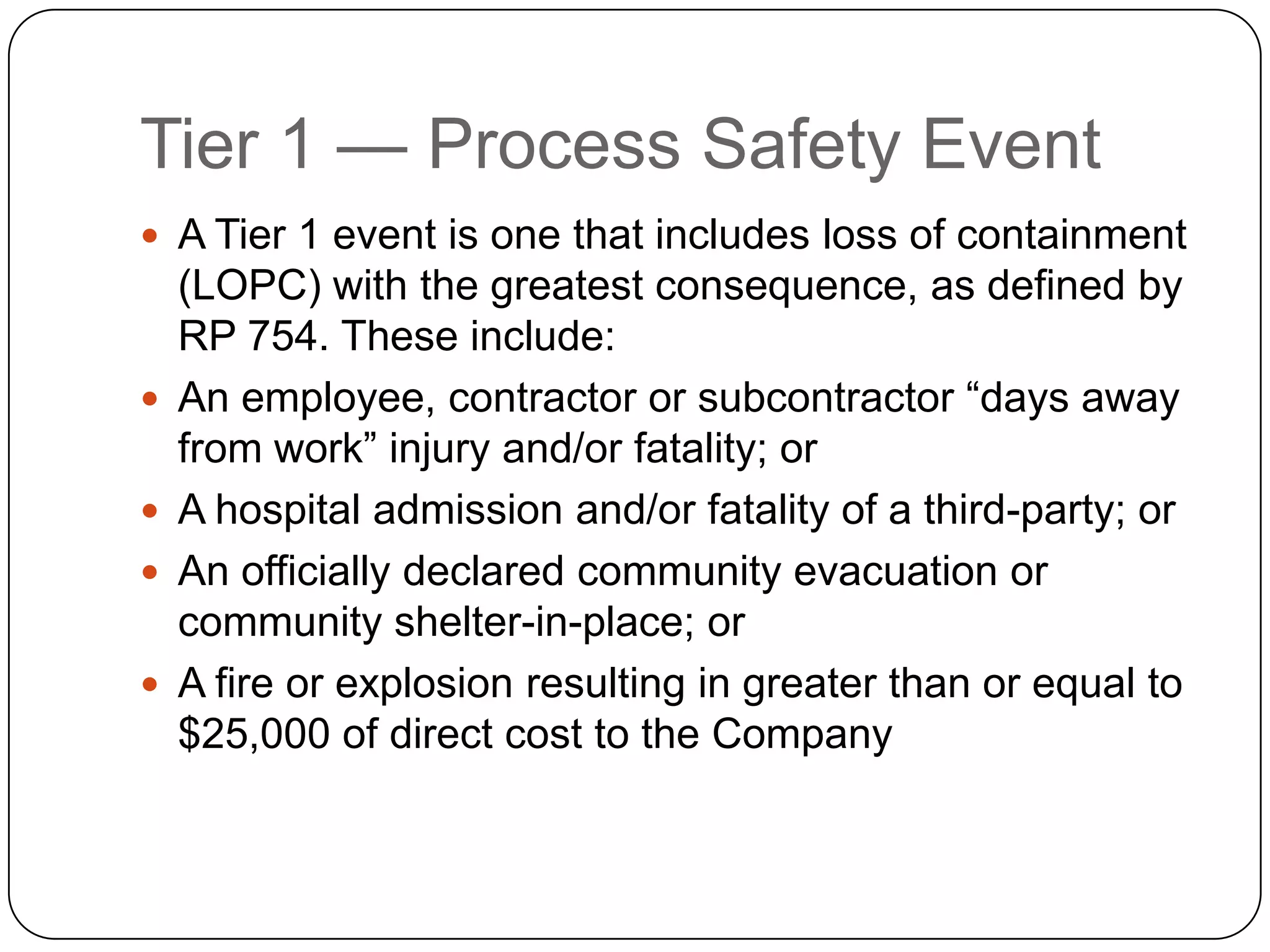
Tier 1 — Process Safety Event
 A Tier 1 event is one that includes loss of containment
(LOPC) with the greatest consequence, as defined by
RP 754. These include:
 An employee, contractor or subcontractor “days away
from work” injury and/or fatality; or
 A hospital admission and/or fatality of a third-party; or
 An officially declared community evacuation or
community shelter-in-place; or
 A fire or explosion resulting in greater than or equal to
$25,000 of direct cost to the Company
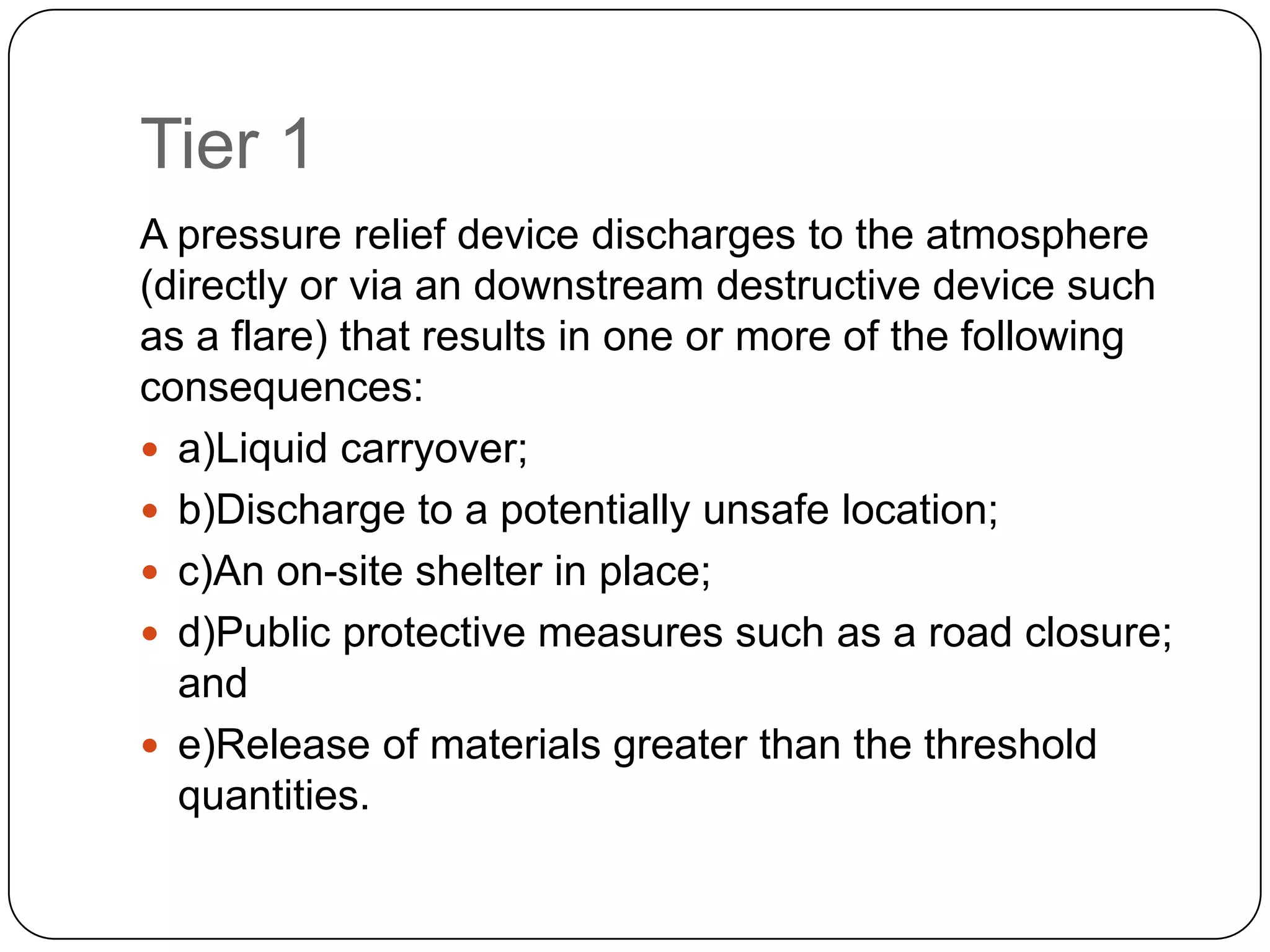
Tier 1
A pressure relief device discharges to the atmosphere
(directly or via an downstream destructive device such
as a flare) that results in one or more of the following
consequences:
 a)Liquid carryover;
 b)Discharge to a potentially unsafe location;
 c)An on-site shelter in place;
 d)Public protective measures such as a road closure;
and
 e)Release of materials greater than the threshold
quantities.
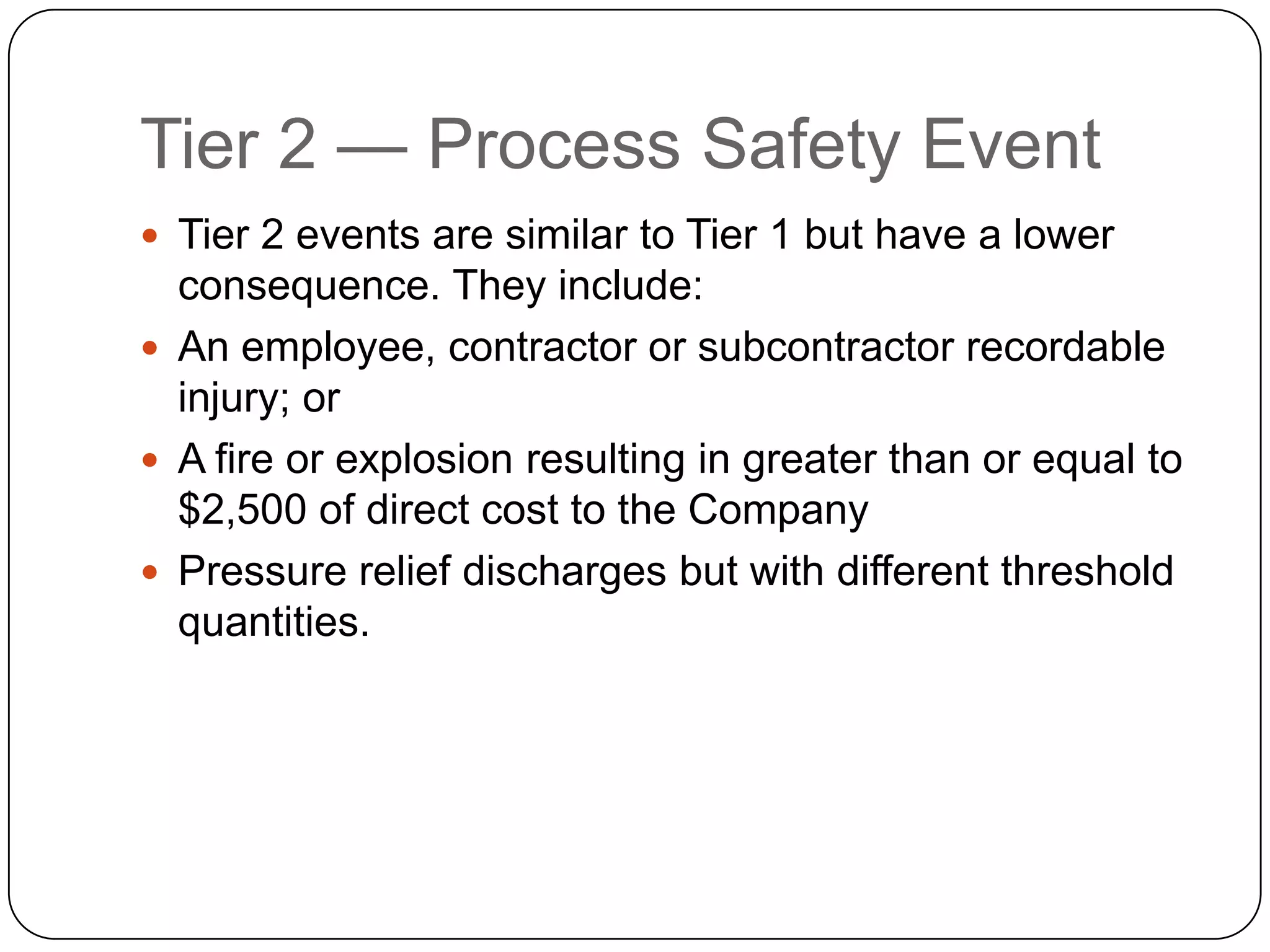
Tier 2 — Process Safety Event
 Tier 2 events are similar to Tier 1 but have a lower
consequence. They include:
 An employee, contractor or subcontractor recordable
injury; or
 A fire or explosion resulting in greater than or equal to
$2,500 of direct cost to the Company
 Pressure relief discharges but with different threshold
quantities.
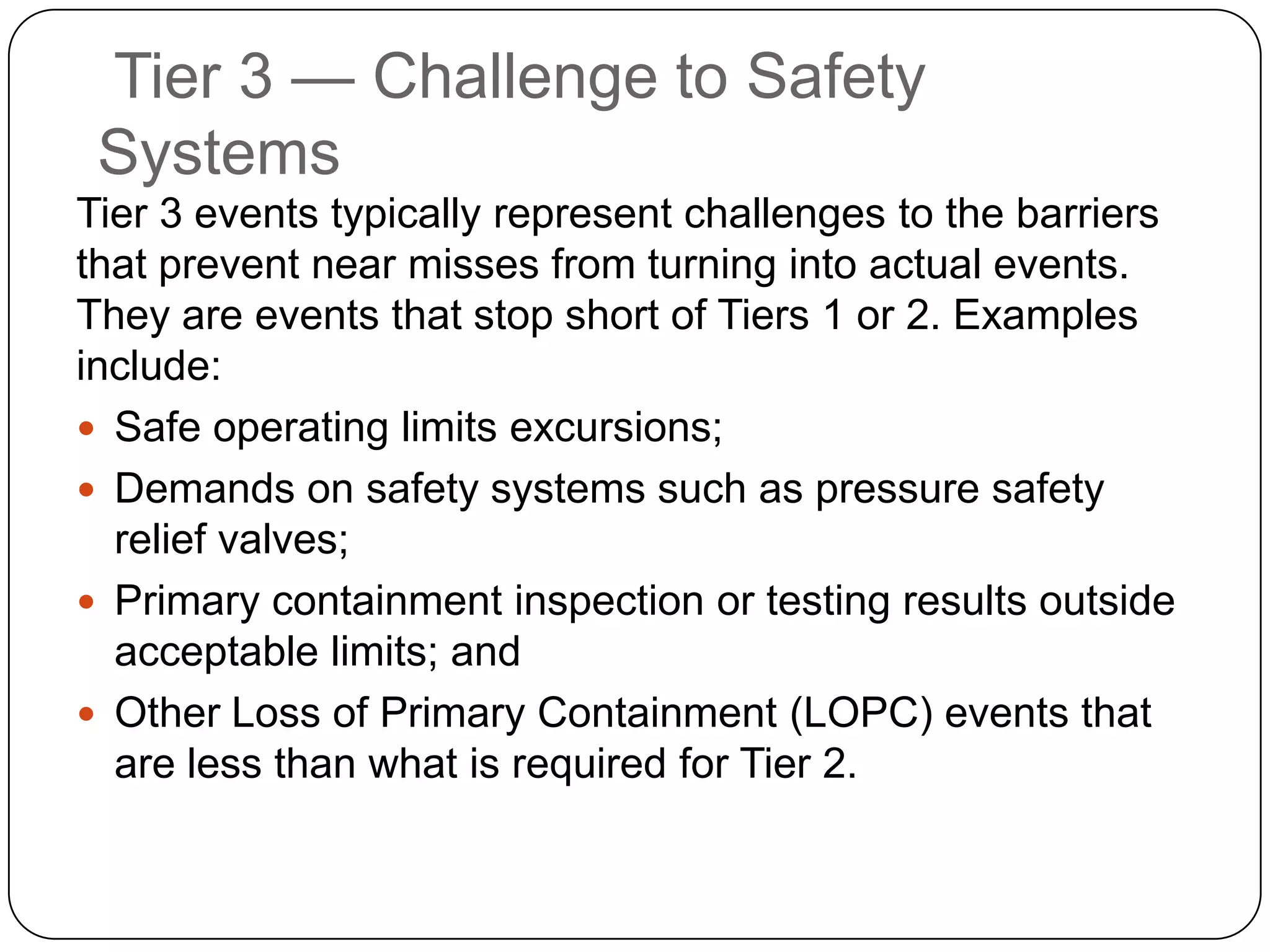
Tier 3 — Challenge to Safety
Systems
Tier 3 events typically represent challenges to the barriers
that prevent near misses from turning into actual events.
They are events that stop short of Tiers 1 or 2. Examples
include:
 Safe operating limits excursions;
 Demands on safety systems such as pressure safety
relief valves;
 Primary containment inspection or testing results outside
acceptable limits; and
 Other Loss of Primary Containment (LOPC) events that
are less than what is required for Tier 2.
and Management System
Performance
 Tier 4 indicators provide measurements of operating
discipline and the management system performance.
Like Tier 3 they are site-specific and will not generally
be used to compare the performance of different
companies.
 Examples of Tier 4 items are:
 A process safety action item is closed on schedule;
 Training is completed on schedule;
 Safety critical equipment items are inspected; and
 Emergency response drills are completed.
Data Submission
 In order to encourage consistent reporting, the API
has published a Guide to Reporting Process Safety
Events along with a matching spreadsheet.
 The Guide provides information for the reporting of
Tier 1 and Tier 2 events. It also provides a glossary
defining the terms used in RP 754.
 It also provides guidance on the selection of
categories (such as types of refining process) to be
used in reporting.
Selection of KPIs
 The performance indicators provided for Tiers 1 and 2
are useful for comparing facilities with one another.
However events at this level occur only rarely and do
not provide an adequate statistical basis whereby a
company can improve its own performance and
implement a continuous improvement program.
Thank you

Defining kpi in terms of unsafe acts/conditions and near miss

  • 1.
    Unsafe acts &conditions and near miss Presented by: Faiz Mohammad Khan M.Tech-HSE (11) Defining Key Performance Indicators
  • 2.
    Key Performance Indicator It is industry jargon for a type of performance measurement. An organization may use KPIs to evaluate its success, or to evaluate the success of a particular activity in which it is engaged.  Sometimes success is defined in terms of making progress toward strategic goals, but often success is simply the repeated, periodic achievement of some level of operational goal (e.g. zero defects, 10/10 customer satisfaction, etc.).
  • 3.
    Key Performance Indicator There should only be a small number of KPIs but they should provide a credible measurement as to trends. Generally they will be normalized.  For example, rather than simply reporting the number of process safety incidents, it is more useful to report the number of incidents per employee. Doing so facilitates comparisons between different sites and organizations.
  • 4.
    Categorization of Indicators Quantitative indicators which can be presented with a number.  Qualitative indicators which can't be presented as a number.  Leading indicators which can predict the future outcome of a process  Lagging indicators which present the success or failure post hoc  Input indicators which measure the amount of resources consumed during the generation of the outcome  Process indicators which represent the efficiency or the productivity of the process
  • 5.
    Cont.  Output indicatorswhich reflect the outcome or results of the process activities  Practical indicators that interface with existing company processes.  Directional indicators specifying whether an organization is getting better or not.  Actionable indicators are sufficiently in an organization's control to affect change.  Financial indicators used in performance measurement and when looking at an operating index.
  • 6.
  • 7.
    Lagging Indicator  Lagging(sometimes called trailing) indicators are widely used to measure performance — particularly for occupational safety and equipment reliability. These indicators include well-established parameters such as near misses, lost time accidents, first aid cases and recordable injuries.  Lagging indicators are widely used because, assuming that there are enough events to ensure statistical significance, they allow management to establish baselines, measure trends and to compare results with other facilities and companies.
  • 8.
  • 9.
    Cont. One oil company,for example, has set the following KPIs for itself (some are monthly, others quarterly and the remainder annual)-  Fatalities;  Days away from work;  Recordable injuries (as a function of exposure hours);  Recordable illnesses;  Spills from primary containment (even if secondary containment was effective);  Spills affecting the environment (failure of all containment barriers);  Volume of oil spilled that is not recovered;
  • 10.
    OSHA Recordable Rate Companiesin the United States pay particular attention to the OSHA recordable rate. An OSHA recordable injury is an occupational injury or illness that meets one of the following criteria:  Death;  Loss of consciousness;  Days away from work;  Restricted work activity or job transfer; or  Medical treatment beyond first aid.
  • 11.
    OSHA Recordable Rate It is calculated for the previous three years and is defined as:  Number of Recordable Cases x 200,000/Total Hours Worked  The OSHA Lost Workday Incident Rate is similar:  Number of Lost Workday Cases x200,000/Total Hours Worked
  • 12.
    OSHA Recordable Rate A lost workday - equivalent to a lost time injury - is one where an individual misses more than one day of work due to an injury sustained while at work is another widely used criterion for measuring occupational safety.
  • 13.
    Process Safety  Itis difficult to identify effective lagging indicators for use with process safety. The most obvious difficulty is that major process safety incidents do not occur frequently enough to develop a statistically significant trend.  If many facilities and companies pool their data it may be possible to that some trending results can be developed. However, such results are always open to doubt, not least because different organizations define terms differently.
  • 14.
    Process Safety  Forexample, the Baker report (Baker 2007) provides a list of events that fall under the term “fire”. That list includes “a fault in a motor control centre”. It is questionable as to how many organizations would call such an event a “fire” unless it resulted in flames and/or smoke.
  • 15.
    Process Safety  Anadditional difficulty is that many process safety events — particularly those that are near misses — may simply not be recognized for what they are.  For example, an operator and a mechanic may fix a leaking pump seal, not realizing how close they were to having a major accident.
  • 16.
    Leading Indicator  Leadingindicators are forward-looking. They provide management with an assessment of their process safety program.  Most leading indicators measure some type of activity, although minor incidents, such as the leaking control valve discussed before, could also fall into the leading indicator category.
  • 17.
    Leading Indicator  Thefollowing are some examples of leading indicators.  Number of field visits and inspections;  Number of safety audits;  Number of safety communications and safety meetings;  Percentage of incidents investigated;  Number of near miss responses;  Number of positive rewards and recognition given; and  Safety communications;  Claims reporting analysis;  Safety committee activities; and  Number of safe/unsafe behaviors/acts observed.
  • 18.
    API RP 754 Following the fire and explosion at BP’s Texas City refinery in Texas City, Texas, the Chemical Safety Board (CSB) conducted an investigation. One of the recommendations from that investigation called for the American Petroleum Institute (API) and the United Steel Workers (USW) to work together to develop an ANSI standard for leading and lagging indicators.  Although the USW later withdrew from the program the API continued with the development of a standard which became Recommended Practice 754, Process Safety Indicators for the Refining and Petrochemical Industries. It was published in April 2010 (API 2010).
  • 19.
    Tiers RP 754 suggests that processsafety performance can be measured through the use of four tiers of indicators. These tiers represent a transition from leading to lagging indicators. Tier 1 is the most lagging, Tier 4 is the most leading.
  • 20.
    Tiers  Events inthe bottom section occur more frequently than in the top section and generally have a lower consequence. It is assumed that there is a direct correlation between the tiers, i.e., that a shift in performance at one level will have a corresponding change at the level above. However, it is important to watch for false assumptions.  For example, a newly invigorated incident reporting program may lead to more Tier 4 incidents being recorded, even if there has been no actual performance change.
  • 21.
    Tiers  Tiers 1and 2 are suitable for nationwide public reporting, and thus have a tightly defined scope. Any Tier 1 or Tier 2 Process Safety Event begins with an unplanned or uncontrolled release of any material, including non-toxic and non-flammable materials resulting in one or more consequences described in the RP.  These events are referred to as a Loss of Primary Containment (LOPC), which is defined as follows:  An unplanned or uncontrolled release of any material from primary containment, including non-toxic and non-flammable materials (e.g. steam, hot condensate, nitrogen, compressed CO2 or compressed air).
  • 22.
    Tiers  Tiers 3and 4 are intended for internal use at individual sites.  Quantification is measured through use of the Process Safety Event (PSE) rate, which is calculated as follows:  PSE Rate = [Total PSE Count x 200,000] / Total Workforce Hours  Each Tier has its own PSE rate.
  • 23.
    Tier 1 —Process Safety Event  A Tier 1 event is one that includes loss of containment (LOPC) with the greatest consequence, as defined by RP 754. These include:  An employee, contractor or subcontractor “days away from work” injury and/or fatality; or  A hospital admission and/or fatality of a third-party; or  An officially declared community evacuation or community shelter-in-place; or  A fire or explosion resulting in greater than or equal to $25,000 of direct cost to the Company
  • 24.
    Tier 1 A pressurerelief device discharges to the atmosphere (directly or via an downstream destructive device such as a flare) that results in one or more of the following consequences:  a)Liquid carryover;  b)Discharge to a potentially unsafe location;  c)An on-site shelter in place;  d)Public protective measures such as a road closure; and  e)Release of materials greater than the threshold quantities.
  • 25.
    Tier 2 —Process Safety Event  Tier 2 events are similar to Tier 1 but have a lower consequence. They include:  An employee, contractor or subcontractor recordable injury; or  A fire or explosion resulting in greater than or equal to $2,500 of direct cost to the Company  Pressure relief discharges but with different threshold quantities.
  • 26.
    Tier 3 —Challenge to Safety Systems Tier 3 events typically represent challenges to the barriers that prevent near misses from turning into actual events. They are events that stop short of Tiers 1 or 2. Examples include:  Safe operating limits excursions;  Demands on safety systems such as pressure safety relief valves;  Primary containment inspection or testing results outside acceptable limits; and  Other Loss of Primary Containment (LOPC) events that are less than what is required for Tier 2.
  • 27.
    and Management System Performance Tier 4 indicators provide measurements of operating discipline and the management system performance. Like Tier 3 they are site-specific and will not generally be used to compare the performance of different companies.  Examples of Tier 4 items are:  A process safety action item is closed on schedule;  Training is completed on schedule;  Safety critical equipment items are inspected; and  Emergency response drills are completed.
  • 28.
    Data Submission  Inorder to encourage consistent reporting, the API has published a Guide to Reporting Process Safety Events along with a matching spreadsheet.  The Guide provides information for the reporting of Tier 1 and Tier 2 events. It also provides a glossary defining the terms used in RP 754.  It also provides guidance on the selection of categories (such as types of refining process) to be used in reporting.
  • 29.
    Selection of KPIs The performance indicators provided for Tiers 1 and 2 are useful for comparing facilities with one another. However events at this level occur only rarely and do not provide an adequate statistical basis whereby a company can improve its own performance and implement a continuous improvement program.
  • 30.