Defibrillator
Dr. Sanjeev Chatni
Definition
An electrical device used to counteract
fibrillation of the heart muscle and restore
normal heartbeat by applying a brief electric
shock
Early defibrillation is
critical to survival
• VF -frequent rhythm witnessed in SCA
• Rx for VF is electrical defibrillation
• Probability of successful defibrillation diminishes
rapidly over time
• VF tends to deteriorate to asystole within a few
minutes
For every minute that passes between
collapse and defibrillation, survival rates
from witnessed VF SCA decrease 7% to 10%
if no CPR is provided
Ann Emerg Med. 1993;22:1652–1658
3 actions that must occur
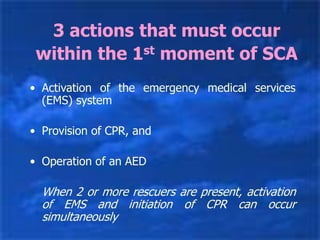
within the 1st moment of SCA
• Activation of the emergency medical services
(EMS) system
• Provision of CPR, and
• Operation of an AED
When 2 or more rescuers are present, activation
of EMS and initiation of CPR can occur
simultaneously
2 critical questions about
CPR+ defibrillation
• ? CPR should be provided before
defibrillation is attempted
• Number of shocks to be delivered in a
sequence before the rescuer resumes CPR
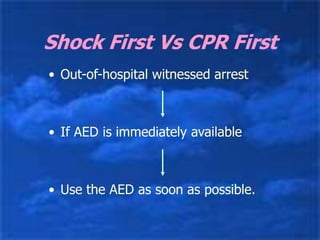
Shock First Vs CPR First
• Out-of-hospital witnessed arrest
• If AED is immediately available
• Use the AED as soon as possible.
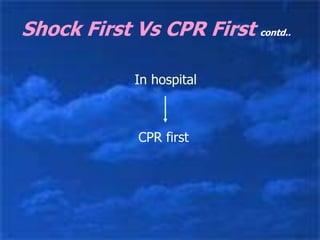
In hospital
CPR first
Shock First Vs CPR First contd..
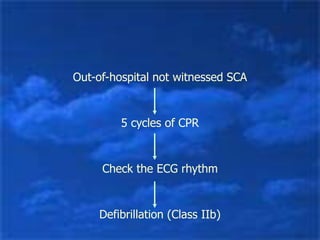
Out-of-hospital not witnessed SCA
5 cycles of CPR
Check the ECG rhythm
Defibrillation (Class IIb)
• One cycle of CPR consists of 30
compressions and 2 breaths
• When compressions are delivered at a rate
of about 100 per minute, 5 cycles of CPR
should take roughly 2 minutes
This recommendation regarding CPR prior to
attempted defibrillation is supported by 2
clinical studies
JAMA. 2003;289:1389 –1395
JAMA. 1999;281:1182–1188
1-shock Vs 3-shock sequence
• No published human studies
• Animal studies- 1 shock f/b CPR
• VF/ Pulseless VT- 1 shock f/b 5 # CPR
• Non shockable rhythm- CPR first
• 1st shock efficacy of Monophasic is lower than
biphasic shock
Defibrillation waveforms
and energy levels
• The energy settings are designed to provide the
lowest effective energy needed to terminate VF
• Shock success -Termination of VF for at least 5
sec following the shock
• VF frequently recurs after successful shocks, but
this recurrence should not be equated with shock
failure
• Modern defibrillators are classified as
Monophasic
Biphasic
• Energy levels vary by type of device
• No specific waveform is associated with a higher
rate of return of spontaneous circulation (ROSC)
or rates of survival to hospital discharge after
cardiac arrest
Monophasic waveform
Defibrillators
• Deliver current of one polarity
• 2 types
• The monophasic damped sinusoidal waveform
(MDS) returns to zero gradually
• Monophasic truncated exponential waveform
(MTE) current is abruptly returned to baseline
(truncated) to zero current flow
Biphasic waveform
Defibrillators
• The optimal energy for termination rate for
VF has not been determined
• 200 J is safe and has equivalent or higher
efficacy for termination of VF than
monophasic waveform shocks of
equivalent or higher energy (Class IIa)
Automated external
Defibrillators
• AEDs are sophisticated, reliable devices
• Use voice and visual prompts to guide lay
rescuers and healthcare providers to safely
defibrillate VF SCA
Lay Rescuer AED programs
• 1995 AHA recommended lay rescuer AED
programs to improve survival rates from out-of-
hospital SCA
• Studies of lay rescuer AED programs in airports,
& casinos have shown a survival rate of 41-74%
from out-of-hospital witnessed VF SCA when
immediate bystander CPR is provided and
defibrillation occurs within about 3 to 5 minutes
of collapse
Electrode placement
• Right pad – Right Infraclavicular
• Left pad – Inf-lateral left chest, lateral to
the left breast
• Position the pad at least 1 inch (2.5 cm)
away from the implantable medical device
• Do not place pads directly on top of a
transdermal medication patch
• If the victim’s chest is covered with water
or the victim is extremely diaphoretic, wipe
the chest before attaching pads
• AEDs can be used when the victim is lying
on snow or ice
• If the victim has a hairy chest, remove
some hair
Manual Defibrillation
• Both low-energy and high-energy biphasic
waveform shocks are effective
• Both escalating & non-escalating energy
defibrillators are available
• Insufficient data to recommend one over another
• Use device specific dose
• Biphasic- 150-200 J
• Monophasic- 360 J
• Although operator selects the shock
energy (in joules), it is the current flow (in
amperes) that actually depolarizes the
myocardium
Transthoracic Impedance
• Human impedance is 70 to 80 Ω
• To reduce use conductive materials
• In O2 rich areas such as CCU’s arcing has
been known to cause fires
Electrode size
• Min of 50 cm2
• 8-12 cm diameter
• Small electrode mat cause myocardial
necrosis
Fire hazard
• In oxygen rich environment
• Self-adhesive minimize the risk of sparks
• Do not use medical gels or pastes with
poor electrical conductivity, such as
ultrasound gel
Synchronized cardioversion
• Shock delivery that is timed (synchronized) with
the QRS complex
• Avoids shock delivery during the relative
refractory portion of the cardiac cycle, when a
shock could produce VF
• Energy (shock dose) used for a synchronized
shock is lower than that used for unsynchronized
shocks (defibrillation)
• Synchronized cardioversion is recommended
to treat
• Unstable SVT
– d/t reentry
– atrial fibrillation
– atrial flutter
SVT
• Monophasic energy for A Fib = 100-200 J
• A Flutter = 50-100 J
• If initial shock fails then increase dose in step
wise manner
• Optimal dose for biphasic waveforms not
established
• Success of terminating A fib with initial
dose = 85%
Ventricular Tachycardia
• Pulseless VT is treated as VF
Thank You

Defibrillator.ppt

  • 1.
  • 2.
    Definition An electrical deviceused to counteract fibrillation of the heart muscle and restore normal heartbeat by applying a brief electric shock
  • 3.
    Early defibrillation is criticalto survival • VF -frequent rhythm witnessed in SCA • Rx for VF is electrical defibrillation • Probability of successful defibrillation diminishes rapidly over time • VF tends to deteriorate to asystole within a few minutes
  • 4.
    For every minutethat passes between collapse and defibrillation, survival rates from witnessed VF SCA decrease 7% to 10% if no CPR is provided Ann Emerg Med. 1993;22:1652–1658
  • 5.
    3 actions thatmust occur within the 1st moment of SCA • Activation of the emergency medical services (EMS) system • Provision of CPR, and • Operation of an AED When 2 or more rescuers are present, activation of EMS and initiation of CPR can occur simultaneously
  • 6.
    2 critical questionsabout CPR+ defibrillation • ? CPR should be provided before defibrillation is attempted • Number of shocks to be delivered in a sequence before the rescuer resumes CPR
  • 7.
    Shock First VsCPR First • Out-of-hospital witnessed arrest • If AED is immediately available • Use the AED as soon as possible.
  • 8.
    In hospital CPR first ShockFirst Vs CPR First contd..
  • 9.
    Out-of-hospital not witnessedSCA 5 cycles of CPR Check the ECG rhythm Defibrillation (Class IIb)
  • 10.
    • One cycleof CPR consists of 30 compressions and 2 breaths • When compressions are delivered at a rate of about 100 per minute, 5 cycles of CPR should take roughly 2 minutes
  • 11.
    This recommendation regardingCPR prior to attempted defibrillation is supported by 2 clinical studies JAMA. 2003;289:1389 –1395 JAMA. 1999;281:1182–1188
  • 12.
    1-shock Vs 3-shocksequence • No published human studies • Animal studies- 1 shock f/b CPR • VF/ Pulseless VT- 1 shock f/b 5 # CPR • Non shockable rhythm- CPR first • 1st shock efficacy of Monophasic is lower than biphasic shock
  • 13.
    Defibrillation waveforms and energylevels • The energy settings are designed to provide the lowest effective energy needed to terminate VF • Shock success -Termination of VF for at least 5 sec following the shock • VF frequently recurs after successful shocks, but this recurrence should not be equated with shock failure
  • 14.
    • Modern defibrillatorsare classified as Monophasic Biphasic • Energy levels vary by type of device • No specific waveform is associated with a higher rate of return of spontaneous circulation (ROSC) or rates of survival to hospital discharge after cardiac arrest
  • 15.
    Monophasic waveform Defibrillators • Delivercurrent of one polarity • 2 types • The monophasic damped sinusoidal waveform (MDS) returns to zero gradually • Monophasic truncated exponential waveform (MTE) current is abruptly returned to baseline (truncated) to zero current flow
  • 16.
    Biphasic waveform Defibrillators • Theoptimal energy for termination rate for VF has not been determined • 200 J is safe and has equivalent or higher efficacy for termination of VF than monophasic waveform shocks of equivalent or higher energy (Class IIa)
  • 17.
    Automated external Defibrillators • AEDsare sophisticated, reliable devices • Use voice and visual prompts to guide lay rescuers and healthcare providers to safely defibrillate VF SCA
  • 18.
    Lay Rescuer AEDprograms • 1995 AHA recommended lay rescuer AED programs to improve survival rates from out-of- hospital SCA • Studies of lay rescuer AED programs in airports, & casinos have shown a survival rate of 41-74% from out-of-hospital witnessed VF SCA when immediate bystander CPR is provided and defibrillation occurs within about 3 to 5 minutes of collapse
  • 19.
    Electrode placement • Rightpad – Right Infraclavicular • Left pad – Inf-lateral left chest, lateral to the left breast • Position the pad at least 1 inch (2.5 cm) away from the implantable medical device
  • 20.
    • Do notplace pads directly on top of a transdermal medication patch • If the victim’s chest is covered with water or the victim is extremely diaphoretic, wipe the chest before attaching pads • AEDs can be used when the victim is lying on snow or ice • If the victim has a hairy chest, remove some hair
  • 21.
    Manual Defibrillation • Bothlow-energy and high-energy biphasic waveform shocks are effective • Both escalating & non-escalating energy defibrillators are available • Insufficient data to recommend one over another • Use device specific dose
  • 22.
    • Biphasic- 150-200J • Monophasic- 360 J • Although operator selects the shock energy (in joules), it is the current flow (in amperes) that actually depolarizes the myocardium
  • 23.
    Transthoracic Impedance • Humanimpedance is 70 to 80 Ω • To reduce use conductive materials • In O2 rich areas such as CCU’s arcing has been known to cause fires
  • 24.
    Electrode size • Minof 50 cm2 • 8-12 cm diameter • Small electrode mat cause myocardial necrosis
  • 25.
    Fire hazard • Inoxygen rich environment • Self-adhesive minimize the risk of sparks • Do not use medical gels or pastes with poor electrical conductivity, such as ultrasound gel
  • 26.
    Synchronized cardioversion • Shockdelivery that is timed (synchronized) with the QRS complex • Avoids shock delivery during the relative refractory portion of the cardiac cycle, when a shock could produce VF • Energy (shock dose) used for a synchronized shock is lower than that used for unsynchronized shocks (defibrillation)
  • 27.
    • Synchronized cardioversionis recommended to treat • Unstable SVT – d/t reentry – atrial fibrillation – atrial flutter
  • 28.
    SVT • Monophasic energyfor A Fib = 100-200 J • A Flutter = 50-100 J • If initial shock fails then increase dose in step wise manner • Optimal dose for biphasic waveforms not established • Success of terminating A fib with initial dose = 85%
  • 29.
  • 31.