© BLR®—Business & Legal Resources 1406
Defensive Driving
© BLR®—Business & Legal Resources 1406
Session Objectives
You will be able to:
• Identify driving hazards
• Understand defensive driving techniques
• Use defensive driving techniques to prevent
accidents and injuries on the road
© BLR®—Business & Legal Resources 1406
Driving Safety Statistics
• Someone is injured every
14 seconds
• Over 2 million injuries
annually
• A person dies in a
crash every 16 minutes
• Motor vehicle accidents
are the most common
cause of work-related
death
• 1 in 4 fatal work injuries
involves a vehicle
accident
1 INJURY
EVERY 14 SEC.
© BLR®—Business & Legal Resources 1406
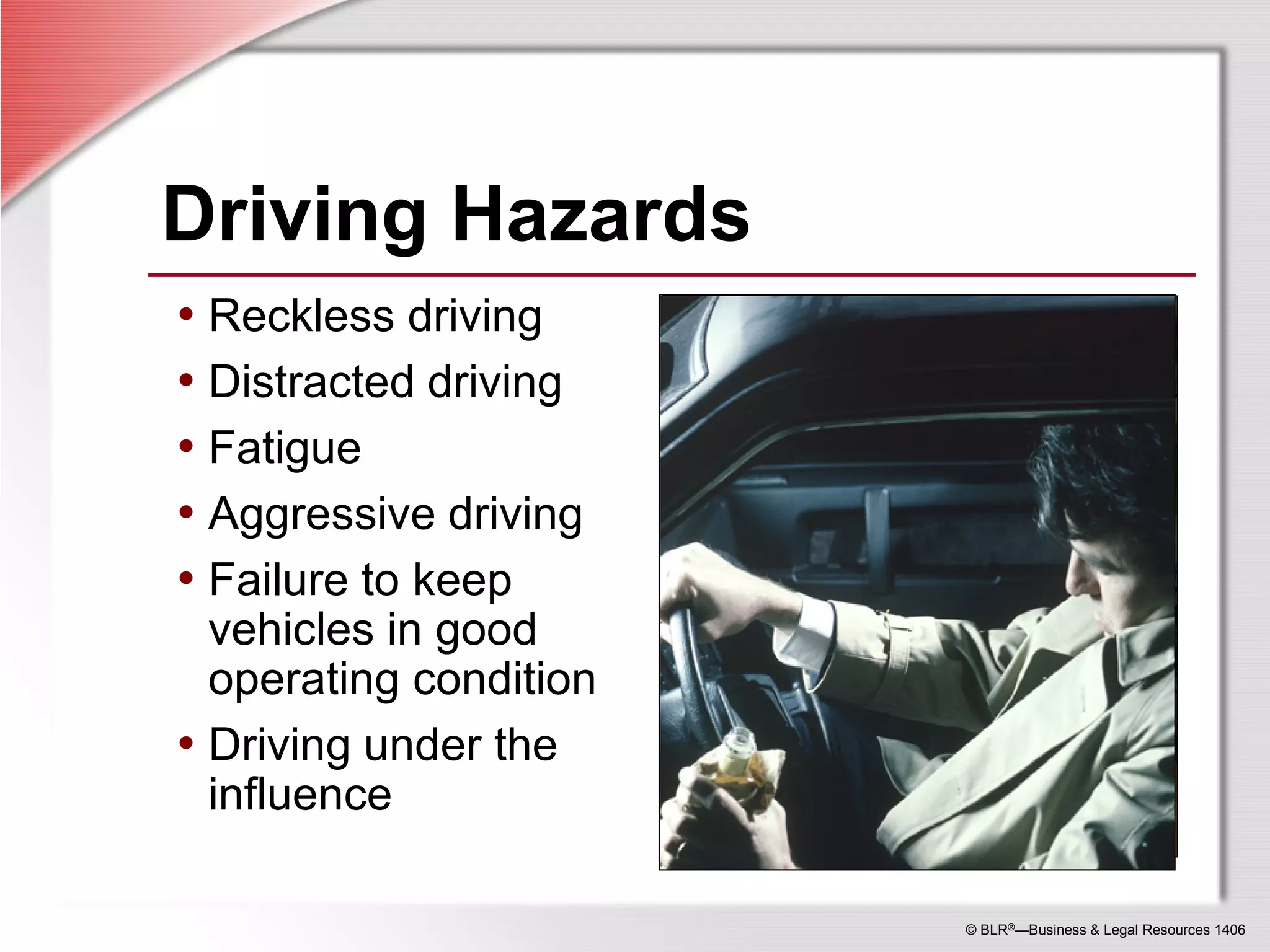
Driving Hazards
• Reckless driving
• Distracted driving
• Fatigue
• Aggressive driving
• Failure to keep
vehicles in good
operating condition
• Driving under the
influence
© BLR®—Business & Legal Resources 1406
Driving Hazards:
Dangerous Conditions
• Bad weather
• Difficult road
conditions
• Poor light or glare
• Heavy traffic
• Road work
• Accidents
© BLR®—Business & Legal Resources 1406
Seat Belts
• Saved hundreds of
thousands of lives
• Prevent crashing into
steering wheel, dash,
or windshield
• Keep you inside vehicle
• Protect body organs
• Improve chance of
remaining conscious
• Keep you behind the
wheel if you have to
swerve or brake suddenly
© BLR®—Business & Legal Resources 1406
Vehicle Maintenance
• Regular tune-ups
• Oil changes
• Fluid levels
• Brakes
• Tire treads
and pressure
• Lights, signals,
and wipers
© BLR®—Business & Legal Resources 1406
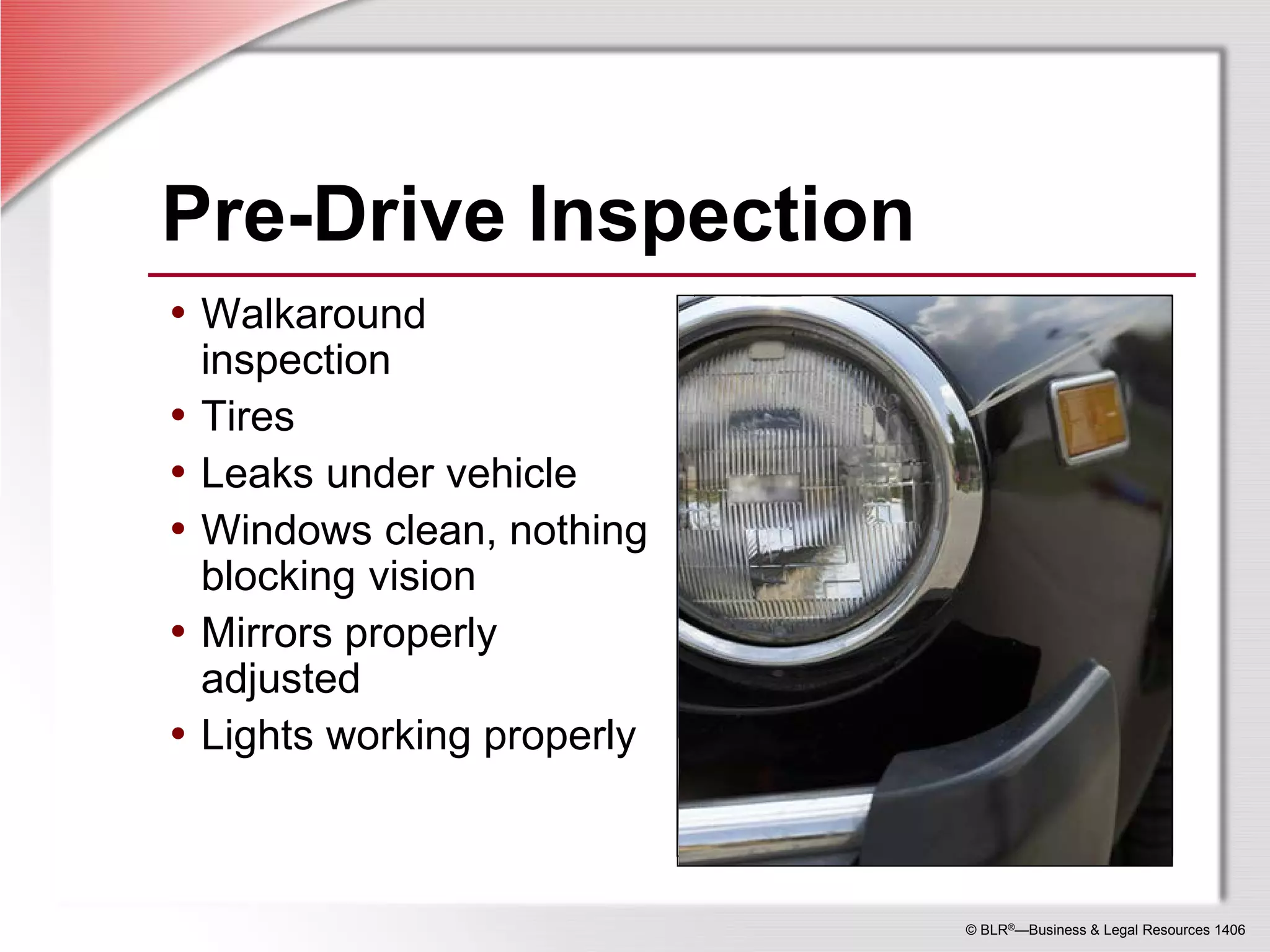
Pre-Drive Inspection
• Walkaround
inspection
• Tires
• Leaks under vehicle
• Windows clean, nothing
blocking vision
• Mirrors properly
adjusted
• Lights working properly
© BLR®—Business & Legal Resources 1406
Carrying a Load?
• Don’t overload
your vehicle
• Make sure everyone
has a seat and
a seat belt
• Make sure cargo is
properly secured
• Be certain your vision
is not blocked
© BLR®—Business & Legal Resources 1406
Identify three driving
hazards caused by
human error
Driving Hazards:
ID Test
Reckless driving
Distracted driving
Fatigue
Aggressive
driving
Vehicles in
poor operating
condition
Driving under
the influence
© BLR®—Business & Legal Resources 1406
Identify three driving
hazards caused by
dangerous conditions
Driving Hazards:
ID Test(cont.)
Bad weather
Difficult road
conditions
Poor light
or glare
Heavy traffic
Road work
Accidents
© BLR®—Business & Legal Resources 1406
Driving Hazards
• Do you understand
the variety of driving
hazards you could
face on the road?
© BLR®—Business & Legal Resources 1406
Avoid Collisions
• Head-on collisions
• Hit from behind
• Hitting the driver
in front
• Side collisions
© BLR®—Business & Legal Resources 1406
Obey Traffic Rules
And Use Common Sense
• Speed limits
• Traffic signs
and signals
• Follow the
3-second rule
• Signal your intentions
• Pass with care and
only where allowed
© BLR®—Business & Legal Resources 1406
Keep Alert and Be Prepared
• Keep your mind on your driving and
your hands on the wheel
• Scan the road ahead for problems
• Check mirrors frequently
• Expect the unexpected
• Yield to other drivers who are determined
to get there first
© BLR®—Business & Legal Resources 1406
Adjust to Weather
And Road Conditions
• Slow down
• Turn on lights and wipers
• Increase following
distance to 4 seconds
• Avoid puddles
• Beware of misty rain
after a dry spell
• Be prepared to handle a skid safely
• Beware of icy patches
© BLR®—Business & Legal Resources 1406
Be Extra Careful at Night
• Keep windshield clean to improve vision
• Turn lights on 1/2 hour before sunset
• Increase following distance to 4 seconds
• Be extra careful on curves and at intersections
• Switch from high to low beams to keep
from blinding other drivers
• If you have trouble, pull completely off
the road and use flashers
© BLR®—Business & Legal Resources 1406
Watch Out for Fatigue
• Be especially careful
during late night, early
morning, and mid-
afternoon hours
• Stop, take a nap, and
drink coffee if you’re
tired
• Stop every so often
over long distances
• Avoid medications that
cause drowsiness
© BLR®—Business & Legal Resources 1406
Keep Cool in Traffic
• Keep your
emotions in check
• Take steps to stay
relaxed no matter what
• Allow enough time
to get there
• Don’t provoke
other drivers
• Report aggressive
drivers to the police
© BLR®—Business & Legal Resources 1406
Don’t Drink or
Take Drugs and Drive
Alcohol and drugs impair:
• Ability to determine
distances
• Reaction time
• Judgment
• Vision
Remember:
• Only time, not coffee,
will sober you up
• Ride with a
designated driver
© BLR®—Business & Legal Resources 1406
If You’re In an Accident, Get the
Following Information Before
Leaving the Area:
• Date, Time, Place
• Your vehicle - year, make, model, tag
• Describe the Accident. Include:
• Direction each vehicle was traveling, weather conditions
• Details of accident
• For all individuals include: name, address,
employer, home and work phone. Describe injuries
claimed and observed; ID hospital, if applicable
• Insured (State Employee) driver
© BLR®—Business & Legal Resources 1406
If You’re In an Accident, Get the
Following Information Before
Leaving the Area (continued):
• Your passengers
• Other driver(s)
• His/her passengers
• Witnesses
• Other vehicles(s): year, make, model, tag,
insurance company and policy number
• Police: agency, officer, citations issued (?), to
whom?
© BLR®—Business & Legal Resources 1406
Defensive Driving
Techniques: True or False
You should keep 3 to 4 seconds behind the
vehicle in front.
If you go into a skid, turn the wheel in the
opposite direction you want the front of the
vehicle to go.
If you’ve had too much to drink, a couple
of cups of coffee will sober you up.
Many drowsy driving accidents occur in
mid-afternoon hours.
© BLR®—Business & Legal Resources 1406
Defensive Driving
Techniques
• Do you understand
the information about
defensive driving
techniques?
© BLR®—Business & Legal Resources 1406
Key Points to Remember
• Know the driving hazards you can face
on the road
• Maintain your vehicle in good condition
• Always wear a seat belt
• Follow traffic rules and obey signs
and signals
• Be a safe and defensive driver every day
• Know what to do if involved in an accident

DefensiveDrivingTrainingPowerPoint.pdf

  • 1.
    © BLR®—Business &Legal Resources 1406 Defensive Driving
  • 2.
    © BLR®—Business &Legal Resources 1406 Session Objectives You will be able to: • Identify driving hazards • Understand defensive driving techniques • Use defensive driving techniques to prevent accidents and injuries on the road
  • 3.
    © BLR®—Business &Legal Resources 1406 Driving Safety Statistics • Someone is injured every 14 seconds • Over 2 million injuries annually • A person dies in a crash every 16 minutes • Motor vehicle accidents are the most common cause of work-related death • 1 in 4 fatal work injuries involves a vehicle accident 1 INJURY EVERY 14 SEC.
  • 4.
    © BLR®—Business &Legal Resources 1406 Driving Hazards • Reckless driving • Distracted driving • Fatigue • Aggressive driving • Failure to keep vehicles in good operating condition • Driving under the influence
  • 5.
    © BLR®—Business &Legal Resources 1406 Driving Hazards: Dangerous Conditions • Bad weather • Difficult road conditions • Poor light or glare • Heavy traffic • Road work • Accidents
  • 6.
    © BLR®—Business &Legal Resources 1406 Seat Belts • Saved hundreds of thousands of lives • Prevent crashing into steering wheel, dash, or windshield • Keep you inside vehicle • Protect body organs • Improve chance of remaining conscious • Keep you behind the wheel if you have to swerve or brake suddenly
  • 7.
    © BLR®—Business &Legal Resources 1406 Vehicle Maintenance • Regular tune-ups • Oil changes • Fluid levels • Brakes • Tire treads and pressure • Lights, signals, and wipers
  • 8.
    © BLR®—Business &Legal Resources 1406 Pre-Drive Inspection • Walkaround inspection • Tires • Leaks under vehicle • Windows clean, nothing blocking vision • Mirrors properly adjusted • Lights working properly
  • 9.
    © BLR®—Business &Legal Resources 1406 Carrying a Load? • Don’t overload your vehicle • Make sure everyone has a seat and a seat belt • Make sure cargo is properly secured • Be certain your vision is not blocked
  • 10.
    © BLR®—Business &Legal Resources 1406 Identify three driving hazards caused by human error Driving Hazards: ID Test Reckless driving Distracted driving Fatigue Aggressive driving Vehicles in poor operating condition Driving under the influence
  • 11.
    © BLR®—Business &Legal Resources 1406 Identify three driving hazards caused by dangerous conditions Driving Hazards: ID Test(cont.) Bad weather Difficult road conditions Poor light or glare Heavy traffic Road work Accidents
  • 12.
    © BLR®—Business &Legal Resources 1406 Driving Hazards • Do you understand the variety of driving hazards you could face on the road?
  • 13.
    © BLR®—Business &Legal Resources 1406 Avoid Collisions • Head-on collisions • Hit from behind • Hitting the driver in front • Side collisions
  • 14.
    © BLR®—Business &Legal Resources 1406 Obey Traffic Rules And Use Common Sense • Speed limits • Traffic signs and signals • Follow the 3-second rule • Signal your intentions • Pass with care and only where allowed
  • 15.
    © BLR®—Business &Legal Resources 1406 Keep Alert and Be Prepared • Keep your mind on your driving and your hands on the wheel • Scan the road ahead for problems • Check mirrors frequently • Expect the unexpected • Yield to other drivers who are determined to get there first
  • 16.
    © BLR®—Business &Legal Resources 1406 Adjust to Weather And Road Conditions • Slow down • Turn on lights and wipers • Increase following distance to 4 seconds • Avoid puddles • Beware of misty rain after a dry spell • Be prepared to handle a skid safely • Beware of icy patches
  • 17.
    © BLR®—Business &Legal Resources 1406 Be Extra Careful at Night • Keep windshield clean to improve vision • Turn lights on 1/2 hour before sunset • Increase following distance to 4 seconds • Be extra careful on curves and at intersections • Switch from high to low beams to keep from blinding other drivers • If you have trouble, pull completely off the road and use flashers
  • 18.
    © BLR®—Business &Legal Resources 1406 Watch Out for Fatigue • Be especially careful during late night, early morning, and mid- afternoon hours • Stop, take a nap, and drink coffee if you’re tired • Stop every so often over long distances • Avoid medications that cause drowsiness
  • 19.
    © BLR®—Business &Legal Resources 1406 Keep Cool in Traffic • Keep your emotions in check • Take steps to stay relaxed no matter what • Allow enough time to get there • Don’t provoke other drivers • Report aggressive drivers to the police
  • 20.
    © BLR®—Business &Legal Resources 1406 Don’t Drink or Take Drugs and Drive Alcohol and drugs impair: • Ability to determine distances • Reaction time • Judgment • Vision Remember: • Only time, not coffee, will sober you up • Ride with a designated driver
  • 21.
    © BLR®—Business &Legal Resources 1406 If You’re In an Accident, Get the Following Information Before Leaving the Area: • Date, Time, Place • Your vehicle - year, make, model, tag • Describe the Accident. Include: • Direction each vehicle was traveling, weather conditions • Details of accident • For all individuals include: name, address, employer, home and work phone. Describe injuries claimed and observed; ID hospital, if applicable • Insured (State Employee) driver
  • 22.
    © BLR®—Business &Legal Resources 1406 If You’re In an Accident, Get the Following Information Before Leaving the Area (continued): • Your passengers • Other driver(s) • His/her passengers • Witnesses • Other vehicles(s): year, make, model, tag, insurance company and policy number • Police: agency, officer, citations issued (?), to whom?
  • 23.
    © BLR®—Business &Legal Resources 1406 Defensive Driving Techniques: True or False You should keep 3 to 4 seconds behind the vehicle in front. If you go into a skid, turn the wheel in the opposite direction you want the front of the vehicle to go. If you’ve had too much to drink, a couple of cups of coffee will sober you up. Many drowsy driving accidents occur in mid-afternoon hours.
  • 24.
    © BLR®—Business &Legal Resources 1406 Defensive Driving Techniques • Do you understand the information about defensive driving techniques?
  • 25.
    © BLR®—Business &Legal Resources 1406 Key Points to Remember • Know the driving hazards you can face on the road • Maintain your vehicle in good condition • Always wear a seat belt • Follow traffic rules and obey signs and signals • Be a safe and defensive driver every day • Know what to do if involved in an accident