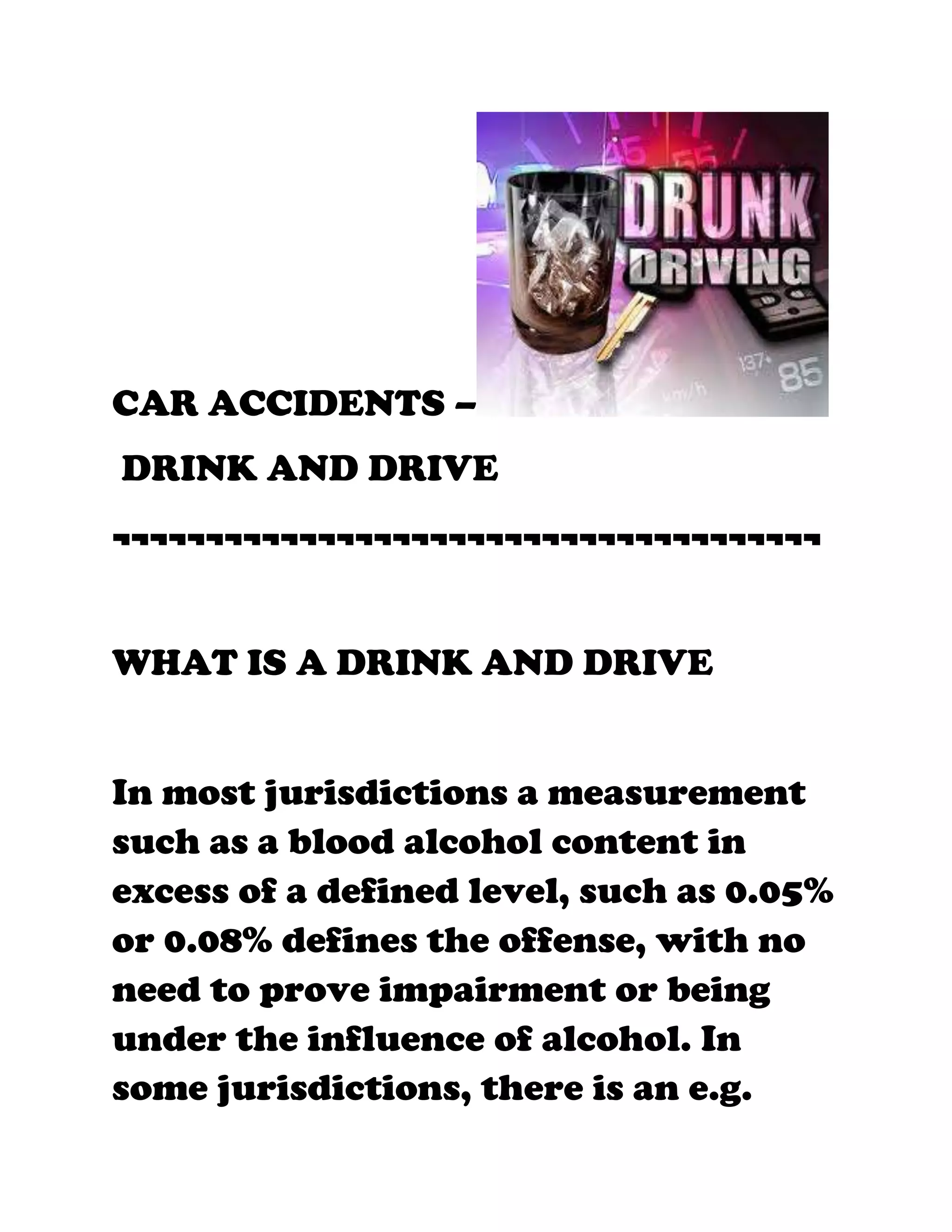
CAR ACCIDENTS โ€“
DRINK AND DRIVE
ยฌยฌยฌยฌยฌยฌยฌยฌยฌยฌยฌยฌยฌยฌยฌยฌยฌยฌยฌยฌยฌยฌยฌยฌยฌยฌยฌยฌยฌยฌยฌยฌยฌยฌยฌยฌยฌยฌ


WHAT IS A DRINK AND DRIVE


In most jurisdictions a measurement
such as a blood alcohol content in
excess of a defined level, such as 0.05%
or 0.08% defines the offense, with no
need to prove impairment or being
under the influence of alcohol. In
some jurisdictions, there is an e.g.
THE PROBLEM' Every single injury
and death caused by drunk driving is
totally preventable.


THE FACTS' Most drivers who have
had something to drink have low
blood alcohol content or
concentration (BAC) and few are
involved in fatal crashes. On the other
hand, while only a few drivers have
BACs higher than .15, a much higher
proportion of those drivers have fatal
crashes.
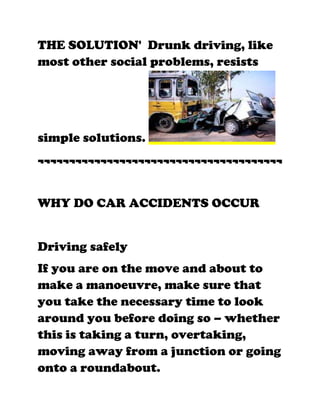
THE SOLUTION' Drunk driving, like
most other social problems, resists


simple solutions.
ยฌยฌยฌยฌยฌยฌยฌยฌยฌยฌยฌยฌยฌยฌยฌยฌยฌยฌยฌยฌยฌยฌยฌยฌยฌยฌยฌยฌยฌยฌยฌยฌยฌยฌยฌยฌยฌยฌยฌ


WHY DO CAR ACCIDENTS OCCUR


Driving safely
If you are on the move and about to
make a manoeuvre, make sure that
you take the necessary time to look
around you before doing so โ€“ whether
this is taking a turn, overtaking,
moving away from a junction or going
onto a roundabout.
Don't rush
Exceeding the speed limit actually
only accounted for 3% of car
accidents, so you need not only make
sure that you are driving at the right
speed for the conditions; you should
try very hard not to become agitated.
Slippery roads or questionable road
conditions mean you should slow
your speed down below the limit and
being stressed can cause you to be
more reckless than you would
normally be.
Keep your distance
Even on roads where the speed limit is
lower than on a dual carriageway or
motorway it is possible to misjudge
the distance between you and the car
in front โ€“ so always give yourself a
little more breathing space (and
therefore braking distance) than you
think you need.


Be covered
Car insurance is mandatory in the UK
and it's important to make sure that
you have the right level of cover.
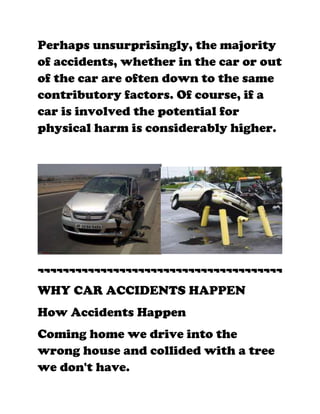
Perhaps unsurprisingly, the majority
of accidents, whether in the car or out
of the car are often down to the same
contributory factors. Of course, if a
car is involved the potential for
physical harm is considerably higher.


ยฌยฌยฌยฌยฌยฌยฌยฌยฌยฌยฌยฌยฌยฌยฌยฌยฌยฌยฌยฌยฌยฌยฌยฌยฌยฌยฌยฌยฌยฌยฌยฌยฌยฌยฌยฌยฌยฌยฌ
WHY CAR ACCIDENTS HAPPEN
How Accidents Happen
Coming home we drive into the
wrong house and collided with a tree
we don't have.
The other car collided with yours
without giving us warning of its
intention.


we think our window is down, but
we find it was up when we put our
head through it.


we collided with a stationary truck
coming the other way.


A pedestrian hit us and went under
my car.The guy was all over the road.
we have to swerve several times
before I hit them.They pulled away
from the side of the road, glanced at
our mother in law and headed over
the embankment.


In an attempt to kill a fly, we drive
into a telephone pole.


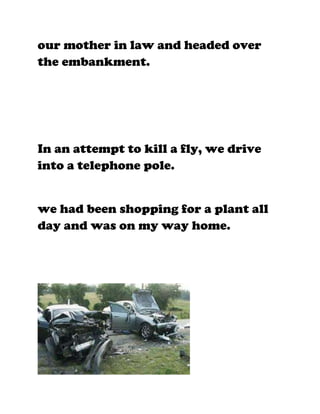
we had been shopping for a plant all
day and was on my way home.
WHAT IS A CAR CRASH


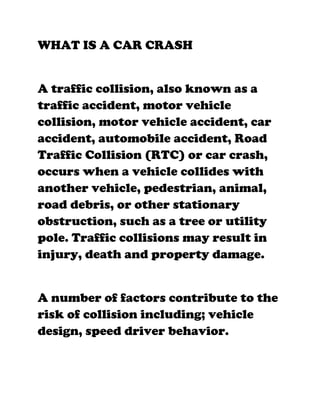
A traffic collision, also known as a
traffic accident, motor vehicle
collision, motor vehicle accident, car
accident, automobile accident, Road
Traffic Collision (RTC) or car crash,
occurs when a vehicle collides with
another vehicle, pedestrian, animal,
road debris, or other stationary
obstruction, such as a tree or utility
pole. Traffic collisions may result in
injury, death and property damage.


A number of factors contribute to the
risk of collision including; vehicle
design, speed driver behavior.
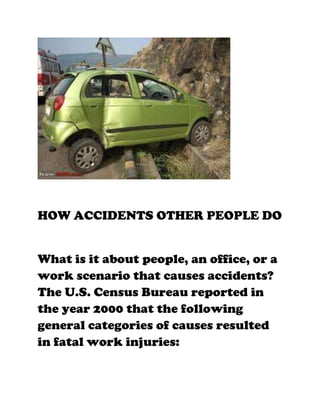
HOW ACCIDENTS OTHER PEOPLE DO


What is it about people, an office, or a
work scenario that causes accidents?
The U.S. Census Bureau reported in
the year 2000 that the following
general categories of causes resulted
in fatal work injuries:
Transportation โ€” 43%
Assaults & violent acts โ€” 16%
Contacts with objects โ€” 17%
Falls โ€” 12%
Exposure to harmful substances or
environment โ€” 8%
Fires โ€” 3%
Other โ€” 1%
Some of the factors associated with
accidents and loss have been
identified as those relating to
management style and beliefs, human
resource policies, operational
procedures, and storage of supplies
and merchandise. Let us examine how
each of these factors contributes to
workplace accidents.
The way a manager approaches
obligations, and the beliefs about
personnel and the nature of work
affect the way in which the person
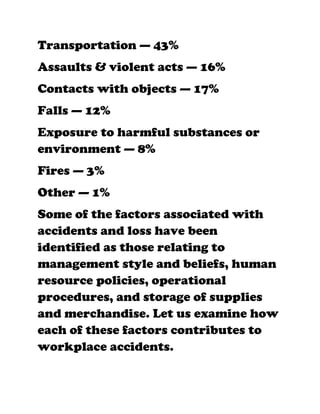
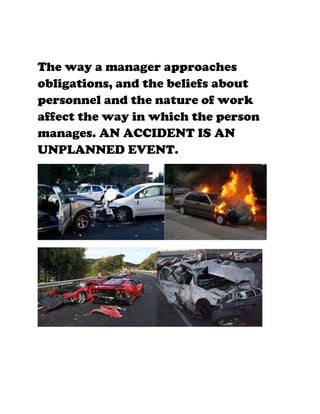
manages. AN ACCIDENT IS AN
UNPLANNED EVENT.
WHAT HAPPENS AFTER ACCIDENT


Making a Claim= If you've been
involved in a collision that may result
in a claim, contact your insurance
representative


as soon as possible. You must notify
your insurer as soon as possible (some
policies specify within seven days)
about any


accident involving the automobile:
Most policies state that a written
declaration ("proof of loss") must be
made within


90 days of the accident.
Preventing further loss = If you are
involved in a collision, you are
responsible for protecting your
vehicle from


further loss or damage. The insurer,
however, will pay for the damage if
you have purchased Collision or All
Perils


coverage. You must not order repairs,
other than those needed for
protection of the vehicle from further
loss or damage,


until the insurer has consented or has
had a reasonable amount of time to
inspect the damage.
Claims adjuster = Once your
insurance company has been advised,
a claims specialist โ€“ an "adjuster" โ€“
will be assigned


to look after your claim. The amount
you receive for your claim will
depend on the type of coverage you
bought. The


adjuster's job is to determine the facts
relating to the claim and the extent to
which the claim is covered by
insurance.


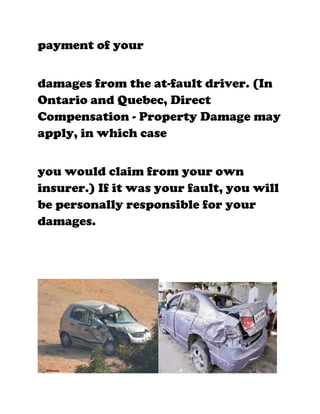
When you don't have Collision
coverage = If the collision was the
other driver's fault, you could claim
payment of your


damages from the at-fault driver. (In
Ontario and Quebec, Direct
Compensation - Property Damage may
apply, in which case


you would claim from your own
insurer.) If it was your fault, you will
be personally responsible for your
damages.
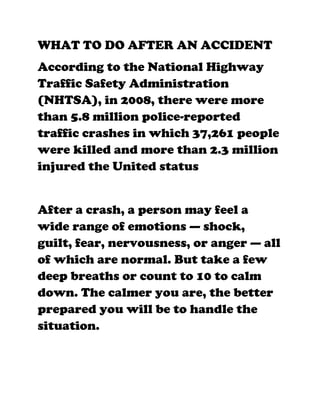
WHAT TO DO AFTER AN ACCIDENT
According to the National Highway
Traffic Safety Administration
(NHTSA), in 2008, there were more
than 5.8 million police-reported
traffic crashes in which 37,261 people
were killed and more than 2.3 million
injured the United status


After a crash, a person may feel a
wide range of emotions โ€” shock,
guilt, fear, nervousness, or anger โ€” all
of which are normal. But take a few
deep breaths or count to 10 to calm
down. The calmer you are, the better
prepared you will be to handle the
situation.
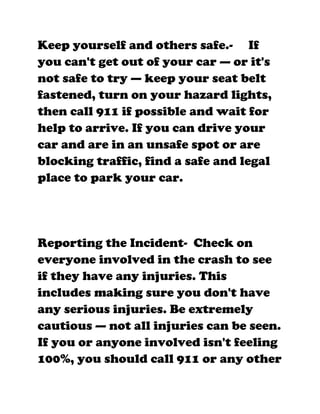
Keep yourself and others safe.- If
you can't get out of your car โ€” or it's
not safe to try โ€” keep your seat belt
fastened, turn on your hazard lights,
then call 911 if possible and wait for
help to arrive. If you can drive your
car and are in an unsafe spot or are
blocking traffic, find a safe and legal
place to park your car.


Reporting the Incident- Check on
everyone involved in the crash to see
if they have any injuries. This
includes making sure you don't have
any serious injuries. Be extremely
cautious โ€” not all injuries can be seen.
If you or anyone involved isn't feeling
100%, you should call 911 or any other
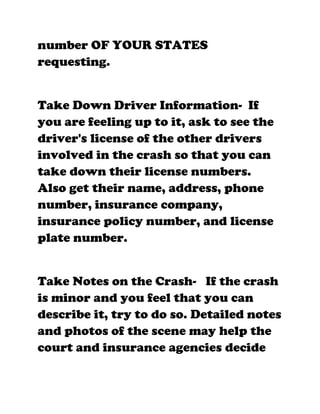
number OF YOUR STATES
requesting.


Take Down Driver Information- If
you are feeling up to it, ask to see the
driver's license of the other drivers
involved in the crash so that you can
take down their license numbers.
Also get their name, address, phone
number, insurance company,
insurance policy number, and license
plate number.


Take Notes on the Crash- If the crash
is minor and you feel that you can
describe it, try to do so. Detailed notes
and photos of the scene may help the
court and insurance agencies decide
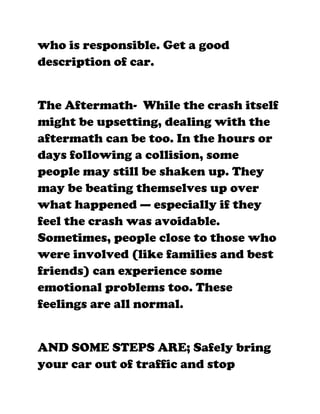
who is responsible. Get a good
description of car.


The Aftermath- While the crash itself
might be upsetting, dealing with the
aftermath can be too. In the hours or
days following a collision, some
people may still be shaken up. They
may be beating themselves up over
what happened โ€” especially if they
feel the crash was avoidable.
Sometimes, people close to those who
were involved (like families and best
friends) can experience some
emotional problems too. These
feelings are all normal.


AND SOME STEPS ARE; Safely bring
your car out of traffic and stop
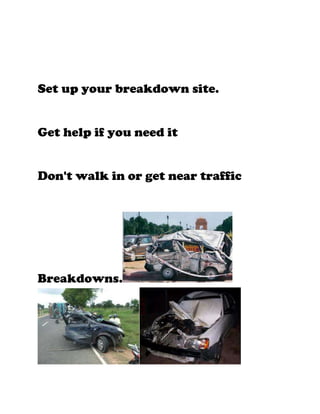
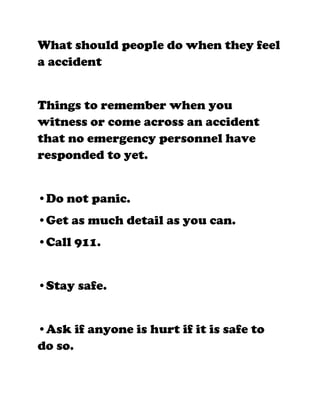
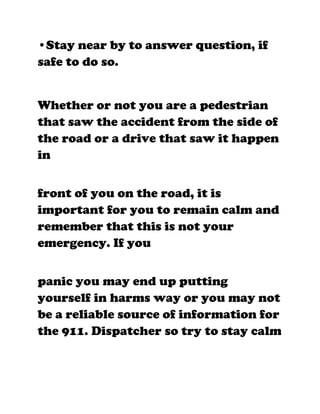
Set up your breakdown site.


Get help if you need it


Don't walk in or get near traffic


Breakdowns.
What should people do when they feel
a accident


Things to remember when you
witness or come across an accident
that no emergency personnel have
responded to yet.


โ€ขDo not panic.
โ€ขGet as much detail as you can.
โ€ขCall 911.


โ€ขStay safe.


โ€ขAsk if anyone is hurt if it is safe to
do so.
โ€ขStay near by to answer question, if
safe to do so.


Whether or not you are a pedestrian
that saw the accident from the side of
the road or a drive that saw it happen
in


front of you on the road, it is
important for you to remain calm and
remember that this is not your
emergency. If you


panic you may end up putting
yourself in harms way or you may not
be a reliable source of information for
the 911. Dispatcher so try to stay calm
โ€•โ€–โ€–โ€–โ€–โ€–โ€–โ€–โ€–โ€–โ€–โ€–โ€–โ€–โ€–โ€–โ€–โ€–โ€–โ€–โ€–โ€–โ€–โ€–โ€–โ€–โ€–โ€–โ€–โ€–โ€–โ€–โ€–โ€–


::::::::::::::::::::::::::::::::::::::::::::::::::::::::::::::
-__---__---_------________-------_____-----____--_-
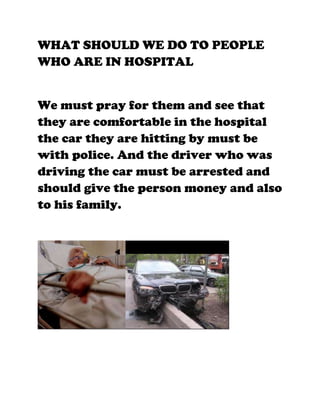
WHAT SHOULD WE DO TO PEOPLE
WHO ARE IN HOSPITAL


We must pray for them and see that
they are comfortable in the hospital
the car they are hitting by must be
with police. And the driver who was
driving the car must be arrested and
should give the person money and also
to his family.
What happens to people who are in
hospital ?


The people in the hospital does not
  survives much and die but the
  people who survies must be ok and
  we must pray for them that they
  led a good life and they must be
  fine .
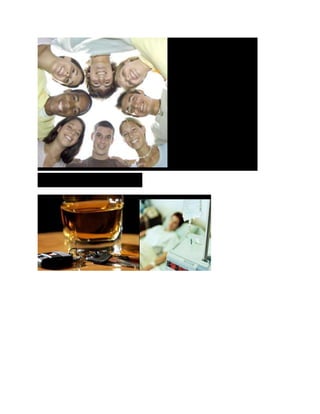
they say donโ€˜t
drink and drive.
GGGGGGGGGGGkii
s omehhs s   some stay but some
beโ€ฆโ€ฆโ€ฆโ€ฆโ€ฆโ€ฆโ€ฆ.


DRINK AND DRIVE STATUS.
ยฌยฌยฌยฌยฌยฌยฌยฌยฌยฌยฌยฌยฌยฌยฌยฌยฌยฌยฌยฌยฌยฌยฌยฌยฌยฌยฌยฌยฌยฌยฌยฌยฌยฌยฌยฌยฌยฌยฌ


THE . โ€— ` ; โ€— = - , . / ? / []                   END
Drink and Drive

Drink and Drive

  • 1.
    CAR ACCIDENTS โ€“ DRINKAND DRIVE ยฌยฌยฌยฌยฌยฌยฌยฌยฌยฌยฌยฌยฌยฌยฌยฌยฌยฌยฌยฌยฌยฌยฌยฌยฌยฌยฌยฌยฌยฌยฌยฌยฌยฌยฌยฌยฌยฌ WHAT IS A DRINK AND DRIVE In most jurisdictions a measurement such as a blood alcohol content in excess of a defined level, such as 0.05% or 0.08% defines the offense, with no need to prove impairment or being under the influence of alcohol. In some jurisdictions, there is an e.g.
  • 2.
    THE PROBLEM' Everysingle injury and death caused by drunk driving is totally preventable. THE FACTS' Most drivers who have had something to drink have low blood alcohol content or concentration (BAC) and few are involved in fatal crashes. On the other hand, while only a few drivers have BACs higher than .15, a much higher proportion of those drivers have fatal crashes.
  • 3.
    THE SOLUTION' Drunkdriving, like most other social problems, resists simple solutions. ยฌยฌยฌยฌยฌยฌยฌยฌยฌยฌยฌยฌยฌยฌยฌยฌยฌยฌยฌยฌยฌยฌยฌยฌยฌยฌยฌยฌยฌยฌยฌยฌยฌยฌยฌยฌยฌยฌยฌ WHY DO CAR ACCIDENTS OCCUR Driving safely If you are on the move and about to make a manoeuvre, make sure that you take the necessary time to look around you before doing so โ€“ whether this is taking a turn, overtaking, moving away from a junction or going onto a roundabout.
  • 4.
    Don't rush Exceeding thespeed limit actually only accounted for 3% of car accidents, so you need not only make sure that you are driving at the right speed for the conditions; you should try very hard not to become agitated. Slippery roads or questionable road conditions mean you should slow your speed down below the limit and being stressed can cause you to be more reckless than you would normally be.
  • 5.
    Keep your distance Evenon roads where the speed limit is lower than on a dual carriageway or motorway it is possible to misjudge the distance between you and the car in front โ€“ so always give yourself a little more breathing space (and therefore braking distance) than you think you need. Be covered Car insurance is mandatory in the UK and it's important to make sure that you have the right level of cover.
  • 6.
    Perhaps unsurprisingly, themajority of accidents, whether in the car or out of the car are often down to the same contributory factors. Of course, if a car is involved the potential for physical harm is considerably higher. ยฌยฌยฌยฌยฌยฌยฌยฌยฌยฌยฌยฌยฌยฌยฌยฌยฌยฌยฌยฌยฌยฌยฌยฌยฌยฌยฌยฌยฌยฌยฌยฌยฌยฌยฌยฌยฌยฌยฌ WHY CAR ACCIDENTS HAPPEN How Accidents Happen Coming home we drive into the wrong house and collided with a tree we don't have.
  • 7.
    The other carcollided with yours without giving us warning of its intention. we think our window is down, but we find it was up when we put our head through it. we collided with a stationary truck coming the other way. A pedestrian hit us and went under my car.The guy was all over the road. we have to swerve several times before I hit them.They pulled away from the side of the road, glanced at
  • 8.
    our mother inlaw and headed over the embankment. In an attempt to kill a fly, we drive into a telephone pole. we had been shopping for a plant all day and was on my way home.
  • 9.
    WHAT IS ACAR CRASH A traffic collision, also known as a traffic accident, motor vehicle collision, motor vehicle accident, car accident, automobile accident, Road Traffic Collision (RTC) or car crash, occurs when a vehicle collides with another vehicle, pedestrian, animal, road debris, or other stationary obstruction, such as a tree or utility pole. Traffic collisions may result in injury, death and property damage. A number of factors contribute to the risk of collision including; vehicle design, speed driver behavior.
  • 10.
    HOW ACCIDENTS OTHERPEOPLE DO What is it about people, an office, or a work scenario that causes accidents? The U.S. Census Bureau reported in the year 2000 that the following general categories of causes resulted in fatal work injuries:
  • 11.
    Transportation โ€” 43% Assaults& violent acts โ€” 16% Contacts with objects โ€” 17% Falls โ€” 12% Exposure to harmful substances or environment โ€” 8% Fires โ€” 3% Other โ€” 1% Some of the factors associated with accidents and loss have been identified as those relating to management style and beliefs, human resource policies, operational procedures, and storage of supplies and merchandise. Let us examine how each of these factors contributes to workplace accidents.
  • 12.
    The way amanager approaches obligations, and the beliefs about personnel and the nature of work affect the way in which the person manages. AN ACCIDENT IS AN UNPLANNED EVENT.
  • 13.
    WHAT HAPPENS AFTERACCIDENT Making a Claim= If you've been involved in a collision that may result in a claim, contact your insurance representative as soon as possible. You must notify your insurer as soon as possible (some policies specify within seven days) about any accident involving the automobile: Most policies state that a written declaration ("proof of loss") must be made within 90 days of the accident.
  • 14.
    Preventing further loss= If you are involved in a collision, you are responsible for protecting your vehicle from further loss or damage. The insurer, however, will pay for the damage if you have purchased Collision or All Perils coverage. You must not order repairs, other than those needed for protection of the vehicle from further loss or damage, until the insurer has consented or has had a reasonable amount of time to inspect the damage.
  • 15.
    Claims adjuster =Once your insurance company has been advised, a claims specialist โ€“ an "adjuster" โ€“ will be assigned to look after your claim. The amount you receive for your claim will depend on the type of coverage you bought. The adjuster's job is to determine the facts relating to the claim and the extent to which the claim is covered by insurance. When you don't have Collision coverage = If the collision was the other driver's fault, you could claim
  • 16.
    payment of your damagesfrom the at-fault driver. (In Ontario and Quebec, Direct Compensation - Property Damage may apply, in which case you would claim from your own insurer.) If it was your fault, you will be personally responsible for your damages.
  • 17.
    WHAT TO DOAFTER AN ACCIDENT According to the National Highway Traffic Safety Administration (NHTSA), in 2008, there were more than 5.8 million police-reported traffic crashes in which 37,261 people were killed and more than 2.3 million injured the United status After a crash, a person may feel a wide range of emotions โ€” shock, guilt, fear, nervousness, or anger โ€” all of which are normal. But take a few deep breaths or count to 10 to calm down. The calmer you are, the better prepared you will be to handle the situation.
  • 18.
    Keep yourself andothers safe.- If you can't get out of your car โ€” or it's not safe to try โ€” keep your seat belt fastened, turn on your hazard lights, then call 911 if possible and wait for help to arrive. If you can drive your car and are in an unsafe spot or are blocking traffic, find a safe and legal place to park your car. Reporting the Incident- Check on everyone involved in the crash to see if they have any injuries. This includes making sure you don't have any serious injuries. Be extremely cautious โ€” not all injuries can be seen. If you or anyone involved isn't feeling 100%, you should call 911 or any other
  • 19.
    number OF YOURSTATES requesting. Take Down Driver Information- If you are feeling up to it, ask to see the driver's license of the other drivers involved in the crash so that you can take down their license numbers. Also get their name, address, phone number, insurance company, insurance policy number, and license plate number. Take Notes on the Crash- If the crash is minor and you feel that you can describe it, try to do so. Detailed notes and photos of the scene may help the court and insurance agencies decide
  • 20.
    who is responsible.Get a good description of car. The Aftermath- While the crash itself might be upsetting, dealing with the aftermath can be too. In the hours or days following a collision, some people may still be shaken up. They may be beating themselves up over what happened โ€” especially if they feel the crash was avoidable. Sometimes, people close to those who were involved (like families and best friends) can experience some emotional problems too. These feelings are all normal. AND SOME STEPS ARE; Safely bring your car out of traffic and stop
  • 21.
    Set up yourbreakdown site. Get help if you need it Don't walk in or get near traffic Breakdowns.
  • 22.
    What should peopledo when they feel a accident Things to remember when you witness or come across an accident that no emergency personnel have responded to yet. โ€ขDo not panic. โ€ขGet as much detail as you can. โ€ขCall 911. โ€ขStay safe. โ€ขAsk if anyone is hurt if it is safe to do so.
  • 23.
    โ€ขStay near byto answer question, if safe to do so. Whether or not you are a pedestrian that saw the accident from the side of the road or a drive that saw it happen in front of you on the road, it is important for you to remain calm and remember that this is not your emergency. If you panic you may end up putting yourself in harms way or you may not be a reliable source of information for the 911. Dispatcher so try to stay calm
  • 24.
  • 25.
    WHAT SHOULD WEDO TO PEOPLE WHO ARE IN HOSPITAL We must pray for them and see that they are comfortable in the hospital the car they are hitting by must be with police. And the driver who was driving the car must be arrested and should give the person money and also to his family.
  • 26.
    What happens topeople who are in hospital ? The people in the hospital does not survives much and die but the people who survies must be ok and we must pray for them that they led a good life and they must be fine .
  • 27.
  • 28.
  • 29.
    s omehhs s some stay but some beโ€ฆโ€ฆโ€ฆโ€ฆโ€ฆโ€ฆโ€ฆ. DRINK AND DRIVE STATUS. ยฌยฌยฌยฌยฌยฌยฌยฌยฌยฌยฌยฌยฌยฌยฌยฌยฌยฌยฌยฌยฌยฌยฌยฌยฌยฌยฌยฌยฌยฌยฌยฌยฌยฌยฌยฌยฌยฌยฌ THE . โ€— ` ; โ€— = - , . / ? / [] END