DRIVING
SAFETY
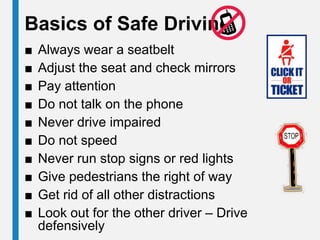
Basics of Safe Driving
■ Always wear a seatbelt
■ Adjust the seat and check mirrors
■ Pay attention
■ Do not talk on the phone
■ Never drive impaired
■ Do not speed
■ Never run stop signs or red lights
■ Give pedestrians the right of way
■ Get rid of all other distractions
■ Look out for the other driver – Drive
defensively
Be a Defensive Driver
Driving defensively means being responsible for your own
actions but also keeping an eye out for other drivers.
• Secure all passengers with safety belts
• Driving too fast or too slow raises the likelihood of an
accident
• Alcohol is a factor in nearly half of all fatal motor vehicle
crashes. Never drink and drive
• Stay clear if you notice a car swerving, making wide turns,
or stopping abruptly, the driver may be impaired
• Do not follow too close or cut off other drivers
• Allow 3 to 6 seconds reaction time
• Abide by the rules of the road and respect other drivers
.
Most Common Causes of Fatal
Automobile Crashes
1. Distracted drivers
Keep from:
• Talking on the cell phone
• Looking at scenery or
“rubbernecking”
• Adjusting the radio/ loud music
Most Common Causes of
Fatal Automobile Crashes
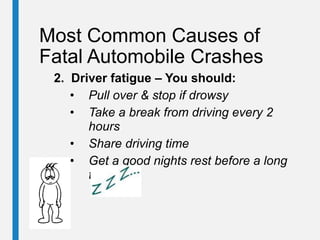
2. Driver fatigue – You should:
• Pull over & stop if drowsy
• Take a break from driving every 2
hours
• Share driving time
• Get a good nights rest before a long
trip
Most Common Causes of Fatal
Automobile Crashes
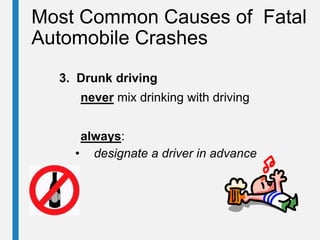
3. Drunk driving
never mix drinking with driving
always:
• designate a driver in advance
Most Common Causes of Fatal
Automobile Crashes
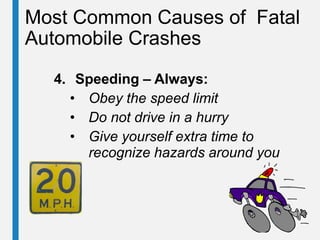
4. Speeding – Always:
• Obey the speed limit
• Do not drive in a hurry
• Give yourself extra time to
recognize hazards around you
Most Common Causes of Fatal
Automobile Crashes
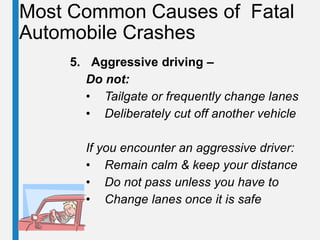
5. Aggressive driving –
Do not:
• Tailgate or frequently change lanes
• Deliberately cut off another vehicle
If you encounter an aggressive driver:
• Remain calm & keep your distance
• Do not pass unless you have to
• Change lanes once it is safe
Most Common Causes of Fatal
Automobile Crashes
6. Weather – Be careful of:
• Heavy rain
• High winds
• Fog
Driver Settings
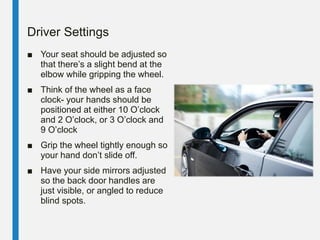
■ Your seat should be adjusted so
that there’s a slight bend at the
elbow while gripping the wheel.
■ Think of the wheel as a face
clock- your hands should be
positioned at either 10 O’clock
and 2 O’clock, or 3 O’clock and
9 O’clock
■ Grip the wheel tightly enough so
your hand don’t slide off.
■ Have your side mirrors adjusted
so the back door handles are
just visible, or angled to reduce
blind spots.
Adjusting Side Mirrors for Blind Spots
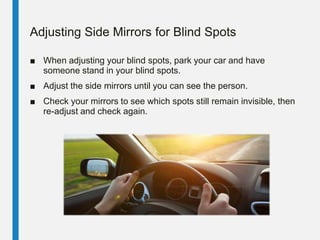
■ When adjusting your blind spots, park your car and have
someone stand in your blind spots.
■ Adjust the side mirrors until you can see the person.
■ Check your mirrors to see which spots still remain invisible, then
re-adjust and check again.
Merging
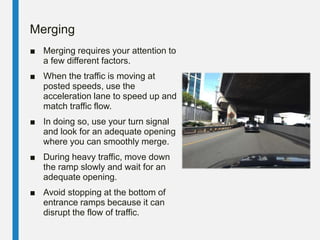
■ Merging requires your attention to
a few different factors.
■ When the traffic is moving at
posted speeds, use the
acceleration lane to speed up and
match traffic flow.
■ In doing so, use your turn signal
and look for an adequate opening
where you can smoothly merge.
■ During heavy traffic, move down
the ramp slowly and wait for an
adequate opening.
■ Avoid stopping at the bottom of
entrance ramps because it can
disrupt the flow of traffic.
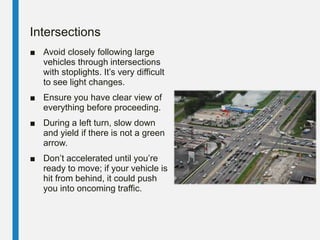
Intersections
■ Avoid closely following large
vehicles through intersections
with stoplights. It’s very difficult
to see light changes.
■ Ensure you have clear view of
everything before proceeding.
■ During a left turn, slow down
and yield if there is not a green
arrow.
■ Don’t accelerated until you’re
ready to move; if your vehicle is
hit from behind, it could push
you into oncoming traffic.
3 Way Stops
■ The first vehicle to arrive at
an intersection with a four-
way stop (whether sign or
traffic light) should be first to
go.
■ The general rule is that the
driver to the right has the
right-of-way if two cars arrive
at the same time.
■ Proceed with caution in case
another driver doesn’t follow
the correct procedure.
Vehicle Maintenance
■ Vehicle that haven’t had
adequate maintenance can
cause car crashes.
■ Maintain the proper air pressure
in your tires to prevent blow-outs
or flat tires.
■ Wiper blades should be changed
regularly.
■ Your owner’s manual should
have a maintenance schedule
which can help you plan
necessary maintenance.
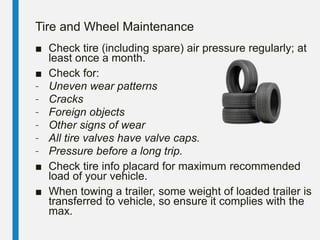
Tire and Wheel Maintenance
■ Check tire (including spare) air pressure regularly; at
least once a month.
■ Check for:
– Uneven wear patterns
– Cracks
– Foreign objects
– Other signs of wear
– All tire valves have valve caps.
– Pressure before a long trip.
■ Check tire info placard for maximum recommended
load of your vehicle.
■ When towing a trailer, some weight of loaded trailer is
transferred to vehicle, so ensure it complies with the
max.
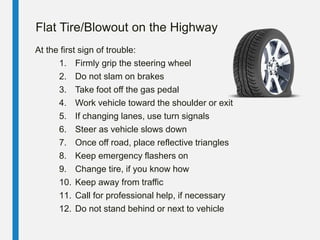
Flat Tire/Blowout on the Highway
At the first sign of trouble:
1. Firmly grip the steering wheel
2. Do not slam on brakes
3. Take foot off the gas pedal
4. Work vehicle toward the shoulder or exit
5. If changing lanes, use turn signals
6. Steer as vehicle slows down
7. Once off road, place reflective triangles
8. Keep emergency flashers on
9. Change tire, if you know how
10. Keep away from traffic
11. Call for professional help, if necessary
12. Do not stand behind or next to vehicle
Safe Driving Skills
■ Keep your eyes constantly moving:
– Look up and down the road
– Look to the sides of the road
– Look into the rear view mirror
■ Always leave yourself an out:
– Try to find a clear spot to go if a crash occurs
– Consider other drivers’ blind spots
■ Don’t linger while passing.
■ Never “tailgate”, or follow someone too closely.
■ Avoid “wolf packs” of vehicles.
Safe Driving Do’s and Don’ts
■ Make sure that other drivers can see you.
■ Allow plenty of time when using a turn signal.
■ Maintain a consistent, average speed on highways.
■ Conform to the traffic speed when merging.
■ Avoid rapid or sudden movements when exiting
highways.
■ Obey traffic signs, lights and signals.
■ Keep your eyes on the road, avoid distracted driving.
■ Watch for pedestrians, bicyclists and motorcyclists.
■ Watch for animals.
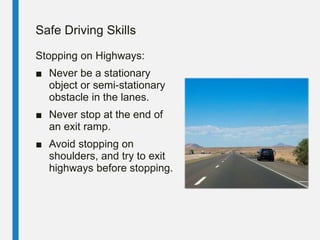
Safe Driving Skills
Stopping on Highways:
■ Never be a stationary
object or semi-stationary
obstacle in the lanes.
■ Never stop at the end of
an exit ramp.
■ Avoid stopping on
shoulders, and try to exit
highways before stopping.
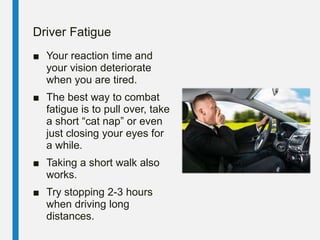
Driver Fatigue
■ Your reaction time and
your vision deteriorate
when you are tired.
■ The best way to combat
fatigue is to pull over, take
a short “cat nap” or even
just closing your eyes for
a while.
■ Taking a short walk also
works.
■ Try stopping 2-3 hours
when driving long
distances.
Knowing Your Vehicle
You should know:
■ What every button, switch and lever does.
■ Where the oil, brake fluid, engine coolant and
window washer reservoirs are.
■ How to fill those reservoirs.
■ What every indicator light means.
■ How to operate basic items, such as the defroster,
wipers, radio and headlights.
Driving at Night
■ Traffic deaths are 3X greater at night than during the
day (Source: National Safety Council).
■ To prepare for nighttime driving, clean headlights,
taillights, signal lights and windows (at least weekly).
■ Never drink and drive!
■ Drive carefully and increase following distances.
■ Don’t out-drive your headlights – your should be able
to stop inside illuminated area.
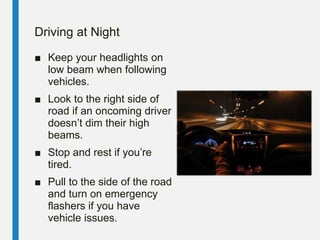
Driving at Night
■ Keep your headlights on
low beam when following
vehicles.
■ Look to the right side of
road if an oncoming driver
doesn’t dim their high
beams.
■ Stop and rest if you’re
tired.
■ Pull to the side of the road
and turn on emergency
flashers if you have
vehicle issues.
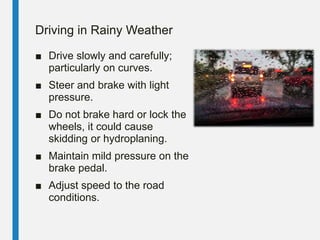
Driving in Rainy Weather
■ Drive slowly and carefully;
particularly on curves.
■ Steer and brake with light
pressure.
■ Do not brake hard or lock the
wheels, it could cause
skidding or hydroplaning.
■ Maintain mild pressure on the
brake pedal.
■ Adjust speed to the road
conditions.
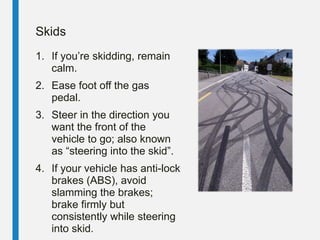
Skids
1. If you’re skidding, remain
calm.
2. Ease foot off the gas
pedal.
3. Steer in the direction you
want the front of the
vehicle to go; also known
as “steering into the skid”.
4. If your vehicle has anti-lock
brakes (ABS), avoid
slamming the brakes;
brake firmly but
consistently while steering
into skid.
Hydroplaning
■ When water in front of tires builds up faster than vehicle’s
weight can push it out of the way, causing loss of traction.
■ The water pressure then causes the vehicle to tread on a
thin layer of water between tires and road.
■ This can can cause skidding, drifting out of lane, leaving
roadway or “fishtailing”.
■ To avoid hydroplaning, keep your tires properly inflated,
maintain good tread, slow down and avoid puddles.
■ If you suspect you’re hydroplaning, do not brake or turn
suddenly.
■ Ease your foot off gas until vehicle slows down, and you can
feel traction again.
■ When braking, do it gently, with light pumping actions.
■ If your vehicle has anti-lock brakes (ABS) you’ll be able to
brake normally.
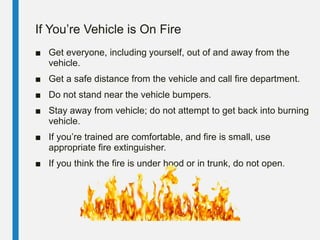
If You’re Vehicle is On Fire
■ Get everyone, including yourself, out of and away from the
vehicle.
■ Get a safe distance from the vehicle and call fire department.
■ Do not stand near the vehicle bumpers.
■ Stay away from vehicle; do not attempt to get back into burning
vehicle.
■ If you’re trained are comfortable, and fire is small, use
appropriate fire extinguisher.
■ If you think the fire is under hood or in trunk, do not open.
General Driving Safety Tips
■ Always wear your seatbelt!
■ When backing up, use caution:
– if you must, have a passenger get out and direct; or
get out and check area before backing.
■ If a gas pump is not operating properly, report it and
discontinue use.
■ Shut off your motor and do not smoke or use cell phone
when refueling.
■ Don’t leave the engine running in an unattended
vehicle.
■ Report all work driving accidents, no matter how minor,
to your supervisor.
PPT-032-02
29
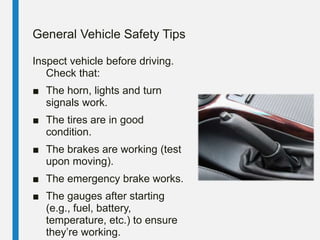
General Vehicle Safety Tips
Inspect vehicle before driving.
Check that:
■ The horn, lights and turn
signals work.
■ The tires are in good
condition.
■ The brakes are working (test
upon moving).
■ The emergency brake works.
■ The gauges after starting
(e.g., fuel, battery,
temperature, etc.) to ensure
they’re working.
■ Distracted driving is a factor in more than 20 percent
of vehicle crashes.
■ Drivers on cell phones fail to see up to half of the
information in their driving environment.
■ Do not text while driving – pull over or send your texts
before driving.
■ Pull over to talk on phone – even “hands free” devices
can be distracting.
Distracted Driving
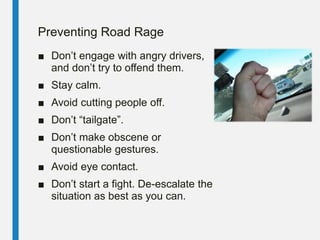
Preventing Road Rage
■ Don’t engage with angry drivers,
and don’t try to offend them.
■ Stay calm.
■ Avoid cutting people off.
■ Don’t “tailgate”.
■ Don’t make obscene or
questionable gestures.
■ Avoid eye contact.
■ Don’t start a fight. De-escalate the
situation as best as you can.
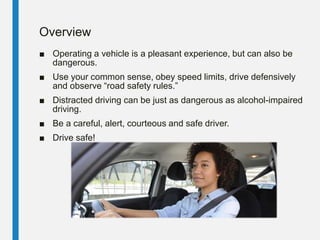
Overview
■ Operating a vehicle is a pleasant experience, but can also be
dangerous.
■ Use your common sense, obey speed limits, drive defensively
and observe “road safety rules.”
■ Distracted driving can be just as dangerous as alcohol-impaired
driving.
■ Be a careful, alert, courteous and safe driver.
■ Drive safe!

Driving Safety.pptxxxxxxxxxxxxxxxxxxxxxxxxxx

  • 1.
  • 2.
    Basics of SafeDriving ■ Always wear a seatbelt ■ Adjust the seat and check mirrors ■ Pay attention ■ Do not talk on the phone ■ Never drive impaired ■ Do not speed ■ Never run stop signs or red lights ■ Give pedestrians the right of way ■ Get rid of all other distractions ■ Look out for the other driver – Drive defensively
  • 3.
    Be a DefensiveDriver Driving defensively means being responsible for your own actions but also keeping an eye out for other drivers. • Secure all passengers with safety belts • Driving too fast or too slow raises the likelihood of an accident • Alcohol is a factor in nearly half of all fatal motor vehicle crashes. Never drink and drive • Stay clear if you notice a car swerving, making wide turns, or stopping abruptly, the driver may be impaired • Do not follow too close or cut off other drivers • Allow 3 to 6 seconds reaction time • Abide by the rules of the road and respect other drivers .
  • 4.
    Most Common Causesof Fatal Automobile Crashes 1. Distracted drivers Keep from: • Talking on the cell phone • Looking at scenery or “rubbernecking” • Adjusting the radio/ loud music
  • 5.
    Most Common Causesof Fatal Automobile Crashes 2. Driver fatigue – You should: • Pull over & stop if drowsy • Take a break from driving every 2 hours • Share driving time • Get a good nights rest before a long trip
  • 6.
    Most Common Causesof Fatal Automobile Crashes 3. Drunk driving never mix drinking with driving always: • designate a driver in advance
  • 7.
    Most Common Causesof Fatal Automobile Crashes 4. Speeding – Always: • Obey the speed limit • Do not drive in a hurry • Give yourself extra time to recognize hazards around you
  • 8.
    Most Common Causesof Fatal Automobile Crashes 5. Aggressive driving – Do not: • Tailgate or frequently change lanes • Deliberately cut off another vehicle If you encounter an aggressive driver: • Remain calm & keep your distance • Do not pass unless you have to • Change lanes once it is safe
  • 9.
    Most Common Causesof Fatal Automobile Crashes 6. Weather – Be careful of: • Heavy rain • High winds • Fog
  • 10.
    Driver Settings ■ Yourseat should be adjusted so that there’s a slight bend at the elbow while gripping the wheel. ■ Think of the wheel as a face clock- your hands should be positioned at either 10 O’clock and 2 O’clock, or 3 O’clock and 9 O’clock ■ Grip the wheel tightly enough so your hand don’t slide off. ■ Have your side mirrors adjusted so the back door handles are just visible, or angled to reduce blind spots.
  • 11.
    Adjusting Side Mirrorsfor Blind Spots ■ When adjusting your blind spots, park your car and have someone stand in your blind spots. ■ Adjust the side mirrors until you can see the person. ■ Check your mirrors to see which spots still remain invisible, then re-adjust and check again.
  • 12.
    Merging ■ Merging requiresyour attention to a few different factors. ■ When the traffic is moving at posted speeds, use the acceleration lane to speed up and match traffic flow. ■ In doing so, use your turn signal and look for an adequate opening where you can smoothly merge. ■ During heavy traffic, move down the ramp slowly and wait for an adequate opening. ■ Avoid stopping at the bottom of entrance ramps because it can disrupt the flow of traffic.
  • 13.
    Intersections ■ Avoid closelyfollowing large vehicles through intersections with stoplights. It’s very difficult to see light changes. ■ Ensure you have clear view of everything before proceeding. ■ During a left turn, slow down and yield if there is not a green arrow. ■ Don’t accelerated until you’re ready to move; if your vehicle is hit from behind, it could push you into oncoming traffic.
  • 14.
    3 Way Stops ■The first vehicle to arrive at an intersection with a four- way stop (whether sign or traffic light) should be first to go. ■ The general rule is that the driver to the right has the right-of-way if two cars arrive at the same time. ■ Proceed with caution in case another driver doesn’t follow the correct procedure.
  • 15.
    Vehicle Maintenance ■ Vehiclethat haven’t had adequate maintenance can cause car crashes. ■ Maintain the proper air pressure in your tires to prevent blow-outs or flat tires. ■ Wiper blades should be changed regularly. ■ Your owner’s manual should have a maintenance schedule which can help you plan necessary maintenance.
  • 16.
    Tire and WheelMaintenance ■ Check tire (including spare) air pressure regularly; at least once a month. ■ Check for: – Uneven wear patterns – Cracks – Foreign objects – Other signs of wear – All tire valves have valve caps. – Pressure before a long trip. ■ Check tire info placard for maximum recommended load of your vehicle. ■ When towing a trailer, some weight of loaded trailer is transferred to vehicle, so ensure it complies with the max.
  • 17.
    Flat Tire/Blowout onthe Highway At the first sign of trouble: 1. Firmly grip the steering wheel 2. Do not slam on brakes 3. Take foot off the gas pedal 4. Work vehicle toward the shoulder or exit 5. If changing lanes, use turn signals 6. Steer as vehicle slows down 7. Once off road, place reflective triangles 8. Keep emergency flashers on 9. Change tire, if you know how 10. Keep away from traffic 11. Call for professional help, if necessary 12. Do not stand behind or next to vehicle
  • 18.
    Safe Driving Skills ■Keep your eyes constantly moving: – Look up and down the road – Look to the sides of the road – Look into the rear view mirror ■ Always leave yourself an out: – Try to find a clear spot to go if a crash occurs – Consider other drivers’ blind spots ■ Don’t linger while passing. ■ Never “tailgate”, or follow someone too closely. ■ Avoid “wolf packs” of vehicles.
  • 19.
    Safe Driving Do’sand Don’ts ■ Make sure that other drivers can see you. ■ Allow plenty of time when using a turn signal. ■ Maintain a consistent, average speed on highways. ■ Conform to the traffic speed when merging. ■ Avoid rapid or sudden movements when exiting highways. ■ Obey traffic signs, lights and signals. ■ Keep your eyes on the road, avoid distracted driving. ■ Watch for pedestrians, bicyclists and motorcyclists. ■ Watch for animals.
  • 20.
    Safe Driving Skills Stoppingon Highways: ■ Never be a stationary object or semi-stationary obstacle in the lanes. ■ Never stop at the end of an exit ramp. ■ Avoid stopping on shoulders, and try to exit highways before stopping.
  • 21.
    Driver Fatigue ■ Yourreaction time and your vision deteriorate when you are tired. ■ The best way to combat fatigue is to pull over, take a short “cat nap” or even just closing your eyes for a while. ■ Taking a short walk also works. ■ Try stopping 2-3 hours when driving long distances.
  • 22.
    Knowing Your Vehicle Youshould know: ■ What every button, switch and lever does. ■ Where the oil, brake fluid, engine coolant and window washer reservoirs are. ■ How to fill those reservoirs. ■ What every indicator light means. ■ How to operate basic items, such as the defroster, wipers, radio and headlights.
  • 23.
    Driving at Night ■Traffic deaths are 3X greater at night than during the day (Source: National Safety Council). ■ To prepare for nighttime driving, clean headlights, taillights, signal lights and windows (at least weekly). ■ Never drink and drive! ■ Drive carefully and increase following distances. ■ Don’t out-drive your headlights – your should be able to stop inside illuminated area.
  • 24.
    Driving at Night ■Keep your headlights on low beam when following vehicles. ■ Look to the right side of road if an oncoming driver doesn’t dim their high beams. ■ Stop and rest if you’re tired. ■ Pull to the side of the road and turn on emergency flashers if you have vehicle issues.
  • 25.
    Driving in RainyWeather ■ Drive slowly and carefully; particularly on curves. ■ Steer and brake with light pressure. ■ Do not brake hard or lock the wheels, it could cause skidding or hydroplaning. ■ Maintain mild pressure on the brake pedal. ■ Adjust speed to the road conditions.
  • 26.
    Skids 1. If you’reskidding, remain calm. 2. Ease foot off the gas pedal. 3. Steer in the direction you want the front of the vehicle to go; also known as “steering into the skid”. 4. If your vehicle has anti-lock brakes (ABS), avoid slamming the brakes; brake firmly but consistently while steering into skid.
  • 27.
    Hydroplaning ■ When waterin front of tires builds up faster than vehicle’s weight can push it out of the way, causing loss of traction. ■ The water pressure then causes the vehicle to tread on a thin layer of water between tires and road. ■ This can can cause skidding, drifting out of lane, leaving roadway or “fishtailing”. ■ To avoid hydroplaning, keep your tires properly inflated, maintain good tread, slow down and avoid puddles. ■ If you suspect you’re hydroplaning, do not brake or turn suddenly. ■ Ease your foot off gas until vehicle slows down, and you can feel traction again. ■ When braking, do it gently, with light pumping actions. ■ If your vehicle has anti-lock brakes (ABS) you’ll be able to brake normally.
  • 28.
    If You’re Vehicleis On Fire ■ Get everyone, including yourself, out of and away from the vehicle. ■ Get a safe distance from the vehicle and call fire department. ■ Do not stand near the vehicle bumpers. ■ Stay away from vehicle; do not attempt to get back into burning vehicle. ■ If you’re trained are comfortable, and fire is small, use appropriate fire extinguisher. ■ If you think the fire is under hood or in trunk, do not open.
  • 29.
    General Driving SafetyTips ■ Always wear your seatbelt! ■ When backing up, use caution: – if you must, have a passenger get out and direct; or get out and check area before backing. ■ If a gas pump is not operating properly, report it and discontinue use. ■ Shut off your motor and do not smoke or use cell phone when refueling. ■ Don’t leave the engine running in an unattended vehicle. ■ Report all work driving accidents, no matter how minor, to your supervisor. PPT-032-02 29
  • 30.
    General Vehicle SafetyTips Inspect vehicle before driving. Check that: ■ The horn, lights and turn signals work. ■ The tires are in good condition. ■ The brakes are working (test upon moving). ■ The emergency brake works. ■ The gauges after starting (e.g., fuel, battery, temperature, etc.) to ensure they’re working.
  • 31.
    ■ Distracted drivingis a factor in more than 20 percent of vehicle crashes. ■ Drivers on cell phones fail to see up to half of the information in their driving environment. ■ Do not text while driving – pull over or send your texts before driving. ■ Pull over to talk on phone – even “hands free” devices can be distracting. Distracted Driving
  • 32.
    Preventing Road Rage ■Don’t engage with angry drivers, and don’t try to offend them. ■ Stay calm. ■ Avoid cutting people off. ■ Don’t “tailgate”. ■ Don’t make obscene or questionable gestures. ■ Avoid eye contact. ■ Don’t start a fight. De-escalate the situation as best as you can.
  • 33.
    Overview ■ Operating avehicle is a pleasant experience, but can also be dangerous. ■ Use your common sense, obey speed limits, drive defensively and observe “road safety rules.” ■ Distracted driving can be just as dangerous as alcohol-impaired driving. ■ Be a careful, alert, courteous and safe driver. ■ Drive safe!

Editor's Notes

  • #3 Be Smart About Driving November 2007 UCOP Safety Meeting
  • #4 Be Smart About Driving November 2007 UCOP Safety Meeting
  • #5 Be Smart About Driving November 2007 UCOP Safety Meeting
  • #6 Be Smart About Driving November 2007 UCOP Safety Meeting
  • #7 Be Smart About Driving November 2007 UCOP Safety Meeting
  • #8 Be Smart About Driving November 2007 UCOP Safety Meeting
  • #9 Be Smart About Driving November 2007 UCOP Safety Meeting
  • #10 Be Smart About Driving November 2007 UCOP Safety Meeting