Defending a Stand
T H E S I S D E F E N S E P R E S E N T A T I O N
contents
01 Analyzing an Issue
02 Defending an Argument
03 Knowing your Reader
04 Writing an Argument
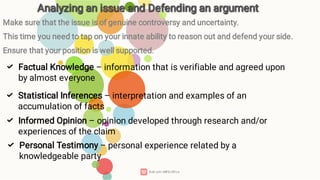
Analyzing an issue and Defending an argument
Make sure that the issue is of genuine controversy and uncertainty.
This time you need to tap on your innate ability to reason out and defend your side.
Ensure that your position is well supported.
 Factual Knowledge – information that is verifiable and agreed upon 
by almost everyone
 Statistical Inferences – interpretation and examples of an 
accumulation of facts
 Informed Opinion – opinion developed through research and/or 
experiences of the claim
 Personal Testimony – personal experience related by a 
knowledgeable party
Many of these sources can be located online
through electronic database
or on the Web. You may be able to retrieve the
actual information electronically
or you may have to visit the library to find the
information in print. You do not
have to use all of the above supporting evidence in
your paper. This is simply a
list of various options available to you.
*
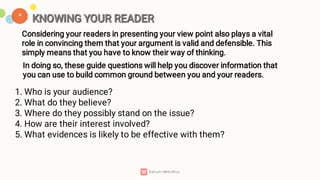
KNOWING YOUR READER
KNOWING YOUR READER
Considering your readers in presenting your view point also plays a vital 
role in convincing them that your argument is valid and defensible. This 
simply means that you have to know their way of thinking.
In doing so, these guide questions will help you discover information that 
you can use to build common ground between you and your readers.
1. Who is your audience?
2. What do they believe?
3. Where do they possibly stand on the issue?
4. How are their interest involved?
5. What evidences is likely to be effective with them?
Writing an Argument
Arguments should always be carefully defended with good reasoning and 
supported by plenty of research. Part of learning to write an argument is 
finding reliable sources or other documents that lend credibility to your 
position. However, you also need to remind yourself that you will not
always win. 
The goal of an argument is not to win a debate but to make a claim and 
support it with credible reasoning and evidences. Make sure you will not 
compromise readers understanding along the process.
01
Introduce your topic and the
issues surrounding it in the first
paragraph of your argument
02
Then, start stating your claim or
the thesis for your essay.
Always use clear and precise
language.
04
Start introducing the points or
arguments in support of your
claim so your readers will
have a clear cut idea as to
what will
be dicussed further.
03
Your reader needs to
understand exactly where
you stand on the issue.
INTRODUCTION
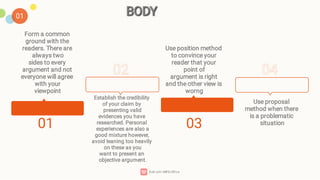
Form a common
ground with the
readers. There are
always two
sides to every
argument and not
everyone will agree
with your
viewpoint
Use position method
to convince your
reader that your
point of
argument is right
and the other view is
worng
01 03
02
02 04
04
Establish the credibility
of your claim by
presenting valid
evidences you have
researched. Personal
experiences are also a
good mixture however,
avoid leaning too heavily
on these as you
want to present an
objective argument.
Use proposal
method when there
is a problematic
situation
01 BODY
BODY
CONCLUSION
Restate the arguments you have
presented but be cautious on 
not introducing any new point in
your conlcusion. The 
conclusion should only review the
arguments you have offered 
on the previous paragraphs.
You can also follow this outline to comprehensively present the 
arguments of your claim:
THANK YOU!

Defending-a-Stand.pdf

  • 1.
    Defending a Stand TH E S I S D E F E N S E P R E S E N T A T I O N
  • 2.
    contents 01 Analyzing anIssue 02 Defending an Argument 03 Knowing your Reader 04 Writing an Argument
  • 3.
    Analyzing an issueand Defending an argument Analyzing an issue and Defending an argument Make sure that the issue is of genuine controversy and uncertainty. This time you need to tap on your innate ability to reason out and defend your side. Ensure that your position is well supported.  Factual Knowledge – information that is verifiable and agreed upon by almost everyone  Statistical Inferences – interpretation and examples of an accumulation of facts  Informed Opinion – opinion developed through research and/or experiences of the claim  Personal Testimony – personal experience related by a knowledgeable party
  • 4.
    Many of thesesources can be located online through electronic database or on the Web. You may be able to retrieve the actual information electronically or you may have to visit the library to find the information in print. You do not have to use all of the above supporting evidence in your paper. This is simply a list of various options available to you.
  • 5.
    * KNOWING YOUR READER KNOWINGYOUR READER Considering your readers in presenting your view point also plays a vital role in convincing them that your argument is valid and defensible. This simply means that you have to know their way of thinking. In doing so, these guide questions will help you discover information that you can use to build common ground between you and your readers. 1. Who is your audience? 2. What do they believe? 3. Where do they possibly stand on the issue? 4. How are their interest involved? 5. What evidences is likely to be effective with them?
  • 6.
    Writing an Argument Argumentsshould always be carefully defended with good reasoning and supported by plenty of research. Part of learning to write an argument is finding reliable sources or other documents that lend credibility to your position. However, you also need to remind yourself that you will not always win. The goal of an argument is not to win a debate but to make a claim and support it with credible reasoning and evidences. Make sure you will not compromise readers understanding along the process.
  • 7.
    01 Introduce your topicand the issues surrounding it in the first paragraph of your argument 02 Then, start stating your claim or the thesis for your essay. Always use clear and precise language. 04 Start introducing the points or arguments in support of your claim so your readers will have a clear cut idea as to what will be dicussed further. 03 Your reader needs to understand exactly where you stand on the issue. INTRODUCTION
  • 8.
    Form a common groundwith the readers. There are always two sides to every argument and not everyone will agree with your viewpoint Use position method to convince your reader that your point of argument is right and the other view is worng 01 03 02 02 04 04 Establish the credibility of your claim by presenting valid evidences you have researched. Personal experiences are also a good mixture however, avoid leaning too heavily on these as you want to present an objective argument. Use proposal method when there is a problematic situation 01 BODY BODY
  • 9.
    CONCLUSION Restate the argumentsyou have presented but be cautious on not introducing any new point in your conlcusion. The conclusion should only review the arguments you have offered on the previous paragraphs.
  • 10.
    You can alsofollow this outline to comprehensively present the arguments of your claim:
  • 11.