A question of fundamentals: teacher
standards and teacher preparation
2014 Australian Teacher Education Association (ATEA)
Conference
ACU North Sydney
Dr Gavin Hazel (HIMH)
CONTEXT
Links to 2014 ATEA presentations
• Menter: Only Connect
• Wang: Relating emotions …
• Hudson and Hudson: Mentor feedback…
• Kreiwaldt: Underplaying learners’ perspectives…
• Goepel: Do teachers’ professional standards create
teacher professionalism
• Papatraianou and Le Cornu: A social network
perspective…
• BRiTE workshop
• Wyatt-Smith: Profiling productive shifts in teacher
education
• Codification of a set of professional standards
for teachers and school leaders
• The standards articulate what teachers are
supposed to be doing
• These standards are joined to the
accreditation of teacher education programs
• Measures of Effective Teaching Project (2009-
2014)
• Sutton trust (2001): Improving the impact of
teachers on pupil achievement in the UK
• OECD (2011): Building a high-quality teaching
profession
• The Hamilton project: Identifying effective
teachers using performance on the job (2004)
• International and national quality teaching and
learning performance models currently in use
(Charmers, Lee, and walker, 2008)
• Measuring teacher effectiveness: A look
under the hood in teacher evaluation in 10
sites (Doyle and Han, 2012)
• Evaluation of teacher preparation programs:
purposes, methods and policy options (2013)
– National Academy
• Measuring what matters: A stronger
accountability model for teacher education
(Crowe, 2010)
Assumptions
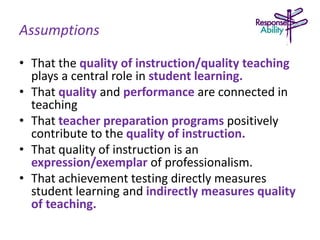
• That the quality of instruction/quality teaching
plays a central role in student learning.
• That quality and performance are connected in
teaching
• That teacher preparation programs positively
contribute to the quality of instruction.
• That quality of instruction is an
expression/exemplar of professionalism.
• That achievement testing directly measures
student learning and indirectly measures quality
of teaching.
CONTEXT: What are the outcomes
of schooling?
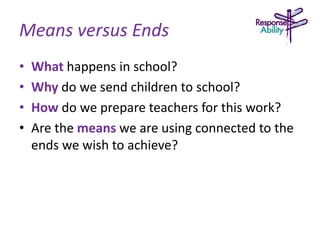
Means versus Ends
• What happens in school?
• Why do we send children to school?
• How do we prepare teachers for this work?
• Are the means we are using connected to the
ends we wish to achieve?
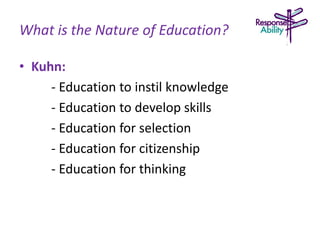
What is the Nature of Education?
• Kuhn:
- Education to instil knowledge
- Education to develop skills
- Education for selection
- Education for citizenship
- Education for thinking
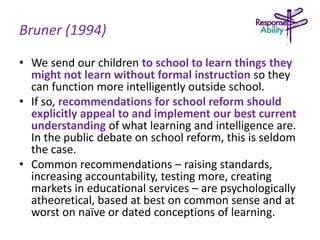
Bruner (1994)
• We send our children to school to learn things they
might not learn without formal instruction so they
can function more intelligently outside school.
• If so, recommendations for school reform should
explicitly appeal to and implement our best current
understanding of what learning and intelligence are.
In the public debate on school reform, this is seldom
the case.
• Common recommendations – raising standards,
increasing accountability, testing more, creating
markets in educational services – are psychologically
atheoretical, based at best on common sense and at
worst on naïve or dated conceptions of learning.
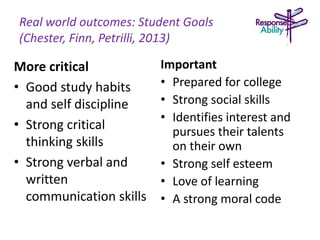
Real world outcomes: Student Goals
(Chester, Finn, Petrilli, 2013)
More critical
• Good study habits
and self discipline
• Strong critical
thinking skills
• Strong verbal and
written
communication skills
Important
• Prepared for college
• Strong social skills
• Identifies interest and
pursues their talents
on their own
• Strong self esteem
• Love of learning
• A strong moral code
UNESCO Education for All Goals (2000)
Quality is at the heart of education, and what
takes place in classrooms and other learning
environments is fundamentally important to
the future wellbeing of children, young people
and adults. A quality education is one that
satisfies basic learning needs, and enriches the
lives of learners and their overall experience of
living. (UNESCO, 2000, Goal 6).
WHAT DO WE KNOW: The contribution
that teachers make to student
outcomes?
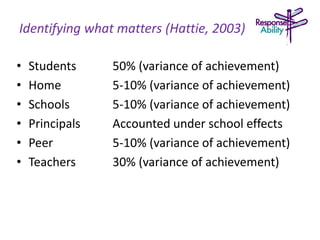
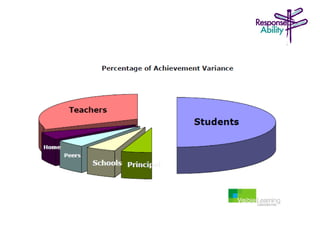
Identifying what matters (Hattie, 2003)
• Students 50% (variance of achievement)
• Home 5-10% (variance of achievement)
• Schools 5-10% (variance of achievement)
• Principals Accounted under school effects
• Peer 5-10% (variance of achievement)
• Teachers 30% (variance of achievement)
Hattie (2003)
• It is what teachers know, do, and care about
which is very powerful in the learning
equation.
WHAT IS EXPECTED: How do we
represent this in practice?
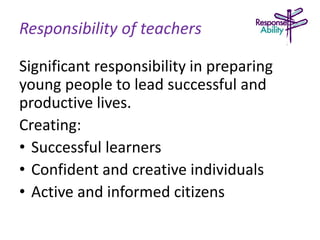
Responsibility of teachers
Significant responsibility in preparing
young people to lead successful and
productive lives.
Creating:
• Successful learners
• Confident and creative individuals
• Active and informed citizens
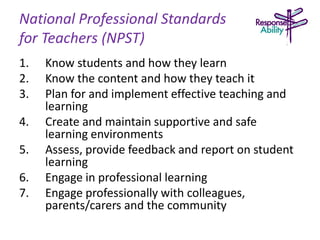
National Professional Standards
for Teachers (NPST)
1. Know students and how they learn
2. Know the content and how they teach it
3. Plan for and implement effective teaching and
learning
4. Create and maintain supportive and safe
learning environments
5. Assess, provide feedback and report on student
learning
6. Engage in professional learning
7. Engage professionally with colleagues,
parents/carers and the community
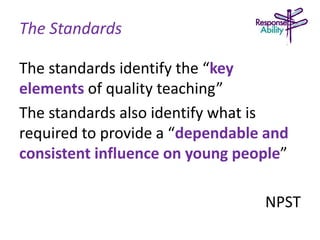
The Standards
The standards identify the “key
elements of quality teaching”
The standards also identify what is
required to provide a “dependable and
consistent influence on young people”
NPST
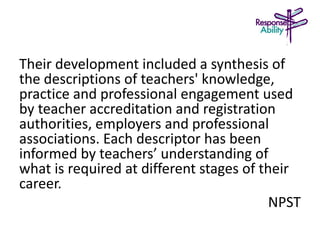
Their development included a synthesis of
the descriptions of teachers' knowledge,
practice and professional engagement used
by teacher accreditation and registration
authorities, employers and professional
associations. Each descriptor has been
informed by teachers’ understanding of
what is required at different stages of their
career.
NPST
Standards
• Define quality teaching
• Define teachers work
• Make explicit the elements of high quality
effective teaching that will improve
educational outcomes for students
NPST
• (Improved) Teacher Quality = Improved
Education Outcomes
• Educational outcomes include:
Successful learners
Confident and creative individuals
Active and informed citizens
NPST
Quality
There is less consensus on what ‘quality’
actually entails, especially when we
move from conditions for quality
(infrastructure, resources, teacher
supply, course access, enrolment and
retention) to the pedagogy through
which educational quality is most direct
mediated (Alexander, 2008, 1).
OECD Indicators of QT1994
• Content knowledge
• Pedagogic skill
• Reflection
• Empathy
• Managerial competence
• Commitment
• Love children
• Set an example
• Manage groups effectively
• Incorporate technology
• Master multiple modes of
teaching and learning
• Adjust and improvise
• Know the students
• Exchange ideas with other
teachers
• Reflect
The international debate about the
quality of education practice has been
dominated by those who operate in the
domains of policy, accountability and
funding rather than in the area of
practice, quality has tended to be
conceived not as what it actually is but
how it can be measured (Alexander,
2008, 3).
When learners themselves are asked
about educational quality they tend to
talk not about test scores but about the
felt experiences of learning, dwelling
especially on their attitude to tasks set
and the degree to which they find the
context of peer and teacher-student
relationships supportive and rewarding
(Alexander, 2008, 3).
Accountability
• We want to know that the things we
do will make a difference
• How do we deepen our
understanding of the science behind
the standards?
• What is the quality of the evidence?
• How do we bring these standards into
our daily interactions with students?
• How does teacher preparation ground
these practices?
• Where is the attitudinal component?
• How will these standards address
attrition in teaching?
Key questions
• Does the account of quality in the NPST
attend to what really matters in teaching
and learning?
• Are the classroom processes and outcomes
that are truly transformative for our
children adequately capture in the NPST?
• If not, what are implications for the
accreditation of teacher preparation
courses?
WHAT IS MISSING: Teachers work
Heckman (2008): More than cognitive
skills
• Cognitive abilities are important determinants of
socioeconomic success.
• So are socioemotional skills, physical and mental
health, perseverance, attention, motivation, and self
confidence. They contribute to the performance in
society at large and even help determine scores n
the very tests that are commonly used to measure
cognitive achievement.
• IF society intervenes early enough, it can improve
cognitive and socioemotional abilities and health of
disadvantaged children.
Life cycle skill formation is dynamic in nature.
Skill begets skill; motivation begets motivation.
Motivation cross fosters skill and skill cross foster
motivation. IF a child is not motivated to learn and
engage early in life, the more likely it is that when
the child becomes an adult, it will fail in social and
economic life. The longer society waits to
intervene in the life cycle of a disadvantaged child,
the more costly it is to remediate disadvantage.
Heckman (2008). Schools, Skills, and Synapses
Key part of teachers work that go
to the goals of schooling
• Partnerships
• Relationships
• Server and return
• Intentional/unintentional learning
• Intentional/purposeful nature of teaching:
Teaching is undertaken for a purpose
• Decision making
• Dynamic
Things that make a difference
• Are these addressed in teachers
work and quality teaching as
described?
• What factors are left out of the
description of teachers work?
• Is it a thin or thick description of
lived experienced?
APPENDIX
Other Assumptions
• Significance and dynamic nature of
relationships
• Centrality of development science to
framing learning
• The complexity and significance of
classroom interactions
• Change
Potential criteria for assessing
quality frameworks
• Comprehensiveness
• Appropriateness
• Consistency
• Manageability
• Conceptual/empirical justifiability
(Alexander, 2008, 18)
Quality - Effectiveness
“The word effective connotes some direct impact
– or effect – on outcomes. In the case of teachers,
this term is usually defined as the teacher’s
contribution to student academic achievement
test scores, though it is possible to measure other
valued student outcomes such as high graduation
rates; student motivation; academic efficacy
beliefs; to other social, behavioural, or intellectual
outcomes.”
(The national Comprehensive Centre for Teacher
Quality, 2007)
THE NATURE OF PROFESSIONALISM
Classic definition of what constitutes
a profession
• Specialised knowledge,
expertise, and professional
language
• Shared standards of
practice
• Long and rigour process of
training and qualification
• A monopoly over the
service that is provided
• An ethic of service, even a
sense of calling, in relation
to clients
• Self-regulation of conduct,
discipline, and dismissals
• Autonomy to make
informed discretionary
judgements
• Working together with
other professionals to
solve complex cases
• Commitment to
continuous learning and
professional upgrading
Are teachers professionals in the way that
practitioners of law and medicine are? Is
there an agreed-upon knowledge base?
Do teachers get the same respect and
support from the public at large as do
other professions? Is teachers’ conduct as
discipline and their judgement as well
founded? Are they allowed the same
degree of autonomy and discretion?
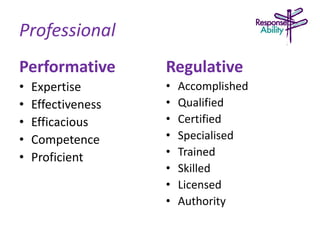
Professional
Performative
• Expertise
• Effectiveness
• Efficacious
• Competence
• Proficient
Regulative
• Accomplished
• Qualified
• Certified
• Specialised
• Trained
• Skilled
• Licensed
• Authority
Questions
• Are the graduate or proficient
standards the ‘minimum dose’ – the
minimum efficacious practices that
lead to educational outcomes?
• If so why – if these lead to the
required outcomes what is the
imperative to beyond these?
• Definition of quality in terms of
outcomes rather than process
• Process and relationships sit at core
of schooling process

A questions of fundamentals

  • 1.
    A question offundamentals: teacher standards and teacher preparation 2014 Australian Teacher Education Association (ATEA) Conference ACU North Sydney Dr Gavin Hazel (HIMH)
  • 2.
  • 3.
    Links to 2014ATEA presentations • Menter: Only Connect • Wang: Relating emotions … • Hudson and Hudson: Mentor feedback… • Kreiwaldt: Underplaying learners’ perspectives… • Goepel: Do teachers’ professional standards create teacher professionalism • Papatraianou and Le Cornu: A social network perspective… • BRiTE workshop • Wyatt-Smith: Profiling productive shifts in teacher education
  • 4.
    • Codification ofa set of professional standards for teachers and school leaders • The standards articulate what teachers are supposed to be doing • These standards are joined to the accreditation of teacher education programs
  • 5.
    • Measures ofEffective Teaching Project (2009- 2014) • Sutton trust (2001): Improving the impact of teachers on pupil achievement in the UK • OECD (2011): Building a high-quality teaching profession • The Hamilton project: Identifying effective teachers using performance on the job (2004) • International and national quality teaching and learning performance models currently in use (Charmers, Lee, and walker, 2008)
  • 6.
    • Measuring teachereffectiveness: A look under the hood in teacher evaluation in 10 sites (Doyle and Han, 2012) • Evaluation of teacher preparation programs: purposes, methods and policy options (2013) – National Academy • Measuring what matters: A stronger accountability model for teacher education (Crowe, 2010)
  • 7.
    Assumptions • That thequality of instruction/quality teaching plays a central role in student learning. • That quality and performance are connected in teaching • That teacher preparation programs positively contribute to the quality of instruction. • That quality of instruction is an expression/exemplar of professionalism. • That achievement testing directly measures student learning and indirectly measures quality of teaching.
  • 8.
    CONTEXT: What arethe outcomes of schooling?
  • 9.
    Means versus Ends •What happens in school? • Why do we send children to school? • How do we prepare teachers for this work? • Are the means we are using connected to the ends we wish to achieve?
  • 10.
    What is theNature of Education? • Kuhn: - Education to instil knowledge - Education to develop skills - Education for selection - Education for citizenship - Education for thinking
  • 11.
    Bruner (1994) • Wesend our children to school to learn things they might not learn without formal instruction so they can function more intelligently outside school. • If so, recommendations for school reform should explicitly appeal to and implement our best current understanding of what learning and intelligence are. In the public debate on school reform, this is seldom the case. • Common recommendations – raising standards, increasing accountability, testing more, creating markets in educational services – are psychologically atheoretical, based at best on common sense and at worst on naïve or dated conceptions of learning.
  • 12.
    Real world outcomes:Student Goals (Chester, Finn, Petrilli, 2013) More critical • Good study habits and self discipline • Strong critical thinking skills • Strong verbal and written communication skills Important • Prepared for college • Strong social skills • Identifies interest and pursues their talents on their own • Strong self esteem • Love of learning • A strong moral code
  • 13.
    UNESCO Education forAll Goals (2000) Quality is at the heart of education, and what takes place in classrooms and other learning environments is fundamentally important to the future wellbeing of children, young people and adults. A quality education is one that satisfies basic learning needs, and enriches the lives of learners and their overall experience of living. (UNESCO, 2000, Goal 6).
  • 14.
    WHAT DO WEKNOW: The contribution that teachers make to student outcomes?
  • 15.
    Identifying what matters(Hattie, 2003) • Students 50% (variance of achievement) • Home 5-10% (variance of achievement) • Schools 5-10% (variance of achievement) • Principals Accounted under school effects • Peer 5-10% (variance of achievement) • Teachers 30% (variance of achievement)
  • 17.
    Hattie (2003) • Itis what teachers know, do, and care about which is very powerful in the learning equation.
  • 18.
    WHAT IS EXPECTED:How do we represent this in practice?
  • 19.
    Responsibility of teachers Significantresponsibility in preparing young people to lead successful and productive lives. Creating: • Successful learners • Confident and creative individuals • Active and informed citizens
  • 20.
    National Professional Standards forTeachers (NPST) 1. Know students and how they learn 2. Know the content and how they teach it 3. Plan for and implement effective teaching and learning 4. Create and maintain supportive and safe learning environments 5. Assess, provide feedback and report on student learning 6. Engage in professional learning 7. Engage professionally with colleagues, parents/carers and the community
  • 21.
    The Standards The standardsidentify the “key elements of quality teaching” The standards also identify what is required to provide a “dependable and consistent influence on young people” NPST
  • 22.
    Their development includeda synthesis of the descriptions of teachers' knowledge, practice and professional engagement used by teacher accreditation and registration authorities, employers and professional associations. Each descriptor has been informed by teachers’ understanding of what is required at different stages of their career. NPST
  • 23.
    Standards • Define qualityteaching • Define teachers work • Make explicit the elements of high quality effective teaching that will improve educational outcomes for students NPST
  • 24.
    • (Improved) TeacherQuality = Improved Education Outcomes • Educational outcomes include: Successful learners Confident and creative individuals Active and informed citizens NPST
  • 25.
    Quality There is lessconsensus on what ‘quality’ actually entails, especially when we move from conditions for quality (infrastructure, resources, teacher supply, course access, enrolment and retention) to the pedagogy through which educational quality is most direct mediated (Alexander, 2008, 1).
  • 26.
    OECD Indicators ofQT1994 • Content knowledge • Pedagogic skill • Reflection • Empathy • Managerial competence • Commitment • Love children • Set an example • Manage groups effectively • Incorporate technology • Master multiple modes of teaching and learning • Adjust and improvise • Know the students • Exchange ideas with other teachers • Reflect
  • 27.
    The international debateabout the quality of education practice has been dominated by those who operate in the domains of policy, accountability and funding rather than in the area of practice, quality has tended to be conceived not as what it actually is but how it can be measured (Alexander, 2008, 3).
  • 28.
    When learners themselvesare asked about educational quality they tend to talk not about test scores but about the felt experiences of learning, dwelling especially on their attitude to tasks set and the degree to which they find the context of peer and teacher-student relationships supportive and rewarding (Alexander, 2008, 3).
  • 29.
    Accountability • We wantto know that the things we do will make a difference • How do we deepen our understanding of the science behind the standards? • What is the quality of the evidence?
  • 30.
    • How dowe bring these standards into our daily interactions with students? • How does teacher preparation ground these practices? • Where is the attitudinal component? • How will these standards address attrition in teaching?
  • 31.
    Key questions • Doesthe account of quality in the NPST attend to what really matters in teaching and learning? • Are the classroom processes and outcomes that are truly transformative for our children adequately capture in the NPST? • If not, what are implications for the accreditation of teacher preparation courses?
  • 32.
    WHAT IS MISSING:Teachers work
  • 33.
    Heckman (2008): Morethan cognitive skills • Cognitive abilities are important determinants of socioeconomic success. • So are socioemotional skills, physical and mental health, perseverance, attention, motivation, and self confidence. They contribute to the performance in society at large and even help determine scores n the very tests that are commonly used to measure cognitive achievement. • IF society intervenes early enough, it can improve cognitive and socioemotional abilities and health of disadvantaged children.
  • 34.
    Life cycle skillformation is dynamic in nature. Skill begets skill; motivation begets motivation. Motivation cross fosters skill and skill cross foster motivation. IF a child is not motivated to learn and engage early in life, the more likely it is that when the child becomes an adult, it will fail in social and economic life. The longer society waits to intervene in the life cycle of a disadvantaged child, the more costly it is to remediate disadvantage. Heckman (2008). Schools, Skills, and Synapses
  • 35.
    Key part ofteachers work that go to the goals of schooling • Partnerships • Relationships • Server and return • Intentional/unintentional learning • Intentional/purposeful nature of teaching: Teaching is undertaken for a purpose • Decision making • Dynamic
  • 36.
    Things that makea difference • Are these addressed in teachers work and quality teaching as described? • What factors are left out of the description of teachers work? • Is it a thin or thick description of lived experienced?
  • 37.
  • 38.
    Other Assumptions • Significanceand dynamic nature of relationships • Centrality of development science to framing learning • The complexity and significance of classroom interactions • Change
  • 39.
    Potential criteria forassessing quality frameworks • Comprehensiveness • Appropriateness • Consistency • Manageability • Conceptual/empirical justifiability (Alexander, 2008, 18)
  • 40.
    Quality - Effectiveness “Theword effective connotes some direct impact – or effect – on outcomes. In the case of teachers, this term is usually defined as the teacher’s contribution to student academic achievement test scores, though it is possible to measure other valued student outcomes such as high graduation rates; student motivation; academic efficacy beliefs; to other social, behavioural, or intellectual outcomes.” (The national Comprehensive Centre for Teacher Quality, 2007)
  • 41.
    THE NATURE OFPROFESSIONALISM
  • 42.
    Classic definition ofwhat constitutes a profession • Specialised knowledge, expertise, and professional language • Shared standards of practice • Long and rigour process of training and qualification • A monopoly over the service that is provided • An ethic of service, even a sense of calling, in relation to clients • Self-regulation of conduct, discipline, and dismissals • Autonomy to make informed discretionary judgements • Working together with other professionals to solve complex cases • Commitment to continuous learning and professional upgrading
  • 43.
    Are teachers professionalsin the way that practitioners of law and medicine are? Is there an agreed-upon knowledge base? Do teachers get the same respect and support from the public at large as do other professions? Is teachers’ conduct as discipline and their judgement as well founded? Are they allowed the same degree of autonomy and discretion?
  • 44.
    Professional Performative • Expertise • Effectiveness •Efficacious • Competence • Proficient Regulative • Accomplished • Qualified • Certified • Specialised • Trained • Skilled • Licensed • Authority
  • 45.
    Questions • Are thegraduate or proficient standards the ‘minimum dose’ – the minimum efficacious practices that lead to educational outcomes? • If so why – if these lead to the required outcomes what is the imperative to beyond these?
  • 46.
    • Definition ofquality in terms of outcomes rather than process • Process and relationships sit at core of schooling process