Outline of presentation
• INTRODUCTION
• EPIDEMIOLOGY
• REASON FOR FAILURE OF NTCP
• RNTCP
• OBJECTIVES OF RNTCP
• UNIQUE FEATURE
• FUNDING
• ORGANISATIONAL STRUCTURE
• STRATEGY
• IMPLIMENTATION OF TREATMENT
• DOTS
• CHALLENGES
INTRODUCTION
• TBis oneof mostimportantpublic healthproblems worldwide.
•Itstands 7th
inthetenleadingcauses of globaldisability
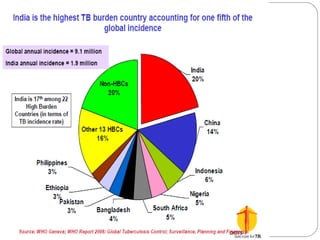
•Indiaaccounts fornearly1/3rdof theglobaltuberculosis burden.
•Tuberculosis in India continues to take a toll of 1,000 per dayor one every
minute.
•NationalTuberculosis ControlProgrammewas startedin1962.
•The objectives of the Programme were to reduce the morbidityandmortality,
to reduce disease transmission and to diagnose as manycases of tuberculosis
as possibleandtoprovidefreetreatment.
Reason for failure of National tuberculosis control
programme
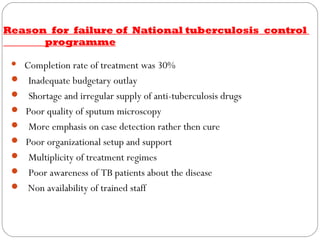
 Completion rate of treatment was 30%
   Inadequate budgetary outlay
   Shortage and irregular supply of anti-tuberculosis drugs
  Poor quality of sputum microscopy
   More emphasis on case detection rather then cure
  Poor organizational setup and support
   Multiplicity of treatment regimes
   Poor awareness of TB patients about the disease
 Non availability of trained staff
MAJOR CHALLENGES IN DOTS
IMPLIMENTATION
Expansion
Private sector involvement
IEC and health Education
Migratory population
Social stigma
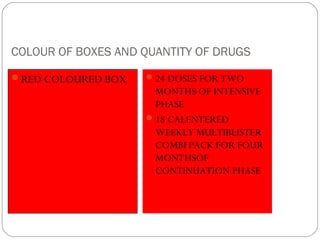
COLOUR OF BOXES AND QUANTITY OF DRUGS
RED COLOURED BOX 24 DOSES FOR TWO
MONTHS OF INTENSIVE
PHASE
18 CALENTERED
WEEKLY MULTIBLISTER
COMBI PACK FOR FOUR
MONTHSOF
CONTINUATION PHASE
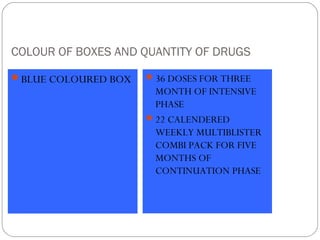
COLOUR OF BOXES AND QUANTITY OF DRUGS
BLUE COLOURED BOX 36 DOSES FOR THREE
MONTH OF INTENSIVE
PHASE
22 CALENDERED
WEEKLY MULTIBLISTER
COMBI PACK FOR FIVE
MONTHS OF
CONTINUATION PHASE
COLOUR OF BOXES AND QUANTITY OF DRUGS
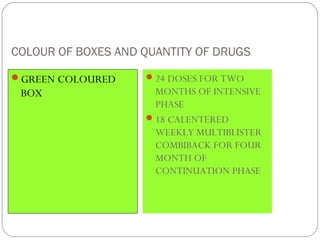
GREEN COLOURED
BOX
24 DOSES FOR TWO
MONTHS OF INTENSIVE
PHASE
18 CALENTERED
WEEKLY MULTIBLISTER
COMBIBACK FOR FOUR
MONTH OF
CONTINUATION PHASE
Drug resistence survillance
under RNTCP
previlence of resistence to TB can be taken as an
indicator of the efectiveness of TB conrol activities over
a period of time and therefore RNTCP has taken steps to
mesure this important indicator.
The aim of DRS is to determine the pevilence of
antimycrobial drug resistence among new sputam smear
positive pulmonary TB patients and also amoungst
previously treated sputam smear positive patients
Treatment observes or Drug providers or
Dots agent
Health inspectors
Pharmacists
Malaria field workers
Work place supervisors
Railway school teachers
Shopkeepers
Cured patients
Wife of medical officers
Self help group volunteers
Mid-wife
Senior dressers
 Multi purpose health workers
Any person
TYPE OF TUBERCULOSIS PATIENT
UNDER RNTCP
NEW CASE
RELAPSE
DEFAULTER
FAILURE CASE
CHRONIC CASE
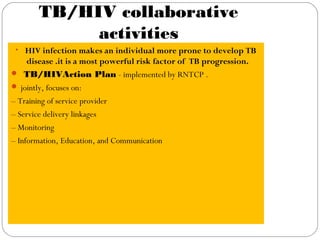
TB/HIV collaborative
activities
• HIV infection makes an individual more prone to develop TB
disease .it is a most powerful risk factor of TB progression.
 TB/HIVAction Plan - implemented by RNTCP .
 jointly, focuses on:
– Training of service provider
– Service delivery linkages
– Monitoring
– Information, Education, and Communication
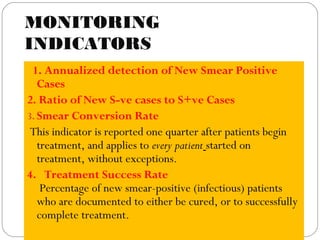
MONITORING
INDICATORS
1. Annualized detection of New Smear Positive
Cases
2. Ratio of New S-ve cases to S+ve Cases
3. Smear Conversion Rate
This indicator is reported one quarter after patients begin
treatment, and applies to every patient started on
treatment, without exceptions.
4. Treatment Success Rate
Percentage of new smear-positive (infectious) patients
who are documented to either be cured, or to successfully
complete treatment.
RECORDS AND REGISTER
TB laboratory register
TB treatment card
Laboratory form for sputum exam.
Patient identity card.
Quarterly report form
FUTURE PLAN
 Maintaining/improving quality and reach of DOTS
 Scaling up of MDR-TB management
 Engaging all care providers
 Promoting community involvement and ownership
 Further strengthening TB-HIV collaborative activities
 Introduction of newer diagnostics
Continued……
• BY 2005--- atleast 70% of people with sputam smear
positive TB will be diagnosed and at least 85% cured
• BY 2015– the global burden of TB will be reduced by
50%
• BY 2050—the global incidence of TB will be less than
or equal to 1 case per million popullation per year

 
     Tuberculosis is a major public health problem in India.This serious situation 
will  further  worsen  with  TB/HIV  co-infection  and  multidrug  resistant 
TB.Several members in India have begun to implement the revised strategy but 
there  are  many  constrains  which  require  both  national  and  regional 
efforts.Strong and sustainable revised RNTCPs must be established in order to 
achieve  the  global  targets  at  a  85%  cure  and  70%  case  finding  by  the  year 
2010.Without DOTS it is highly unlikely that countries will be able to develop 
effective  and  sustainable  national  tuberculosis  programme.With  the 
introduction of DOTS, achieving the global targets for tuberculosis control has 
now become a realistic proposition.“Is it now time for DOTS to become the 
standard of care in tuberculosis worldwide”.
CONCLUSION
THANK YOU

Deepak rntcp

  • 2.
    Outline of presentation •INTRODUCTION • EPIDEMIOLOGY • REASON FOR FAILURE OF NTCP • RNTCP • OBJECTIVES OF RNTCP • UNIQUE FEATURE • FUNDING • ORGANISATIONAL STRUCTURE • STRATEGY • IMPLIMENTATION OF TREATMENT • DOTS • CHALLENGES
  • 3.
    INTRODUCTION • TBis oneofmostimportantpublic healthproblems worldwide. •Itstands 7th inthetenleadingcauses of globaldisability •Indiaaccounts fornearly1/3rdof theglobaltuberculosis burden. •Tuberculosis in India continues to take a toll of 1,000 per dayor one every minute. •NationalTuberculosis ControlProgrammewas startedin1962. •The objectives of the Programme were to reduce the morbidityandmortality, to reduce disease transmission and to diagnose as manycases of tuberculosis as possibleandtoprovidefreetreatment.
  • 6.
    Reason for failureof National tuberculosis control programme  Completion rate of treatment was 30%    Inadequate budgetary outlay    Shortage and irregular supply of anti-tuberculosis drugs   Poor quality of sputum microscopy    More emphasis on case detection rather then cure   Poor organizational setup and support    Multiplicity of treatment regimes    Poor awareness of TB patients about the disease  Non availability of trained staff
  • 21.
    MAJOR CHALLENGES INDOTS IMPLIMENTATION Expansion Private sector involvement IEC and health Education Migratory population Social stigma
  • 23.
    COLOUR OF BOXESAND QUANTITY OF DRUGS RED COLOURED BOX 24 DOSES FOR TWO MONTHS OF INTENSIVE PHASE 18 CALENTERED WEEKLY MULTIBLISTER COMBI PACK FOR FOUR MONTHSOF CONTINUATION PHASE
  • 24.
    COLOUR OF BOXESAND QUANTITY OF DRUGS BLUE COLOURED BOX 36 DOSES FOR THREE MONTH OF INTENSIVE PHASE 22 CALENDERED WEEKLY MULTIBLISTER COMBI PACK FOR FIVE MONTHS OF CONTINUATION PHASE
  • 25.
    COLOUR OF BOXESAND QUANTITY OF DRUGS GREEN COLOURED BOX 24 DOSES FOR TWO MONTHS OF INTENSIVE PHASE 18 CALENTERED WEEKLY MULTIBLISTER COMBIBACK FOR FOUR MONTH OF CONTINUATION PHASE
  • 26.
    Drug resistence survillance underRNTCP previlence of resistence to TB can be taken as an indicator of the efectiveness of TB conrol activities over a period of time and therefore RNTCP has taken steps to mesure this important indicator. The aim of DRS is to determine the pevilence of antimycrobial drug resistence among new sputam smear positive pulmonary TB patients and also amoungst previously treated sputam smear positive patients
  • 27.
    Treatment observes orDrug providers or Dots agent Health inspectors Pharmacists Malaria field workers Work place supervisors Railway school teachers Shopkeepers Cured patients Wife of medical officers Self help group volunteers Mid-wife Senior dressers  Multi purpose health workers Any person
  • 28.
    TYPE OF TUBERCULOSISPATIENT UNDER RNTCP NEW CASE RELAPSE DEFAULTER FAILURE CASE CHRONIC CASE
  • 30.
    TB/HIV collaborative activities • HIVinfection makes an individual more prone to develop TB disease .it is a most powerful risk factor of TB progression.  TB/HIVAction Plan - implemented by RNTCP .  jointly, focuses on: – Training of service provider – Service delivery linkages – Monitoring – Information, Education, and Communication
  • 31.
    MONITORING INDICATORS 1. Annualized detectionof New Smear Positive Cases 2. Ratio of New S-ve cases to S+ve Cases 3. Smear Conversion Rate This indicator is reported one quarter after patients begin treatment, and applies to every patient started on treatment, without exceptions. 4. Treatment Success Rate Percentage of new smear-positive (infectious) patients who are documented to either be cured, or to successfully complete treatment.
  • 32.
    RECORDS AND REGISTER TBlaboratory register TB treatment card Laboratory form for sputum exam. Patient identity card. Quarterly report form
  • 33.
    FUTURE PLAN  Maintaining/improvingquality and reach of DOTS  Scaling up of MDR-TB management  Engaging all care providers  Promoting community involvement and ownership  Further strengthening TB-HIV collaborative activities  Introduction of newer diagnostics
  • 34.
    Continued…… • BY 2005---atleast 70% of people with sputam smear positive TB will be diagnosed and at least 85% cured • BY 2015– the global burden of TB will be reduced by 50% • BY 2050—the global incidence of TB will be less than or equal to 1 case per million popullation per year
  • 35.
           Tuberculosis is a major public health problem in India.This serious situation  will  further  worsen with  TB/HIV  co-infection  and  multidrug  resistant  TB.Several members in India have begun to implement the revised strategy but  there  are  many  constrains  which  require  both  national  and  regional  efforts.Strong and sustainable revised RNTCPs must be established in order to  achieve  the  global  targets  at  a  85%  cure  and  70%  case  finding  by  the  year  2010.Without DOTS it is highly unlikely that countries will be able to develop  effective  and  sustainable  national  tuberculosis  programme.With  the  introduction of DOTS, achieving the global targets for tuberculosis control has  now become a realistic proposition.“Is it now time for DOTS to become the  standard of care in tuberculosis worldwide”. CONCLUSION
  • 36.