D.O.T.
MODEL
The Deep Organisational Transformation Model is a 4-Layer model to
promote organisational transformation and improve your corporate Agility.
This model gives concrete direction and instruments to start or continue
your transformation.
- D.O.T. Model - Prins 2017 - Version 1.0 -
A powerful combination of techniques and good practices to transform your organisation
When Deep Organisational Transformation is required, a single instrument focused on a single issue is not enough.
Transforming large organisations requires attention for all levels in your organisation, from strategy towards the
individual employee.


Based on years of experience this 4-Layer D.O.T. Model presents a set of (existing) tools that enable organisations and
coaches to improve corporate Agility.
THE D.O.T. MODEL
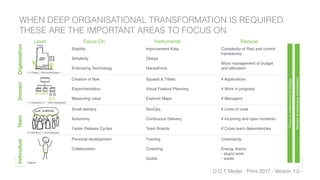
Focusonundercurrentofchange
Mindsetofcontinuousimprovement
Stability
Simplicity
Embracing Technology
Creation of flow


Experimentation
Measuring value
Small delivery


Autonomy
Faster Release Cycles
Personal development

Collaboration
Improvement Kata


Obeya
Hackathons
Squads & Tribes


Visual Feature Planning


Explorer Maps
DevOps


Continuous Delivery


Team Boards
Training


Coaching


Guilds
Complexity of Risk and control
frameworks 

Micro management of budget
and allocation
# Applications

# Work in progress

# Managers
# Lines of code


# Incoming and open incidents

# Cross team dependencies
Uncertainty
Energy drains:

- stupid work

- waste
WHEN DEEP ORGANISATIONAL TRANSFORMATION IS REQUIRED
THESE ARE THE IMPORTANT AREAS TO FOCUS ON
- D.O.T. Model - Prins 2017 - Version 1.0 -
IndivudualTeamDomainOrganisation
Level Focus On Instruments Reduce
Lifetime
0-3 Months | +/-8 employees
1- 3 Quarters | 0 - 1200 employees
1- 5 Years | 1200 employees +
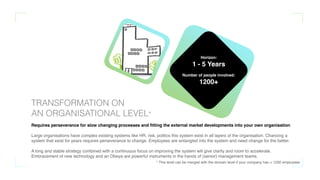
Horizon:
1 - 5 Years
Number of people involved:
1200+
Requires perseverance for slow changing processes and fitting the external market developments into your own organisation
Large organisations have complex existing systems like HR, risk, politics this system exist in all layers of the organisation. Chancing a
system that exist for years requires perseverance to change. Employees are entangled into the system and need change for the better.
A long and stable strategy combined with a continuous focus on improving the system will give clarity and room to accelerate.
Embracement of new technology and an Obeya are powerful instruments in the hands of (senior) management teams.
TRANSFORMATION ON 

AN ORGANISATIONAL LEVEL*
* This level can be merged with the domain level if your company has < 1200 employees
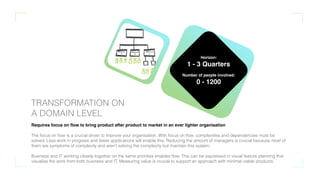
Requires focus on flow to bring product after product to market in an ever lighter organisation
The focus on flow is a crucial driver to improve your organisation. With focus on flow, complexities and dependencies must be
solved. Less work in progress and fewer applications will enable this. Reducing the amount of managers is crucial because most of
them are symptoms of complexity and aren’t solving the complexity but maintain this system.
Business and IT working closely together on the same priorities enables flow. This can be expressed in visual feature planning that
visualise the work from both business and IT. Measuring value is crucial to support an approach with minimal viable products.
TRANSFORMATION ON 

A DOMAIN LEVEL
Horizon:
1 - 3 Quarters
Number of people involved:
0 - 1200
Requires focus on faster release cycles because these are a result of many improvements along the way
Autonomous teams sound easy, but so much should take place before autonomous teams can grow. The team level is where many
organisations start and coaching can be given. However teams are caught in a web of priority setting, complex IT and many cross
team dependencies.
It’s crucial to lean both the domain and team level by removing waste to create more business value
TRANSFORMATION ON 

A TEAM LEVEL
Horizon:
0 -3 Months
Number of people involved:
+/- 8
In the end, it is the individual employee that creates the real value. Personal development is the key driver
Can you imagine what the impact of a complex, large organisation is on the individual person? Can you imagine how the happiness
and satisfaction will increase if uncertainty disappears. People are free to focus on their work instead of their job.
Training and coaching are great instruments to be practiced regularly. Collaboration is the oil to increase your employees’ knowledge.
TRANSFORMATION ON 

AN INDIVIDUAL LEVEL
Horizon:
Lifetime
Number of people involved:
a valuable
employee
D.O.T. MODEL
FEBRUARY 2017
VERSION 1.0
This model is developed by Andreas Prins and
based on his experience as coach and manager.
Many books, training, blogs, teams and chats with
friends and colleagues are the basis for this model.
Check for more information www.ideetotit.nl.

Deep Organisational Transformation a model for a higher Agility

  • 1.
    D.O.T. MODEL The Deep OrganisationalTransformation Model is a 4-Layer model to promote organisational transformation and improve your corporate Agility. This model gives concrete direction and instruments to start or continue your transformation. - D.O.T. Model - Prins 2017 - Version 1.0 -
  • 2.
    A powerful combinationof techniques and good practices to transform your organisation When Deep Organisational Transformation is required, a single instrument focused on a single issue is not enough. Transforming large organisations requires attention for all levels in your organisation, from strategy towards the individual employee.
 
 Based on years of experience this 4-Layer D.O.T. Model presents a set of (existing) tools that enable organisations and coaches to improve corporate Agility. THE D.O.T. MODEL
  • 3.
    Focusonundercurrentofchange Mindsetofcontinuousimprovement Stability Simplicity Embracing Technology Creation offlow
 
 Experimentation Measuring value Small delivery
 
 Autonomy Faster Release Cycles Personal development
 Collaboration Improvement Kata
 
 Obeya Hackathons Squads & Tribes
 
 Visual Feature Planning
 
 Explorer Maps DevOps
 
 Continuous Delivery
 
 Team Boards Training
 
 Coaching
 
 Guilds Complexity of Risk and control frameworks 
 Micro management of budget and allocation # Applications
 # Work in progress
 # Managers # Lines of code 
 # Incoming and open incidents
 # Cross team dependencies Uncertainty Energy drains:
 - stupid work
 - waste WHEN DEEP ORGANISATIONAL TRANSFORMATION IS REQUIRED THESE ARE THE IMPORTANT AREAS TO FOCUS ON - D.O.T. Model - Prins 2017 - Version 1.0 - IndivudualTeamDomainOrganisation Level Focus On Instruments Reduce Lifetime 0-3 Months | +/-8 employees 1- 3 Quarters | 0 - 1200 employees 1- 5 Years | 1200 employees +
  • 4.
    Horizon: 1 - 5Years Number of people involved: 1200+ Requires perseverance for slow changing processes and fitting the external market developments into your own organisation Large organisations have complex existing systems like HR, risk, politics this system exist in all layers of the organisation. Chancing a system that exist for years requires perseverance to change. Employees are entangled into the system and need change for the better. A long and stable strategy combined with a continuous focus on improving the system will give clarity and room to accelerate. Embracement of new technology and an Obeya are powerful instruments in the hands of (senior) management teams. TRANSFORMATION ON 
 AN ORGANISATIONAL LEVEL* * This level can be merged with the domain level if your company has < 1200 employees
  • 5.
    Requires focus onflow to bring product after product to market in an ever lighter organisation The focus on flow is a crucial driver to improve your organisation. With focus on flow, complexities and dependencies must be solved. Less work in progress and fewer applications will enable this. Reducing the amount of managers is crucial because most of them are symptoms of complexity and aren’t solving the complexity but maintain this system. Business and IT working closely together on the same priorities enables flow. This can be expressed in visual feature planning that visualise the work from both business and IT. Measuring value is crucial to support an approach with minimal viable products. TRANSFORMATION ON 
 A DOMAIN LEVEL Horizon: 1 - 3 Quarters Number of people involved: 0 - 1200
  • 6.
    Requires focus onfaster release cycles because these are a result of many improvements along the way Autonomous teams sound easy, but so much should take place before autonomous teams can grow. The team level is where many organisations start and coaching can be given. However teams are caught in a web of priority setting, complex IT and many cross team dependencies. It’s crucial to lean both the domain and team level by removing waste to create more business value TRANSFORMATION ON 
 A TEAM LEVEL Horizon: 0 -3 Months Number of people involved: +/- 8
  • 7.
    In the end,it is the individual employee that creates the real value. Personal development is the key driver Can you imagine what the impact of a complex, large organisation is on the individual person? Can you imagine how the happiness and satisfaction will increase if uncertainty disappears. People are free to focus on their work instead of their job. Training and coaching are great instruments to be practiced regularly. Collaboration is the oil to increase your employees’ knowledge. TRANSFORMATION ON 
 AN INDIVIDUAL LEVEL Horizon: Lifetime Number of people involved: a valuable employee
  • 8.
    D.O.T. MODEL FEBRUARY 2017 VERSION1.0 This model is developed by Andreas Prins and based on his experience as coach and manager. Many books, training, blogs, teams and chats with friends and colleagues are the basis for this model. Check for more information www.ideetotit.nl.