Deep Oceans (Mariana Trench) Lauren Banda Biology II Period 7
Homeostasis According to Dictionary.com homeostasis is defined as: a state of psychological equilibrium obtained when tension or a drive has been reduced or eliminated  In order to maintain homeostasis in the deep oceans you need to adapt to the water temperature by dressing properly.
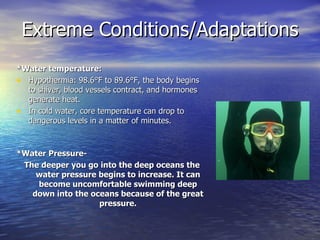
Extreme Conditions/Adaptations *Water temperature: Hypothermia: 98.6°F to 89.6°F, the body begins to shiver, blood vessels contract, and hormones generate heat.  In cold water, core temperature can drop to dangerous levels in a matter of minutes.  *Water Pressure- The deeper you go into the deep oceans the water pressure begins to increase. It can become uncomfortable swimming deep down into the oceans because of the great pressure.
Proper Clothing and Equipment 1. Protective diving goggles and/or mask 2. Dive bags 3. Flags for safety for deep sea divers 4. Air hoses 5. Air hose links 6. Breathing regulators (oxygen tanks)
Continues 7. Deep sea diving lights 8. Deep diving footwear 9. Diving weights 10. Scuba diving fins 11. Wet Suit 12. Knives
Respiratory System Pressure under water can cause respiratory muscles to become tired. Divers use breathing apparatuses (Oxygen tanks) in order to breathe underwater for a longer period of time.
Circulatory System High water pressure causes the capillaries especially at the legs, to contract. This results in over cooling of the limbs.
Nervous System  A syndrome which is a result of rapid compression, called “High-Pressure Nervous System” may be experienced. Vomiting, breathing problems, and even complications of confusion may also be experienced.
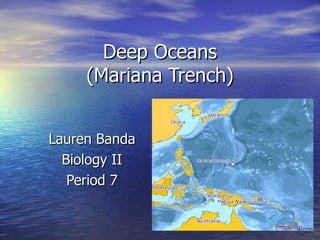
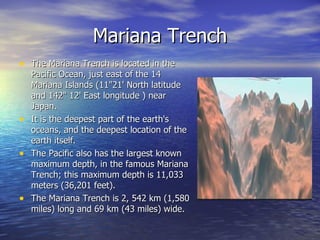
Mariana Trench The Mariana Trench is located in the Pacific Ocean, just east of the 14 Mariana Islands (11"21' North latitude and 142" 12' East longitude ) near Japan. It is the deepest part of the earth's oceans, and the deepest location of the earth itself. The Pacific also has the largest known maximum depth, in the famous Mariana Trench; this maximum depth is 11,033 meters (36,201 feet). The Mariana Trench is 2, 542 km (1,580 miles) long and 69 km (43 miles) wide.
Mariana Trench http://www.youtube.com/watch?v=5D3VkGkU5Dw

Deep Oceans

  • 1.
    Deep Oceans (MarianaTrench) Lauren Banda Biology II Period 7
  • 2.
    Homeostasis According toDictionary.com homeostasis is defined as: a state of psychological equilibrium obtained when tension or a drive has been reduced or eliminated In order to maintain homeostasis in the deep oceans you need to adapt to the water temperature by dressing properly.
  • 3.
    Extreme Conditions/Adaptations *Watertemperature: Hypothermia: 98.6°F to 89.6°F, the body begins to shiver, blood vessels contract, and hormones generate heat. In cold water, core temperature can drop to dangerous levels in a matter of minutes. *Water Pressure- The deeper you go into the deep oceans the water pressure begins to increase. It can become uncomfortable swimming deep down into the oceans because of the great pressure.
  • 4.
    Proper Clothing andEquipment 1. Protective diving goggles and/or mask 2. Dive bags 3. Flags for safety for deep sea divers 4. Air hoses 5. Air hose links 6. Breathing regulators (oxygen tanks)
  • 5.
    Continues 7. Deepsea diving lights 8. Deep diving footwear 9. Diving weights 10. Scuba diving fins 11. Wet Suit 12. Knives
  • 6.
    Respiratory System Pressureunder water can cause respiratory muscles to become tired. Divers use breathing apparatuses (Oxygen tanks) in order to breathe underwater for a longer period of time.
  • 7.
    Circulatory System Highwater pressure causes the capillaries especially at the legs, to contract. This results in over cooling of the limbs.
  • 8.
    Nervous System A syndrome which is a result of rapid compression, called “High-Pressure Nervous System” may be experienced. Vomiting, breathing problems, and even complications of confusion may also be experienced.
  • 9.
    Mariana Trench TheMariana Trench is located in the Pacific Ocean, just east of the 14 Mariana Islands (11"21' North latitude and 142" 12' East longitude ) near Japan. It is the deepest part of the earth's oceans, and the deepest location of the earth itself. The Pacific also has the largest known maximum depth, in the famous Mariana Trench; this maximum depth is 11,033 meters (36,201 feet). The Mariana Trench is 2, 542 km (1,580 miles) long and 69 km (43 miles) wide.
  • 10.