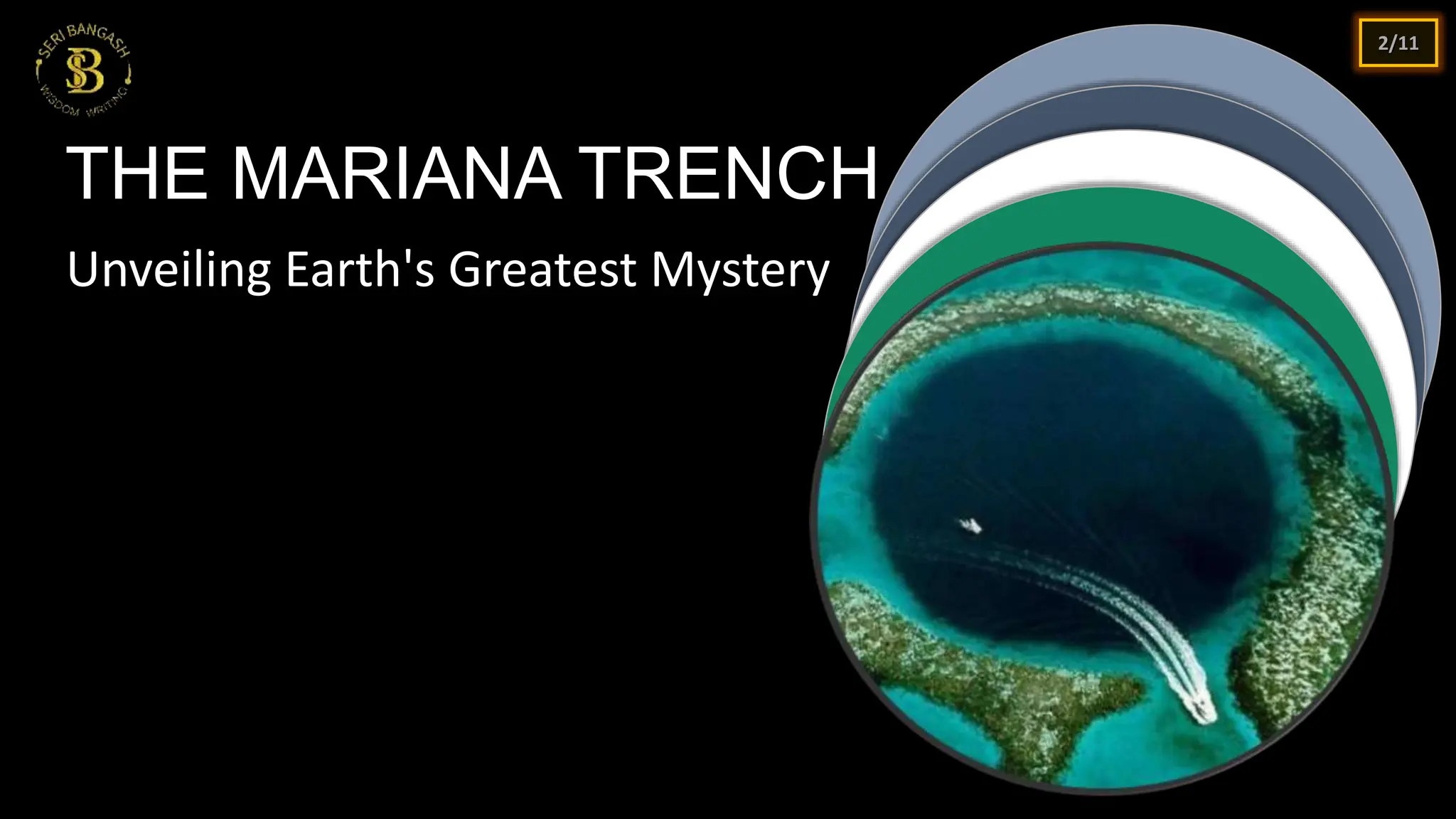
THE MARIANA TRENCH
Unveiling Earth's Greatest Mystery
2/11
The Mariana Trench is the deepest known part of Earth's
oceans, located in the western Pacific Ocean.
Join us as we embark on a journey to uncover its secrets.
3/11
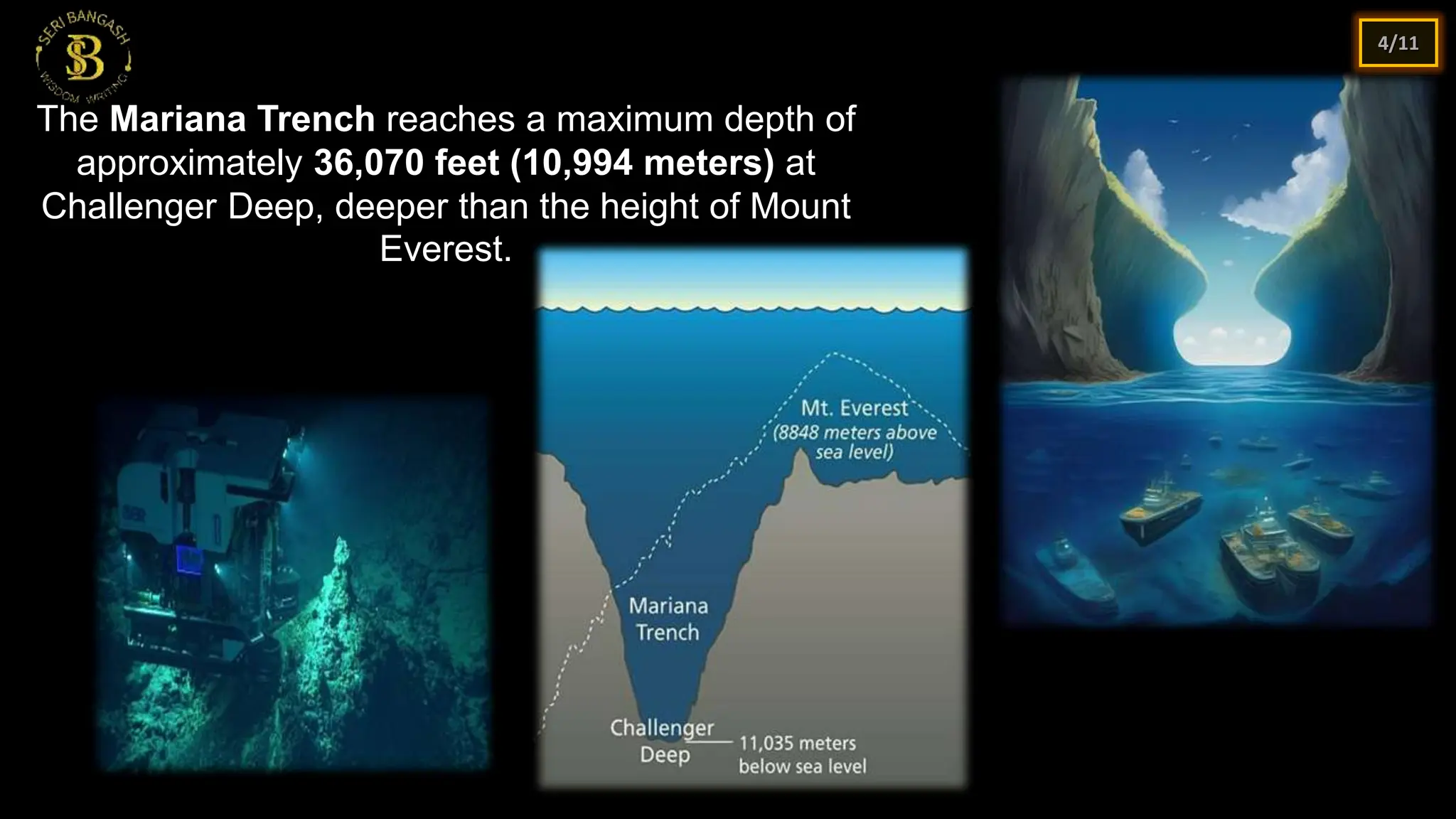
The Mariana Trench reaches a maximum depth of
approximately 36,070 feet (10,994 meters) at
Challenger Deep, deeper than the height of Mount
Everest.
4/11
MARIANA TRENCH
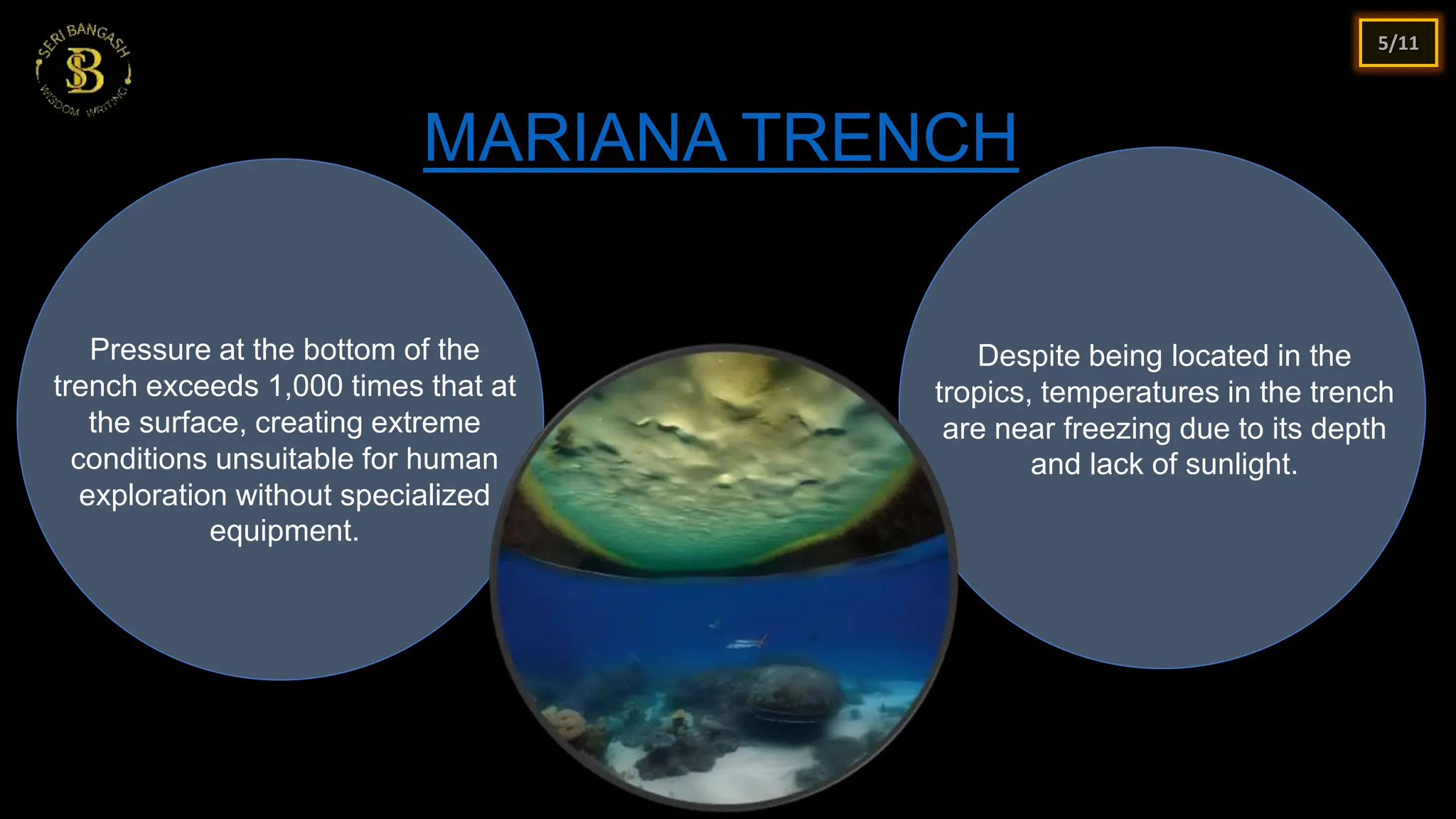
Pressure at the bottom of the
trench exceeds 1,000 times that at
the surface, creating extreme
conditions unsuitable for human
exploration without specialized
equipment.
Despite being located in the
tropics, temperatures in the trench
are near freezing due to its depth
and lack of sunlight.
5/11
Unique geological formations in the
trench, such as hydrothermal vents,
support diverse ecosystems
adapted to extreme
The Mariana Trench was created by
the collision of tectonic plates,
resulting in a deep subduction zone
where one tectonic plate slides
beneath another.
The trench is seismically active, with
frequent earthquakes and volcanic
activity along its length.
UNVEILING EARTH'S SECRETS
6/11
Despite the harsh environment,
the Mariana Trench is home to a
variety of unique and often
bizarre species, including deep-
sea fish, crustaceans, and
microbes.
Organisms in the trench have
evolved remarkable adaptations to
survive in the extreme pressure,
darkness, and cold temperatures,
providing insights into the limits of
life on Earth.
Recent expeditions have led to the
discovery of new species and
ecosystems in the trench,
expanding our understanding of
deep-sea biodiversity.
7/11
Geological Insights:
Studies of the Mariana
Trench contribute to
our understanding of
plate tectonics,
subduction zone
processes, and Earth's
geological history.
Researchers use advanced technology such as
deep-sea submersibles, remotely operated
vehicles (ROVs), and autonomous underwater
vehicles (AUVs) to explore the trench's depths.
UNRAVELING MYSTERIES OF THE DEEP
Research in the trench
informs assessments
of human impacts on
deep-sea ecosystems
and helps guide
conservation efforts.
8/11
PROTECTING EARTH'S FINAL FRONTIER
The Mariana Trench faces
environmental threats such as
deep-sea mining, pollution, and
climate change, which could
have devastating impacts on its
unique ecosystems.
Balancing scientific exploration
and resource extraction with
conservation priorities is
essential for ensuring the long-
term health of the trench.
International efforts are
underway to protect the trench
and its biodiversity through the
establishment of marine
protected areas and regulations
on deep-sea mining.
9/11
WWW.SERIBANGASH.COM
https://seribangash.com/ber
muda-triangle-umkown-
mystery-of-life/
https://seribangash.com/barbe
r-shop-business-complete-
guide-for-beginners/
http://seribangash.com/pow
er-point-of-t-shirt-printing-
machine/
For More PowerPoints Presentations &
Blogs Please Visit…
10/11
The Mariana Trench remarkable geological features on Earth.pptx

The Mariana Trench remarkable geological features on Earth.pptx

  • 2.
    THE MARIANA TRENCH UnveilingEarth's Greatest Mystery 2/11
  • 3.
    The Mariana Trenchis the deepest known part of Earth's oceans, located in the western Pacific Ocean. Join us as we embark on a journey to uncover its secrets. 3/11
  • 4.
    The Mariana Trenchreaches a maximum depth of approximately 36,070 feet (10,994 meters) at Challenger Deep, deeper than the height of Mount Everest. 4/11
  • 5.
    MARIANA TRENCH Pressure atthe bottom of the trench exceeds 1,000 times that at the surface, creating extreme conditions unsuitable for human exploration without specialized equipment. Despite being located in the tropics, temperatures in the trench are near freezing due to its depth and lack of sunlight. 5/11
  • 6.
    Unique geological formationsin the trench, such as hydrothermal vents, support diverse ecosystems adapted to extreme The Mariana Trench was created by the collision of tectonic plates, resulting in a deep subduction zone where one tectonic plate slides beneath another. The trench is seismically active, with frequent earthquakes and volcanic activity along its length. UNVEILING EARTH'S SECRETS 6/11
  • 7.
    Despite the harshenvironment, the Mariana Trench is home to a variety of unique and often bizarre species, including deep- sea fish, crustaceans, and microbes. Organisms in the trench have evolved remarkable adaptations to survive in the extreme pressure, darkness, and cold temperatures, providing insights into the limits of life on Earth. Recent expeditions have led to the discovery of new species and ecosystems in the trench, expanding our understanding of deep-sea biodiversity. 7/11
  • 8.
    Geological Insights: Studies ofthe Mariana Trench contribute to our understanding of plate tectonics, subduction zone processes, and Earth's geological history. Researchers use advanced technology such as deep-sea submersibles, remotely operated vehicles (ROVs), and autonomous underwater vehicles (AUVs) to explore the trench's depths. UNRAVELING MYSTERIES OF THE DEEP Research in the trench informs assessments of human impacts on deep-sea ecosystems and helps guide conservation efforts. 8/11
  • 9.
    PROTECTING EARTH'S FINALFRONTIER The Mariana Trench faces environmental threats such as deep-sea mining, pollution, and climate change, which could have devastating impacts on its unique ecosystems. Balancing scientific exploration and resource extraction with conservation priorities is essential for ensuring the long- term health of the trench. International efforts are underway to protect the trench and its biodiversity through the establishment of marine protected areas and regulations on deep-sea mining. 9/11
  • 10.