Geological Time Scale
1
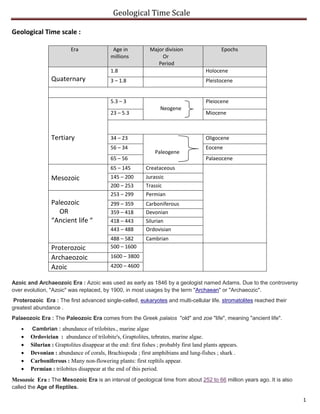
Geological Time scale :
Era Age in
millions
Major division
Or
Period
Epochs
Quaternary
1.8 Holocene
3 – 1.8 Pleistocene
Tertiary
5.3 – 3
Neogene
Pleiocene
23 – 5.3 Miocene
34 – 23
Paleogene
Oligocene
56 – 34 Eocene
65 – 56 Palaeocene
Mesozoic
65 – 145 Creataceous
145 – 200 Jurassic
200 – 253 Trassic
Paleozoic
OR
“Ancient life “
253 – 299 Permian
299 – 359 Carboniferous
359 – 418 Devonian
418 – 443 Silurian
443 – 488 Ordovisian
488 – 582 Cambrian
Proterozoic 500 – 1600
Archaeozoic 1600 – 3800
Azoic 4200 – 4600
Azoic and Archaeozoic Era : Azoic was used as early as 1846 by a geologist named Adams. Due to the controversy
over evolution, "Azoic" was replaced, by 1900, in most usages by the term "Archaean" or "Archaeozic".
Proterozoic Era : The first advanced single-celled, eukaryotes and multi-cellular life. stromatolites reached their
greatest abundance .
Palaeozoic Era : The Paleozoic Era comes from the Greek palaios "old" and zoe "life", meaning "ancient life".
 Cambrian : abundance of trilobites., marine algae
 Ordovician : abundance of trilobite's, Graptolites, tebrates, marine algae.
 Silurian : Graptolites disappear at the end: first fishes ; probably first land plants appears.
 Devonian : abundance of corals, Brachiopoda ; first amphibians and lung-fishes ; shark .
 Carboniferous : Many non-flowering plants: first repltils appear.
 Permian : trilobites disappear at the end of this period.
Mesozoic Era : The Mesozoic Era is an interval of geological time from about 252 to 66 million years ago. It is also
called the Age of Reptiles.
Geological Time Scale
2
 Trassic : Ammonites, reptiles and amphibia abundant , Arid climate. Gymnosperms dominant and declined towards
the end.
 Jurassic : Ammonites abundant, first birds, flowering plants. Continent fairly high.
 Cretaceous : Gaint reptiles and ammonites disappear at the end. Flowering plant become numerous. First bird and
snakes appearance.
Tertiary or Cenozoic Era : This “Modern life Era” is the “age of mammals”.
 Palaeogene : It is divided into 3 epochs.
 Paleocene – Himalaya-I uplift, folding in Rockies Mountain, Appearnce of Angiosperm. Rise of archaic
mammals.
 Eocene – climate became warmer, rise of flowering plants.
 Oligocene – Alps, Himalaya – II uplift, Archaic mammals extinct.
 Neogene : It is divided into 2 epochs.
 Miocene – Andes, Himalaya – III uplift, cooler climate, appearance of grasses,
 Pliocene – Himalaya – IV uplift, volcanic activity, origin of man, evolution of horse, elephant, camels almost
like modern species.
Quaternary Era : It is recent Era divided into 2 epochs.
 Pleistocene : Periodic glaciation, rise of herbs, Extinction of mammals ; first human social life.
 Holocene or Recent : climate warmer, end of last ice age. Rise of modern man.

Geological time scale

  • 1.
    Geological Time Scale 1 GeologicalTime scale : Era Age in millions Major division Or Period Epochs Quaternary 1.8 Holocene 3 – 1.8 Pleistocene Tertiary 5.3 – 3 Neogene Pleiocene 23 – 5.3 Miocene 34 – 23 Paleogene Oligocene 56 – 34 Eocene 65 – 56 Palaeocene Mesozoic 65 – 145 Creataceous 145 – 200 Jurassic 200 – 253 Trassic Paleozoic OR “Ancient life “ 253 – 299 Permian 299 – 359 Carboniferous 359 – 418 Devonian 418 – 443 Silurian 443 – 488 Ordovisian 488 – 582 Cambrian Proterozoic 500 – 1600 Archaeozoic 1600 – 3800 Azoic 4200 – 4600 Azoic and Archaeozoic Era : Azoic was used as early as 1846 by a geologist named Adams. Due to the controversy over evolution, "Azoic" was replaced, by 1900, in most usages by the term "Archaean" or "Archaeozic". Proterozoic Era : The first advanced single-celled, eukaryotes and multi-cellular life. stromatolites reached their greatest abundance . Palaeozoic Era : The Paleozoic Era comes from the Greek palaios "old" and zoe "life", meaning "ancient life".  Cambrian : abundance of trilobites., marine algae  Ordovician : abundance of trilobite's, Graptolites, tebrates, marine algae.  Silurian : Graptolites disappear at the end: first fishes ; probably first land plants appears.  Devonian : abundance of corals, Brachiopoda ; first amphibians and lung-fishes ; shark .  Carboniferous : Many non-flowering plants: first repltils appear.  Permian : trilobites disappear at the end of this period. Mesozoic Era : The Mesozoic Era is an interval of geological time from about 252 to 66 million years ago. It is also called the Age of Reptiles.
  • 2.
    Geological Time Scale 2 Trassic : Ammonites, reptiles and amphibia abundant , Arid climate. Gymnosperms dominant and declined towards the end.  Jurassic : Ammonites abundant, first birds, flowering plants. Continent fairly high.  Cretaceous : Gaint reptiles and ammonites disappear at the end. Flowering plant become numerous. First bird and snakes appearance. Tertiary or Cenozoic Era : This “Modern life Era” is the “age of mammals”.  Palaeogene : It is divided into 3 epochs.  Paleocene – Himalaya-I uplift, folding in Rockies Mountain, Appearnce of Angiosperm. Rise of archaic mammals.  Eocene – climate became warmer, rise of flowering plants.  Oligocene – Alps, Himalaya – II uplift, Archaic mammals extinct.  Neogene : It is divided into 2 epochs.  Miocene – Andes, Himalaya – III uplift, cooler climate, appearance of grasses,  Pliocene – Himalaya – IV uplift, volcanic activity, origin of man, evolution of horse, elephant, camels almost like modern species. Quaternary Era : It is recent Era divided into 2 epochs.  Pleistocene : Periodic glaciation, rise of herbs, Extinction of mammals ; first human social life.  Holocene or Recent : climate warmer, end of last ice age. Rise of modern man.