Deep learning for Dummies
- Ashok
Govindarajan
20-12-2017 Technology sharing series 1
Contents
20-12-2017 Technology sharing series 2
• Introduction
 Artificial Intelligence
 Machine Learning
 Deep Learning
• Examples – what is an input and what is an output in a deep learning system
• Use-cases – where are the potential applications?
• Common Libraries used in the Python context – keras.io
• Conclusion
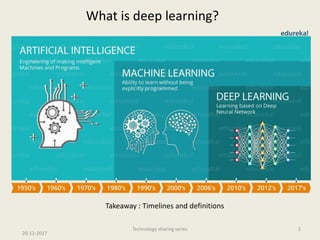
What is deep learning?
20-12-2017
Technology sharing series 3
Takeaway : Timelines and definitions
Definition of Deep learning
20-12-2017
Technology sharing series 4
Deep learning is a branch of machine learning often applied to image recognition
that uses algorithms to learn in multiple levels corresponding to different levels of
abstraction.
It typically relies on complex neural networks.
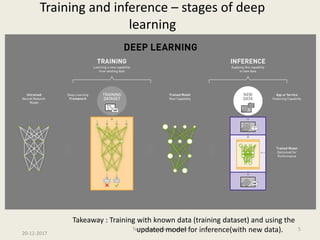
Training and inference – stages of deep
learning
20-12-2017
Technology sharing series 5
Takeaway : Training with known data (training dataset) and using the
updated model for inference(with new data).
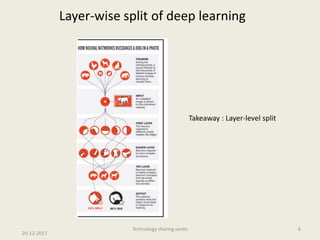
Layer-wise split of deep learning
20-12-2017
Technology sharing series 6
Takeaway : Layer-level split
Examples
20-12-2017
Technology sharing series 7
What is an input and output in a deep-learning system?
Refer Page 440 in the following link :
http://graveleylab.cam.uchc.edu/WebData/mduff/MEDS_6498_SPRING_2016/d
eep_learning_nature_2015.pdf
What is the use-case?
20-12-2017
Technology sharing series 8
• As part of the smart-phone and cloud eco-system, how is deep learning going to
integrate and what are the challenges?
• https://www.technologyreview.com/s/534736/deep-learning-squeezed-onto-a-
phone/
• http://www.dqindia.com/intelligent-devices-device-prediction-learning/
.
Common Libraries used in Python context
20-12-2017
Technology sharing series 9
• Keras – higher level library in Python that uses Tensorflow
https://keras.io/
Keras provides an additional layer of NN primitives with Theano and TensorFlow
as its back-end. It has a highly customizable interface to quickly experiment with
and deploy deep NNs, and has become our primary tool used to generate
numerical results.
Other libraries of interest include :
Caffe , MxNet, Tensor Flow, Theoano, Torch
Some aspects of keras cheat sheet will be discussed
Conclusion
20-12-2017 Technology sharing series 10
• The future of deep-learning
 Unsupervised learning had a catalytic effect in reviving interest in deep learning, but
has since been overshadowed by the successes of purely supervised learning. Although
we have not focused on it in this review, we expect unsupervised learning to become
far more important in the longer term.
 Human and animal learning is largely unsupervised: we discover the structure of the
world by observing it, not by being told the name of every object
Acknowledgements and References
20-12-2017
Technology sharing series 11
• http://graveleylab.cam.uchc.edu/WebData/mduff/MEDS_6498_SPRING_2016
/deep_learning_nature_2015.pdf
• http://fortune.com/ai-artificial-intelligence-deep-machine-learning/
• https://www.technologyreview.com/s/534736/deep-learning-squeezed-onto-
a-phone/
• https://www.computerworld.com/article/3027217/smartphones/
deep-learning-is-coming-to-your-android-phone.html
20-12-2017 Technology sharing series 12
Thank You

Deep learning for dummies dec 23 2017

  • 1.
    Deep learning forDummies - Ashok Govindarajan 20-12-2017 Technology sharing series 1
  • 2.
    Contents 20-12-2017 Technology sharingseries 2 • Introduction  Artificial Intelligence  Machine Learning  Deep Learning • Examples – what is an input and what is an output in a deep learning system • Use-cases – where are the potential applications? • Common Libraries used in the Python context – keras.io • Conclusion
  • 3.
    What is deeplearning? 20-12-2017 Technology sharing series 3 Takeaway : Timelines and definitions
  • 4.
    Definition of Deeplearning 20-12-2017 Technology sharing series 4 Deep learning is a branch of machine learning often applied to image recognition that uses algorithms to learn in multiple levels corresponding to different levels of abstraction. It typically relies on complex neural networks.
  • 5.
    Training and inference– stages of deep learning 20-12-2017 Technology sharing series 5 Takeaway : Training with known data (training dataset) and using the updated model for inference(with new data).
  • 6.
    Layer-wise split ofdeep learning 20-12-2017 Technology sharing series 6 Takeaway : Layer-level split
  • 7.
    Examples 20-12-2017 Technology sharing series7 What is an input and output in a deep-learning system? Refer Page 440 in the following link : http://graveleylab.cam.uchc.edu/WebData/mduff/MEDS_6498_SPRING_2016/d eep_learning_nature_2015.pdf
  • 8.
    What is theuse-case? 20-12-2017 Technology sharing series 8 • As part of the smart-phone and cloud eco-system, how is deep learning going to integrate and what are the challenges? • https://www.technologyreview.com/s/534736/deep-learning-squeezed-onto-a- phone/ • http://www.dqindia.com/intelligent-devices-device-prediction-learning/ .
  • 9.
    Common Libraries usedin Python context 20-12-2017 Technology sharing series 9 • Keras – higher level library in Python that uses Tensorflow https://keras.io/ Keras provides an additional layer of NN primitives with Theano and TensorFlow as its back-end. It has a highly customizable interface to quickly experiment with and deploy deep NNs, and has become our primary tool used to generate numerical results. Other libraries of interest include : Caffe , MxNet, Tensor Flow, Theoano, Torch Some aspects of keras cheat sheet will be discussed
  • 10.
    Conclusion 20-12-2017 Technology sharingseries 10 • The future of deep-learning  Unsupervised learning had a catalytic effect in reviving interest in deep learning, but has since been overshadowed by the successes of purely supervised learning. Although we have not focused on it in this review, we expect unsupervised learning to become far more important in the longer term.  Human and animal learning is largely unsupervised: we discover the structure of the world by observing it, not by being told the name of every object
  • 11.
    Acknowledgements and References 20-12-2017 Technologysharing series 11 • http://graveleylab.cam.uchc.edu/WebData/mduff/MEDS_6498_SPRING_2016 /deep_learning_nature_2015.pdf • http://fortune.com/ai-artificial-intelligence-deep-machine-learning/ • https://www.technologyreview.com/s/534736/deep-learning-squeezed-onto- a-phone/ • https://www.computerworld.com/article/3027217/smartphones/ deep-learning-is-coming-to-your-android-phone.html
  • 12.
    20-12-2017 Technology sharingseries 12 Thank You