1
Deep Learning
Vlad Ovidiu Mihalca
PhD student – AI & Vision
Mechatronics @ University of Oradea
16th of January, 2018
2
Series of talks
●
Part I: theoretical base concepts
●
Part II: frameworks and DL industry use
●
Part III: usage in robotics and Computer Vision, state of
the art in research
3
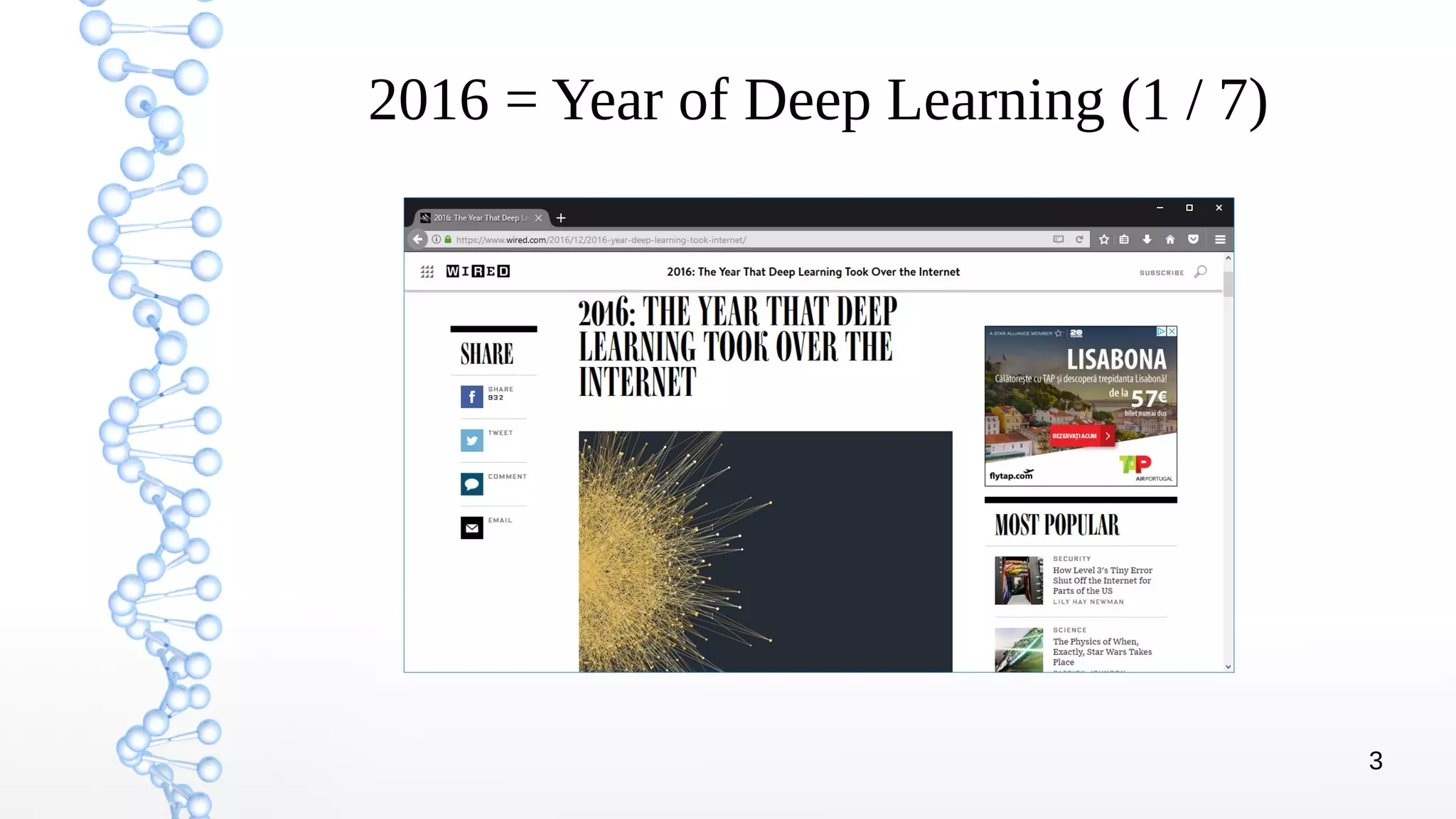
2016 = Year of Deep Learning (1 / 7)
4
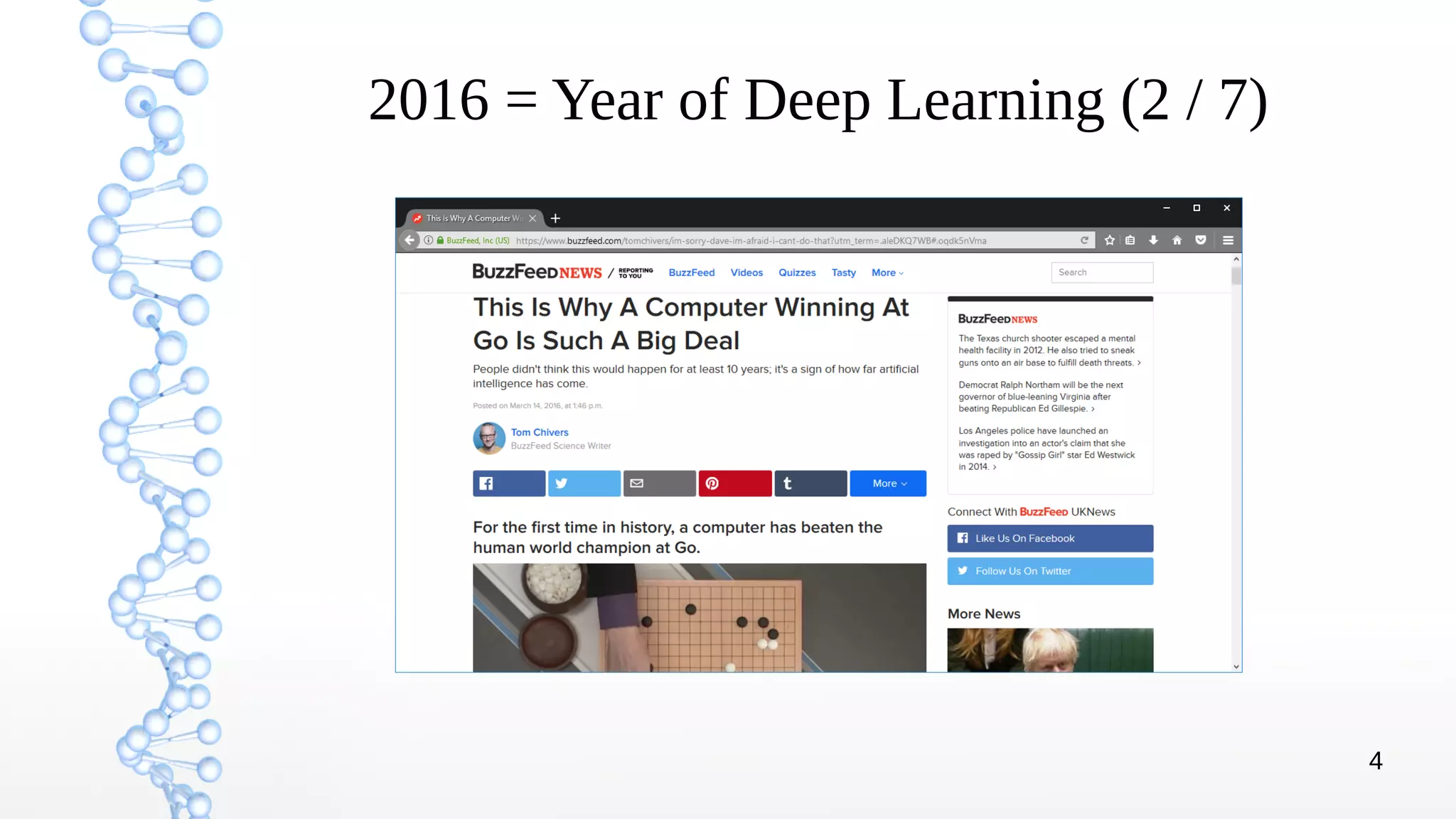
2016 = Year of Deep Learning (2 / 7)
5
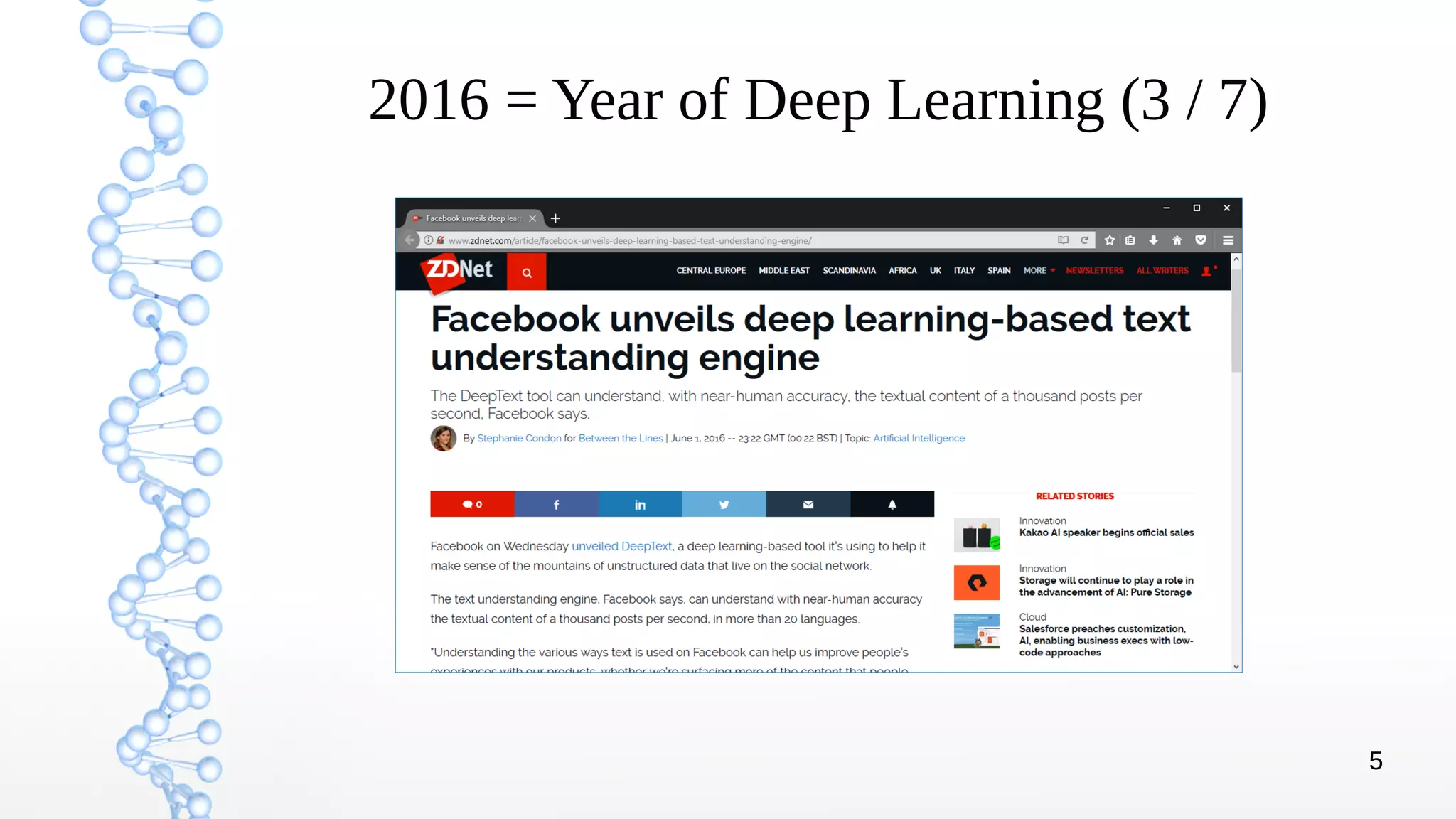
2016 = Year of Deep Learning (3 / 7)
6
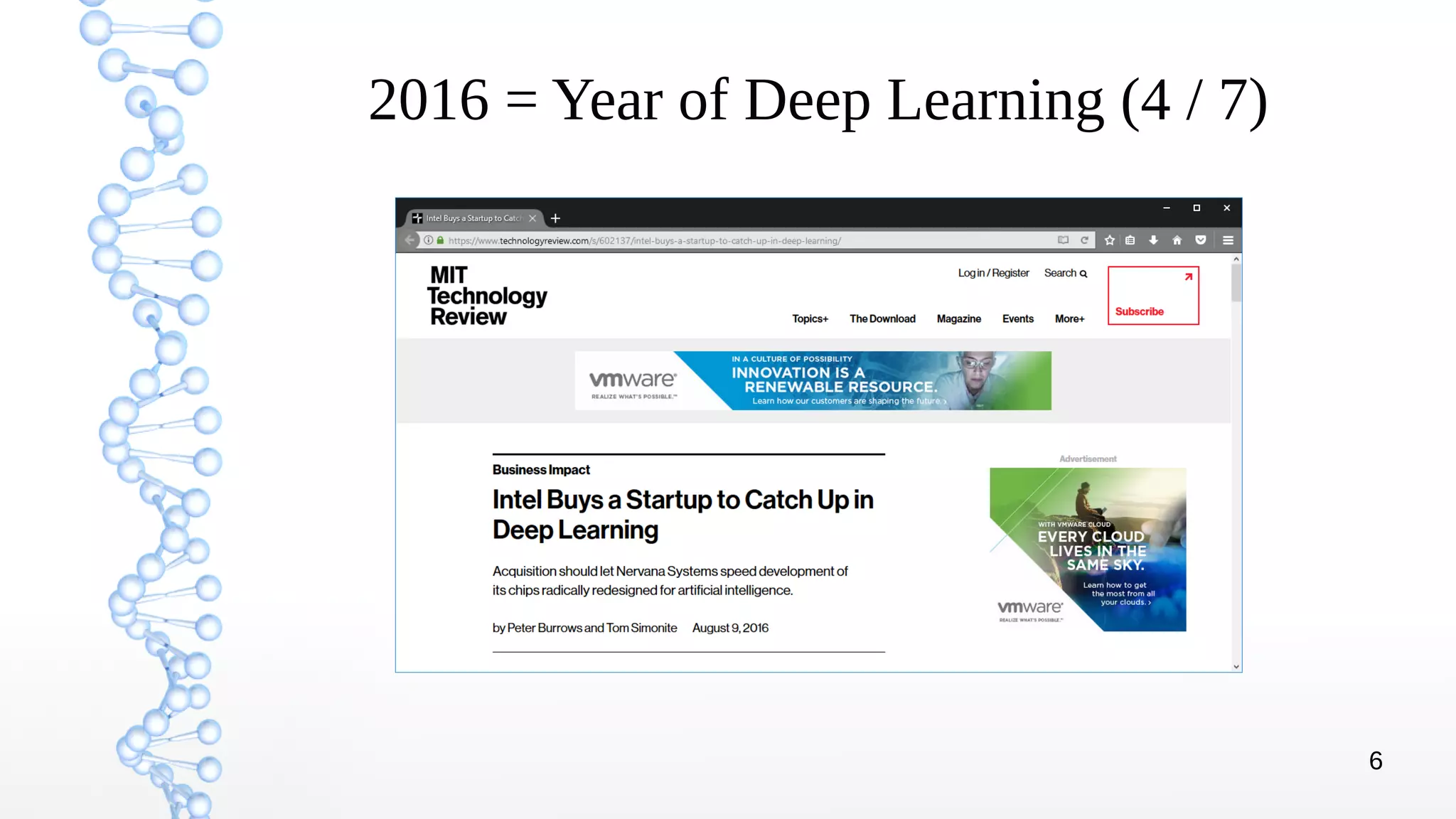
2016 = Year of Deep Learning (4 / 7)
7
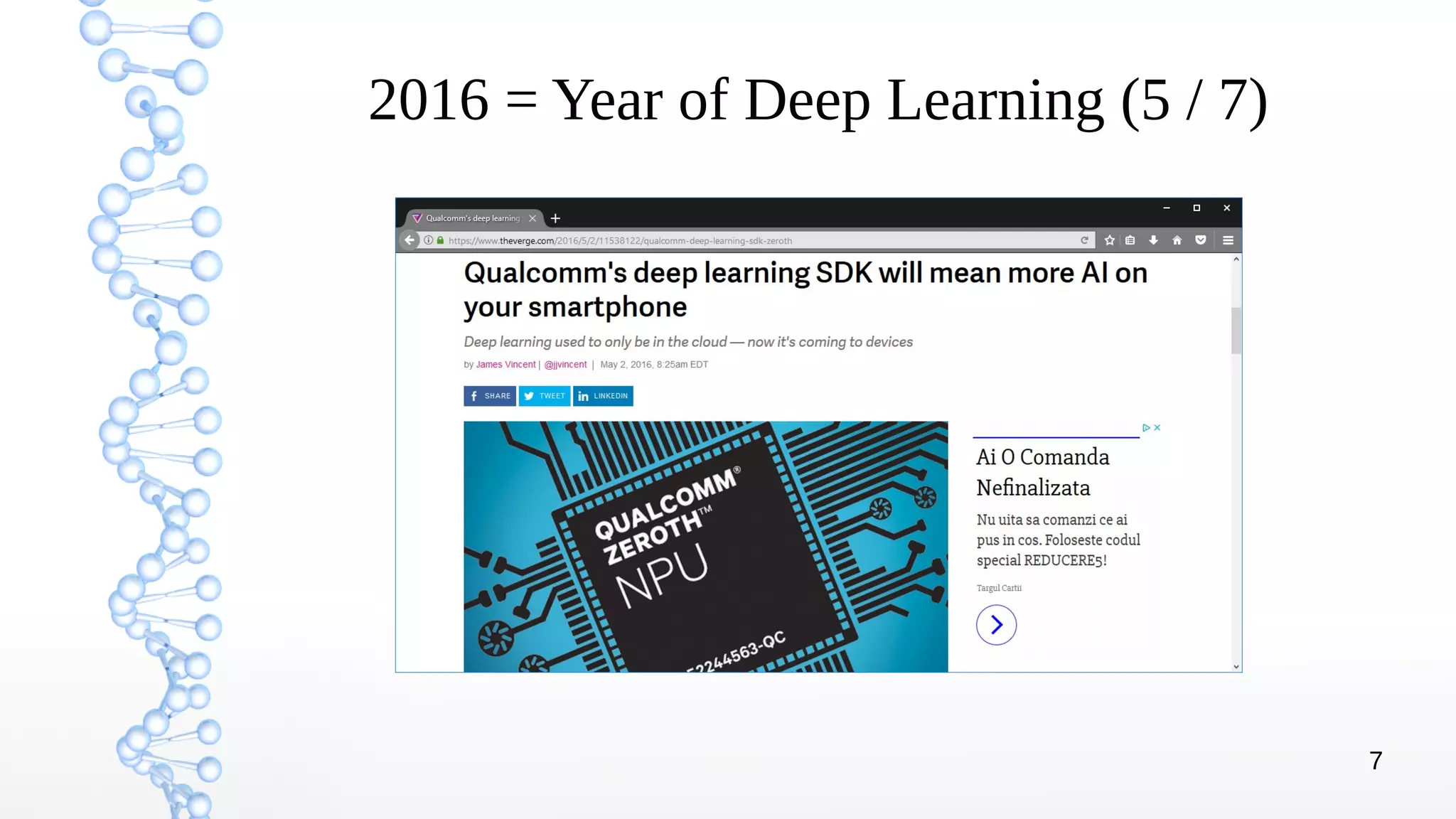
2016 = Year of Deep Learning (5 / 7)
8
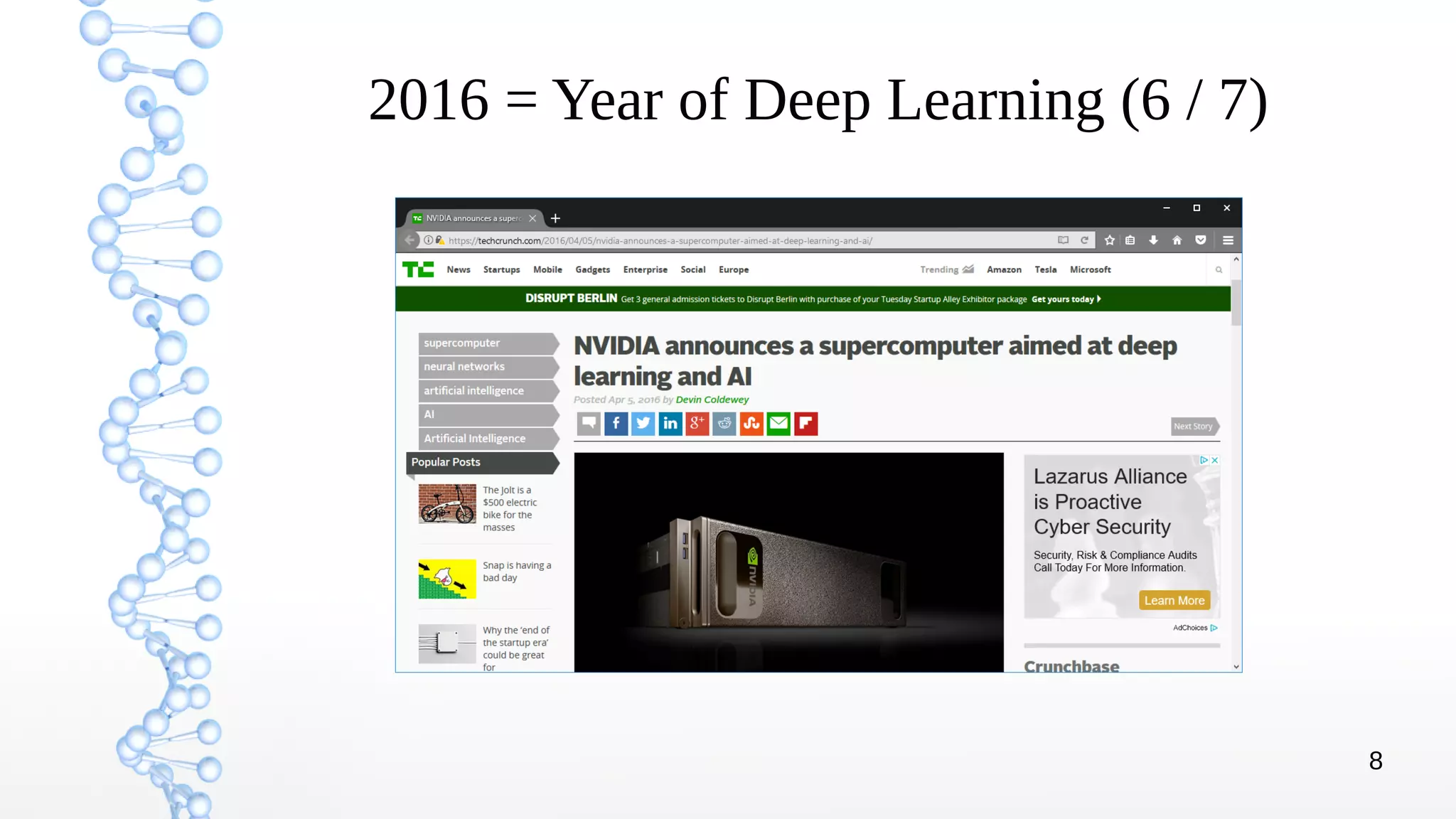
2016 = Year of Deep Learning (6 / 7)
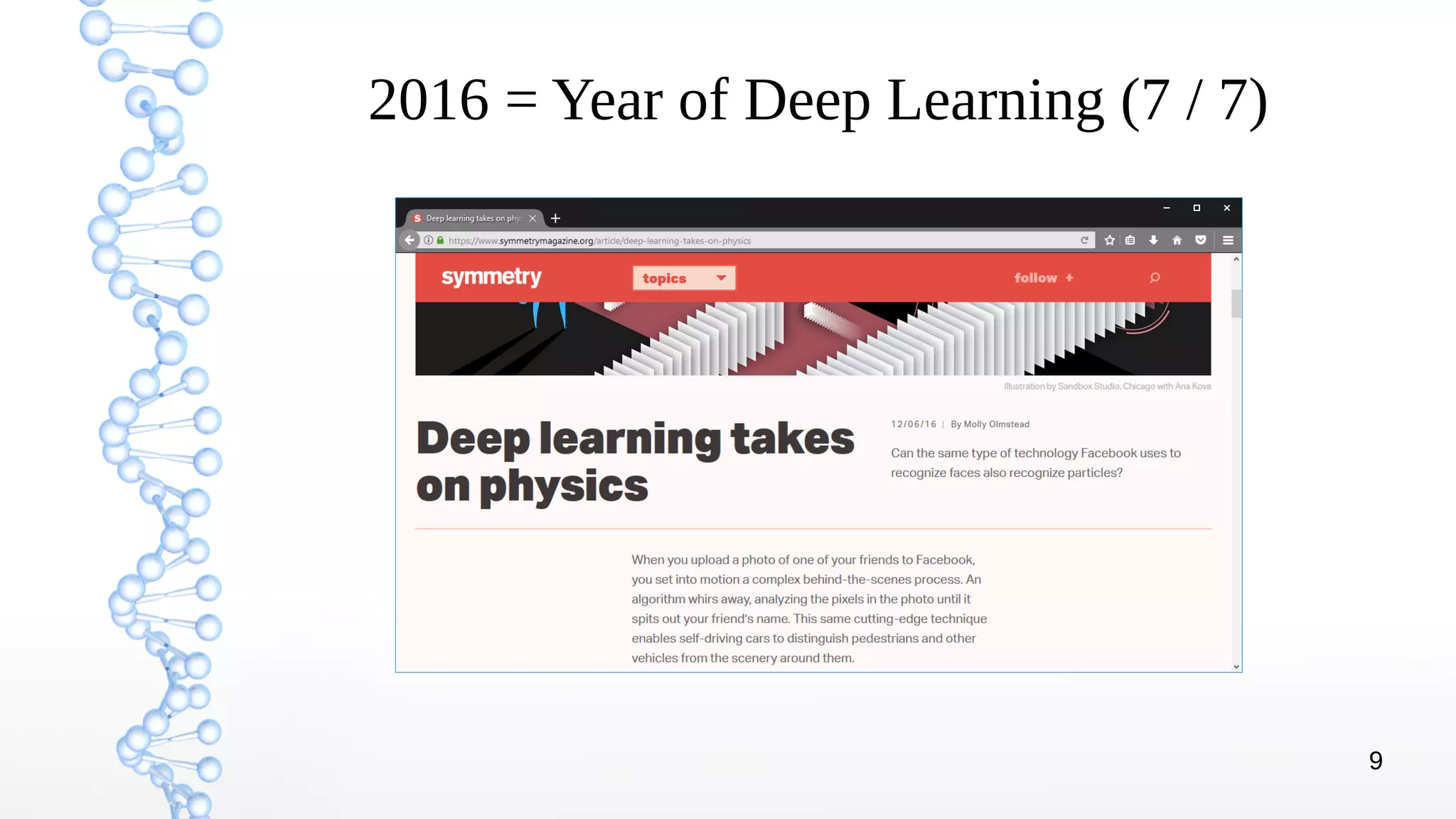
9
2016 = Year of Deep Learning (7 / 7)
10
About Deep Learning. Why now?
●
D.L. = topic in Artificial Intelligence, specifically belonging to Machine
Learning
●
Methods used are based on learning models
●
These techniques are in contrast to algorithms with manually-crafted
features
●
Neural nets knowledge existed for decades. Why now the emergence
of D.L.?
–
Availability of an extensive dataset
–
GPU progress and better hardware, cheaper products
–
Improved techniques
11
Inspiration for D.L. models
●
The human brain
–
Comes with an initial model => approximates reality
–
While growing up => receives sensory inputs => approximates
the experience
●
External factors (= our parents)
–
Confirm or correct our approximations => the model is
reinforced / is adjusted
●
Similar ideas to the above inspired Machine Learning =>
self-adjusting models that learn from example
12
The linear perceptron
●
A simple learning model:
–
A mathematical function h(x, θ)
–
x = model input vector
–
θ = internal parameters vector
●
Example: an exam result guess model => above/below
average exam result – based on sleep hours and study
hours
h(x ,θ)=
{
−1,x
T
⋅
[θ 1
θ 2]+θ 0<0
1,xT
⋅
[θ 1
θ 2
]+θ 0≥0
x=[x1, x2]T
θ=[θ 1,θ 2,θ 0]T
x1
– sleep hours
x2
– study hours
13
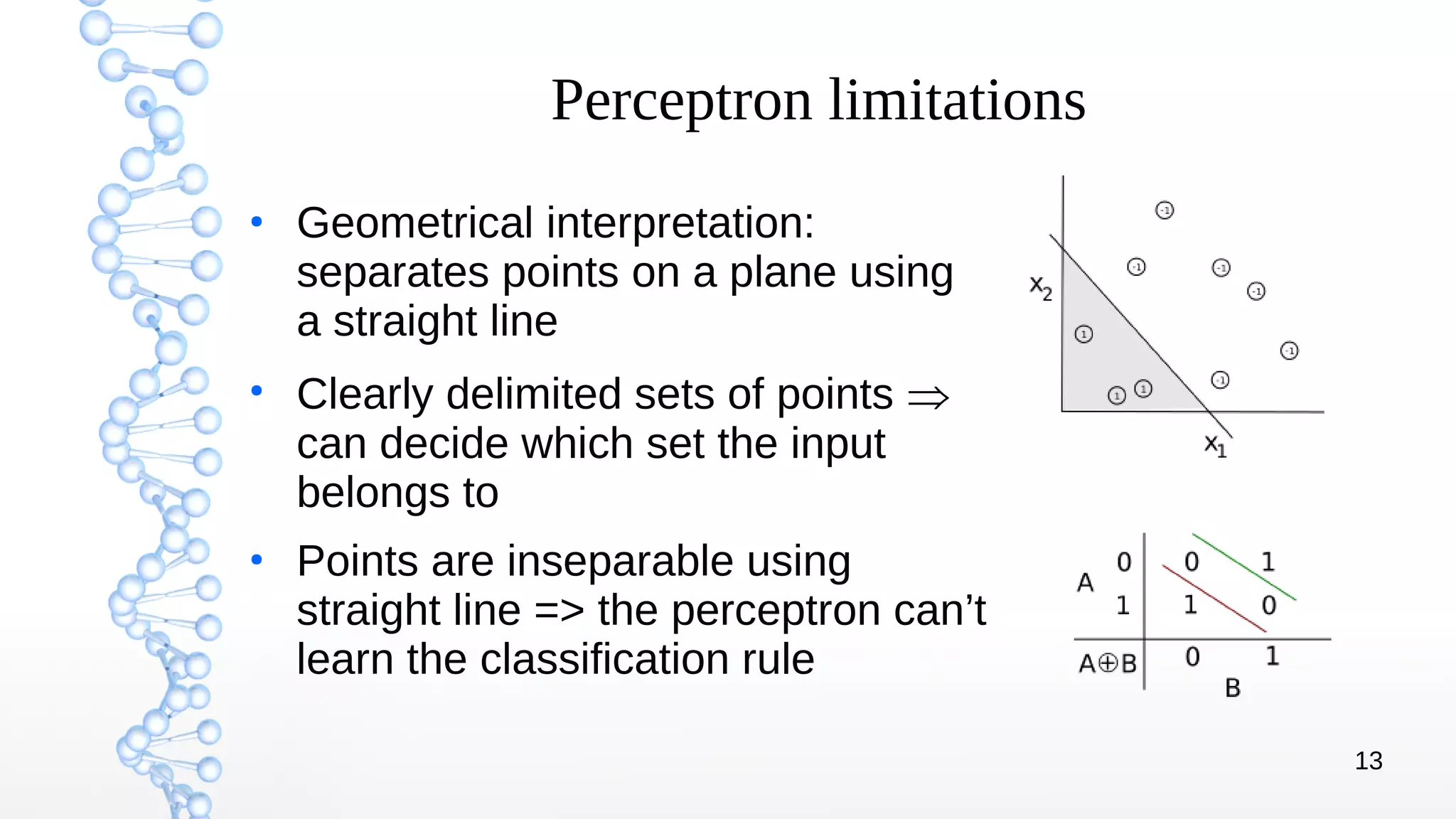
Perceptron limitations
●
Geometrical interpretation:
separates points on a plane using
a straight line
●
Clearly delimited sets of points 
can decide which set the input
belongs to
●
Points are inseparable using
straight line => the perceptron can’t
learn the classification rule
14
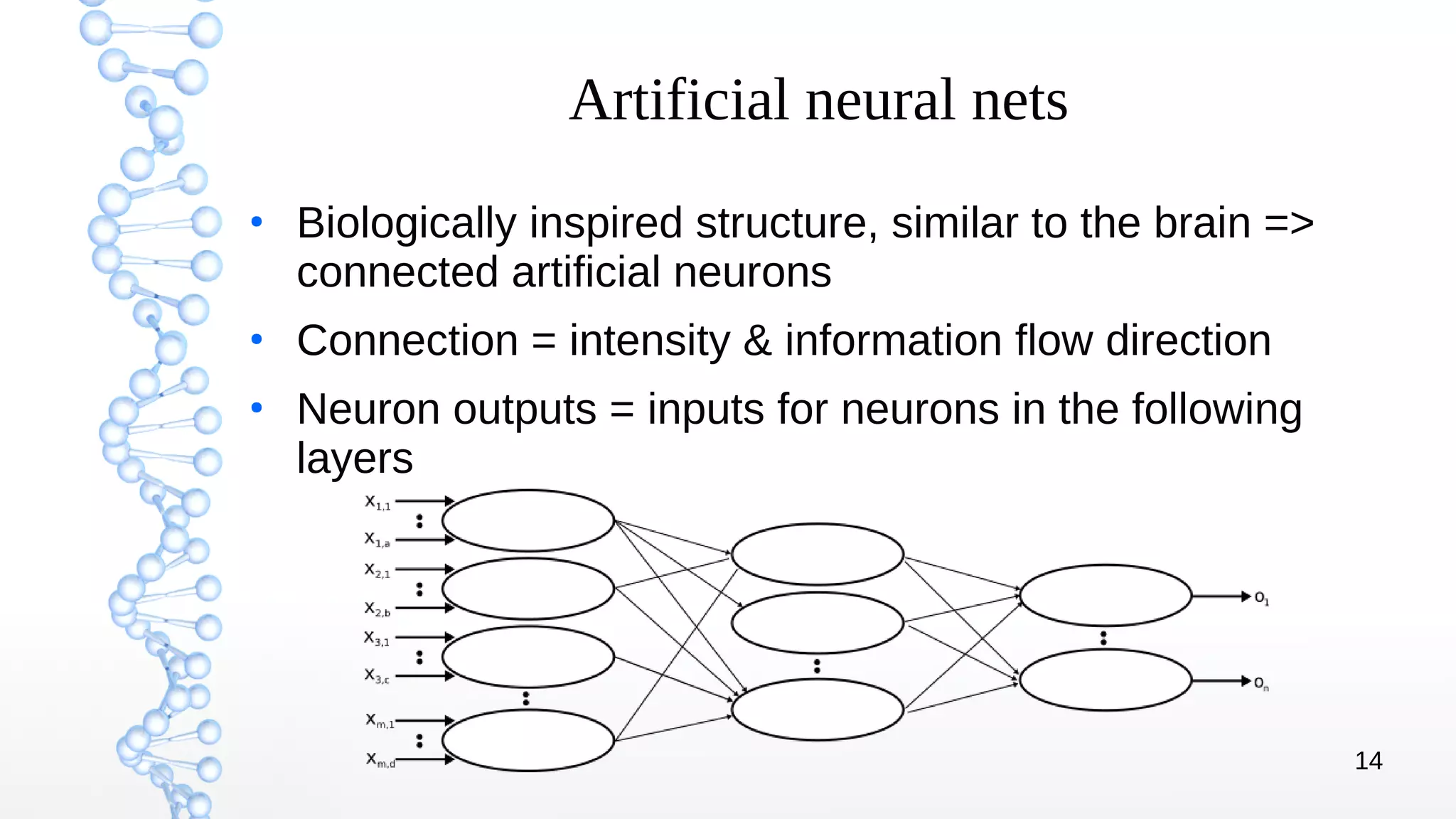
Artificial neural nets
●
Biologically inspired structure, similar to the brain =>
connected artificial neurons
●
Connection = intensity & information flow direction
●
Neuron outputs = inputs for neurons in the following
layers
15
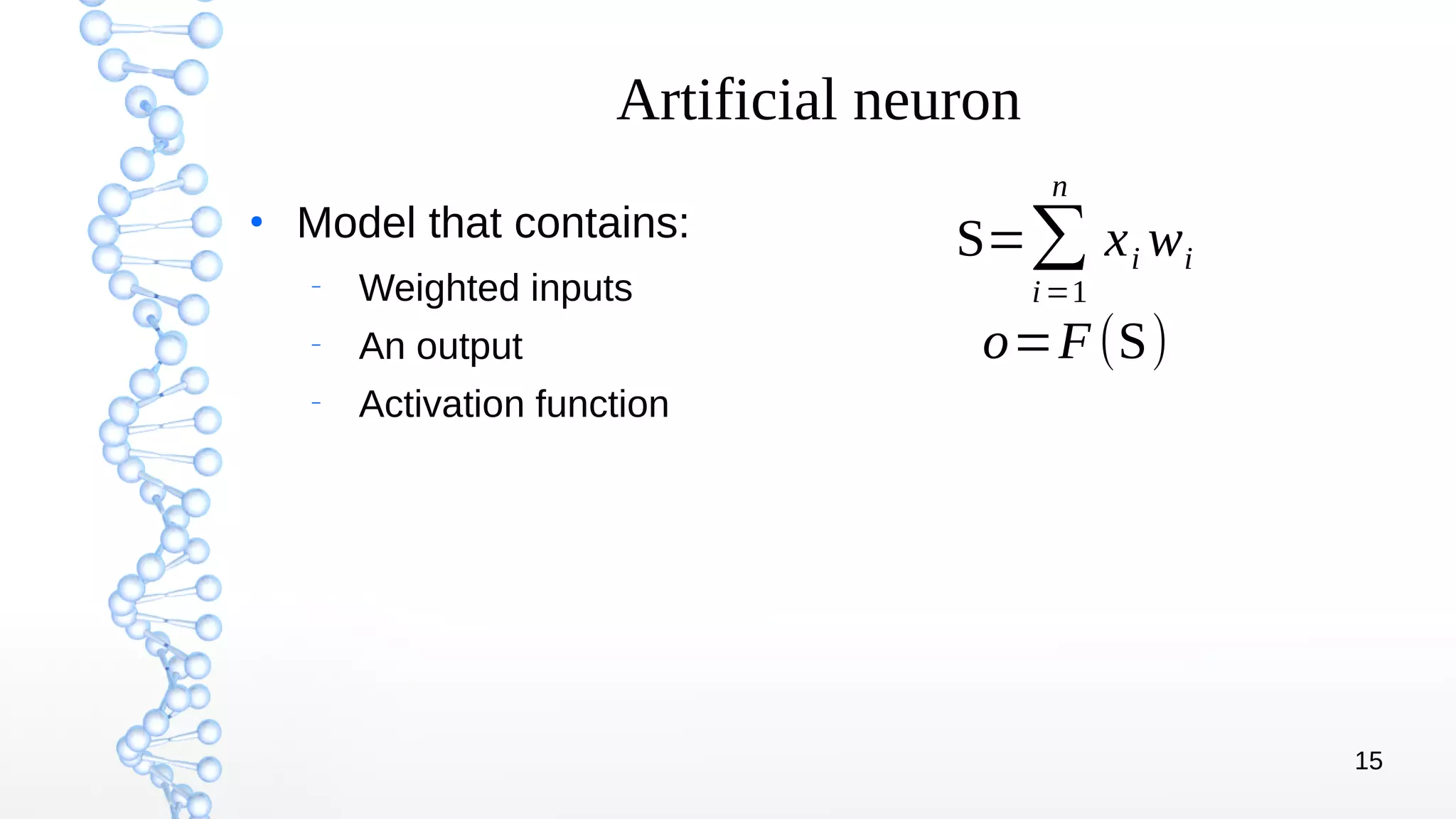
Artificial neuron
●
Model that contains:
–
Weighted inputs
–
An output
–
Activation function
S=∑
i=1
n
xi wi
o=F(S)
16
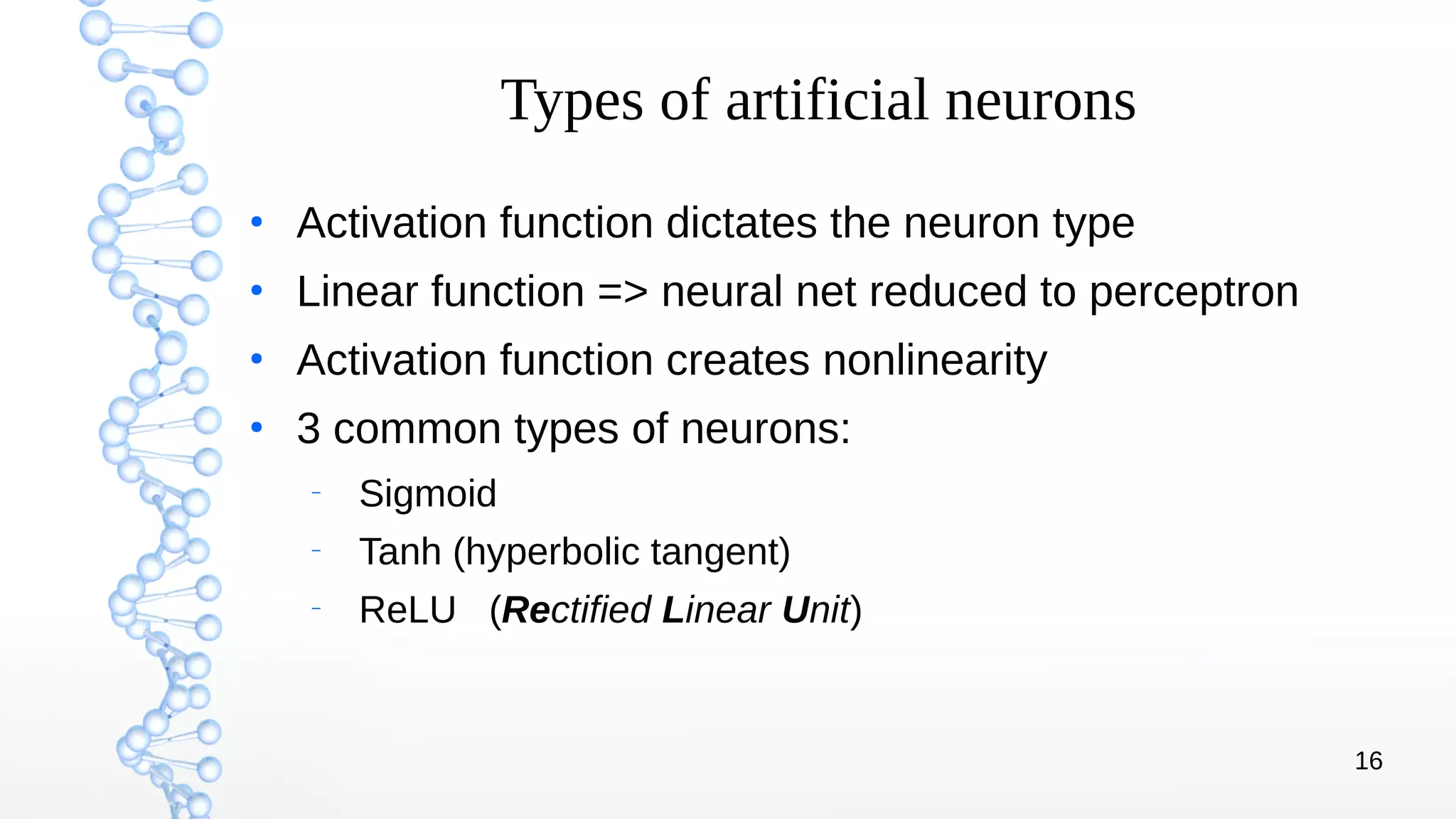
Types of artificial neurons
●
Activation function dictates the neuron type
●
Linear function => neural net reduced to perceptron
●
Activation function creates nonlinearity
●
3 common types of neurons:
–
Sigmoid
–
Tanh (hyperbolic tangent)
–
ReLU (Rectified Linear Unit)
17
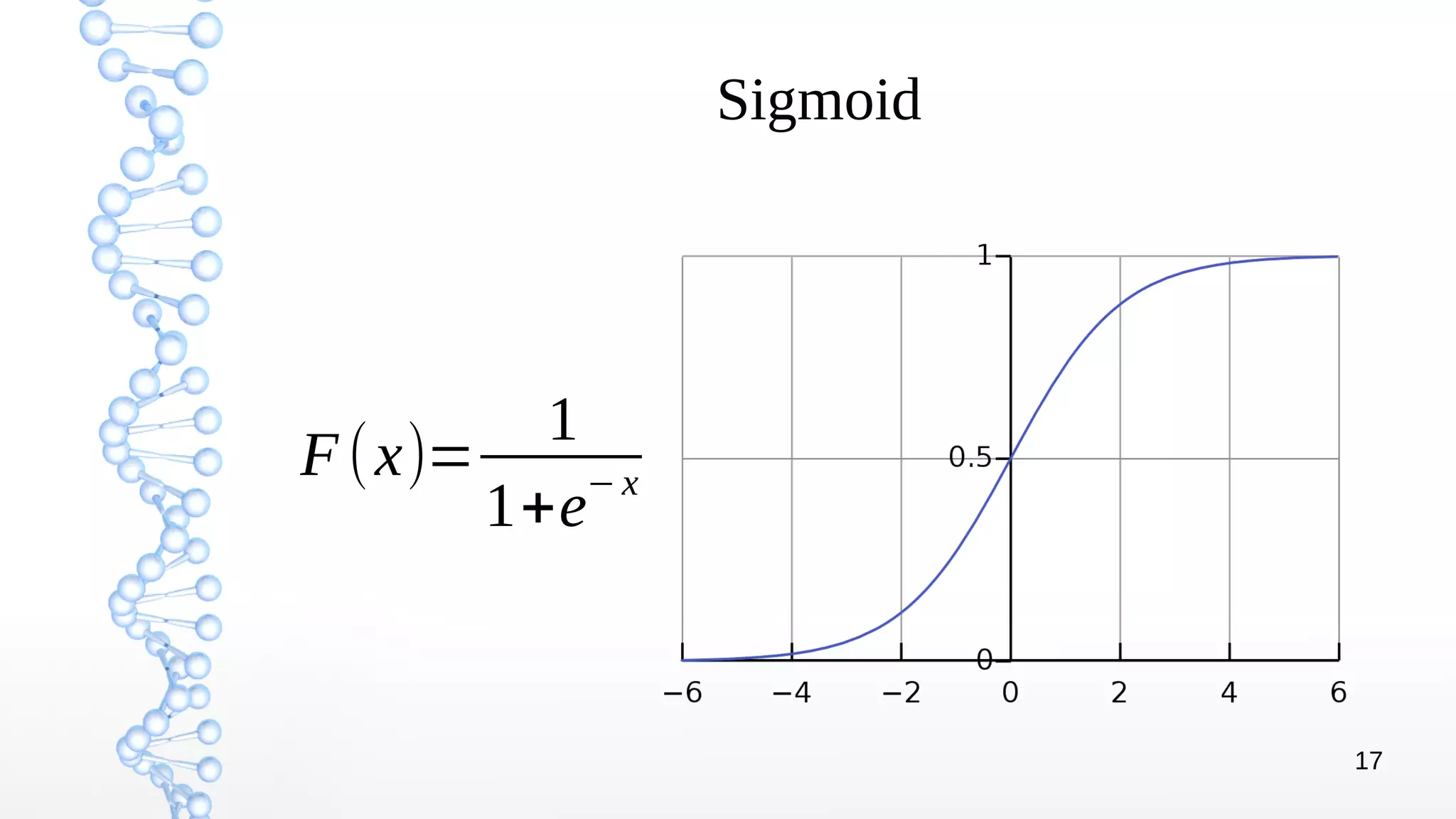
Sigmoid
F(x)=
1
1+e
− x
18
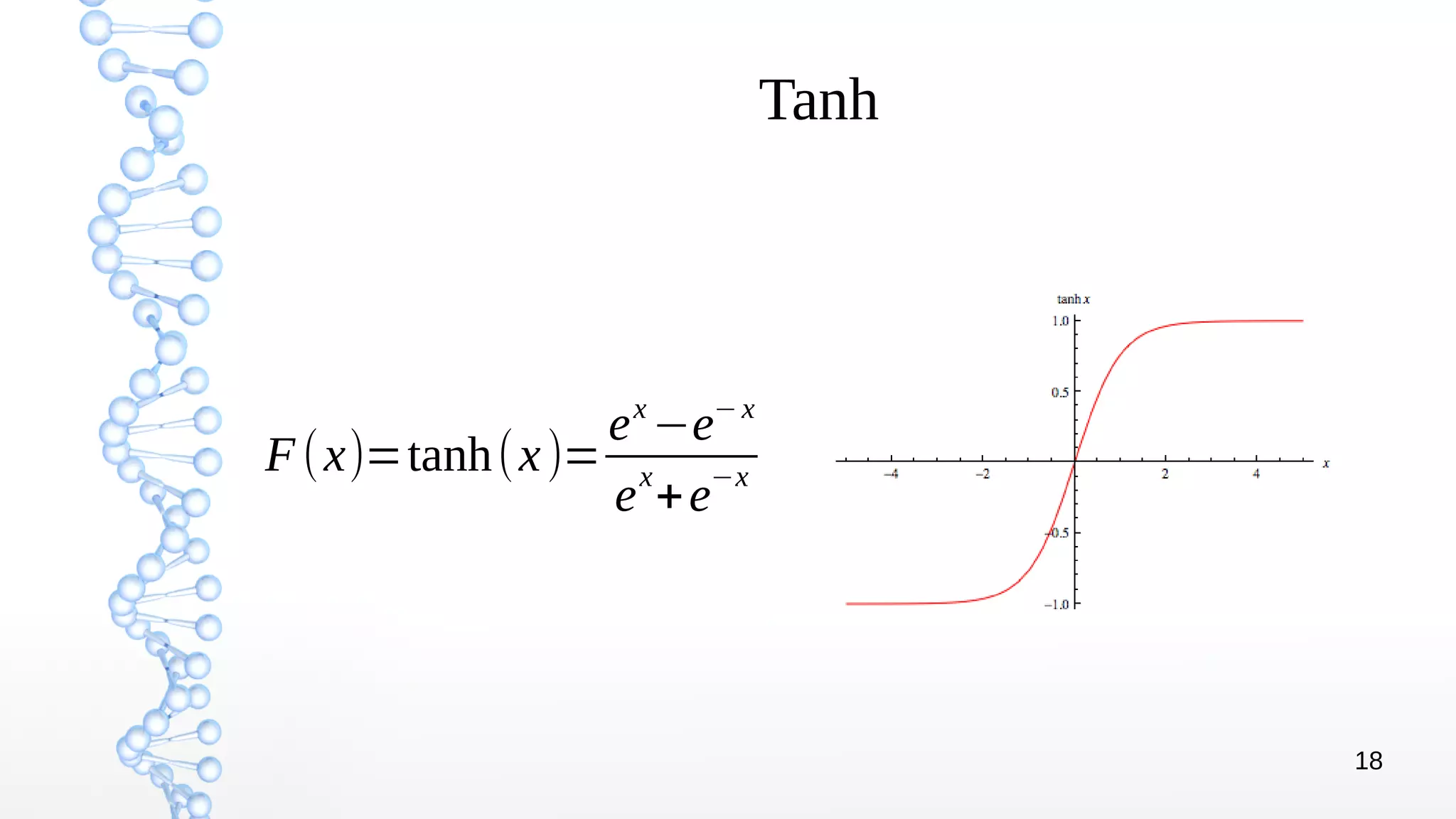
Tanh
F(x)=tanh(x)=
ex
−e− x
e
x
+e
−x
19
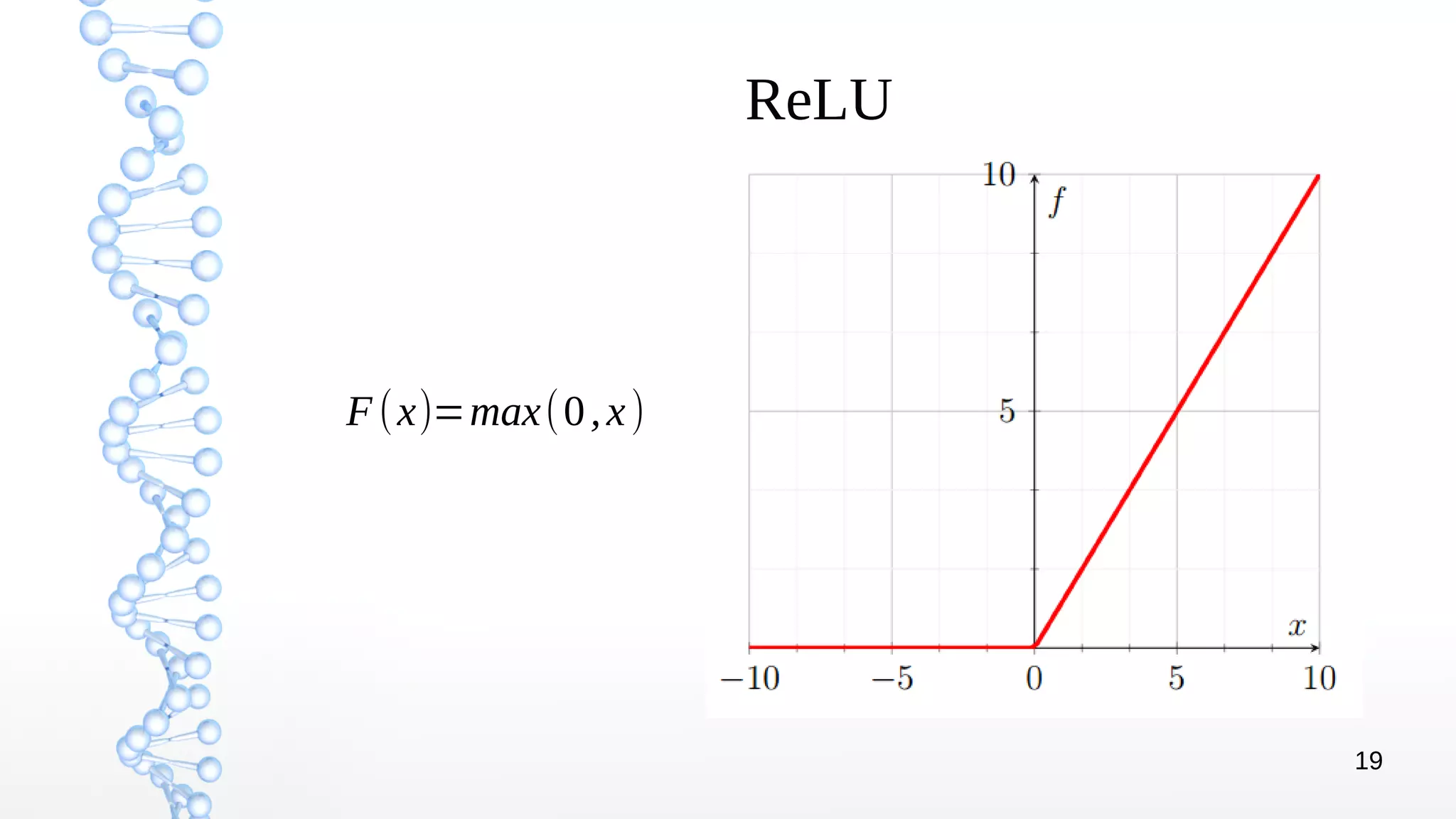
ReLU
F(x)=max(0,x)
20
The learning process
●
Adjusting edge weights in an iterative way, to output
desired answers
●
Several techniques and algorithms
●
The backpropagation algorithm: ripple the difference
between result and objective backwards on previous
layers
21
Backpropagation - outline
1) Use a vector as input => get result as output
2) Compare output with desired vector
3) The difference is propagated backwards in the net
4) Adjust weights according to an error-minimizing
algorithm
22
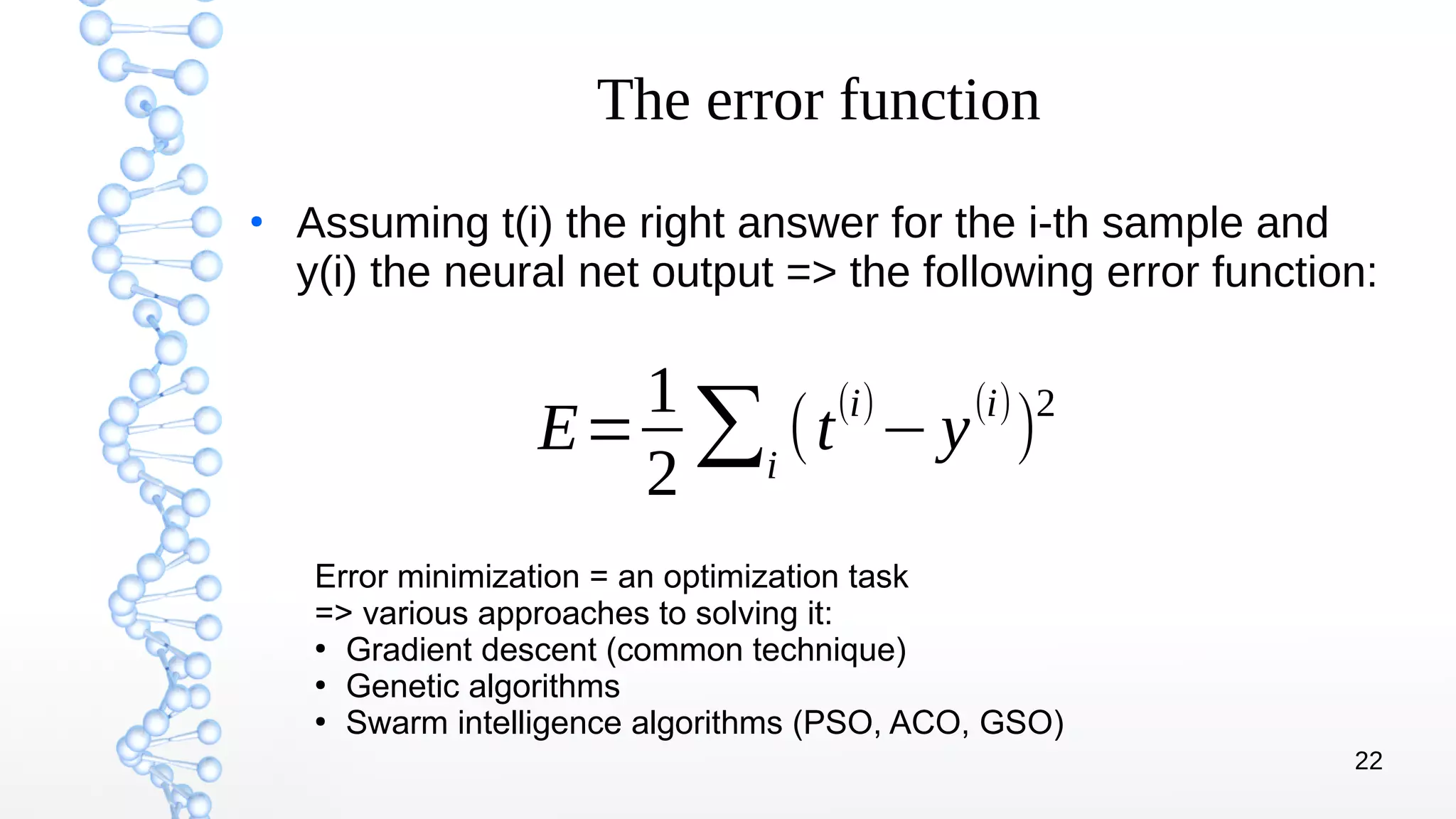
The error function
●
Assuming t(i) the right answer for the i-th sample and
y(i) the neural net output => the following error function:
Error minimization = an optimization task
=> various approaches to solving it:
●
Gradient descent (common technique)
●
Genetic algorithms
●
Swarm intelligence algorithms (PSO, ACO, GSO)
E=
1
2
∑i
(t
(i)
−y
(i)
)
2
23
Gradient descent
●
Assume 2 weights: w1 and w2 => XY plane made of
[w1, w2] pairs
●
Z axis: error value at [w1, w2] coordinates =>
somewhere on the graph surface
●
Need to descend on the slope towards a minimum point
●
Steepest curve = perpendicular line to level ellipse =>
descend on the gradient of the error function
Δ wk=−ϵ
∂ E
∂wk
=...=∑
i
ϵ xk
(i)
(t
(i)
− y
(i)
)
ϵ = learning rate xk(i) = k-th input of i-th sample
i = i-th sample t(i),y(i) = desired outcome / actual output
24
Backpropagation & gradient descent
●
Weight adjustment în hidden layers:
–
Calculate error change depending on hidden outputs
–
Calculate error change depending on individual weights
●
For this we can use a dynamic programming approach
–
Store previously calculated values in a table and reuse them
as necessary
25
Convolutional neural nets
●
Classical neural net density gets very large for images
●
Simplify graph by calculating a subgraph
●
Multiple filters are repeatedly applied to parts of the image
=> smaller array
●
The operation is known as convolution
●
It is a linear operation => nonlinearity is later added through
ReLU or sigmoids
●
The neural net trains on these feature maps
●
More details about these in a future session...
26
Thank you for attending!
27
Bibliography
●
MIT 6.S191 course: Intro to Deep Learning
●
Nikhil Buduma – Fundamentals of Deep Learning
●
Ecaterina Vladu – Inteligenţa artificială
●
Wikipedia. Deep learning

Deep learning @ University of Oradea - part I (16 Jan. 2018)

  • 1.
    1 Deep Learning Vlad OvidiuMihalca PhD student – AI & Vision Mechatronics @ University of Oradea 16th of January, 2018
  • 2.
    2 Series of talks ● PartI: theoretical base concepts ● Part II: frameworks and DL industry use ● Part III: usage in robotics and Computer Vision, state of the art in research
  • 3.
    3 2016 = Yearof Deep Learning (1 / 7)
  • 4.
    4 2016 = Yearof Deep Learning (2 / 7)
  • 5.
    5 2016 = Yearof Deep Learning (3 / 7)
  • 6.
    6 2016 = Yearof Deep Learning (4 / 7)
  • 7.
    7 2016 = Yearof Deep Learning (5 / 7)
  • 8.
    8 2016 = Yearof Deep Learning (6 / 7)
  • 9.
    9 2016 = Yearof Deep Learning (7 / 7)
  • 10.
    10 About Deep Learning.Why now? ● D.L. = topic in Artificial Intelligence, specifically belonging to Machine Learning ● Methods used are based on learning models ● These techniques are in contrast to algorithms with manually-crafted features ● Neural nets knowledge existed for decades. Why now the emergence of D.L.? – Availability of an extensive dataset – GPU progress and better hardware, cheaper products – Improved techniques
  • 11.
    11 Inspiration for D.L.models ● The human brain – Comes with an initial model => approximates reality – While growing up => receives sensory inputs => approximates the experience ● External factors (= our parents) – Confirm or correct our approximations => the model is reinforced / is adjusted ● Similar ideas to the above inspired Machine Learning => self-adjusting models that learn from example
  • 12.
    12 The linear perceptron ● Asimple learning model: – A mathematical function h(x, θ) – x = model input vector – θ = internal parameters vector ● Example: an exam result guess model => above/below average exam result – based on sleep hours and study hours h(x ,θ)= { −1,x T ⋅ [θ 1 θ 2]+θ 0<0 1,xT ⋅ [θ 1 θ 2 ]+θ 0≥0 x=[x1, x2]T θ=[θ 1,θ 2,θ 0]T x1 – sleep hours x2 – study hours
  • 13.
    13 Perceptron limitations ● Geometrical interpretation: separatespoints on a plane using a straight line ● Clearly delimited sets of points  can decide which set the input belongs to ● Points are inseparable using straight line => the perceptron can’t learn the classification rule
  • 14.
    14 Artificial neural nets ● Biologicallyinspired structure, similar to the brain => connected artificial neurons ● Connection = intensity & information flow direction ● Neuron outputs = inputs for neurons in the following layers
  • 15.
    15 Artificial neuron ● Model thatcontains: – Weighted inputs – An output – Activation function S=∑ i=1 n xi wi o=F(S)
  • 16.
    16 Types of artificialneurons ● Activation function dictates the neuron type ● Linear function => neural net reduced to perceptron ● Activation function creates nonlinearity ● 3 common types of neurons: – Sigmoid – Tanh (hyperbolic tangent) – ReLU (Rectified Linear Unit)
  • 17.
  • 18.
  • 19.
  • 20.
    20 The learning process ● Adjustingedge weights in an iterative way, to output desired answers ● Several techniques and algorithms ● The backpropagation algorithm: ripple the difference between result and objective backwards on previous layers
  • 21.
    21 Backpropagation - outline 1)Use a vector as input => get result as output 2) Compare output with desired vector 3) The difference is propagated backwards in the net 4) Adjust weights according to an error-minimizing algorithm
  • 22.
    22 The error function ● Assumingt(i) the right answer for the i-th sample and y(i) the neural net output => the following error function: Error minimization = an optimization task => various approaches to solving it: ● Gradient descent (common technique) ● Genetic algorithms ● Swarm intelligence algorithms (PSO, ACO, GSO) E= 1 2 ∑i (t (i) −y (i) ) 2
  • 23.
    23 Gradient descent ● Assume 2weights: w1 and w2 => XY plane made of [w1, w2] pairs ● Z axis: error value at [w1, w2] coordinates => somewhere on the graph surface ● Need to descend on the slope towards a minimum point ● Steepest curve = perpendicular line to level ellipse => descend on the gradient of the error function Δ wk=−ϵ ∂ E ∂wk =...=∑ i ϵ xk (i) (t (i) − y (i) ) ϵ = learning rate xk(i) = k-th input of i-th sample i = i-th sample t(i),y(i) = desired outcome / actual output
  • 24.
    24 Backpropagation & gradientdescent ● Weight adjustment în hidden layers: – Calculate error change depending on hidden outputs – Calculate error change depending on individual weights ● For this we can use a dynamic programming approach – Store previously calculated values in a table and reuse them as necessary
  • 25.
    25 Convolutional neural nets ● Classicalneural net density gets very large for images ● Simplify graph by calculating a subgraph ● Multiple filters are repeatedly applied to parts of the image => smaller array ● The operation is known as convolution ● It is a linear operation => nonlinearity is later added through ReLU or sigmoids ● The neural net trains on these feature maps ● More details about these in a future session...
  • 26.
    26 Thank you forattending!
  • 27.
    27 Bibliography ● MIT 6.S191 course:Intro to Deep Learning ● Nikhil Buduma – Fundamentals of Deep Learning ● Ecaterina Vladu – Inteligenţa artificială ● Wikipedia. Deep learning