Deep Learning:
State of the Art (2019)
2019https://deeplearning.mit.eduFor the full list of references visit:
https://hcai.mit.edu/references
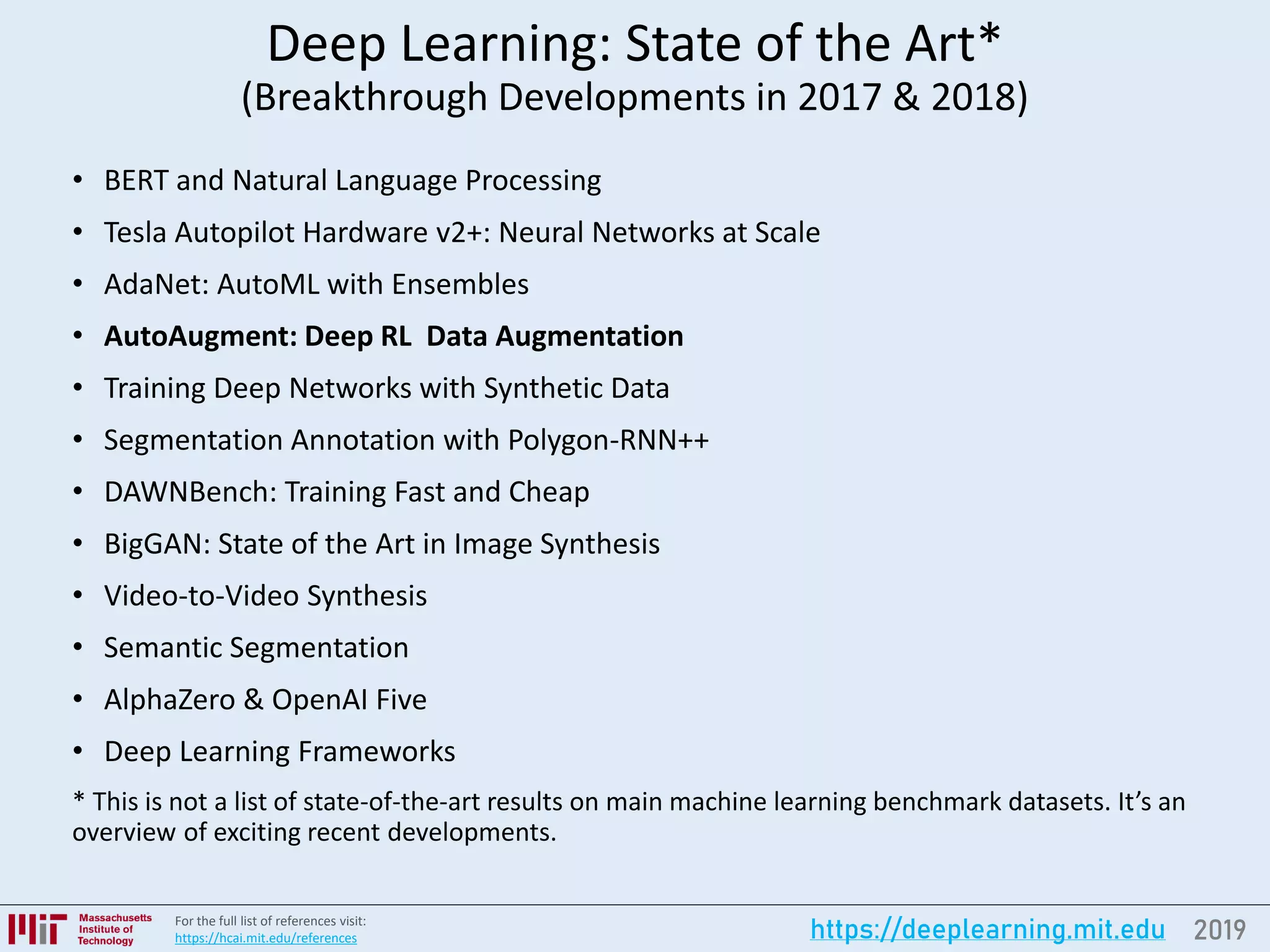
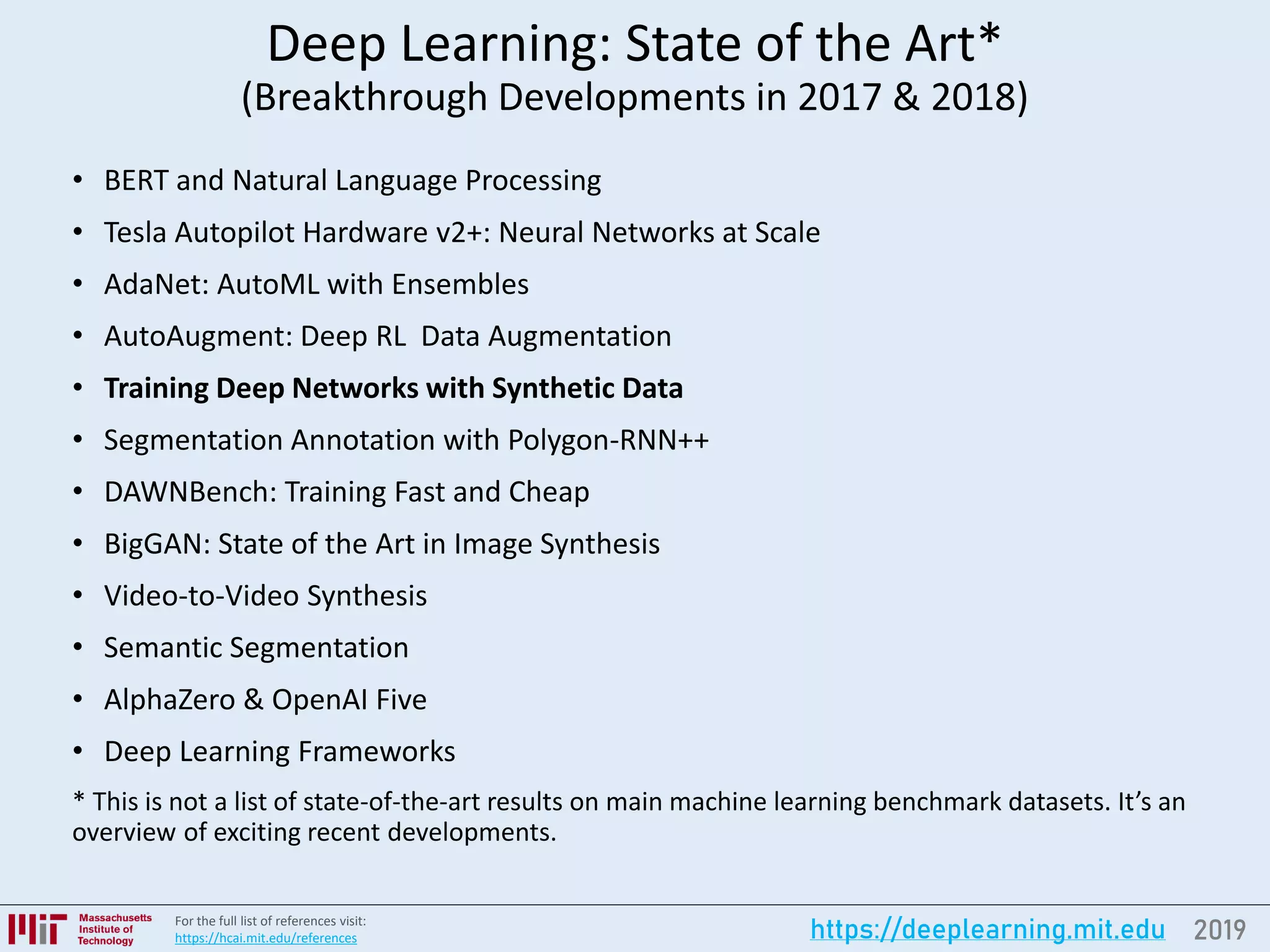
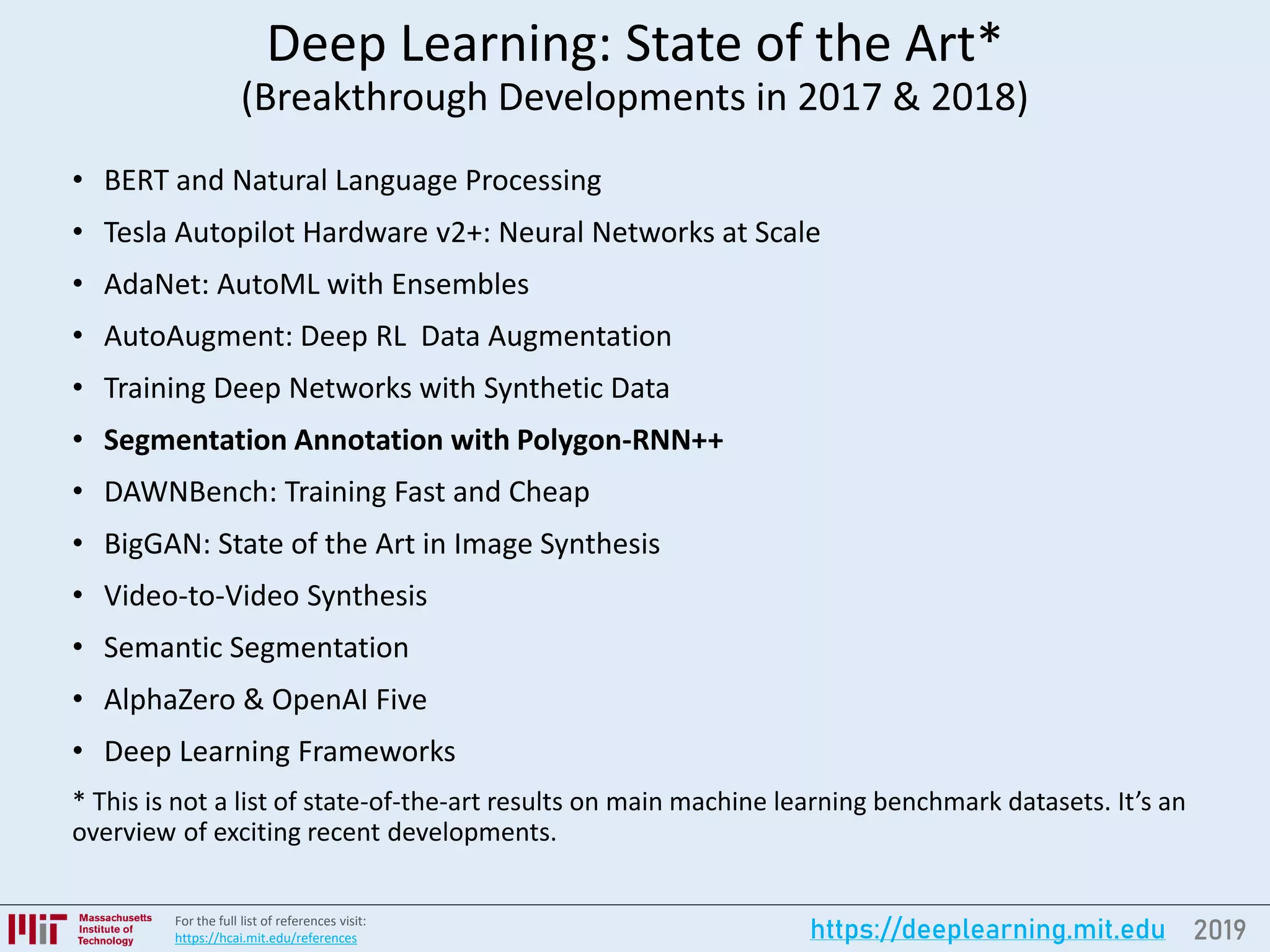
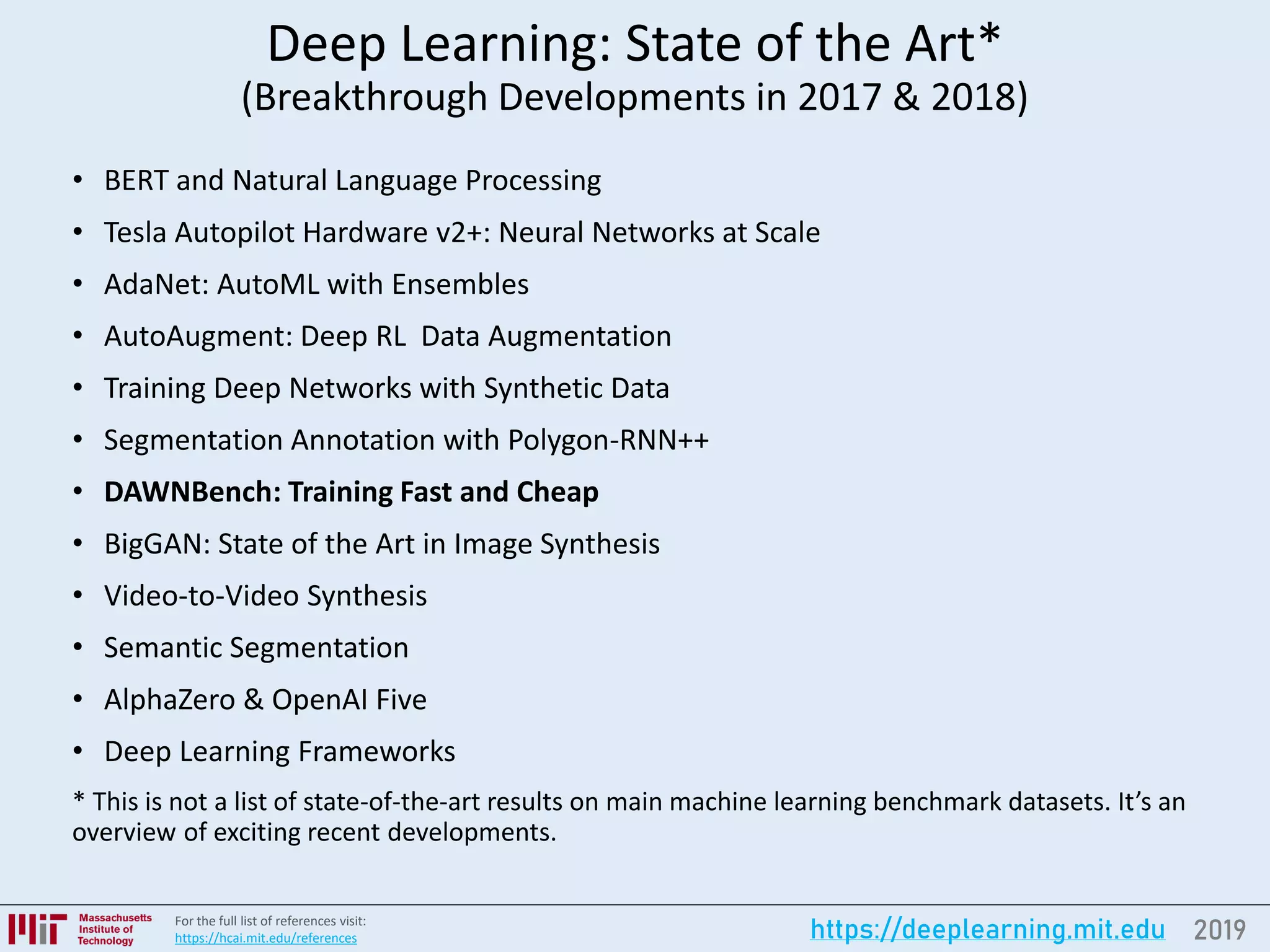
Deep Learning: State of the Art*
(Breakthrough Developments in 2017 & 2018)
• BERT and Natural Language Processing
• Tesla Autopilot Hardware v2+: Neural Networks at Scale
• AdaNet: AutoML with Ensembles
• AutoAugment: Deep RL Data Augmentation
• Training Deep Networks with Synthetic Data
• Segmentation Annotation with Polygon-RNN++
• DAWNBench: Training Fast and Cheap
• BigGAN: State of the Art in Image Synthesis
• Video-to-Video Synthesis
• Semantic Segmentation
• AlphaZero & OpenAI Five
• Deep Learning Frameworks
* This is not a list of state-of-the-art results on main machine learning benchmark datasets. It’s an
overview of exciting recent developments.
2019https://deeplearning.mit.eduFor the full list of references visit:
https://hcai.mit.edu/references
Encoder-Decoder Architecture
Sequence-to-Sequence Model - Neural Machine Translation
[295]
Encoder RNN encodes input sequence into a fixed size vector,
and then is passed repeatedly to decoder RNN.
2019https://deeplearning.mit.eduFor the full list of references visit:
https://hcai.mit.edu/references
Attention
[296]
Attention mechanism allows the network to refer back to the
input sequence, instead of forcing it to encode all information
into one fixed-length vector.
2019https://deeplearning.mit.eduFor the full list of references visit:
https://hcai.mit.edu/references
Attention
[312]
2019https://deeplearning.mit.eduFor the full list of references visit:
https://hcai.mit.edu/references
Attention
[312]
2019https://deeplearning.mit.eduFor the full list of references visit:
https://hcai.mit.edu/references
Self-Attention
[312]
"The animal didn't cross the street because it was too tired"
More details: http://jalammar.github.io/illustrated-transformer/
2019https://deeplearning.mit.eduFor the full list of references visit:
https://hcai.mit.edu/references
Transformer
[312]
Vaswani, Ashish, et al. "Attention is all you need." Advances in Neural Information Processing Systems. 2017.
2019https://deeplearning.mit.eduFor the full updated list of references visit:
https://selfdrivingcars.mit.edu/references
Word Embeddings
(Word2Vec)
[297]
Word Vector
Skip Gram Model:
2019https://deeplearning.mit.eduFor the full list of references visit:
https://hcai.mit.edu/references
Context-Aware Embeddings
[312]
2019https://deeplearning.mit.eduFor the full list of references visit:
https://hcai.mit.edu/references
OpenAI Transformer
1. Pre-train a Transformer’s decoder for language modeling
2. Train it on, for example, a sentence classification task
[312]
1 2
2019https://deeplearning.mit.eduFor the full list of references visit:
https://hcai.mit.edu/references
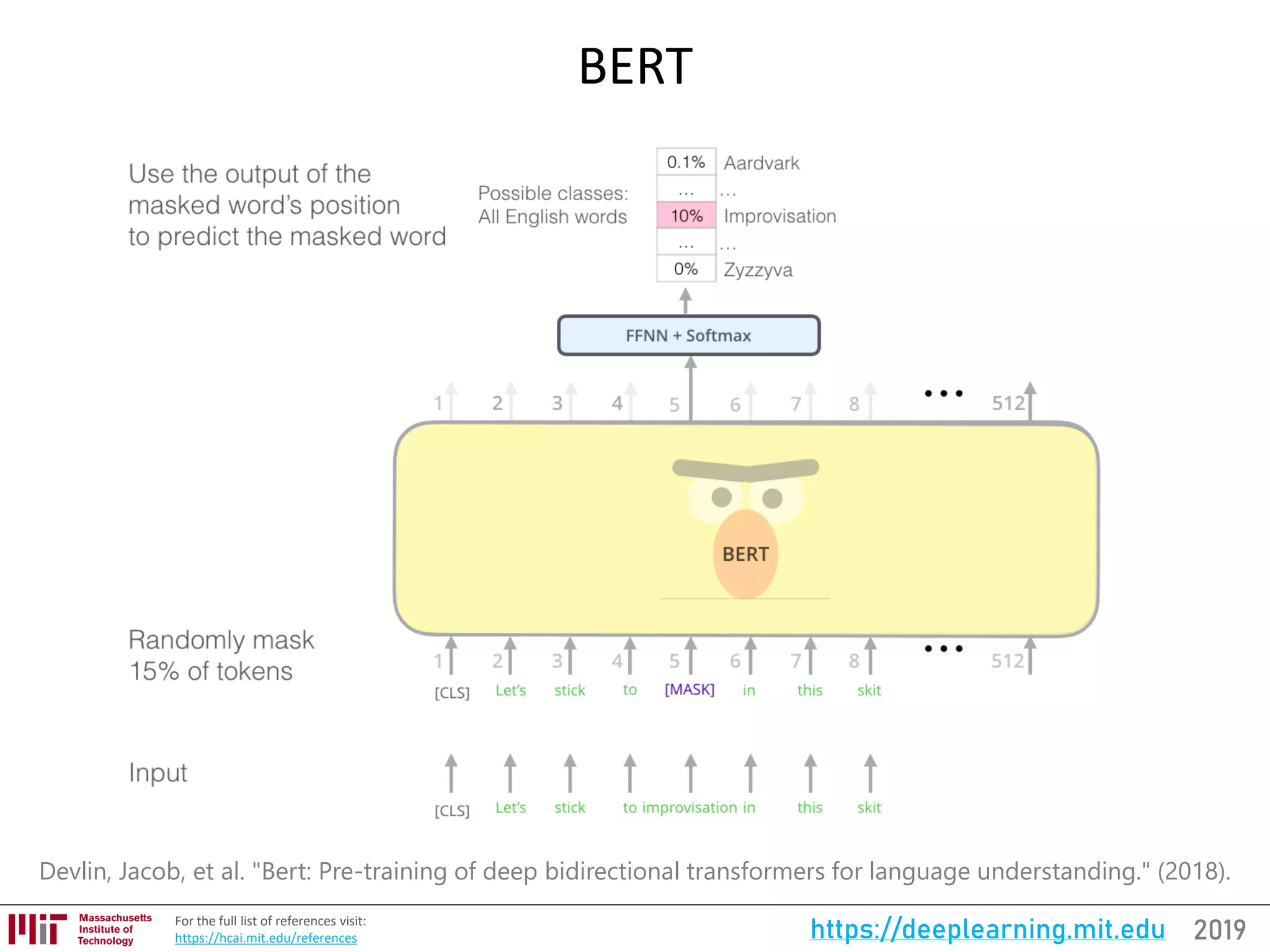
BERT
Devlin, Jacob, et al. "Bert: Pre-training of deep bidirectional transformers for language understanding." (2018).
2019https://deeplearning.mit.eduFor the full list of references visit:
https://hcai.mit.edu/references
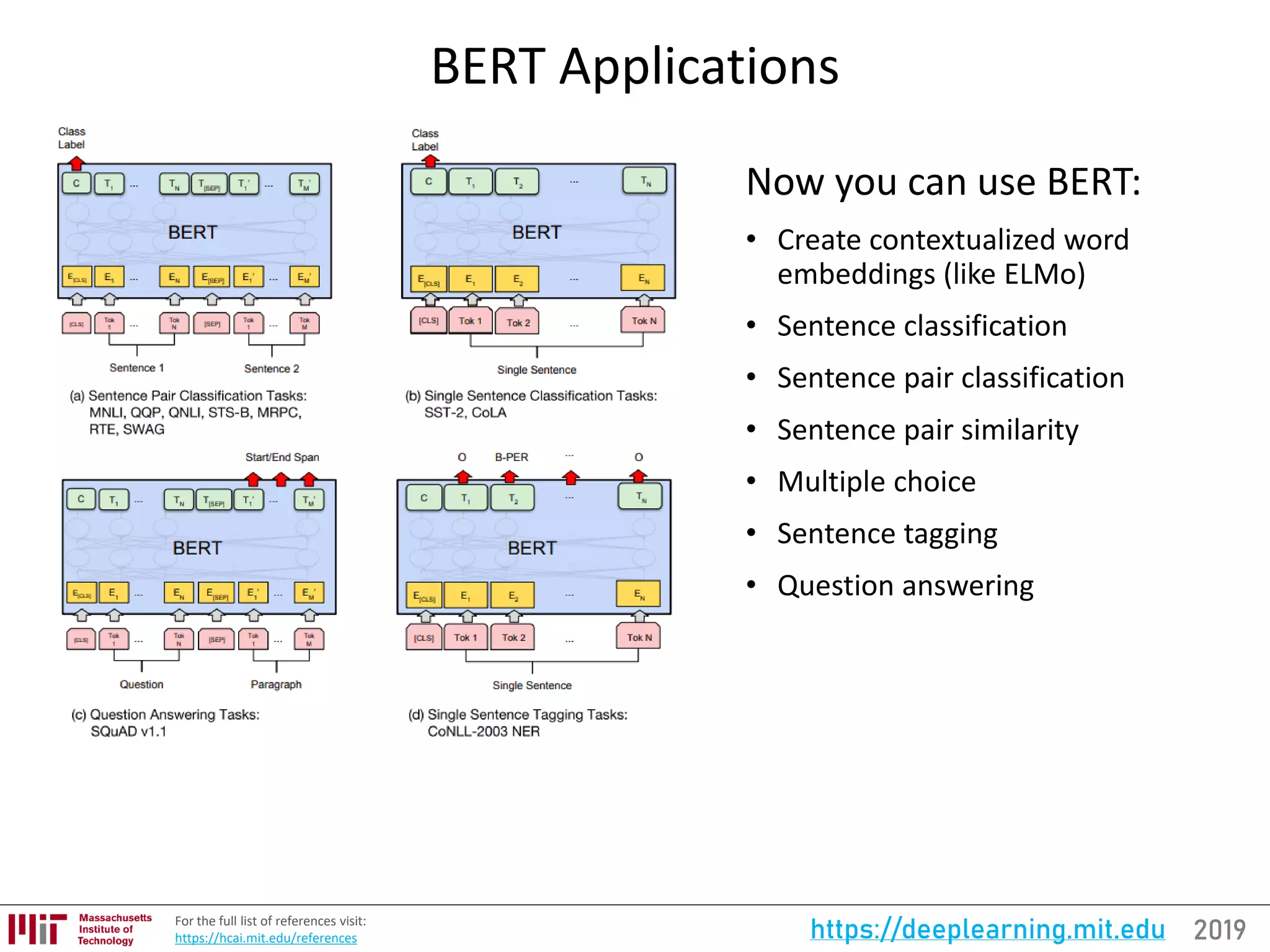
BERT Applications
Now you can use BERT:
• Create contextualized word
embeddings (like ELMo)
• Sentence classification
• Sentence pair classification
• Sentence pair similarity
• Multiple choice
• Sentence tagging
• Question answering
2019https://deeplearning.mit.eduFor the full list of references visit:
https://hcai.mit.edu/references
Deep Learning: State of the Art*
(Breakthrough Developments in 2017 & 2018)
• BERT and Natural Language Processing
• Tesla Autopilot Hardware v2+: Neural Networks at Scale
• AdaNet: AutoML with Ensembles
• AutoAugment: Deep RL Data Augmentation
• Training Deep Networks with Synthetic Data
• Segmentation Annotation with Polygon-RNN++
• DAWNBench: Training Fast and Cheap
• BigGAN: State of the Art in Image Synthesis
• Video-to-Video Synthesis
• Semantic Segmentation
• AlphaZero & OpenAI Five
• Deep Learning Frameworks
* This is not a list of state-of-the-art results on main machine learning benchmark datasets. It’s an
overview of exciting recent developments.
2019https://deeplearning.mit.eduFor the full list of references visit:
https://hcai.mit.edu/references
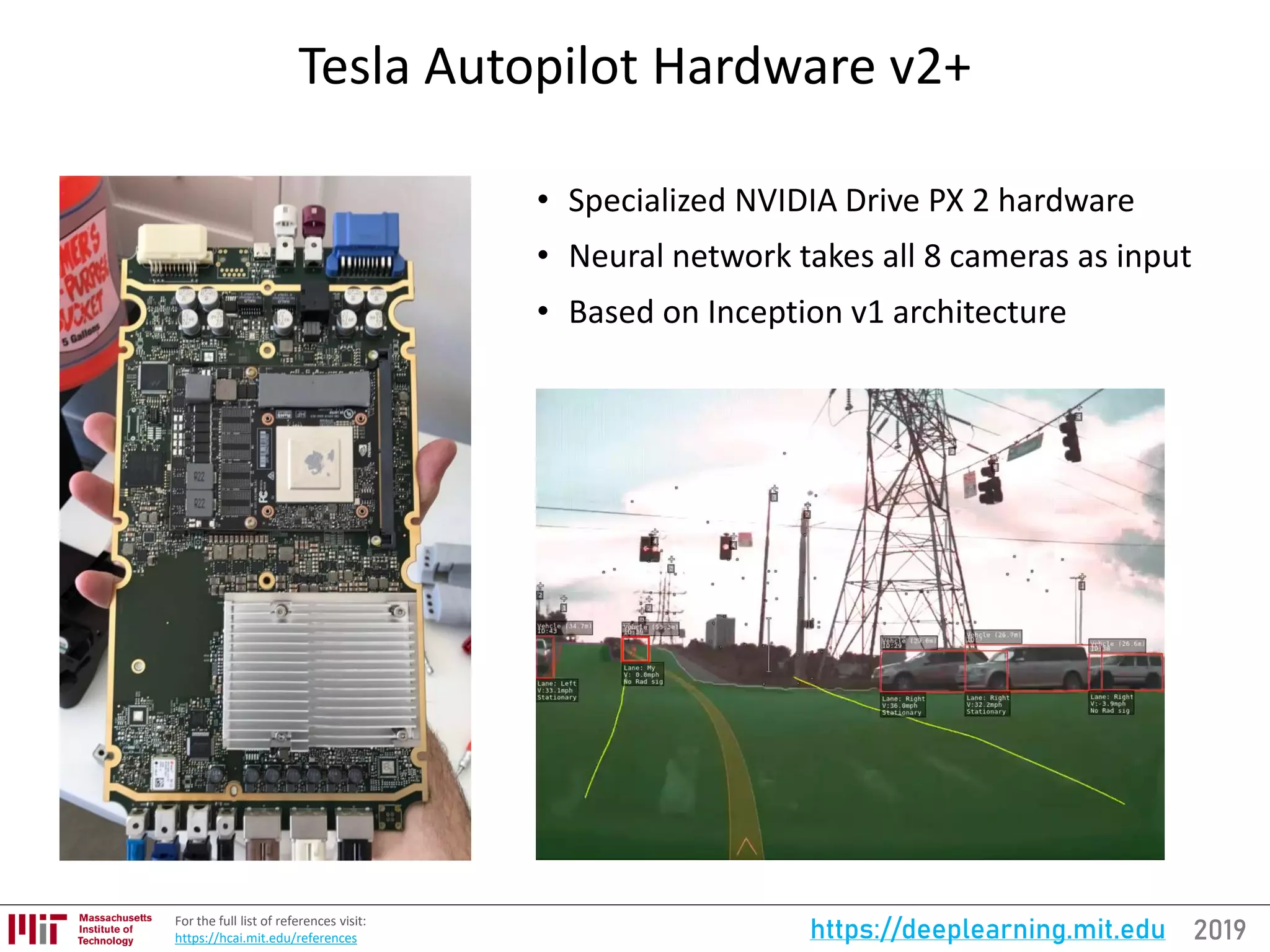
Tesla Autopilot Hardware v2+
• Specialized NVIDIA Drive PX 2 hardware
• Neural network takes all 8 cameras as input
• Based on Inception v1 architecture
2019https://deeplearning.mit.eduFor the full list of references visit:
https://hcai.mit.edu/references
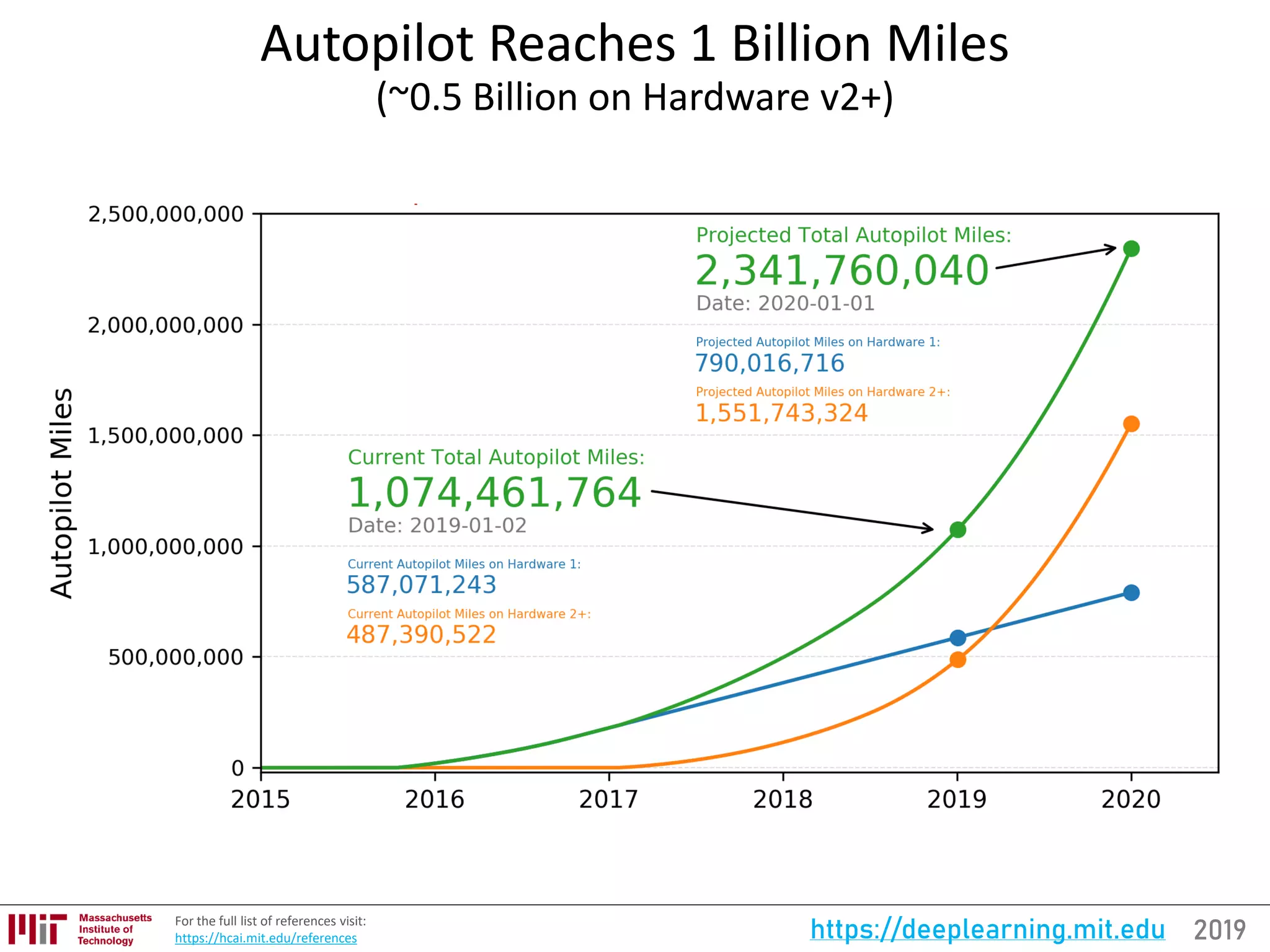
Autopilot Reaches 1 Billion Miles
(~0.5 Billion on Hardware v2+)
2019https://deeplearning.mit.eduFor the full list of references visit:
https://hcai.mit.edu/references
Deep Learning: State of the Art*
(Breakthrough Developments in 2017 & 2018)
• BERT and Natural Language Processing
• Tesla Autopilot Hardware v2+: Neural Networks at Scale
• AdaNet: AutoML with Ensembles
• AutoAugment: Deep RL Data Augmentation
• Training Deep Networks with Synthetic Data
• Segmentation Annotation with Polygon-RNN++
• DAWNBench: Training Fast and Cheap
• BigGAN: State of the Art in Image Synthesis
• Video-to-Video Synthesis
• Semantic Segmentation
• AlphaZero & OpenAI Five
• Deep Learning Frameworks
* This is not a list of state-of-the-art results on main machine learning benchmark datasets. It’s an
overview of exciting recent developments.
2019https://deeplearning.mit.eduFor the full updated list of references visit:
https://selfdrivingcars.mit.edu/references
AutoML and Neural Architecture Search (NASNet)
[300, 301]
2019https://deeplearning.mit.eduFor the full list of references visit:
https://hcai.mit.edu/references
AdaNet
[317]
2019https://deeplearning.mit.eduFor the full list of references visit:
https://hcai.mit.edu/references
Deep Learning: State of the Art*
(Breakthrough Developments in 2017 & 2018)
• BERT and Natural Language Processing
• Tesla Autopilot Hardware v2+: Neural Networks at Scale
• AdaNet: AutoML with Ensembles
• AutoAugment: Deep RL Data Augmentation
• Training Deep Networks with Synthetic Data
• Segmentation Annotation with Polygon-RNN++
• DAWNBench: Training Fast and Cheap
• BigGAN: State of the Art in Image Synthesis
• Video-to-Video Synthesis
• Semantic Segmentation
• AlphaZero & OpenAI Five
• Deep Learning Frameworks
* This is not a list of state-of-the-art results on main machine learning benchmark datasets. It’s an
overview of exciting recent developments.
2019https://deeplearning.mit.eduFor the full list of references visit:
https://hcai.mit.edu/references
AutoAugment: RL for Data Augmentation
[318]
• Show that transfer learning can also be done augmentation
policies instead of weights (or with).
2019https://deeplearning.mit.eduFor the full list of references visit:
https://hcai.mit.edu/references
Deep Learning: State of the Art*
(Breakthrough Developments in 2017 & 2018)
• BERT and Natural Language Processing
• Tesla Autopilot Hardware v2+: Neural Networks at Scale
• AdaNet: AutoML with Ensembles
• AutoAugment: Deep RL Data Augmentation
• Training Deep Networks with Synthetic Data
• Segmentation Annotation with Polygon-RNN++
• DAWNBench: Training Fast and Cheap
• BigGAN: State of the Art in Image Synthesis
• Video-to-Video Synthesis
• Semantic Segmentation
• AlphaZero & OpenAI Five
• Deep Learning Frameworks
* This is not a list of state-of-the-art results on main machine learning benchmark datasets. It’s an
overview of exciting recent developments.
2019https://deeplearning.mit.eduFor the full list of references visit:
https://hcai.mit.edu/references
Training on Randomized Synthetic Data
[319]
• number and types of objects
• number, types, colors, and scales of distractors
• texture on the object of interest, and background photograph
• location of the virtual camera with respect to the scene
• angle of the camera with respect to the scene
• number and locations of point lights
Tremblay, Jonathan, et al. "Training deep networks with synthetic data:
Bridging the reality gap by domain randomization." (2018).
2019https://deeplearning.mit.eduFor the full list of references visit:
https://hcai.mit.edu/references
Deep Learning: State of the Art*
(Breakthrough Developments in 2017 & 2018)
• BERT and Natural Language Processing
• Tesla Autopilot Hardware v2+: Neural Networks at Scale
• AdaNet: AutoML with Ensembles
• AutoAugment: Deep RL Data Augmentation
• Training Deep Networks with Synthetic Data
• Segmentation Annotation with Polygon-RNN++
• DAWNBench: Training Fast and Cheap
• BigGAN: State of the Art in Image Synthesis
• Video-to-Video Synthesis
• Semantic Segmentation
• AlphaZero & OpenAI Five
• Deep Learning Frameworks
* This is not a list of state-of-the-art results on main machine learning benchmark datasets. It’s an
overview of exciting recent developments.
2019https://deeplearning.mit.eduFor the full list of references visit:
https://hcai.mit.edu/references
Segmentation Annotation with Polygon-RNN++
• High-resolution polygon
segmentation generation
with human-in-the-loop
[319]
Acuna, David, et al. "Efficient Interactive Annotation of
Segmentation Datasets With Polygon-RNN++." CVPR 2018.
2019https://deeplearning.mit.eduFor the full list of references visit:
https://hcai.mit.edu/references
Deep Learning: State of the Art*
(Breakthrough Developments in 2017 & 2018)
• BERT and Natural Language Processing
• Tesla Autopilot Hardware v2+: Neural Networks at Scale
• AdaNet: AutoML with Ensembles
• AutoAugment: Deep RL Data Augmentation
• Training Deep Networks with Synthetic Data
• Segmentation Annotation with Polygon-RNN++
• DAWNBench: Training Fast and Cheap
• BigGAN: State of the Art in Image Synthesis
• Video-to-Video Synthesis
• Semantic Segmentation
• AlphaZero & OpenAI Five
• Deep Learning Frameworks
* This is not a list of state-of-the-art results on main machine learning benchmark datasets. It’s an
overview of exciting recent developments.
2019https://deeplearning.mit.eduFor the full list of references visit:
https://hcai.mit.edu/references
DAWNBench: Training Fast and Cheap
DAWNBench:
• Competition on speed and cost of
training and inference that achieves
93% for ImageNet and 94% for CIFAR
10
fast.ai – Training:
• ImageNet in 3 hours for $25
• CIFAR10 for $0.26
• Key idea: During training, if you very
slowly increase learning rate while
decreasing momentum, you can
train at extremely high learning
rates, thus avoiding over-fitting, and
training in far fewer epochs.
• Details: http://bit.ly/2H6yv6H
[320]
2019https://deeplearning.mit.eduFor the full list of references visit:
https://hcai.mit.edu/references
Deep Learning: State of the Art*
(Breakthrough Developments in 2017 & 2018)
• BERT and Natural Language Processing
• Tesla Autopilot Hardware v2+: Neural Networks at Scale
• AdaNet: AutoML with Ensembles
• AutoAugment: Deep RL Data Augmentation
• Training Deep Networks with Synthetic Data
• Segmentation Annotation with Polygon-RNN++
• DAWNBench: Training Fast and Cheap
• BigGAN: State of the Art in Image Synthesis
• Video-to-Video Synthesis
• Semantic Segmentation
• AlphaZero & OpenAI Five
• Deep Learning Frameworks
* This is not a list of state-of-the-art results on main machine learning benchmark datasets. It’s an
overview of exciting recent developments.
2019https://deeplearning.mit.eduFor the full list of references visit:
https://hcai.mit.edu/references
BigGAN: State of the Art in Image Synthesis
• Same GAN techniques, much larger scale
• Increase model capacity + increase batch size
[321]
Brock, Andrew, Jeff Donahue, and Karen Simonyan. "Large scale gan
training for high fidelity natural image synthesis." (2018).
2019https://deeplearning.mit.eduFor the full list of references visit:
https://hcai.mit.edu/references
Deep Learning: State of the Art*
(Breakthrough Developments in 2017 & 2018)
• BERT and Natural Language Processing
• Tesla Autopilot Hardware v2+: Neural Networks at Scale
• AdaNet: AutoML with Ensembles
• AutoAugment: Deep RL Data Augmentation
• Training Deep Networks with Synthetic Data
• Segmentation Annotation with Polygon-RNN++
• DAWNBench: Training Fast and Cheap
• BigGAN: State of the Art in Image Synthesis
• Video-to-Video Synthesis
• Semantic Segmentation
• AlphaZero & OpenAI Five
• Deep Learning Frameworks
* This is not a list of state-of-the-art results on main machine learning benchmark datasets. It’s an
overview of exciting recent developments.
2019https://deeplearning.mit.eduFor the full list of references visit:
https://hcai.mit.edu/references
Video-to-Video Synthesis
• Model temporal dynamics by adding a spatio-temporal
adversarial objective to the GAN framework
[322]
Wang, Ting-Chun, et al. "Video-to-video synthesis." (2018).
2019https://deeplearning.mit.eduFor the full list of references visit:
https://hcai.mit.edu/references
Video-to-Video Synthesis
• Model temporal dynamics by adding a spatio-temporal
adversarial objective to the GAN framework
[322]
Wang, Ting-Chun, et al. "Video-to-video synthesis." (2018).
2019https://deeplearning.mit.eduFor the full list of references visit:
https://hcai.mit.edu/references
Video-to-Video Synthesis
• Model temporal dynamics by adding a spatio-temporal
adversarial objective to the GAN framework
[322]
Wang, Ting-Chun, et al. "Video-to-video synthesis." (2018).
2019https://deeplearning.mit.eduFor the full list of references visit:
https://hcai.mit.edu/references
Deep Learning: State of the Art*
(Breakthrough Developments in 2017 & 2018)
• BERT and Natural Language Processing
• Tesla Autopilot Hardware v2+: Neural Networks at Scale
• AdaNet: AutoML with Ensembles
• AutoAugment: Deep RL Data Augmentation
• Training Deep Networks with Synthetic Data
• Segmentation Annotation with Polygon-RNN++
• DAWNBench: Training Fast and Cheap
• BigGAN: State of the Art in Image Synthesis
• Video-to-Video Synthesis
• Semantic Segmentation
• AlphaZero & OpenAI Five
• Deep Learning Frameworks
* This is not a list of state-of-the-art results on main machine learning benchmark datasets. It’s an
overview of exciting recent developments.
2019https://deeplearning.mit.edu
• AlexNet (2012): First CNN (15.4%)
• 8 layers
• 61 million parameters
• ZFNet (2013): 15.4% to 11.2%
• 8 layers
• More filters. Denser stride.
• VGGNet (2014): 11.2% to 7.3%
• Beautifully uniform:
3x3 conv, stride 1, pad 1, 2x2 max pool
• 16 layers
• 138 million parameters
• GoogLeNet (2014): 11.2% to 6.7%
• Inception modules
• 22 layers
• 5 million parameters
(throw away fully connected layers)
• ResNet (2015): 6.7% to 3.57%
• More layers = better performance
• 152 layers
• CUImage (2016): 3.57% to 2.99%
• Ensemble of 6 models
• SENet (2017): 2.99% to 2.251%
• Squeeze and excitation block: network
is allowed to adaptively adjust the
weighting of each feature map in the
convolutional block.
References: [90]
Human error (5.1%)
surpassed in 2015
2019https://deeplearning.mit.eduFor the full list of references visit:
https://hcai.mit.edu/references
Object Detection / Localization
Region-Based Methods | Shown: Faster R-CNN
[299]
2019https://deeplearning.mit.eduFor the full list of references visit:
https://hcai.mit.edu/references
Object Detection / Localization
Single-Shot Methods | Shown: SSD
[299]
2019https://deeplearning.mit.eduFor the full list of references visit:
https://hcai.mit.edu/references
Object Detection: State of the Art Progress
[326]
2019https://deeplearning.mit.eduFor the full list of references visit:
https://hcai.mit.edu/references
Semantic Segmentation
[175]
2019https://deeplearning.mit.eduFor the full list of references visit:
https://hcai.mit.edu/references
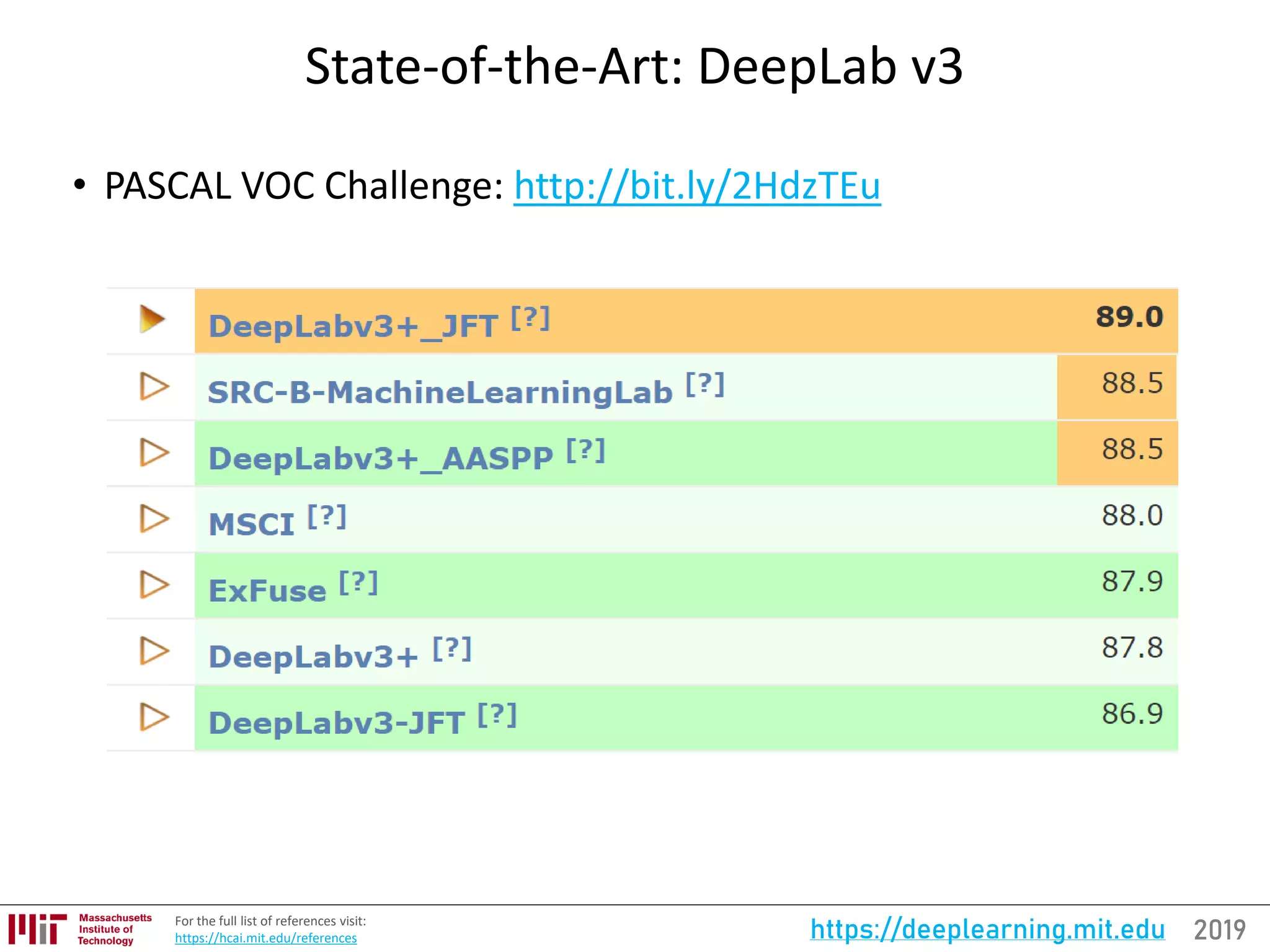
State-of-the-Art: DeepLab v3
• PASCAL VOC Challenge: http://bit.ly/2HdzTEu
2019https://deeplearning.mit.eduFor the full updated list of references visit:
https://selfdrivingcars.mit.edu/references
FCN (Nov 2014)
Paper: “Fully Convolutional Networks for Semantic Segmentation”
• Repurpose Imagenet pretrained nets
• Upsample using deconvolution
• Skip connections to improve coarseness of upsampling
[173]
2019https://deeplearning.mit.eduFor the full updated list of references visit:
https://selfdrivingcars.mit.edu/references
SegNet (Nov 2015)
Paper: “SegNet: A Deep Convolutional Encoder-Decoder Architecture for Image Segmentation”
• Maxpooling indices transferred to decoder to improve the
segmentation resolution.
[175]
2019https://deeplearning.mit.eduFor the full updated list of references visit:
https://selfdrivingcars.mit.edu/references
Dilated Convolutions (Nov 2015)
Paper: “Multi-Scale Context Aggregation by Dilated Convolutions”
• Since pooling decreases resolution:
• Added “dilated convolution layer”
• Still interpolate up from 1/8 of original image size
[175]
2019https://deeplearning.mit.eduFor the full updated list of references visit:
https://selfdrivingcars.mit.edu/references
DeepLab v1, v2 (Jun 2016)
Paper: “DeepLab: Semantic Image Segmentation with Deep Convolutional Nets, Atrous Convolution, and
Fully Connected CRFs”
• Added fully-connected Conditional Random Fields (CRFs) – as a
post-processing step
• Smooth segmentation based on the underlying image intensities
[179]
2019https://deeplearning.mit.eduFor the full updated list of references visit:
https://selfdrivingcars.mit.edu/references
Key Aspects of Segmentation
• Fully convolutional networks (FCNs) - replace fully-connected
layers with convolutional layers. Classification network is where
the biggest gains come from.
• Deeper, updated models (ResNet, etc) consistent with ImageNet
Challenge object classification tasks.
• Conditional Random Fields (CRFs) to capture both local and
long-range dependencies within an image to refine the
prediction map.
• Dilated convolution (aka Atrous convolution) – maintain
computational cost, increase resolution of intermediate feature
maps
• Process at multiple scales and combine the information
together
[174, 176]
2019https://deeplearning.mit.eduFor the full updated list of references visit:
https://selfdrivingcars.mit.edu/references
DeepLab v3
Paper: “Rethinking Atrous Convolution for Semantic Image Segmentation”
• Multi-scale processing, without increasing parameters.
• Increasing “atrous rate” enlarges the model’s “field-of-view”
[179]
2019https://deeplearning.mit.eduFor the full updated list of references visit:
https://selfdrivingcars.mit.edu/references
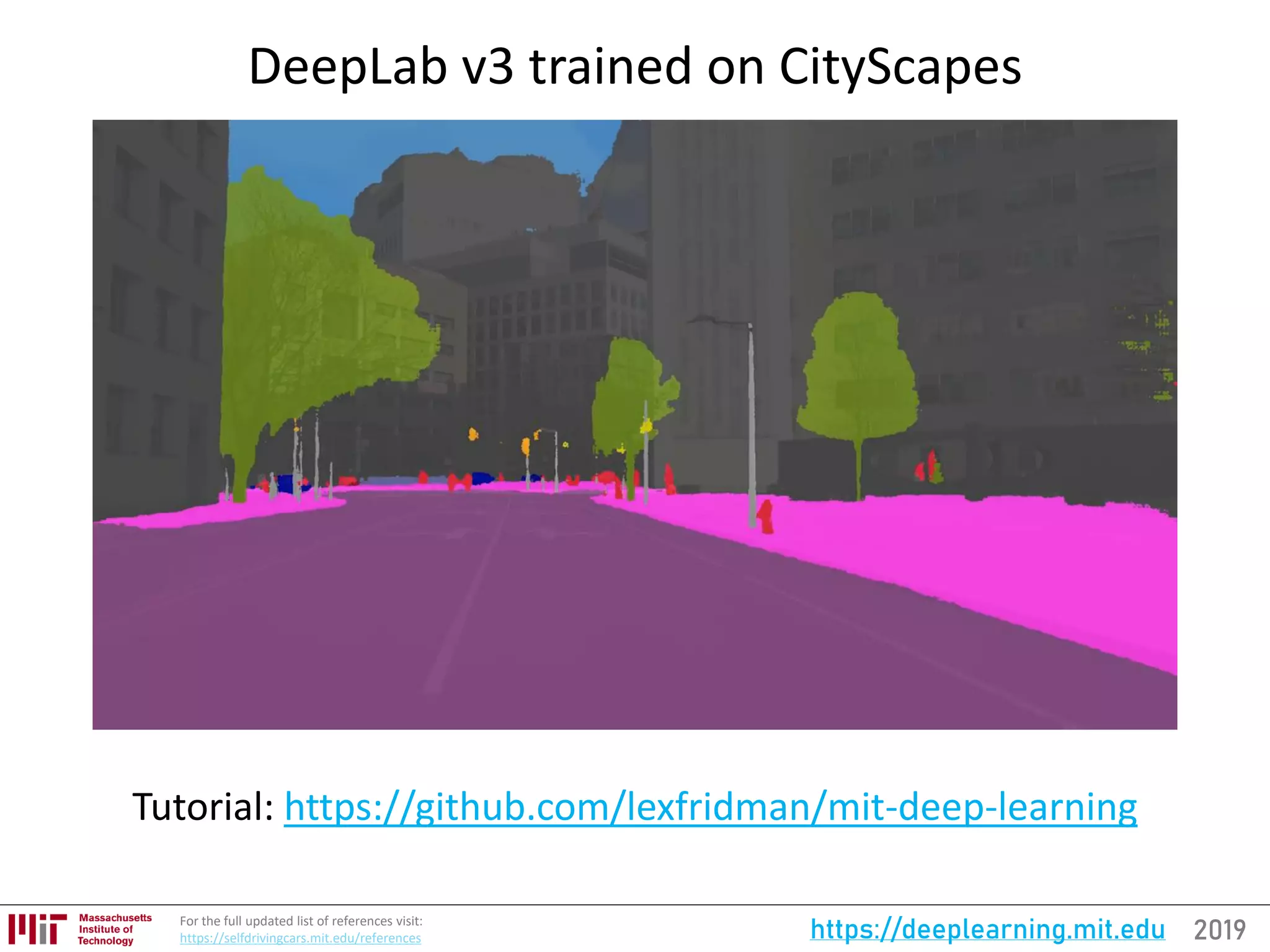
DeepLab v3 trained on CityScapes
Tutorial: https://github.com/lexfridman/mit-deep-learning
2019https://deeplearning.mit.eduFor the full list of references visit:
https://hcai.mit.edu/references
Deep Learning: State of the Art*
(Breakthrough Developments in 2017 & 2018)
• BERT and Natural Language Processing
• Tesla Autopilot Hardware v2+: Neural Networks at Scale
• AdaNet: AutoML with Ensembles
• AutoAugment: Deep RL Data Augmentation
• Training Deep Networks with Synthetic Data
• Segmentation Annotation with Polygon-RNN++
• DAWNBench: Training Fast and Cheap
• BigGAN: State of the Art in Image Synthesis
• Video-to-Video Synthesis
• Semantic Segmentation
• AlphaZero & OpenAI Five
• Deep Learning Frameworks
* This is not a list of state-of-the-art results on main machine learning benchmark datasets. It’s an
overview of exciting recent developments.
2019https://deeplearning.mit.eduFor the full updated list of references visit:
https://selfdrivingcars.mit.edu/references
Atari Breakout
[85]
After
120 Minutes
of Training
After
10 Minutes
of Training
After
240 Minutes
of Training
2019https://deeplearning.mit.eduFor the full updated list of references visit:
https://selfdrivingcars.mit.edu/references
DQN: Atari Games (2015)
[83]
2019https://deeplearning.mit.eduFor the full updated list of references visit:
https://selfdrivingcars.mit.edu/references
AlphaGo (2016): Beat Top Human at Go
[83]
2019https://deeplearning.mit.eduFor the full updated list of references visit:
https://selfdrivingcars.mit.edu/references
AlphaGo Zero (2017): Beats AlphaGo
[149]
2019https://deeplearning.mit.eduFor the full list of references visit:
https://hcai.mit.edu/references [324]
AlphaZero (Dec 2017) vs StockFish (Chess) & Elmo (Shogi)
2019https://deeplearning.mit.eduFor the full list of references visit:
https://hcai.mit.edu/references
OpenAI & Dota 2
• Dota 2 as a testbed for the messiness and continuous nature of
the real world: teamwork, long time horizons, and hidden
information.
[325]
2019https://deeplearning.mit.eduFor the full list of references visit:
https://hcai.mit.edu/references
OpenAI & Dota 2 Progress
• Aug, 2017: 1v1 bot beats top professional Dota 2 players.
• Aug, 2018: OpenAI Five lost two games against top Dota 2 players at The
International. “We are looking forward to pushing Five to the next level.”
[325]
2019https://deeplearning.mit.eduFor the full list of references visit:
https://hcai.mit.edu/references
Deep Learning: State of the Art*
(Breakthrough Developments in 2017 & 2018)
• BERT and Natural Language Processing
• Tesla Autopilot Hardware v2+: Neural Networks at Scale
• AdaNet: AutoML with Ensembles
• AutoAugment: Deep RL Data Augmentation
• Training Deep Networks with Synthetic Data
• Segmentation Annotation with Polygon-RNN++
• DAWNBench: Training Fast and Cheap
• BigGAN: State of the Art in Image Synthesis
• Video-to-Video Synthesis
• Semantic Segmentation
• AlphaZero & OpenAI Five
• Deep Learning Frameworks
* This is not a list of state-of-the-art results on main machine learning benchmark datasets. It’s an
overview of exciting recent developments.
2019https://deeplearning.mit.eduFor the full list of references visit:
https://hcai.mit.edu/references
Deep Learning Frameworks
[327]
Deep Learning Framework
Power Scores (by Jeff Hale)
http://bit.ly/2GBa3tU
1.
2.
3.
4.
5.
6.
7.
8.
9.
10.
11.
Factors to consider:
• Learning curve
• Speed of development
• Size and passion of community
• Number of papers implemented in framework
• Likelihood of long-term growth and stability
• Ecosystem of tooling
2019https://deeplearning.mit.eduFor the full list of references visit:
https://hcai.mit.edu/references
Deep Learning: 2019 and Beyond
• On backpropagation:
“My view is throw it all
away and start again.”
• “The future depends on
some graduate student
who is deeply suspicious
of everything I have said.”
- Geoffrey Hinton
“Godfather of Deep Learning”
[328]
2019https://deeplearning.mit.eduFor the full list of references visit:
https://hcai.mit.edu/references
Thank You
Website:
deeplearning.mit.edu
• Videos and slides posted on the website
• Code posted on GitHub:
https://github.com/lexfridman/mit-deep-learning

Deep Learning State of the Art (2019) - MIT by Lex Fridman

  • 1.
  • 2.
    2019https://deeplearning.mit.eduFor the fulllist of references visit: https://hcai.mit.edu/references Deep Learning: State of the Art* (Breakthrough Developments in 2017 & 2018) • BERT and Natural Language Processing • Tesla Autopilot Hardware v2+: Neural Networks at Scale • AdaNet: AutoML with Ensembles • AutoAugment: Deep RL Data Augmentation • Training Deep Networks with Synthetic Data • Segmentation Annotation with Polygon-RNN++ • DAWNBench: Training Fast and Cheap • BigGAN: State of the Art in Image Synthesis • Video-to-Video Synthesis • Semantic Segmentation • AlphaZero & OpenAI Five • Deep Learning Frameworks * This is not a list of state-of-the-art results on main machine learning benchmark datasets. It’s an overview of exciting recent developments.
  • 3.
    2019https://deeplearning.mit.eduFor the fulllist of references visit: https://hcai.mit.edu/references Encoder-Decoder Architecture Sequence-to-Sequence Model - Neural Machine Translation [295] Encoder RNN encodes input sequence into a fixed size vector, and then is passed repeatedly to decoder RNN.
  • 4.
    2019https://deeplearning.mit.eduFor the fulllist of references visit: https://hcai.mit.edu/references Attention [296] Attention mechanism allows the network to refer back to the input sequence, instead of forcing it to encode all information into one fixed-length vector.
  • 5.
    2019https://deeplearning.mit.eduFor the fulllist of references visit: https://hcai.mit.edu/references Attention [312]
  • 6.
    2019https://deeplearning.mit.eduFor the fulllist of references visit: https://hcai.mit.edu/references Attention [312]
  • 7.
    2019https://deeplearning.mit.eduFor the fulllist of references visit: https://hcai.mit.edu/references Self-Attention [312] "The animal didn't cross the street because it was too tired" More details: http://jalammar.github.io/illustrated-transformer/
  • 8.
    2019https://deeplearning.mit.eduFor the fulllist of references visit: https://hcai.mit.edu/references Transformer [312] Vaswani, Ashish, et al. "Attention is all you need." Advances in Neural Information Processing Systems. 2017.
  • 9.
    2019https://deeplearning.mit.eduFor the fullupdated list of references visit: https://selfdrivingcars.mit.edu/references Word Embeddings (Word2Vec) [297] Word Vector Skip Gram Model:
  • 10.
    2019https://deeplearning.mit.eduFor the fulllist of references visit: https://hcai.mit.edu/references Context-Aware Embeddings [312]
  • 11.
    2019https://deeplearning.mit.eduFor the fulllist of references visit: https://hcai.mit.edu/references OpenAI Transformer 1. Pre-train a Transformer’s decoder for language modeling 2. Train it on, for example, a sentence classification task [312] 1 2
  • 12.
    2019https://deeplearning.mit.eduFor the fulllist of references visit: https://hcai.mit.edu/references BERT Devlin, Jacob, et al. "Bert: Pre-training of deep bidirectional transformers for language understanding." (2018).
  • 13.
    2019https://deeplearning.mit.eduFor the fulllist of references visit: https://hcai.mit.edu/references BERT Applications Now you can use BERT: • Create contextualized word embeddings (like ELMo) • Sentence classification • Sentence pair classification • Sentence pair similarity • Multiple choice • Sentence tagging • Question answering
  • 14.
    2019https://deeplearning.mit.eduFor the fulllist of references visit: https://hcai.mit.edu/references Deep Learning: State of the Art* (Breakthrough Developments in 2017 & 2018) • BERT and Natural Language Processing • Tesla Autopilot Hardware v2+: Neural Networks at Scale • AdaNet: AutoML with Ensembles • AutoAugment: Deep RL Data Augmentation • Training Deep Networks with Synthetic Data • Segmentation Annotation with Polygon-RNN++ • DAWNBench: Training Fast and Cheap • BigGAN: State of the Art in Image Synthesis • Video-to-Video Synthesis • Semantic Segmentation • AlphaZero & OpenAI Five • Deep Learning Frameworks * This is not a list of state-of-the-art results on main machine learning benchmark datasets. It’s an overview of exciting recent developments.
  • 15.
    2019https://deeplearning.mit.eduFor the fulllist of references visit: https://hcai.mit.edu/references Tesla Autopilot Hardware v2+ • Specialized NVIDIA Drive PX 2 hardware • Neural network takes all 8 cameras as input • Based on Inception v1 architecture
  • 16.
    2019https://deeplearning.mit.eduFor the fulllist of references visit: https://hcai.mit.edu/references Autopilot Reaches 1 Billion Miles (~0.5 Billion on Hardware v2+)
  • 17.
    2019https://deeplearning.mit.eduFor the fulllist of references visit: https://hcai.mit.edu/references Deep Learning: State of the Art* (Breakthrough Developments in 2017 & 2018) • BERT and Natural Language Processing • Tesla Autopilot Hardware v2+: Neural Networks at Scale • AdaNet: AutoML with Ensembles • AutoAugment: Deep RL Data Augmentation • Training Deep Networks with Synthetic Data • Segmentation Annotation with Polygon-RNN++ • DAWNBench: Training Fast and Cheap • BigGAN: State of the Art in Image Synthesis • Video-to-Video Synthesis • Semantic Segmentation • AlphaZero & OpenAI Five • Deep Learning Frameworks * This is not a list of state-of-the-art results on main machine learning benchmark datasets. It’s an overview of exciting recent developments.
  • 18.
    2019https://deeplearning.mit.eduFor the fullupdated list of references visit: https://selfdrivingcars.mit.edu/references AutoML and Neural Architecture Search (NASNet) [300, 301]
  • 19.
    2019https://deeplearning.mit.eduFor the fulllist of references visit: https://hcai.mit.edu/references AdaNet [317]
  • 20.
    2019https://deeplearning.mit.eduFor the fulllist of references visit: https://hcai.mit.edu/references Deep Learning: State of the Art* (Breakthrough Developments in 2017 & 2018) • BERT and Natural Language Processing • Tesla Autopilot Hardware v2+: Neural Networks at Scale • AdaNet: AutoML with Ensembles • AutoAugment: Deep RL Data Augmentation • Training Deep Networks with Synthetic Data • Segmentation Annotation with Polygon-RNN++ • DAWNBench: Training Fast and Cheap • BigGAN: State of the Art in Image Synthesis • Video-to-Video Synthesis • Semantic Segmentation • AlphaZero & OpenAI Five • Deep Learning Frameworks * This is not a list of state-of-the-art results on main machine learning benchmark datasets. It’s an overview of exciting recent developments.
  • 21.
    2019https://deeplearning.mit.eduFor the fulllist of references visit: https://hcai.mit.edu/references AutoAugment: RL for Data Augmentation [318] • Show that transfer learning can also be done augmentation policies instead of weights (or with).
  • 22.
    2019https://deeplearning.mit.eduFor the fulllist of references visit: https://hcai.mit.edu/references Deep Learning: State of the Art* (Breakthrough Developments in 2017 & 2018) • BERT and Natural Language Processing • Tesla Autopilot Hardware v2+: Neural Networks at Scale • AdaNet: AutoML with Ensembles • AutoAugment: Deep RL Data Augmentation • Training Deep Networks with Synthetic Data • Segmentation Annotation with Polygon-RNN++ • DAWNBench: Training Fast and Cheap • BigGAN: State of the Art in Image Synthesis • Video-to-Video Synthesis • Semantic Segmentation • AlphaZero & OpenAI Five • Deep Learning Frameworks * This is not a list of state-of-the-art results on main machine learning benchmark datasets. It’s an overview of exciting recent developments.
  • 23.
    2019https://deeplearning.mit.eduFor the fulllist of references visit: https://hcai.mit.edu/references Training on Randomized Synthetic Data [319] • number and types of objects • number, types, colors, and scales of distractors • texture on the object of interest, and background photograph • location of the virtual camera with respect to the scene • angle of the camera with respect to the scene • number and locations of point lights Tremblay, Jonathan, et al. "Training deep networks with synthetic data: Bridging the reality gap by domain randomization." (2018).
  • 24.
    2019https://deeplearning.mit.eduFor the fulllist of references visit: https://hcai.mit.edu/references Deep Learning: State of the Art* (Breakthrough Developments in 2017 & 2018) • BERT and Natural Language Processing • Tesla Autopilot Hardware v2+: Neural Networks at Scale • AdaNet: AutoML with Ensembles • AutoAugment: Deep RL Data Augmentation • Training Deep Networks with Synthetic Data • Segmentation Annotation with Polygon-RNN++ • DAWNBench: Training Fast and Cheap • BigGAN: State of the Art in Image Synthesis • Video-to-Video Synthesis • Semantic Segmentation • AlphaZero & OpenAI Five • Deep Learning Frameworks * This is not a list of state-of-the-art results on main machine learning benchmark datasets. It’s an overview of exciting recent developments.
  • 25.
    2019https://deeplearning.mit.eduFor the fulllist of references visit: https://hcai.mit.edu/references Segmentation Annotation with Polygon-RNN++ • High-resolution polygon segmentation generation with human-in-the-loop [319] Acuna, David, et al. "Efficient Interactive Annotation of Segmentation Datasets With Polygon-RNN++." CVPR 2018.
  • 26.
    2019https://deeplearning.mit.eduFor the fulllist of references visit: https://hcai.mit.edu/references Deep Learning: State of the Art* (Breakthrough Developments in 2017 & 2018) • BERT and Natural Language Processing • Tesla Autopilot Hardware v2+: Neural Networks at Scale • AdaNet: AutoML with Ensembles • AutoAugment: Deep RL Data Augmentation • Training Deep Networks with Synthetic Data • Segmentation Annotation with Polygon-RNN++ • DAWNBench: Training Fast and Cheap • BigGAN: State of the Art in Image Synthesis • Video-to-Video Synthesis • Semantic Segmentation • AlphaZero & OpenAI Five • Deep Learning Frameworks * This is not a list of state-of-the-art results on main machine learning benchmark datasets. It’s an overview of exciting recent developments.
  • 27.
    2019https://deeplearning.mit.eduFor the fulllist of references visit: https://hcai.mit.edu/references DAWNBench: Training Fast and Cheap DAWNBench: • Competition on speed and cost of training and inference that achieves 93% for ImageNet and 94% for CIFAR 10 fast.ai – Training: • ImageNet in 3 hours for $25 • CIFAR10 for $0.26 • Key idea: During training, if you very slowly increase learning rate while decreasing momentum, you can train at extremely high learning rates, thus avoiding over-fitting, and training in far fewer epochs. • Details: http://bit.ly/2H6yv6H [320]
  • 28.
    2019https://deeplearning.mit.eduFor the fulllist of references visit: https://hcai.mit.edu/references Deep Learning: State of the Art* (Breakthrough Developments in 2017 & 2018) • BERT and Natural Language Processing • Tesla Autopilot Hardware v2+: Neural Networks at Scale • AdaNet: AutoML with Ensembles • AutoAugment: Deep RL Data Augmentation • Training Deep Networks with Synthetic Data • Segmentation Annotation with Polygon-RNN++ • DAWNBench: Training Fast and Cheap • BigGAN: State of the Art in Image Synthesis • Video-to-Video Synthesis • Semantic Segmentation • AlphaZero & OpenAI Five • Deep Learning Frameworks * This is not a list of state-of-the-art results on main machine learning benchmark datasets. It’s an overview of exciting recent developments.
  • 29.
    2019https://deeplearning.mit.eduFor the fulllist of references visit: https://hcai.mit.edu/references BigGAN: State of the Art in Image Synthesis • Same GAN techniques, much larger scale • Increase model capacity + increase batch size [321] Brock, Andrew, Jeff Donahue, and Karen Simonyan. "Large scale gan training for high fidelity natural image synthesis." (2018).
  • 30.
    2019https://deeplearning.mit.eduFor the fulllist of references visit: https://hcai.mit.edu/references Deep Learning: State of the Art* (Breakthrough Developments in 2017 & 2018) • BERT and Natural Language Processing • Tesla Autopilot Hardware v2+: Neural Networks at Scale • AdaNet: AutoML with Ensembles • AutoAugment: Deep RL Data Augmentation • Training Deep Networks with Synthetic Data • Segmentation Annotation with Polygon-RNN++ • DAWNBench: Training Fast and Cheap • BigGAN: State of the Art in Image Synthesis • Video-to-Video Synthesis • Semantic Segmentation • AlphaZero & OpenAI Five • Deep Learning Frameworks * This is not a list of state-of-the-art results on main machine learning benchmark datasets. It’s an overview of exciting recent developments.
  • 31.
    2019https://deeplearning.mit.eduFor the fulllist of references visit: https://hcai.mit.edu/references Video-to-Video Synthesis • Model temporal dynamics by adding a spatio-temporal adversarial objective to the GAN framework [322] Wang, Ting-Chun, et al. "Video-to-video synthesis." (2018).
  • 32.
    2019https://deeplearning.mit.eduFor the fulllist of references visit: https://hcai.mit.edu/references Video-to-Video Synthesis • Model temporal dynamics by adding a spatio-temporal adversarial objective to the GAN framework [322] Wang, Ting-Chun, et al. "Video-to-video synthesis." (2018).
  • 33.
    2019https://deeplearning.mit.eduFor the fulllist of references visit: https://hcai.mit.edu/references Video-to-Video Synthesis • Model temporal dynamics by adding a spatio-temporal adversarial objective to the GAN framework [322] Wang, Ting-Chun, et al. "Video-to-video synthesis." (2018).
  • 34.
    2019https://deeplearning.mit.eduFor the fulllist of references visit: https://hcai.mit.edu/references Deep Learning: State of the Art* (Breakthrough Developments in 2017 & 2018) • BERT and Natural Language Processing • Tesla Autopilot Hardware v2+: Neural Networks at Scale • AdaNet: AutoML with Ensembles • AutoAugment: Deep RL Data Augmentation • Training Deep Networks with Synthetic Data • Segmentation Annotation with Polygon-RNN++ • DAWNBench: Training Fast and Cheap • BigGAN: State of the Art in Image Synthesis • Video-to-Video Synthesis • Semantic Segmentation • AlphaZero & OpenAI Five • Deep Learning Frameworks * This is not a list of state-of-the-art results on main machine learning benchmark datasets. It’s an overview of exciting recent developments.
  • 35.
    2019https://deeplearning.mit.edu • AlexNet (2012):First CNN (15.4%) • 8 layers • 61 million parameters • ZFNet (2013): 15.4% to 11.2% • 8 layers • More filters. Denser stride. • VGGNet (2014): 11.2% to 7.3% • Beautifully uniform: 3x3 conv, stride 1, pad 1, 2x2 max pool • 16 layers • 138 million parameters • GoogLeNet (2014): 11.2% to 6.7% • Inception modules • 22 layers • 5 million parameters (throw away fully connected layers) • ResNet (2015): 6.7% to 3.57% • More layers = better performance • 152 layers • CUImage (2016): 3.57% to 2.99% • Ensemble of 6 models • SENet (2017): 2.99% to 2.251% • Squeeze and excitation block: network is allowed to adaptively adjust the weighting of each feature map in the convolutional block. References: [90] Human error (5.1%) surpassed in 2015
  • 36.
    2019https://deeplearning.mit.eduFor the fulllist of references visit: https://hcai.mit.edu/references Object Detection / Localization Region-Based Methods | Shown: Faster R-CNN [299]
  • 37.
    2019https://deeplearning.mit.eduFor the fulllist of references visit: https://hcai.mit.edu/references Object Detection / Localization Single-Shot Methods | Shown: SSD [299]
  • 38.
    2019https://deeplearning.mit.eduFor the fulllist of references visit: https://hcai.mit.edu/references Object Detection: State of the Art Progress [326]
  • 39.
    2019https://deeplearning.mit.eduFor the fulllist of references visit: https://hcai.mit.edu/references Semantic Segmentation [175]
  • 40.
    2019https://deeplearning.mit.eduFor the fulllist of references visit: https://hcai.mit.edu/references State-of-the-Art: DeepLab v3 • PASCAL VOC Challenge: http://bit.ly/2HdzTEu
  • 41.
    2019https://deeplearning.mit.eduFor the fullupdated list of references visit: https://selfdrivingcars.mit.edu/references FCN (Nov 2014) Paper: “Fully Convolutional Networks for Semantic Segmentation” • Repurpose Imagenet pretrained nets • Upsample using deconvolution • Skip connections to improve coarseness of upsampling [173]
  • 42.
    2019https://deeplearning.mit.eduFor the fullupdated list of references visit: https://selfdrivingcars.mit.edu/references SegNet (Nov 2015) Paper: “SegNet: A Deep Convolutional Encoder-Decoder Architecture for Image Segmentation” • Maxpooling indices transferred to decoder to improve the segmentation resolution. [175]
  • 43.
    2019https://deeplearning.mit.eduFor the fullupdated list of references visit: https://selfdrivingcars.mit.edu/references Dilated Convolutions (Nov 2015) Paper: “Multi-Scale Context Aggregation by Dilated Convolutions” • Since pooling decreases resolution: • Added “dilated convolution layer” • Still interpolate up from 1/8 of original image size [175]
  • 44.
    2019https://deeplearning.mit.eduFor the fullupdated list of references visit: https://selfdrivingcars.mit.edu/references DeepLab v1, v2 (Jun 2016) Paper: “DeepLab: Semantic Image Segmentation with Deep Convolutional Nets, Atrous Convolution, and Fully Connected CRFs” • Added fully-connected Conditional Random Fields (CRFs) – as a post-processing step • Smooth segmentation based on the underlying image intensities [179]
  • 45.
    2019https://deeplearning.mit.eduFor the fullupdated list of references visit: https://selfdrivingcars.mit.edu/references Key Aspects of Segmentation • Fully convolutional networks (FCNs) - replace fully-connected layers with convolutional layers. Classification network is where the biggest gains come from. • Deeper, updated models (ResNet, etc) consistent with ImageNet Challenge object classification tasks. • Conditional Random Fields (CRFs) to capture both local and long-range dependencies within an image to refine the prediction map. • Dilated convolution (aka Atrous convolution) – maintain computational cost, increase resolution of intermediate feature maps • Process at multiple scales and combine the information together [174, 176]
  • 46.
    2019https://deeplearning.mit.eduFor the fullupdated list of references visit: https://selfdrivingcars.mit.edu/references DeepLab v3 Paper: “Rethinking Atrous Convolution for Semantic Image Segmentation” • Multi-scale processing, without increasing parameters. • Increasing “atrous rate” enlarges the model’s “field-of-view” [179]
  • 47.
    2019https://deeplearning.mit.eduFor the fullupdated list of references visit: https://selfdrivingcars.mit.edu/references DeepLab v3 trained on CityScapes Tutorial: https://github.com/lexfridman/mit-deep-learning
  • 48.
    2019https://deeplearning.mit.eduFor the fulllist of references visit: https://hcai.mit.edu/references Deep Learning: State of the Art* (Breakthrough Developments in 2017 & 2018) • BERT and Natural Language Processing • Tesla Autopilot Hardware v2+: Neural Networks at Scale • AdaNet: AutoML with Ensembles • AutoAugment: Deep RL Data Augmentation • Training Deep Networks with Synthetic Data • Segmentation Annotation with Polygon-RNN++ • DAWNBench: Training Fast and Cheap • BigGAN: State of the Art in Image Synthesis • Video-to-Video Synthesis • Semantic Segmentation • AlphaZero & OpenAI Five • Deep Learning Frameworks * This is not a list of state-of-the-art results on main machine learning benchmark datasets. It’s an overview of exciting recent developments.
  • 49.
    2019https://deeplearning.mit.eduFor the fullupdated list of references visit: https://selfdrivingcars.mit.edu/references Atari Breakout [85] After 120 Minutes of Training After 10 Minutes of Training After 240 Minutes of Training
  • 50.
    2019https://deeplearning.mit.eduFor the fullupdated list of references visit: https://selfdrivingcars.mit.edu/references DQN: Atari Games (2015) [83]
  • 51.
    2019https://deeplearning.mit.eduFor the fullupdated list of references visit: https://selfdrivingcars.mit.edu/references AlphaGo (2016): Beat Top Human at Go [83]
  • 52.
    2019https://deeplearning.mit.eduFor the fullupdated list of references visit: https://selfdrivingcars.mit.edu/references AlphaGo Zero (2017): Beats AlphaGo [149]
  • 53.
    2019https://deeplearning.mit.eduFor the fulllist of references visit: https://hcai.mit.edu/references [324] AlphaZero (Dec 2017) vs StockFish (Chess) & Elmo (Shogi)
  • 54.
    2019https://deeplearning.mit.eduFor the fulllist of references visit: https://hcai.mit.edu/references OpenAI & Dota 2 • Dota 2 as a testbed for the messiness and continuous nature of the real world: teamwork, long time horizons, and hidden information. [325]
  • 55.
    2019https://deeplearning.mit.eduFor the fulllist of references visit: https://hcai.mit.edu/references OpenAI & Dota 2 Progress • Aug, 2017: 1v1 bot beats top professional Dota 2 players. • Aug, 2018: OpenAI Five lost two games against top Dota 2 players at The International. “We are looking forward to pushing Five to the next level.” [325]
  • 56.
    2019https://deeplearning.mit.eduFor the fulllist of references visit: https://hcai.mit.edu/references Deep Learning: State of the Art* (Breakthrough Developments in 2017 & 2018) • BERT and Natural Language Processing • Tesla Autopilot Hardware v2+: Neural Networks at Scale • AdaNet: AutoML with Ensembles • AutoAugment: Deep RL Data Augmentation • Training Deep Networks with Synthetic Data • Segmentation Annotation with Polygon-RNN++ • DAWNBench: Training Fast and Cheap • BigGAN: State of the Art in Image Synthesis • Video-to-Video Synthesis • Semantic Segmentation • AlphaZero & OpenAI Five • Deep Learning Frameworks * This is not a list of state-of-the-art results on main machine learning benchmark datasets. It’s an overview of exciting recent developments.
  • 57.
    2019https://deeplearning.mit.eduFor the fulllist of references visit: https://hcai.mit.edu/references Deep Learning Frameworks [327] Deep Learning Framework Power Scores (by Jeff Hale) http://bit.ly/2GBa3tU 1. 2. 3. 4. 5. 6. 7. 8. 9. 10. 11. Factors to consider: • Learning curve • Speed of development • Size and passion of community • Number of papers implemented in framework • Likelihood of long-term growth and stability • Ecosystem of tooling
  • 58.
    2019https://deeplearning.mit.eduFor the fulllist of references visit: https://hcai.mit.edu/references Deep Learning: 2019 and Beyond • On backpropagation: “My view is throw it all away and start again.” • “The future depends on some graduate student who is deeply suspicious of everything I have said.” - Geoffrey Hinton “Godfather of Deep Learning” [328]
  • 59.
    2019https://deeplearning.mit.eduFor the fulllist of references visit: https://hcai.mit.edu/references Thank You Website: deeplearning.mit.edu • Videos and slides posted on the website • Code posted on GitHub: https://github.com/lexfridman/mit-deep-learning