Copyright © 2017 MathWorks, Inc 1
How to Test and Validate an Automated
Driving System
Avinash Nehemiah
May 2017
Copyright © 2017 MathWorks, Inc 2
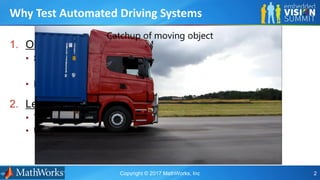
1. Obvious Reasons
• Safety critical software driving cars on public roads
• Human lives depend on this
• Integration of new sensors and software into existing vehicles
2. Less Obvious Reasons
• Test the interaction of automated driving with human drivers
• Understand the driving passenger experience
Why Test Automated Driving Systems
Copyright © 2017 MathWorks, Inc 3
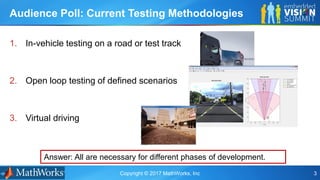
1. In-vehicle testing on a road or test track
2. Open loop testing of defined scenarios
3. Virtual driving
Audience Poll: Current Testing Methodologies
Answer: All are necessary for different phases of development.
Copyright © 2017 MathWorks, Inc 4
• Automated driving sub-systems
• Most common challenges faced testing automated driving
• Perception system testing
• Controls and system-level testing
• Summary
Talk Outline
How to Test and Validate an Automated Driving System
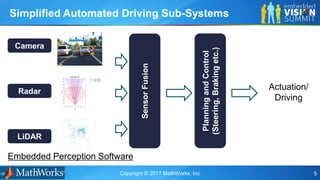
Copyright © 2017 MathWorks, Inc 5
Simplified Automated Driving Sub-Systems
Embedded Perception Software
SensorFusion
PlanningandControl
(Steering,Brakingetc.)
LiDAR
Camera
Radar
Actuation/
Driving
Copyright © 2017 MathWorks, Inc 6
• Automated driving sub-systems
• Challenges faced testing automated driving
• Perception system testing
• Controls and system-level testing
• Summary
Talk Outline
How to Test and Validate an Automated Driving System
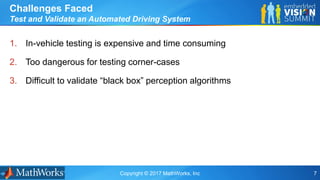
Copyright © 2017 MathWorks, Inc 7
1. In-vehicle testing is expensive and time consuming
2. Too dangerous for testing corner-cases
3. Difficult to validate “black box” perception algorithms
Challenges Faced
Test and Validate an Automated Driving System
Copyright © 2017 MathWorks, Inc 8
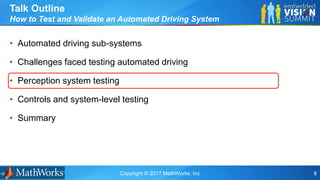
• Automated driving sub-systems
• Challenges faced testing automated driving
• Perception system testing
• Controls and system-level testing
• Summary
Talk Outline
How to Test and Validate an Automated Driving System
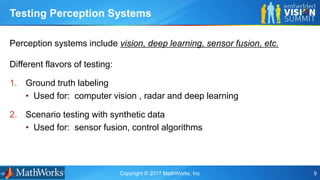
Copyright © 2017 MathWorks, Inc 9
Perception systems include vision, deep learning, sensor fusion, etc.
Testing Perception Systems
Different flavors of testing:
1. Ground truth labeling
• Used for: computer vision , radar and deep learning
2. Scenario testing with synthetic data
• Used for: sensor fusion, control algorithms
Copyright © 2017 MathWorks, Inc 10
How do auto companies verify changes to
perception algorithms ?
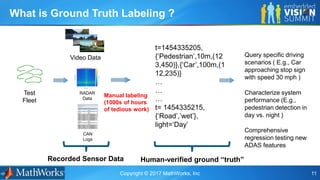
Copyright © 2017 MathWorks, Inc 11
Test
Fleet
Video Data
RADAR
Data
CAN
Logs
t=1454335205,
{‘Pedestrian’,10m,(12
3,450)},{‘Car’,100m,(1
12,235)}
…
…
…
t= 1454335215,
{‘Road’,’wet’},
light=‘Day’
What is Ground Truth Labeling ?
Query specific driving
scenarios ( E.g., Car
approaching stop sign
with speed 30 mph )
Characterize system
performance (E.g.,
pedestrian detection in
day vs. night )
Comprehensive
regression testing new
ADAS features
Recorded Sensor Data Human-verified ground “truth”
Manual labeling
(1000s of hours
of tedious work)
Copyright © 2017 MathWorks, Inc 12
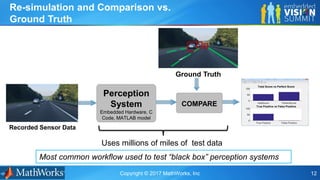
Re-simulation and Comparison vs.
Ground Truth
Recorded Sensor Data
Ground Truth
Perception
System
Embedded Hardware, C
Code, MATLAB model
COMPARE
Most common workflow used to test “black box” perception systems
Uses millions of miles of test data
Copyright © 2017 MathWorks, Inc 13
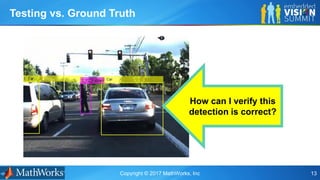
Testing vs. Ground Truth
How can I verify this
detection is correct?
Copyright © 2017 MathWorks, Inc 14
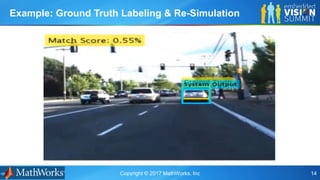
Example: Ground Truth Labeling & Re-Simulation
Copyright © 2017 MathWorks, Inc 15
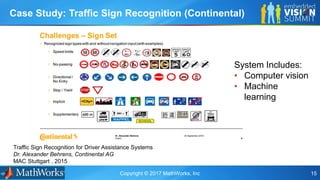
Case Study: Traffic Sign Recognition (Continental)
System Includes:
• Computer vision
• Machine
learning
Traffic Sign Recognition for Driver Assistance Systems
Dr. Alexander Behrens, Continental AG
MAC Stuttgart , 2015
Copyright © 2017 MathWorks, Inc 16
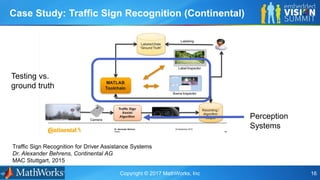
Case Study: Traffic Sign Recognition (Continental)
Traffic Sign Recognition for Driver Assistance Systems
Dr. Alexander Behrens, Continental AG
MAC Stuttgart, 2015
Testing vs.
ground truth
Perception
Systems
Copyright © 2017 MathWorks, Inc 17
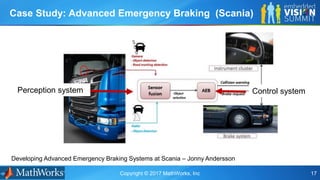
Case Study: Advanced Emergency Braking (Scania)
Developing Advanced Emergency Braking Systems at Scania – Jonny Andersson
Control systemPerception system
Copyright © 2017 MathWorks, Inc 18
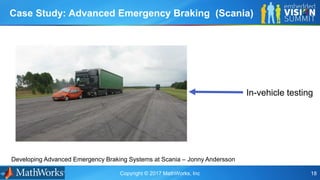
Case Study: Advanced Emergency Braking (Scania)
Developing Advanced Emergency Braking Systems at Scania – Jonny Andersson
In-vehicle testing
Copyright © 2017 MathWorks, Inc 19
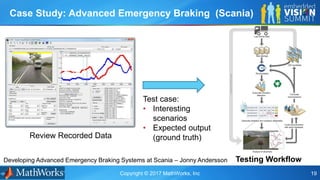
Case Study: Advanced Emergency Braking (Scania)
Developing Advanced Emergency Braking Systems at Scania – Jonny Andersson
Review Recorded Data
Testing Workflow
Test case:
• Interesting
scenarios
• Expected output
(ground truth)
Copyright © 2017 MathWorks, Inc 20
How would you test a dangerous driving situation ?
Copyright © 2017 MathWorks, Inc 21
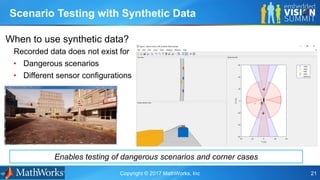
When to use synthetic data?
Recorded data does not exist for
• Dangerous scenarios
• Different sensor configurations
Enables testing of dangerous scenarios and corner cases
Scenario Testing with Synthetic Data
Copyright © 2017 MathWorks, Inc 22
How does my vision algorithm respond to changes
to acceleration and steering ?
Copyright © 2017 MathWorks, Inc 23
• Automated driving sub-systems
• Challenges faced testing automated driving
• Perception system testing
• Controls and system-level testing
• Summary
Talk Outline
How to Test and Validate an Automated Driving System
Copyright © 2017 MathWorks, Inc 24
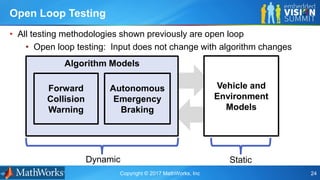
Algorithm Models
Vehicle and
Environment
Models
• All testing methodologies shown previously are open loop
• Open loop testing: Input does not change with algorithm changes
Open Loop Testing
Forward
Collision
Warning
Autonomous
Emergency
Braking
Dynamic Static
Copyright © 2017 MathWorks, Inc 25
• All testing methodologies shown previously are open loop
• Open loop testing: Input does not change with algorithm
changes
Testing Control Systems – What Else?
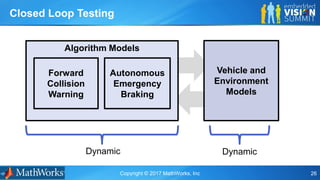
• Closed loop testing is required to test control systems
• Closed loop testing: Environment changes with
algorithm.
Copyright © 2017 MathWorks, Inc 26
Algorithm Models
Vehicle and
Environment
Models
Closed Loop Testing
Forward
Collision
Warning
Autonomous
Emergency
Braking
Dynamic Dynamic
Copyright © 2017 MathWorks, Inc 27
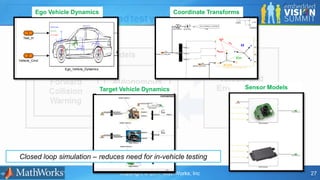
Ego Vehicle Dynamics
Target Vehicle Dynamics
Coordinate Transforms
Sensor Models
Closed loop simulation – reduces need for in-vehicle testing
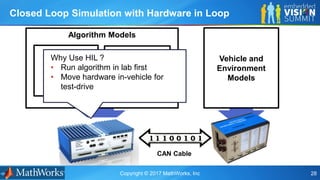
Copyright © 2017 MathWorks, Inc 28
Closed Loop Simulation with Hardware in Loop
Algorithm Models
Vehicle and
Environment
Models
Forward
Collision
Warning
Autonomous
Emergency
Braking
CAN Cable
Why Use HIL ?
• Run algorithm in lab first
• Move hardware in-vehicle for
test-drive
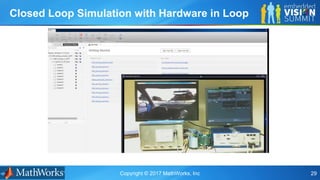
Copyright © 2017 MathWorks, Inc 29
Closed Loop Simulation with Hardware in Loop
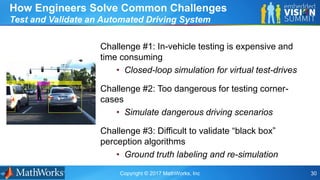
Copyright © 2017 MathWorks, Inc 30
Challenge #1: In-vehicle testing is expensive and
time consuming
• Closed-loop simulation for virtual test-drives
Challenge #2: Too dangerous for testing corner-
cases
• Simulate dangerous driving scenarios
Challenge #3: Difficult to validate “black box”
perception algorithms
• Ground truth labeling and re-simulation
How Engineers Solve Common Challenges
Test and Validate an Automated Driving System
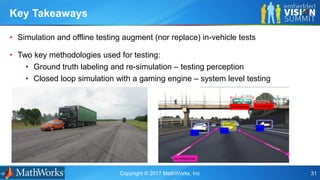
Copyright © 2017 MathWorks, Inc 31
• Simulation and offline testing augment (nor replace) in-vehicle tests
• Two key methodologies used for testing:
• Ground truth labeling and re-simulation – testing perception
• Closed loop simulation with a gaming engine – system level testing
Key Takeaways
Copyright © 2017 MathWorks, Inc 32
Automated Driving System Toolbox
Design, simulate, and test ADAS and autonomous driving systems
Resources
More Information (Links)
• Traffic Sign Recognition for Driver Assistance Systems, Dr. Alexander Behrens,
Continental AG, MAC Stuttgart , 2015
• Developing Advanced Emergency Braking Systems at Scania - Jonny Andersson
• Jayaraman, A., Micks, A., and Gross, E., "Creating 3D Virtual Driving Environments
for Simulation-Aided Development of Autonomous Driving and Active Safety," SAE
Technical Paper 2017-01-0107, 2017, doi:10.4271/2017-01-0107.

"How to Test and Validate an Automated Driving System," a Presentation from MathWorks

  • 1.
    Copyright © 2017MathWorks, Inc 1 How to Test and Validate an Automated Driving System Avinash Nehemiah May 2017
  • 2.
    Copyright © 2017MathWorks, Inc 2 1. Obvious Reasons • Safety critical software driving cars on public roads • Human lives depend on this • Integration of new sensors and software into existing vehicles 2. Less Obvious Reasons • Test the interaction of automated driving with human drivers • Understand the driving passenger experience Why Test Automated Driving Systems
  • 3.
    Copyright © 2017MathWorks, Inc 3 1. In-vehicle testing on a road or test track 2. Open loop testing of defined scenarios 3. Virtual driving Audience Poll: Current Testing Methodologies Answer: All are necessary for different phases of development.
  • 4.
    Copyright © 2017MathWorks, Inc 4 • Automated driving sub-systems • Most common challenges faced testing automated driving • Perception system testing • Controls and system-level testing • Summary Talk Outline How to Test and Validate an Automated Driving System
  • 5.
    Copyright © 2017MathWorks, Inc 5 Simplified Automated Driving Sub-Systems Embedded Perception Software SensorFusion PlanningandControl (Steering,Brakingetc.) LiDAR Camera Radar Actuation/ Driving
  • 6.
    Copyright © 2017MathWorks, Inc 6 • Automated driving sub-systems • Challenges faced testing automated driving • Perception system testing • Controls and system-level testing • Summary Talk Outline How to Test and Validate an Automated Driving System
  • 7.
    Copyright © 2017MathWorks, Inc 7 1. In-vehicle testing is expensive and time consuming 2. Too dangerous for testing corner-cases 3. Difficult to validate “black box” perception algorithms Challenges Faced Test and Validate an Automated Driving System
  • 8.
    Copyright © 2017MathWorks, Inc 8 • Automated driving sub-systems • Challenges faced testing automated driving • Perception system testing • Controls and system-level testing • Summary Talk Outline How to Test and Validate an Automated Driving System
  • 9.
    Copyright © 2017MathWorks, Inc 9 Perception systems include vision, deep learning, sensor fusion, etc. Testing Perception Systems Different flavors of testing: 1. Ground truth labeling • Used for: computer vision , radar and deep learning 2. Scenario testing with synthetic data • Used for: sensor fusion, control algorithms
  • 10.
    Copyright © 2017MathWorks, Inc 10 How do auto companies verify changes to perception algorithms ?
  • 11.
    Copyright © 2017MathWorks, Inc 11 Test Fleet Video Data RADAR Data CAN Logs t=1454335205, {‘Pedestrian’,10m,(12 3,450)},{‘Car’,100m,(1 12,235)} … … … t= 1454335215, {‘Road’,’wet’}, light=‘Day’ What is Ground Truth Labeling ? Query specific driving scenarios ( E.g., Car approaching stop sign with speed 30 mph ) Characterize system performance (E.g., pedestrian detection in day vs. night ) Comprehensive regression testing new ADAS features Recorded Sensor Data Human-verified ground “truth” Manual labeling (1000s of hours of tedious work)
  • 12.
    Copyright © 2017MathWorks, Inc 12 Re-simulation and Comparison vs. Ground Truth Recorded Sensor Data Ground Truth Perception System Embedded Hardware, C Code, MATLAB model COMPARE Most common workflow used to test “black box” perception systems Uses millions of miles of test data
  • 13.
    Copyright © 2017MathWorks, Inc 13 Testing vs. Ground Truth How can I verify this detection is correct?
  • 14.
    Copyright © 2017MathWorks, Inc 14 Example: Ground Truth Labeling & Re-Simulation
  • 15.
    Copyright © 2017MathWorks, Inc 15 Case Study: Traffic Sign Recognition (Continental) System Includes: • Computer vision • Machine learning Traffic Sign Recognition for Driver Assistance Systems Dr. Alexander Behrens, Continental AG MAC Stuttgart , 2015
  • 16.
    Copyright © 2017MathWorks, Inc 16 Case Study: Traffic Sign Recognition (Continental) Traffic Sign Recognition for Driver Assistance Systems Dr. Alexander Behrens, Continental AG MAC Stuttgart, 2015 Testing vs. ground truth Perception Systems
  • 17.
    Copyright © 2017MathWorks, Inc 17 Case Study: Advanced Emergency Braking (Scania) Developing Advanced Emergency Braking Systems at Scania – Jonny Andersson Control systemPerception system
  • 18.
    Copyright © 2017MathWorks, Inc 18 Case Study: Advanced Emergency Braking (Scania) Developing Advanced Emergency Braking Systems at Scania – Jonny Andersson In-vehicle testing
  • 19.
    Copyright © 2017MathWorks, Inc 19 Case Study: Advanced Emergency Braking (Scania) Developing Advanced Emergency Braking Systems at Scania – Jonny Andersson Review Recorded Data Testing Workflow Test case: • Interesting scenarios • Expected output (ground truth)
  • 20.
    Copyright © 2017MathWorks, Inc 20 How would you test a dangerous driving situation ?
  • 21.
    Copyright © 2017MathWorks, Inc 21 When to use synthetic data? Recorded data does not exist for • Dangerous scenarios • Different sensor configurations Enables testing of dangerous scenarios and corner cases Scenario Testing with Synthetic Data
  • 22.
    Copyright © 2017MathWorks, Inc 22 How does my vision algorithm respond to changes to acceleration and steering ?
  • 23.
    Copyright © 2017MathWorks, Inc 23 • Automated driving sub-systems • Challenges faced testing automated driving • Perception system testing • Controls and system-level testing • Summary Talk Outline How to Test and Validate an Automated Driving System
  • 24.
    Copyright © 2017MathWorks, Inc 24 Algorithm Models Vehicle and Environment Models • All testing methodologies shown previously are open loop • Open loop testing: Input does not change with algorithm changes Open Loop Testing Forward Collision Warning Autonomous Emergency Braking Dynamic Static
  • 25.
    Copyright © 2017MathWorks, Inc 25 • All testing methodologies shown previously are open loop • Open loop testing: Input does not change with algorithm changes Testing Control Systems – What Else? • Closed loop testing is required to test control systems • Closed loop testing: Environment changes with algorithm.
  • 26.
    Copyright © 2017MathWorks, Inc 26 Algorithm Models Vehicle and Environment Models Closed Loop Testing Forward Collision Warning Autonomous Emergency Braking Dynamic Dynamic
  • 27.
    Copyright © 2017MathWorks, Inc 27 Ego Vehicle Dynamics Target Vehicle Dynamics Coordinate Transforms Sensor Models Closed loop simulation – reduces need for in-vehicle testing
  • 28.
    Copyright © 2017MathWorks, Inc 28 Closed Loop Simulation with Hardware in Loop Algorithm Models Vehicle and Environment Models Forward Collision Warning Autonomous Emergency Braking CAN Cable Why Use HIL ? • Run algorithm in lab first • Move hardware in-vehicle for test-drive
  • 29.
    Copyright © 2017MathWorks, Inc 29 Closed Loop Simulation with Hardware in Loop
  • 30.
    Copyright © 2017MathWorks, Inc 30 Challenge #1: In-vehicle testing is expensive and time consuming • Closed-loop simulation for virtual test-drives Challenge #2: Too dangerous for testing corner- cases • Simulate dangerous driving scenarios Challenge #3: Difficult to validate “black box” perception algorithms • Ground truth labeling and re-simulation How Engineers Solve Common Challenges Test and Validate an Automated Driving System
  • 31.
    Copyright © 2017MathWorks, Inc 31 • Simulation and offline testing augment (nor replace) in-vehicle tests • Two key methodologies used for testing: • Ground truth labeling and re-simulation – testing perception • Closed loop simulation with a gaming engine – system level testing Key Takeaways
  • 32.
    Copyright © 2017MathWorks, Inc 32 Automated Driving System Toolbox Design, simulate, and test ADAS and autonomous driving systems Resources More Information (Links) • Traffic Sign Recognition for Driver Assistance Systems, Dr. Alexander Behrens, Continental AG, MAC Stuttgart , 2015 • Developing Advanced Emergency Braking Systems at Scania - Jonny Andersson • Jayaraman, A., Micks, A., and Gross, E., "Creating 3D Virtual Driving Environments for Simulation-Aided Development of Autonomous Driving and Active Safety," SAE Technical Paper 2017-01-0107, 2017, doi:10.4271/2017-01-0107.