https://mvp.in.tum.de Machine Vision and Perception Group ShanghAI Lectures, Dec 10, 2020
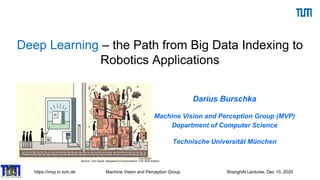
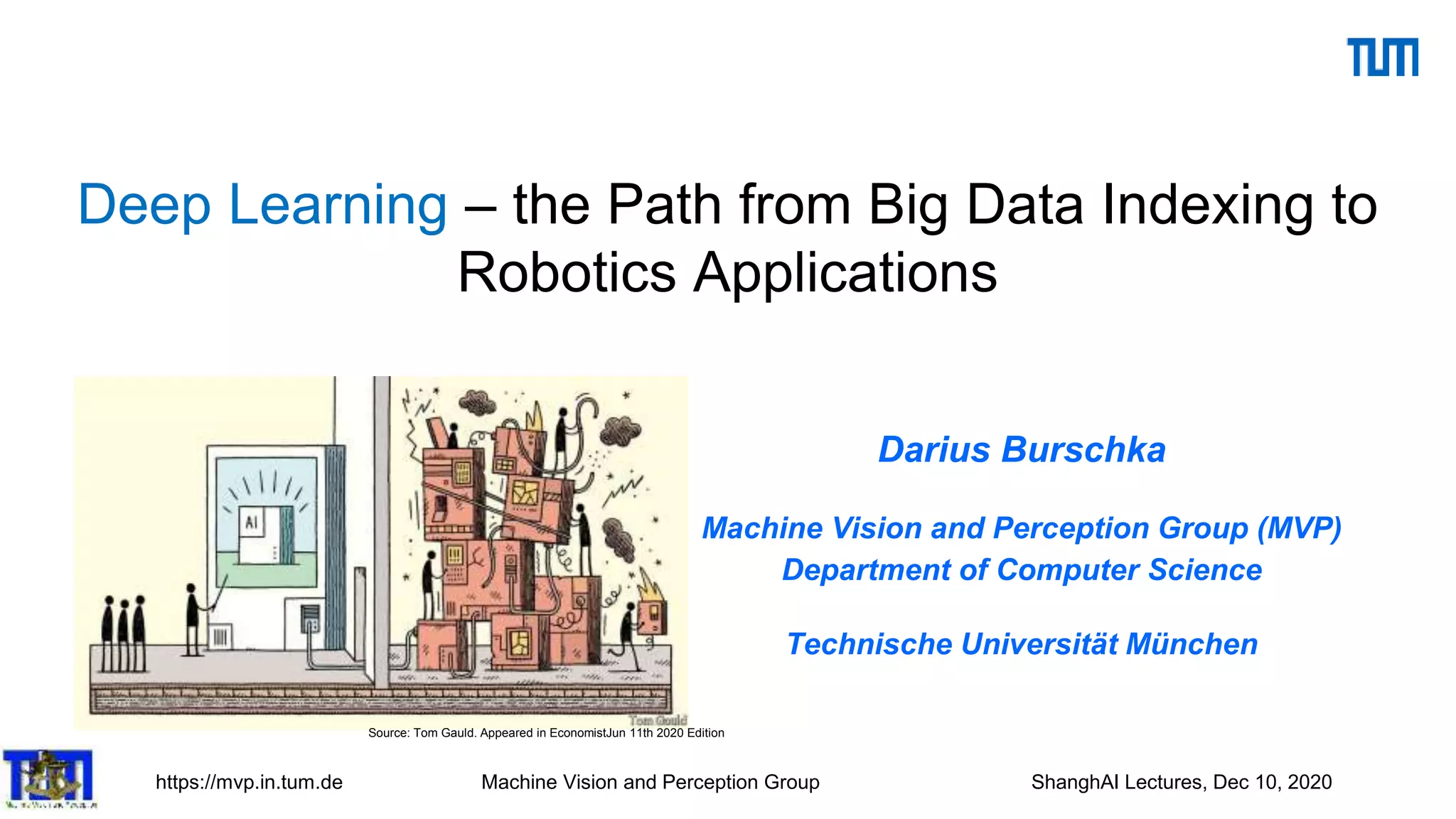
Deep Learning – the Path from Big Data Indexing to
Robotics Applications
Darius Burschka
Machine Vision and Perception Group (MVP)
Department of Computer Science
Technische Universität München
Source: Tom Gauld. Appeared in EconomistJun 11th 2020 Edition
https://mvp.in.tum.de Machine Vision and Perception Group ShanghAI Lectures, Dec 10, 2020
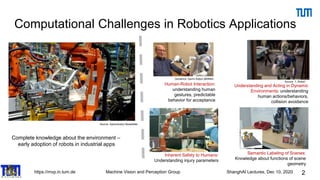
Computational Challenges in Robotics Applications
2
Source: Aytoindustry Newsletter
Complete knowledge about the environment –
early adoption of robots in industrial apps
Geriatrics: Garmi Robot (MSRM)
Human-Robot Interaction:
understanding human
gestures, predictable
behavior for acceptance
Source: “I, Robot”
Understanding and Acting in Dynamic
Environments: understanding
human actions/behaviors,
collision avoidance
Inherent Safety to Humans:
Understanding injury parameters
Semantic Labeling of Scenes:
Knowledge about functions of scene
geometry
https://mvp.in.tum.de Machine Vision and Perception Group ShanghAI Lectures, Dec 10, 2020
Early rule-based AI Approaches to Deal with the
Challenges
3
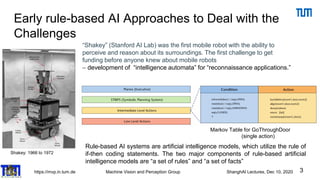
“Shakey” (Stanford AI Lab) was the first mobile robot with the ability to
perceive and reason about its surroundings. The first challenge to get
funding before anyone knew about mobile robots
– development of “intelligence automata” for “reconnaissance applications.”
Shakey: 1966 to 1972
Markov Table for GoThroughDoor
(single action)
Rule-based AI systems are artificial intelligence models, which utilize the rule of
if-then coding statements. The two major components of rule-based artificial
intelligence models are “a set of rules” and “a set of facts”
https://mvp.in.tum.de Machine Vision and Perception Group ShanghAI Lectures, Dec 10, 2020
Modern Rule-Based AI System
4
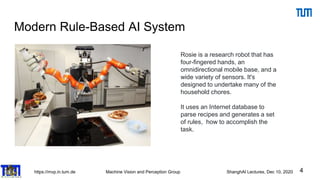
Rosie is a research robot that has
four-fingered hands, an
omnidirectional mobile base, and a
wide variety of sensors. It's
designed to undertake many of the
household chores.
It uses an Internet database to
parse recipes and generates a set
of rules, how to accomplish the
task.
https://mvp.in.tum.de Machine Vision and Perception Group ShanghAI Lectures, Dec 10, 2020
Current Trend to Avoid direct Rule Programming -
Learning Approaches
5
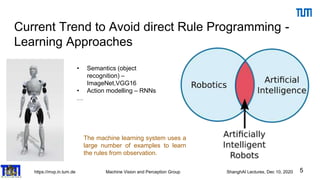
• Semantics (object
recognition) –
ImageNet,VGG16
• Action modelling – RNNs
…
The machine learning system uses a
large number of examples to learn
the rules from observation.
https://mvp.in.tum.de Machine Vision and Perception Group ShanghAI Lectures, Dec 10, 2020
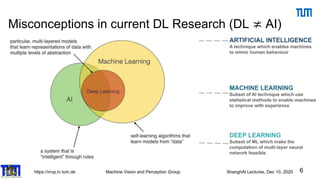
Misconceptions in current DL Research (DL ≭ AI)
6
Source: Edureka
https://mvp.in.tum.de Machine Vision and Perception Group ShanghAI Lectures, Dec 10, 2020
Emergence of Deep Learning – Big Data
7
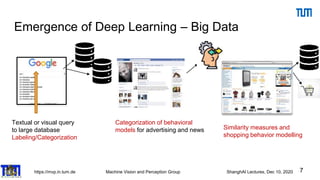
Textual or visual query
to large database
Labeling/Categorization
Categorization of behavioral
models for advertising and news Similarity measures and
shopping behavior modelling
https://mvp.in.tum.de Machine Vision and Perception Group ShanghAI Lectures, Dec 10, 2020
What is different in Robotics compared to Big Data
Queries?
8
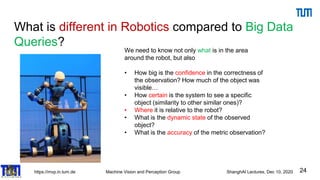
We need to know not only what is in the area
around the robot, but also
• How big is the confidence in the correctness of
the observation? How much of the object was
visible…
• How certain is the system to see a specific
object (similarity to other similar ones)?
• Where it is relative to the robot?
• What is the dynamic state of the observed
object?
• What is the accuracy of the metric observation?
https://mvp.in.tum.de Machine Vision and Perception Group ShanghAI Lectures, Dec 10, 2020
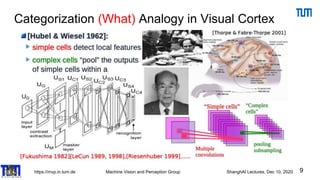
Categorization (What) Analogy in Visual Cortex
9
https://mvp.in.tum.de Machine Vision and Perception Group ShanghAI Lectures, Dec 10, 2020
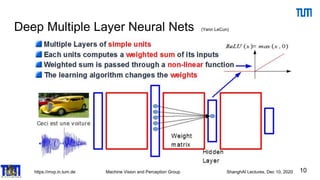
Deep Multiple Layer Neural Nets (Yann LeCun)
10
https://mvp.in.tum.de Machine Vision and Perception Group ShanghAI Lectures, Dec 10, 2020
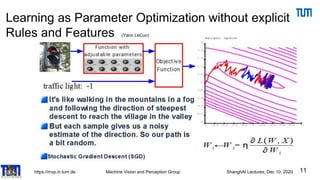
Learning as Parameter Optimization without explicit
Rules and Features (Yann LeCun)
11
https://mvp.in.tum.de Machine Vision and Perception Group ShanghAI Lectures, Dec 10, 2020
The NN anecdote from the 80s is still alive
In the 1980s, the Pentagon wanted to harness computer technology to make their tanks harder to attack.The preliminary plan was to fit each tank
with a digital camera hooked up to a computer. The computer would continually scan the environment outside for possible threats (such as an enemy
tank hiding behind a tree), and alert the tank crew to anything suspicious. Computers are really good at doing repetitive tasks without taking a break, but
they are generally bad at interpreting images. The only possible way to solve the problem was to employ a neural network.
The research team went out and took 100 photographs of tanks hiding behind trees, and then took 100 photographs of trees - with no tanks. They took half the
photos from each group and put them in a vault for safe-keeping, then scanned the other half into their mainframe computer. The huge neural network was fed each
photo one at a time and asked if there was a tank hiding behind the trees. The question was did it understand the concept of tanks vs. no tanks, or had it merely
memorized the answers? So the scientists took out the photos they had been keeping in the vault and fed them through the computer. The computer had never seen
these photos before -- this would be the big test. To their immense relief the neural net correctly identified each photo as either having a tank or not having one.
Independent team commissioned another set of photos (half with tanks and half without) and scanned them into the computer and through the neural
network. The results were completely random. For a long time nobody could figure out why. After all nobody understood how the neural had trained
itself. Grey skies for the US military - Eventually someone noticed that in the original set of 200 photos, all the images with tanks had been taken on a
cloudy day while all the images without tanks had been taken on a sunny day. The neural network had been asked to separate the two groups of
photos and it had chosen the most obvious way to do it -
12
https://mvp.in.tum.de Machine Vision and Perception Group ShanghAI Lectures, Dec 10, 2020
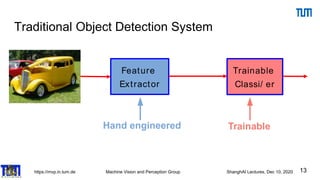
Traditional Object Detection System
13
...and “traditional” Machine Learning
Trainable
Classi/ er
Feature
Extractor
Hand engineered Trainable
https://mvp.in.tum.de Machine Vision and Perception Group ShanghAI Lectures, Dec 10, 2020
Deep Learning = Learning Representations
14
Deep Learning = Learning Hierarchical Representations
It's deep if it has more than one stage of non-linear feature transformation
Trainable
Classi/ er
Low-Level
Feature
Mid-Level
Feature
High-
Level
Feature
Feature visualization of convolutional net trained on ImageNet from [Zeiler & Fergus 2013]
https://mvp.in.tum.de Machine Vision and Perception Group ShanghAI Lectures, Dec 10, 2020
Impressive DL Performance, but we lost the ability to
understand, how it is done…
15
Prediction wolf vs. husky
[ Ribeiro et al. 2016 ]
https://mvp.in.tum.de Machine Vision and Perception Group ShanghAI Lectures, Dec 10, 2020
Explaining DL at CVision example is cheating…
16
Y. LeCun
Deep Learning = Learning Hierarchical Representations
It's deep if it has more than one stage of non-linear feature transformation
Trainable
Classi/ er
Low-Level
Feature
Mid-Level
Feature
High-
Level
Feature
Feature visualization of convolutional net trained on ImageNet from [Zeiler & Fergus 2013]
Computer Vision is a well-studied and well-understood problem. This is what helps to formulate all the
explanations but… you notice that it is hard to understand DL net structures on an unsolved problem.
Toy example to understand the problem:
DL framework that predicts girlfriend’s anger
After a successful training, you will end up with the system that may
correctly predict the anger state, but it will not help you understand the
process and involved cues in any sense (black box)
https://mvp.in.tum.de Machine Vision and Perception Group ShanghAI Lectures, Dec 10, 2020
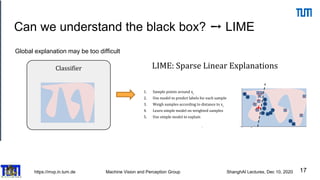
Can we understand the black box? ➙ LIME
17
Global explanation may be too difficult
https://mvp.in.tum.de Machine Vision and Perception Group ShanghAI Lectures, Dec 10, 2020 18
Instances
[ Ribeiro et al. 2016 ](Certainty)
https://mvp.in.tum.de Machine Vision and Perception Group ShanghAI Lectures, Dec 10, 2020
Categorize Wolf vs Husky
19
Prediction wolf vs. husky
[ Ribeiro et al. 2016 ]
https://mvp.in.tum.de Machine Vision and Perception Group ShanghAI Lectures, Dec 10, 2020
System learned the wrong classifier because of not
enough diversity in the training set
20
[ Ribeiro et al. 2016 ]
https://mvp.in.tum.de Machine Vision and Perception Group ShanghAI Lectures, Dec 10, 2020
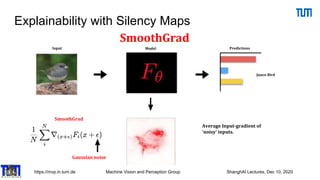
Explainability with Silency Maps
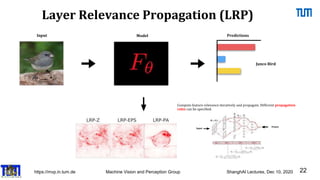
https://mvp.in.tum.de Machine Vision and Perception Group ShanghAI Lectures, Dec 10, 2020 22
https://mvp.in.tum.de Machine Vision and Perception Group ShanghAI Lectures, Dec 10, 2020
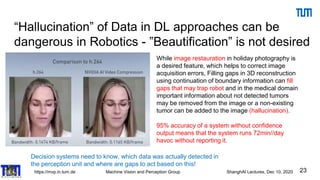
“Hallucination” of Data in DL approaches can be
dangerous in Robotics - ”Beautification” is not desired
23
While image restauration in holiday photography is
a desired feature, which helps to correct image
acquisition errors, Filling gaps in 3D reconstruction
using continuation of boundary information can fill
gaps that may trap robot and in the medical domain
important information about not detected tumors
may be removed from the image or a non-existing
tumor can be added to the image (hallucination).
95% accuracy of a system without confidence
output means that the system runs 72min//day
havoc without reporting it.
Decision systems need to know, which data was actually detected in
the perception unit and where are gaps to act based on this!
https://mvp.in.tum.de Machine Vision and Perception Group ShanghAI Lectures, Dec 10, 2020
What is different in Robotics compared to Big Data
Queries?
24
We need to know not only what is in the area
around the robot, but also
• How big is the confidence in the correctness of
the observation? How much of the object was
visible…
• How certain is the system to see a specific
object (similarity to other similar ones)?
• Where it is relative to the robot?
• What is the dynamic state of the observed
object?
• What is the accuracy of the metric observation?
https://mvp.in.tum.de Machine Vision and Perception Group ShanghAI Lectures, Dec 10, 2020
25
Navigation for Control – what have we learned from
conventional systems?
VINS filter design
[Schmid et al. IROS 2012]
Synchronization of real-time and non realtime modules by sensor hardware trigger
Direct system state:
High rate calculation by „Strap Down Algorithm“ (SDA)
Indirect system state:
Estimation by indirect Extended Kalman Filter (EKF)
https://mvp.in.tum.de Machine Vision and Perception Group ShanghAI Lectures, Dec 10, 2020
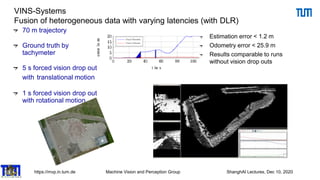
70 m trajectory
Ground truth by
tachymeter
5 s forced vision drop out
with translational motion
1 s forced vision drop out
with rotational motion
Estimation error < 1.2 m
Odometry error < 25.9 m
Results comparable to runs
without vision drop outs
VINS-Systems
Fusion of heterogeneous data with varying latencies (with DLR)
https://mvp.in.tum.de Machine Vision and Perception Group ShanghAI Lectures, Dec 10, 2020 27
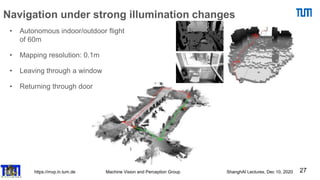
Navigation under strong illumination changes
• Autonomous indoor/outdoor flight
of 60m
• Mapping resolution: 0.1m
• Leaving through a window
• Returning through door
https://mvp.in.tum.de Machine Vision and Perception Group ShanghAI Lectures, Dec 10, 2020
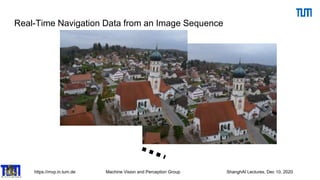
Real-Time Navigation Data from an Image Sequence
https://mvp.in.tum.de Machine Vision and Perception Group ShanghAI Lectures, Dec 10, 2020
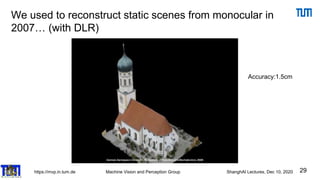
We used to reconstruct static scenes from monocular in
2007… (with DLR)
29
Accuracy:1.5cm
https://mvp.in.tum.de Machine Vision and Perception Group ShanghAI Lectures, Dec 10, 2020
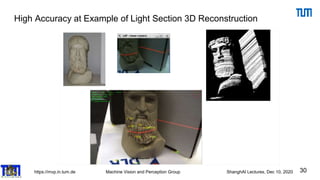
High Accuracy at Example of Light Section 3D Reconstruction
30
MachineVisionandPerceptionGroup@TUMMVP
http://www6.in.tum.de/burschka/ Seminar, Oct 28, 2016
Light Section Principle
https://mvp.in.tum.de Machine Vision and Perception Group ShanghAI Lectures, Dec 10, 2020
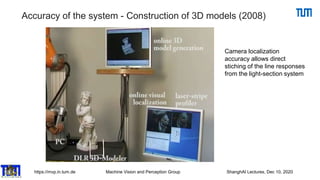
Accuracy of the system - Construction of 3D models (2008)
Camera localization
accuracy allows direct
stiching of the line responses
from the light-section system
https://mvp.in.tum.de Machine Vision and Perception Group ShanghAI Lectures, Dec 10, 2020
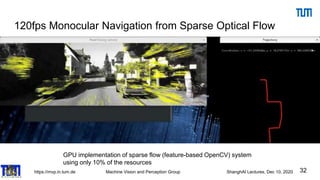
120fps Monocular Navigation from Sparse Optical Flow
32
GPU implementation of sparse flow (feature-based OpenCV) system
using only 10% of the resources
https://mvp.in.tum.de Machine Vision and Perception Group ShanghAI Lectures, Dec 10, 2020
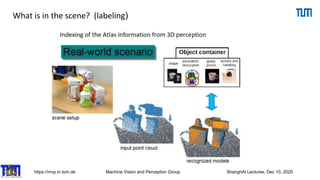
What is in the scene? (labeling)
https://mvp.in.tum.de Machine Vision and Perception Group ShanghAI Lectures, Dec 10, 2020
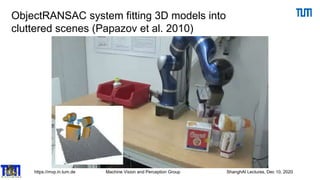
ObjectRANSAC system fitting 3D models into
cluttered scenes (Papazov et al. 2010)
https://mvp.in.tum.de Machine Vision and Perception Group ShanghAI Lectures, Dec 10, 2020
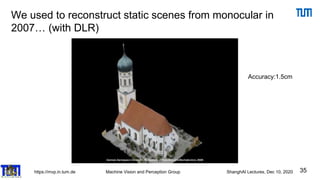
We used to reconstruct static scenes from monocular in
2007… (with DLR)
35
Accuracy:1.5cm
https://mvp.in.tum.de Machine Vision and Perception Group ShanghAI Lectures, Dec 10, 2020
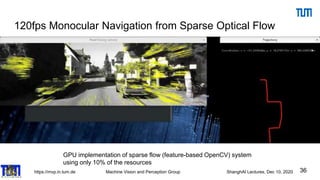
120fps Monocular Navigation from Sparse Optical Flow
36
GPU implementation of sparse flow (feature-based OpenCV) system
using only 10% of the resources
https://mvp.in.tum.de Machine Vision and Perception Group ShanghAI Lectures, Dec 10, 2020
Benchmarks in the Age of Deep Learning…
37
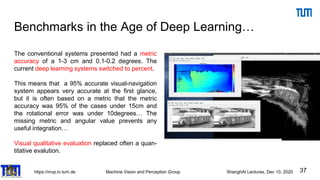
The conventional systems presented had a metric
accuracy of a 1-3 cm and 0.1-0.2 degrees. The
current deep learning systems switched to percent.
This means that a 95% accurate visual-navigation
system appears very accurate at the first glance,
but it is often based on a metric that the metric
accuracy was 95% of the cases under 15cm and
the rotational error was under 10degrees… The
missing metric and angular value prevents any
useful integration…
Visual qualitative evaluation replaced often a quan-
titative evalution.
https://mvp.in.tum.de Machine Vision and Perception Group ShanghAI Lectures, Dec 10, 2020
Combination DL and Conventional Methods
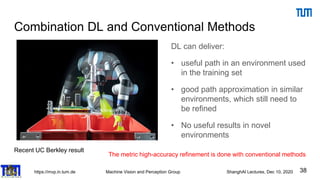
DL can deliver:
• useful path in an environment used
in the training set
• good path approximation in similar
environments, which still need to
be refined
• No useful results in novel
environments
38
Recent UC Berkley result
The metric high-accuracy refinement is done with conventional methods
https://mvp.in.tum.de Machine Vision and Perception Group ShanghAI Lectures, Dec 10, 2020
Deep Learning is not AI but Artificial Experience
• Deep Nets provide a powerful method to compare current view to the
previously seen examples in the training set. It is a powerful method to train
the robot to operate in a specific know domain without specification of
features.
• The network does not extrapolate well into regions without training
samples. Variational extensions to improve the gradient field of, e.g.,
Variational Autoencoder (VAE) improve but only in local neighborhoods
• Deep Net can be compared to a librarian, who does know what are the
most similar books to the currently parsed text, but who does not know how
to apply the knowledge for novelty - not Intelligence, but Experience
39
https://mvp.in.tum.de Machine Vision and Perception Group ShanghAI Lectures, Dec 10, 2020
MVP
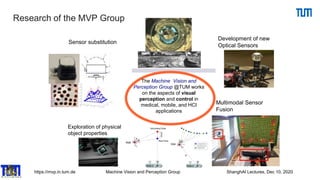
Research of the MVP Group
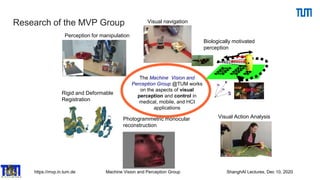
The Machine Vision and
Perception Group @TUM works
on the aspects of visual
perception and control in
medical, mobile, and HCI
applications
Visual navigation
Biologically motivated
perception
Perception for manipulation
Visual Action AnalysisPhotogrammetric monocular
reconstruction
Rigid and Deformable
Registration
https://mvp.in.tum.de Machine Vision and Perception Group ShanghAI Lectures, Dec 10, 2020
Research of the MVP Group
Exploration of physical
object properties
Sensor substitution
Multimodal Sensor
Fusion
Development of new
Optical Sensors
The Machine Vision and
Perception Group @TUM works
on the aspects of visual
perception and control in
medical, mobile, and HCI
applications

Deep Learning - a Path from Big Data Indexing to Robotic Applications

  • 1.
    https://mvp.in.tum.de Machine Visionand Perception Group ShanghAI Lectures, Dec 10, 2020 Deep Learning – the Path from Big Data Indexing to Robotics Applications Darius Burschka Machine Vision and Perception Group (MVP) Department of Computer Science Technische Universität München Source: Tom Gauld. Appeared in EconomistJun 11th 2020 Edition
  • 2.
    https://mvp.in.tum.de Machine Visionand Perception Group ShanghAI Lectures, Dec 10, 2020 Computational Challenges in Robotics Applications 2 Source: Aytoindustry Newsletter Complete knowledge about the environment – early adoption of robots in industrial apps Geriatrics: Garmi Robot (MSRM) Human-Robot Interaction: understanding human gestures, predictable behavior for acceptance Source: “I, Robot” Understanding and Acting in Dynamic Environments: understanding human actions/behaviors, collision avoidance Inherent Safety to Humans: Understanding injury parameters Semantic Labeling of Scenes: Knowledge about functions of scene geometry
  • 3.
    https://mvp.in.tum.de Machine Visionand Perception Group ShanghAI Lectures, Dec 10, 2020 Early rule-based AI Approaches to Deal with the Challenges 3 “Shakey” (Stanford AI Lab) was the first mobile robot with the ability to perceive and reason about its surroundings. The first challenge to get funding before anyone knew about mobile robots – development of “intelligence automata” for “reconnaissance applications.” Shakey: 1966 to 1972 Markov Table for GoThroughDoor (single action) Rule-based AI systems are artificial intelligence models, which utilize the rule of if-then coding statements. The two major components of rule-based artificial intelligence models are “a set of rules” and “a set of facts”
  • 4.
    https://mvp.in.tum.de Machine Visionand Perception Group ShanghAI Lectures, Dec 10, 2020 Modern Rule-Based AI System 4 Rosie is a research robot that has four-fingered hands, an omnidirectional mobile base, and a wide variety of sensors. It's designed to undertake many of the household chores. It uses an Internet database to parse recipes and generates a set of rules, how to accomplish the task.
  • 5.
    https://mvp.in.tum.de Machine Visionand Perception Group ShanghAI Lectures, Dec 10, 2020 Current Trend to Avoid direct Rule Programming - Learning Approaches 5 • Semantics (object recognition) – ImageNet,VGG16 • Action modelling – RNNs … The machine learning system uses a large number of examples to learn the rules from observation.
  • 6.
    https://mvp.in.tum.de Machine Visionand Perception Group ShanghAI Lectures, Dec 10, 2020 Misconceptions in current DL Research (DL ≭ AI) 6 Source: Edureka
  • 7.
    https://mvp.in.tum.de Machine Visionand Perception Group ShanghAI Lectures, Dec 10, 2020 Emergence of Deep Learning – Big Data 7 Textual or visual query to large database Labeling/Categorization Categorization of behavioral models for advertising and news Similarity measures and shopping behavior modelling
  • 8.
    https://mvp.in.tum.de Machine Visionand Perception Group ShanghAI Lectures, Dec 10, 2020 What is different in Robotics compared to Big Data Queries? 8 We need to know not only what is in the area around the robot, but also • How big is the confidence in the correctness of the observation? How much of the object was visible… • How certain is the system to see a specific object (similarity to other similar ones)? • Where it is relative to the robot? • What is the dynamic state of the observed object? • What is the accuracy of the metric observation?
  • 9.
    https://mvp.in.tum.de Machine Visionand Perception Group ShanghAI Lectures, Dec 10, 2020 Categorization (What) Analogy in Visual Cortex 9
  • 10.
    https://mvp.in.tum.de Machine Visionand Perception Group ShanghAI Lectures, Dec 10, 2020 Deep Multiple Layer Neural Nets (Yann LeCun) 10
  • 11.
    https://mvp.in.tum.de Machine Visionand Perception Group ShanghAI Lectures, Dec 10, 2020 Learning as Parameter Optimization without explicit Rules and Features (Yann LeCun) 11
  • 12.
    https://mvp.in.tum.de Machine Visionand Perception Group ShanghAI Lectures, Dec 10, 2020 The NN anecdote from the 80s is still alive In the 1980s, the Pentagon wanted to harness computer technology to make their tanks harder to attack.The preliminary plan was to fit each tank with a digital camera hooked up to a computer. The computer would continually scan the environment outside for possible threats (such as an enemy tank hiding behind a tree), and alert the tank crew to anything suspicious. Computers are really good at doing repetitive tasks without taking a break, but they are generally bad at interpreting images. The only possible way to solve the problem was to employ a neural network. The research team went out and took 100 photographs of tanks hiding behind trees, and then took 100 photographs of trees - with no tanks. They took half the photos from each group and put them in a vault for safe-keeping, then scanned the other half into their mainframe computer. The huge neural network was fed each photo one at a time and asked if there was a tank hiding behind the trees. The question was did it understand the concept of tanks vs. no tanks, or had it merely memorized the answers? So the scientists took out the photos they had been keeping in the vault and fed them through the computer. The computer had never seen these photos before -- this would be the big test. To their immense relief the neural net correctly identified each photo as either having a tank or not having one. Independent team commissioned another set of photos (half with tanks and half without) and scanned them into the computer and through the neural network. The results were completely random. For a long time nobody could figure out why. After all nobody understood how the neural had trained itself. Grey skies for the US military - Eventually someone noticed that in the original set of 200 photos, all the images with tanks had been taken on a cloudy day while all the images without tanks had been taken on a sunny day. The neural network had been asked to separate the two groups of photos and it had chosen the most obvious way to do it - 12
  • 13.
    https://mvp.in.tum.de Machine Visionand Perception Group ShanghAI Lectures, Dec 10, 2020 Traditional Object Detection System 13 ...and “traditional” Machine Learning Trainable Classi/ er Feature Extractor Hand engineered Trainable
  • 14.
    https://mvp.in.tum.de Machine Visionand Perception Group ShanghAI Lectures, Dec 10, 2020 Deep Learning = Learning Representations 14 Deep Learning = Learning Hierarchical Representations It's deep if it has more than one stage of non-linear feature transformation Trainable Classi/ er Low-Level Feature Mid-Level Feature High- Level Feature Feature visualization of convolutional net trained on ImageNet from [Zeiler & Fergus 2013]
  • 15.
    https://mvp.in.tum.de Machine Visionand Perception Group ShanghAI Lectures, Dec 10, 2020 Impressive DL Performance, but we lost the ability to understand, how it is done… 15 Prediction wolf vs. husky [ Ribeiro et al. 2016 ]
  • 16.
    https://mvp.in.tum.de Machine Visionand Perception Group ShanghAI Lectures, Dec 10, 2020 Explaining DL at CVision example is cheating… 16 Y. LeCun Deep Learning = Learning Hierarchical Representations It's deep if it has more than one stage of non-linear feature transformation Trainable Classi/ er Low-Level Feature Mid-Level Feature High- Level Feature Feature visualization of convolutional net trained on ImageNet from [Zeiler & Fergus 2013] Computer Vision is a well-studied and well-understood problem. This is what helps to formulate all the explanations but… you notice that it is hard to understand DL net structures on an unsolved problem. Toy example to understand the problem: DL framework that predicts girlfriend’s anger After a successful training, you will end up with the system that may correctly predict the anger state, but it will not help you understand the process and involved cues in any sense (black box)
  • 17.
    https://mvp.in.tum.de Machine Visionand Perception Group ShanghAI Lectures, Dec 10, 2020 Can we understand the black box? ➙ LIME 17 Global explanation may be too difficult
  • 18.
    https://mvp.in.tum.de Machine Visionand Perception Group ShanghAI Lectures, Dec 10, 2020 18 Instances [ Ribeiro et al. 2016 ](Certainty)
  • 19.
    https://mvp.in.tum.de Machine Visionand Perception Group ShanghAI Lectures, Dec 10, 2020 Categorize Wolf vs Husky 19 Prediction wolf vs. husky [ Ribeiro et al. 2016 ]
  • 20.
    https://mvp.in.tum.de Machine Visionand Perception Group ShanghAI Lectures, Dec 10, 2020 System learned the wrong classifier because of not enough diversity in the training set 20 [ Ribeiro et al. 2016 ]
  • 21.
    https://mvp.in.tum.de Machine Visionand Perception Group ShanghAI Lectures, Dec 10, 2020 Explainability with Silency Maps
  • 22.
    https://mvp.in.tum.de Machine Visionand Perception Group ShanghAI Lectures, Dec 10, 2020 22
  • 23.
    https://mvp.in.tum.de Machine Visionand Perception Group ShanghAI Lectures, Dec 10, 2020 “Hallucination” of Data in DL approaches can be dangerous in Robotics - ”Beautification” is not desired 23 While image restauration in holiday photography is a desired feature, which helps to correct image acquisition errors, Filling gaps in 3D reconstruction using continuation of boundary information can fill gaps that may trap robot and in the medical domain important information about not detected tumors may be removed from the image or a non-existing tumor can be added to the image (hallucination). 95% accuracy of a system without confidence output means that the system runs 72min//day havoc without reporting it. Decision systems need to know, which data was actually detected in the perception unit and where are gaps to act based on this!
  • 24.
    https://mvp.in.tum.de Machine Visionand Perception Group ShanghAI Lectures, Dec 10, 2020 What is different in Robotics compared to Big Data Queries? 24 We need to know not only what is in the area around the robot, but also • How big is the confidence in the correctness of the observation? How much of the object was visible… • How certain is the system to see a specific object (similarity to other similar ones)? • Where it is relative to the robot? • What is the dynamic state of the observed object? • What is the accuracy of the metric observation?
  • 25.
    https://mvp.in.tum.de Machine Visionand Perception Group ShanghAI Lectures, Dec 10, 2020 25 Navigation for Control – what have we learned from conventional systems? VINS filter design [Schmid et al. IROS 2012] Synchronization of real-time and non realtime modules by sensor hardware trigger Direct system state: High rate calculation by „Strap Down Algorithm“ (SDA) Indirect system state: Estimation by indirect Extended Kalman Filter (EKF)
  • 26.
    https://mvp.in.tum.de Machine Visionand Perception Group ShanghAI Lectures, Dec 10, 2020 70 m trajectory Ground truth by tachymeter 5 s forced vision drop out with translational motion 1 s forced vision drop out with rotational motion Estimation error < 1.2 m Odometry error < 25.9 m Results comparable to runs without vision drop outs VINS-Systems Fusion of heterogeneous data with varying latencies (with DLR)
  • 27.
    https://mvp.in.tum.de Machine Visionand Perception Group ShanghAI Lectures, Dec 10, 2020 27 Navigation under strong illumination changes • Autonomous indoor/outdoor flight of 60m • Mapping resolution: 0.1m • Leaving through a window • Returning through door
  • 28.
    https://mvp.in.tum.de Machine Visionand Perception Group ShanghAI Lectures, Dec 10, 2020 Real-Time Navigation Data from an Image Sequence
  • 29.
    https://mvp.in.tum.de Machine Visionand Perception Group ShanghAI Lectures, Dec 10, 2020 We used to reconstruct static scenes from monocular in 2007… (with DLR) 29 Accuracy:1.5cm
  • 30.
    https://mvp.in.tum.de Machine Visionand Perception Group ShanghAI Lectures, Dec 10, 2020 High Accuracy at Example of Light Section 3D Reconstruction 30 MachineVisionandPerceptionGroup@TUMMVP http://www6.in.tum.de/burschka/ Seminar, Oct 28, 2016 Light Section Principle
  • 31.
    https://mvp.in.tum.de Machine Visionand Perception Group ShanghAI Lectures, Dec 10, 2020 Accuracy of the system - Construction of 3D models (2008) Camera localization accuracy allows direct stiching of the line responses from the light-section system
  • 32.
    https://mvp.in.tum.de Machine Visionand Perception Group ShanghAI Lectures, Dec 10, 2020 120fps Monocular Navigation from Sparse Optical Flow 32 GPU implementation of sparse flow (feature-based OpenCV) system using only 10% of the resources
  • 33.
    https://mvp.in.tum.de Machine Visionand Perception Group ShanghAI Lectures, Dec 10, 2020 What is in the scene? (labeling)
  • 34.
    https://mvp.in.tum.de Machine Visionand Perception Group ShanghAI Lectures, Dec 10, 2020 ObjectRANSAC system fitting 3D models into cluttered scenes (Papazov et al. 2010)
  • 35.
    https://mvp.in.tum.de Machine Visionand Perception Group ShanghAI Lectures, Dec 10, 2020 We used to reconstruct static scenes from monocular in 2007… (with DLR) 35 Accuracy:1.5cm
  • 36.
    https://mvp.in.tum.de Machine Visionand Perception Group ShanghAI Lectures, Dec 10, 2020 120fps Monocular Navigation from Sparse Optical Flow 36 GPU implementation of sparse flow (feature-based OpenCV) system using only 10% of the resources
  • 37.
    https://mvp.in.tum.de Machine Visionand Perception Group ShanghAI Lectures, Dec 10, 2020 Benchmarks in the Age of Deep Learning… 37 The conventional systems presented had a metric accuracy of a 1-3 cm and 0.1-0.2 degrees. The current deep learning systems switched to percent. This means that a 95% accurate visual-navigation system appears very accurate at the first glance, but it is often based on a metric that the metric accuracy was 95% of the cases under 15cm and the rotational error was under 10degrees… The missing metric and angular value prevents any useful integration… Visual qualitative evaluation replaced often a quan- titative evalution.
  • 38.
    https://mvp.in.tum.de Machine Visionand Perception Group ShanghAI Lectures, Dec 10, 2020 Combination DL and Conventional Methods DL can deliver: • useful path in an environment used in the training set • good path approximation in similar environments, which still need to be refined • No useful results in novel environments 38 Recent UC Berkley result The metric high-accuracy refinement is done with conventional methods
  • 39.
    https://mvp.in.tum.de Machine Visionand Perception Group ShanghAI Lectures, Dec 10, 2020 Deep Learning is not AI but Artificial Experience • Deep Nets provide a powerful method to compare current view to the previously seen examples in the training set. It is a powerful method to train the robot to operate in a specific know domain without specification of features. • The network does not extrapolate well into regions without training samples. Variational extensions to improve the gradient field of, e.g., Variational Autoencoder (VAE) improve but only in local neighborhoods • Deep Net can be compared to a librarian, who does know what are the most similar books to the currently parsed text, but who does not know how to apply the knowledge for novelty - not Intelligence, but Experience 39
  • 40.
    https://mvp.in.tum.de Machine Visionand Perception Group ShanghAI Lectures, Dec 10, 2020 MVP Research of the MVP Group The Machine Vision and Perception Group @TUM works on the aspects of visual perception and control in medical, mobile, and HCI applications Visual navigation Biologically motivated perception Perception for manipulation Visual Action AnalysisPhotogrammetric monocular reconstruction Rigid and Deformable Registration
  • 41.
    https://mvp.in.tum.de Machine Visionand Perception Group ShanghAI Lectures, Dec 10, 2020 Research of the MVP Group Exploration of physical object properties Sensor substitution Multimodal Sensor Fusion Development of new Optical Sensors The Machine Vision and Perception Group @TUM works on the aspects of visual perception and control in medical, mobile, and HCI applications