TELKOMNIKA, Vol.16, No.3, June 2018, pp. 955~964
ISSN: 1693-6930, accredited A by DIKTI, Decree No: 58/DIKTI/Kep/2013
DOI: 10.12928/TELKOMNIKA.v16i3.9033  955
Received December 23, 2017; Revised April 9, 2018; Accepted April 27, 2018
Stereo Vision Human Motion Detection and Tracking in
Uncontrolled Environment
Bunseng Chan*
1
, King Hann Lim
2
, Lenin Gopal
3
, Alpha Agape Gopalai
4
,
Darwin Gouwanda
5
1,2,3
Department of Electrical and Computer Engineering, Faculty of Engineering and Science, Curtin
University Malaysia
4,5
Mechatronic Engineering Department, School of Engineering, Monash University Malaysia
*Corresponding author, e-mail: bunsengchan@ieee.org
Abstract
Stereo vision in detecting human motion is an emerging research for automation, robotics, and
sports science field due to the advancementofimaging sensors and information technology. The difficulty
of human motion detection and tracking is relatively complex when it is applied to uncontrolled
environment. In this paper, a hybrid filter approach is proposed to detect human motion in the stereo
vision. The hybrid filter approach integrates Gaussian filter and median filter to reduce the coverage of
shadow and sudden change of illumination. In addition,sequential thinning and thickening morphological
method is used to construct the skeleton model. The proposed hybrid approach is compared with the
normalized filter. As a result, the proposed approach produces better skeleton model with less influential
effect on shadow and illumination. The output results of the proposed approach can show up to 86% of
average accuracy matched with skeleton model. In addition, obtains approximately 94% of sensitivity
measurementin the stereo vision. The proposed approach using hybrid filter and sequential morphology
could improve the performance of the detection in the uncontrolled environment.
Keywords:Stereo vision,human motion detection and tracking,sequential morphology,skeleton model
Copyright © 2018 Universitas Ahmad Dahlan. All rights reserved.
1. Introduction
The technology of stereo vision has grown exponentially nowadays as a sensory tool to
capture visual information. Inspired by human eyes, stereo vision uses two cameras displaced
horizontally on a calibrated platform to reconstruct three-dimensional (3D) perception of an
object based on the visual properties such as shape, color distribution, and illumination [1]-[2].
With the emerging of the imaging sensors and computer vision technology, the application of
the stereo vision is extended to various industrial fields including virtual reality, gaming, military
training filmmaking, and sports activities [3]-[4].
Stereo vision can be divided into two categories, i.e., active stereo-vision and passive
stereo-vision. Active stereo vision uses direct light source radiance on a subject, and the
reflected light is captured via a camera [5]. However, the cost of the active stereo vision is
relatively high, and its visual output is affected by surrounding illumination [6]. On the other
hand, active stereo vision incorporated with the depth sensors including ranging camera, flash
LIDAR, time-of-flight, and RGB-D camera to improve its performance [7]. Nevertheless, the field
of view and resolution for this camera system is restricted by the specification of depth
sensors [8].
Conversely, passive stereo vision constructs the images based on the interreflection of
the light source to the subject [5]. Passive stereo vision is commonly used in 3D image
reconstruction due to its simplicity. It is a user-friendly system, and the system cost is low [9].
Ganapathi et al. [10] used the graphics processing unit (GPU) with single time-of-flight (ToF)
camera to capture the object. The ToF camera measures the depth of the object with the assist
of the depth sensors unit to produce the 3D information. This system increases the robustness
of the system, but it requires high dimensionality of the memory space for the processing.
Human detection and segmentation methods are the initial step of the human features
extraction before proceed to the gait analysis. Background subtraction is one of the commonly
used background removals to detect the object in image sequences. However, background
 ISSN: 1693-6930
TELKOMNIKA Vol. 16, No. 3, June 2018 : 955 – 964
956
subtraction method has limitation in extracting fine human object from an uncontrolled
environment due to illumination [11]. This limitation was led to the failure of full human feature
extraction for further analysis. The human feature is also known as human silhouette, which is
important for the human skeleton model construction in motion analysis [12]. Hence, image
enhancement is important to improve the human feature extraction.
Image filtering is one of the image enhancing techniques integrating into background
subtraction to enhance the image quality. Commonly, image filter is used to emphasize the
image features or smoothen the noises of the image. However, the selection of the filter must be
appropriated to achieve an optimum output for analysis purpose. The sudden illumination
change is still one of the challenges needed to be overcome in image processing. Various type
of filters including mean filter, Gaussian filter, and median filter has been applied by the
researchers to improve the sudden illumination change issue [13]. Nevertheless, it does not
achieve an ideal output required in the uncontrolled environment.
In this paper, the use of a hybrid filter is proposed for an accurate human detection in
stereo vision under an uncontrolled environment. The paper is outlined into three sections.
Sections 2 is the overview of human detection and tracking in stereo vision; and Section 3
shows the experimental setup, experimental results and discussion.
2. Human Detection and Tracking in Stereo Vision
This work aims to establish human detection and tracking in an uncontrolled
environment using stereo cameras. Human motion being detected from stereo vision can be
used as gait recognition and analysis. Hence, human detection is the important step to
recognize the dynamic object in a video. Once human is detected, human tracking is applied to
localize an human object continuously in a video to ensure the computational reduction for real-
time application [14].
Human skeleton extraction is one of the tracking methods employed in human object. It
basically uses the mathematical morphology algorithms to enhance the human model and
display the relevant connection of the human joints [15]. Human detection and tracking is
relatively complex when it is performed in the uncontrolled due to the unpredicted illumination
changes and complex background [16].
An overview of the proposed algorithm is shown in Figure 1. It consists of two major
sections, i.e., human detection and segmentation, and human tracking with skeleton model. The
first part assists to capture, detect the human, and enhance the motion segmentation.
Meanwhile, the second part serves as continuous tracking of the detected object from the
previous segment and transforms into skeleton model.
Stereo camera emulates human vision using two passive cameras to initiate 3D
capability of human eyes in a digital world [17]. The output of the stereo vision provided depth
information which provided more detail information about the object. In addition, it improves the
robustness of the object information. There are many applications in entertainment and training
system due to its advantages.
In a color image, it consists of three color channels, i.e., Red, Green, and Blue (RGB).
However, direct image processing using three channels largely increases the computational
cost of system. Therefore, a pre-processing module was included to transform the color image
obtained from the stereo camera into a grayscale image. By combining of the normalized RGB
value, it produces the neutral white color (R+G+B=1). The grayscale image can be obtained by
combining the 29.5% of Red value, 55.4% of the Green value, and 14.8% of the Blue value [18].
The combination of this value produces the grayscale image.The conversion of the color scale
to grayscale image is based on the equation shown as follows:
( ) ( ) ( ) (1)
A two frame differentiation method is employed to remove the background and obtain the
human motion from the frame. The frame differentiation formula defines as:
( ) {
( )
(2)
TELKOMNIKA ISSN: 1693-6930 
Stereo Vision Human Motion Detection and Tracking in Uncontrolled .... (Bunseng Chan)
957
kkkkd fff   1)1,( (3)
where ( ) is the two-frame differencing, is the frame at k+1 in the image sequences,
and is the current frame or frame k in the image sequences.
Human motion detected using the two-frame differencing faces illumination issue when
the system is implemented at the outdoor environment. Therefore, post-processing is required
to remove the illumination problem. Generally, the median filter is used to reduce the noise of an
image and remain the edges [19]. Meanwhile, the Gaussian filter uses Gaussian function to
smooth the little-unwanted noises. In the post-processing module, a hybrid filter integrating
Gaussian filter and median filter is proposed to remove the effect of shadow. The hybrid filter
equation is shown as follows:
( ) ( ) ( ) (4)
( ) (5)
( ) * ( ) + (6)
where ( ) is the output image, G(x,y) and M(x,y) is the Gaussian filter and median filter
respectively, is the standard deviation of the distribution, and is the mask.
Figure 1. Overview of the proposed approach
The human detected is then enhanced its features after the noise filtering. The
enhancement involving mathematical morphology to removes the cavities, holes, or opens up
holes of the unwanted region. The mathematical morphology involves in this process including
the opening and closing morphology. The mathematical morphology for opening and closing of
an image ( ) by a structuring element ( ) and its defined accordingly as:
( ) (7)
 ( ) (8)
Human tracking
w ith skeleton model
Human detection
and segmentation Frame Differentiation
Pre-Processing
Post-Processing
(Hybrid Filter)
Human Tracking
Human Skeleton
(Sequential
Morphology)
Stereo Camera
 ISSN: 1693-6930
TELKOMNIKA Vol. 16, No. 3, June 2018 : 955 – 964
958
The detected human shape recovered its features then is used for continuous tracking
of its movement and transform into skeleton model. The skeleton model is a stick diagram of an
object which is used for to representing its basic shape. Basically, the skeleton construction can
be done in two different techniques, i.e., maximal balls technique, and thinning and thickening
technique [15]. Maximal balls technique used multiple constant radius balls concept in a
Euclidean space to identify the center of the structure to construct the skeleton [20]. However,
maximal balls technique produced disconnected skeleton model during its construction and did
not provide an efficient extraction [20]. Hence, it is not suitable for the human skeleton
construction.
Therefore, the human skeleton construction in this module will focus only on thinning
and thickening technique. Basically, the thinning and thickening technique is using the
sequential method as structuring elements [21]. The basic mathematical morphology for
thinning and thickening of an image ( ) is composite with a structuring element ( ) as
defined accordingly as:
( ) (9)
( ) (10)
Sequential structuring element will be employed to construct the skeleton model using the
thinning and thickening equation respectively as shown:
Let },...,,,{ 321 neeeee 
((( ) ) ) (11)
((( ) ) ) (12)
3. Experimental Results and Discussion
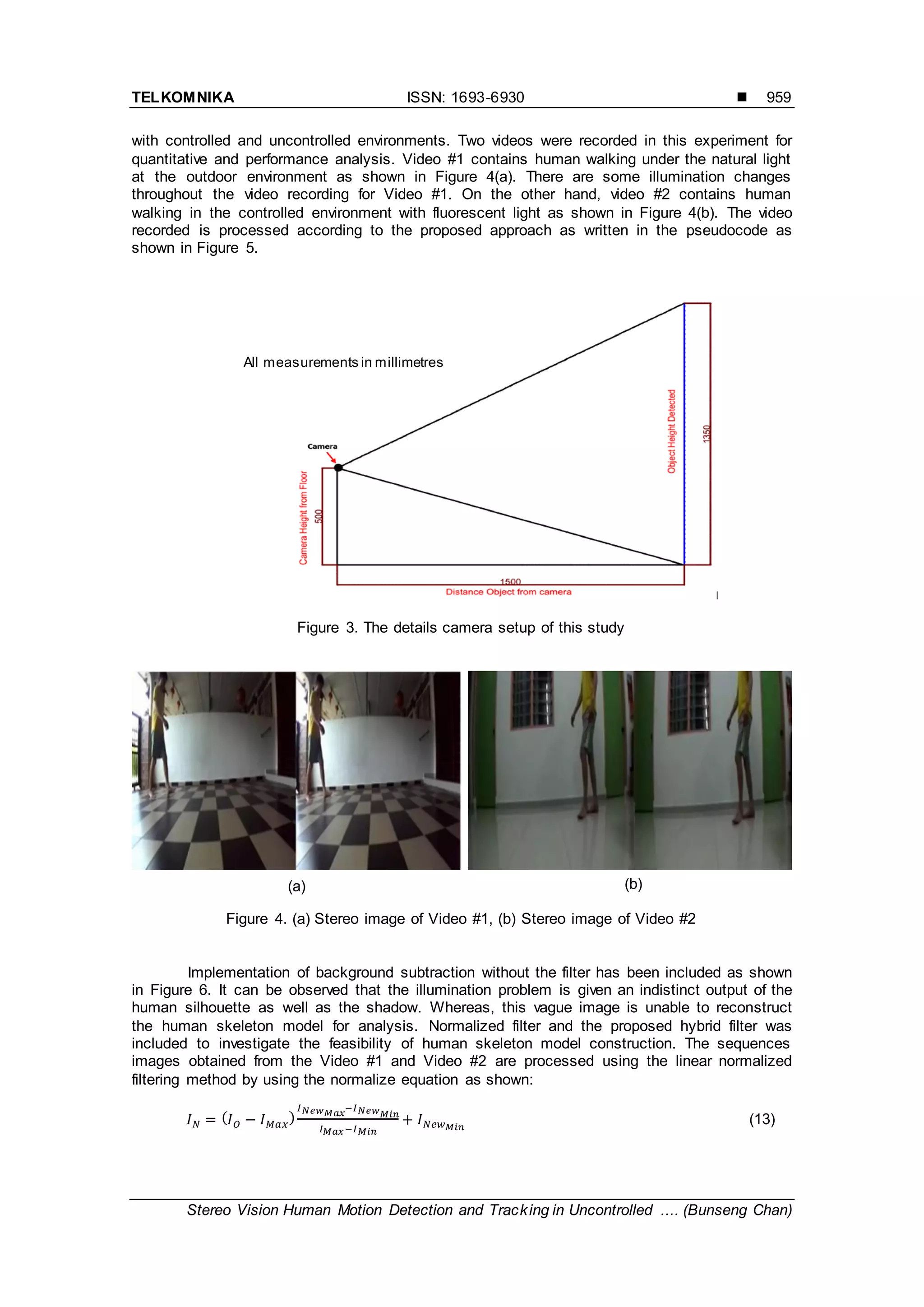
An experimental setup was implemented using a set of high resolution and high frame
rate stereo camera as shown in Figure 2(a). The camera module with depth range between
700mm to 20000mm and the maximum viewing angle provided is 110
o
. The frame size in this
experiment is 1344 × 376 pixels, and the frame rate is 60 FPS. The proposed distance between
camera and subject in this study is 1.5 meter, and details of setup are depicted in Figure 2(b).
The distance of the setup in Figure 2(b) is based on the human capture requirement in gold
standard human motion capture system. The proposed camera height from the floor is 0.5m
depicted in Figure 3.
Figure 2. (a) High frame rate stereo camera module, (b) Proposed camera setup
We ran the proposed setup using a Jetson TX1. Jetson TX1 module possessed NVIDIA
Maxwell
TM
GPU with 256 NVIDIA
®
CUDA
®
Cores and Quad-core ARM
®
Cortex
®
-A57 MPCore
Processor with 4GB LPDDR4 memory.The proposed stereo vision human tracking was tested
Camera
1.5m
Object
(a) (b)
TELKOMNIKA ISSN: 1693-6930 
Stereo Vision Human Motion Detection and Tracking in Uncontrolled .... (Bunseng Chan)
959
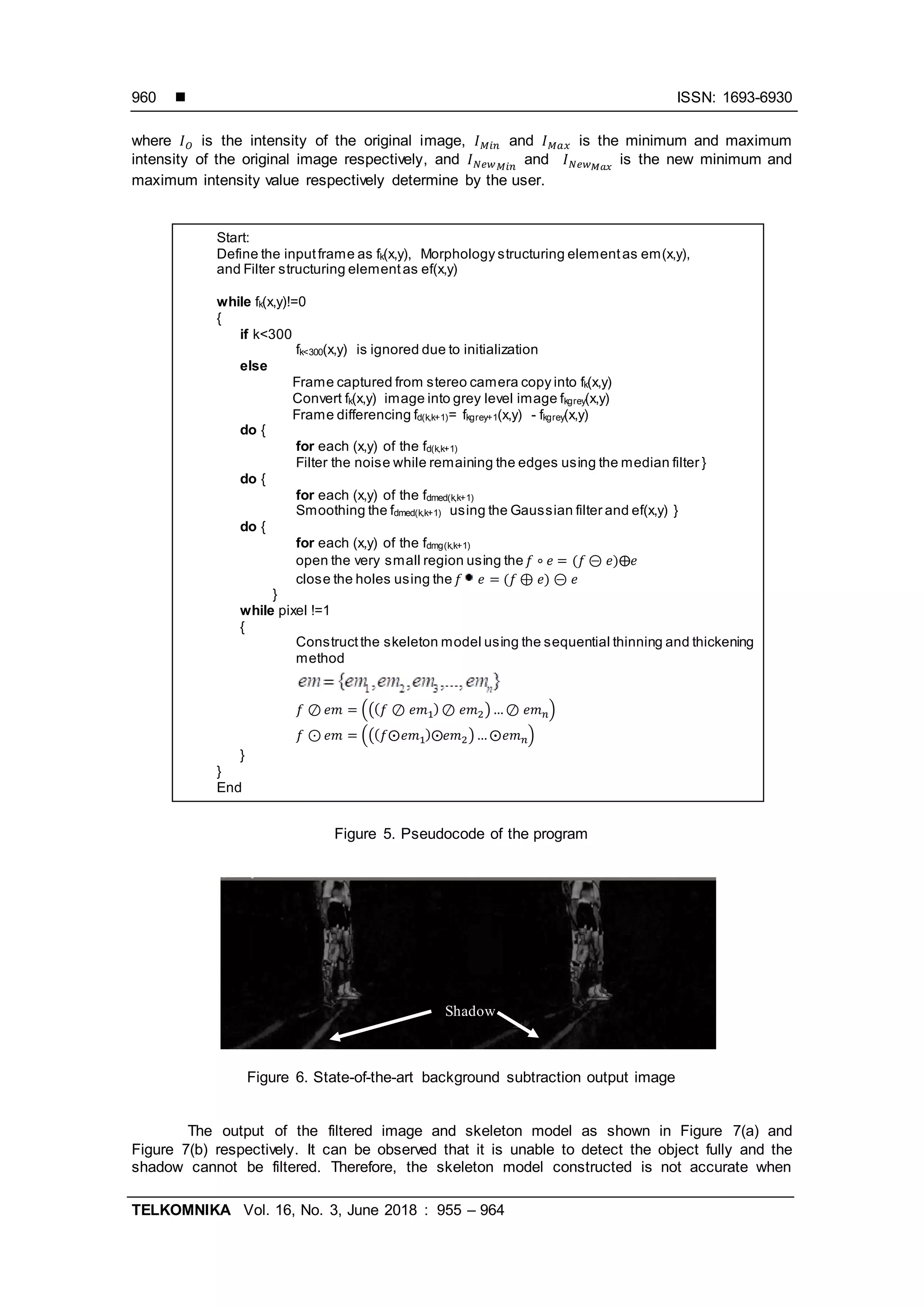
with controlled and uncontrolled environments. Two videos were recorded in this experiment for
quantitative and performance analysis. Video #1 contains human walking under the natural light
at the outdoor environment as shown in Figure 4(a). There are some illumination changes
throughout the video recording for Video #1. On the other hand, video #2 contains human
walking in the controlled environment with fluorescent light as shown in Figure 4(b). The video
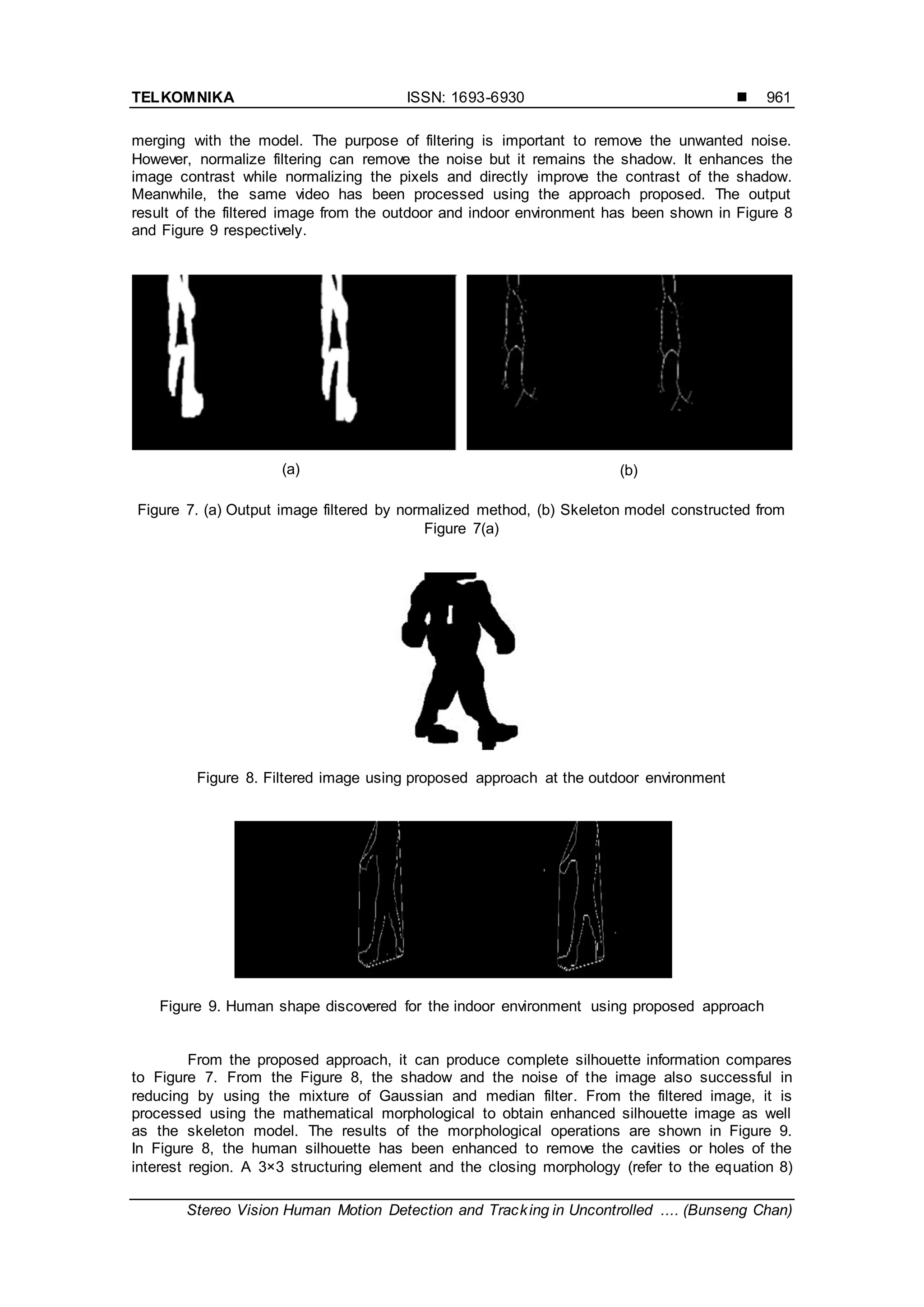
recorded is processed according to the proposed approach as written in the pseudocode as
shown in Figure 5.
Figure 3. The details camera setup of this study
Figure 4. (a) Stereo image of Video #1, (b) Stereo image of Video #2
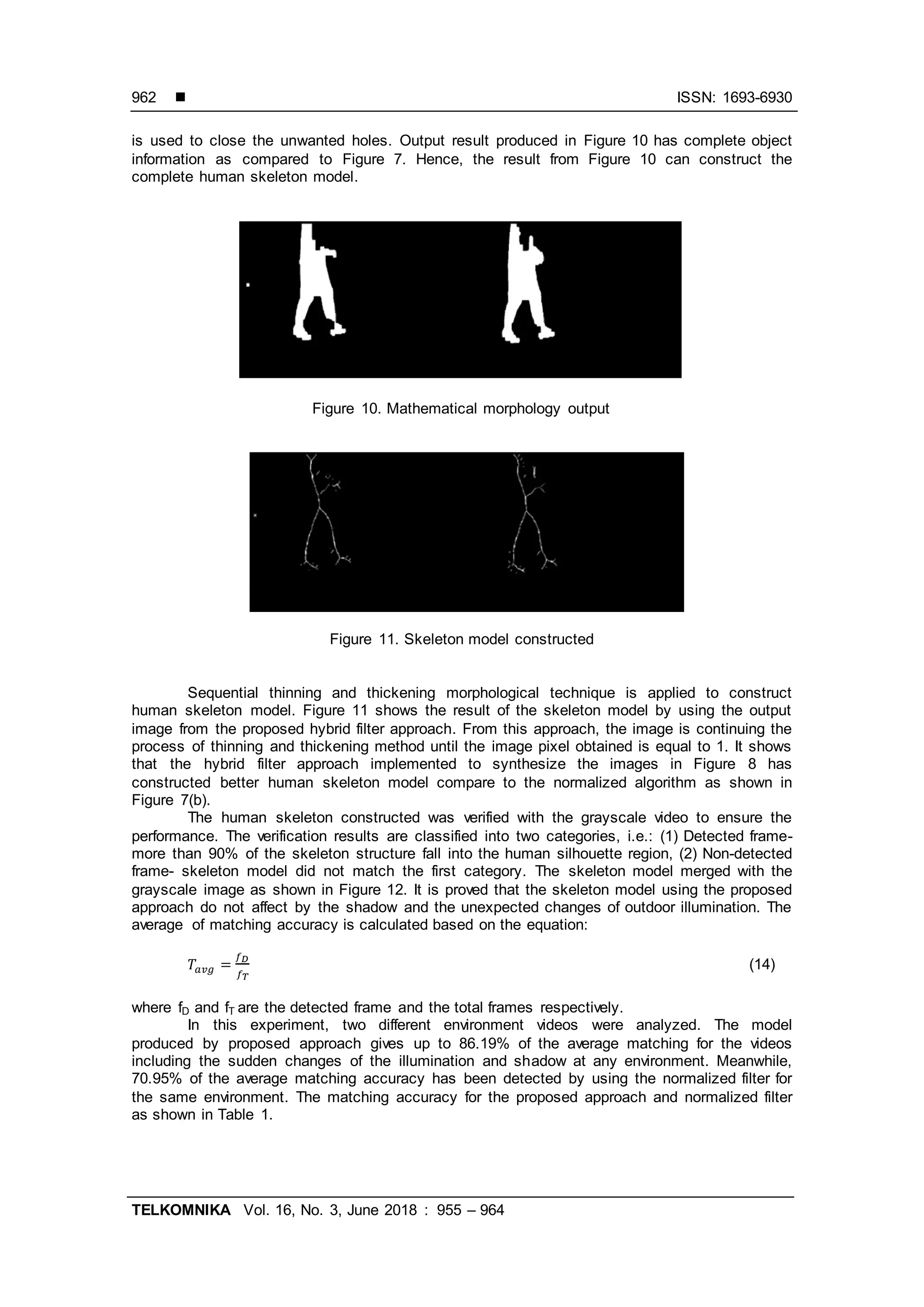
Implementation of background subtraction without the filter has been included as shown
in Figure 6. It can be observed that the illumination problem is given an indistinct output of the
human silhouette as well as the shadow. Whereas, this vague image is unable to reconstruct
the human skeleton model for analysis. Normalized filter and the proposed hybrid filter was
included to investigate the feasibility of human skeleton model construction. The sequences
images obtained from the Video #1 and Video #2 are processed using the linear normalized
filtering method by using the normalize equation as shown:
( ) (13)
All measurements in millimetres
(a) (b)
 ISSN: 1693-6930
TELKOMNIKA Vol. 16, No. 3, June 2018 : 955 – 964
960
where is the intensity of the original image, and is the minimum and maximum
intensity of the original image respectively, and and is the new minimum and
maximum intensity value respectively determine by the user.
Figure 5. Pseudocode of the program
Figure 6. State-of-the-art background subtraction output image
The output of the filtered image and skeleton model as shown in Figure 7(a) and
Figure 7(b) respectively. It can be observed that it is unable to detect the object fully and the
shadow cannot be filtered. Therefore, the skeleton model constructed is not accurate when
Start:
Define the inputframe as fk(x,y), Morphology structuring elementas em(x,y),
and Filter structuring elementas ef(x,y)
while fk(x,y)!=0
{
if k<300
fk<300(x,y) is ignored due to initialization
else
Frame captured from stereo camera copy into fk(x,y)
Convert fk(x,y) image into grey level image fkgrey(x,y)
Frame differencing fd(k,k+1)= fkgrey+1(x,y) - fkgrey(x,y)
do {
for each (x,y) of the fd(k,k+1)
Filter the noise while remaining the edges using the median filter }
do {
for each (x,y) of the fdmed(k,k+1)
Smoothing the fdmed(k,k+1) using the Gaussian filter and ef(x,y) }
do {
for each (x,y) of the fdmg(k,k+1)
open the very small region using the 𝑓 𝑒 (𝑓 𝑒) 𝑒
close the holes using the 𝑓 𝑒 (𝑓 𝑒) 𝑒
}
while pixel !=1
{
Constructthe skeleton model using the sequential thinning and thickening
method
𝑓 𝑒𝑚 ((( 𝑓 𝑒𝑚 ) 𝑒𝑚 ) 𝑒𝑚 𝑛)
}
}
End
Shadow
TELKOMNIKA ISSN: 1693-6930 
Stereo Vision Human Motion Detection and Tracking in Uncontrolled .... (Bunseng Chan)
961
merging with the model. The purpose of filtering is important to remove the unwanted noise.
However, normalize filtering can remove the noise but it remains the shadow. It enhances the
image contrast while normalizing the pixels and directly improve the contrast of the shadow.
Meanwhile, the same video has been processed using the approach proposed. The output
result of the filtered image from the outdoor and indoor environment has been shown in Figure 8
and Figure 9 respectively.
Figure 7. (a) Output image filtered by normalized method, (b) Skeleton model constructed from
Figure 7(a)
Figure 8. Filtered image using proposed approach at the outdoor environment
Figure 9. Human shape discovered for the indoor environment using proposed approach
From the proposed approach, it can produce complete silhouette information compares
to Figure 7. From the Figure 8, the shadow and the noise of the image also successful in
reducing by using the mixture of Gaussian and median filter. From the filtered image, it is
processed using the mathematical morphological to obtain enhanced silhouette image as well
as the skeleton model. The results of the morphological operations are shown in Figure 9.
In Figure 8, the human silhouette has been enhanced to remove the cavities or holes of the
interest region. A 3×3 structuring element and the closing morphology (refer to the equation 8)
(a) (b)
 ISSN: 1693-6930
TELKOMNIKA Vol. 16, No. 3, June 2018 : 955 – 964
962
is used to close the unwanted holes. Output result produced in Figure 10 has complete object
information as compared to Figure 7. Hence, the result from Figure 10 can construct the
complete human skeleton model.
Figure 10. Mathematical morphology output
Figure 11. Skeleton model constructed
Sequential thinning and thickening morphological technique is applied to construct
human skeleton model. Figure 11 shows the result of the skeleton model by using the output
image from the proposed hybrid filter approach. From this approach, the image is continuing the
process of thinning and thickening method until the image pixel obtained is equal to 1. It shows
that the hybrid filter approach implemented to synthesize the images in Figure 8 has
constructed better human skeleton model compare to the normalized algorithm as shown in
Figure 7(b).
The human skeleton constructed was verified with the grayscale video to ensure the
performance. The verification results are classified into two categories, i.e.: (1) Detected frame-
more than 90% of the skeleton structure fall into the human silhouette region, (2) Non-detected
frame- skeleton model did not match the first category. The skeleton model merged with the
grayscale image as shown in Figure 12. It is proved that the skeleton model using the proposed
approach do not affect by the shadow and the unexpected changes of outdoor illumination. The
average of matching accuracy is calculated based on the equation:
(14)
where fD and fT are the detected frame and the total frames respectively.
In this experiment, two different environment videos were analyzed. The model
produced by proposed approach gives up to 86.19% of the average matching for the videos
including the sudden changes of the illumination and shadow at any environment. Meanwhile,
70.95% of the average matching accuracy has been detected by using the normalized filter for
the same environment. The matching accuracy for the proposed approach and normalized filter
as shown in Table 1.
TELKOMNIKA ISSN: 1693-6930 
Stereo Vision Human Motion Detection and Tracking in Uncontrolled .... (Bunseng Chan)
963
Figure 12. Stitching the skeleton model and the grayscale image
Table 1. Matching accuracy of proposed approach
Method fD fT Accuracy
Proposed approach Video #1 600 700 85.71%
Video #2 780 900 86.66%
Normalized Filter [22] Video #1 480 700 68.57%
Video #2 660 900 73.33%
In Table 1, it can be observed that the matching accuracy for the proposed approach
can achieve 86% of accuracy, which is higher than normalized filter. Meanwhile, the sensitivity
of the proposed approach is measured as the number of detected human in video frames
without the influence of the sudden illumination change and shadow [23]. The sensitivity
measurement is shown as follows [24]:
(15)
where TP is the number of frames detected as a human object when human exists in the frame,
and FN is the number of frames detected as a non-human object when human exists in the
frame.
Comparison of the sensitivity measurement for proposed approach and normalized filter
in two videos as shown in Table 2. It can be seen that the sensitivity of the proposed approach
in human detection is much higher than the normalized filter in uncontrolled environment.
Therefore, this proposed approach can improve the sudden illumination changing and shadow
issues.
Table 2. Sensitivity analysis of proposed approach
Method TP FN S
Proposed approach Video #1 420 30 93.3%
Video #2 590 40 93.7%
Normalized Filter Video #1 360 120 75.0%
Video #2 490 180 73.1%
4. Conclusion
A hybrid filter approach consisting of a Gaussian and Median filter is proposed in this
paper to detect human motion in an uncontrolled environment. Problems of sudden changes of
the illumination at the outdoor environment and the shadow produced during human movement
are removed using the hybrid filter. Subsequently, a sequential morphological method is used to
construct the skeleton model. With the proposed approach, the shadow of an image is reduced,
and the skeleton built are matched with the stereo vision. It has obtained approximately 86% of
the average matching accuracy and achieved nearly 94% of the detection sensitivity. In future
work, the focus on the occlusion issue will be addressed by three-dimensional human
construction and human model tracking with the proposed approach. In addition, multiple stereo
cameras are used to increase the distance of the recording to capture the full object information
for the tracking purpose.
 ISSN: 1693-6930
TELKOMNIKA Vol. 16, No. 3, June 2018 : 955 – 964
964
Acknowledgement
The authors would like to acknowledge the financial support from E-Science-Fund (03-
02-07-SF0035) of MOSTI Malaysia. We gratefully acknowledge the support of NVIDIA
Corporation with the contribution of the TITAN X used for this research.
References
[1] RA Hamzah and H Ibrahim. Literature survey on stereo vision disparity map algorithms. J. Sensors.
2016; 2016.
[2] T Inoue and H Ohzu. Accommodative responses to stereoscopic three-dimensional display. Appl.
Opt. 1997; 36(19): 4509–4515.
[3] R Khilar, S Chitrakala, SS Parvathy. 3D image reconstruction: Techniques, applications and
challenges. 2013 Int. Conf. Opt. Imaging Sens. Secur. 2013: 1–6.
[4] DL Fernández, FJM Cuevas, AC Poyato, RM Salinas, RM Carnicer. A new approach for multi-view
gait recognition on unconstrained paths. J. Vis. Commun. Image Represent. 2016.
[5] G Bianco,A Gallo, F Bruno,M Muzzupappa. A Comparison Between Active and Passive Techniques
for Underwater 3D Applications. ISPRS - Int. Arch. Photogramm. Remote Sens. Spat. Inf. Sci. 2012;
XXXVIII-5: 357–363.
[6] A Leone, G Diraco, C Distante. A Stereo Vision Framework for 3-D Underwater Mosaicking. Stereo
Vis. 2008: 372.
[7] T Deley. Low-Cost Depth Cameras to Emerge in 2010. Hizook. 2010.
[8] K Litomisky. Consumer rgb-d cameras and their applications. Rapp. Tech. 2012.
[9] N Uchida, T Shibahara, T Aoki, H Nakajima, K Kobayashi. 3D face recognition using passive stereo
vision. IEEE Int. Conf. Image Process. 2005: 2: 950–953.
[10] V Ganapathi,C Plagemann,D Koller,S Thrun. Real time motion capture using a single time-of-flight
camera. 2010 IEEE Comput. Soc. Conf. Comput. Vis. Pattern Recognit. 2010: 755–762.
[11] M Moussa,M Hmila,A Douik.Comparative study of statistical background modeling and subtraction.
Indonesiab Journal of Electical Engineering and Computer Science. 2017; 8(2): 287–295.
[12] JK I and P Peer. Human Skeleton Model Based Dynamic Features for Walking Speed Invariant Gait
Recognition. 2014.
[13] R Chandel and G Gupta. Image Filtering Algorithms and Techniques: A Review. Int. J. Adv. Res.
Comput. Sci. Softw. Eng. 2013; 3(10): 2277–128.
[14] L Wang, T Tan, S Member, H Ning, W Hu. Silhouette Analysis-Based Gait Recognition for Human
Identification. IEEE Trans. Pattern Anal. Mach. Intell. 2003; 25(12): 1505–1518.
[15] F Angella, O Lavialle, P Baylou. Hierarchical Skeleton Extraction Based on A Deformable Particle
System. Signal Processing Conference (EUSIPCO 1998). 1998.
[16] X Yuan, X Hao, H Chen, X Wei. Background Modeling Method based on 3D Shape Reconstruction
Technology. Indonesian Jounal ofElectrical Engineering and Computer Science. 2013; 11(4): 2079–
2083.
[17] R Dahyot, G Lacey, KD Howe, F Pitié, D Moloney. 3D Reconstruction of Reflective Spherical
Surfaces from Multiple Images. IRISH MACHINE VISION & IMAGE PROCESSING Conference
proceedings 2015. 2014: 201.
[18] VA Gowri and AC Subhajini. A Flexible Algorithm for Conversion of RGB Image to Gray Image using
MATLAB. Int. J. Control Theory Appl. 2017; 10(27): 153–161.
[19] EA Castro and DL Donoho.Does Median Filtering Truly Preserve Edges Better Than Linear Filtering.
Ann. Stat. 2009; 37(3): 1172–1206.
[20] S Beucher. Critical Balls. Int. Congr. Stereol. 2013.
[21] G Sanniti and CE Caianiello. 2D Grey-level Skeleton Computation : A Discrete 3D Approach.
International Conference on Pattern Recognition. 2004: 2–5.
[22] W Wu, J Shao, W Guo. Moving-object Detection Based on Shadow Removal and Prospect.
International Conference on Artificial Intelligence and Soft Computing. 2012; 12(2): 369–374.
[23] DK Singh.Gaussian Elliptical Fitting based Skin Color Modeling for Human Detection. in 2017 IEEE
8th Control and System Graduate Research Colloquium. 2017: 197–201.
[24] M Sundaram and A Mani. Face Recognition : Demystification of Multifarious Aspect in Evaluation
Metrics. in Face Recognition - Semisupervised Classification, Subspace Projection and Evaluation
Methods, S. Ramakrishnan, Ed. INTECH. 2016: 75–92.

Stereo Vision Human Motion Detection and Tracking in Uncontrolled Environment

  • 1.
    TELKOMNIKA, Vol.16, No.3,June 2018, pp. 955~964 ISSN: 1693-6930, accredited A by DIKTI, Decree No: 58/DIKTI/Kep/2013 DOI: 10.12928/TELKOMNIKA.v16i3.9033  955 Received December 23, 2017; Revised April 9, 2018; Accepted April 27, 2018 Stereo Vision Human Motion Detection and Tracking in Uncontrolled Environment Bunseng Chan* 1 , King Hann Lim 2 , Lenin Gopal 3 , Alpha Agape Gopalai 4 , Darwin Gouwanda 5 1,2,3 Department of Electrical and Computer Engineering, Faculty of Engineering and Science, Curtin University Malaysia 4,5 Mechatronic Engineering Department, School of Engineering, Monash University Malaysia *Corresponding author, e-mail: bunsengchan@ieee.org Abstract Stereo vision in detecting human motion is an emerging research for automation, robotics, and sports science field due to the advancementofimaging sensors and information technology. The difficulty of human motion detection and tracking is relatively complex when it is applied to uncontrolled environment. In this paper, a hybrid filter approach is proposed to detect human motion in the stereo vision. The hybrid filter approach integrates Gaussian filter and median filter to reduce the coverage of shadow and sudden change of illumination. In addition,sequential thinning and thickening morphological method is used to construct the skeleton model. The proposed hybrid approach is compared with the normalized filter. As a result, the proposed approach produces better skeleton model with less influential effect on shadow and illumination. The output results of the proposed approach can show up to 86% of average accuracy matched with skeleton model. In addition, obtains approximately 94% of sensitivity measurementin the stereo vision. The proposed approach using hybrid filter and sequential morphology could improve the performance of the detection in the uncontrolled environment. Keywords:Stereo vision,human motion detection and tracking,sequential morphology,skeleton model Copyright © 2018 Universitas Ahmad Dahlan. All rights reserved. 1. Introduction The technology of stereo vision has grown exponentially nowadays as a sensory tool to capture visual information. Inspired by human eyes, stereo vision uses two cameras displaced horizontally on a calibrated platform to reconstruct three-dimensional (3D) perception of an object based on the visual properties such as shape, color distribution, and illumination [1]-[2]. With the emerging of the imaging sensors and computer vision technology, the application of the stereo vision is extended to various industrial fields including virtual reality, gaming, military training filmmaking, and sports activities [3]-[4]. Stereo vision can be divided into two categories, i.e., active stereo-vision and passive stereo-vision. Active stereo vision uses direct light source radiance on a subject, and the reflected light is captured via a camera [5]. However, the cost of the active stereo vision is relatively high, and its visual output is affected by surrounding illumination [6]. On the other hand, active stereo vision incorporated with the depth sensors including ranging camera, flash LIDAR, time-of-flight, and RGB-D camera to improve its performance [7]. Nevertheless, the field of view and resolution for this camera system is restricted by the specification of depth sensors [8]. Conversely, passive stereo vision constructs the images based on the interreflection of the light source to the subject [5]. Passive stereo vision is commonly used in 3D image reconstruction due to its simplicity. It is a user-friendly system, and the system cost is low [9]. Ganapathi et al. [10] used the graphics processing unit (GPU) with single time-of-flight (ToF) camera to capture the object. The ToF camera measures the depth of the object with the assist of the depth sensors unit to produce the 3D information. This system increases the robustness of the system, but it requires high dimensionality of the memory space for the processing. Human detection and segmentation methods are the initial step of the human features extraction before proceed to the gait analysis. Background subtraction is one of the commonly used background removals to detect the object in image sequences. However, background
  • 2.
     ISSN: 1693-6930 TELKOMNIKAVol. 16, No. 3, June 2018 : 955 – 964 956 subtraction method has limitation in extracting fine human object from an uncontrolled environment due to illumination [11]. This limitation was led to the failure of full human feature extraction for further analysis. The human feature is also known as human silhouette, which is important for the human skeleton model construction in motion analysis [12]. Hence, image enhancement is important to improve the human feature extraction. Image filtering is one of the image enhancing techniques integrating into background subtraction to enhance the image quality. Commonly, image filter is used to emphasize the image features or smoothen the noises of the image. However, the selection of the filter must be appropriated to achieve an optimum output for analysis purpose. The sudden illumination change is still one of the challenges needed to be overcome in image processing. Various type of filters including mean filter, Gaussian filter, and median filter has been applied by the researchers to improve the sudden illumination change issue [13]. Nevertheless, it does not achieve an ideal output required in the uncontrolled environment. In this paper, the use of a hybrid filter is proposed for an accurate human detection in stereo vision under an uncontrolled environment. The paper is outlined into three sections. Sections 2 is the overview of human detection and tracking in stereo vision; and Section 3 shows the experimental setup, experimental results and discussion. 2. Human Detection and Tracking in Stereo Vision This work aims to establish human detection and tracking in an uncontrolled environment using stereo cameras. Human motion being detected from stereo vision can be used as gait recognition and analysis. Hence, human detection is the important step to recognize the dynamic object in a video. Once human is detected, human tracking is applied to localize an human object continuously in a video to ensure the computational reduction for real- time application [14]. Human skeleton extraction is one of the tracking methods employed in human object. It basically uses the mathematical morphology algorithms to enhance the human model and display the relevant connection of the human joints [15]. Human detection and tracking is relatively complex when it is performed in the uncontrolled due to the unpredicted illumination changes and complex background [16]. An overview of the proposed algorithm is shown in Figure 1. It consists of two major sections, i.e., human detection and segmentation, and human tracking with skeleton model. The first part assists to capture, detect the human, and enhance the motion segmentation. Meanwhile, the second part serves as continuous tracking of the detected object from the previous segment and transforms into skeleton model. Stereo camera emulates human vision using two passive cameras to initiate 3D capability of human eyes in a digital world [17]. The output of the stereo vision provided depth information which provided more detail information about the object. In addition, it improves the robustness of the object information. There are many applications in entertainment and training system due to its advantages. In a color image, it consists of three color channels, i.e., Red, Green, and Blue (RGB). However, direct image processing using three channels largely increases the computational cost of system. Therefore, a pre-processing module was included to transform the color image obtained from the stereo camera into a grayscale image. By combining of the normalized RGB value, it produces the neutral white color (R+G+B=1). The grayscale image can be obtained by combining the 29.5% of Red value, 55.4% of the Green value, and 14.8% of the Blue value [18]. The combination of this value produces the grayscale image.The conversion of the color scale to grayscale image is based on the equation shown as follows: ( ) ( ) ( ) (1) A two frame differentiation method is employed to remove the background and obtain the human motion from the frame. The frame differentiation formula defines as: ( ) { ( ) (2)
  • 3.
    TELKOMNIKA ISSN: 1693-6930 Stereo Vision Human Motion Detection and Tracking in Uncontrolled .... (Bunseng Chan) 957 kkkkd fff   1)1,( (3) where ( ) is the two-frame differencing, is the frame at k+1 in the image sequences, and is the current frame or frame k in the image sequences. Human motion detected using the two-frame differencing faces illumination issue when the system is implemented at the outdoor environment. Therefore, post-processing is required to remove the illumination problem. Generally, the median filter is used to reduce the noise of an image and remain the edges [19]. Meanwhile, the Gaussian filter uses Gaussian function to smooth the little-unwanted noises. In the post-processing module, a hybrid filter integrating Gaussian filter and median filter is proposed to remove the effect of shadow. The hybrid filter equation is shown as follows: ( ) ( ) ( ) (4) ( ) (5) ( ) * ( ) + (6) where ( ) is the output image, G(x,y) and M(x,y) is the Gaussian filter and median filter respectively, is the standard deviation of the distribution, and is the mask. Figure 1. Overview of the proposed approach The human detected is then enhanced its features after the noise filtering. The enhancement involving mathematical morphology to removes the cavities, holes, or opens up holes of the unwanted region. The mathematical morphology involves in this process including the opening and closing morphology. The mathematical morphology for opening and closing of an image ( ) by a structuring element ( ) and its defined accordingly as: ( ) (7)  ( ) (8) Human tracking w ith skeleton model Human detection and segmentation Frame Differentiation Pre-Processing Post-Processing (Hybrid Filter) Human Tracking Human Skeleton (Sequential Morphology) Stereo Camera
  • 4.
     ISSN: 1693-6930 TELKOMNIKAVol. 16, No. 3, June 2018 : 955 – 964 958 The detected human shape recovered its features then is used for continuous tracking of its movement and transform into skeleton model. The skeleton model is a stick diagram of an object which is used for to representing its basic shape. Basically, the skeleton construction can be done in two different techniques, i.e., maximal balls technique, and thinning and thickening technique [15]. Maximal balls technique used multiple constant radius balls concept in a Euclidean space to identify the center of the structure to construct the skeleton [20]. However, maximal balls technique produced disconnected skeleton model during its construction and did not provide an efficient extraction [20]. Hence, it is not suitable for the human skeleton construction. Therefore, the human skeleton construction in this module will focus only on thinning and thickening technique. Basically, the thinning and thickening technique is using the sequential method as structuring elements [21]. The basic mathematical morphology for thinning and thickening of an image ( ) is composite with a structuring element ( ) as defined accordingly as: ( ) (9) ( ) (10) Sequential structuring element will be employed to construct the skeleton model using the thinning and thickening equation respectively as shown: Let },...,,,{ 321 neeeee  ((( ) ) ) (11) ((( ) ) ) (12) 3. Experimental Results and Discussion An experimental setup was implemented using a set of high resolution and high frame rate stereo camera as shown in Figure 2(a). The camera module with depth range between 700mm to 20000mm and the maximum viewing angle provided is 110 o . The frame size in this experiment is 1344 × 376 pixels, and the frame rate is 60 FPS. The proposed distance between camera and subject in this study is 1.5 meter, and details of setup are depicted in Figure 2(b). The distance of the setup in Figure 2(b) is based on the human capture requirement in gold standard human motion capture system. The proposed camera height from the floor is 0.5m depicted in Figure 3. Figure 2. (a) High frame rate stereo camera module, (b) Proposed camera setup We ran the proposed setup using a Jetson TX1. Jetson TX1 module possessed NVIDIA Maxwell TM GPU with 256 NVIDIA ® CUDA ® Cores and Quad-core ARM ® Cortex ® -A57 MPCore Processor with 4GB LPDDR4 memory.The proposed stereo vision human tracking was tested Camera 1.5m Object (a) (b)
  • 5.
    TELKOMNIKA ISSN: 1693-6930 Stereo Vision Human Motion Detection and Tracking in Uncontrolled .... (Bunseng Chan) 959 with controlled and uncontrolled environments. Two videos were recorded in this experiment for quantitative and performance analysis. Video #1 contains human walking under the natural light at the outdoor environment as shown in Figure 4(a). There are some illumination changes throughout the video recording for Video #1. On the other hand, video #2 contains human walking in the controlled environment with fluorescent light as shown in Figure 4(b). The video recorded is processed according to the proposed approach as written in the pseudocode as shown in Figure 5. Figure 3. The details camera setup of this study Figure 4. (a) Stereo image of Video #1, (b) Stereo image of Video #2 Implementation of background subtraction without the filter has been included as shown in Figure 6. It can be observed that the illumination problem is given an indistinct output of the human silhouette as well as the shadow. Whereas, this vague image is unable to reconstruct the human skeleton model for analysis. Normalized filter and the proposed hybrid filter was included to investigate the feasibility of human skeleton model construction. The sequences images obtained from the Video #1 and Video #2 are processed using the linear normalized filtering method by using the normalize equation as shown: ( ) (13) All measurements in millimetres (a) (b)
  • 6.
     ISSN: 1693-6930 TELKOMNIKAVol. 16, No. 3, June 2018 : 955 – 964 960 where is the intensity of the original image, and is the minimum and maximum intensity of the original image respectively, and and is the new minimum and maximum intensity value respectively determine by the user. Figure 5. Pseudocode of the program Figure 6. State-of-the-art background subtraction output image The output of the filtered image and skeleton model as shown in Figure 7(a) and Figure 7(b) respectively. It can be observed that it is unable to detect the object fully and the shadow cannot be filtered. Therefore, the skeleton model constructed is not accurate when Start: Define the inputframe as fk(x,y), Morphology structuring elementas em(x,y), and Filter structuring elementas ef(x,y) while fk(x,y)!=0 { if k<300 fk<300(x,y) is ignored due to initialization else Frame captured from stereo camera copy into fk(x,y) Convert fk(x,y) image into grey level image fkgrey(x,y) Frame differencing fd(k,k+1)= fkgrey+1(x,y) - fkgrey(x,y) do { for each (x,y) of the fd(k,k+1) Filter the noise while remaining the edges using the median filter } do { for each (x,y) of the fdmed(k,k+1) Smoothing the fdmed(k,k+1) using the Gaussian filter and ef(x,y) } do { for each (x,y) of the fdmg(k,k+1) open the very small region using the 𝑓 𝑒 (𝑓 𝑒) 𝑒 close the holes using the 𝑓 𝑒 (𝑓 𝑒) 𝑒 } while pixel !=1 { Constructthe skeleton model using the sequential thinning and thickening method 𝑓 𝑒𝑚 ((( 𝑓 𝑒𝑚 ) 𝑒𝑚 ) 𝑒𝑚 𝑛) 𝑓 𝑒𝑚 ((( 𝑓 𝑒𝑚 ) 𝑒𝑚 ) 𝑒𝑚 𝑛) } } End Shadow
  • 7.
    TELKOMNIKA ISSN: 1693-6930 Stereo Vision Human Motion Detection and Tracking in Uncontrolled .... (Bunseng Chan) 961 merging with the model. The purpose of filtering is important to remove the unwanted noise. However, normalize filtering can remove the noise but it remains the shadow. It enhances the image contrast while normalizing the pixels and directly improve the contrast of the shadow. Meanwhile, the same video has been processed using the approach proposed. The output result of the filtered image from the outdoor and indoor environment has been shown in Figure 8 and Figure 9 respectively. Figure 7. (a) Output image filtered by normalized method, (b) Skeleton model constructed from Figure 7(a) Figure 8. Filtered image using proposed approach at the outdoor environment Figure 9. Human shape discovered for the indoor environment using proposed approach From the proposed approach, it can produce complete silhouette information compares to Figure 7. From the Figure 8, the shadow and the noise of the image also successful in reducing by using the mixture of Gaussian and median filter. From the filtered image, it is processed using the mathematical morphological to obtain enhanced silhouette image as well as the skeleton model. The results of the morphological operations are shown in Figure 9. In Figure 8, the human silhouette has been enhanced to remove the cavities or holes of the interest region. A 3×3 structuring element and the closing morphology (refer to the equation 8) (a) (b)
  • 8.
     ISSN: 1693-6930 TELKOMNIKAVol. 16, No. 3, June 2018 : 955 – 964 962 is used to close the unwanted holes. Output result produced in Figure 10 has complete object information as compared to Figure 7. Hence, the result from Figure 10 can construct the complete human skeleton model. Figure 10. Mathematical morphology output Figure 11. Skeleton model constructed Sequential thinning and thickening morphological technique is applied to construct human skeleton model. Figure 11 shows the result of the skeleton model by using the output image from the proposed hybrid filter approach. From this approach, the image is continuing the process of thinning and thickening method until the image pixel obtained is equal to 1. It shows that the hybrid filter approach implemented to synthesize the images in Figure 8 has constructed better human skeleton model compare to the normalized algorithm as shown in Figure 7(b). The human skeleton constructed was verified with the grayscale video to ensure the performance. The verification results are classified into two categories, i.e.: (1) Detected frame- more than 90% of the skeleton structure fall into the human silhouette region, (2) Non-detected frame- skeleton model did not match the first category. The skeleton model merged with the grayscale image as shown in Figure 12. It is proved that the skeleton model using the proposed approach do not affect by the shadow and the unexpected changes of outdoor illumination. The average of matching accuracy is calculated based on the equation: (14) where fD and fT are the detected frame and the total frames respectively. In this experiment, two different environment videos were analyzed. The model produced by proposed approach gives up to 86.19% of the average matching for the videos including the sudden changes of the illumination and shadow at any environment. Meanwhile, 70.95% of the average matching accuracy has been detected by using the normalized filter for the same environment. The matching accuracy for the proposed approach and normalized filter as shown in Table 1.
  • 9.
    TELKOMNIKA ISSN: 1693-6930 Stereo Vision Human Motion Detection and Tracking in Uncontrolled .... (Bunseng Chan) 963 Figure 12. Stitching the skeleton model and the grayscale image Table 1. Matching accuracy of proposed approach Method fD fT Accuracy Proposed approach Video #1 600 700 85.71% Video #2 780 900 86.66% Normalized Filter [22] Video #1 480 700 68.57% Video #2 660 900 73.33% In Table 1, it can be observed that the matching accuracy for the proposed approach can achieve 86% of accuracy, which is higher than normalized filter. Meanwhile, the sensitivity of the proposed approach is measured as the number of detected human in video frames without the influence of the sudden illumination change and shadow [23]. The sensitivity measurement is shown as follows [24]: (15) where TP is the number of frames detected as a human object when human exists in the frame, and FN is the number of frames detected as a non-human object when human exists in the frame. Comparison of the sensitivity measurement for proposed approach and normalized filter in two videos as shown in Table 2. It can be seen that the sensitivity of the proposed approach in human detection is much higher than the normalized filter in uncontrolled environment. Therefore, this proposed approach can improve the sudden illumination changing and shadow issues. Table 2. Sensitivity analysis of proposed approach Method TP FN S Proposed approach Video #1 420 30 93.3% Video #2 590 40 93.7% Normalized Filter Video #1 360 120 75.0% Video #2 490 180 73.1% 4. Conclusion A hybrid filter approach consisting of a Gaussian and Median filter is proposed in this paper to detect human motion in an uncontrolled environment. Problems of sudden changes of the illumination at the outdoor environment and the shadow produced during human movement are removed using the hybrid filter. Subsequently, a sequential morphological method is used to construct the skeleton model. With the proposed approach, the shadow of an image is reduced, and the skeleton built are matched with the stereo vision. It has obtained approximately 86% of the average matching accuracy and achieved nearly 94% of the detection sensitivity. In future work, the focus on the occlusion issue will be addressed by three-dimensional human construction and human model tracking with the proposed approach. In addition, multiple stereo cameras are used to increase the distance of the recording to capture the full object information for the tracking purpose.
  • 10.
     ISSN: 1693-6930 TELKOMNIKAVol. 16, No. 3, June 2018 : 955 – 964 964 Acknowledgement The authors would like to acknowledge the financial support from E-Science-Fund (03- 02-07-SF0035) of MOSTI Malaysia. We gratefully acknowledge the support of NVIDIA Corporation with the contribution of the TITAN X used for this research. References [1] RA Hamzah and H Ibrahim. Literature survey on stereo vision disparity map algorithms. J. Sensors. 2016; 2016. [2] T Inoue and H Ohzu. Accommodative responses to stereoscopic three-dimensional display. Appl. Opt. 1997; 36(19): 4509–4515. [3] R Khilar, S Chitrakala, SS Parvathy. 3D image reconstruction: Techniques, applications and challenges. 2013 Int. Conf. Opt. Imaging Sens. Secur. 2013: 1–6. [4] DL Fernández, FJM Cuevas, AC Poyato, RM Salinas, RM Carnicer. A new approach for multi-view gait recognition on unconstrained paths. J. Vis. Commun. Image Represent. 2016. [5] G Bianco,A Gallo, F Bruno,M Muzzupappa. A Comparison Between Active and Passive Techniques for Underwater 3D Applications. ISPRS - Int. Arch. Photogramm. Remote Sens. Spat. Inf. Sci. 2012; XXXVIII-5: 357–363. [6] A Leone, G Diraco, C Distante. A Stereo Vision Framework for 3-D Underwater Mosaicking. Stereo Vis. 2008: 372. [7] T Deley. Low-Cost Depth Cameras to Emerge in 2010. Hizook. 2010. [8] K Litomisky. Consumer rgb-d cameras and their applications. Rapp. Tech. 2012. [9] N Uchida, T Shibahara, T Aoki, H Nakajima, K Kobayashi. 3D face recognition using passive stereo vision. IEEE Int. Conf. Image Process. 2005: 2: 950–953. [10] V Ganapathi,C Plagemann,D Koller,S Thrun. Real time motion capture using a single time-of-flight camera. 2010 IEEE Comput. Soc. Conf. Comput. Vis. Pattern Recognit. 2010: 755–762. [11] M Moussa,M Hmila,A Douik.Comparative study of statistical background modeling and subtraction. Indonesiab Journal of Electical Engineering and Computer Science. 2017; 8(2): 287–295. [12] JK I and P Peer. Human Skeleton Model Based Dynamic Features for Walking Speed Invariant Gait Recognition. 2014. [13] R Chandel and G Gupta. Image Filtering Algorithms and Techniques: A Review. Int. J. Adv. Res. Comput. Sci. Softw. Eng. 2013; 3(10): 2277–128. [14] L Wang, T Tan, S Member, H Ning, W Hu. Silhouette Analysis-Based Gait Recognition for Human Identification. IEEE Trans. Pattern Anal. Mach. Intell. 2003; 25(12): 1505–1518. [15] F Angella, O Lavialle, P Baylou. Hierarchical Skeleton Extraction Based on A Deformable Particle System. Signal Processing Conference (EUSIPCO 1998). 1998. [16] X Yuan, X Hao, H Chen, X Wei. Background Modeling Method based on 3D Shape Reconstruction Technology. Indonesian Jounal ofElectrical Engineering and Computer Science. 2013; 11(4): 2079– 2083. [17] R Dahyot, G Lacey, KD Howe, F Pitié, D Moloney. 3D Reconstruction of Reflective Spherical Surfaces from Multiple Images. IRISH MACHINE VISION & IMAGE PROCESSING Conference proceedings 2015. 2014: 201. [18] VA Gowri and AC Subhajini. A Flexible Algorithm for Conversion of RGB Image to Gray Image using MATLAB. Int. J. Control Theory Appl. 2017; 10(27): 153–161. [19] EA Castro and DL Donoho.Does Median Filtering Truly Preserve Edges Better Than Linear Filtering. Ann. Stat. 2009; 37(3): 1172–1206. [20] S Beucher. Critical Balls. Int. Congr. Stereol. 2013. [21] G Sanniti and CE Caianiello. 2D Grey-level Skeleton Computation : A Discrete 3D Approach. International Conference on Pattern Recognition. 2004: 2–5. [22] W Wu, J Shao, W Guo. Moving-object Detection Based on Shadow Removal and Prospect. International Conference on Artificial Intelligence and Soft Computing. 2012; 12(2): 369–374. [23] DK Singh.Gaussian Elliptical Fitting based Skin Color Modeling for Human Detection. in 2017 IEEE 8th Control and System Graduate Research Colloquium. 2017: 197–201. [24] M Sundaram and A Mani. Face Recognition : Demystification of Multifarious Aspect in Evaluation Metrics. in Face Recognition - Semisupervised Classification, Subspace Projection and Evaluation Methods, S. Ramakrishnan, Ed. INTECH. 2016: 75–92.