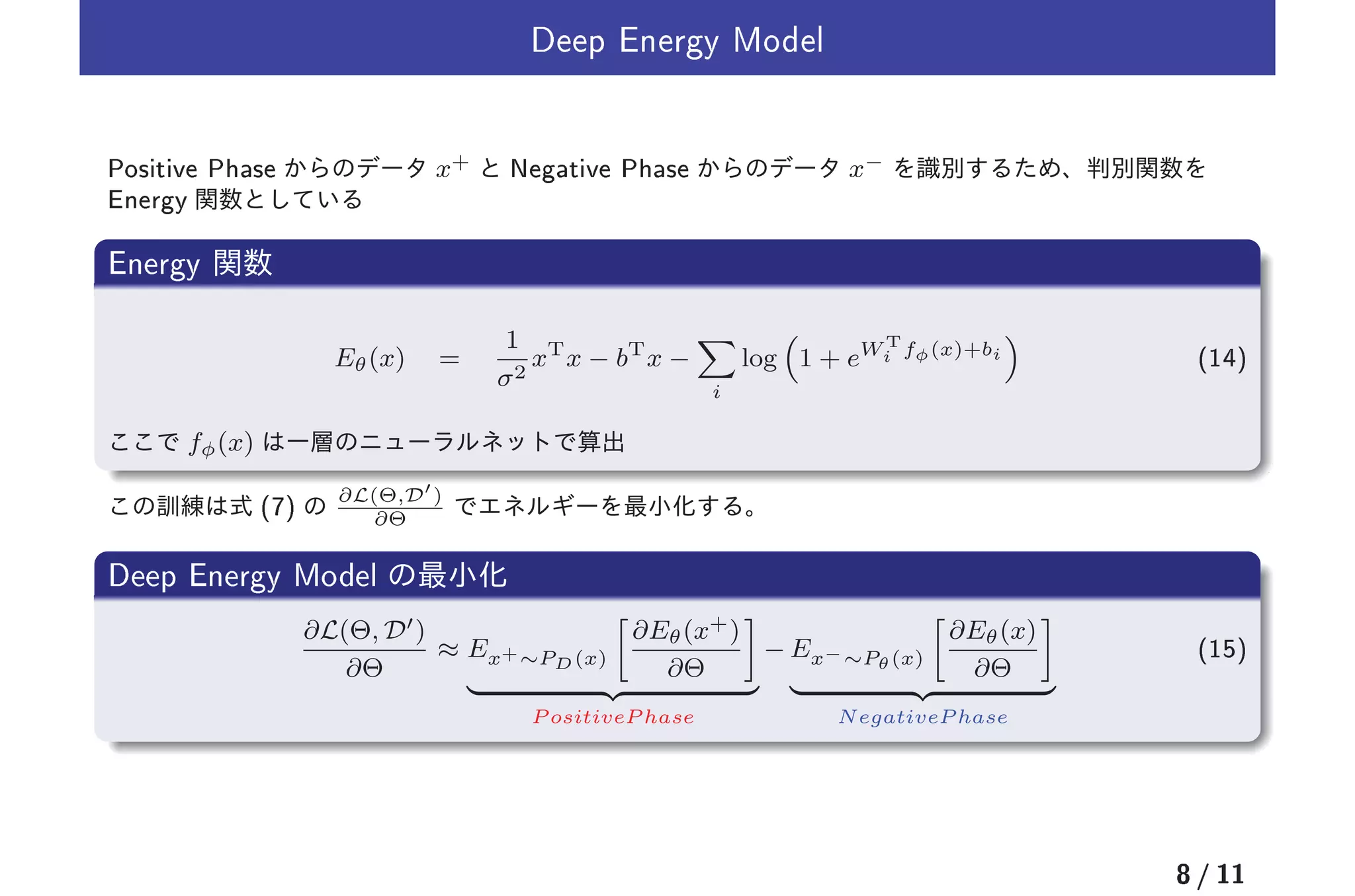
1) The document discusses deep directed generative models that use energy-based probability estimation. It describes using an energy function to define a probability distribution over data and training the model using positive and negative phases.
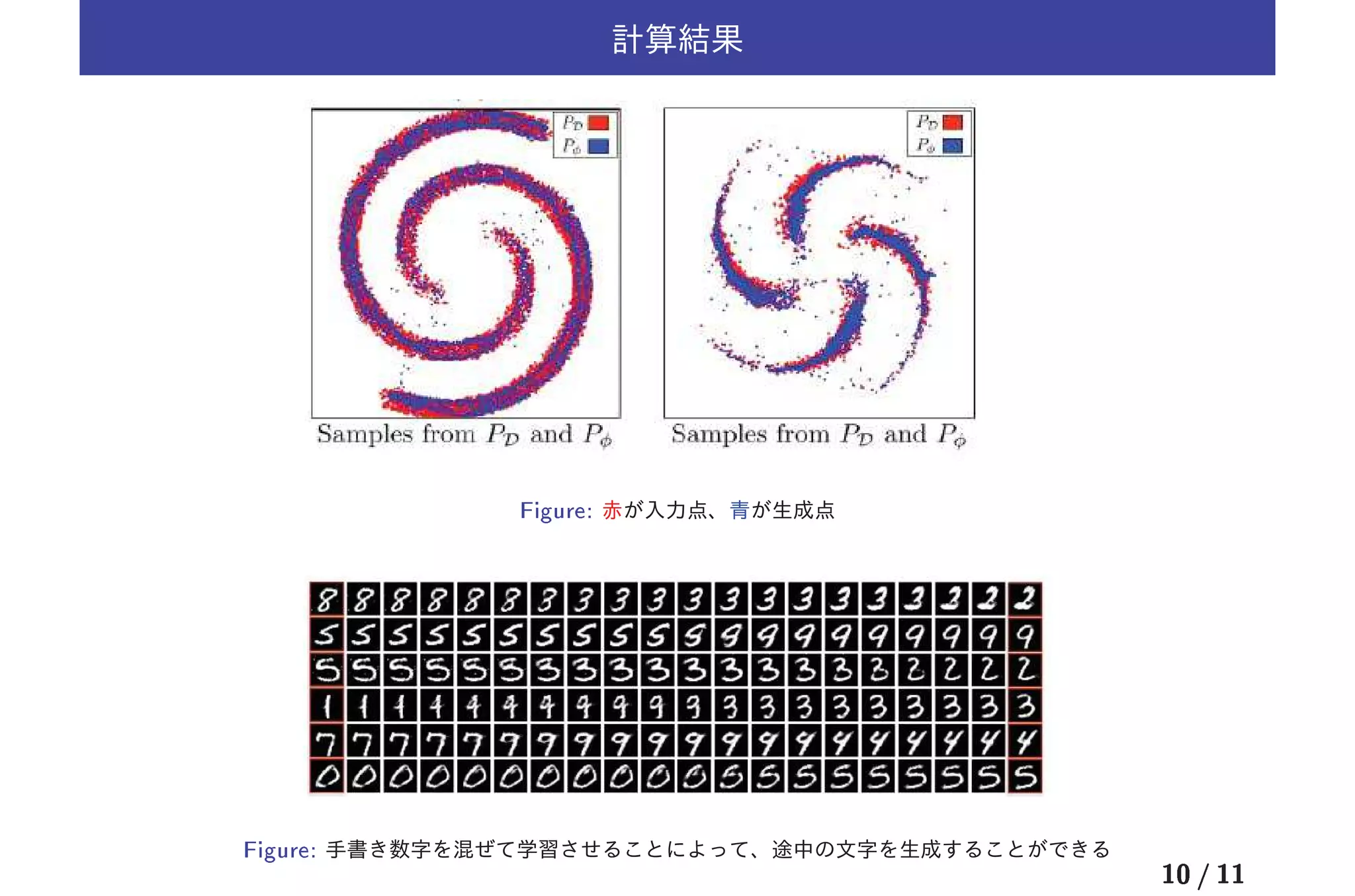
2) The training process involves using samples from the data distribution as positive examples and samples from the model's distribution as negative examples. The model is trained to minimize the difference in energy between positive and negative samples.
3) Applications discussed include deep energy models, variational autoencoders combined with generative adversarial networks, and adversarial neural machine translation using energy functions.




![[DL輪読会]GANとエネルギーベースモデル](https://cdn.slidesharecdn.com/ss_thumbnails/dlseminar20200828-210519065921-thumbnail.jpg?width=640&height=640&fit=bounds)


![[Dl輪読会]A simple neural network module for relational reasoning](https://cdn.slidesharecdn.com/ss_thumbnails/dlhacks0616hozumi-170623012735-thumbnail.jpg?width=640&height=640&fit=bounds)


![[DLHacks 実装]Network Dissection: Quantifying Interpretability of Deep Visual R...](https://cdn.slidesharecdn.com/ss_thumbnails/171030netdissectimple1-171030120240-thumbnail.jpg?width=640&height=640&fit=bounds)
![[DL輪読会]Xception: Deep Learning with Depthwise Separable Convolutions](https://cdn.slidesharecdn.com/ss_thumbnails/2017-06-22-170623004409-thumbnail.jpg?width=640&height=640&fit=bounds)


![[DL輪読会]Deep Direct Reinforcement Learning for Financial Signal Representation...](https://cdn.slidesharecdn.com/ss_thumbnails/dlhacks171113miyazaki-171114063842-thumbnail.jpg?width=640&height=640&fit=bounds)


![[DL輪読会]Recent Advances in Autoencoder-Based Representation Learning](https://cdn.slidesharecdn.com/ss_thumbnails/20190119dljournalclubweb-190401063633-thumbnail.jpg?width=640&height=640&fit=bounds)
![[DL輪読会]近年のエネルギーベースモデルの進展](https://cdn.slidesharecdn.com/ss_thumbnails/energybasedmodel-200124020855-thumbnail.jpg?width=640&height=640&fit=bounds)
![[GAN by Hung-yi Lee]Part 1: General introduction of GAN](https://cdn.slidesharecdn.com/ss_thumbnails/part1-180809095233-thumbnail.jpg?width=640&height=640&fit=bounds)


![[DSC Europe 25] Max Talanov - Non digital NNs.pptx](https://cdn.slidesharecdn.com/ss_thumbnails/wif8tr3gtua74qvtopke-non-digital-nns-251205090438-26b0eea6-thumbnail.jpg?width=640&height=640&fit=bounds)


![[DSC Europe 25] Dragana Ilic - AI for Big Data in Astronomy.pptx](https://cdn.slidesharecdn.com/ss_thumbnails/8palya86qaatvjhva1ms-2-dragana-ilic-ai-ilic-251208151906-652b819c-thumbnail.jpg?width=640&height=640&fit=bounds)


![[DSC Europe 25] Andy Cotgreave - Nothing is new in analytics.pptx](https://cdn.slidesharecdn.com/ss_thumbnails/mba4vzcurvoh5lfrd5zw-6-251205194645-341bbbbe-thumbnail.jpg?width=640&height=640&fit=bounds)


![[DSC Europe 25] Nikola Rajovic - Hardware Technologies Under the Hood: RISC-V...](https://cdn.slidesharecdn.com/ss_thumbnails/o2gptrmtoyqndgoshwgq-dsc2025-tenstorrent-rajovic-251205090438-814685f5-thumbnail.jpg?width=640&height=640&fit=bounds)
![[DSC Europe 25] Dragan Vucic - Building the Learning Organization - How AI Tr...](https://cdn.slidesharecdn.com/ss_thumbnails/8brigo2sbu6qur6gxrra-7-251205085715-6ae07d24-thumbnail.jpg?width=640&height=640&fit=bounds)


![[DSC Europe 25] Dusan Jovicic - AI Story: From on-prem to cloud and back agai...](https://cdn.slidesharecdn.com/ss_thumbnails/8kp49m6uq22ifnbwhfnk-2-251205085715-964d11a6-thumbnail.jpg?width=640&height=640&fit=bounds)