1 
A 
Training Report on 
“BSNL(Telecom) ” 
In 
(Telecom District manager ,shahjahanpur) 
Submitted in the partial fulfillment of the requirement of degree of 
BACHELOR OF TECHNOLOGY 
in 
Electronics & Communication Engg. 
By 
PRAVEEN KUMAR PAL 
( 11071035 ) 
DEPARTMENT OF ELECTRONIC & COMMUNICATION 
SCHOOL OF ENGINEERING & TECHNOLOGY 
IFTM UNIVERSITY 
MORADABAD 
Session: 2014-15
2 
INTRODUCTION 
All industries operate in a specific environment which keeps changing and the firms in the 
business need to understand it to dynamically adjust their actions for best results. Like 
minded firms get together to form associations in order to protect their common interests. 
Other stake holders also develop a system to take care of their issues. Governments also need 
to intervene for ensuring fair competition and the best value for money for its citizens. This 
handout gives exposure on the Telecom Environment in India and also dwells on the role of 
international bodies in standardizing and promoting Telecom Growth in the world. 
The Indian postal and telecom sectors saw a slow and uneasy start. In 1850, the first 
experimental electric telegraph line was started between and . In 1851, it was opened for the 
use of. The Posts and Telegraphs department occupied a small corner of the Public Works 
Department, at that time. 
Subsequently, the construction of 4,000 miles (6,400 km) of telegraph lines connecting 
Kolkata (then Calcutta) and Peshawar in the north along with Agra, (then Bombay) through 
Sindwa Ghats, and well as and was started in November 1853. , who pioneered the and in 
India, belonged to the Public Works Department, and worked towards the development of 
telecom throughout this period. A separate department was opened in 1854 when telegraph 
facilities were opened to the public. 
In 1880, two namely The Ltd. and The Anglo-Indian Telephone Company Ltd. 
approached to establish the permission was refused on the grounds that the establishment of 
telephones was a Government monopoly and that the Government itself would undertake the 
work. In 1881, the Government later reversed its earlier decision and a licence was granted to 
the Limited of for opening telephone exchanges at ,and and the first formal telephone service 
was established in the country. On the 28th January 1882, Major E. Baring, Member of the 's 
Council declared open the Telephone Exchanges in Calcutta, Bombay and Madras. The 
exchange in Calcutta named the "Central Exchange", was opened at third floor of the 
building at 7, Council House Street, with a total of 93 subscribers. Later that year, Bombay 
also witnessed the opening of a telephone exchange. 
ABOUT THE EXCHANGE 
In the field of , a telephone exchange or telephone switch is a system of electronic 
components that connects telephone calls. A central office is the physical building used to
house equipment including telephone switches, which make "work" in the sense of making 
connections and relaying the speech information 
3 
TYPE’S OF EXCHANGE 
 Manual exchange 
 Strowger exchange 
 Cross bar exchange 
 Electronics exchange (analog and digital exchange) 
MANUAL EXCAHNGE 
With manual service, the customer lifts the receiver off-hook and asks the operator to connect 
the call to a requested number. Provided that the number is in the same central office, the 
operator connects the call by plugging into the jack on the switchboard corresponding to the 
called customer's line. If the call is to another central office, the operator plugs into the trunk 
for the other office and asks the operator answering (known as the "inward" operator) to 
connect the call. 
STROWGER EXCHANGE 
Strowger developed a system of automatic switching using an electromechanical switch 
based around electromagnets and pawls. With the help of his nephew (Walter S. Strowger) he 
produced a working model in 1888 .selector starts in the 'home' position and with each 
'impulse' the wiper contacts would progress round the output bank to the next position. Each 
output would be connected to a different subscriber, thus the caller could connect to any other 
subscriber who was connected to that bank, without any manual assistance from an operator. 
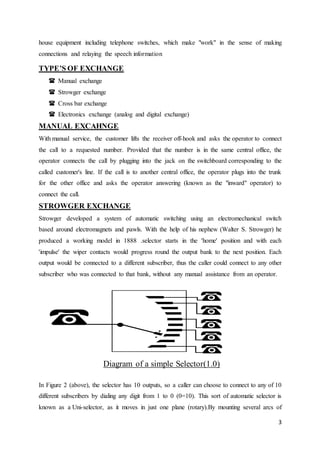
Diagram of a simple Selector(1.0) 
In Figure 2 (above), the selector has 10 outputs, so a caller can choose to connect to any of 10 
different subscribers by dialing any digit from 1 to 0 (0=10). This sort of automatic selector is 
known as a Uni-selector, as it moves in just one plane (rotary).By mounting several arcs of
outlets on top of each other, the number of outlets can be increased significantly but the 
wipers are then required to move both horizontally to select a bank and then vertically to 
move around that bank to the required outlet. Such a selector is known as a Two-Motion 
Selector. Two-motion selectors typically have 10 rows of 10 outlets, thus 100 possible outlets 
altogether. A two-motion selector can therefore accept two dialed digits from a subscriber 
and route the call to any of 100 numbers. The selector 'wipers' always start in their resting 
'home' position. The first digit moves the selector vertically up to the corresponding level and 
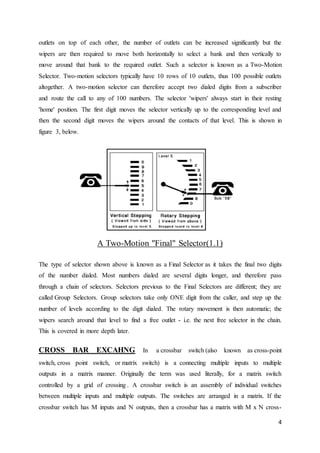
then the second digit moves the wipers around the contacts of that level. This is shown in 
figure 3, below. 
4 
A Two-Motion "Final" Selector(1.1) 
The type of selector shown above is known as a Final Selector as it takes the final two digits 
of the number dialed. Most numbers dialed are several digits longer, and therefore pass 
through a chain of selectors. Selectors previous to the Final Selectors are different; they are 
called Group Selectors. Group selectors take only ONE digit from the caller, and step up the 
number of levels according to the digit dialed. The rotary movement is then automatic; the 
wipers search around that level to find a free outlet - i.e. the next free selector in the chain. 
This is covered in more depth later. 
CROSS BAR EXCAHNG In a crossbar switch (also known as cross-point 
switch, cross point switch, or matrix switch) is a connecting multiple inputs to multiple 
outputs in a matrix manner. Originally the term was used literally, for a matrix switch 
controlled by a grid of crossing . A crossbar switch is an assembly of individual switches 
between multiple inputs and multiple outputs. The switches are arranged in a matrix. If the 
crossbar switch has M inputs and N outputs, then a crossbar has a matrix with M x N cross-
points or places where the "bars" cross. At each cross point is a switch; when closed, it 
connects one of M inputs to one of N outputs. A given crossbar is a single layer, non-blocking 
switch. Collections of crossbars can be used to implement multiple layer and/or 
blocking switches. A crossbar switching system is also called a co-ordinate switching system. 
5 
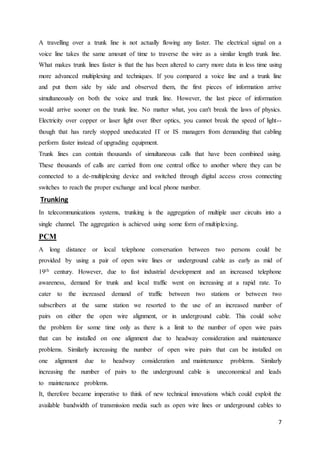
ELECTRONICS EXCHANGE 
It is based on the automatic control by stored programmed in computer linked to it. It cover 
all the main drawbacks of above mentioned exchange. It may be digital or analog but mostly 
digital electronics exchanges are now common. It base on the principal time division 
switching or space division switching. Space division switching is used for analog electronics 
exchange and time division switching is used for digital exchange. 
Fig(1.3) 
Space Division switching System 
In a space Division Switching system, a continuous physical path is set up between input and 
output terminations. This path is separate for each connection and is held for the entire 
duration of the call. Path for different connections is independent of each other. Once a 
continuous path has been established., Signals are interchanged between the two 
terminations. Such a switching network can employ either metallic or electronic cross points. 
Previously, usage of metallic cross-points using reed relays and all were favored. They have 
the advantage of compatibility with the existing line and trunk signaling conditions in the 
network.
6 
Time Division Switching System 
In Time Division Switching, a number of calls share the same path on time division sharing 
basis. The path is not separate for each connection, rather, is shared sequentially for a fraction 
of a time by different calls. This process is repeated periodically at a suitable high rate. The 
repetition rate is 8 KHz, i.e. once every 125 microseconds for transmitting speech on 
telephone network, without any appreciable distortion. These samples are time multiplexed 
with staggered samples of other speech channels, to enable sharing of one path by many calls. 
The Time Division Switching was initially accomplished by Pulse Amplitude. 
Local and trunk Network 
The term Trunk Line in telecommunications refers to the high-speed connection between 
telephone central offices in the. Trunk lines are always digital. The wiring between central 
offices was originally just pairs of twisted copper wire (the twists in the wiring prevented 
things known as crosstalk and noise). Because it is expensive to string up (or lay trenches for 
buried cables), the phone company researched ways in which to carry more data over the 
existing copper lines. This was achieved by using. Later, when fiber-optic technology became 
available, phone companies upgraded their trunk lines to fiber optics and used statistical time-division 
multiplexing coarse or dense wave division multiplexing and optical switching to 
further improve transmission speeds. 
The signaling information exchanged between different exchanges via inter exchange trunks 
for the routing of calls is termed as Inter exchange Signaling. Earlier in band /out of band 
frequencies were used for transmitting signaling information. Later on, with the emergence of 
PCM systems, it was possible to segregate the signaling from the speech channel. A trunk 
line is a connecting (or other switching equipment), as distinguished from local loop circuit 
which extends from telephone exchange switching equipment to individual or information 
origination/termination equipment. When dealing with a private branch exchange (PBX), 
trunk lines are the phone lines coming into the PBX from the telephone provider. This 
differentiates these incoming lines from extension telephone lines that connect the PBX to 
(usually) individual phone sets. Trunking saves cost, because there are usually fewer trunk 
lines than extension lines, since it is unusual in most offices to have all extension lines in use 
for external calls at once. Trunk lines transmit voice and data in formats such as analog, 
digital signal 1, ISDN or primary rate interface. The dial tone lines for outgoing calls are 
called DDCO (Direct Dial Central Office) trunks.
A travelling over a trunk line is not actually flowing any faster. The electrical signal on a 
voice line takes the same amount of time to traverse the wire as a similar length trunk line. 
What makes trunk lines faster is that the has been altered to carry more data in less time using 
more advanced multiplexing and techniques. If you compared a voice line and a trunk line 
and put them side by side and observed them, the first pieces of information arrive 
simultaneously on both the voice and trunk line. However, the last piece of information 
would arrive sooner on the trunk line. No matter what, you can't break the laws of physics. 
Electricity over copper or laser light over fiber optics, you cannot break the speed of light-- 
though that has rarely stopped uneducated IT or IS managers from demanding that cabling 
perform faster instead of upgrading equipment. 
Trunk lines can contain thousands of simultaneous calls that have been combined using. 
These thousands of calls are carried from one central office to another where they can be 
connected to a de-multiplexing device and switched through digital access cross connecting 
switches to reach the proper exchange and local phone number. 
Trunking 
In telecommunications systems, trunking is the aggregation of multiple user circuits into a 
single channel. The aggregation is achieved using some form of multiplexing. 
PCM 
A long distance or local telephone conversation between two persons could be 
provided by using a pair of open wire lines or underground cable as early as mid of 
19th century. However, due to fast industrial development and an increased telephone 
awareness, demand for trunk and local traffic went on increasing at a rapid rate. To 
cater to the increased demand of traffic between two stations or between two 
subscribers at the same station we resorted to the use of an increased number of 
pairs on either the open wire alignment, or in underground cable. This could solve 
the problem for some time only as there is a limit to the number of open wire pairs 
that can be installed on one alignment due to headway consideration and maintenance 
problems. Similarly increasing the number of open wire pairs that can be installed on 
one alignment due to headway consideration and maintenance problems. Similarly 
increasing the number of pairs to the underground cable is uneconomical and leads 
to maintenance problems. 
It, therefore became imperative to think of new technical innovations which could exploit the 
available bandwidth of transmission media such as open wire lines or underground cables to 
7
provide more number of circuits on one pair. The technique used to provide a number of 
circuits using a single transmission link is called Multiplexing. 
Basic Requirements for PCM System: 
To develop a PCM signal from several analogue signals, the following processing steps are 
required: 
8 
1. Filtering 
2. Sampling 
3. Quantisation 
4. Encoding 
5. Line Coding 
Duplexing Methodology: 
Duplexing is the technique by which the send and receive paths are separated over the 
medium, since transmission entities (modulator, amplifiers, demodulators) are involved. 
There are two types of Duplexing: 
1. Frequency Division Duplexing (FDD) 
2. Time Division Duplexing (TDD) 
Frequency Division Duplexing (FDD): 
Different frequencies are used for send and receive paths and hence there will be a forward 
band and reverse band. Duplexer is needed if simultaneous transmission (send) and reception 
(receive) methodology is adopted. Frequency separation between forward band and reverse 
band is constant. 
Time Division Duplexing (TDD): 
TDD uses different time slots for transmission and reception paths. Single radio frequency 
can be used in both the directions instead of two as in FDD. No duplexer is required. Only a 
fast switching synthesizer, RF filter path and fast antenna switch are needed. It increases the 
battery life of mobile phones.
9 
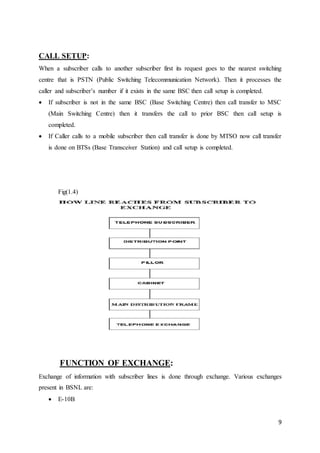
CALL SETUP: 
When a subscriber calls to another subscriber first its request goes to the nearest switching 
centre that is PSTN (Public Switching Telecommunication Network). Then it processes the 
caller and subscriber’s number if it exists in the same BSC then call setup is completed. 
ď‚· If subscriber is not in the same BSC (Base Switching Centre) then call transfer to MSC 
(Main Switching Centre) then it transfers the call to prior BSC then call setup is 
completed. 
ď‚· If Caller calls to a mobile subscriber then call transfer is done by MTSO now call transfer 
is done on BTSs (Base Transceiver Station) and call setup is completed. 
Fig(1.4) 
FUNCTION OF EXCHANGE: 
Exchange of information with subscriber lines is done through exchange. Various exchanges 
present in BSNL are: 
ď‚· E-10B
10 
ď‚· OCB283 
ď‚· EWSD 
ď‚· CDOT 
All exchange has some purposes and some basic structural units, which are: 
ď‚· 1. subscribers connection unit 
ď‚· 2. switching network (CX) 
ď‚· 3. control unit 
ď‚· 4. OMC 
ELECTRONICSEXCHANGE 
It is based on the automatic control by stored programmed in computer linked to it. It cover 
all the main drawbacks of above mentioned exchange. It may be digital or analog but mostly 
digital electronics exchanges are now common. It base on the principal time division 
switching or space division switching. Space division switching is used for analog electronics 
exchange and time division switching is used for digital exchange. 
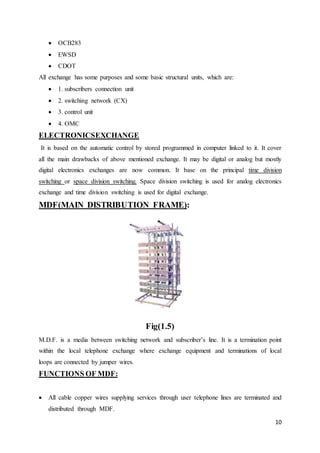
MDF(MAIN DISTRIBUTION FRAME): 
Fig(1.5) 
M.D.F. is a media between switching network and subscriber’s line. It is a termination point 
within the local telephone exchange where exchange equipment and terminations of local 
loops are connected by jumper wires. 
FUNCTIONS OF MDF: 
ď‚· All cable copper wires supplying services through user telephone lines are terminated and 
distributed through MDF.
ď‚· The most common kind of large MDF is a long steel rack accessible from both sides. 
11 
Each jumper is a twisted wire. 
ď‚· It consists of local connection and broadband connection frames for the main Exchange 
area. 
ď‚· The MDF usually holds central office protective devices including heat coils and 
functions as a test point between a line and the office. 
ď‚· It provides testing of calls. 
ď‚· It checks whether fault is indoor or external. 
PARTS OF THE MDF 
Horizontal side 
Vertical side 
HORIZONTAL SIDE: 
It is again subdivided in to two part 
Exchange side Line side 
RACK: - On the rack, the tags are situated. One rack is having eight tags. The courting is 
done from up (0) to down (7). 
TAG: - Each rack consists of eight tags. 
1 tag = 4 core 
1 core = 4 bunch 
1 bunch = 2 line 
Vertical side is again subdivided in two parts: 
One part is connected with the horizontal side and another with the subscriber line by using 
100 pair underground cable. 
SVERTICAL SIDE: 
The vertical aside connected to the underground cable. This cable is having 100 pairs. 
These pair is distributed when we allot the telephone number to the subscriber. 
POWER PLANT 
ď‚· It consists of a online U.P.S. (Uninterruptable Power Supply). 
ď‚· It provides -48V to the switch rooms and 48V to the connections.
12 
ď‚· Batteries are artificially discharged once in a year for their maintenance. 
ď‚· Cooling is provided through fans & AC. 
ď‚· There is earth region too for protection. 
CENTRAL AIR CONDITIONER 
For the function of electrical equipment, cooling system is basic requirement. The basic 
advantages of cooling systems are to cool the exchange and to maintain the thermal stability 
of the exchange. 
VARIOUS INTERNET SERVICES 
LEASED LINES 
The information sent through the leased line travels along dedicated secure channels, 
eliminating the congestion that occurs in shared networks. 
between two points set up by a telecommunications carrier. They can be used for telephone, 
data, or Internet services 
A leasedline (dedicated line) is a permanent fiber optic or telephone connection. 
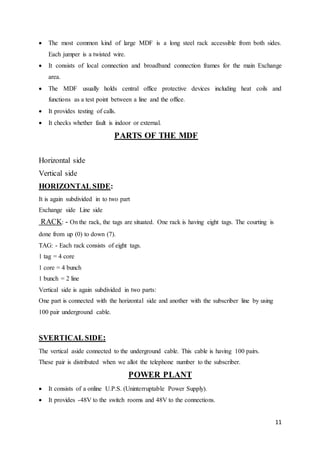
WI-FI (WIRELESS FIDELITY) 
A Wi-Fi network provides the features and benefits of traditional LAN technologies such as 
Ethernet and Token Ring without the limitations of wires or cables 
WIFI is a wireless LAN Technology to deliver wireless broad band speeds up to 54 Mbps to 
Laptops, PCs 
Wi-Fi enabled phones etc. 
Fig(1.6)
13 
BSNL Broadband Service 
Broadband refers to a connection that has capacity to transmit large amount of data speed. 
Presently a connection having download speeds of 256 kbps or more is classified as 
broadband. When connected to the Internet broadband connection allows surfing or 
downloading much faster than a dial-up or any other narrowband connections. BSNL offers 2 
Mbps minimum download speed for its Broadband connections.Requirement for providing 
Broad Band connection 
ď‚· Personal Computer 
ď‚· ADSL Modem 
ď‚· Land Line Connection 
ď‚· Splitter for separating telephone from Personal computer 
ď‚· High speed Internet Access: This is the always-on Internet access service with speed 
ranging from 256 kbps to 8 Mbps. 
WIMAX 
WI-MAX is an acronym that stands for World- wide Interoperability for Microwave 
Access and thistechnology is designed to accommodate both fixed and mobile broadband 
applications 
SALIENT FEATURES OF WIMAX: 
ď‚· OFDM-based physical layer. 
ď‚· Very high peak data rates. 
ď‚· Adaptive modulation and coding (AMC) 
ď‚· Support for TDD and FDD OFDMA. 
ď‚· Flexible and dynamic per user resource allocation. 
ď‚· Support for mobility. 
ď‚· IP-based architecture.
14 
FTTH 
FTTH is an acronym which stands for Fiber To The Home .In this technology an optical 
fiber of desired bandwidth and frequency is connected to the local residence of the user 
to provide high speed internet facility up togbps.This facility is first launched by BSNL 
in India. 
OSI NETWORKING MODEL 
The open systems interconnection model defines all the methods and protocols needed to 
connect one computer to any other over a network .It consists of following seven layers: 
Physical Layer: 
The physical layer defines the properties of the physical medium used to make a network 
connection 
Data Link Layer: 
The data link layer, layer 2, defines standard that assign meaning to the bits carried by the 
physical layer 
Network Layer: 
The network layer, Layer-3, is where a lot of action goes on for most networks. 
Transport Layer: 
The Transport Layer, layer-4, manages the flow of information from one network node to 
another. 
Session layer: 
The session layer, layer-5, defines the connection from a user to a network server, or from a 
peer on a network to another peer 
Presentation Layer: 
The presentation layer, layer-6, takes the data supplied by the lower level layer and transform 
so it can be presented to the system 
Application Layer:
The Application layer, layer 7, controls how the operating system and its application interact 
with network. 
15 
FIBER OPTIC TRANSMISSION SYSTEM 
FIBER OPTICS: 
The use and demand for optical fiber has grown tremendously and optical-fiber applications 
are numerous. Telecommunication applications are widespread, ranging from global 
networks to desktop computers. These involve the transmission of voice, data, or video over 
distances of less than a meter to hundreds of kilometers, using one of a few standard fiber 
designs in one of several cable designs. 
Another important application for optical fiber is the biomedical industry. Fiber-optic systems 
are used in most modern telemedicine devices for transmission of digital diagnostic images. 
Other applications for optical fiber include space, military, automotive, and the industrial 
sector 
The high bandwidth provided by fiber makes it the perfect choice for transmitting broadband 
signals, such as high-definition television (HDTV) telecasts. 
Optical fiber is also used extensively for transmission of data. Multinational firms need 
secure, reliable systems to transfer data and financial information. 
ADVANTAGES OF FIBRE OPTICS 
Fiber Optics has the following advantages 
• SPEED: Fiber optic networks operate at high speeds - up into the gigabits 
• BANDWIDTH: large carrying capacity 
• DISTANCE: Signals can be transmitted further without needing to be "refreshed" or 
strengthened. 
• RESISTANCE: Greater resistance to electromagnetic noise such as radios, motors or 
other nearby cables. 
• MAINTENANCE: Fiber optic cables costs much less to maint 
CLASSIFICATION 
There are three types of fibers:
16 
1.STEP-INDEX MULTIMODE FIBER: It has a large core, up to 100 microns in 
diameter. 
This type of fiber is best suited for transmission over short distances, in an endoscope. 
2. GRADED-INDEX MULTIMODE FIBER: It contains a core in which the refractive 
index diminishes gradually from the center axis out toward the cladding. 
3. SINGLE-MODE FIBER: It has a narrow core (eight microns or less), and the index 
of refraction between the core and the cladding changes less than it does for multimode fibers 
OPTICAL FIBER CABLE (OFC) 
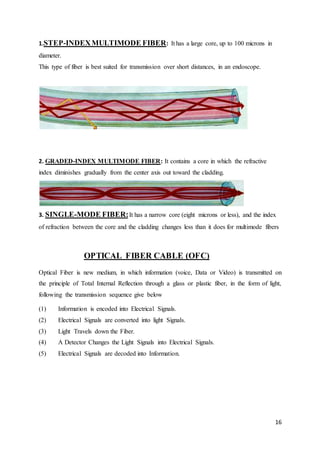
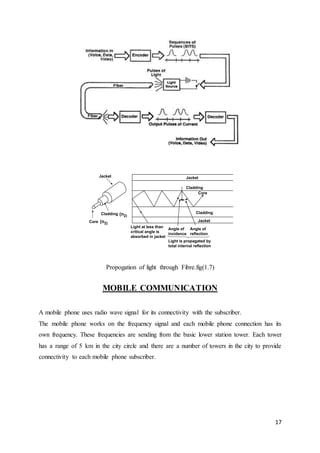
Optical Fiber is new medium, in which information (voice, Data or Video) is transmitted on 
the principle of Total Internal Reflection through a glass or plastic fiber, in the form of light, 
following the transmission sequence give below 
(1) Information is encoded into Electrical Signals. 
(2) Electrical Signals are converted into light Signals. 
(3) Light Travels down the Fiber. 
(4) A Detector Changes the Light Signals into Electrical Signals. 
(5) Electrical Signals are decoded into Information.
17 
Jacket 
Cladding 
Core 
Cladding 
Jacket 
Angle of 
reflection 
Angle of 
incidence 
Light at less than 
critical angle is 
absorbed in jacket 
Light is propagated by 
total internal reflection 
Jacket 
Cladding 
(n2) 
(n2) 
Fig. Total Internal Reflection in an optical Fibre 
Propogation of light through Fibre.fig(1.7) 
MOBILE COMMUNICATION 
Core 
A mobile phone uses radio wave signal for its connectivity with the subscriber. 
The mobile phone works on the frequency signal and each mobile phone connection has its 
own frequency. These frequencies are sending from the basic lower station tower. Each tower 
has a range of 5 km in the city circle and there are a number of towers in the city to provide 
connectivity to each mobile phone subscriber.
18 
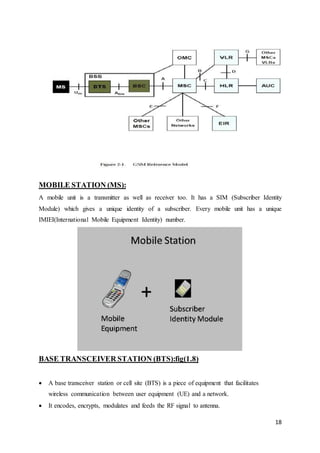
MOBILE STATION (MS): 
A mobile unit is a transmitter as well as receiver too. It has a SIM (Subscriber Identity 
Module) which gives a unique identity of a subscriber. Every mobile unit has a unique 
IMIEI(International Mobile Equipment Identity) number. 
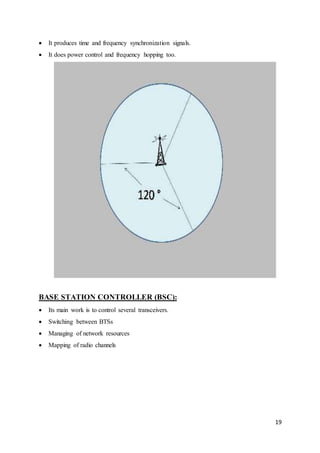
BASE TRANSCEIVER STATION (BTS):fig(1.8) 
ď‚· A base transceiver station or cell site (BTS) is a piece of equipment that facilitates 
wireless communication between user equipment (UE) and a network. 
ď‚· It encodes, encrypts, modulates and feeds the RF signal to antenna.
19 
ď‚· It produces time and frequency synchronization signals. 
ď‚· It does power control and frequency hopping too. 
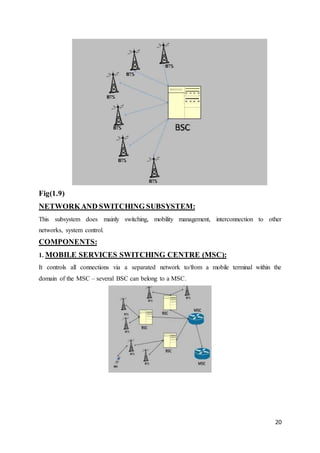
BASE STATION CONTROLLER (BSC): 
ď‚· Its main work is to control several transceivers. 
ď‚· Switching between BTSs 
ď‚· Managing of network resources 
ď‚· Mapping of radio channels
20 
Fig(1.9) 
NETWORK AND SWITCHING SUBSYSTEM: 
This subsystem does mainly switching, mobility management, interconnection to other 
networks, system control. 
COMPONENTS: 
1. MOBILE SERVICES SWITCHING CENTRE (MSC): 
It controls all connections via a separated network to/from a mobile terminal within the 
domain of the MSC – several BSC can belong to a MSC.
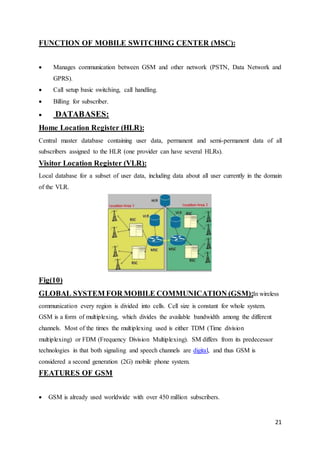
21 
FUNCTION OF MOBILE SWITCHING CENTER (MSC): 
ď‚· Manages communication between GSM and other network (PSTN, Data Network and 
GPRS). 
ď‚· Call setup basic switching, call handling. 
ď‚· Billing for subscriber. 
ď‚· DATABASES: 
Home Location Register (HLR): 
Central master database containing user data, permanent and semi-permanent data of all 
subscribers assigned to the HLR (one provider can have several HLRs). 
Visitor Location Register (VLR): 
Local database for a subset of user data, including data about all user currently in the domain 
of the VLR. 
Fig(10) 
GLOBAL SYSTEM FOR MOBILE COMMUNICATION (GSM);In wireless 
communication every region is divided into cells. Cell size is constant for whole system. 
GSM is a form of multiplexing, which divides the available bandwidth among the different 
channels. Most of the times the multiplexing used is either TDM (Time division 
multiplexing) or FDM (Frequency Division Multiplexing). SM differs from its predecessor 
technologies in that both signaling and speech channels are digital, and thus GSM is 
considered a second generation (2G) mobile phone system. 
FEATURES OF GSM 
ď‚· GSM is already used worldwide with over 450 million subscribers.
22 
The availability of Subscriber Identity Modules, which are smart cards that provide secure 
data encryption give GSM m-commerce advantages. 
GENERAL PACKET RADIO SERVICE (GPRS) 
General packet radio service (GPRS) is a packet oriented mobile data service available to 
users of the 2G cellular communication systems, global system for mobile communications 
(GSM), as well as in the 3G systems. In 2G systems, GPRS provides data rates of 56-114 
kbps 
GPRS extends the GSM circuit switched data capabilities and makes the following services 
possible: 
 “Always on” Internet access 
ď‚· Multimedia messaging service (MMS) 
ď‚· Push to talk over cellular (PoC/PTT) 
ď‚· Point to Point (P2P) service: inter-networking with the internet (IP). 
ď‚· Increase message sending speed 30 messages per minute approximately. 
CODE DIVISION MULTIPLE ACCESS (CDMA) 
Code Division Multiple Access (CDMA) consistently provides better capacity for voice and 
data communications that other commercial mobile technologies, allowing more subscribers 
to connect at any given time, and it is the common platform on which 3G technologies are 
built. 
CDMA is a spread spectrum technology, allowing many users to occupy the same time and 
frequency allocations in a given band/space 
ADVANTAGES OF CDMA 
Increased cellular communications security 
ď‚· Simultaneous conversations 
ď‚· Low power requirements and little cell-to-cell coordination needed by operators. 
ď‚· Extended reach-beneficial to rural users situated far from cells. 
DIFFERENCE BETWEEN CDMA AND GSM: 
ď‚· The GSM stands for global system for mobile communication and CDMA for code 
division multiple accesses. 
ď‚· GSM is a form of multiplexing, which divides the available bandwidth among the 
different channels. Most of the times the multiplexing used are either TDM (Time
Division Multiplexing) or FDM (Frequency Division Multiplexing). On the other 
hand CDMA is a type of multiple access scheme (which means allotting the given 
bandwidth to multiple users) and makes use of spread spectrum technique which is 
essentially increasing the size of spectrum. 
23 
FDMA (Frequency Division Multiple Access):Where individual transmission 
separated by each other by the time. 
WIRELESS IN LOCAL LOOP (WLL) MOBILE: 
WLL is a communication system that connects customers to the Public Switch Telephone 
Network (PSTN) using radio frequency signals as substitutes of conventional wires for all 
part of connection between the subscribers and the telephone exchange. It works on CDMA 
technique. 
There is no standard for this so far. However, a number of national and international air 
interface standards for digital cellular mobile telephone system are available. 
CONCLUSION 
The working in the project was an interesting and an all together learning experience. New 
technologies, new progress and new competition are the order of the day. The core area to 
look for is highly fragmented and information intense activity sequence that involves a 
number of player and audiences. 
The project mainly revolves around: EWSD, TAX, internet node, mobile communication, 
WLL and intelligence network. 
The emphasis of the different parts of the project is to throw light on the systems working in 
Patna Main Exchange. The project also deals with modern technologies attributes and the 
scope of implementation of the same in Patna. The area under study was limited to Patna 
Main Exchange. 
The scope of the study is very vast and the topic under study deals with the volatile 
technology world. After the study, suggestions and strategy has been formulated keeping in 
view the limitations of the field. 
Evolution of this technological world is occurring every minute. Thanks to telecom and web 
technologies, countries are coming closer day by day 
REFERENCES 
1. Data Communication And Networking- Behrouz A.Foruzan 
2. Wireless Communication and Networks-William Stallings
24
25

Deeep

  • 1.
    1 A TrainingReport on “BSNL(Telecom) ” In (Telecom District manager ,shahjahanpur) Submitted in the partial fulfillment of the requirement of degree of BACHELOR OF TECHNOLOGY in Electronics & Communication Engg. By PRAVEEN KUMAR PAL ( 11071035 ) DEPARTMENT OF ELECTRONIC & COMMUNICATION SCHOOL OF ENGINEERING & TECHNOLOGY IFTM UNIVERSITY MORADABAD Session: 2014-15
  • 2.
    2 INTRODUCTION Allindustries operate in a specific environment which keeps changing and the firms in the business need to understand it to dynamically adjust their actions for best results. Like minded firms get together to form associations in order to protect their common interests. Other stake holders also develop a system to take care of their issues. Governments also need to intervene for ensuring fair competition and the best value for money for its citizens. This handout gives exposure on the Telecom Environment in India and also dwells on the role of international bodies in standardizing and promoting Telecom Growth in the world. The Indian postal and telecom sectors saw a slow and uneasy start. In 1850, the first experimental electric telegraph line was started between and . In 1851, it was opened for the use of. The Posts and Telegraphs department occupied a small corner of the Public Works Department, at that time. Subsequently, the construction of 4,000 miles (6,400 km) of telegraph lines connecting Kolkata (then Calcutta) and Peshawar in the north along with Agra, (then Bombay) through Sindwa Ghats, and well as and was started in November 1853. , who pioneered the and in India, belonged to the Public Works Department, and worked towards the development of telecom throughout this period. A separate department was opened in 1854 when telegraph facilities were opened to the public. In 1880, two namely The Ltd. and The Anglo-Indian Telephone Company Ltd. approached to establish the permission was refused on the grounds that the establishment of telephones was a Government monopoly and that the Government itself would undertake the work. In 1881, the Government later reversed its earlier decision and a licence was granted to the Limited of for opening telephone exchanges at ,and and the first formal telephone service was established in the country. On the 28th January 1882, Major E. Baring, Member of the 's Council declared open the Telephone Exchanges in Calcutta, Bombay and Madras. The exchange in Calcutta named the "Central Exchange", was opened at third floor of the building at 7, Council House Street, with a total of 93 subscribers. Later that year, Bombay also witnessed the opening of a telephone exchange. ABOUT THE EXCHANGE In the field of , a telephone exchange or telephone switch is a system of electronic components that connects telephone calls. A central office is the physical building used to
  • 3.
    house equipment includingtelephone switches, which make "work" in the sense of making connections and relaying the speech information 3 TYPE’S OF EXCHANGE  Manual exchange  Strowger exchange  Cross bar exchange  Electronics exchange (analog and digital exchange) MANUAL EXCAHNGE With manual service, the customer lifts the receiver off-hook and asks the operator to connect the call to a requested number. Provided that the number is in the same central office, the operator connects the call by plugging into the jack on the switchboard corresponding to the called customer's line. If the call is to another central office, the operator plugs into the trunk for the other office and asks the operator answering (known as the "inward" operator) to connect the call. STROWGER EXCHANGE Strowger developed a system of automatic switching using an electromechanical switch based around electromagnets and pawls. With the help of his nephew (Walter S. Strowger) he produced a working model in 1888 .selector starts in the 'home' position and with each 'impulse' the wiper contacts would progress round the output bank to the next position. Each output would be connected to a different subscriber, thus the caller could connect to any other subscriber who was connected to that bank, without any manual assistance from an operator. Diagram of a simple Selector(1.0) In Figure 2 (above), the selector has 10 outputs, so a caller can choose to connect to any of 10 different subscribers by dialing any digit from 1 to 0 (0=10). This sort of automatic selector is known as a Uni-selector, as it moves in just one plane (rotary).By mounting several arcs of
  • 4.
    outlets on topof each other, the number of outlets can be increased significantly but the wipers are then required to move both horizontally to select a bank and then vertically to move around that bank to the required outlet. Such a selector is known as a Two-Motion Selector. Two-motion selectors typically have 10 rows of 10 outlets, thus 100 possible outlets altogether. A two-motion selector can therefore accept two dialed digits from a subscriber and route the call to any of 100 numbers. The selector 'wipers' always start in their resting 'home' position. The first digit moves the selector vertically up to the corresponding level and then the second digit moves the wipers around the contacts of that level. This is shown in figure 3, below. 4 A Two-Motion "Final" Selector(1.1) The type of selector shown above is known as a Final Selector as it takes the final two digits of the number dialed. Most numbers dialed are several digits longer, and therefore pass through a chain of selectors. Selectors previous to the Final Selectors are different; they are called Group Selectors. Group selectors take only ONE digit from the caller, and step up the number of levels according to the digit dialed. The rotary movement is then automatic; the wipers search around that level to find a free outlet - i.e. the next free selector in the chain. This is covered in more depth later. CROSS BAR EXCAHNG In a crossbar switch (also known as cross-point switch, cross point switch, or matrix switch) is a connecting multiple inputs to multiple outputs in a matrix manner. Originally the term was used literally, for a matrix switch controlled by a grid of crossing . A crossbar switch is an assembly of individual switches between multiple inputs and multiple outputs. The switches are arranged in a matrix. If the crossbar switch has M inputs and N outputs, then a crossbar has a matrix with M x N cross-
  • 5.
    points or placeswhere the "bars" cross. At each cross point is a switch; when closed, it connects one of M inputs to one of N outputs. A given crossbar is a single layer, non-blocking switch. Collections of crossbars can be used to implement multiple layer and/or blocking switches. A crossbar switching system is also called a co-ordinate switching system. 5 ELECTRONICS EXCHANGE It is based on the automatic control by stored programmed in computer linked to it. It cover all the main drawbacks of above mentioned exchange. It may be digital or analog but mostly digital electronics exchanges are now common. It base on the principal time division switching or space division switching. Space division switching is used for analog electronics exchange and time division switching is used for digital exchange. Fig(1.3) Space Division switching System In a space Division Switching system, a continuous physical path is set up between input and output terminations. This path is separate for each connection and is held for the entire duration of the call. Path for different connections is independent of each other. Once a continuous path has been established., Signals are interchanged between the two terminations. Such a switching network can employ either metallic or electronic cross points. Previously, usage of metallic cross-points using reed relays and all were favored. They have the advantage of compatibility with the existing line and trunk signaling conditions in the network.
  • 6.
    6 Time DivisionSwitching System In Time Division Switching, a number of calls share the same path on time division sharing basis. The path is not separate for each connection, rather, is shared sequentially for a fraction of a time by different calls. This process is repeated periodically at a suitable high rate. The repetition rate is 8 KHz, i.e. once every 125 microseconds for transmitting speech on telephone network, without any appreciable distortion. These samples are time multiplexed with staggered samples of other speech channels, to enable sharing of one path by many calls. The Time Division Switching was initially accomplished by Pulse Amplitude. Local and trunk Network The term Trunk Line in telecommunications refers to the high-speed connection between telephone central offices in the. Trunk lines are always digital. The wiring between central offices was originally just pairs of twisted copper wire (the twists in the wiring prevented things known as crosstalk and noise). Because it is expensive to string up (or lay trenches for buried cables), the phone company researched ways in which to carry more data over the existing copper lines. This was achieved by using. Later, when fiber-optic technology became available, phone companies upgraded their trunk lines to fiber optics and used statistical time-division multiplexing coarse or dense wave division multiplexing and optical switching to further improve transmission speeds. The signaling information exchanged between different exchanges via inter exchange trunks for the routing of calls is termed as Inter exchange Signaling. Earlier in band /out of band frequencies were used for transmitting signaling information. Later on, with the emergence of PCM systems, it was possible to segregate the signaling from the speech channel. A trunk line is a connecting (or other switching equipment), as distinguished from local loop circuit which extends from telephone exchange switching equipment to individual or information origination/termination equipment. When dealing with a private branch exchange (PBX), trunk lines are the phone lines coming into the PBX from the telephone provider. This differentiates these incoming lines from extension telephone lines that connect the PBX to (usually) individual phone sets. Trunking saves cost, because there are usually fewer trunk lines than extension lines, since it is unusual in most offices to have all extension lines in use for external calls at once. Trunk lines transmit voice and data in formats such as analog, digital signal 1, ISDN or primary rate interface. The dial tone lines for outgoing calls are called DDCO (Direct Dial Central Office) trunks.
  • 7.
    A travelling overa trunk line is not actually flowing any faster. The electrical signal on a voice line takes the same amount of time to traverse the wire as a similar length trunk line. What makes trunk lines faster is that the has been altered to carry more data in less time using more advanced multiplexing and techniques. If you compared a voice line and a trunk line and put them side by side and observed them, the first pieces of information arrive simultaneously on both the voice and trunk line. However, the last piece of information would arrive sooner on the trunk line. No matter what, you can't break the laws of physics. Electricity over copper or laser light over fiber optics, you cannot break the speed of light-- though that has rarely stopped uneducated IT or IS managers from demanding that cabling perform faster instead of upgrading equipment. Trunk lines can contain thousands of simultaneous calls that have been combined using. These thousands of calls are carried from one central office to another where they can be connected to a de-multiplexing device and switched through digital access cross connecting switches to reach the proper exchange and local phone number. Trunking In telecommunications systems, trunking is the aggregation of multiple user circuits into a single channel. The aggregation is achieved using some form of multiplexing. PCM A long distance or local telephone conversation between two persons could be provided by using a pair of open wire lines or underground cable as early as mid of 19th century. However, due to fast industrial development and an increased telephone awareness, demand for trunk and local traffic went on increasing at a rapid rate. To cater to the increased demand of traffic between two stations or between two subscribers at the same station we resorted to the use of an increased number of pairs on either the open wire alignment, or in underground cable. This could solve the problem for some time only as there is a limit to the number of open wire pairs that can be installed on one alignment due to headway consideration and maintenance problems. Similarly increasing the number of open wire pairs that can be installed on one alignment due to headway consideration and maintenance problems. Similarly increasing the number of pairs to the underground cable is uneconomical and leads to maintenance problems. It, therefore became imperative to think of new technical innovations which could exploit the available bandwidth of transmission media such as open wire lines or underground cables to 7
  • 8.
    provide more numberof circuits on one pair. The technique used to provide a number of circuits using a single transmission link is called Multiplexing. Basic Requirements for PCM System: To develop a PCM signal from several analogue signals, the following processing steps are required: 8 1. Filtering 2. Sampling 3. Quantisation 4. Encoding 5. Line Coding Duplexing Methodology: Duplexing is the technique by which the send and receive paths are separated over the medium, since transmission entities (modulator, amplifiers, demodulators) are involved. There are two types of Duplexing: 1. Frequency Division Duplexing (FDD) 2. Time Division Duplexing (TDD) Frequency Division Duplexing (FDD): Different frequencies are used for send and receive paths and hence there will be a forward band and reverse band. Duplexer is needed if simultaneous transmission (send) and reception (receive) methodology is adopted. Frequency separation between forward band and reverse band is constant. Time Division Duplexing (TDD): TDD uses different time slots for transmission and reception paths. Single radio frequency can be used in both the directions instead of two as in FDD. No duplexer is required. Only a fast switching synthesizer, RF filter path and fast antenna switch are needed. It increases the battery life of mobile phones.
  • 9.
    9 CALL SETUP: When a subscriber calls to another subscriber first its request goes to the nearest switching centre that is PSTN (Public Switching Telecommunication Network). Then it processes the caller and subscriber’s number if it exists in the same BSC then call setup is completed.  If subscriber is not in the same BSC (Base Switching Centre) then call transfer to MSC (Main Switching Centre) then it transfers the call to prior BSC then call setup is completed.  If Caller calls to a mobile subscriber then call transfer is done by MTSO now call transfer is done on BTSs (Base Transceiver Station) and call setup is completed. Fig(1.4) FUNCTION OF EXCHANGE: Exchange of information with subscriber lines is done through exchange. Various exchanges present in BSNL are:  E-10B
  • 10.
    10  OCB283  EWSD  CDOT All exchange has some purposes and some basic structural units, which are:  1. subscribers connection unit  2. switching network (CX)  3. control unit  4. OMC ELECTRONICSEXCHANGE It is based on the automatic control by stored programmed in computer linked to it. It cover all the main drawbacks of above mentioned exchange. It may be digital or analog but mostly digital electronics exchanges are now common. It base on the principal time division switching or space division switching. Space division switching is used for analog electronics exchange and time division switching is used for digital exchange. MDF(MAIN DISTRIBUTION FRAME): Fig(1.5) M.D.F. is a media between switching network and subscriber’s line. It is a termination point within the local telephone exchange where exchange equipment and terminations of local loops are connected by jumper wires. FUNCTIONS OF MDF:  All cable copper wires supplying services through user telephone lines are terminated and distributed through MDF.
  • 11.
    ď‚· The mostcommon kind of large MDF is a long steel rack accessible from both sides. 11 Each jumper is a twisted wire. ď‚· It consists of local connection and broadband connection frames for the main Exchange area. ď‚· The MDF usually holds central office protective devices including heat coils and functions as a test point between a line and the office. ď‚· It provides testing of calls. ď‚· It checks whether fault is indoor or external. PARTS OF THE MDF Horizontal side Vertical side HORIZONTAL SIDE: It is again subdivided in to two part Exchange side Line side RACK: - On the rack, the tags are situated. One rack is having eight tags. The courting is done from up (0) to down (7). TAG: - Each rack consists of eight tags. 1 tag = 4 core 1 core = 4 bunch 1 bunch = 2 line Vertical side is again subdivided in two parts: One part is connected with the horizontal side and another with the subscriber line by using 100 pair underground cable. SVERTICAL SIDE: The vertical aside connected to the underground cable. This cable is having 100 pairs. These pair is distributed when we allot the telephone number to the subscriber. POWER PLANT ď‚· It consists of a online U.P.S. (Uninterruptable Power Supply). ď‚· It provides -48V to the switch rooms and 48V to the connections.
  • 12.
    12 ď‚· Batteriesare artificially discharged once in a year for their maintenance. ď‚· Cooling is provided through fans & AC. ď‚· There is earth region too for protection. CENTRAL AIR CONDITIONER For the function of electrical equipment, cooling system is basic requirement. The basic advantages of cooling systems are to cool the exchange and to maintain the thermal stability of the exchange. VARIOUS INTERNET SERVICES LEASED LINES The information sent through the leased line travels along dedicated secure channels, eliminating the congestion that occurs in shared networks. between two points set up by a telecommunications carrier. They can be used for telephone, data, or Internet services A leasedline (dedicated line) is a permanent fiber optic or telephone connection. WI-FI (WIRELESS FIDELITY) A Wi-Fi network provides the features and benefits of traditional LAN technologies such as Ethernet and Token Ring without the limitations of wires or cables WIFI is a wireless LAN Technology to deliver wireless broad band speeds up to 54 Mbps to Laptops, PCs Wi-Fi enabled phones etc. Fig(1.6)
  • 13.
    13 BSNL BroadbandService Broadband refers to a connection that has capacity to transmit large amount of data speed. Presently a connection having download speeds of 256 kbps or more is classified as broadband. When connected to the Internet broadband connection allows surfing or downloading much faster than a dial-up or any other narrowband connections. BSNL offers 2 Mbps minimum download speed for its Broadband connections.Requirement for providing Broad Band connection ď‚· Personal Computer ď‚· ADSL Modem ď‚· Land Line Connection ď‚· Splitter for separating telephone from Personal computer ď‚· High speed Internet Access: This is the always-on Internet access service with speed ranging from 256 kbps to 8 Mbps. WIMAX WI-MAX is an acronym that stands for World- wide Interoperability for Microwave Access and thistechnology is designed to accommodate both fixed and mobile broadband applications SALIENT FEATURES OF WIMAX: ď‚· OFDM-based physical layer. ď‚· Very high peak data rates. ď‚· Adaptive modulation and coding (AMC) ď‚· Support for TDD and FDD OFDMA. ď‚· Flexible and dynamic per user resource allocation. ď‚· Support for mobility. ď‚· IP-based architecture.
  • 14.
    14 FTTH FTTHis an acronym which stands for Fiber To The Home .In this technology an optical fiber of desired bandwidth and frequency is connected to the local residence of the user to provide high speed internet facility up togbps.This facility is first launched by BSNL in India. OSI NETWORKING MODEL The open systems interconnection model defines all the methods and protocols needed to connect one computer to any other over a network .It consists of following seven layers: Physical Layer: The physical layer defines the properties of the physical medium used to make a network connection Data Link Layer: The data link layer, layer 2, defines standard that assign meaning to the bits carried by the physical layer Network Layer: The network layer, Layer-3, is where a lot of action goes on for most networks. Transport Layer: The Transport Layer, layer-4, manages the flow of information from one network node to another. Session layer: The session layer, layer-5, defines the connection from a user to a network server, or from a peer on a network to another peer Presentation Layer: The presentation layer, layer-6, takes the data supplied by the lower level layer and transform so it can be presented to the system Application Layer:
  • 15.
    The Application layer,layer 7, controls how the operating system and its application interact with network. 15 FIBER OPTIC TRANSMISSION SYSTEM FIBER OPTICS: The use and demand for optical fiber has grown tremendously and optical-fiber applications are numerous. Telecommunication applications are widespread, ranging from global networks to desktop computers. These involve the transmission of voice, data, or video over distances of less than a meter to hundreds of kilometers, using one of a few standard fiber designs in one of several cable designs. Another important application for optical fiber is the biomedical industry. Fiber-optic systems are used in most modern telemedicine devices for transmission of digital diagnostic images. Other applications for optical fiber include space, military, automotive, and the industrial sector The high bandwidth provided by fiber makes it the perfect choice for transmitting broadband signals, such as high-definition television (HDTV) telecasts. Optical fiber is also used extensively for transmission of data. Multinational firms need secure, reliable systems to transfer data and financial information. ADVANTAGES OF FIBRE OPTICS Fiber Optics has the following advantages • SPEED: Fiber optic networks operate at high speeds - up into the gigabits • BANDWIDTH: large carrying capacity • DISTANCE: Signals can be transmitted further without needing to be "refreshed" or strengthened. • RESISTANCE: Greater resistance to electromagnetic noise such as radios, motors or other nearby cables. • MAINTENANCE: Fiber optic cables costs much less to maint CLASSIFICATION There are three types of fibers:
  • 16.
    16 1.STEP-INDEX MULTIMODEFIBER: It has a large core, up to 100 microns in diameter. This type of fiber is best suited for transmission over short distances, in an endoscope. 2. GRADED-INDEX MULTIMODE FIBER: It contains a core in which the refractive index diminishes gradually from the center axis out toward the cladding. 3. SINGLE-MODE FIBER: It has a narrow core (eight microns or less), and the index of refraction between the core and the cladding changes less than it does for multimode fibers OPTICAL FIBER CABLE (OFC) Optical Fiber is new medium, in which information (voice, Data or Video) is transmitted on the principle of Total Internal Reflection through a glass or plastic fiber, in the form of light, following the transmission sequence give below (1) Information is encoded into Electrical Signals. (2) Electrical Signals are converted into light Signals. (3) Light Travels down the Fiber. (4) A Detector Changes the Light Signals into Electrical Signals. (5) Electrical Signals are decoded into Information.
  • 17.
    17 Jacket Cladding Core Cladding Jacket Angle of reflection Angle of incidence Light at less than critical angle is absorbed in jacket Light is propagated by total internal reflection Jacket Cladding (n2) (n2) Fig. Total Internal Reflection in an optical Fibre Propogation of light through Fibre.fig(1.7) MOBILE COMMUNICATION Core A mobile phone uses radio wave signal for its connectivity with the subscriber. The mobile phone works on the frequency signal and each mobile phone connection has its own frequency. These frequencies are sending from the basic lower station tower. Each tower has a range of 5 km in the city circle and there are a number of towers in the city to provide connectivity to each mobile phone subscriber.
  • 18.
    18 MOBILE STATION(MS): A mobile unit is a transmitter as well as receiver too. It has a SIM (Subscriber Identity Module) which gives a unique identity of a subscriber. Every mobile unit has a unique IMIEI(International Mobile Equipment Identity) number. BASE TRANSCEIVER STATION (BTS):fig(1.8) ď‚· A base transceiver station or cell site (BTS) is a piece of equipment that facilitates wireless communication between user equipment (UE) and a network. ď‚· It encodes, encrypts, modulates and feeds the RF signal to antenna.
  • 19.
    19 ď‚· Itproduces time and frequency synchronization signals. ď‚· It does power control and frequency hopping too. BASE STATION CONTROLLER (BSC): ď‚· Its main work is to control several transceivers. ď‚· Switching between BTSs ď‚· Managing of network resources ď‚· Mapping of radio channels
  • 20.
    20 Fig(1.9) NETWORKAND SWITCHING SUBSYSTEM: This subsystem does mainly switching, mobility management, interconnection to other networks, system control. COMPONENTS: 1. MOBILE SERVICES SWITCHING CENTRE (MSC): It controls all connections via a separated network to/from a mobile terminal within the domain of the MSC – several BSC can belong to a MSC.
  • 21.
    21 FUNCTION OFMOBILE SWITCHING CENTER (MSC): ď‚· Manages communication between GSM and other network (PSTN, Data Network and GPRS). ď‚· Call setup basic switching, call handling. ď‚· Billing for subscriber. ď‚· DATABASES: Home Location Register (HLR): Central master database containing user data, permanent and semi-permanent data of all subscribers assigned to the HLR (one provider can have several HLRs). Visitor Location Register (VLR): Local database for a subset of user data, including data about all user currently in the domain of the VLR. Fig(10) GLOBAL SYSTEM FOR MOBILE COMMUNICATION (GSM);In wireless communication every region is divided into cells. Cell size is constant for whole system. GSM is a form of multiplexing, which divides the available bandwidth among the different channels. Most of the times the multiplexing used is either TDM (Time division multiplexing) or FDM (Frequency Division Multiplexing). SM differs from its predecessor technologies in that both signaling and speech channels are digital, and thus GSM is considered a second generation (2G) mobile phone system. FEATURES OF GSM ď‚· GSM is already used worldwide with over 450 million subscribers.
  • 22.
    22 The availabilityof Subscriber Identity Modules, which are smart cards that provide secure data encryption give GSM m-commerce advantages. GENERAL PACKET RADIO SERVICE (GPRS) General packet radio service (GPRS) is a packet oriented mobile data service available to users of the 2G cellular communication systems, global system for mobile communications (GSM), as well as in the 3G systems. In 2G systems, GPRS provides data rates of 56-114 kbps GPRS extends the GSM circuit switched data capabilities and makes the following services possible:  “Always on” Internet access  Multimedia messaging service (MMS)  Push to talk over cellular (PoC/PTT)  Point to Point (P2P) service: inter-networking with the internet (IP).  Increase message sending speed 30 messages per minute approximately. CODE DIVISION MULTIPLE ACCESS (CDMA) Code Division Multiple Access (CDMA) consistently provides better capacity for voice and data communications that other commercial mobile technologies, allowing more subscribers to connect at any given time, and it is the common platform on which 3G technologies are built. CDMA is a spread spectrum technology, allowing many users to occupy the same time and frequency allocations in a given band/space ADVANTAGES OF CDMA Increased cellular communications security  Simultaneous conversations  Low power requirements and little cell-to-cell coordination needed by operators.  Extended reach-beneficial to rural users situated far from cells. DIFFERENCE BETWEEN CDMA AND GSM:  The GSM stands for global system for mobile communication and CDMA for code division multiple accesses.  GSM is a form of multiplexing, which divides the available bandwidth among the different channels. Most of the times the multiplexing used are either TDM (Time
  • 23.
    Division Multiplexing) orFDM (Frequency Division Multiplexing). On the other hand CDMA is a type of multiple access scheme (which means allotting the given bandwidth to multiple users) and makes use of spread spectrum technique which is essentially increasing the size of spectrum. 23 FDMA (Frequency Division Multiple Access):Where individual transmission separated by each other by the time. WIRELESS IN LOCAL LOOP (WLL) MOBILE: WLL is a communication system that connects customers to the Public Switch Telephone Network (PSTN) using radio frequency signals as substitutes of conventional wires for all part of connection between the subscribers and the telephone exchange. It works on CDMA technique. There is no standard for this so far. However, a number of national and international air interface standards for digital cellular mobile telephone system are available. CONCLUSION The working in the project was an interesting and an all together learning experience. New technologies, new progress and new competition are the order of the day. The core area to look for is highly fragmented and information intense activity sequence that involves a number of player and audiences. The project mainly revolves around: EWSD, TAX, internet node, mobile communication, WLL and intelligence network. The emphasis of the different parts of the project is to throw light on the systems working in Patna Main Exchange. The project also deals with modern technologies attributes and the scope of implementation of the same in Patna. The area under study was limited to Patna Main Exchange. The scope of the study is very vast and the topic under study deals with the volatile technology world. After the study, suggestions and strategy has been formulated keeping in view the limitations of the field. Evolution of this technological world is occurring every minute. Thanks to telecom and web technologies, countries are coming closer day by day REFERENCES 1. Data Communication And Networking- Behrouz A.Foruzan 2. Wireless Communication and Networks-William Stallings
  • 24.
  • 25.